“Skinny with razor stubble and glasses”

Last weekend, the St. Petersburg Times ran a story on polyamory called A Love Triangle? Try A Hexagon about smoocherie and her relationships. We sat and talked to the reporter for a couple of hours, and she did followup interviews with smoocherie and radven. She even did a followup interview via email with me, the skinny guy with razor stubble and glasses.

Fortunately, she didn’t mention the kuru. When we got to the restaurant where we were to meet her for the interview, james_the_evil1 and radven and I were talking about kuru, the prion-based sickness transmitted only by eating the brain of an infected person. (Kinda scary, really, that the Fore tribesmen have been practicing ritual cannibalism for long enough that a pathology developed to take advantage of that transmission vector…but I digress.)

Overall the article is positive and balanced, even if I am the skinny guy with glasses and razor stubble.

Some thoughts on love, hate, and war

This morning, I received in my email a long essay, written (EDIT: or rather, quoted; this person has since said she isn’t the original author of the piece) by one of the founders of the New Age, Tantric-sex-loving “World Polyamory Association,” claiming that polyamory can save the world. The reasoning, if it can be described with that word, is very straightforward. The essay begins with

Polyamory – the answer to the hate of our world …

Polyamory is not about deception – devious behaviour, wantonness, lust, passion, licentious behaviour or wreckless [sic] abandon. It’s about the ability to see beyond the narrow forms of society’s restrictive norms – be able to reach out … touch, offer … share and grow.

Love is about being compassionate, giving, sharing … becoming whole – not destroying all that is about us … the negative, destructive … evil by-products of hate. Love is about connecting and forming that special bond with those whom we love. It is about reaching – attaining a higher plain in our evolutionary stage as homo sapiens.

When the world has lost all concept of humanism – waging wars – devastation & destruction… outright genocide – killing millions of innocent people (women and children) it no longer possesses any moral compass. We have been rendered to the lowest ebb of what civilization was ever meant to be.

It goes on from there, asserting that since polyamory is about love and that war and terror are about hate, the solution to war and terror is more love–ie, polyamory. Now, I happen to think this idea is bunk, for a number of reasons, but I didn’t come here to talk about polyamory at all. I came to talk about the nature of war, and the nature of hate.


It’s a mistake to believe that love is the opposite of hate. Human emotions aren’t so simple. Love and hate do not exist on opposite ends of the Great Continuum of Feeling, and increasing the number of people one loves does not necessarily move a person away from hate. In fact, it is quite possible, and indeed altogether common, for a person to love some people, and hate some other people, and adding names to the list of people in the “loved” category does not remove names from the list of people in the “hated” category. Only a shallow and tenuous grasp of human emotional behavior would suggest otherwise.

In fact, love can be the genesis of hate, and can sometimes even provide a fertile field in which hate can grow.

Consider, for example, the Palestinian refugee whose beloved family is killed by an Israeli bomb, or the mother of a child killed in the World Trade Center. The loss of a loved one usually results in a strong emotional response, and if a person feels that those he loves have been taken from him with malice, his love for those who were lost can fuel his hate for those he perceives as responsible for that loss. Combine loss with a feeling of powerlessness, hopelessness, or despair, and you can easily end up with a person who expresses his pain and hate by strapping dynamite to his body and blowing himself up in a roadside cafe.


It need not even take any act of malice for this to happen. Anyone who’s survived a divorce or the end of a romantic relationship is likely familiar with how easily and how completely love can transition into hate. The person who one once shared his life, his home, and his bed can become a threatening, spiteful monster in his eyes overnight; the loss of something valued leads to grief, anger is a normal and natural part of the grieving process, and anger is fertile ground indeed for hate.

This is not helped at all by the fact that we tend to look in the outside world for things which justify our emotional responses. Look for reasons to hate someone, and they become easy–trivial, even–to find. So much of the way we perceive other people is in interpretation. If we believe, rightly or wrongly, that someone means us ill, we interpret that person’s behavior very differently than we might if we perceive they love us; and that perception can make the love or the ill real.


There’s a monkeysphere issue at work here, too. At the end of the day, our monkeyspheres–the sum total of those people with whom we can form meaningful, intimate emotional connections–is finite. Not only is it finite, it’s pitifully small; perhaps a hundred and fifty people or so. Past that point, we start taking shortcuts–lumping people into groups, and considering them only in terms of the group to which we’ve assigned them.

There are people who say they love everyone, or they love the whole human race. Those people are full of shit, at least if you are talking about meaningful, intimate bonds of love rather than a vague, poorly-defined, general sense of generic goodwill toward all of mankind. The silliness in the idea that it’s possible to love everyone is exposed by a simple thought experiment: did you mourn the deaths of the hundreds of people killed in the Philippines last month like you would the loss of your lover, or your child? Would it even be possible to function if you did? If the lives and deaths of everyone in the world impacted you the way the lives and deaths of those most intimate to you did, would you be able to survive at all?

The monkeysphere sets an upper limit on those we can love, yet it the same does not apply to hate; love is a uniquely personal, uniquely intimate experience, but we as human beings seem capable of hating people as a class or a group. Witness only those who hate all blacks, or all Jews, or all Americans, or all Arabs, and the fanaticism and obsession with which that hatred burns. We can not seem to love in the same way; one can not feel a deeply personal love for all Muslims, but people can and do feel a deeply personal hatred for all Muslims, or members of any other group, and build the entire shape of their lives around that hate.


Is love the answer to war? Answering that question requires understanding why wars are fought, and that understanding sometimes runs counter to intuition.

Wars are sometimes fought for reasons at least partially rooted in emotion, it is true. It’s not terribly difficult to support the notion that the bitter conflicts in the Middle East are fueled at least as often by equally bitter personal hate as they are by more prosaic concerns, such as control of economic resources.

But it’s not always so straightforward.

Let’s take a look at a very simple question. You are the leader of one nation; I am the leader of another. Your army has four divisions of troops. My army has ten. Our troops are in all respects equally matched. Our nations are at war. When will our war end?

This is the basis of an article with a nonintuitive answer to the question. The most simple answer, of course, says that the war will end when our armies engage in battle, and my ten divisions destroy your four divisions. But is that actually the case?

A sociologist might say that the war will end before it even begins. Given that the outcome is certain, your best course of action is to surrender before a shot is fired; if we do go to war, you will lose your entire army, and you will lose the war.

But in the real world, the answer is neither of the above. The answer is that the war will end when one of us reaches a point past which we are unwilling to accept further loss. Even if my army dominates yours entirely, even if my soldiers kill 170 of your soldiers for every man I lose (as was the case with US and North Vietnamese armies in Viet Nam), if you are willing to sustain losses that are sufficiently greater than the losses I sustain, you will win and I will lose. War then becomes a question of information theory; we will know the victor when we know the point at which one of us is unwilling to sustain further losses.


So. Back to the question at hand. Why do we fight wars? We fight wars because you and I have different and mutually incompatible goals. How do we fight wars? We fight wars by inflicting pain on one another until one of us reaches the point at which we are no longer willing to tolerate any additional pain. This process may be hateful, but it need not be driven by hate; two competing armies do not necessarily hate one another, and nations that were once embraced in war, such as Japan and the United States, can upon the conclusion of that war be embraced as allies.

But the process of inflicting pain during the prosecution of that war can breed hate, and love is not the answer to that hate; indeed, love can be the progenitor of that hate. If in the process of inflicting pain upon your nation, I deprive your people of something that they love, I will breed in your people a hatred for me. This hatred can actually increase the amount of pain you are willing to withstand; if I deprive your people of that which they love, they no longer have anything left to lose, and a person with nothing to lose can withstand just about any pain. A person with nothing to lose can become a dangerous person indeed, as many governments throughout the world might be well-advised to remember.

A person capable of love is capable also of hate. A person who loses that which he loves can easily turn to hate, whether that loss comes through the irreconcilable differences that end a marriage or the acts of malice that begin a war. More love does not mean less hate, for love is fundamentally bounded and hate, sadly, seems not to be.


In the scheme of world events, polyamory is essentially irrelevant. It is a relationship model, nothing more. It does not breed love nor turn hate to love, and people who adopt this relationship model are as capable of malice and spite as those who adopt any other–witness the dot_poly_snark community. In fact, I submit that the belief that polyamorous people are somehow more enlightened, wiser, or more evolved than their poor plodding monogamous brethren is nothing more than narrow elitism, no different save in the details than the belief that whites are somehow better than blacks. Believing one’s self to belong to a class of people superior in any dimension to the rest of the people with whom we share this planet does not breed love, but it certainly can and does breed hate–a nice irony, if one believes the class of people to which he belongs is superior because it is more loving.

Some thoughts on pets and polyamory

My parents have two pets: a high-strung hunting dog (a German shorthair pointer, if you’re curious), and a psychotic cat with no claws who originally belonged to my sister. The dog is exuberantly, enthusiastically erratic, ninety pounds of jumping, barking, tearing around the house, freaking-out-without-warning teeth and claws that has actually injured my mother badly enough to require surgery on a morning walk. (“Oh look! A squirrel! I’m going to go chase it, oh boy oh boy!” led in very short order to a torn rotator cuff, when the dog hit the end of her leash.) The cat doesn’t much cotton to people, or to anything else really, and will growl, hiss, and generally make her displeasure known when one of us naked hairy apes intrudes into her presence.

This is actually a post about polyamory. I’ll get to that in a bit.


The dog doesn’t much like the cat, and the cat doesn’t much like the dog. Actually, that’s not quite accurate. It’s probably more fair to say that the dog, being carefully bred for the purpose of hunting, rather does like the cat, in much the same way she likes any prey animal, and the cat hates the dog with a fury that is scarcely comprehensible to mere humans, but it’s a fury that is as impotent as it is malevolent. There’s no contest between the two. If the dog were actually to get at the cat, the dog would kill the cat in very short order–game over, the end–exactly as the dog has been bred to do.

For this reason, my parents carefully segregate the dog and the cat. The cat lives in one side of the house; the dog lives in the other, and doors are closed between them.

It would only take one mistake, one accidental slip-up, for my parents to own not two pets, but one pet and one collection of bloody scraps. So they are religious about keeping the animals separated. Doors and windows are checked after every passage (the cat’s domain includes the screened-in porch, which the dog is not permitted in). The habit of closing the door after every passage has become so strong that every door in the house is generally kept closed.

In some ways, this mirrors their relationship. My father lives on one side of the house; my mother lives on the other. They interact seldom and actually spend time together more rarely still. Even on vacations, they tend to go in separate directions.

A very large part of the poly community seems predicated on the same model as my parents use with their pets.


For many people, polyamory in practice seems a bit like owning a dog and a cat that don’t much get along, or in some cases might even try to kill one another. Each relationship functions as a separate entity, and doors are shut between them. If Alice is dating Bob, and Alice wants to date Bill too, and Bob and Bill don’t much care for one another, the solution is scheduling. Keep Bob and Bill away from one another, and it’s all good.

After all, Bob and Bill aren’t involved with each other, right? There’s no reason that Bob and Bill have to force a friendship, or even interact with one another at all, just because they’re both dating Alice, right?

Well, right. Certainly no reasonable person would suggest that Bob and Bill should try to be something that they’re not, or should attempt to force a connection or a friendship where none exists. that way disfunction lies.

But that misses the point.


Presumably, Alice has a choice. One would, generally speaking, probably assume that Alice can choose who she becomes romantically linked to. Alice can choose to date Bob and to date Bill, if she likes…but she can also choose not to.

I may be getting cynical in my old age, but it does seem to me that many people in the poly community approach their relationships from a desperate, starvation model. Connections are so rare, and the number of people who would actually want to date me so few, the reasoning seems to go, that if Bob asks me out, I have to say yes! If I don’t, I may never get another chance to start a new relationship again. Best to take every opportunity that comes down the pike; best not to risk never having a new relationship ever again.

And sure, it can work, in much the way my parent’s lives work–you learn to cope, you develop the reflex of shutting doors, you learn to police yourself constantly and to keep the things in your lives segregated. The habit of openness can be quashed, in time; you learn not to share things with Bill about Bob, you learn not to schedule things where Bob and Bill might interact. You develop a subconscious internal policeman, whose job it is to maintain that separation, to ensure that Bob and Bill forever occupy different spaces in your life.

But what the fuck kind of life is that?


It’s not necessary to try to make Bob and Bill like each other. Nor is it even possible, really. But what Alice can do is make choices. She is not obligated to date anyone who will have her; indeed, most people would argue that dating anyone who will have you is likely a symptom of a pathology.

What she can do is choose the kind of life she wants. She can, if she doesn’t want to become a devout follower of the Church of Closed Doors, evaluate as part of the decisions she makes what impact a potential new mate will have on her existing mates. She can say “I like Bob; I enjoy Bob’s company; but I don’t want to spend the rest of my life closing doors and policing my partners, so if Bob doesn’t fit well in my life, I will make another choice. I can develop a friendship with Bob that honors and respects the connection between us, without being involved in a relationship with him. I can choose relationships with people who complement my life and each other’s…even if they’re not actually involved in romantic relationships with each other. I can build a life without doors and walls.”

There are disadvantages to this approach. One may, from time to time, have to pass up the opportunity to sleep with someone one wants to sleep with. One may not be able to pursue every opportunity that presents itself. But in a world of six billion people, we have to make choices anyway; and love is abundant. There is no need to date whoever will have you.


The benefit to a life without doors and walls seems opaque to some people I’ve spoken with. I can’t rightly comprehend that, because it seems obvious to me. It means less headache and less hassle. It means less worrying, less policing one’s thoughts and deeds. I am very fortunate to have found in Shelly, and in my other sweeties, people who understand this intuitively. And I am fortunate in that there are certain things I do not have to worry about. I never have to worry about Shelly’s other partners; I can trust implicitly that when she chooses to open herself to other partners, she will make those choices in ways that consider my needs as well.

The benefits are wonderful. She has chosen other partners who have become friends of mine as well–people who add value to my life, even though I am not romantically or sexually linked to them. Relationships like this–relationships chosen to complement one another, not be separated from one another–are not zero-sum. Everyone benefits; when she chooses another partner, my life is enriched by it as well, and vice versa.

Happy birthday, Shelly. 🙂

It would be funny, if it weren’t so sad…

Shelly went to Tallahassee yesterday; she’s spending the weekend with her other boyfriend and his wife. So I’ve been spending the last two days straight playing World of Warcraft nonstop. Shelly gave me a call this afternoon to say hi, and laughed when I told her what I’d been doing.

Her: You need a local girlfriend. One you have a lot of sex with. While I watch.
Me: Okay, you’re on.
Her: We need to have rules, though. We need to tell her that she can sodomize you with a strap-on, but no oral sex.
Me: No oral sex? But I like oral sex!
Her: Yeah, but…um, no oral sex because…um, because your cock belongs to me. Or something.
Me: Hey, I’ve got an idea. Write down every sex act you can think of on a sheet of paper. Then go through the list and roll a six-sided die for each one. If you roll a 1 or a 2, she’s forbidden to do it; otherwise, she can.
Her: Hey! We should do that every day.
Me: So the rules change every day and she never feels secure?
Her: Yes! In fact, I think I’ll write up a 48-page contract, and you can tell any new girlfriend she has to sign it before she’s allowed to date you.

Then it occurred to me that several people on one of the poly mailing lists I subscribe to are essentially doing just that, and they can’t figure out why they can’t seem to find any new partners.

*sigh*

Some thoughts on polyamorous relationships

Recently, I received an email taking exception with something I’ve written on one of my poly pages to the extent that one of the most important parts of polyamory is to be able to know one’s partner’s partners. The person emailed me to say that as long as everyone was honest, that was sufficient; a polyamorous relationship in which, say, Alice and Bob are a couple, and Bob had other partners on the condition that Alice never meets, knows, or talks to them, is a perfectly okay arrangement.

My reply:

The thing I find most important about relationship agreements is not the form the agreement takes, but the REASON behind the agreements. This is, in my experience, most especially true with agreements of the form “I do not want to know about _____” or “I do not want to meet _____.”

Often, if you ask someone who makes such a rule “Why don’t you want to know about X?” the answer you’ll get is “I just don’t, that’s all.” To me, that tends to show a lack of communication; people feel the things they feel and want the things they want for a reason.

Now, if a person doesn’t want to know about, or doesn’t want to know, one of the people involved in a relationship, I think that speaks volumes about his approach to relationship. I’ve met many such people, of course; it’s hard to be active in the poly community without meeting people who have this approach. In every such case in my experience, though, without exception, the *reason* that the person doesn’t want to know about or doesn’t want to know everyone else always comes down to some unvoiced insecurity, fear, or uncertainty about the relationship.

I’ve met people who don’t want to know a partner’s other partner because they believe that keeping this kind of distance will help them preserve their primacy status in enforced, prescriptive primary/secondary relationships. I’ve met people for whom it is a defensive mechanism; they feel that meeting the other person makes that person more “real,” and that triggers insecurities. I’ve met people for whom it helps create emotional distance that prevents them from having to consider the needs and feelings of that other partner, and who fear that if they have to think about that other partner as a real human being, they will lose their power or status in the relationship.

There are many different forms that a polyamorous relationship can take. But all healthy polyamorous relationships–indeed, all healthy relationships of any kind, polyamorous or monogamous–have certain things in common. Healthy relationships live on open, honest communication; and it is not possible to develop good communication with a person you refuse to be in the same room with.

I can not reconcile “I refuse to meet your other partner, I refuse to know that person, I refuse to talk to that person, and I refuse to be in the same space as that person” with “respect.” When person A refuses to speak to person B, it is hard to make a case that A and B have developed good communication, and harder still to argue that A respects B.

I do not necessarily subscribe to the idea that as long as everyone talks about their feelings, it’s all good. That is a n ecessary first step, but building successful relationships requires more than just talking about how you feel. It also requires understanding those feelings, looking at them critically, figuring out where they come from, figuring out whether or not they are well-founded, determining if the things you feel match reality, figuring out if those feelings are healthy or unhealthy, and in some cases (such as with fear or insecurity) figuring out what you can do to change them. All of these things start with clarity and honesty, but clarity and honesty by themselves are not enough to guarantee success.

I sometimes feel like a heretic in the poly community. One thing I hear repeated often, especially when issues such as jealousy or insecurity arise, is that “all feelings are valid.” I do not believe that’s true.

I do believe that all feelings feel genuine to the person who feels them, that feelings are inherently irrational, and that telling a person “Oh, you shouldn’t feel X, so just get over it already” is insensitive and unhelpful.

But that doesn’t mean that all feelings are valid.

As an extreme example, say that a person has a fear of being kidnapped by flying ninjas. Is this fear valid? It might be genuine, but is it valid? I would say “no, it is not,” based on the idea that flying ninjas do not (to my knowledge) exist; the actual odds of anyone save datan0de actually being kidnapped by flying ninjas is nil. So the fear is not “valid” in the sense that the thing being feared simply is not going to happen; the fear serves no purpose and does not reflect reality.

People act the way they do for a reason. People feel the way they do for a reason. If Alice refuses to meet Bob’s other lovers, there is a reason. “Oh, I just don’t want to, that’s just the way I feel” is not a genuine response; it is not a reason.

I say that not all feelings are valid. I also say that it is not enough to be honest about your feelings; there is also, if your goal is to build healthy relationships, the additional component of exploring the why of your feelings, and being honest about that.

There is also the component of recognizing that not all feelings are healthy, and not all feelings should necessarily be catered to.

I realize that “all feelings are valid” is a very validating idea; it makes people feel good about themselves regardless of how irrational or destructive their feelings are.

But not all feelings are valid, and not all emotional responses make for healthy, stable foundations for relationship structures. Sometimes, building healthy, functional relationship structures requires examining one’s feelings, and, if they are found to be predicated on ideas that are untrue or unhelpful, changing them.

This is extremely difficult, uncomfortable, awkward work, and it can and likely will take you nose to nose with some of your deepest fears and most sensitive, vulnerable areas. It’s not fun. But expressing how you feel is not enough.

Comments?

With the fire from the fireworks up above
With a gun for a lover and a shot for the pain
You run for cover in the Temple of Love
shine like thunder, cry like rain
And the Temple of Love grows old and strong
But the wind blows stronger, cold and long
And the Temple of Love will fall before this
black wind calls my name to you no more

Tuesday, the Florida part of the Squiggle and I spent the evening at Disney watching the fireworks over Cinderella’s Castle. The Squiggle is the name given to this extended romantic network I’m a part of; Shelly, smoocherie and her other sweeties Fritz and james_the_evil1, S (who now has a LiveJournal! Welcome joreth!) and her other sweetie sterlingsilver9, and his other sweetie M were all in attendance.

Watching fireworks at Disney has become something of a tradition, if anything that one has done twice in a row can be said to be a “tradition”–though in all fairness that’s usually as close to tradition as I care to get.

I have a picture from last year, same time, same place. The people in that picture are not the same as the people who were there this year; looking at that picture, the social dynamic it represents has changed so much that it seems weird and slightly incomprehensible to me now. It’s interesting how much can change in such a short span of time.

But I didn’t come here to talk about fireworks, or my social life. I came here to talk about feelings.


j5nn5r made a post in polyrelations recently that has some words of wisdom I think bear repeating:

1. Just because I feel bad doesn’t mean somebody else did something wrong.
2. Just because I feel good doesn’t mean I’m doing the right thing.

These two things, taken together, would do much to alleviate about seventy-five percent of the angst, pain, and suffering afflicting the human species today, were they more universally understood and appreciated. Hell, these things should be tattooed on every human being alive today–as long as, y’know, it’s in a nice font or something. In fact, I’m going to say them again, because I like them so much:

1. Just because I feel bad doesn’t mean somebody else did something wrong.
2. Just because I feel good doesn’t mean I’m doing the right thing.

Universal application of these ideas would probably do more good for the sum of all mankind than universal application even of the Golden Rule. The Golden Rule prevents people from behaving evilly to one another; these two principles, properly applied, prevent people from behaving evilly to one another even when they feel justified in doing so.


I’ve been spending a lot of time thinking about feelings lately. Over the course of the past several days, on various forums scattered all over the Internet, I’ve been participating in conversations with a person who was upset because her partner has passed a relationship rule forbidding her to masturbate; with a person who says that certain forms of roleplay in a D/s or BDSM context are always unacceptable under all circumstances, and that she would “beat up” anyone who engaged in, for example, Nazi roleplay; and with a person who’s been personally attacking and viciously slandering one of the lead software engineers of the company that makes one of the compilers I use, because the latest version of that compiler’s IDE has a radically different user interface than earlier versions did.

Now, on the surface, these seem like completely separate, unrelated things. But each one actually has the same roots. In each of these three cases, exactly the same thing is happening: someone is feeling a negative or unpleasant emotion, and that person believes that the way to deal with this negative or unpleasant emotion is by controlling the people around him. That is, each case describes a situation where a person is seeking an external solution to an internal emotional state.


Western philosophy and thought makes a great deal of the distinction between the rational self and the emotional self. We talk about these two things as thought they were entirely different; “Should I go with my head or my heart?” “What do you do when your thoughts tell you one thing and your feelings tell you another?”

This idea is pure poppycock.

Thoughts and feelings come from the same source; they’re not different things at all. Feelings are how the parts of our brain that do not have language talk to us; thoughts are how the parts of our brain that do have language talk to us. If there’s a contradiction between someone’s thoughts and his feelings, it likely means that person simply hasn’t taken the time to understand his feelings, that’s all.

Of course, we all know what it feels like to believe something is true, and then later to find out we were wrong; or to believe we understand something, and then later find out we don’t. Happens all the time; if someone believes that New York City is the capital of New York State, then finds out that, no, it’s actually Albany, it’s no big deal.

Feelings can be wrong as well. In fact, it may be that feelings will be wrong more often than rational thoughts; the parts of the brain responsible for our feelings are much simpler, much more primitive, less able to understand abstract ideas or complex situations.

So why is it people rarely seem to understand that their feelings might not always be right?


Emotions are one of the ways we make sense of the world. Unfortunately, an emotion always feels right, by definition. People tend by default to feel justified in their emotions, and accept without question that those emotions are true. The person who feels wronged believes he has been wronged; the person who feels betrayed believes without ever even stopping to consider, or even thinking about whether he should stop to consider, that he has been betrayed.

On one of the UseNet newsgroups I read, there is this guy who has written–loudly, noisily, and repeatedly–about how a change in the user interface of a particular compiler represents a personal “betrayal.” He feels, quite strongly, that the software vendor has betrayed and abandoned him, and to retaliate for this perceived injury, he has taken to (among other things) posting the most amazing rants while masquerading as one of the engineers from that software vendor. He has also attacked the engineers from that vendor in a most amazing way, even posting excerpts from their personal Weblogs with what can only be described as “colorful commentary” on the newsgroup.

Now, this guy is probably quite sincere in his feelings. He genuinely feels slighted and personally affronted; I have no doubt whatsoever that his feelings are very real. What he can’t do is step away from those feelings enough to see how completely outrageous and over-the-top his behavior is; if he does have a legitimate complaint about the redesigned user interface of his compiler, it’s totally buried beneath the landslide of extremely inappropriate behavior, and nobody’s going to listen to anything he says because of it.


When someone behaves in such a clearly outrageous way, it’s pretty easy to point and laugh and say “man, that guy’s a real nutjob!” But people do this same kind of thing, especially in romantic relationships, every day. A feeling of injury or slight always seems real from the inside; it takes a good deal of discipline and good skills at self-understanding to be able to step far enough away from them to say “Just because I feel hurt does not mean that someone attacked me.”

And the real bitch of it is that someone who feels hurt or slighted will behave in ways that under any other circumstances he knows are wrong, because when a person feels hurt, lashing out at the author of the perceived injury feels like the right thing to do. It seems perfectly justified and reasonable.

Feelings are deceptive, and should not be taken at face value, The fact that a thing feels justified and right does not necessarily mean that it is justified and right–but realizing that, and doing what is right, is very, very difficult to do.


It gets worse when the feeling genuinely is justified. There are many people who have a strong emotional reaction to Nazi symbolism, and rightly so. The Nazi party was an abomination, and perpetrated acts of atrocity on an almost inconceivable scale. The symbols associated with the Nazis still have an incredible emotional power; the Holocaust is still within the memories of people who are alive today. It’s reasonable to expect that this kind of symbol will trigger an absolutely overwhelming emotional response in a great many people.

The trap that goes hand in hand with that emotional response is the belief that the emotion justifies an action. The person on the forum I read who says she would commit acts of violence against people who use Nazi symbolism in a BDSM context is so overwhelmed by her emotional response that she lacks the cognitive ability to distinguish between a symbol and the thing that symbol represents, and feels so justified in her emotional response that she lacks the ability to differentiate between a feeling and an action. She, like the Usenet kook who believes that stalking, impersonating, and attacking a software engineer over a change in the user interface of a computer program, sincerely believes that her emotional response justifies her actions; she believes that it is acceptable for her to commit an act of violence because of the way she feels when she sees certain symbols.

The willingness to commit, justify, advocate, defend, or rationalize acts of violence on the basis of an emotion is arguably among the most evil of all human impulses. The irony, invisible to her, is that in her attitude, in her willingness to believe that her internal emotional state justifies violence, she is actually not so different from the very thing she hates. The only difference between her belief that her emotional reaction justifies her violence and the belief on the part of a Ku Klux Klansman that his emotional reaction to the thought of a black person having a romantic relationship with a white partner justifies his violence is in the minor details. In essential philosophical and moral attitudes, these two people are birds of a feather.

As human beings, we react emotionally to symbols; it’s written in our brains. When people confuse the symbol with the thing it represents, evil happens. Emotions are not sophisticated; the emotional part of the brain does not understand subtlety. To the emotional part of the brain, the symbol and the thing it stands for are the same; it takes the application of intellect to understand why they are not. In its petty forms, you get people who become so emotional over someone burning a flag that they imagine the nation that flag stands for has somehow been attacked; in its more virulent forms, you see people reacting so strongly to a symbol that they believe their reaction justifies acts of physical violence.

The thing that’s important, though, is that the emotion does not, of and by itself, justify an action, even in cases where the emotion itself is justified. I would be very uncomfortable if someone showed up at a play party I was attending dressed in full SS regalia; the difference between me and the person on the forum I’m reading is that I recognize that my discomfort is an emotion that belongs to me, and my emotions do not justify violence.


This same philosophy applies on a smaller scale as well. The person who feels uncomfortable or inadequate at the thought of his mate masturbating, and acts on that feeling by ordering his partner not to touch herself, is making the same mistake as the person who beats up someone for engaging in role-play that makes her uncomfortable, just on a smaller scale. In each case, the mental malfunction is exactly the same: the belief that the appropriate way to deal with an uncomfortable emotion is to force others to change their behavior.

Emotions tend to justify the actions they prompt, and emotions tend to try to make people believe that they are justified and right, so if there is a contradiction between the world and a person’s emotional state, it’s the world that has to change. The desire to try to force the world to change to suit our emotional state, rather than changing our emotional state to suit the world, is a very natural one; our emotions are one of the the mechanisms by which we determine whether something is wrong or right, especially in social contexts, so of course our emotions will always feel right. You cannot use your emotions to determine whether or not your emotions are justified; emotions, almost by definition, always feel justified. If we feel slighted, then our emotions are telling us we have been slighted; even if those emotions are wrong, they will still feel right. Believing that you are justified because you feel justified is not good enough.

The way out of the self-referential morass is actually quite easy: evaluate your actions with your head, not your heart. If you feel slighted, don’t assume that the feeling is valid; check your facts first. It’s tough, though, because “checking your facts” does not mean “look for things that validate and support the feeling,” but if you’re not careful, that’s exactly what you’ll end up doing…because, you see, it feels like the right thing to do. Doing what actually is right means fact-checking your feelings, which means that you cannot trust your feelings to give you the right answer.

Just because you feel bad does not mean someone did something wrong. Just because you feel good does not mean what you are doing is right. Feel with your heart, but check your facts.

Whew!

Wow, it’s been busy lately…I’ve been working six days a week, ten to fifteen hours a day. As a result, I haven’t had time to read my flist, or in fact do much of anything else.

I have, however, finally managed to update my Web site, by taking my laptop to McDonald’s with me every day and working on it on my lunch break. Uploaded it from McDonald’s yesterday; this revision affects nearly every page of the polyamory section.

Most significantly, I’ve finally put the Mono-Poly Dialog up. After five rounds of editing, it still weighs in at about seventeen thousand, five hundred words, so it’s a significant read…but I didn’t want to cut any more out, as I wanted to preserve the feel and the content of the original conversation.

And now, off to work.

Poly Geeks Gone Wild

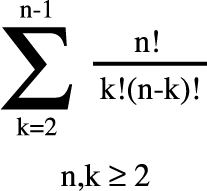
So, what happens when you get a bunch of polyamorous geeks together at a party? Someone starts charting relationship configurations, and someone else starts wondering how many possible relationship configurations there are in a particular group, and someone else gets out a calculator and a sheet of paper, and…

As it turns out, the equation that will tell you for any size group of people n how many possible relationship configurations (couples, triads, and so on) are possible within that group is pretty complicated. It took a lot of work and many sheets of paper, and the considerable brainpower of a couple people with degrees in mathematics, but the equation is:

This will tell you for any group of people n how many possible relationship configurations exist in that group.

And the number goes up fast. Scary fast. For n=9, there are 502 possible relationship configurations in that group. The number of people in the Squiggle I belong to is 15; I haven’t calculated the number of possible relationship configurations exist in such a group.

I think I’m going to make this formula into a T-shirt.

Whew! Back from FPR…

Much to post about, but most of it will have to wait. In the interim, however, I will tease you with this picture of the trebuchet I designed for the communication and conflict management workshop:

There is also a movie of the trebuchet firing here (3.5 MB direct download).

Whee!

Trebuchet habeo.

Nisi pecuniam omnem mihi dabis, ad caput tuum saxum immane mittam.


Next weekend is the Florida Poly Retreat. I am signed up to do two workshops: one on jealousy management, and one on the design and construction of a trebuchet, a type of Medieval seige engine capable of throwing 300-pound boulders through a castle wall.

Trebuchets are cool.

This weekend, I’ll be designing and constructing hte trebuchet that’ll be used in the workshop. Originally, I had planned to build a six-foot trebuchet with an eight-foot throwing arm, capable of hurling a projectile the size and weight of a bowling ball about fifty yards or so. Shelly and smoocherie both, sadly, nixed that idea–Shelly because she was horrified at the safety implications of such a device, and smoocherie because the facility evidently doesn’t have enough space to be chucking bowling balls around.

So, alas, I’ve had to scale back a bit. I’m designing a trebuchet about three feet high, designed to toss golf balls or tennis balls around. Which is very sad, because tossing a golf ball is so much less fun than tossing a bowling ball. I think it would be fun to use an old-fashioned steel lawn dart as the projectile, but I don’t think you can buy those any more. (I certainly haven’t seen them in years…which, now that I think about it, is probably a good idea. Who the hell thought that throwing five-pound, sharp steel darts high in the air was a fun family game? No way THAT could go wrong…bit I digress.)

There’s actually a bit of accidental history behind this particular workshop. During the first Florida Poly Retreat in 2003, Shelly and I and some various other people found a pile of scrap wood at the facility, and I decided to use that and duct tape to make a quick, improvised trebuchet.

Well, actually, that’s not quite true. The device we ended up making was technically a mangonel–it was powered by a combination of a small counterweight and human muscle, a design first pioneered by the Mongols, who used caputured enemies as slaves to operate their mangonels, and built versions that could be disassembled quickly and carried on horseback which they used as antipersonnel devices rather than as seige engines…but again, I digress.

Anyway, the FPR in 2003 was arguably the first nationwide polyamory meeting to arm itself. We test-fired the mangonel by using it to fire the flashlights that were giveaways at the retreat, that projectile being necessitated because (a) it had a lanyard designed to be worn around the neck, removing the need for a firing sling on the weapon, and (b) it was dark by the time we were finished, so we needed a projectile that could be seen at night.

The finished engine worked far better than I had anticipated; by the time we got the firing mechanism worked out, it was hurling the flashlights about three times farther than I’d estimated. Which was great fun, as you can probably imagine.

Anyway, it’s been something of a standing joke since then–Florida Poly Retreat, the only polyamorous gathering to have seige equipment! So when smoocherie approached me with the idea of doing a formal workshop this time around, hey, who was I to say no?

The trebuchet workshop is being billed as a workshop on communication. Legendary cynic Ambrose Bierce described war as “untying with the teeth a political knot that would not yield to the tongue,” after all.

I plan to do a packet for the workshop that contains the plans, plus a writeup on the physics, theory of operation, and history of the trebuchet. For anyone who cares, this will be a HCW (hinged counterweight) design with a fixed throwing arm, and I’ll probably put it on wheels. If there is enough interest, I’ll probably make the packet available as a PDF from my Web site.

And now, off to Home Depot, the “Toys R Us” of the mad scientist and pervert communities.