Dreams and Weekend Stuff

So. Ove the weekend I had a dream–one involving zensidhe, datan0de, femetal, fatesgirl, and zombies. Any of you who know one or all of those people will probably know that adding zombies to the mix really isn’t that much of a stretch.

Anyway, in this dream, the six of us–the Smoosh, Shelly, and I–were all living in a big rambling country house together, a couple miles from town. During the dream, there was an enormous storm over the town, with weird glowing clouds and lightning and tornados and all kinds of chaos, and datan0de and I were standing outside the house watching the storm. A huge cone of light blasted out of the weird glowing clouds and hit right in the center of town, and somehow (through that weird dream logic that lets you know this sort of thing) we knew that it had turned all the dogs in town into zombies, and that soon the dogs would be biting people and turning them into zombies too.

So. datan0de and I were talking about this, in a casual offhand way–“Should be at least a Class 2 zombie outbreak in just a few minutes.” “Yep, seems about right. We probably have a couple hours before zombies are swarming all over the house.” “Yeah, I’d say that’s probably true. Hey, we should get the camera and take some pictures of the storm. Check out all the lightning!”

We were all relaxed and casual about the whole thing, because zensidhe was there, and if anyone knows how to handle a zombie outbreak, it’s him. So all of us were greeting the prospect of being overrun with a swarm of hungry zombies with about as much panic as you might expect from a weather report of a chance of scattered afternoon showers–“Yep, maybe we should take the lawn furniture inside and load the shotguns.”

Shelly feels that this dream is an expression of a great deal of confidence on my part in zensidhe‘s abilities. I think it’s just a subconscious desire to live with femetal and fatesgirl because they’re cute and all.


Sunday, Shelly and S‘s other boyfriend S and I drove up to Gainesville to meet indywind and her partner. I have no idea of her partner is on LJ or not.

We lounged in a park–or rather, I lounged in a park while indywind and her partner taught Shelly and S various Renaissance-era dances that are appropriate for poly folk. I have a new respect for how bawdy the Renaissance-era peasants were, but that’s a whole ‘nother post altogether.

Flowers on the razor wire: or, how the weekend went

The catholic girls now, stark in their dark and white
Dread in monochrome, the sisters of mercy
High tide, wide eyed, sped on adrenochrome…

Friday, Shelly and I got gothed out and headed to Orlando to meet up with friends at a Sisters of Mercy show. Shelly now has a Catholic schoolgirl uniform, which she wore for the first time that night…and no, you don’t get to see any pictures, neener neener.

Good show, all in all. I’ve never seen Sisters before and never been to the House of Blues before. House of Blues is a weird venue, in that “corporate rock meets gospel with a touch of urban decay” sort of way; they try really hard to give the place atmosphere, honestly they do, but a corporate chain’s idea of “atmosphere” always comes off in much the same way (witness Sony’s corporate idea of “cool,” the Metreon in San Francisco, and you’ll see what I mean.) House of Blues is decorated in a kind of “folk art with a vaguely nonthreatening gospel theme and AK-47s” style, and features television monitors that run ads for HOB merchandise on a loop–even during the show. But I digress.

Opening for Sisters was a goth band called Warlock. Picture a group of avid, hardcore D&D gamers who get together one day and say “Hey, we should start a band! And…and…we’ll call it ‘Warlock,’ ’cause that’s like, the most goth name ever! And we can practice in my mom’s garage!” ‘Nuff said.

We are few, and far between
I was thinking about her skin
Love is a many splintered thing, don’t be afraid now
Just walk on in

We met up with smoocherie there. She’s decided she’s moving to California for sure, which means that the relationship between us is about to become long-distance.

And that right sucks.

She seems to be quite good at maintaining long-distance relationships. Evidence would suggest, however, that I am not. One could argue that we have a long-distance relationship now; she lives on one side of the state, and Shelly and I live on the other, a good several hours away…but we still see each other nearly every weekend. Opposite sides of the country makes that more…difficult. I don’t know yet how this will work.

I hear the roar of a big machine
Two worlds and in between
Love lost, fire at will
Dum-dum bullets and shoot to kill,
I hear dive bombers, and empire down

My archnemesis datanode and I have remarkably similar desires for the world, all things considered. At the concert, we began negotiating a temporary truce, at least until such time as the Apocalypse comes. The idea of stalking him from within a steel exoskeleton across the shattered ruins of a post-apocalyptic world just seems so much more…satisfying than stalking him across a Wal-Mart parking lot, you know? And perhaps, if we learn to work together, we can pool our talents and help bring about that arclight-illuminated future nightmare of twisted steel and broken concrete that much sooner.

Besides, with the money I save on the swarm of self-replicating nanorobotic hunter-killer machines, maybe I can get a new G5 Quad computer this year.

Somebody tell me about the rhythm of the 4th floor.
This is the image, this is the place
Somebody tell me about the rhythm of the dance floor
This is the way the world will end

We spent the remainder of the weekend with smoocherie who has a Dance Dance Revolution pad for her Playstation. I’ve never understood the cultural phenomenon of DDR, much as I’ve never really understood the cultural phenomenon of “Friends” on TV, but Shelly seemed to think it was great fun. Somehow, things went from that to ballroom dancing, and Shelly (who’s taking a class in it) was showing some things to smoocherie (who’s planning to), and this involved me “being a guy” by, evidently, standing there and raising my arm periodically so that one or the other of them could twirl underneath it.

Which is an interesting metaphor for life, when you think about it.

Some people get by with a little understanding
Some people get by with a whole lot more
I don’t know why you gotta be so undemanding
One thing I know, I want more
and I need all the love I can get…

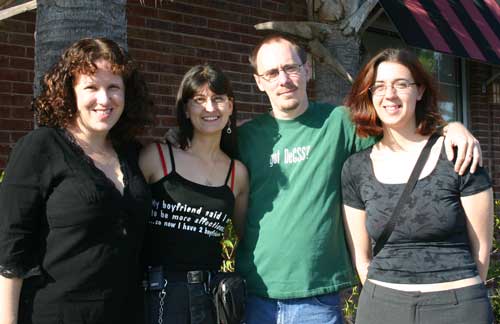
Sunday saw a PolyCentral meeting, which S was actually able to make. We realized that this represented the first time since I’ve been romantically involved with Shelly, smoocherie, and S that all of us have been in the same room together, so we took a picture outside the restaurant to mark the occasion:

I think it’d be great to get a picture of the whole extended family all in one place–smoocherie‘s other sweeties, S‘s other sweetie, Shelly’s other sweetie, and so on–but that would require rather a lot of travel, as at least two of those other sweeties live in California.

Long-distance relationships seem to be an ongoing theme here.

S is wearing a T-shirt reading “My boyfriend said I should be more affectionate…so now I have 2 boyfriends.” She has an online shop where you can buy it and other designs here.

You bought a mask, I put it on
You never thought to ask me if I wear it when you’re gone
Get real, get another
I don’t exist when you don’t see me
I don’t exist when you’re not here

Shelly has become disenchanted with the poly community lately, and I think I’m reaching that point myself. Part of the reason is that when it comes to communication the folks in the poly community can talk the talk but they often don’t walk the walk–poly folks stress communication more than any other group I have ever seen, but when it comes to actual communication, they’re lousy at it. Just trying to define words like “polyamory,” much less, say, defining relationships and expectaions, is met by fierce resistance bordering on hysteria in some corners of the poly community.

And part of the problem is that there is a certain approach to polyamory that seeks to box and contain things before they even exist: “Well, I already have a Primary relationship, and my Primary and I are reluctant to face our own insecurities and jealousies, so we’ll deal with them by making damn sure we let everyone else foolish enough to get involved with us that they are Secondary, not Primary, and that our Primacy will always reign supreme. Because, y’know, that’s the only way we can do this without being jealous, right?”

And lest you think that there’s a contradiction between wanting to define a thing and not wanting to box it in: defining a thing merely describes the reality of the form it has taken; it does not assign a shape to it.

Relationships are with people, and it is hard to see people for who they are if you’re too scared to talk about what you see and too jealous to let relationships take their natural form.

Sunday evening, S introduced us to some friends of hers (visiting, natch, from California). Her friends do not self-identify as “polyamorous,” and are supremely uninterested in having anything to do with the organized poly community at large. They are, however, cut in many ways from the same cloth as Shelly and I in matters related to romantic relationships; their refusal to identify as “poly” comes not from the fact that they’re monogamous but rather from a very similar frustration that Shelly and I are beginning to feel with polyamory as it is often practiced within the poly community.

Meeting them was absolutely delightful, and talking to them was natural and effortless. It’s nice, sometimes, to see a shared commonality in approach in someone.

I had a face on the mirror
I had a hand on the gun
I had a place in the sun
And a ticket to Syria…

We all–Shelly, smoocherie, S and her friends, and I–wandered around a shopping mall for a bit, then ended up at a combination ice cream shop/miniature golf place for a while. I realized that I haven’t taken a picture of myself since Shelly got at me with a set of electric trimmers, so I slipped into the restroom to rectify that:

I think I like the short hair. It’s…err, growing on me.

And finally, because this is LiveJournal and LiveJournal is ultimately all about pictures of cats, I give you:

Molly the cat, who spent last night sleeping in the dirty clothes hamper

Some thoughts on specialness…

…taken from a reply in a thread in polyamory, borrowing in turn from a similar conversation thread on a mailing list I read.

Many, many people feel special in a relationship because of the things their partners do. For example, some people feel special by exclusivity–“I am special because he does not love anyone else,” “I am special because he only does thus-and-such with me.”

The danger in doing this is that if you’re not careful, sometimes what happens is you end up placing your sense of worth, your sense of value, and your sense of “specialness” on things outside of yourself.

If you need certain exclusive things in order to feel secure with your lover and in order to feel unique and special and valued, then you will never really be secure and you will never really feel unique and special and
valued–because you will always know that these things can be taken away from you.

I feel secure in my relationships because I know, deep down in my heart, that nobody else is like me and nobody can ever take my place. If my partner Shelly does everything with her other boyfriend that she does with me–if she goes to the same restaurants, watches the same movies, has sex in the same positions–it does not bother me and does not make me feel jealous or insecure, because I know that the things that make me special and irreplaceable are inside myself, not outside.

My specialness does not come from the exclusive things we do. My specialness comes from *who I am.* Knowing that makes me secure, and it also means I don’t need tokens of my specialness, like exclusive things from my partners; my specialness is assured, is concrete, and can never be taken away.

It’s been my observation that the more you place your sense of value and worth on things outside yourself–the more you need, and rely on, tokens of exclusivity in order to feel special–the more you will struggle with jealousy and insecurity. Real security, in the end, can come only from within.

I think that many problems people have with their partners’ behavior, especially in polyamorous relationships (but sometimes in monogamous relationships as well), come from the need to have their partner make them feel special. If you are in fact special to your partner, then there should be no need to set boundaries or controls on your partner’s behavior in order to feel it; it will shine through in everything your partner does, all the time. If, on the other hand, you are not special to your partner, then controlling your partner’s behavior isn’t going to make you special.

Being a Secure Person: Practicing the Piano for Love and Profit

Note: This message started out as a reply to a post in a completely different, non-LJ-related forum, about how to deal with fear and insecurity in a polyamorous relationship. It’s been reworked a bit from there.

I’m not terribly spiritual. (Yes, it’s true!) I don’t see polyamory as a “spiritual path,” I’m not prone to believing in “sacred sexuality” as a way to explore my connection with the Universal Cosmic Divine, and my own approach to polyamory (and to life in general) is very practical and hands-on. This is why I do not believe, for example, that love is infinite…but that’s a topic for another time.

There is a saying: “There is no fear in love, but perfect love casteth out fear.” I don’t believe a word of it. Often, the way it works in practice is quite the opposite. You get rid of fear, and the love follows more easily. The “getting rid of fear” part is the bitch…but it can be done.

And getting rid of fear and insecurity makes life better. Ultimately, dealing with fears and insecurities is something that must be done; a person can deal with them by hiding from them, deal with them by rearranging his life around them, or deal with them by destroying them completely, but not dealing with them generally isn’t an option. And frankly, with the amount of time and effort people invest in hiding from their fears or building their lives around their fears, just eradicating them to begin with is actually less effort in the long run.

So. Practical, ordinary dealings with fear:

Fear is deceptive. Fear will attempt to justify itself. Often, you can think of your fears as though they were living creatures of their own; they will fight to protect and defend themselves, just like any other living thing.

Fear is tricky because it can color and distort the way you see the world. You will often see (or, sometimes, fabricate) things which support your fear, while totally missing things which contradict your fear. On top of that, when you are afraid, you tend to project that feeling into the past, remembering most strongly those things which confirm your fear; and into the future, and believe, if only subconsciously, that this is the only way you will ever respond to this kind of situation, and no other response is possible.

Fear tends to wither and die if you drag it out into the light, though. I’m personally a big fan of marching into the closet, grabbing the biggest and ugliest monster in there by the tail, and then dragging it out and going toe-to-toe with it. Fears gain strength when you let them hide in the shadows, and lose strength when you examine them and confront them head-on.

So. I’m going to start with a hypothetical situation, and lay out a plan for conquering a fear, step by step. Different fears express themselves differently, and fears and insecurities can manifest in many ways, but the same tools can be used for dealing with them all. For the sake of example, I’ll start with a fairly common response I’ve seen in poly relationships many times: you have a partner, your partner has another partner, and you feel insecure or jealous when you see them together in a romantic context, like when you see them kiss.

Ready? Here we go.

Look beneath the surface

Figure out what lies at root of the response. This is the first and most critical of all tools for dealing with fear or insecurity. Insecurities, jealousies, and fears are often composite emotions–emotions made of other emotions. You can’t confront the fear until you understand what lies beneath it.

Say, for example, you see your sweetie kissing someone else, and that brings up a negative emotional response–jealousy, fear, whatever. Look at that fear! (Yes, I know this is difficult; when you’re in the grip of a negative emotion, all you want to do is make it stop, right now, by any means necessary.) Examine what it’s telling you. Why do you have that response? Is it because you believe that you can’t compete with the other person? Is it because you’re afraid your lover may find you wanting? Is it because you’re afraid your lover will leave you, or want you less, or prefer someone else’s company? Try filling in the blanks: “If my lover kisses another person in front of me, then the bad thing that will happen is ______.” “If this keeps happening, then it means ________.” “If my lover really loves this other person, then ______.”

Further Down the Rabbit Hole

Once you have an idea of what it is that underlies the fear, keep following it down the rabbit hole. For example, let’s say that you have a negative emotional response when you see your partner kiss someone else, and you figure out “I am afraid that that other person might kiss better than me, and my partner might want that other person more than me.” Well, now figure out what’s underlying *that* fear. Is it rooted in fear of abandonment? Low self-esteem? Fear of competition? Fear of loss? What is it you’re afraid that means? Why do you believe that the other person might kiss better than you–and more to the point, why do you think that’s even relevant?

Disassemble! Disassemble!

When you’ve done that, you’ve made a lot of progress. For example, let’s say you have a negative emotional response when you see your partner kiss someone else, you’ve figured out that the response is caused because you fear that if your partner’s other partner kisses better than you you will lose something, and you’ve figured out that this is rooted in the idea that if your partner’s other partner is more pleasing to him, your partner will want to be with that other person and not with you.

Okay, now we’re getting somewhere! The root of the response is fear of abandonment. Now you need to take that fear apart. This is what I mean when I say “drag the fear out of the closet and go toe-to-toe with it.” You need to disassemble the response, and figure out whether or not it’s valid.

One way to do this is to examine the assumptions about your relationship that your fear reveals. Do you believe that your partner is with you because of the way you please him in bed? Do you believe that if your partner finds another person more sexy or more pleasing, you may lose some or all of your relationship? Are those beliefs founded? Is it possible that your partner is with you for reasons besides those? What might those reasons be? What value do you add to your partner’s life? Does your partner value you for the way you please him, or for who you are? Is it even meaningful to say that one person can replace another?

Now, the danger in doing this is that sometimes, you may find your fear really is justified. Not all fears are irrational. There are people in the world who are only with someone for a lay, and will move on as soon as they find a better fuck. It could very well be that in this hypothetical situation, this is the case. If so, so be it. The best way to keep from being disillusioned is not to have any illusions in the first place; if your partner is only with you for a lay, then this is the kind of thing you should know.

But more likely, you will find that when you do this, your fears fall apart. When you examine your relationship with your partner, you will likely find that, no, you add value to your partner’s life in a myriad of ways, large and small, and that even if your top-level fears are realized and your partner finds someone better in bed than you (or whatever), it does not mean you will lose your partner.

How do you get to Carnegie Hall?

At this point, I’m going to digress a bit and talk about what it means to be a “fearful person” or an “insecure person” or a “jealous person.”

I’ve talked to a lot of people who say things like “Oh, i could never be polyamorous; I’m just a jealous person”–as if being a jealous person were some matter of genetics, something over which we all have no control, like being born with blond hair or…well, no, people actually think they have more control over their hair color than over their own conceptions about themselves, which is interesting.

Let’s say you went to a piano concert. Would you say that the pianist up on the stage was “just a good pianist,” as if that’s all there was to it? Hell, no–and if you did, she’d likely punch you. You get to be a good pianist by long, hard practice. A good pianist is made, not born.

The same is true of being a secure person–or an insecure person. People are accomplished at being insecure because they practice being insecure. They practice diligently, every day, for years; it’s no wonder they’re good at it.

You practice being insecure every time you let yourself think “Oh, I’m not good enough for that” or “Oh, my partner doesn’t really want to be with me” or “Oh, I don’t deserve that” or whatever.

After a time, this way of thinking becomes natural and effortless. A pianist who has practiced enough does not consciously have to move each finger to the proper key; after a while, they find the keys by themselves, without conscious effort. A person who practices being afraid or insecure soon becomes very natural at it; you find the things to support your fear, you learn the tools to reinforce your fear, without consciously thinking about it.

The same is true of self-confidence and security. These are things you practice; practice them enough, and they become totally natural, a part of who you are.

So back to dealing with fear. Once you’ve deconstructed your fear, discovered what it’s rooted in and taken those roots apart, once you’ve found a list of things which discredit your fear, it’s simply a matter of reaching for those things that your partner values in you and that you add to your partner’s life whenever the fear raises its head. The thing about fear and jealousy and insecurity is that these things are in some ways like playing a piano; they represent ways of looking at the world which improve with practice. Just as practice can make a person into a highly accomplished pianist, so does practice turn someone into a highly fearful or highly jealous person. And contrawise, practicing discrediting your fear, developing the mental habit of staring down your fears and insecurities and saying “No, you’re wrong, and here’s why” whenever they stir, will make you accomplished at feeling self-confident and secure.

Once you understand why your fear is flawed, you simply have to train yourself to stop reinforcing it, and to reinforce the feelings of value and security instead. This will feel awkward and unnatural at first, just as learning to play the piano feels awkward and unnatural at first. But you become good at what you practice. If you practice being afraid, you get good at it; if you practice being courageous and fearless, you get good at that.

Now, me, when I feel something that makes me feel insecure or fearful, I tend to want to push on that thing–a habit I picked up from Shelly, who is a master of it. So to take my hypothetical example, if I were to feel an unexpected negative reaction at seeing a partner kiss someone else, rather than try to hide from it or to tell my partner not to do it, I would instead tell her “I feel this way when I see this, so when you do this when I’m around, I may want to talk to you about those feelings later.” I certainly would not expect her not to do it in front of me; I believe that approach is the way away from courage, and would simply make the fear stronger.

When you push on the things that make you afraid–when you deliberately expose yourself to those things–you rob them of their power. On the other hand, when you give in to those fears, or (worse yet) when you pass relationship rules designed to hide the things you’re afraid of–“No kissing when I am around!”–you reinforce those fears, and you allow them to control your life. Building your life around your fears is not an effective strategy for leading a happy life; and manuvering your partner’s behavior around your fears is not a good strategy for building a happy relationship.

We believe in the future of the human race: music, hot bi babes, and Citizen Cyborg

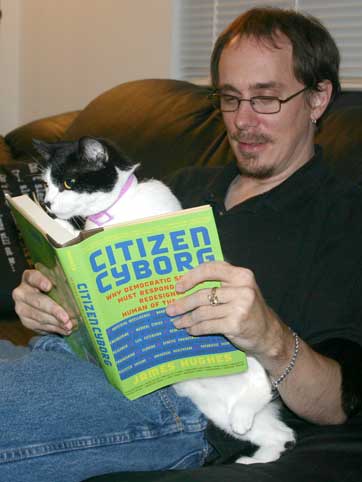
I finally got my own copy of James Huges’ transhumanist book Citizen Cyborg, after flipping through smoocherie‘s copy some time ago. It actually arrived last week, just as Shelly and I were preparing to drive out to Ormond Beach to spend the weekend camping with smoocherie and her partner Fritz. It’s one of the tangible benefits of my Web site; I maintain a list of books and resources about polyamory and another similar list of resources about BDSM, and every year enough people visit my resource pages and buy books from it that I can afford to get two or three books myself from Amazon.

I just recently had a chance to settle down and start reading it, which I need to do soon as we’re scheduled to have dinner with James Huges, the author, the first week in January.

I wrote some time ago about how my kitty Snow Crash is not an Extropian, and why this was bad for society. The same cannot be said of Molly, the other kitty, who is an extropian of the highest order. No sooner had I settled in and begun reading than she was all over me like white on…er, on public water fountains and in public schools in the segregated South before more reasonable people intervened and said “Listen, I don’t care what your goddamn tradition says, treating people as inferior just because they’re black is wrong.”


The camping trip was great fun. We stayed out in Ormond Beach for a couple of days, talking philosophy and kayaking and watching Invader Zim on Cherie’s laptop and gathering around the campfire for lesbian orgies. (Campfire + toasted marshmallows + chocolate + graham crackers + Shelly + smoocherie = lesbian orgy, but I digress.)

I’ve actually become quite spoiled. I’ve seen quite a lot of smoocherie lately; it’s almost enough to make me forget that it is, technically, a long-distance relationship. She and Fritz spent last weekend with us, and it’s been so jam-packed with industrial poly goodness I’ve scarcely had time to catch my breath.


Friday: What’s outside? retailiation what’s outside? burning flags what’s outside? the pressure of daily life what’s outside? nothing to be afraid of we believe in we believe in the future of the human race

Front 242 played in town on Friday. The four of us joined nihilus, datan0de, nekidsteve, and alias_node–who’d gone off his pain meds to be there–for an evening of industrial/EBM goodness at 130 beats per minute. great show, but the real pleasant surprise was the opening act, Gray Area. I know nothing about these guys and hadn’t even heard of them, but wow, they’re really, really, really good.

alias_node got clipped pretty hard in the back during the show and was in a great deal of pain, complaining that his vision was all funny, so he went to the after-show party at the Castle and the rest of us went out for ice cream and headed home. If there were two words to describe alias_node and they weren’t “deleriously happy,” the first would be “hard” and the second would be “core.”

Saturday: What the flame does not consume, consumes the flame.

smoocherie had been invited to the Southern Polyamory Gathering, which I’d never heard of. She, Fritz, and I piled into her Prius, sans Shelly, who had far too much homework to do but gave us quite the cute sendoff anyway:

She’s such a cutie…but I digress. Anyway, the three of us scoped out the pagan poly folks for a while, then crushed them all in our iron fist inadvertently ended up dominating the talk circle with matters of practical, hands-on polyamory.

Neat bunch of people, for the most part, though many of them seemed remarkably unaware of the Internet, which probably accounts for the fact that there’s near-zero crossover between the local pagan poly community and the rest of the poly community at large.

I’m always surprised when I encounter some counterculture group that doesn’t make use of the Internet. How do they find each other?

In the foreword of Citizen Cyborg, James Huges talks about “bioLuddites”–people resistant to technological change in general and change in biomedical technology that threatens to make us re-examine our ideas abouut what it means to be human and what it means to be a person in particular. What’s interesting about these people is they come from all over; they’re a mix of far-right religious Fundamentalists, social conservatives, environmental activists, far-left anti-capitalist and anti-consumerist advocates… you name it. I catch a faint whiff of resentment to technology and to transhumanist ideals in much of the pagan community, which makes the irony of the fact that smoocherie‘s Toyota was the only hybrid among a sea of hulking Ford and GM SUVs all the sharper.

Afterward, Aeon Flux.

I won’t give away any of the movie, though I will say that they did an excellent job of preserving the visual language of the original comic, live-action aside. Charlize Theron was not an intuitive choice for Aeon, though she handled the role magnificently. The story was okay; had some glaring plot holes, and it, too, had an undercurrent of anti-transhumanist ideology. (“Humans were meant to die”? WTF is that all about? But again, I digress.) Pros: More coherent than the cartoon, though that’s not saying much; an epileptic who’s just overdosed on PCP is more coherent than the cartoon. Cons: Not the same characters.

Fritz observed, right on the mark, that the characters of Trevor and Aeon in the cartoon can be seen as archetypes of radical order and radical chaos; each is more or less indifferent to the consequences of their actions on the people around them. The movie redefined the characters radically; Aeon was still more or less recognizable, but Trevor wasn’t even in the same ballpark, or for that matter in the same city, or the same sport, even. in the cartoons, the single overriding factor in his psychological makeup is his boundless, cast-iron arrogance, something completely lacking in the new, redesigned Trevor.

Sunday

I have no clever quotes for Sunday. Sunday was PolyCentral, a once-monthly Orlando meeting of all us polyamorous freaks. Shelly accompanied us, despite the crushing amount of homework piled atop her as she goes into finals; she did homework in the car on the way there, homework at the restaurant, and homework in the car on the way back. PolyC’s current home is a Thai sushi restaurant, whose owners are apparently involved with two other couples in some capacity I’m not entirely clear on, and plan at some point to sit in with the rest of us freaks.

Then back home for studying, sex, and World of Warcraft, more or less in that order.


Tonight, my sweetie S‘s other partner, whose name also begins with the letter S, has invited Shelly and I to Cirque du Soleil. God is an iron; he lives in Orlando, she lives here in Tampa (a very short distance away, in fact), and her schedule has been so over-the-top busy lately that I’ve seen more of him than I have of her in the past couple of weeks. (No, not that way, you perv!)

Bad poly: Resenting your partner’s other partner. Good poly: Going to Cirque do Soleil with your partner’s other partner because she’s busy for the evening.

And now, alas, more work beckons.

Polyamory as a zero-sum game and other musings on relationship

I get a lot of email from my polyamory site. The majority of that email is very positive, but every so often someone takes issue with the idea of polyamory (not so much of the idea of being polyamorous, so much as the entire existance of polyamory), and objects to polyamory in principle as well as in practice.

One of the most common objections to polyamory is based on time management, and betrays a fundamental worldview which, I think, is not necessarily accurate, but which is buried so deeply in assumptions about the way relationships work that it’s nearly inaccessible.

Now, before I go any further, I do think it’s important to say that there is a kernel of truth in complaints about polyamory from a time-management perspective. Love isn’t infinite, press releases to the contrary; but more important, time and energy are definitely not infinite, and are sometimes in very short supply indeed. It is not possible, philosophically or practically, for a person to have an indefinite number of partners; eventually, even the most patient of people will simply run out of time.

But that doesn’t happen as quickly as people think it does, because love is not a poker game.


A poker game is a classic example of a zero-sum system. In game theory (and in economics), something is said to be “zero sum” if all the gains and losses in the system, added together, always equal zero.

In poker, it’s easy to see how this works. If Alan and Bob play poker, then for every dollar that Alan wins, Bob loses exactly one dollar. The total of the winnings and losses added up equals zero; each dollar in the pot that one person wins, the other players have lost.

Many people approach relationships in much the same way. The assumption is that relationships are also zero-sum; every minute of time, every bit of attention you give to one partner is a minute of time or a bit of attention that is taken away from someone else. If Alan is dating Betty and Cindy, the net sum of the time Allen spends with Betty is time taken away from Cindy, and if you add the total amount of time one partner gains and the other loses, you always end up at zero.

Now, hidden deeply within this idea is another, related idea, and that is that a person who is in a relationship has a rightful claim on his partner’s time and attention. If I am dating Alice, then Alice’s time and attention rightfully belongs to me; if Alice spends that time and attention on someone else, i have lost something which I am entitled to and which is mine by right. Her time is mine; she has no right to take it away from me and spend it on someone else.

Both ideas are wrong, though for different reasons.


The fact is, my partner’s time does not belong to me. Nor is it anything I should legitimately feel entitled to. Two people engage in a romantic relationship for the mutual benefit of each; should the relationship not be a source of joy for each person, it’s certainly reasonable for them to look for relationships which are satisfying. More importantly, though, it’s neither beneficial nor necessary to lay claim to a person’s time and attention.

It’s not necessary because if a person is interested in you, it’s reasonable to assume that person will dedicate time and attention to you; people tend to spend their time on things which are important to them, and to find time for those things. Behavior is an emergent phenomenon; people behave the way they do as a result of the things they believe. Someone who does not believe that his partner is a priority or that his relationship is important is not likely to focus a lot of time on it, and compelling him to do so won’t make him feel like it’s important to him.

It’s not beneficial because a person who gives his partner time and attention only because his partner forces him to is not likely to provide high-quality time. Just the opposite, in fact; he’s likely to resent it. You can’t compel someone to find you important, which is precisely what you’re doing when you believe that his attention is something you can lay claim to.


Getting back to the point, though, love is not a poker game. Time and attention are not zero-sum, and time spent with one person does not necessarily mean time taken away from another.

It’s reasonable for the people in any romantic relationship to expect to have a certain amount of “alone time” with their lovers, of course. This is something healthy relationships need in order to grow and develop; and because time is not infinite, it’s reasonable to say that no person can really expect to build high-quality relationships with a vast number of people.

But even considering that healthy relationships do need some measure of alone time, it’s still not a zero-sum game. This is because it’s possible for a person to spend quality time with two or more partners concurrently.

If–and this is important–that person does not see his relationships as separate and discrete things to be kept isolated from one another.


here is a model of polyamory I call the “free agent” model. People who subscribe to this model tend to isolate and compartmentalize their relationships, and one of the hallmarks of free-agent polyamory is that the people who subscribe to it will often present themselves as “single” when meeting new people, and behave in public as if they were unpartnered, even when they have existing relationships.

On the other end of the continuum from free agents is people who subscribe to an “inclusion” model of polyamory, one that sees all the relationships as interconnected, and that seeks to build relationships which are mutually compatible and supporting. This does not necessarily mean that people with an inclusion ideal of polyamory want their partners to be dating each other, or sleeping in the same bed; it means that they seek to find partners who will respect the existing relationships, who can spend time together, and who don’t view each other as competition. It also means that they seek to find relationships in which everyone involved feels comfortable with everyone else involved, and tend to be aware of the effects of each of their relationships on all the others.

One of the primary drawbacks of the free-agent model is that it can lead to resource competition, in which time and attention given to one person is taken away from someone else. If Alice is dating Bob and Charles, and Alice compartmentalizes those two relationships–by spending time with Bob or with Charles but not with both, for example–then the relationships are zero-sum. Time given to Bob is time not available to Charles, and vice versa.

But it doesn’t have to be that way.


The benefit of seeking relationships which are mutually supportive and which aren’t compartmentalized is that Alice can spend quality time with Bob and Charles simultaneously, without competition. When this happens, suddenly those two relationships aren’t zero-sum any more; it’s possible for the sum total of time spent with Bob and time spent with Charles to exceed 100%. It is not necessary for Bob and Charles to be romantically connected with each other, and it certainly is not necessarily for Bob and Charles to be sleeping with each other; all that’s necessary is that Bob and Charles be able to function together without competing for Alice’s time.

Of course, there’s a drawback. It means thinking about relationships, and choosing partners who fit into the existing network of relationships well. It means finding partners who are philosophically compatible with one another. And, it means being aware of the effects of each of those relationships on all the others, and taking responsibility for those effects.


I have in the past been involved in situations where my relationship with someone is a source of pain or discomfort for that person’s other partner. When that happens, i don’t try to isolate myself from her other partner; instead, I’ll tend to put the brakes on that relationship until I and her other partner can work out where the problem is. Doing this means I don’t always get to pursue all the relationships I want to as quickly as I want to–but it also means that I’m not participating in a system that’s hurtful to someone else, even though that person’s happiness is not directly my responsibility, and it means that, in the end, the relationships I build are healthier and more inclusive.

When you build relationships this way, something magical happens.

If Alice is dating Bob and Charles, and each of them is equally important to her, and Alice wants to give each of them equal time, but she compartmentalizes those relationships, at the end of the day Bob and Charles can have no more than 50% of her time and attention. But if Alice does not compartmentalize her relationships, then at the end of the day each of them can get much more than 50% of her time and attention; each of them may get 70%, or 80%, or more, of her time and attention. The relationship isn’t a poker game.


I have been involved with people who do not believe it’s possible to spend quality time with two partners concurrently. I’ve also seen it often in other people’s relationships. In fact, this belief often lies beneath many enforced primary/secondary structures; people will construct primary/secondary relationships out of fear of losing importance or losing a partner’s time and attention, and see primary/secondary as a means to keep the time and attention they feel rightfully belongs to them.

I remember one night when Shelly and my ex-wife and I had gone out to dinner together after I came home from work. We went to a Thai restaurant, spent a while lingering over dinner and talking, then came home. On the way home, my ex-wife asked me “When am I going to get to spend some time with you?”

The fact was, she’d spent the entire evening with me. But the fact that another person was present somehow invalidated that time in her mind; even though we’d had a wonderful dinner together, it “didn’t count’ for her, because she believed that love is zero-sum. Time with her had to be time spent away from any other romantic partner, or else it wasn’t really “her” time. (Interestingly, the same was not true of time spent together with friends who were not romantic partners–far from it, my ex loves to entertain, and was extremely happy spending time with me and with friends, provided they were not lovers.)

When a person approaches a relationship with that philosophy, it cannot help but become zero-sum. he sad part of that is that in a zero-sum relationship, everyone loses. The total amount of time and attention spent on all the members of the relationship can never exceed 100%; the pot is smaller, and there is no win-win scenario.

Love does not have to be a poker game. When it is, it becomes a game nobody wins.

More on the Green-Eyed Monster, or Fixing the Refrigerator for Love and Profit

So, in my last entry about jealousy, dealing with the emotional responses that deal with jealousy, and developing the fine art of fixing refrigerators, I said “there’s more to say on the subject.” And indeed there is. I would’ve said it then, except that (a) I had to run out the door to see a client–I can’t spend all my time on LiveJournal, as much fun as that would be–and (b) we all know that nobody’ll read a seventy-six-page LiveJournal entry, anyway. So, to save my bank account and your patience, I didn’t get into everything that really needs to be got into about fixing refrigerators.

If you don’t have the faintest idea of what I’m talking about, you need to read that post first. Really, you do. Go ahead, I’ll wait.


Anyway. You wake up one morning and discover that something’s wrong in your relationship; something your partner is doing is creating an emotional response in you that cascades, like those little metal balls in a pachinko machine, until you feel jealous. Metaphorically speaking, your refrigerator is broken; you can fix it, you can replace it, or you can pretend that nothing’s actually wrong and just make up a rule that says no refrigerated or frozen food in the house. After all, if you can avoid the thing that makes you confront the broken refrigerator, it’s all good, right?

Now, I would argue that fixing the refrigerator–identifying the things leading to the jealousy, identifying the fears or insecurities that underlie the jealousy, and then dealing with the jealousy at its root–is the best course of action. I would also argue that the most common response is ignoring the problem and banning any kind of frozen food in the house.

But these two things aren’t necessarily mutually exclusive. If you’re on your hands and knees behind the refrigerator with a flashlight in your mouth, you probably don’t want your partner trying to pile more food into the fridge while you’re working on it, right? So it seems reasonable to say “Honey, don’t put any more food in there until I fix the problem, ‘kay?” And this is exactly what many people will tell you they’re doing when they say “My partner does something with someone else, and it makes me feel jealous, so I told him not to do that thing any more–but only until I get to the bottom of it and deal with the jealousy.”

All well and good, but you have to be really careful with this approach. If you’re not, then what happens is that days turn into weeks, weeks turn into months, you’re still uncomfortable with your partner doing whatever it is, months turn into years, and what’s actually happened is that you’ve said you’re going to fix the refrigerator but it’s still sitting in the corner dripping water all over everything and, effectively, you’re just not buying any refrigerated foods any more.


When dealing with a jealousy or insecurity issue, it’s important to differentiate between not wanting to do something because it’s uncomfortable, and not wanting to do something because it’s actually harmful. Some things are a no-brainer.

People often accuse me of being against rules of any sort in a relationship. Actually, this isn’t the case at all; I have rules in all my relationships, and certain standards of behavior which are essential and non-negotiable for anyone who wants to be partnered with me. I do not intend to come across as saying that there should be no rules in a relationship. Quite the contrary; some rules are reasonable and prudent, and some fears are rational and justified.

A trivial example is sexual health. STDs are real. they exist, and they can kill you. Anyone in a sexual relationship of any sort, especially multiple sexual relationships, is well-advised to keep that in mind, and design a minimum standard of behavior for himself and his partners to deal with that risk. In fact, you’d have to be a fool or a madman not to think about STDs when you create your relationship arrangements, and fear of STDs is not only rational, it’s downright prudent. Creating rules to protect yourself from this risk is a damn good idea.

Things aren’t as clear-cut when you’re dealing with emotional risk, however, Fears and insecurities are very, very clever at protecting and justifying themselves, and separating something that is actually harmful from something that’s merely uncomfortable isn’t always easy. It requires work. It requires examining, with an unflinching eye, what it is you’re afraid of and what it is you think will happen if your partner continues doing the thing that makes you jealous. And above all, it requires that you ask yourself, on a regular basis, What is the point of all this?


Many people in the poly community seem to be inherent pessimists, and to have a worst-case scenario of relationship.

What I mean by that is that many people start their polyamorous relationships from the perspective that polyamory itself is inherently destructive, you can’t reasonably expect your poly relationships to be healthy and positive, and if you don’t ride herd on them all the time and manage your relationships and your partner’s behavior strictly, all that will happen is you’ll lose everything.

You see this in the language that people use to describe their relationships. “Well, we do primary/secondary in order to protect the primary relationship.” Protect the primary relationship? Protect it from what? The basic premise is that if you DON’T do primary/secondary, then you’ll automatically find yourself in a situation that destroys the primary relationship; after all, if that were not the case, why would you need these structures to “protect” the existing relationship in the first place? If you believe that you need these rules in order to make sure your needs are met, then what is it that makes you think that another person’s needs must automatically come at the expense of your own?

When you start from the default assumption that other relationships are a threat, and you need to manage and control that threat, then of course it makes sense to assume that part of managing that threat means passing rules that place strict controls on your other relationships. But if you start from the default assumption that polyamory is implicitly threatening to your existing relationship, then what the hell are you doing poly for?


But wait, it gets worse! You see, people’s behaviors don’t spring from a vacuum. People act the way they do for a reason. If your partne’s behavior, left unchecked, is disrespectful to you and recklessly disregards your needs, then you don’t really solve the problem by placing controls on his behavior. The problem runs deeper than that. And contrawise, if your partner loves and respects you and wants to do right by your relationship, then you don’t need to place controls on his behavior; his behavior will reflect the fact that he wants to do right by you, and does so because he chooses to, not because you make him. As Shelly wrote elsewhere, behavior is an emergent phenomenon. You don’t actually control your partner’s heart by controlling his behavior. If your partner’s heart is not really with your relationship, making rules won’t protect your relationship; if your partner’s heart is with your relationship, making rules to protect the relationship is unnecessary.


But back to not putting vegetables into the fridge while it’s being fixed. Yes, this is a very, very good idea. It is not always true that a person who says “not now” actually means “not ever.” There are many people who say “not now” because they are, in fact, working on the problem, and sometimes working on the problem takes time.

Here’s the thing, though. Working on the problem means working on the problem. It means taking affirmative action toward addressing the underlying jealousy. It means making progress.

What can sometimes happen is that a person can sincerely believe that he wants to address the underlying insecurities or fears behind his jealousy, and he can genuinely imagine a time when he does not have those fears and his partner can do whatever it is that triggers the jealousy. But you aren’t going to get from here to there without discomfort. If you wait for a time when you no longer feel uncomfortable, then you’ll be waiting forever, and that time will never come, because the very act of working on the fears and insecurities means being uncomfortable. You cannot challenge a fear without exposing yourself to it. You cannot fix the refrigerator until you actually get on your hands and knees and crawl around behind it and start tinkering with the guts of the thing with a flashlight in your mouth, and that’s uncomfortable. If you say “Don’t do this until I feel comfortable with it” and then you don’t challenge your discomfort, you are saying “Don’t do this” and sneaking the rule in the back door. If your relationship is broken and three weeks later you’re still saying “No, honey, don’t bring any frozen foods home yet, it’s still not working,” what kind of progress are you making?


Things can get a little trickier still (this business of romantic relationship is messy, isn’t it?) when your partner has done something, intentionally or unintentionally, to damage your trust or to mistreat you in some way. When this happens, it takes time to rebuild trust and to repair the damage, and it’s reasonable to expect not to keep doing things which are threatening until you get enough time and distance to separate the damage from mere discomfort.

Of course, i say “mere discomfort” even though I know full well that that “mere discomfort” can be an overwhelming tidal wave of jealousy that so completely washes over you that it leaves you shaking and twisted up in agony and unable to do or say or think about anything save for making the feeling go away. Hey, I never said it was easy–only that it’s possible, and necessary.

Some Thoughts on Practical Jealousy Mangement

This entry started out as a reply to a comment elsewhere in my journal in this thread, and expanded until it touched on some of the things I was saying in this entry in the polyamory community, and grew too big to be posted as a comment anyway, so I’ll probably just end up putting this whole thing in my journal and in polyamory.


One of the central fixtures in most polyamorous relationships, especially polyamorous relationships between an existing couple who begin with a monogamous relationship and then expand the relationship to include polyamory, is a set of rules or covenants designed to protect the existing relationship and to make the people in the relationship feel secure–in other words, to deal with issues like jealousy, insecurity, and threat. I’m going to borrow peristaltor‘s metaphor of the refrigerator and bend it to my own ends.

Let’s assume your relationship is a refrigerator. One day, a problem arises in your relationship–the refrigerator quits working. You walk into your kitchen, there’s a puddle on the floor, and all your frozen pizzas and ice cream are a gooey mass in the bottom of the freezer. There are a few things you can do at this point, once you’ve mopped up the mess and scraped the remains of last night’s lunch out of the fridge. One solution is to fix the refrigerator; another is to replace it. A third solution is to leave the refrigerator exactly where it is and change your life around the problem–“From this day forward, I will bring no frozen or refrigerated foods into this house.” In the poly community, the last option is the one most people choose.


I’ll get back to the fridge in a bit, though, because first, I think it’s important to address something that peristaltor said, which is that sometimes, fears have a purpose. I’m going to spend a good deal of the rest of this entry talking about fear and threat, and it’s important to keep in mind that not all fear is irrational. Fear of snakes? Positive and healthy. fear of spiders, or falling, or drowning? Positive and healthy. A lot of our distant ancestors had to die to bequeath us with these instinctual fears, and they’ve served us well. There’s a difference between a rational fear and an irrational fear, a difference between a fear that genuinely keeps you safe and a fear that makes you contort your life (and the lives of the people around you) for no good reason. The latter kind of fear seeks only to protect itself, not to protect you–and ironically, sometimes it creates the very thing you’re afraid of!


In a relationship, a fear or an insecurity is a symptom of a problem. In some cases, the fear is perfectly rational and justified. An abused child lives in fear of his abusive parent for good reason; he has tangible reason to fear. In a healthy relationship, though, these fears are almost always irrational and unfounded.

Jealousy itself is an interesting emotion, because jealousy is a composite emotion, that is based on other emotions. It’s a second-order emotional response–something happens, that thing causes you to feel threatened or to feel insecure or to feel something negative about yourself, and then that fear or insecurity makes you feel jealous. For that reason, the root of jealousy is often surprisingly difficult to pin down and understand.

Instead, what happens is that people look at the event which is the proximal cause of the jealousy and assume that that event is the source of the problem. “My partner kisses another person, I feel jealous; therefore, it’s the kiss that makes me jealous. The way to deal with the jealousy is to address his habit of kissing people.”


Back about thirteen or fourteen years ago, I was dating a woman I’d met at college, R. During the course of our relationship, R started dating another close friend of mine, T. And for the first time in my life, for the first time in my history (at the time) of a half-dozen successful long-term poly relationships, I was jealous.

I don’t mean “You know, this makes me uncomfortable” jealous. I mean “completely overwhelmed, smashed to pieces beneath a tidal wave of feelings I could not anticipate or predict or control, gut-wrenching, wanting-to-puke” jealous. I mean the kind of jealous that consumes every other feeling and leaves nothing but ashes behind. I’d never felt those things before, and when I was in the middle of those feelings the only thing–the ONLY thing–I could think about was making the feelings stop, however I could. Because it happened when she was with T, and didn’t happen at other times, I made the logical, reasonable, and totally stupid assumption that the cause of the feelings was her relationship with T. From there, I reached the equally stupid conclusion that the thing which would make the jealousy go away was if she changed something about her behavior or her relationship with T. (I also didn’t really recognize the jealousy for what it was, powerful as it was, because I’d never felt it before, which only reinforced the notion that it was “caused by” her relationship with him.)

I behaved pretty reprehensibly, playing passive-aggressive games and just generally acting like…well, like a lot of people dealing with their first crisis in a poly relationship act. predictably, it destroyed my relationship with her. She went on to marry T and cut me out of her life completely; the very thing I was afraid of came to pass because of my jealousy. Had I not behaved the way I did, we’d probably still be close, almost fifteen years later.


In hindsight, now that I have a lot more experience and a bit more emotional wisdom under my belt, I can see where I went wrong. When a person feels jealous, and attributes the jealousy to the things which trigger the jealousy, he doesn’t actually understand the jealousy. It’s a bit like a person who has never seen a rabbit except when it’s being pursued by a dog believing that the dog is the cause of the rabbit. In reality, jealousy is built of other emotions; jealousy is not “caused” in any direct sense by the action which triggers it, but rather by a different emotional response to the act which triggers it.

In my case, R and I had never really discussed her relationship with T; nor had we talked about, in any capacity at all, what her intentions with T were or what effect, if any, that would have on her intentions with and her relationship with me. Put most simply, I saw her and T together, I had no idea what that meant for her and I, so I became afraid of being replaced. The fear of being replaced, in turn, led to the jealousy.

Now, had I actually taken the time to examine the jealousy and really try to understand it, I probably would’ve figured that out. And, once I understood that the jealousy was caused by a fear of being replaced…well, a fear of being replaced is a fear that you can work with. A fear of being replaced, all things considered, is really not that difficult to address. All it requires is conversation about intentions, perhaps a bit of reassurance, and time enough to demonstrate that the conversations and reassurance are genuine, and hey, there you go.


Getting back to the refrigerator:

Fixing the refrigerator means doing exactly that. It means saying “I know that I am feeling jealous. I know that the jealousy is brought about by some other emotion–some emotion which is triggered by the action that makes me jealous. I need to figure out what that other emotion is, and I need to figure out why that action triggers that emotion.”

Until you do that, you are helpless in the face of the jealousy. If you don’t understand it, there is nothing you can do to address it. Trying to understand it isn’t easy; when you’re ass-deep in alligators, it’s easy to forget that the initial goal was to drain the swamp, and when you’re entirely overwhelmed by gut-wrenching emotions that are tearing you to pieces, it’s easy to forget that these emotions are grounded in some other emotions. In the middle of jealousy, all you want is for the jealousy to stop, and you don’t care how.

So, you confuse the trigger with the cause. You believe, erroneously, that the source of the jealousy is the action that triggers it. You see your partner kiss someone, you feel jealous, you want the jealousy to stop, you pass a rule: “No more kissing.”

This is the equivalent of saying “No more frozen food in the house.” The problem is still there. The root has not been touched. The broken refrigerator is still sitting in the corner, dripping water. You haven’t actually dealt with the underlying causes at all; you haven’t addressed the insecurity or fear of loss or fear of being replaced; you’ve just “solved” the problem by shielding yourself from situations that might make you address it. You’ve “solved” the broken refrigerator by passing a rule against bringing refrigerated food into the house.

And then you do the same thing to anyone else who comes in to your relationship. You tell anyone coming into the house, “Look, here’s how it is. You can come over, you can have dinner with us, you can spend time here. but under no circumstances are you to bring any frozen food into these premises.” And if anyone asks ‘why’–well, secondary partners don’t get to ask ‘why,’ do they? Those are the rules, take ’em or leave ’em. We Just Don’t Talk About the giant, leaky, broken refrigerator in the corner. We don’t talk about it and we don’t allow anything that might make us confront the fact that the damn fridge is busted. No frozen foods. No kissing, no saying “I love you,” no doing anything that might make us actually have to deal with the fucking refrigerator.

Take it or leave it.


Not to pick on leotheseadragon, but I’ve spent a lot of time over the last several days thinking about what he said here in the polyamory community, and my response. My response to the situation he talks about now is a lot different than my response would have been thirteen years ago.

The situation leotheseadragon is an excellent example to use when talking about jealousy, because it happens so often. I’ve seen similar situations no fewer than a dozen times in the past three years; it’s a microcosm of the kinds of emotional responses people can have to a situation, and the kinds of rules and covenants they put into place to deal with those responses.

Abstracting from his exact situation a bit, the general idea is this: A person has an existing, primary relationship. He, or they, then begin sexual or romantic relationships with others. One of the people in the primary relationship has a jealousy response, such as “I don’t care when you are with a partner of the same sex, but when you are with a partner of the opposite sex I feel insecure.”

This happens amazingly often. (Sometimes it works the other way: “I don’t mind if you have partners of the same sex, because I know what they can offer you and I know I can compete with them, but I get insecure when you have partners of the opposite sex because they can provide an experience I can’t.” Whatever. The emotional process is pretty much the same.)

Now, put yourself in that position: you are jealous when your partner has some sort of relationship with some other person under some particular circumstance, such as when your partner has sex with someone of the same sex as you. What do you do?

Well, you can take the “I’m not the boss of my partner, so I will let my partner do his thing; my healousy is my issue to deal with, and I souldn’t feel it, so I won’t” approach. That usually involves squashing or suppressing the jealousy, which in turn usually means sitting in a dark room crying and feeling like you’re going to throw up when your partner is out having fun, sometimes combined with moodiness and passive-aggressiveness when your partner returns..y’know, just to spice things up.

Of course, you’re going to feel like crap. Getting back to the refrigerator, this is like continuing to put food into the fridge even though you know it’s broken. Result: wilted lettuce and sour milk. Bon appetit!

Or, you can say “I get jealous if my partner does X or Y with a person of Z sex, so we’ll make a rule in our relationship: no X or Y with someone of Z sex.” There you go, you don’t feel jealous any more. Of course, the underlying cause is still there–you haven’t fixed it. What will likely happen then is that six monthsdown the road, you’ll find that action W triggers the same jealousy. Okay, no biggie–we’ll outlaw W too. But wait, action Q and S trigger jealousy too–who knew? Hey, we can handle this; we’ll pass rules against Q and S. Oh, and against T, too, because T is, y’know, kinda like S. And we’ll pass rules against–you know what, this other partner of yours is just making me feel jealous in general. Veto!!!

And then you end up with problems in your own relationship, because, y’know, unintended consequences and all that. One of the unintended consequences of vetoing a person your partner loves is that you hurt your partner; one of the predictable consequences of doing things which hurt your partner is you damage your relationship.

Or, there’s a third solution. You can break up with your partner, because you feel jealous when your partner does X with a person of sex Y, and your partner wants to do X with people of sex Y, and you don’t like controlling your partner and you don’t like feeling jealous, so this isn’t the relationship for you.

Hey, at least it’s an honest response. You’ve thrown the refrigerator away, and replaced it with a new one.

And that’s about where your options end, right?


Wrong.

There’s another option. You can fix the fucking refrigerator.

Rathewr than retype it, I’ll simply repost here what I said in the thread to leotheseadragon:

“Were I in your partner’s shoes, the conversation would go a bit differently:

“I am uncomfortable with this, and for some reason the idea of you playing alone with a person of the same sex is OK with me but the idea of you playing alone with the person of the opposite sex is not OK with me.

I do not understand these feelings yet, but they seem like they are rooted in some kind of fear (such as the fear that I cannot compete with someone of the same sex as me), or possibly some jealousy. I need to work on this, because I recognize that it is irrational and unjustified. Therefore, it is OK with me if you play with someone of either sex, but I will want to talk to you about it afterward, and analyze my feelings and reactions, and try to understand them so that I can address whatever is causing these reactions. After you are done, I will need some time with you so that we can work together at identifying what is causing this irrational emotional response on my part.”

That’s what I mean when I say “fix the refrigerator.”

The nice thing about doing this is that you can, if you have isolated the emotional response beneath the jealousy and identified positive ways to deal with it directly, end up in a position where you don’t feel jealous any more. Even when your partner does the things that used to trigger the jealousy. You just don’t feel jealous any more. You do not need to pass rules banning certain behavior and you do not need to veto someone, because you don’t feel jealous any more.

The downside, though, is that your irrational fear will fight to protect itself; it won’t go down easy. The thought process goes like this:

“If my partner does these things with someone of the same sex as me, then I might lose my partner, because someone else might give him the same things I give him. If I lose my fear of losing my partner, I will no longer have a reason to ask my partner not to do these things. If I don’t have a reason to ask my partner not to do these things, then my partner will do them, because I know he wants to do them. If my partner does these things, I will lose my partner, because then someone else will give him the same things I give him. So I better not get over my fear, because if I get over my fear, then i won’t have a reason to ask him not to do these things, and that means he’ll do these things, and that means…I’ll lose him!”

And ’round and ’round it goes. You don’t want to lose the fear, because you’re afraid something bad will happen, and you can’t give up the fear of something bad happening because if you do…you’re afraid something bad will happen.

Fixing the refrigerator requires a leap of faith. It requires believing, even if your fear is telling you otherwise, that your partner is with you because your partner wants to be with you. If you start with the assumption that your partner wants to be with you, then anything becomes possible–including defeating your jealousy without passing rules.

But you got to start there. You got to take it on faith, even when your fear is telling you otherwise–and believe me, it will.


There’s more to say on the subject, but this message is too long anyway, and I have a meeting with a client.

Some musings about security in relationship

So what is it that makes one person secure in a relationship, and another person not secure? Why is it that some people are perfectly fine with the idea of their partners having lunch with, romantic relationships with, or mad passionate sex with another person, while some people would rather be shot multiple times in a drive-by than see that happen?

It’s too easy just to say “Oh, some people are jealous.” That’s a non-answer. Whenever I hear someone say something like “Oh, I could never do that, I’m a jealous person,” it sounds as nonsensical as saying “Oh, I’m a hungry person” or “Oh, I’m a tired person.” Jealousy is an emotional response; to say “Oh, I’m a jealous person” and to let it go at that is to treat it as if it is some fixed, immutable thing we are powerless over, like saying “Oh, I’m a Western European person” or “Oh, I’m a dark-haired person.” In fact, scratch that–many people seem to feel they have more control over the color of their hair than over their emotional lives!

Now, there are certainly plenty of people in the world who do indeed feel unhappy and insecure if their partner spends time with someone else. There are many reasons that someone might feel this way, of course; insecurity, low self-esteem, a feeling of being expendable or interchangeable, a feeling that one’s needs are not important to one’s partner, feelings of being marginalized or trivialized.

Some of these, such as low self-esteem, are internal. Low self-esteem in particular is a real bitch, especially when it comes to relationships; I’ve seen many people cling to their low self-esteem like drowning men cling to a piece of driftwood, refusing to give it up. It’s self-reinforcing, because it creates a sense that you’re not valuable and thare are many people in the world who are better than you are, so you best not let your partner be with any of them, or best make sure you’re in control of the situation. The thought of giving up the low self-esteem is terrifying, because if you give up your low self-esteem, then it might be okay for your partner to spend time with another person–and you don’t want that to happen, because it makes you feel insecure! Hence, you don’t want to give up the low self-esteem, because giving it up means that you may face situations which…trigger your low self-esteem.

Some of these are external. There really are people who shouldn’t be comfortable if their partners express an interest in someone else; there really are people who treat their partners as expendable and interchangeable, and who aren’t concerned with taking care of their partner’s needs. Many “free agents” in the poly community behave in ways that don’t exactly inspire confidence in their lovers; some behave as if they barely recognize the differences between them at all.


Okay, so there’s nothing new in any of that. We all know this already, right? Behave in a way that doesn’t acknowledge the needs of your lover, and your lover may not feel secure in your relationship. Behave with indifference to your lover, and your lover may not feel secure in your relationship. Behave as if your lover is the flavor of the day–“Ooh, you’re so cool, I dig you, I’m so glad we met, I totally lov–oh, look, potato chips!”–and your lover may not feel secure in your relationship. This isn’t really rocket science.

But what happens if you flip that coin over and look at the other side?

There are people in the world–I’ve met more than a few–who have a strong sense of self, a robust sense of security, who are in partnerships with people who are sensitive to their needs and treat them well, yet who still seem plagued by insecurity in their relationships. I’m not talking about people who simply aren’t polyamorous; there are secure people in healthy relationships who are just monogamous, and that’s the end of it. No, I mean people who seem to be secure in themselves and have partners who treat them well, yet seem insecure in their relationships all the same. So what’s the difference?


Conjecture: Putting your partner’s needs first, putting your partner’s happiness before your own, doing everything you do in your relationship for the sake of your partner, can also cause your partner to be insecure.

Reasoning: Now, this doesn’t seem to make intuitive sense at all; if your partner is respectful of your needs and consistently puts your needs ahead of his own, it wouldn’t seem like this should breed insecurity. Just the opposite, in fact; a person in a relationship with someone who has a consistent track record of making his happiness the most important thing should feel secure, right? But bear with me here.

Let’s say Alice and Bob are in a relationship, and Alice consistently puts Bob’s happiness ahead of her own. Alice genuinely wants to make Bob happy; in fact, this is her first priority in all matters great and small. Alice has always done everything she can to make Bob’s needs her first concern. Could you reasonably expect Bob to feel secure with Alice?

I think the answer is “no.” Every human being does have needs; a romantic relationship where one person’s needs are important and another’s are not isn’t sustainable, even if it’s the choice of the person whose needs are being neglected.

But it gets worse. If Alice has never made her needs or her happiness a priority, and has never stood up for the things she wants, then it’s entirely possible that Bob doesn’t understand her needs, and because of that has no idea how to make her happy. Alice’s self-sacrifice backfires, because by not standing up for her needs, she has denied Bob the opportunity to meet them. Can Bob make Alice happy in their relationship? Bob has absolutely no way to know; he has no handle on what Alice needs…and indeed Alice herself may not have a handle on her needs! When the day comes that the relationship becomes unsustainable, when Alice must start considering her own happiness…what then? Bob doesn’t have the tools to make Alice happy; if some situation comes along which DOES make Alice happy–even if it’s a situation Alice herself could not have foreseen or anticipated–the Bob may very well lose Alice, and the poor guy never had a chance.

The dangers of putting your own needs ahead of everyone else’s are pretty obvious, really. Being a selfish prick isn’t a good relationship strategy, and I think most reasonably people can easily see why.

But the reverse–putting your partner’s needs ahead of your own–is a dangerous game as well. There comes a point where you must stand up for your own happiness, and defend the things you need and want; if you do not, your partner may be left with no idea what those things are, and no idea how to make you happy.

Were I in a relationship with someone I did not know how to make happy, I do not believe it would be possible for me to be secure in that relationship–even if my lover did everything in the world for me. Reciprocity in a relationship is more than just fair; it’s the very thing that gives the people involved the tools they need to make one another happy. It’s very important for me that my lover stand up for her happiness, and be able to assert herself and ask for what she wants. If I know what she wants, I may or may not be able to provide it–but if I don’t know what she wants, I don’t have the most basic tools I need to make her happy, and if I cannot make her happy, I can never really trust that she will stay.

Pro-poly bumper stickers!

Some time ago, in response to the popular “Marriage = (man) + (woman)” bumper stickers some right-wing conservative religious groups have been handing out, I designed a poly-friendly version of the same thing. A bunch of people have asked me when I’m going to make the bumper stickers available for real, so I’ve finally gotten off my ass and done it.

The bumper stickers are available from my small Cafe Press store. If you click on the picture below, you’ll go right to the bumper sticker itself:

(Note that the URL is not part of the actual bumper sticker design and does not appear on the bumper sticker.) There are a handful of other poly-related things on the Cafe Press store which I can’t actually screen print myself.