Some thoughts on social issues in video games

Unless you’ve spent the last year living entirely under a rock, far from the hustle and bustle of normal life, and entirely without any sort of Internet connection, you’re probably aware to some extent of a rather lengthy fuss about the heart and soul of computer gaming. This fuss, spearheaded by a diverse group of people loosely gathered under a name whose initials are similar to GargleGoose, is concerned about the future of comic book and video game entertainment. They believe that a sinister, shadowy cabal of “social justice warriors”–folks who are on a mission to, you know, right wrongs and uplift the oppressed, kind of the way Batman or Superman do only without the fabulous threads. This cabal, they fear, is coming for their video games. The social justice warriors, if we are to believe GameteGoose, are so obsessed with political correctness that they wish to make every game in the world a sanitized, sterile sandbox where not the slightest whisper of sex or violence may be seen.

Okay, so granted that’s not likely the characterization GrizzleGoose would put to their aims, though I think the general gist is there.

And they’re not entirely wrong, though they’re pretty far from right. There is a battle going on for the heart and soul of entertainment. For decades, comic books and video games have catered to straight white middle-class guys, who overwhelmingly make up the demographic that bought the games, read the comics, and to whom writers, artists, and developers catered with laser focus.

But times have changed, comics and games have gone mainstream, and they’re attracting more and more people who aren’t straight white dudes any more. And as other folks have come into the scene, they have started pointing out that some of the tropes that’ve long been taken for granted in these media are, well, a little problematic.

And merely by pointing that out, the folks talking about these problematic things have provoked pushback. When you live in a world where everyone caters to your exact tastes, the idea that some people might start making some things that aren’t to your liking feels like a betrayal. And the suggestion that there might be something about your taste that isn’t quite right? Well, that can quickly turn into an existential threat.

GooeyGoose has effectively capitalized on that existential threat, rallying straight white dudes into believing they’re the Rebel Alliance who are under attach from the forces of social justice while adroitly handwaving away the reality that when it comes to popular taste in entertainment media, straight white middle-class dudes are and have always been the hegemonizing Empire.

But here’s the thing. You can point out that popular entertainment media is problematic without saying the people who like it are bad people.


I play Skyrim.

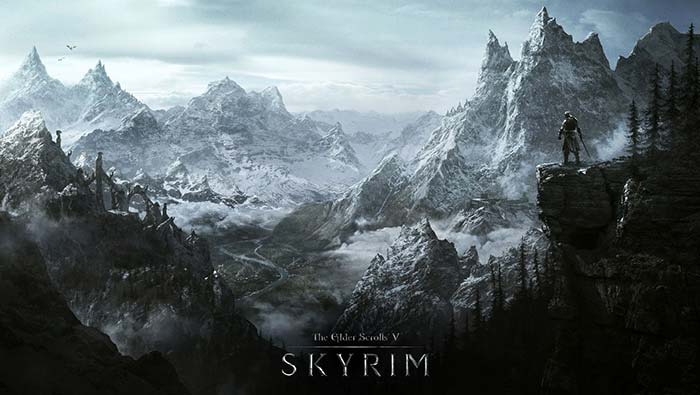
Skyrim is an open-world role-playing game where the player takes on the persona of a mythic hero trying to save a world plagued by dragons, a civil war, and the restless undead. It’s almost entirely unstructured, with players having the ability to choose to do just about Anything. Non-player characters the player interacts with offer advice and provide quests, which the player can choose whether or not to do.

It’s a lot of fun to play. I’ve lost quite a number of hours of my life to it, fighting dragons, deciding which side of the civil war to support, participating in political intrigue, exploring creepy dungeons, and exploring a lush and richly detailed world.

It also has some problematic issues.

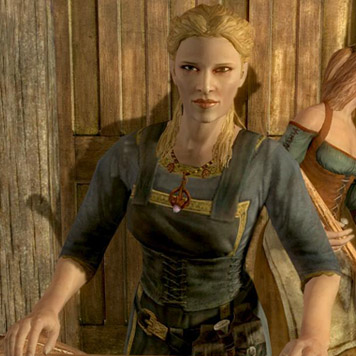
This is Haelga, one of the characters in the game. The player can be given a minor side quest in the game by her niece, who works for Haelga but doesn’t like her very much. Haelga’s niece, Svana Far-Shield, tells the player that Haelga is having sex with several different men, and wants the player to get proof in order to shame and humiliate Haelga.

The way the quest is written, it’s sex-negative as hell. It plays to just about every derogatory trope out there: open female sexuality is shameful, women who are perceived as sexual are “sluts,” and pouncing on a woman with evidence of her sexual attitude is a sure way to humiliate (and therefore control) her.

You might argue that Skyrim is set in a time that is not as enlightened as the modern-day West, but that ignores a very important reality: Skyrim is set in a time and place that never existed. There’s no compelling reason to write sex-negativity into the script. The game works well without it. It’s there not because the distant faux-medieval past was sex-negative, but because modern-day America is.

But that, too, misses a point, and it misses the same point the GiggleGoose folks miss:

It is possible to recognize problematic elements of a game and still enjoy the game.

I recognize that this quest in Skyrim is sex-negative, and that’s a problem. I still like the game.

The people who play these games and read these comic books are not bad people for doing so. The content of the games and comics is troubling to anyone who cares about people other than straight white middle-class men, sure, and it’s certainly reasonable to point these things out when they occur (though they happen so damn often that one could easily make a full-time career of pointing them out). That doesn’t make the people who like them Bad And Wrong simply because they enjoy them.

GiddyGoose believes that saying video games are a problem is the same thing as saying people who enjoy video games are a problem. And if you identify with comic books and video games so strongly that you can not separate your entertainment media from your sense of self, they might be on to something.

But most folks, I think, are able to take a deep breath, step back a half pace, and recognize that the writers and developers have done some really cool, fun stuff, but they can still do better. It would not kill anyone if the quest in Skyrim were rewritten (how about have Haelga’s character replaced by a man? There’s a thought…), or even dropped entirely. Nobody suffers from recognizing that it’s not cool to make fun of people who aren’t like you.

Nobody’s saying that Skyrim shouldn’t exist, or that people who play it are terrible people. I would like to think, on my optimistic days, that that’s an idea anyone smart enough to work a computer can recognize.

Some thoughts on porn, coercion, and the Fundamental Reconstruction Error

If you spend any time in any forums where people talk about sex, it is a truth as inevitable as night following day that, sooner or later, someone is going to talk about porn.

And as soon as someone starts to talk about porn, a certain predictable conversation will come up.

“Porn performers are coerced and trafficked,” someone will say. “Porn is bad because women are forced into it. It is a terrible meat-grinder industry. We need to rescue all the victims of porn.”

The same narrative comes up around sex work as well. Sex workers, according to a certain kind of person, are victims, people there because they have been forced, threatened, or tricked into it.

The people who make these arguments, in my experience, almost certainly don’t know any porn performers or sex workers. They will cite “studies” they read on the Internet, like the rather dreadful study that claims legal prostitution in the Netherlands has resulted in a huge increase in trafficking in that country. (I’ve read that study. Buried in the fine print: the study’s authors define a “traffick victim” as any person who for any reason crosses national boundaries and then ends up working in any capacity in the sex trade. So a person who immigrates legally and voluntarily goes to work as a sex worker is a “trafficking victim” according to the study.)

A particularly pernicious variant on this “women-as-victims” narrative is circulating amongst folks who are generally politically liberal and see themselves as allies of women, but still face discomfort about porn and sex work: Well, yes, women can and do freely choose to go into porn or sex work, but, you see, not abuse porn like what you see at Kink.com. Those women go into normal mainstream porn, and then they get “groomed” to do abusive porn.

I’ve seen variants on this narrative turning up in places where people are otherwise open to the notion that not all sex workers or performers are victims–sure, “mainstream” porn (whatever that is–I would say there really isn’t any such thing as “mainstream” porn; porn is, by its nature, niche) isn’t inherently exploitive, but that kinky stuff? Man, just look at it! Sometimes the performers cry! That’s clearly abuse!–and for a long time, I’ve simply chalked it up to standard, ordinary squicks about exchanging money for sex, cultural taboos about sex, ideas about what is “normal” or “not normal” around sex. You know, the ordinary soup of preconceptions, emotions, and cultural norms that oozes through the public discourse on sex.

But lately, I’ve started thinking there’s something else at work, too. Something that lies rooted in a tacit assumption that those who hold these ideas about porn and sex work hold, but don’t directly articulate, and an assumption that sex-positive folks who support the right of people to choose porn and sex work don’t directly address: the starvation model of sex work.


The starvation model of sex work starts with the assumption that it is hard to find people who want to do porn or sex work. A reasonable person wouldn’t make that choice, except through coercion or the most dire of necessity. Therefore, to feed the demand for sex workers and porn performers, there must be coercion and abuse.

In places where porn and sex work are criminalized, that makes sense. Production of porn and sex work becomes a criminal enterprise. The pool of people willing to work in criminal enterprises is small.

In places where these things are not criminalized, the equation is different. I personally know many porn performers and sex workers (yes, including performers for Kink.com). They report they enjoy what they do and choose to do it freely. I have no reason to doubt them.

And yet, whenever I ask the folks who criticize the porn and sex work industries, or cast sex workers as victims, if they’ve ever talked to sex workers, the answer is almost always “no.” And when I say the people I know choose what they do, the response is almost always incredulity.

If we assume that it is true nobody would voluntarily choose to do porn or sex work, then it makes sense to think the folks who are doing it, aren’t there by choice, and to look for coercion. If we assume there are lots of people who are willing to do porn or sex work, but nobody would choose to do “abusive” sex work, then the same thing holds–the folks who appear in Kink photo shoots must be being groomed, tricked, manipulated, or coerced.

If, on the other hand, we assume that there are actually quite a lot of folks who are totally okay with porn and sex work, the narrative falls apart. Why would I, as a porn producer, risk my business (and prison) forcing women to perform when I can simply put out a call that I’m looking for performers, and people will come to me voluntarily? Why would we assume that every sex worker is a trafficking victim, given that there are people who like the idea of doing sex work?

For the women-as-victims narrative to hold true, a necessary prerequisite is women wouldn’t choose to do this voluntarily. But that premise is rarely stated explicitly.

So why would people make that assumption?

I spent some time asking questions of people who promote the sex-worker-as-victim narrative, and discovered something interesting.


Psychologists often talk about a quirk of human psychology called the fundamental attribution error. It’s a bug in our firmware; we, as human beings, are prone to explaining our own actions in terms of our circumstance, but the actions of other people in terms of their character. The standard go-to example of the fundamental attribution error I use is the traffic example: “That guy just cut me off because he’s a reckless, inconsiderate asshole who doesn’t know how to drive. I just cut that car off because the sun was in my eyes and there was so much glare on the windshield I didn’t see it.”

We do this All. The. Time. We do it without being aware we’re doing it. We do it countless times per day, in ways large and small.

The penny dropped for me that something similar was going on in discussions about sex work during a different conversation–not about sex work but about polyamory. There was a guy who was railing, and I mean railing, about polyamory. Nobody, he said, would ever truly be okay with it–not really. No guy would ever willingly share a woman with another guy. Sure, poly folks say they are okay with it, but that’s just because they think it’s the only way they can keep the one they love. You give any poly person the magical power to have absolutely anything they wanted, he declared, and nobody would choose to share a partner.

Now, this is a load of bollocks, of course. I would, in a perfect world, still be poly, and still not have any desire to have my partners be sexually fidelitous to me.

When I told him that, he flipped out. That’s disgusting, he said. No man–no man, no man ever–would be okay with it. No man. If someone says otherwise, there’s something wrong with him.

We see the same line of reasoning used in other arenas. No man would be okay with having sex with another man–if a guy fancies other men, there must be some kind of damage or trauma, as one example.

And then it clicked.

I would like to propose that there is another bug in the operating firmware of humanity, similar to the fundamental attribution error. Call it the fundamental construction error, if you will. We as human beings re-construct the world in our own image, assigning our own values, ideas, squicks, taboos, likes, and dislikes to the great mass of humanity as a whole. “Nobody likes,” “everybody wants,” “nobody would,” “everybody thinks”–all statements of this class can most properly be understood to mean “I don’t like,” “I want,” “I wouldn’t,” and “I think.”

“You must be damaged in order to be gay” really means “nobody would want to be gay,” which really means “I wouldn’t want to be gay.”

“All sex workers are victims” really means “nobody would want to be a sex worker,” which really means “I wouldn’t want to be a sex worker.”

The fundamental reconstruction error makes it extremely difficult to realize that other people can be, on a very deep level, not like us. We assume that others are like us. This tacit assumption is the foundation of most of the models we build of the social world around us. It doesn’t get explicitly mentioned because it’s wired so deep it doesn’t even get noticed.

Why are porn performers and sex workers victims? Because nobody would do these things voluntarily. Why would nobody do these things voluntarily? Because I wouldn’t do these things voluntarily. Ergo, it must be–it follows inevitably that it has to be–that people who do these things are damaged, broken, victimized, or have no other choice.

And since it follows that these people are damaged, broken, victimized, or have no other choice, then the stories of people who work in the sex industry voluntarily can be discarded–because they are the words of someone who is damaged, broken, victimized, or has no other choice.


I would like, therefore, to propose a radical idea:

The world is made of lots of people. Some of those people are different from you, and have different ideas about what they want, what turns them on, what is and is not acceptable for them, and what they would like to do.

Some of those ideas are alien, maybe even incomprehensible, to you.

Accept that it is true. Start from the assumption that even if something sounds weird, distasteful, or even disgusting to you, it may not be so to others–and that fact alone does not prove those other folks have something wrong with them. If someone tells you they like something, and you have no compelling evidence that they’re lying, believe them–even if you don’t understand why.

How do you do it?

Awareness of the fact that your cognitive impulses are buggy is a good place to start. I started looking at myself any time I caught myself saying “oh, that driver is an asshole” or “oh, that person is obviously an inconsiderate jerkoff”–I would stop and say “huh. Have I ever done that? Is this an example of the fundamental attribution error?”

Doing the same thing when you find yourself assuming that all X are Y, especially if it’s “all X are victims” or “all X are damaged goods,” is probably a good mechanism for sorting out the fundamental reconstruction error. Is that really true, or are you just re-creating the world in your own image?

#WLAMF no. 26: The more things change…

There is a rather delightful little book on Amazon, available in Kindle edition for free. It’s called The Ladies’ Guide to True Politeness and Perfect Manners or, Miss Leslie’s Behaviour Book, and it’s a book about proper manners written in 1864 by Eliza Leslie.

In among endless detailed information about how the British peerage system works and how you should talk to your servants, there are gems like these:

Truth is, the female sex is really as inferior to the male in vigour of mind as in strength of body; and all arguments to the contrary are founded on a few anomalies, or based on theories that can never be reduced to practice.

and

Men make fortunes, women make livings. And none make poorer livings than those who waste their time, and bore their friends, by writing and lecturing upon the equality of the sexes, and what they call “Women’s Rights.” How is it that most of these ladies live separately from their husbands; either despising them, or being despised by them?

Proof, perhaps, that conservative talking points aren’t new. And also, it’s possible (probably even common) for those oppressed by a system to endorse that same system.

Did I say this was a delightful book? I meant that other thing.


I’m writing one blog post for every contribution to our crowdfunding we receive between now and the end of the campaign. Help support indie publishing! We’re publishing five new books on polyamory in 2015.

#WLAMF no. 19: Kinky sex

A while back, I was participating in a conversation about sex, and the subject of kink came up. A guy was saying his girlfriend had approached him with the idea of some sort of non-specific kink, and he was reluctant to engage in it for fear that “nice guys” don’t do that sort of thing with their partners. What, he wondered, would it be like if the sexes were reversed? A guy who asked his girlfriend for kinky sex was clearly not a nice guy; nice guys would never do such a thing! So why should it be okay for a woman to ask her boyfriend for kink? Didn’t it show a double standard–women can do something bad but guys aren’t allowed to? Someone else said that he shouldn’t be a nice guy, because women don’t want nice guys–nice guys, he explained, are emasculated, and women actually want strong, alpha guys, guys who will control them.

And listening to it, I felt despair.

I’ve always been suspicious of framing things in terms of “nice guy” vs. “bad boy;” I think, to be blunt, it’s childish and stupid. Modern social expectations do not “emasculate” men, being a “soft male,” or “losing your center.” That’s a load of rubbish. Modern social expectations are about treating women as human beings rather than need-fulfillment machines. That’s it. You don’t have to be “emasculated” or any of that other silly stuff to do that. You simply have to look at women as full human beings, deserving the same levels of respect and consideration you’d give any other person.

At the end of the day, it’s about consent, not disempowerment. It’s messed up to see relationships in terms of who’s empowered and who’s disempowered; in a good relationship, it’s possible for two (or more!) people to all be empowered.

Likewise, being a “nice guy” or treating women with “respect” does not mean holding doors open, always being soft and gentle, or always having sex in candlelight on a bed strewn with roses. REAL respect, as I’ve said many thousands of times, means talking to women about what THEY want, and then treating them the way they want to be treated.

Are you seeing the Matrix yet?

The “nice guy” who refuses to try anything kinky because he thinks it’s disrespectful isn’t really a nice guy. He’s not listening to his partner, because he knows what’s best for her.

And the “bad guy” who talks to his lover about what she wants, talks about what he wants, and then works with his lover to explore their mutual fantasies together? He isn’t really a bad guy…even if those fantasies involve kinky sex.

It seems to me the world might be a happier place if we all stop trying to figure out the rules about how to treat women “properly,” and instead just talk to women like human beings and treat each individual the way she wants to be treated. A lot of men say they just don’t understand women. A lot of women say they don’t understand men. I respectfully submit that perhaps, if we listen to each other, that might change.


I’m writing one blog post for every contribution to our crowdfunding we receive between now and the end of the campaign. Help support indie publishing! We’re publishing five new books on polyamory in 2015: https://www.indiegogo.com/projects/thorntree-press-three-new-polyamory-books-in-2015/x/1603977

Musings on being fucked: Christian millennialism and the Fermi paradox

When all the world’s armies are assembled in the valley that surrounds Mount Megiddo they will be staging a resistance front against the advancing armies of the Chinese. It will be the world’s worst nightmare – nuclear holocaust at its worst. A full-out nuclear bombardment between the armies of the Antichrist’s and the Kings of the East.

It is during this nuclear confrontation that a strange sight from the sky will catch their attention. The Antichrist’s armies will begin their defense in the Jezreel Valley in which the hill of Megiddo is located. […] At the height of their nuclear assault on the advancing armies something strange will happen.

Jesus predicted the suddenness of His return. He said, “For just as lightening comes from the east, and flashes even to the west, so shall the coming of the Son of Man be” (Matt. 24:27). And again He said, “…and then the sign of the Son of Man will appear in the sky, and then all the tribes of the earth shall mourn, and they will see the Son of Man coming in the clouds of heaven with power and great glory” (Matt. 24:30).
–Sherry Shriner Live

Believers must be active in helping to fulfill certain biblical conditions necessary to usher in the return of Christ. Key to this plan is for Gentiles to help accomplish God’s purpose for the Jews. […] Jesus is saying that His Second Coming will not take place until there is a Jewish population in Jerusalem who will welcome Him with all of their hearts.
— Johannes Facius, Hastening the Coming of the Messiah: Your Role in Fulfilling Prophecy

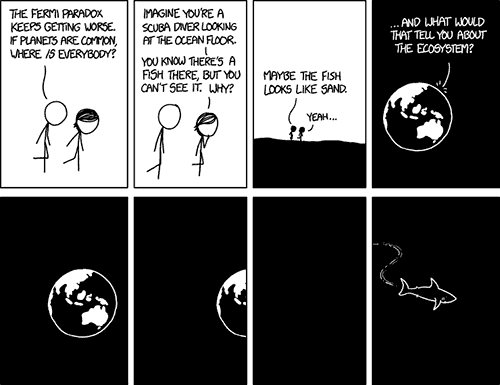
There is a problem in astronomy, commonly referred to as the Fermi paradox. In a nutshell, the problem is, where is everyone?

Life seems to be tenacious and ubiquitous. Wherever we look here on earth, we see life–even in the most inhospitable of places. The stuff seems downright determined to exist. When combined with the observation that the number of planetary systems throughout the universe seems much greater than even the most optimistic projections of, say, thirty years ago, it really seems quite likely that life exists out there somewhere. In fact, it seems quite likely that life exists everywhere out there. And given that sapient, tool-using life evolved here, it seems quite probable that sapient, tool-using life evolved somewhere else as well…indeed, quite often. (Given that our local galactic supercluster contains literally quadrillions of stars, if sapient life exists in only one one-hundredth of one percent of the places life evolved and if life evolves in only one one-hundredth of one percent of the places that have planets, the universe should be positively teeming with sapience.)
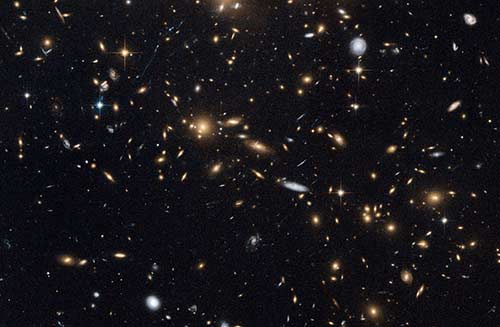

These aren’t stars. They’re galaxies. Where is everyone? (Image: Hubble Space Telescope)

When you’re sapient and tool-using, radio waves are obvious. It’s difficult to imagine getting much beyond the steam engine without discovering them. Electromagnetic radiation bathes the universe, and most any tool-using sapience will, sooner or later, stumble across it. All kinds of technologies create, use, and radiate electromagnetic radiation. So if there are sapient civilizations out there, we should see evidence of it–even if they aren’t intentionally attempting to communicate with anyone.

But we don’t.

So the question is, why not?

This is Fermi’s paradox, and researchers have proposed three answers: we’re first, we’re rare, or we’re fucked. I have, until now, been leaning toward the “we’re rare” answer, but more and more, I think the answer might be “we’re fucked.”


Let’s talk about the “first” or “rare” possibilities.

The “first” possibility posits that our planet is exceptionally rare, perhaps even unique–of all the planets around all the stars everywhere in the universe, no other place has the combination of ingredients (liquid water and so on) necessary for complex life. Alternately, life is common but sapient life is not. It’s possible; there’s nothing especially inevitable about sapience. Evolution is not goal-directed, and big brains aren’t necessarily a survival strategy more common or more compelling than any other. After all, we’re newbies. There was no sapient life on earth for most of its history.

Assuming we are that unique, though, seems to underestimate the number of planets that exist, and overestimate the specialness of our particular corner of existence. There’s nothing about our star, our solar system, or even our galaxy that sets it apart in any way we can see from any of a zillion others out there. And even if sapience isn’t inevitable–a reasonable assumption–if life evolved elsewhere, surely some fraction of it must have evolved toward sapience! With quadrillions of opportunities, you’d expect to see it somewhere else.

The “we’re rare” hypothesis posits that life is common, but life like what we see here is orders of magnitude less common, because something happened here that’s very unlikely even on galactic or universal scales. Perhaps it’s the jump from prokaryotes (cells without a nucleus) to eukaryotes (cells with a nucleus, which are capable of forming complex multicellular animals). For almost the entire history of life on earth, only single-celled life existed, after all; multicellular life is a recent innovation. Maybe the universe is teeming with life, but none of it is more complex than bacteria.
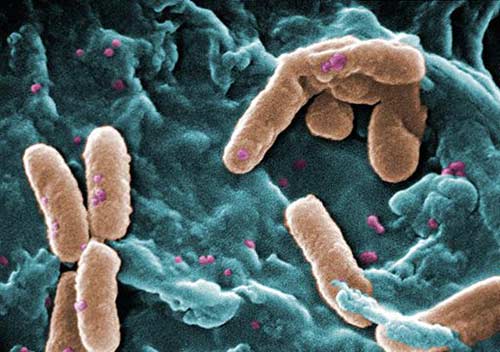

Depressing thought: The universe has us and these guys in it, and that’s it.

The third hypothesis is “we’re fucked,” and that’s the one I’m most concerned about.

The “we’re fucked” hypothesis suggests that sapient life isn’t everywhere we look because wherever it emerges, it gets wiped out. It might be that it gets wiped out by a spacefaring civilization, a la Fred Saberhagen’s Berserker science fiction stories.

But maybe…just maybe…it won’t be an evil extraterrestrial what does us in. Maybe tool-using sapience intrinsically contains the seeds of its own annihilation.


K. Eric Drexler wrote a book called Engines of Creation, in which he posited a coming age of nanotechnology that would offer the ability to manipulate, disassemble, and assemble matter at a molecular level.

It’s not as farfetched as it seems. You and I, after all, are vastly complex entities constructed from the level of molecules by programmable molecular machinery able to assemble large-scale, fine-grained structures from the ground up.

All the fabrication technologies we use now are, in essence, merely evolutionary refinements on stone knives and bearskins. When we want to make something, we take raw materials and hack at, carve, heat, forge, or mold them into what we want.


Even the Large Hadron Collider is basically just incremental small improvements on this

The ability to create things from the atomic level up, instead from big masses of materials down, promises to be more revolutionary than the invention of agriculture, the Iron Age, and the invention of the steam engine combined. Many of the things we take for granted–resources will always be scarce, resources must always be distributed unequally, it is not possible for a world of billions of people to have the standard of living of North America–will fade like a bad dream. Nanotech assembly offers the possibility of a post-scarcity society1.

It also promises to turn another deeply-held belief into a myth: Nuclear weapons are the scariest weapons we will ever face.

Molecular-level assembly implies molecular-level disassembly as well. And that…well, that opens the door to weapons of mass destruction on a scale as unimaginable to us as the H-bomb is to a Roman Centurion.


Cute little popgun you got there, son. Did your mom give you that?

Miracle nanotechnology notwithstanding, the course of human advancement has meant the distribution of greater and greater destructive power across wider and wider numbers of people. An average citizen today can go down to Wal-Mart and buy weapon technology that could have turned the tide of some of the world’s most significant historical battles. Even without nanotech, there’s no reason to think weapons technology and distribution just suddenly stopped in, say, 2006, and will not continue to increase from here on.


And that takes us to millennialist zealotry.

There are, in the world today, people who believe they have a sacred duty, given them by omnipotent supernatural entities, to usher in the Final Conflict between good and evil that will annihilate all the wicked with righteous fire, purging them from God’s creation. These millennialists don’t just believe the End is coming–they believe God has charged them with the task of bringing it about.

Christian millennialists long for nuclear war, which they believe will trigger the Second Coming. Some Hindus believe they must help bring about the end of days, so that the final avatar of Vishnu will return on a white horse to bring about the end of the current cycle and its corruption. In Japan, the Aum Shinrikyo sect believed it to be their duty to create the conditions for nuclear Armageddon, which they believed would trigger the ascendancy of the sect’s leader Shoko Asahara to his full divine status as the Lamb of God. Judaism, Islam, and nearly all other religious traditions have at least some adherents who likewise embrace the idea of global warfare that will cleanse the world of evil.

The notion of the purification of the world through violence is not unique to any culture or age–the ancient Israelites, for example, were enthusiastic fans of the notion–but it has particularly deep roots in American civic culture, and we export that idea all over the world. (The notion of the mythic superhero, for instance, is an embodiment of the idea of purifying violence, as the book Captain America and the Crusade Against Evil explains in some depth.)

I’m not suggesting that religious zealots have a patent on inventive destructiveness. From Chairman Mao to Josef Stalin, the 20th century is replete with examples of secular governments that are as gleefully, viciously bonkers as the most passionate of religious extremists.

But religious extremism does seem unique in one regard: we don’t generally see secularists embracing the fiery destruction of the entire world in order to cleanse os of evil. Violent secular institutions might want resources, or land, or good old-fashioned power, but they don’t usually seem to want to destroy the whole of creation in order to invoke a supernatural force to save it.

Putting it all together, we can expect that as time goes on, the trend toward making increasingly destructive technology available to increasingly large numbers of people will likely continue. Which means that, one day, we will likely arrive at the point where a sufficiently determined individual or small group of people can, in fact, literally unleash destruction on a global scale.

Imagine that, say, any reasonably motivated group of 100 or more people anywhere in the world could actually start a nuclear war. Given that millennialist end-times ideology is a thing, how safe would you feel?

It is possible, just possible, that we don’t see a ubniverse teeming with sapient, tool-using, radio-broadcasting, exploring-the-cosmos life because sapient tool-using species eventually reach the point where any single individual has the ability to wipe out the whole species, and very shortly after that happens, someone wipes out the whole species.

“But Franklin,” I hear you say, “even if there are human beings who can and will do that, given the chance, that doesn’t mean space aliens would! They’re not going to be anything like us!”

Well, right. Sure. Other sapient species wouldn’t be like us.

But here’s the thing: We are, it seems, pretty unremarkable. We live on an unremarkable planet orbiting an unremarkable star in an unremarkable corner of an unremarkable galaxy. We’re probably not special snowflakes; statistically, the odds are good that the trajectory we have taken is, um, unremarkable.


Yes, yes, they’re all unique and special…but they all have six arms, too.
(Image: National Science Foundation.)

Sure, sapient aliens might be, overall, less warlike and aggressive (or more warlike and aggressive!) than we are, but does that mean every single individual is? If we take millions of sapient tool-using intelligent species and give every individual of every one of those races the ability to push a button and destroy the whole species, how many species do you think would survive?

Perhaps the solution to the Fermi paradox is not that we’re first or we’re rare; perhaps we’re fucked. Perhaps we are rolling down a well-traveled groove, worn deep by millions of sapient species before us, a groove that ends in a predictable place.

I sincerely hope that’s not the case. But it seems possible it might be. Maybe, just maybe, our best hope to last as long as we can is to counter millennial thinking as vigorously as possible–not to save us, ultimately, but to buy as much time as we possibly can.


1Post-scarcity society of the sort that a lot of transhumanists talk about may never really be a thing, given there will always be something that is scarce, even if that “something” is intangible. Creativity, for instance, can’t be mass-produced. But a looser kind of post-scarcity society, in which material resources are abundant, does have some plausibility.

Astonishing Beauty

The world around us is fractally beautiful. Not only is it filled with the most extraordinary, breathtaking beauty, but that beauty exists no matter what level you set your gaze upon. At any scale, at any magnification, beauty persists.

Look at a flower.

It’s beautiful–the colors, the symmetry, the shape. These things are all pleasing in their own right.

But look closer. Much, much closer. What will you find? An enormous array of tiny cells, in a proliferation of shapes and functions, each working with the ones around it to give the flower its form and color, all of them filled with activity. Inside every cell, an array of bogglingly complex molecular machines, running all the time, consuming energy, producing still more molecular machines, and always, always striving to survive and make more of themselves.

Now look up, from the microscopic to the macroscopic.


Image: NASA/Hubble Space Telescope team

This is NGC 2818, a magnificent planetary nebula in the southern constellation Pyxis. This and other planetary nebulae are the remnants of violent explosions, the result of a star that has fused all its available hydrogen fuel and is no longer able to support itself against gravity. In the last few seconds of the star’s life, it explodes, leaving behind a glowing ember called a white dwarf and throwing off a shockwave of expanding gas.

These stellar remnants are beautiful, but like that flower, they are fractally beautiful. In fact, they are connected with that flower. Most of the elements necessary for life, all the molecules with an atomic weight greater than iron, are forged in these fiery explosions, when the unimaginable forces of a nova or supernova fuse lighter elements into heavier ones. The atoms in this flower, and in you and me, were birthed in fire and sent out into the universe, to eventually coalesce into this sun, this solar system, this planet, at this place and this time, and became us and kittens and chocolate and motorcycles and ice cream sundaes.

The universe is both incomprehensibly huge and incomprehensibly fine-grained, and it’s beauty all the way down.

Even when we look at the same scale over time, we see beauty. Beauty is enduring. It emerges, over and over again, wherever there is the possibility of change.

Indeed, there is quite literally more beauty around us than we are capable of seeing. White flowers are richly colored, to eyes that can see in ultraviolet. The sky above our heads is a tapestry whose richness we could not recognize until we built machines to augment our feeble vision.

But it isn’t just the grandeur of the natural world. Beauty lurks in every corner. It hides in a tumbler filled with colored glass stones on a restaurant table.



Color is a myth, of course. It’s a perceptual invention, created by the sorting of light of different frequencies into neural impulses by our visual system, with sensors tuned to respond best to different wavelengths of light. It’s a crude approximation of the diversity of photons filling the air around us. These photons chart extraordinarily complex paths through the tumbler, reflecting and refracting, sometimes being absorbed or scattered, and we glance at this intricate mathematical dance of physics for a moment and then look away.

The complexity and beauty of the physical world is both breathtaking and ordinary. Breathtaking because it exists on scales we can scarcely begin to understand; ordinary because it surrounds us all the time, beauty so abundant we forget it’s even there.

Every moment of our lives is spent in a world so beautiful, so incredibly filled with marvels, that we are blessed with abundance beyond measure. I can not help but feel that, should we become more mindful of it, the dull and ugly parts of the world will lift, just a bit. And perhaps, just perhaps, we will be that much less inclined to manufacture more of that dullness and ugliness.

We are here for only a brief time. Let us never forget how beautiful it is to be so privileged to exist in this place.

Oh, Joss: “Morality doesn’t exist without the fear of death”

A couple of years ago, during a lackadaisical time in my life when I was only running two businesses and wasn’t on tour to support a book I’d just coauthored, I sat down with my sweetie Zaiah and we watched all the episodes of the Joss Whedon television show Dollhouse over the course of a week or so.

The premise of the show, which isn’t really important to what I want to write about, concerns a technology that allows personalities, identities, and skills to be constructed in a computer (much as one might write a computer program) and then implanted in a person’s brain, such that that person takes on that identity and personality and has those skills. The television show followed a company that rented out custom-designed people, constructed in a bespoke fashion for clients’ jobs and then erased once those jobs were over. Need a master assassin, a perfect lover, a simulation of your dead wife, a jewel thief? No problem! Rent that exact person by the hour!

Anyway, in Episode 10 of the short-lived series, one of the characters objects to the idea of using personality transplants as a kind of immortality, telling another character, “morality doesn’t exist without the fear of death.” I cringed when I heard it.

And that’s the bit I want to talk about.


The New York Times has an article about research which purports to show that when reminded of their own mortality, people tend to cling to their ethical and moral values tightly. The article hypothesizes,

Researchers see in these findings implications that go far beyond the psychology of moralistic judgments. They propose a sweeping theory that gives the fear of death a central and often unsuspected role in psychological life. The theory holds, for instance, that a culture’s very concept of reality, its model of “the good life,” and its moral codes are all intended to protect people from the terror of death.

This seems plausible to me. Religious value systems–indeed, religions in general–provide a powerful defense against the fear of death. I remember when I first came nose to nose with the idea of my own mortality back when I was 12 or 13, how the knowledge that one day I would die filled me with stark terror, and how comforting religion was in protecting me from it. Now that I no longer have religious belief, the knowledge of the Void is a regular part of my psychological landscape. There is literally not a day that goes by I am not aware of my own mortality.

But the idea that fear of death reminds people of their values, and causes them to cling more tightly to them, doesn’t show that there are no values without the fear of death.

As near as I can understand it, the statement “morality doesn’t exist without the fear of death” appears to be saying that without fear of punishment, we can’t be moral. (I’m inferring here that the fear of death is actually the fear of some kind of divine judgment post-death, which seems plausible given the full context of the statement: “That’s the beginning of the end. Life everlasting. It’s…it’s the ultimate quest. Christianity, most religion, morality….doesn’t exist, without the fear of death.”) This is a popular idea among some theists, but does it hold water?

The notion that there is no morality without the fear of death seems to me to rest on two foundational premises:

1. Morality is extrinsic, not intrinsic. It is given to us by an outside authority; without that outside authority, no human-derived idea about morality, no human-conceived set of values is any better than any other.

2. We behave in accordance with moral strictures because we fear being punished if we do not.

Premise 1 is a very common one. “There is no morality without God” is a notion those of us who aren’t religious never cease to be tired of hearing. There are a number of significant problems with this idea (whose God? Which set of moral values? What if those moral values–“thou shalt not suffer a witch to live,” say, or “if a man also lie with mankind, as he lieth with a woman, both of them have committed an abomination: they shall surely be put to death,” or “whatsoever hath no fins nor scales in the waters, that shall be an abomination unto you”–cause you to behave reprehensibly to other people? What is the purpose of morality, if not to tell us how to be more excellent to one another rather than less?), but its chief difficulty lies in what it says about the nature of humankind.

It says that we are not capable of moral action, or even of recognizing moral values, on our own; we must be given morals from an outside authority, which becomes the definition of morality. I have spoken to self-identified Christians who say that without religion, nothing would prevent them from committing rape and murder at will; it is only the strictures of their religion that prevent them from doing so. I have spoken to self-identified Christians who say if they believed the Bible commanded them to murder children or shoot people from a clock tower, they would do it. (There is, unsurprisingly, considerable overlap between these two sets of self-identified Christian.) If it takes the edict of an outside force to tell you why it’s wrong to steal or rape or kill, I am unlikely to trust you with my silverware, much less my life. Folks who say either of these things seldom get invited back to my house.

The notion that the fear of death is a necessary component of moral behavior because without punishment, we will not be moral is, if anything, even more problematic. If the only thing making you behave morally is fear of punishment, I submit you’re not actually a moral person at all, no matter which rules of moral behavior you follow.

Morality properly flows from empathy, from compassion, from the recognition that other people are just as real as you are and just as worthy of dignity and respect. Reducing morality to a list of edicts we’ll be punished if we disobey means there is no need for empathy, compassion, charity, or respect–we aren’t moral people by exercising these traits, we’re moral by following the list of rules. If the list of rules tells us to stone gays, then by God, that’s what we’ll do.

An argument I hear all the time (and in these kinds of conversations, I do mean all the time) is “well, if there’s no God and no fear of Hell, who’s to say the Nazis were wrong in what they did?” It boggles me every single time I hear it. I cannot rightly apprehend the thought process that would lead to such a statement, in no small part because it seems to betray a boggling inability to allow empathy and compassion be one’s moral signposts.

What it all comes down to, when you get to brass tacks, is internal moral values vs. external moral values. When we can empathize with other human beings, even those who are different from us, and allow ourselves to fully appreciate their essential humanness, treating them ethically becomes easy. When we do not–and often, religious prescriptions on behavior explicitly tell us not to–it becomes impossible. An intrinsic set of moral values is predicated on that foundation of reciprocal recognition of one another’s humanness, worth, and dignity.

Those who say without God or without fear of punishment there can be no morality seem blind to that reciprocal recognition of one another’s humanness, worth, and dignity. And those folks scare me.

Some thoughts on the Seven Virtues

A while ago, I started talking about the Seven Deadly Sins.

I am not terribly good at them; in fact, it took a while to remember what they were (greed, envy, sloth, lust, gluttony, pride, and wrath). Of the seven, the only one at which I have any skill is lust; in fact, I’ve put so many character points into lust I’m still forced to make default rolls for all six others.

I got to thinking about the Seven Deadly Sins, and wondering if there were Seven Virtues to go along with them. Apparently, there are; a few hundred years after the list of vices caught hold, someone decided there should be a similar list of virtues, and made such a list by negating the vices. The virtue Chastity was proposed as the opposite of Lust, for example, and the virtue Humility as the opposite of Pride. (Some of the others don’t really make a lot of sense; proposing Kindness as Envy’s opposite ignores the fact that people can simultaneously feel envious and behave kindly. But no matter.)

The negative version of the Seven Deadly Sins didn’t really seem to catch on, so Catholic doctrine has embraced a different set of virtues: prudence, justice, temperance, courage, faith, hope, and charity.

I look at that list, and find it a bit…underwhelming. We’ve given Christianity two thousand years to come up with a cardinal list of virtues in human thought and deed, and that’s the best it can do? It’s almost as disappointing as the list of Ten Commandments, which forbids working on Saturday and being disrespectful to your parents but not, say, slavery or rape, as I talked about here.

Now, don’t get me wrong, some of the things on the list of virtues I heartily endorse. Courage, that’s a good one. Justice is another good one, though as often as not people have an unfortunate tendency to perpetrate the most horrifying atrocities in its name. (Handy hint for the confused: “justice” and “vengeance” aren’t the same thing, and in fact aren’t on speaking terms with one another.) Temperance in opposing injustice is not a virtue, hope is that thing at the bottom of Pandora’s jar of evils, and faith…well, the Catholic catechism says that faith means “we believe in God and believe all that he has said and revealed to us,” and furthermore that we believe all “that Holy Church proposes for our belief.” In this sense, to quote Mark Twain, faith is believing what you know ain’t so. (On the subject of hope, though, it should be mentioned that Hesiod’s epic poem about Pandora says of women, “From her is the race of women and female kind: of her is the deadly race and tribe of women who live amongst mortal men to their great trouble, no helpmates in hateful poverty, but only in wealth.” So it is without an exuberance of cynicism that I might suggest there is perhaps a synchronicity between the ancient Greek and modern Catholic thinkings on the subject of the fairer sex.)

In any event, it seems that, once again, the traditional institutions charged with the prescription of human morality have proven insufficient to the task. In my musings on the Ten Commandments, I proposed a set of ten commandments that might, all things considered, prove a better moral guideline than the ten we already have, and it is with the same spirit I’d like to propose a revised set of Seven Cardinal Virtues.

Courage. I quite like this one. In fact, to quote Maya Angelou, “Courage is the most important of all the virtues, because without courage you can’t practice any other virtue consistently. You can practice any virtue erratically, but nothing consistently without courage.” So this one stays; in fact, I think it moves to the head of the list.

Prudence is a bit of an odd duck. Most simply, it means something like “foresight,” or perhaps “right thinking.” The Catholic Education Site defines prudence as the intellectual virtue which rightly directs particular human acts, through rectitude of the appetite, toward a good end. But that seems a bit tail-recursive to me; a virtue is that which directs you to do good, and doing good means having these virtues…yes, yes, that’s fine and all, but what is good? You can’t define a thing in terms of a quality a person has and then define that quality in terms of that thing!

So perhaps it might be better to speak of Beneficence, which is the principle of making choices that, first, do no harm to others, and, second, seek to prevent harm to others. The principle of harm reduction seems a better foundation for an ethical framework than the principle of “right action” without any context for the “right” bit. (I’m aware that a great deal of theology attempts to provide context for the virtue of prudence, but I remain unconvinced; I would find, for example, it is more prudent to deny belonging to a religion than to be hanged for it, simply on the logic that it is difficult for dead Utopians to build Utopia…)

Justice is another virtue I like, though in implementation it can be a bit tricky. Justice, when it’s reduced to the notion of an eye for an eye, becomes mere retribution. If it is to be a virtue, it must be the sort of justice that seeks the elevation of all humankind, rather than a list of rules about which forms of retaliation are endorsed against whom; formal systems of justice, being invented and maintained by corruptible humans, all too easily become corrupt. A system which does not protect the weakest and most vulnerable people is not a just system.

Temperance needs to go. Moderation in the pursuit of virtue is no virtue, and passion in the pursuit of things which improve the lot of people everywhere is no vice. And this virtue too easily becomes a blanket prohibition; the Women’s Christian Temperance Union, who were anything but temperate in their zeal to eradicate alcohol, failed to acknowledge that drinking is not necessarily, of and by itself, intemperate; and their intemperance helped create organized crime in the US, a scourge we have still been unable to eradicate.

In its place, I would propose Compassion, and particularly, the variety of compassion that allows us to see the struggles of others, and to treat others with kindness wherever and whenever possible, to the greatest extent we are able. It is a virtue arising from the difficult realization that other people are actually real, and so deserve to be treated the way we would have them treat us.

Faith and Hope seem, to be frank, like poor virtues to me, at least as they are defined by Catholicism. (There is a broader definition of “faith,” used by mainline Protestant denominations, that has less to do with accepting the inerrancy of the Church in receiving divine revelation and more to do with an assurance that, even in the face of the unknown, it’s possible to believe that one will be okay; this kind of faith, I can get behind.) Indeed, an excess of faith of the dogmatic variety leads to all sorts of nasty problems, as folks who have faith their god wants them to bomb a busy subway might illustrate. And hope (in the Catholic sense of “desiring the kingdom of heaven and eternal life as our happiness, placing our trust in Christ’s promises and relying not on our own strength, but on the help of the grace of the Holy Spirit”) can lead to inaction in the face of real-world obstacles–if we believe that once we get past the grave, nothing can go wrong, we might be disinclined to pursue happiness or oppose injustice in the here and now.

I would suggest that better virtues might be Integrity and Empathy. Integrity as a virtue means acting in accordance with one’s own stated moral precepts; but there’s more to it than that. As a virtue, integrity also means acknowledging when others are right; being intellectually rigorous, and mindful of the traps of confirmation bias and anti-intellectualism; and being clear about what we know and what we hope. (When, for example, we state something we want to be true but don’t know is true as a fact, we are not behaving with integrity.)

Empathy in this context means, first and foremost, not treating other people as things. It is related to compassion, in that it recognizes the essential humanity of others. As a moral principle, it means acknowledging the agency and rights of others, as we would have them acknowledge our agency and our rights.

Charity is, I think, a consequence arising from the applications of justice, compassion, and empathy, rather than a foundational virtue itself. In its place, I propose Sovereignty, the assumption that the autonomy and self-determinism of others is worthy of respect, and must not be infringed insofar as is possible without compromising one’s own self.

So bottom line, that gives us the following list of Seven Virtues: Courage, Beneficence, Justice, Compassion, Integrity, Empathy, and Sovereignty. I like this draft better than the one put forth by Catholicism. But coming up with a consistent, coherent framework of moral behavior is hard! What say you, O Interwebs?

Some Thoughts on Anti-Intellectualism as a Red Queen Problem

“Well, in our country,” said Alice, still panting a little, “you’d generally get to somewhere else — if you ran very fast for a long time, as we’ve been doing.”
“A slow sort of country!” said the Queen. “Now, here, you see, it takes all the running you can do, to keep in the same place. If you want to get somewhere else, you must run twice as fast as that!”
“I’d rather not try, please!” said Alice. “I’m quite content to stay here — only I am so hot and thirsty!”

— Lewis Carroll, Through the Looking Glass

“When we just saw that man, I think it was [biologist P.Z. Myers], talking about how great scientists were, I was thinking to myself the last time any of my relatives saw scientists telling them what to do they were telling them to go to the showers to get gassed … that was horrifying beyond words, and that’s where science – in my opinion, this is just an opinion – that’s where science leads you.”
— Ben Stein, Trinity Broadcasting System interview, 2008

What do spam emails, AIDS denial, conspiracy theories, fear of GM foods, rejection of global warming, antivaccination crusades, and the public school district of Tucson, Arizona banning Shakespeare’s The Tempest have in common?


A typical spam message in my inbox

The answer is anti-intellectualism. Anti-intellectualism–the rejection of scientific study and reason as tools for understanding the physical world, and the derision of people who are perceived as educated or “intellectual”–has deep roots in the soil of American civil discourse. John Cotton, theological leader of the Puritans of Massachusetts Bay, wrote in 1642, “the more learned and witty you bee, the more fit to act for Satan will you bee”–a sentiment many Evangelical Protestants identify with today. (Tammy Faye Bakker, wife of the disgraced former televangelist Jim Bakker, once remarked “it’s possible to educate yourself right out of a personal relationship with Jesus Christ.”)

It seems weird that such a virulent streak of anti-intellectualism should be present in the world’s only remaining superpower, a position the US achieved largely on the merits of its technological and scientific innovation. Our economic, military, and political position in the world were secured almost entirely by our ability to discover, invent, and innovate…and yet there is a broad swath of American society that despises the intellectualism that makes that innovation possible in the first place.

Liberals in the US tend to deride conservatives as ignorant, anti-intellectual hillbillies. It’s arguably easy to see why; the conservative political party in the US is actively, openly hostile to science and intellectualism. The Republican Party of Texas has written into the party platform a passage opposing the teaching of critical thinking in public school. Liberals scoff at conservatives who deny the science of climate change, teach that the world and everything in it is six thousand years old, and seek to ban the teaching of evolutionary science…all while claiming that GMO foods are dangerous and vaccines cause autism. Anti-intellectualism is an equal-opportunity phenomenon that cuts across the entire American political landscape. The differences in liberal and conservative rejection of science are merely matters of detail.

So why is it such a pervasive part of American cultural dialog? There are a lot of reasons. Anti-intellectualism is built into the foundation of US culture; the Puritans, whose influence casts a very long shadow over the whole of US society, were famously suspicious of any sort of intellectual pursuit. They came to the New World seeking religious freedom, by which they meant the freedom to execute anyone they didn’t like, a practice their European contemporaries were insufficiently appreciative of; and the list of people they didn’t like included any unfortunate person suspected of learning or knowledge. That suspicion lingers; we’ve never succeeded in purging ourselves of it entirely.

Those of a cynical nature like to suggest that anti-intellectualism is politically convenient It’s easier, so the narrative goes, to control a poorly educated populace, especially when that populace lacks even basic reasoning skills. If you’ve ever watched an evening of Fox News, it’s a difficult argument to rebut. One does not need to be all that cynical to suggest a party plank rejecting critical thinking skills is a very convenient thing to a political party that enshrines young-earth Creationism, for instance.

But the historical narrative and the argument from political convenience seem insufficient to explain the breathtaking aggressiveness of anti-intellectualism in the US today, particularly among political progressives and liberals, who are often smugly self-congratulatory about how successfully they have escaped the clutches of tradition and dogma.

I think there’s another factor, and that’s the Red Queen problem.

In evolutionary, biology, the Red Queen hypothesis suggests that organisms in competition with each other must continue to evolve and adapt merely to maintain the status quo. When cheetahs prey on gazelles, the fastest cheetahs will be most successful at catching prey; the fastest gazelles will be most successful at escaping cheetahs. So natural selection favors faster and faster gazelles and cheetahs as each adapts to the other. Parasites evolve and become more efficient at parasitizing their hosts, which develop more efficient defenses against the parasites. I would like to propose that the same hypothesis can help explain anti-intellectualism, at least in part.

As we head into the twenty-first century, the sum total of human knowledge is increasing exponentially. When I was in college in the late 1980s and early 1990s, my neurobiology professors taught me things–adult human brains don’t grow new neurons, we’re all born with all the brain cells we’ll ever have–that we now know not to be true. And that means anyone who wants to be educated needs to keep learning new things all the time, just to stay in one place.

Those who reject science like to say that science is flawed because it changes all the time. How can we trust science, they say, when it keeps changing? In fact, what’s flawed is such critics’ estimation of how complicated the natural world is, and how much there is to know about it. Science keeps changing because we keep shining lights into previously dark areas of understanding.

But it’s really hard to keep up. A person who wants to stay abreast of the state of the art of human understanding has to run faster and faster and faster merely to stay in one place. It’s fatiguing, not just because it means constantly learning new things, but because it means constantly examining things you believed you already knew, re-assessing how new discoveries fit into your mental framework of how the world works.

For those without the time, inclination, tools, and habits to keep up with the state of human understanding, scientists look like priests. We must merely accept what they say, because we don’t have the tools to fact-check them. Their pronouncements seem arbitrary, and worse, inconsistent; why did they say we never grow new brain cells yesterday, only to say the exact opposite today? If two different scientists say two different things, who do you trust?

If you don’t race to keep up with the Red Queen, that’s what it is–trust. You must simply trust what someone else says, because trying to wrap your head around what’s going on is so goddamn fatiguing. And it’s easier to trust people who say the same thing every time than to trust people who say something different today than what they said yesterday. (Or who, worse, yet, tell you “I don’t know” when you ask a question. “I don’t know” is a deeply unsatisfying answer. If a Bronze Age tribesman asks two people “What is the sun?” and one of them gives a fanciful story about a fire-god and a dragon, and the other says “I don’t know,” the answer about the fire-god and the dragon is far more satisfying, even in complete absence of any evidence that fire-gods or dragons actually exist at all.)

Science is comfortable with the notion that models and frameworks change, and science is comfortable with “I don’t know” as an answer. Human beings, rather less so. We don’t want to run and run to keep up with the Red Queen. We also don’t want to hear “I don’t know” as an answer.

So science, then, becomes a kind of trust game, not that much different from the priesthood. We accept the pronouncements of priests and scientists alike when they tell us things they want to hear, and reject them when they don’t. Political conservatives don’t want to hear that our industrial activity is changing the global climate; liberals don’t want to hear that there’s nothing wrong with GMO food. Both sides of the political aisle find common ground in one place: running after the Red Queen is just plain too much work.

Some thoughts on machine learning: context-based approaches

A nontrivial problem with machine learning is organization of new information and recollection of appropriate information in a given circumstance. Simple storing of information (cats are furry, balls bounce, water is wet) is relatively straightforward, and one common approach to doing this is simply to define the individual pieces of knowledge as objects which contain things (water, cats, balls) and descriptors (water is wet, water flows, water is necessary for life; cats are furry, cats meow, cats are egocentric little psychopaths).

This presents a problem with information storage and retrieval. Some information systems that have a specific function, such as expert systems that diagnose illness or identify animals, solve this problem by representing the information hierarchically as a tree, with the individual units of information at the tree’s branches and a series of questions representing paths through the tree. For instance, if an expert system identifies an animal, it might start with the question “is this animal a mammal?” A “yes” starts down one side of the tree, and a “no” starts down the other. At each node in the tree, another question identifies which branch to take—”Is the animal four-legged?” “Does the animal eat meat?” “Does the animal have hooves?” Each path through the tree is a series of questions that leads ultimately to a single leaf.

This is one of the earliest approaches to expert systems, and it’s quite successful for representing hierarchical knowledge and for performing certain tasks like identifying animals. Some of these expert systems are superior to humans at the same tasks. But the domain of cognitive tasks that can be represented by this variety of expert system is limited. Organic brains do not really seem to organize knowledge this way.

Instead, we can think of the organization of information in an organic brain as a series of individual facts that are context dependent. In this view, a “context” represents a particular domain of knowledge—how to build a model, say, or change a diaper. There may be thousands, tens of thousands, or millions of contexts a person can move within, and a particular piece of information might belong to many contexts.

What is a context?

A context might be thought of as a set of pieces of information organized into a domain in which those pieces of information are relevant to each other. Contexts may be procedural (the set of pieces of information organized into necessary steps for baking a loaf of bread), taxonomic (a set of related pieces of information arranged into a hierarchy, such as knowledge of the various birds of North America), hierarchical (the set of information necessary for diagnosing an illness), or simply related to one another experientially (the set of information we associate with “visiting grandmother at the beach).

Contexts overlap and have fuzzy boundaries. In organic brains, even hierarchical or procedural contexts will have extensive overlap with experiential contexts—the context of “how to bake bread” will overlap with the smell of baking bread, our memories of the time we learned to bake bread, and so on. It’s probably very, very rare in an organic brain that any particular piece of information belongs to only one context.

In a machine, we might represent this by creating a structure of contexts CX (1,2,3,4,5,…n) where each piece of information is tagged with the contexts it belongs to. For instance, “water” might appear in many contexts: a context called “boating,” a context called “drinking,” a context called “wet,” a context called “transparent,” a context called “things that can kill me,” a context called “going to the beach,” and a context called “diving.” In each of these contexts, “water” may be assigned different attributes, whose relevance is assigned different weights based on the context. “Water might cause me to drown” has a low relevance in the context of “drinking” or “making bread,” and a high relevance in the context of “swimming.”

In a contextually based information storage system, new knowledge is gained by taking new information and assigning it correctly to relevant contexts, or creating new contexts. Contexts themselves may be arranged as expert systems or not, depending on the nature of the context. A human doctor diagnosing illness might have, for instance, a diagnostic context that behaves similarly in some ways to the way a diagnostic expert system; a doctor might ask a patient questions about his symptoms, and arrive at her conclusion by following the answers to a single possible diagnosis. This process might be informed by past contexts, though; if she has just seen a dozen patients with norovirus, her knowledge of those past diagnoses, her understanding of how contagious norovirus is, and her observation of the similarity of this new patient’s symptoms to those previous patients’ symptoms might allow her to bypass a large part of the decision tree. Indeed, it is possible that a great deal of what we call “intuition” is actually the ability to make observations and use heuristics that allow us to bypass parts of an expert system tree and arrive at a leaf very quickly.

But not all types of cognitive tasks can be represented as traditional expert systems. Tasks that require things like creativity, for example, might not be well represented by highly static decision trees.

When we navigate the world around us, we’re called on to perform large numbers of cognitive tasks seamlessly and to be able to switch between them effortlessly. A large part of this process might be thought of as context switching. A context represents a domain of knowledge and information—how to drive a car or prepare a meal—and organic brains show a remarkable flexibility in changing contexts. Even in the course of a conversation over a dinner table, we might change contexts dozens of times.

A flexible machine learning system needs to be able to switch contexts easily as well, and deal with context changes resiliently. Consider a dinner conversation that moves from art history to the destruction of Pompeii to a vacation that involved climbing mountains in Hawaii to a grandparent who lived on the beach. Each of these represents a different context, but the changes between contexts aren’t arbitrary. If we follow the normal course of conversations, there are usually trains of thought that lead from one subject to the next; and these trains of thought might be represented as information stored in multiple contexts. Art history and Pompeii are two contexts that share specific pieces of information (famous paintings) in common. Pompeii and Hawaii are contexts that share volcanoes in common. Understanding the organization of individual pieces of information into different contexts is vital to understanding the shifts in an ordinary human conversation; where we lack information—for example, if we don’t know that Pompeii was destroyed by a volcano—the conversation appears arbitrary and unconnected.

There is a danger in a system being too prone to context shifts; it meanders endlessly, unable to stay on a particular cognitive task. A system that changes contexts only with difficulty, on the other hand, appears rigid, even stubborn. We might represent focus, then, in terms of how strongly (or not) we cling to whatever context we’re in. Dustin Hoffman’s character in Rain Man possesses a cognitive system that clung very tightly to the context he was in!

Other properties of organic brains and human knowledge might also be represented in terms of information organized into contexts. Creativity is the ability to find connections between pieces of information that normally exist in different contexts, and to find commonalities of contextual overlap between them. Perception is the ability to assign new information to relevant contexts easily.

Representing contexts in a machine learning system is a nontrivial challenge. It is difficult, to begin with, to determine how many contexts might exist. As a machine entity gains new information and learns to perform new cognitive tasks, the number of contexts in which it can operate might increase indefinitely, and the system must be able to assign old information to new contexts as it encounters them. If we think of each new task we might want the machine learning system to be able to perform as a context, we need to devise mechanisms by which old information can be assigned to these new contexts.

Organic brains, of course, don’t represent information the way computers do. Organic brains represent information as neural traces—specific activation pathways among collections of neurons.

These pathways become biased toward activation when we are in situations similar to those where they were first formed, or similar to situations in which they have been previously activated. For example, when we talk about Pompeii, if we’re aware that it was destroyed by a volcano, other pathways pertaining to our experiences with or understanding of volcanoes become biased toward activation—and so, for example, our vacation climbing the volcanoes in Hawaii come to mind. When others share these same pieces of information, their pathways similarly become biased toward activation, and so they can follow the transition from talking about Pompeii to talking about Hawaii.

This method of encoding and recalling information makes organic brains very good at tasks like pattern recognition and associating new information with old information. In the process of recalling memories or performing tasks, we also rewrite those memories, so the process of assigning old information to new contexts is transparent and seamless. (A downside of this approach is information reliability; the more often we access a particular memory, the more often we rewrite it, so paradoxically, the memories we recall most often tend to be the least reliable.)

Machine learning systems need a system for tagging individual units of information with contexts. This becomes complex from an implementation perspective when we recall that simply storing a bit of information with descriptors (such as water is wet, water is necessary for life, and so on) is not sufficient; each of those descriptors has a value that changes depending on context. Representing contexts as a simple array CX (1,2,3,4,…n) and assigning individual facts to contexts (water belongs to contexts 2, 17, 43, 156, 287, and 344) is not sufficient. The properties associated with water will have different weights—different relevancies—depending on the context.

Machine learning systems also need a mechanism for recognizing contexts (it would not do for a general purpose machine learning system to respond to a fire alarm by beginning to bake bread) and for following changes in context without becoming confused. Additionally, contexts themselves are hierarchical; if a person is driving a car, that cognitive task will tend to override other cognitive tasks, like preparing notes for a lecture. Attempting to switch contexts in the middle of driving can be problematic. Some contexts, therefore, are more “sticky” than others, more resistant to switching out of.

A context-based machine learning system, then, must be able to recognize context and prioritize contexts. Context recognition is itself a nontrivial problem, based on recognition of input the system is provided with, assignment of that input to contexts, and seeking the most relevant context (which may in most situations be the context with greatest overlap with all the relevant input). Assigning some cognitive tasks, such as diagnosing an illness, to a context is easy; assigning other tasks, such as natural language recognition, processing, and generation in a conversation, to a context is more difficult to do. (We can view engaging in natural conversation as one context, with the topics of the conversation belonging to sub-contexts. This is a different approach than that taken by many machine conversational approaches, such as Markov chains, which can be viewed as memoryless state machines. Each state, which may correspond for example to a word being generated in a sentence, can be represented by S(n), and the transition from S(n) to S(n+1) is completely independent of S(n-1); previous parts of the conversation are not relevant to future parts. This creates limitations, as human conversations do not progress this way; previous parts of a conversation may influence future parts.)

Context seems to be an important part of flexibility in cognitive tasks, and thinking of information in terms not just of object/descriptor or decision trees but also in terms of context may be an important part of the next generation of machine learning systems.