Accomplishments and stuff!

So, things at That Place Where I Work have been painfully slow, as we hold our collective breaths to see if we survive 2008. I’ve been productive, though, adding two new sections to my BDSM page and one new section to my poly page, updating my grammar page, and tracking down Russian virus writers.

I’ve also started tinkering with a new toy, a server-side RSS feed aggregator. I’m trying to sharpen some of my (rather weak) PHP skillz and learn about RSS and feed aggregation, and being (as I may have mentioned in the past) a seasoned, veteran pervert, thought what better way to do it than to create a Web portal for syndication of sex blogs?

Right now the only thing on it is Whispers…which I will once again encourage anyone on my flist to contribute to. You can see what I have so far here.

Right now it’s just a toy and kind of a learning experiment, but I’d like to make it into something interesting. Anyone out ther who has a LJ sex blog, RSS feed, or other blog or whatever about sex or sexuality, and is interested in seeing it listed, drop me a comment or email me at tacitr (at) aol (dot) com. Eventually, I hope to turn this into a true multiuser sex-blog aggregator. Why? Because it’s fun, and after all, what else is teh Internets for?

Holy crap! Coolest thing EVAR….

…via physicsduck

Video of a French guy who makes triodes (a type of vaccum tube) by hand. And when I say “by hand,” I mean glass envelope and all.

Pay particular attention to his testing equipment.

Man, this is really, really, really cool. If you like tech, you like seeing tech made, and you like old school tech, check this out. Worksafe, sound.

Horror, pure horror

And not even the good kind of horror.

Christmas eve, Shelly and I and her sweetie and his wife celebrated Christmas eve by seeing Sweeny Todd, the movie that shows that Johnny Depp is capable, when he chooses, of reaching very near to the pinnacle of creepiness set long ago by Christopher Walken. This is no small feat, for Christopher Walken is a creepy motherfucker.

That’s not the horror, though. Lots of people being killed very graphically, but that’s not the horror.

We didn’t look up the movie times,a nd as a result we spent over three hours chasing around from theater to theater, always arriving either two hours before the movie started or twenty minutes after it had begun. That’s not the horror, either.

Finally, we ended up spending a couple hours in a Barnes & Noble waiting for the last showing of the movie. That, too, is not the horror; indeed, there are many worse ways to spend several hours than in a book store. I even learned something while I was there1.

The horror is that we live in a world in which there is Dick Cheney slash fiction.

And it’s sold in the “literature” section of Barnes & Noble.

I don’t know what the book is called. I’ve blotted it from my memory. Shelly found it; it’s a collection of short stories, all erotica. And one of those short stories is… shudder… Dick Cheney slash. In a gun store.

In which Cheney gets sodomized.

I fear I will never recover.


1 I ended up picking up a book on helicopter design. Most of the book was way over my head; the math began on page 1, and the bulk of the book’s three inches in heft was calculus and fluid dynamics. One interesting tidbit, which did get lodged in my brain and will no doubt stay there forever, even though I can never quite seem to remember things like what street I live on, concerns autorotation.

If a helicopter’s engine fails, the helicopter can land safely using a principle called autorotation. The rotor blades are disengaged from the engine, so they can spin freely. As the helicopter falls, the air rushing past it causes the rotor blades to spin, generating lift and slowing the fall.

The neat bit of information, which is wildly non-intuitive but makes perfect sense when you stop to think about the physics involved, is that a light helicopter that is autorotating will fall much faster than a heavy helicopter.

The acceleration imparted by gravity is constant: 9.8m/sec2. Objects which are behaving ballistically always fall at the same speed regardless of their weight. However, a heavy object has more potential energy than a light object. As an object falls, this potential energy is converted to kinetic energy. A heavy helicopter has more potential energy than a light helicopter, so more energy is available to spin the rotor blades as it falls. Until you reach the point where the weight of the helicopter is so great that it overcomes the blades’ ability to generate lift, a heavy helicopter falls more slowly than a light helicopter, because it loses more energy per vertical foot of drop, and so there is more energy available to be turned into rotational energy in the blades (and hence lift), which slows its drop.

The book had about four pages of calculus to support this assertion, and it makes perfect sense from a conservation of energy perspective.

And man, that’s got to be the biggest and most irrelevant digression EVER.

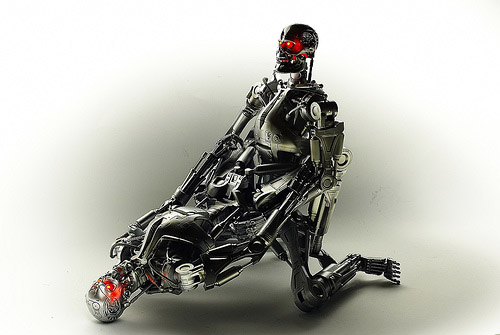
It’s the Terminator Kama Sutra!

This one’s for datan0de:

An illustrated guide to sex positions…with Terminators!

I for one welcome our new robot overlords

Foster-Miller, Inc., now part of QinetiQ North America, is a technology and product development company with an international reputation for delivering innovative products and systems that perform under the most demanding conditions.

Did I say overlords? I meant protectors.

Sex and technology

Several years ago, I designed a gizmo that was intended to allow people to control sex toys through an Internet connection. The idea was that you’d fire up a chat client, the person at the other end of the chat would have one of these things, and that person would plug some sex toys (up to three of them) into the gizmo. While you were chatting, you could switch the various toys on and off.

I actually tried building and selling these things, a project that was something of a flop–in part because of some design shortcomings, and in part because I don’t really have the money or resources to do something like this properly. I called the gizmo “Symphony,” and lost money on the project.


The Symphony design actually started as a phone-sex gadget; in the original conception, you’d plug the gizmo into your phone jack (remember those?), plug your telephone handset into the gizmo, and talk to someone on the phone. If your partner pressed buttons on the touch-tone phone, he could switch the sex toys plugged into the gizmo on and off.

For that reason, the Symphony works on DTMF–the shrill noises you hear when you push buttons on a phone. Basically, it’s nothing more than a DTMF decoder (that recognizes the buttons), a series of bi-stable latches, and three relays. When you push the buttons on the phone, the relays switch on or off, depending on which buttons you push.

In fact, there’s a schematic of the Symphony below this cut

A call to Linux geeks

Okay, so my sex game Onyx is available for Mac, Windows, and Linux. I keep several Linux virtual machines handy for testing and debugging–Ubuntu, Fedora, and so on.

I’m maintaining some of my Linux systems, and I go to install some tools associated with my virtualization into Mandriva, formerly Mandrake Linux, one of the various Linux flavors I keep handy.

I type:

sudo sh /mnt/cdrom/parallels-tools.run

and it responds with

bash: sudo: command not found

WTF??! Mandriva’s defult install doesn’t include sudo? Isn’t that, like making a motorcycle that doesn’t include a seat, or a house that doesn’t include windowpanes? How in the name of all that is holy do you release a Linux distro without sudo? Am I missing something here?

Steve Jobs is God

So last night, I went to bed very late. I don’t know if it was spending the entire day playing World of Warcraft, or eating little besides leftover Subway and frozen microwave dinners, or perhaps the fact that I was working on my Web site every time I was waiting for my mage to recover mana, but for some reason I was visited by the spirit of Steve Jobs in my dreams.

The dreams were so vivid that when I woke up, I could almost feel the presence of Steve there in my bedroom. I remember talking to the Great Mr. Jobs about the inside skinny at Apple, and learning some rather…remarkable things. A small part of our conversation:

Me: So when Apple switched from PowerPC processors to Intel processors, you made it possible for users to run their old PowerPC programs.

Steve: Yes. We created an emulation program called Rosetta, which emulates a PowerPc processor on an Intel processor.

Me: Other people have done the same thing before; there’s an open-source program called PearPC that runs Mac OS X on Intel computers. But it’s very slow. I’ve seen it run; it takes about half an hour to boot. How did you get Rosetta to run so fast?

Steve: Well, for technical reasons, emulating a RISC processor like a PowerPC on a CISC processor like the ones Intel makes is very difficult to do. At first, our emulation program was very slow, too.

But then we thought, what if the laws of physics are changed? Is it possible that under different fundamental laws, emulating a RISC processor on CISC architecture might be easy? So when our engineers started going down that path, we discovered we could get much better performance.

Me: Come again?

Steve: It’s quite simple, really. Rather than emulating a processor, what if Rosetta emulated an entire universe–one where the laws of physics made running PowerPC code on an Intel chip easy? We searched through a large number of parallel universes, and found one where the basic physical properties of the universe gave us the results we wanted.

Me: Wait a minute. Are you telling me that Rosetta doesn’t emulate a processor, it emulates an entire universe?

Steve: Exactly! We got the idea from watching The Matrix. When you launch a PowerPC application, Rosetta brings a new universe into being. This particular universe has non-Euclidean geometry; it turns out that Euclidean geometry is particularly bad for emulating RISC on CISC.

Within the laws of this universe, it’s easy to run PowerPC applications on the Intel processor found in all our current computers, like our best-selling iMac or our high-end Mac Pro.

The only drawback to this approach is memory. Emulating an entire universe within Mac OS X requires significant memory, which is why we recommend that our users who still find themselves running legacy PowerPC applications install at least two gigabytes of RAM. You can add more memory to your computer as a build-to-order option from the Apple store.

Me: And this actually works?

Steve: Oh, yes. Emulating an entire universe involves more overhead, of course, but the speed advantage you get by running RISC code on a CISC processor in non-Euclidean space more than makes up for it.

Me: I’ve noticed that when I keep my computer running for a long time, PowerPC apps can suddenly start to slow down.

Steve: Yes. We’ve observed that issue in our labs as well. It has to do with the formation of life in the parallel universe.

Me: What??!

Steve: If you let Rosetta run for long enough, eventually life will arise in the universe it creates. Because emulating the complex functions of life is a processor-intensive task, the performance of PowerPC applications can diminish over time.

It’s impossible to predict precisely when this slowdown will occur, because life doesn’t always arise at the same time or in the same way. We’ve found that on an eight-core Mac Pro system, it usually takes about three or four days for life to appear. On an iMac or a MacBook, it can take longer.

When this happens, we recommend that our users quit all their Rosetta applications. This causes Rosetta to destroy the parallel universe. When you launch a PowerPC application again, Rosetta will create a brand-new universe without life in it, and performance will be restored.

Me: Is any of this life…intelligent?

Steve: Sometimes. If you let your PowerPC applications run long enough, you may see intelligent life inside of Rosetta. When this happens, you’ll notice a significant slowdown of your PowerPC apps. We recommend that you quit all your apps at this point.

Me: Waitaminit–isn’t that murder?

Steve: Technically, no.

Me: But…you’re destroying an entire universe full of sapient life!

Steve: If you look at it that way, sure. We look at it as freeing system resources.

Me: But…it’s life!

Steve: Yes. We thought about releasing a game based on Rosetta, to compete with The Sims. The game would allow the user to interact with the parallel universe created by Rosetta and take a hand in shaping the life that formed there.

Me: And?

Steve: It turns out our market research shows that people only want to play with games that emulate human life. And not just human life, but middle-class twentieth-century American human life. Dealing with non-human sapience in a non-Euclidean universe didn’t have the same draw, so in the end we left it out of iLife ’08. However, we’re working on a smart backup feature for Leopard that we’re very excited about.

Me: Do you mean Time Machine?

Steve: Oh, no. That’s a data recovery app that folds the fabric of space-time to recover accidentally deleted files by grabbing them from a past version of this universe. The new smart backup feature uses the intelligence of sapient life in a parallel universe. But that’s all I can say about it right—

And then I woke up. No more WoW and frozen TV dinners for me, I think.