
Why we believe what we believe, and why that makes us gullible

Just how deep do you believe?
Will you bite the hand that feeds?
Will you chew until it bleeds?
Can you get up off your knees?
Are you brave enough to see?
Do you want to change it?

What is the purpose of the human brain? What function does it serve? Be careful; this is a trick question!

If you say “The brain is an organ of thought” or “The brain is an instrument of knowledge” or “The brain is the way we understand the world,” that’s the wrong answer. The correct answer is that the brain is an organ of survival. We have these big brains because they enabled our ancestors to survive; in that sense, they are no different from claws or fur or fangs.

And like all organs of survival, the brain was shaped by natural selection, sculpted by evolutionary pressures that favored the traits that helped our ancestors survive. The big brains we have now were molded and shaped to one purpose: to help small bands of hunter-gatherers survive.


Back in the day, when we rarely lived longer than 20 or 25 years and starvation battled with predation by other large carnivores for the number one spot in “things that killed human beings,” our brains gave us a competitive advantage. They did this in part by acting as engines of belief, allowing us to form models of the world and create beliefs about the world that gave us an advantage.

For example, an early human who observed that if he was upwind of his prey, the prey got away, but if he was downwind of his prey, he could more easily kill it formed a belief: “Staying downwind from the prey makes it more likely that the prey will not escape.”

Of course, other animals know these things instinctively. But the advantage of our big monkey brains is that we do not have to rely on instinct; we can form beliefs on the fly, as we go along, which means we can function in environments our instincts are not prepared to deal with. The brain as an organ of survival allows us to make observations and draw beliefs from these observations, and these beliefs give us a competitive advantage.


These beliefs can be immediate and concrete, such as “If I stick my hand in the fire, it will hurt.” They can make predictions about the future, such as “The sun will rise tomorrow” or “If the days grow longer and the weather grows colder, then winter is coming, and food is about to become less plentiful.” A belief can be negative, such as “If I leap from the top of this tree, I will not be able to fly.”

Having a brain optimized for forming beliefs is important if forming beliefs your survival schtick. If you think of the brain as a belief engine, which can either believe something or disbelieve it, and if you think of a particular belief as being true or false, it is easy to construct a game theory matrix describing all the possibilities, with two success modes and two failure modes:
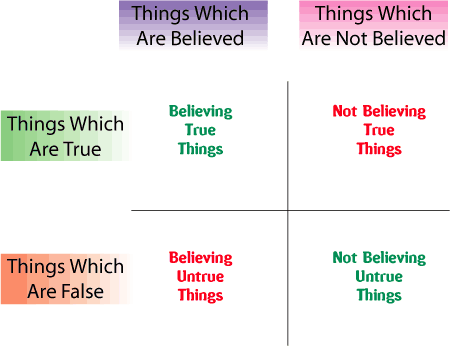
Ideally, our brains lead us to believe things that are true, such as “A large leopard is a dangerous adversary,” and to disbelieve things that are not true, such as “I can eat rocks.” But there are two failure conditions as well: rejecting beliefs that are true, and accepting beliefs that are not.


The failure conditions have survival implications. Believing untrue things and not believing true things can both lead to disaster.

Of the two, though, believing untrue things will, in a small group of hunter-gatherers, usually cause fewer problems than not believing true things. Believing that dancing in circles three times and carrying a magic stone around with you will increase the chances of a successful hunt doesn’t really hurt anything; not believing that staying downwind from your prey is important has a significant survival penalty attached to it.

There’s a strong survival imperative, in other words, to prefer failure by believing something untrue over failure by not believing something that is true. Believing is less expensive than not believing. If a primitive hunter-gatherer eats an unfamiliar food, then becomes sick, it might not be the food that caused him to get sick–but if he believes the food makes him sick, and he’s wrong, the consequences are not too great, whereas if he does not believe the food made him sick,a nd he’s wrong, the consequences can be deadly. The guy who ate some food, got sick, and believed the food made him sick is the guy who survived; today, his descendants give their kids a measles vaccination, and when coincidentally their kids are diagnosed with autism, believe that the measles vaccination caused the autism.

From a survival standpoint, the consequences of not believing something true are worse than the consequences of believing something that is not true. Natural selection, therefore, tends to select in favor of people whose default state is to believe something rather than in favor of people whose default state is to disbelieve something.

And to confound matters further, humans are social animals. In our earliest days, when our social groups tended to number fifty or a hundred people and leopards were a serious and ongoing threat, to live alone was a death sentence. We depended on the support of others to survive.

But that support had a price. Groups, like individuals, form beliefs. To reject the beliefs of your group was to risk ostracism and death. People who questioned and challenged the beliefs of their tribe often did not survive to pass on their genes to future generations; the ones that were most likely to pass along their genes were the ones who learned to believe what the group believed, even if it was contradicted by clear and available evidence.

And those who were adept at manipulating the belief engines of others–shamans, tribal rulers who convinced others of their divine right to rule–tended to be disproportionately successful at mating and tended to control a disproportionate amount of resources, meaning they tended to pass on their genes most successfully.


The greatest invention of the human mind is not fire, or agriculture, or iron, or the steam engine, or even the splitting of the atom. From the perspective of understanding the physical world, the greatest invention of the human mind is the scientific method–the systematic, skeptical approach to claims about the way the world works.

When a scientist has an idea, he does not believe it, and he does not seek to prove it. Instead, he approaches it skeptically, and he seeks to disprove it. The more the idea resists increasingly sophisticated and vigorous attempts to disprove it, the more faith he begins to put in it. This is why any idea that is not falsifiable is not science.

A correlary of this idea is the notion that physical reality behaves the same way everywhere, for everyone. If a brick falls when it is dropped in Kansas, it also falls when it is dropped in Salt Lake City–and, importantly, it falls no matter who drops it, whether the person who drops it believes that it will fall or not. The physical world does not change itself to conform to human wishes and expectations. A claim that is made about some process that must be believed in order to be seen, such as ESP, is not science.


But skepticism is not innate. It is learned. The human brain has been shaped by natural selection not to be skeptical. It has been shaped by evolutionary pressure into a belief engine that believes things more easily than it disbelieves things. For our ancestors, the penalty for skepticism was very high; those early hominids for whom skepticism came naturally did not live long enough to pass on their genes to us. Our brains evolved to be gullible, not skeptical.


Today, we live in a cognitive and physical environment very different from that of our ancestors. But the machinery of natural selection is slow.

In the modern world, the same four states of our belief engines still apply. We are still predisposed to believe things rather than disbelieve them; and we can still believe things that are true, disbelieve things that are true, believe things that aren’t true, or disbelieve things that aren’t true:

Believing things that are true
  • Eating uncooked pork can make you sick
  • If you do not feed your pet dog, your dog will become unhappy, and eventually will die
  • Provoking a large predator may have serious consequences
  • Falling from a great height may have serious consequences
  • A speeding car can not stop instantly
Believing things that are not true
  • A pill can make your penis grow bigger
  • There is a sea monster living in a small landlocked lake in Scotland
  • Atlantis was a lost continent possessed of fabulous technology
  • Space aliens abduct people and perform experiments on them
  • Republicans favor small government; Democrats favor big government
  • There is an invisible man living in the sky who will spank you if you have sex in the wrong position
Not believing things that are true
  • The Holocaust never happened
  • Vaccination does not protect from disease
  • NASA never went to the moon
  • Evolutionary processes did not created the variety of life we can observe on this planet
  • Viruses and bacteria do not cause disease
  • The world is not more than six thousand years old
  • Americans are not obligated to pay income tax
Not believing things that are untrue
  • The world is not flat
  • You can not fly no matter how fast you flap your arms
  • There is no jolly fat man at the North Pole who hands out gifts
  • Money does not grow on trees
  • Forwarding an email to all your friends will not get Bill Gates to give you money
  • Solar eclipses are not caused by gigantic maurading dragons swallowing the sun

What does this mean in practical terms? Simple. It means that your brain has been hard-wired over hundreds of thousands of years of natural selection to make you credulous. Look at the brain as an instrument of survival, look at natural selection creating pressures to prefer the failure mode of believing that which isn’t true over the failure mode of not believing that which is true, and you end up with people hard-wired from the ground up to be gullible.

Your brain is a tool of survival that works by acting as an engine for creating beliefs. When you form a belief, you get a little squirt of pleasure that lights up the reward circuit of your brain. You’re emotionally rewarded every time you believe something.

At the same time, skepticism, and rational, analytical thought, do not come naturally. They’re not what your brain was optimized for; because of that, they are skills which must be learned, and are not innate. In fact, they feel unnatural and uncomfortable to you. Your brain gives you a reward for accepting beliefs, not for challenging them.


There is good news, however. When you introduce sapience into the mix, things change. Biology is not destiny. Your brain is optimized to make you gullible, but you do not need to be. You can train yourself to recognize that little squirt of pleasure you get when you believe something for what it is–a biological holdover from a time when adopting beliefs quickly and without skepticism had survival advantage. You can train yourself to be skeptical, even though it’s not natural for you.

And the rewards for doing so are great. In a modern world, where people want you to believe that they will transfer THE SUM OF $25,000,000 (TWO HUNDRED FIFTY MILLION US$) into your bank account from Nigeria if you give them your bank account information, where emails tell you that you need to update your credit card information or PayPal will shut you down, where people tell you that viruses and bacteria don’t cause disease and if you just order magic “balancing powder” ($360 for a 6-month supply) from their Web site you’ll never get sick, credulity is a survival disadvantage, and skepticism an advantage.

But it doesn’t come naturally. You have to work at it.

The Cobb County Periodic Table of Elements

Ganked from datan0de, the official table of elements, as taught in Cobb County, Georgia, epicenter of the cultural wars against reason and enlightenment.

Bandwidth-crushing image below the cut

In which Franklin gets very, very, very cranky

In his book The Demon-Haunted World, Carl Sagan writes, “The siren song of unreason is not just a cultural wrong but a dangerous plunge into darkness that threatens our most basic freedoms.” The book was published in 1988, when trickle-down economics and alien abductions were all the rage, and it is hard to imagine anything more appropriate today.

The last six years or so have proven Sagan right in a way I doubt even he could have imagined. In 2006, nearly twenty years after those words were penned, we have an American President who is a fundamentalist Christian and who seems to believe that science and highfalutin book-larnin’ never did nobody a lick of good; anti-intellectualism is rampant in American society and politics; and people are actually arguing about “Intelligent Design”–Intelligent Design, fer Chrissakes!–as if it were something for real that should, y’know, be taught in schools.

And frankly, it all pisses me right the fuck off.


Shelly tends to get frustrated with me, because I get so frustrated whenever I see credulous, anti-intellectual claptrap spewing out of some hole somewhere. And, to be quite blunt, it’s everywhere. It’s as if somebody plugged all the sewers in New York City, and all this brown stuff is bubbling up out of the manhole covers and flooding the streets, and nobody notices.

Hell, people seem to like it.

And it pisses me off. It pisses me off because these people should know better. It pisses me off because gullibility and credulity are corrosive to society; the United States today dominates the world politically, socially, and economically largely on the strength of our belief that the world is knowable and comprehensible, and that the pursuit of reason is a valuable undertaking. (I’m sure the Chinese, who could not hope to compete with us otherwise, are more than happy to see us abdicate our global leadership as a powerhouse of knowledge and research; they don’t have to defeat us; we’re happy to defeat ourselves!) It pisses me off because reason is the greatest single gift that humankind has, the thing that sets us apart from all the rest of nature, and to squander that gift–to fritter away our reason, to exchange knowledge and understanding for faeries and pixie dust–is a travesty beyond imagining.


Faeries and pixie dust are remarkably seductive. Continue reading →

Credulity, autism, and vaccination information…oh, and space aliens, too.

So lately, I’ve noticed a trend.

More and more often, on various unrelated forums I read, it seems that anti-vaccination activism is becoming the trendy topic du jour. Decrying vaccinations as “dangerous” and “unproven” is hot these days; and worse yet, people are now advocating not immunizing children.

I keep seeing the same claims posted again and again on all these different forums…sometimes, word-for-word the same, which suggests that people are copying the information from one place and pasting it into another, without actually doing any research to verify the authenticity of this information.

This points, I think, to the same kind of credulity that lets people believe in the Loch Ness monster and the notion that human beings were created by space aliens from the tenth planet who used us as slaves to mine gold, but at the same time not believe that the world is round. Credulity pisses me off, as long-term readers of this journal will no doubt have noticed.

So I did some legwork. I visited a bunch of anti-vaccination Web sites, and made a list of the claims I’ve seen posted on many of these sites, and then tracked down the truth. I’ve invested, at this point, about seven or eight hours into looking up each of these claims, reading very dry articles, doing Google searches, looking at links, and compiling an assessment of whether the claims are true or false.

As it turns out, not all the claims are false. Some of them are true, though often not true in the way the activists campaigning against vaccination might think. And I found some surprises, too.

Into the abyss…

Quote of the Day

“The first entry of Sin into the mind occurs when, out of cowardice or conformity or vanity, the Real is replaced by a comforting lie.”
— Integritas, Consonantia, Claritas

A quick list o’ linky-links

Both links from the same person, over on Blogspot.

First, The President and Intelligent Design:

I just have to say to my conservative friends … listen, I don’t want to hear SHIT when this comes back to bite us in the ass. When you’re watching your children rocket downward through the Brave New Working Classes from gamma through delta straight to the epsilons, not a word. When the leader of your party turns his back on science, the product of God’s 2nd greatest gift to us, reason, when he turns from the very process which brought so much progress and prosperity to this land and encourages those would so eagerly toss aside rational thought itself … gah, never mind voting Democrat: if my choice were between these cowards who would turn back the Enlightenment and anal-probing yet intellectually honest Martians, I would grit my teeth, vote for the Martians and learn to visualize my Happy Place during my Probe-Center appointments.

And secondly, I Miss Republicans.

Remember Republicans? Sober men in suits, pipes, who’d nod thoughtfully over their latest tract on market-driven fiscal conservatism while grinding out the numbers on rocket science. Remember those serious-looking 1950’s-1960’s science guys in the movies — Republican to a one.

They were the grown-ups. They were the realists. Sure they were a bummer, maaaaan, but on the way to La Revolution you need somebody to remember where you parked the car. I was never one (nor a Democrat, really, more an agnostic libertarian big on the social contract, but we don’t have a party …), but I genuinely liked them.

How did they become the party of fairy dust and make believe? How did they become the anti-science guys? The anti-fact guys? The anti-logic guys?

Good stuff, all of it.

I have a problem.

It’s a serious problem. No, it’s not a medical condition. No, it’s not the fact that I hold political, social, and sexual views that put me at odds with 90% of the population. No, it’s not fleas.

My problem is this: Credulity pisses me off. I mean really pisses me off. When I see people spouting nonsense about how the Egyptian pyramids were built by space aliens or how meditation can teach you to levitate, unlock your psychic powers, and cast out demons or how vaccination is a Jewish plot to murder Christian children or whatnot, I get mad. Breatharians, Bigfoot fanatics, the looney tunes who hang out in Groom Lake, Nevada believing they’ll uncover evidence that the government is hiding the wreckage of a crashed flying saucer, and the yahoos who go on about the lost continent of Atlantis and its super-advanced spacefaring civilization produce in me the exact same emotional reaction as I have when I hear someone say something like “This world would be a better place if we killed all the niggers.” I get that pissed.

The world is filled with people who dress up turds to look like brownies, and then sell them on the street corner. And the world is filled with people perfectly willing to take a bite. And it’s infuriating.

You see, this kind of credulity is never harmless. It softens the brain. It corrodes reason, the one thing that sets us apart from the other animals. It makes a person easy to manipulate. Atrocities happen because the gullible are willing to believe that thus-and-such a person isn’t really human, doesn’t have a soul, murdered Jesus, whatever. Gullibility is a knife at the throat of civilization.

Even in its less extreme incarnations, the credulity that lets people happily munch on turds and believe they’re brownies is expensive. I’ve ranted before about the gullible nitwits that spent hundreds of thousands of dollars of taxpayer money–MY money–on “psychic drug detectors” (empty plastic boxes from Radio Shack whose “inventor” claimed could harness “psychic energy” to detect drugs and even locate missing persons, which he sold for $8,000 a pop to schools and police departments all across the country). And, of course, there’s the yahoos who buy everything from “laundry balls” (which supposedly “energize water” to get clothes clean without detergent) to “AIDS crystals” that use the energy of those Egyptian pyramids to cure AIDS.

It all well and truly pisses me off.

It’s amazing, really. I feel like I’m living in a society of people who cannot muster the cognitive skills to tell the difference between shit and brownies. You show a person two Web sites–one published by the CDC, for instance, and the other by that aforementioned Christian Fundamentalist group that believes that vaccination is a Jewish plot to kill Christian babies, and it’s a crap shoot which one he’ll believe. Basic analytical and reasoning skills are so lacking in the population at large that you might as well flip a coin.

“But,” the person will say, “it’s important to hear both sides of the story.”

Both sides??!! Both sides of the story? One side contains carefully collected, peer-reviewed, objectively verifiable data; the other contains the ravings of religious zealots about how the Jews fabricated evidence of past smallpox epidemics, invented margarine to poison Christian women, and oh, by the way, the holocaust never happened.

Christ, people. Seriously, if that’s your idea of “listening to both sides of the argument,” you’d best re-open the debate about whether or not the world is flat.

There is absolutely nothing that is so well-documented, so obviously true, that a turd-dresser can’t come along and try to make believe that, no, wait, there’s another side to the story. Unfortunately, it seems that very few people have functional bullshit detectors; hell, there are actually people willing to believe that water will change its crystal structure in response to human emotion–which, when you examine the methodology (namely, writing words with an emotional content onto a piece of paper and taping it to the side of a glass in a freezer) leads one to the inescapable conclusion that not only is water responsive to human thought, but it’s also possessed of the remarkable ability to read written Japanese.

If water is fluent in reading Japanese, and my body is 70% water, shouldn’t I be able to read written Japanese with at least 70% fluency? And what happens if a person writes a Japanese word on a piece of paper but doesn’t know what the word means–does the water still react? But I digress.

Of course, for the faithful who believe this nonsense, the turd-peddler has many devices for sale. They’ll energize the water with, y’know, positive emotions, to, y’know, cure cancer. God help me, I am not making this up.

Why? Why why why? Why are people so goddamn incapable of distinguishing between shit and brownies? Why is it that no matter how many turds these people bite into, they’re so eager for the next? Do they so desperately NEED to believe something–conspiracies, sea monsters, anything because their lives are so crushingly dull? Are they completely blind to the breathtaking, awe-inspiring wonder that really exists in the real world? Are they just so intellectually sloppy that they don’t know any better–they can’t read total gibberish dressed up with scientific-sounding words and tell the difference between that and real science? What makes a person gullible? Why are otherwise intelligent, articulate people so hopelessly credulous that they’ll send their bank account information to deposed government officials in Nigeria who want to wire them “THE SUM OF $150,000,000 (ONE HUNDRED FIFTY MILLION US DOLLARS),” believe in Bigfoot and Nessie and space aliens in the deserts of Africa, but will refuse to immunize their kids because “oh, there’s no real proof that it works”? Where do these people COME from?

Grr. Maybe I’m the space alien.

All I can say is, God bless James Randi–a far, far more patient man than I.

And from THIS corner of reality…

I belong to an email list. Actually, I belong to several, but one of them is run by a person who, among other things, gives classes. On alien abduction.

Yes, you read that right. He gives classes. On alien abduction.

He gives classes. On alien abduction. You know, as if alien abduction were an actual event that actually occurs. In real life.

He gives classes. On alien abduction. And he offers certification. For those people who, y’know, attend his classes. On alien abduction.

*sigh*

Gullibility is a knife at the throat of civilization.

And now for something completely different.

In the “things that make you go ‘huh’ category…it’s long been postulated that an infinite number of monkeys typing on an infinitie number of typewriters will produce the works of Shakespeare, but I suspect they’d be more likely to produce something like this.

“Place a 100 people within this Cubic like room and they will not increase the number of corners anymore than 6 billion people on Earth will increase the 4 corners of Earth. It is dumb, stupid, evil and unworthy of life on Earth to claim that this Creation Cube has 6 sides –  or no top and bottom.
Academia equates to a deadly plague.”

…uh, yeah. What he said.

It’s all about perception, not about reality

Observation: The Air Force operates a highly secure facility in Groom Lake, Nevada, known as “Area 51.”
Observation: Area 51 is used to test supersecret experimental aircraft and prototypes of new figher and reconaissance planes.
Observation: There are things in the sky over Area 51 that I can’t identify.
—–
Conclusion: They must be extraterrestrial space aliens.

*headsmack*