Science Literacy: Of Pickles and Probability

STUDY PROVES THAT PLACING A PICKLE ON YOUR NOSE GRANTS PSYCHIC POWERS

For immediate release: Scientists at the Min Planck Institute announced today that placing a pickle on your nose can improve telekinetic ability.

According to the researchers, they performed a study in which a volunteer was asked to place a pickle on her nose and then flip a coin to see whether or not the pickle would help her flip heads. The volunteer flipped the coin, which came up heads.

“This is a crowning achievement for our research,” the study’s authors said. “Our results show that having a pickle on your nose allows you to determine the outcome of a coin-toss.”

Let’s say you’re browsing the Internet one day, and you come across this report. Now, you’d probably think that there was something hinkey about this experiment, right? We know intuitively that the odds of a coin toss coming up heads are about 50/50, so if someone puts a pickle on her nose and flips a coin, that doesn’t actually prove a damn thing. But we might not know exactly how that applies to studies that don’t involve flipping coins.


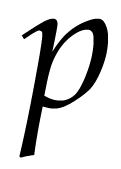
So let’s talk about our friend p. This is p.

p represents the probability that a scientific study’s results are total bunk. Formally, it’s the probability that results like the ones observed could occur even if the null hypothesis is true. In English, that basically means that it represents how likely it is to get these results even if whatever the study is trying to show doesn’t actually exist at all, and so the study’s results don’t mean a damn thing.

Every experiment (or at least every experiment seeking to show a relationship between things) has a p value. In the nose-pickle experiment, the p value is 0.5, which means there is a 50% chance that the subject would flip heads even if there’s no connection between the pickle on her nose and the results of the experiment.

There’s a p value associated with any experiment. For example if someone wanted to show that watching Richard Simmons on television caused birth defects, he might take two groups of pregnant ring-tailed lemurs and put them in front of two different TV sets, one of them showing Richard Simmons reruns and one of them showing reruns of Law & Order, to see if any of the lemurs had pups that were missing legs or had eyes in unlikely places or something.



But here’s the thing. There’s always a chance that a lemur pup will be born with a birth defect. It happens randomly.

So if one of the lemurs watching Richard Simmons had a pup with two tails, and the other group of lemurs had normal pups, that wouldn’t necessarily mean that watching Mr. Simmons caused birth defects. The p value of this experiment is related to the probability that one out of however many lemurs you have will randomly have a pup with a birth defect. As the number of lemurs gets bigger, the probability of one of them having a weird pup gets bigger. The experiment needs to account for that, and the researchers who interpret the results need to factor that into the analysis.


If you want to be able to evaluate whether or not some study that supposedly shows something or other is rubbish, you need to think about p. Most of the time, p is expressed as a “less than or equal to” thing, as in “This study’s p value is <= 0.005″. That means “We don’t know exactly what the p value is, but we know it can’t be greater than one half of one percent.”

A p value of 0.005 is pretty good; it means there’s a 0.5% chance that the study is rubbish. Obviously, the larger the p value, the more skeptical you should be of a study. A p value of 0.5, like with our pickle experiment, shows that the experiment is pretty much worthless.

There are a lot of ways to make an experiment’s p value smaller. With the pickle experiment, we could simply do more than one trial. As the number of coin tosses goes up, the odds of a particular result go down. If our subject flips a coin twice, the odds of getting a heads twice in a row are 1 in 4, which gives us a p value of 0.25–still high enough that any reasonable person would call rubbish on a positive trial. More coin tosses still give successively smaller p values; the p value of our simple experiment is given (roughly) by 1/2n, where n is the number of times we flip the coin.


There’s more than just the p value to consider when evaluating a scientific study, of course. The study still needs to be properly constructed and controlled. Proper control groups are important for eliminating confirmation bias, which is a very powerful tendency for human beings to see what they expect to see and to remember evidence that supports their preconceptions while forgetting evidence which does not. And, naturally, the methodology has to be carefully implemented too. A lot goes into making a good experiment.

And even if the experiment is good, there’s more to deciding whether or not its conclusions are valid than looking at its p value. Most experiments are considered pretty good if they have a p value of .005, which means there’s a 1 in 200 chance that the results could be attributed to pure random chance.

That sounds like it’s a fairly good certainty, but consider this: That’s about the same as the odds of flipping heads on a coin 8 times in a row.

Now, if you were to flip a coin eight times, you’d probably be surprised if it landed on heads every single time.

But, if you were to flip a coin eight thousand times, it would be surprising if you didn’t get eight heads in a row somewhere in there.


One of the hallmarks of science is replicability. If something is true, it should be true no matter how many people run the experiment. Whenever an experiment is done, it’s never taken as gospel until other people also do it. (Well, to be fair, it’s never taken as gospel period; any scientific observation is only as good as the next data.)

So that means that experiments get repeated a lot. And when you do something a lot, sometimes, statistical anomalies come in. If you flip a coin enough times, you’re going to get eight heads in a row, sooner or later. If you do an experiment enough times, you’re going to get weird results, sooner or later.

So a low p value doesn’t necessarily mean that the results of an experiment are valid. In order to figure out if they’re valid or not, you need to replicate the experiment, and you need to look at ALL the results of ALL the trials. And if you see something weird, you need to be able to answer the question “Is this weird because something weird is actually going on, or is this weird because if you toss a coin enough times you’ll sometimes see weird runs?”

That’s where something called Bayesian analysis comes in handy.

I’m not going to get too much into it, because Bayesian analysis could easily make a post (or a book) of its own. In this context, the purpose of Bayesian analysis is to ask the question “Given the probability of something, and given how many times I’ve seen it, could what I’m seeing can be put down to random chance without actually meaning squat?”

For example, if you flip a coin 50 times and you get a mix of 30 heads and 20 tails, Bayesian analysis can answer the question “Is this just a random statistical fluke, or is this coin weighted?”

When you evaluate a scientific study or a clinical trial, you can’t just take a single experiment in isolation, look at its p value, and decide that the results must be true. You also have to look at other similar experiments, examine their results, and see whether or not what you’re looking at is just a random artifact.


I ran into a real-world example of how this can fuck you up a bit ago, where someone on a forum I belong to posted a link to an experiment that purports to show that feeding genetically modified corn to mice will cause health problems in their offspring. The results were (and still are) all over the Internet; fear of genetically modified food is quite rampant among some folks, especially on the political left.

The experiment had a p value of <= .005, meaning that if the null hypothesis is true (that is, there is no link between genetically modified corn and the health of mice), we could expect to see this result about one time in 200.

So it sounds like the result is pretty trustworthy…until you consider that literally thousands of similar experiments have been done, and they have shown no connection between genetically modified corn and ill health in test mice.

If an experiment’s p value is .005, and you do the experiment a thousand times, it’s not unexpected that you’d get 5 or 6 “positive” results even if the null hypothesis is true. This is part of the reason that replicability is important to science–no matter how low your p value may be, the results of a single experiment can never be conclusive.

U.S. Teenager Cut With Knife. Could It Be…….Satan?

Culture is a funny thing.

It seems that most–perhaps all–cultures have, somewhere down deep in their collective folklore, some very strange embedded ideas that simply refuse to go away no matter how implausible (or impossible) they are.

In the Congo, for example, there is a deeply held belief that sorcerers can use black magic to steal men’s penises. Despite how absurd this belief is on the face of it, every so often there will be a penis-theft panic that results in suspected penis-ensorcering black magic users getting killed in the streets. Apparently, one’s penis grows back after this is done. Seems to me a quick status check of a purported victim’s trowser snake might be a good idea before lynching someone, but what do I know?

Here in the States, we have a couple of these bizarre nuggets of superstitious moose dung, sitting buried deep within the veneer of civilization surrounding us.


One of these is the notion that there are people who produce snuff films–movies intended for sexual entertainment in which a person is actually killed on screen for the sexual gratification of the audience. A lot of folks believe that these movies actually exist (and some folks believe them to be the logical end result of any interest in porn), despite the fact that thousands of investigations by law enforcement on several continents has yet to turn up even one example of such a thing.

Another common cultural trope is the notion of ritual Satanic human sacrifice. This idea is so firmly engrained the in the American psyche, despite its ridiculousness, that even ordinary crimes can end up being reported with breathless hysteria if there’s even a hint of violent religion tangentially associated in any way, however ephemeral or indirect, with perpetrators or the victim.

Or, any violent religion other than those which are culturally endorsed, in any event.

So it is with some amusement that I direct your attention, Gentle Readers, to a series of events that took place on November 6 of this year, and more to the point, on the way those events are reported.


Let’s start with CBS News. According to a CBS News article headlined Cops: Man bound and stabbed over 300 times by two women, a rather unfortunate 18-year-old kid met a couple of women on the Internet, and then travelled to Milwaukee with the hopes of having a kinky threesome with them. The women tied him up and then over an extended period of time inflicted 300 cuts on him. He escaped, called the police, and they were arrested.

Pretty straightforward, seems to me. Some folks, including several sweeties of mine, are into erotic knife play as a kink. I’m assuming that’s what this is based on the notion that if one intends to kill one’s victim and after 300 cuts fails to do so, one is either using the wrong tool for the job or is so stunningly incompetent as to be quite unable to work a typical, average doorknob, much less a computer. Hell, even a pair of those blunt scissors they give you in kindergarten can be used to kill someone, if you’re willing to put that much effort into it.

But there is one additional little detail in the CBS News report, a tiny little inconsequential thing that has turned the whole affair, sordid and sad as it is, into a bit of a circus.

Apparently, you see, one of the two women involved owns some books that might be about pagan or occult stuff. They were sitting on the bookshelf when the police arrived. And so…

OMG SATAN!!!


It ratcheted up quickly. Before long, the headlines started featuring the word “Satanic” prominently.

In the UK, where the news-reading consumer likes a bit of salaciousness with their Satanism, the Daily Mail went for the sex angle, with a headline reading Two female room-mates ‘tied up teenager and cut him 300 times during two-day satanic sex torture marathon’

Over on Whacktrap, the headline read, Teen Plans Sex with Two Women But Instead Gets Cut 300 Times in Satanic Ritual Stabbing.

By the time the story had spread across news outlets, it was all about the Satan. By far the most common headline on the story reads “US Teen stabbed 300 times in Satanic sex ritual”–in fact, it’s actually pretty tough to locate news articles that don’t play up the Satanism.

And finally, by the time it got ’round to Glenn Beck (a man who is, I have it on good authority, personally knowledgable in all things Satanic, seeing how he has the Great Horned One on speed-dial), the sex bit had disappeared entirely; Beck’s take is Man stabbed over 300 times in satanic ritual. The first version of the article claimed the luckless teen had been killed–Mr. Beck has never met a fact-checker, or a fact, that he doesn’t want to drag out behind the chemical shed and shoot in the head, as his regular listeners know–and the URL on his Web site still reflects that mistaken notion. It has better narrative value, I’m sure.

So what we seem to have is that this kid decided to have a kinky threesome with a couple of women who were into knife play, they had some books on werewolves and pagan ideas sitting on the bookshelf, and these things combined into “ZOMG Satanic ritual stabbing!” Even though there seems to my eye to be nothing particularly ritual or Satanic about it.

Though I bet they totally used sorcery to steal his penis. It happens, you know. All the time.

Liberals and Conservatives: Living Together in Fear

In April of this year, a report appeared in the scientific journal Cell which claimed that there are significant quantifiable neurological differences in the brains of liberals and conservatives.

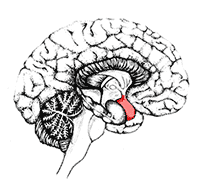
Specifically, the report shows that political conservatives have larger amygdalas, which mediate emotional reactions such as fear and aggression.

This report got picked up all over the mainstream press, as with this article in The Atlantic headlined Are Liberals and Conservatives Hard-Wired to Disagree? and another article over on Raw Story titled Brain structure differs in liberals, conservatives: study, which says “Liberals have more gray matter in a part of the brain associated with understanding complexity, while the conservative brain is bigger in the section related to processing fear, said the study on Thursday in Current Biology.”

From a purely sociological standpoint, this may have some element of truth, at least in the sense that repeated sociological studies have shown conservatives to be motivated by fears of collapsing social order, loss of social hierarchy, and social disorder.

But qualifying conservatives as fearful and liberals as optimistic is really kind of silly, seems to me. Liberals, in my experience, are just as likely to be driven by irrational fears, and to make decisions based on poor evaluation of those fears, as conservatives are.

Take, for example, the nearly universal fear among those on the political left of nuclear power. Despite the fact that nuclear power is by far the safest form of large-scale electrical generation yet invented (coal power kills more human beings every year, primarily from air pollution but also from coal mining accidents, than nuclear power has killed in the entire history of its use combined–including Chernobyl), liberals are nearly universal in their stark raving terror of all things “nuclear.”

Liberals like to mock conservatives as ignorant, uninformed, and anti-intellectual, but the reality is that across the United States, anti-intellectualism is extraordinarily popular; its cause is championed by people of all political stripes. It manifests differently, sure; conservatives tend to oppose pure science, particularly biological and geological science (but even physics is not immune; there are some highly vocal nutjobs on the right who claim that Einstein’s theory of relativity is a sinful attempt to undermine public morality by embracing moral relativism), though quixotically they tend to embrace technology.

Liberals, on the other hand, claim to champion science, at least when they can be arsed to learn enough to be able to separate it from pseudoscience; but they reject technology, in forms ranging from vaccination to food processing. Liberals are particularly frightened of life sciences; their terror of genetically modified food is second only to their terror of nuclear power as a common source of fear.

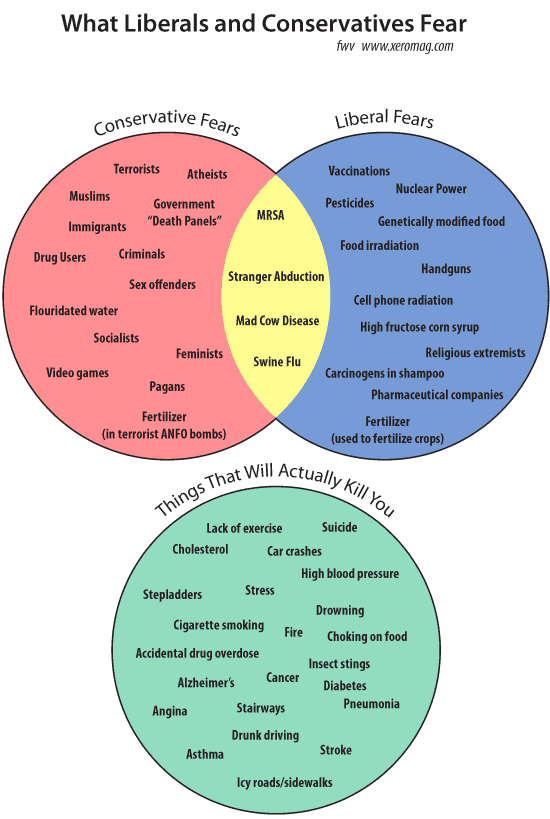
I’ve been chewing on this for a while, and as I often do, I’ve made a chart.

The things that will actually kill you tend, by and large, not to be the things you’re afraid of. Conservatives fear terrorism, which is stunningly unlikely to kill you; the number of Americans who lose their lives to terrorists every year is roughly on par with the number killed by sharks and bears, and is dwarfed by the number of people killed by falling off stepladders. On the other hand, as small as this number is, it’s still mountains bigger than the number of Americans killed by nuclear power every year, which tends to hover year after year at somewhere around zero.

How ironic, then, that the billions spent fighting these fears and the work done on both sides to advocate for these fears, and it’s actually driving to the office or not getting away from the TV to exercise that will do you in.

A Taxonomy of Crackpot Ideas

Some time ago, when the anti-science, anti-evolution, religious literalist movie “Expelled” was making the rounds, it occurred to me that a strict 6-day, young-earth creationist idea of the world requires a particular confluence of perceptual filters in order to exist. There has to be an unquestioned acceptance of literalist religious dogma, a profound ignorance of some of the basic tenets of science, and a willingness to believe in a vast, orchestrated conspiracy on the part of all the world’s geologists, biologists, archaeologists, geneticists, and anthropologists in order for this notion to seem reasonable.

I’ve been chewing on that thought for a while, and looking at the perceptive filters that have to be in place to accept any number of implausible ideas, from moon hoaxers to lizard people conspiracy theories to anti-vaccinationism.

And, since making charts is something I do, I plotted some of these ideas in a Venn diagram that shows an overlapping set of prerequisites for a number of different flavors of nuttiness.

As usual, you can click on the image for an embiggened version.

How to Tell when Something Isn’t Science

The process of science–the systematic, evidence-based, rigorous, controlled exploration of the processes of the natural world–has produced an explosion of knowledge and understanding. Since the Italian Renaissance and the Abbasid period in the Persian empire, both of which saw enormous gains in scientific thinking and with them huge leaps in technology and understanding, science has been the beacon of light shining in the darkness of superstition and ignorance.

So it’s probably not too surprising that many folks who seek to embrace all sorts of non-scientific ideas try to claim that their ideas are science. Calling these ideas “science” gives them a stamp of validation. If an idea is scientific, that means it has greater legitimacy in many people’s minds.

And the world needs to cut that shit out. Not all ideas are science, yet everything from phrenology to metaphysics to “crystal energy” tries to clamber onto the scientific bandwagon.

Most recently, the cry of the pseudoscientist has become “Quantum mechanics says!” Folks who can’t actually define what quantum mechanics is are nevertheless eager to fill New Age bookstores with books that claim to “prove” that quantum mechanics validates their ideas.

So here’s a handy-dandy, more-than-pocket-sized guide that will help you tell what science actually is and is not. Ready? Here we go!

RULE 1: If it doesn’t make a precisely defined, testable, falsifiable claim, it is not science.

This is the first and most basic premise of this whole “science” business. If someone claims “Science shows us that” or “Quantum mechanics proves that” and the next thing out of their mouth isn’t a testable, falsifiable claim, then what they’re saying is probably bollocks.

Continue reading

Some thoughts about atheists

I’ve been seeing an uptick lately in popular media about atheism. A lot of these things I’ve been seeing start with “Atheists are…” and then lay out the premise that folks who don’t believe in some kind of supernatural god have all sorts of negative characteristics, whether they be fat or immoral or selfish or whatever.

And a lot of these “atheists are” statements are just silly. Some of them, like “atheists are sexist,” are both silly and also filled with apparently unconscious irony, given the history of organized religion; others, like “atheists are immoral,” are silly and also point to an inability on the speaker’s part to conceptualize an internal code of ethics. But all of them are silly.

And so, I’d like to present this handy, pocket-sized guide to some of those silly ideas, and the reality.

Claim Atheists are immoral I: Atheism offers no framework for morality.
Fact It is possible to construct a rational framework for morality without reference to anything supernatural. For example, racism can be shown to be immoral simply because it hurts everyone–the racist and the subject of the racism alike. The first surgeon to perform open-heart surgery was black; had he not been permitted to go to medical school because of his race, as was the norm at the time, many people would have died because he would not have made the contributions he did. Michael Shermer has written a book, The Science of Good and Evil, that lays out a framework for morality which doesn’t depend on a supernatural entity.
Commentary Claiming a supernatural agent as the framework of morality can lead to some spectacularly, catastrophically immoral consequences–as was the case in 2010 when Pope Benedict XVI, a man whose purported job it is to interpret morality, decreed that ordaining women into the clergy was an immoral act that was equal to pedophilia. When a person who dedicates his entire life to the interpretation of morality as defined by a supernatural entity runs off the rails so badly, it is because he has lost touched with the effects of people’s behavior on other people–which is, after all, the core purpose of morality.

Claim Atheists are immoral II: Atheists can not have a framework of morality. Morality can only come from a god or gods.
Fact Religions do not set the standards of morality; they just reflect the moral ideas that people already have. In a society where slavery is common, the religious institutions tend to say that slavery is OK; when societies say that interracial marriage is bad, the churches agree. When the social mores change, so do the religions.
Commentary When morality is seen as a list of arbitrary rules handed down from a god, then anything that is on that list, no matter how atrocious, is viewed as ‘moral.’ Morality that comes from compassion, on the other hand, does not justify acts of atrocity. (I have actually written an essay about how morality as defined by organized religion has steered us wrong and let society down.)

Claim If you don’t believe in a god, you have no reason to behave in a good or moral way. Atheists have no reason not to murder or rape or commit other immoral acts.
Fact Even without god, there are consequences for violent acts. Going to prison is a pretty good reason not to run around committing rape or murder, no matter what you believe or don’t believe. No society can survive that permits its members to do these things; even an atheist society still outlaws rape and murder. More to the point, though, being an atheist does not mean being without compassion. In fact, if we look at the prison population in the United States, the vast, overwhelming majority of inmates–including violent inmates–identify as religious (primarily Christian), so clearly being religious does not guarantee moral behavior!
Commentary The people who argue that if there isn’t a god, there is no reason not to commit murder are really scary. Basically, they are saying "I can not imagine having an internal sense of morality. The only reason that I am moral is I think I will get punished if I am not. If I believe that my god will let me get away with rape or murder, I’ll do it." Those aren’t folks I would trust with my silverware, my wallet, or my life.

Claim Atheists are arrogant.
Fact Atheism sees humanity as a part of the universe, not set above it. Atheists do not believe that human beings are the centerpiece of all creation; to call humanity the highest point of all the universe is extremely arrogant.
Commentary Many theists believe that the entire world–whose surface is 75% covered with water–was created specifically for man, who has no gills. To my ears, someone who says that the supernatural creator of the universe cares specifically about his life, even down to what job he works and what kind of car he drives, and that he can know what that creator wants from his fellow man, sounds pretty arrogant to me…

Claim Atheists are immoral III: Atheists just want to be free to commit immoral acts.
Fact Atheists don’t believe that there is a god or gods. This has nothing at all to do with morality; many devoutly religious people commit grotesquely immoral acts, and many non-religious people are quite moral.
Commentary If a person wants to commit immoral acts, Christianity is actually a pretty good belief system to allow him to do so. Christianity teaches that the consequences of immoral acts are only temporary (after all, if you kill someone and he goes to heaven, he’s not really gone–at least not forever) and that all it takes is prayer and repentance to wash away any immoral act. Atheists can not fall back on the idea that immorality is only temporary, that someone is not really dead after he has died, or that the right words spoken to someone in the sky will make the consequences of immorality go away.

Claim Atheism is based on faith I: Atheism is a religion.
Fact Atheism is a non-belief in a god or gods. This is a religion in the same way that not betting on horses is a form of gambling, not collecting stamps is a hobby, and bald is a hair color. If you don’t believe that there is a god or gods, you’re not practicing a religious belief.
Commentary The notion that atheism is a religion seems to be held primarily by folks who can not imagine not accepting the idea that the world is under the control of a god or some gods. A lack of belief in a god is not in any meaningful way a religion; there are no sacred objects, texts, or ideas in atheism, nor any of the cultural, doctrinal, social, or philosophical elements that are characteristic of a religion.

Claim Atheists are actually Muslim.
Fact Muslims believe in a divinity (the same dvinity as Christians and Jews, in fact) and believe that a man (Muhammad) was the prophet of that divinity. They also believe that a book attributed to Muhammad was directly inspired by that supernatural god. Atheists accept none of these things; ergo, by definition, atheists are not Muslim.
Commentary The idea that "atheists are actually Muslim" appears to have originated with a handful of American Fundamentalist Protestant sects. There is a convoluted rationale behind it, which starts with the notion that atheists do not actually not believe in god; in all honesty, though, it looks to my eyes like little more than an attempt to take one group of people who some folks feel justified in hating, Muslims, and turning this bigotry on another group of people, atheists, that they also wish to hate.

Claim Atheists are actually polytheists.
Fact A person who denies the existence of a supernatural entity of any sort most probably denies the existence of multiple supernatural entities.
Commentary The notion that atheists are polytheists appears to have originated with a conservative Muslim named Jaafar Sheikh Idris. It’s the flip side of the "atheists are Muslim" argument; Islam tends to despise polytheism. The argument claims that science, evolutionary biology, and nature are revered and imbued with supernatural powers and abilities by atheists, and therefore atheists worship these things as gods. It’s not clear where the church services are held…

Claim Atheism is based on faith II: Atheists have just as much faith that there is no god as believers have that there is.
Fact Even legendary atheist Richard Dawkins, in the book The God Delusion, says "There almost certainly is no god." Not "There definitely is no god," but "There almost certainly is no god."
Commentary There are atheists who assert that a god or gods definitely do not exist. Atheism, though, is defined by the lack of belief that a god or gods exist (an “atheist” is literally “not a theist”), which is not the same thing. Even theists feel confident asserting that a god or gods don’t exist, as long as we’re talking about a god or gods outside their belief system. Few folks would claim that it is a statement of faith to say that Apollo does not exist or Odin does not exist (or even that Santa Claus does not exist).

Claim Atheism is based on faith III: Atheists are closed-minded about god.
Fact Atheists believe that there is no evidence to believe that there is a god or gods, and that listening to people talk about a god or reading books presumed to be sacred do not qualify as "evidence." Not believing in something is not an act of faith. Faith lies in believing something without direct corroborating evidence; if I say there are invisible leprechauns in my garden, that’s faith, but if I say there is no evidence to support the notion of invisible leprechauns at all, it’s not.
Commentary One of the key difference between every atheist I’ve ever met and every believer I’ve ever met is about evidence. If you ask an atheist "Is there evidence that will convince you of the existence of a supernatural divine entity?" she will almost certainly say "Yes, there is," and probably even be able to spell out what that evidence would look like. If you ask a believer "Is there any evidence that would convince you that there is not a god?" the answer is almost always "No; I will continue to believe there is a god no matter what evidence to the contrary I see." That shows a huge difference between faith and atheism.

Claim Atheists are miserable, unhappy people.
Fact All the atheists I’ve met personally tend to be optimistic and filled with joy.
Commentary If we are fallen spiritual beings, then we can not be any more than what we are right now; if we are the natural result of natural law, then there’s no upper limit to what we might become. Many religions teach that the world is something to be endured. For example, many Christians believe the world to be a burden that should be rejected, while many Buddhists see life as the result of undesirable attachment, and the goal of a spiritual path to be the end of attachment so that the cycle of rebirth is broken. These ideas inherently turn away from the world. Atheists see the world as an amazing, awe-inspiring, incredible, wonderful thing, filled with sublime beauty and working in intricate, subtle, and ultimately comprehensible ways. This is, I believe, a far more optimistic, and happier, view of the world.

Claim Atheists are angry at god.
Fact This makes as little sense as being angry at Santa Claus or the Keebler elves. It’s hard to be angry at something you don’t believe even exists!
Commentary I’ve met some atheists who are angry at being made to foot the bill for tax-exempt institutions that teach things which they see as destructive and harmful, or at the results of writing superstition into penal codes, or at the horrific human cost of the anti-intellectual, misogynistic, and homophobic ideas that permeate many religions, but anger at the machinery of institutional organized religion is not anger at god.

Claim Atheists are fat.
Fact In the US, there’s a strong correlation between obesity and conservative parts of the country, with the most religious state in the US (Mississippi) also having the greatest per capita incidence of obesity. There’s a great map to that effect here.
Commentary The notion that "atheists are fat" comes from Conservapedia…the same source which says that E=mC2 is a liberal plot.

Claim Atheists think that everything in the world came from nothing.
Fact The current model of cosmology is that everything in the universe came to be from a singularity whose total mass energy is that of the universe and whose size was less than the Planck constant, which is not "nothing."
Commentary Many, though of course not all, theists of various stripes reject scientific models of the physical world–regardless of any evidence supports those models. Unfortunately, the folks who reject those models tend not to understand them; so you get misunderstandings like this one and the one below.

Claim Atheists think that everything in the world came to be by random chance.
Fact Cosmology suggests that random fluctuations in the initial makeup of the universe were the seeds from which large-scale structures formed; evolutionary biology suggests that small random variation in individuals is the seed upon which natural selection works. However, the large-scale structures in the universe and the formation of different species of organism are both the result of NON-random forces, such as gravity and adaptation, working on those initial variations. The things we see around us are NOT the result of random chance; they are the result of forces which act to preserve certain kinds of variation, and so accumulate non-randomness over long periods of time.
Commentary As with the notion that atheists believe everything came from nothing, this particular misconception comes from a misunderstanding of principles of astronomy and evolutionary biology.

Claim Atheists are hateful. Atheists hate religious people.
Fact Atheists may hate the effects of organized religion on society–bans on stem-cell research, women being burned alive in rural Hindu areas if their parents don’t pay sufficient dowries, women in Afghanistan and Saudi Arabia being kept as virtual prisoners in their homes, and so on–but that’s a different thing from hating people. When it comes to hating individuals, it’s hard to beat fundamentalist theists, who will often proclaim all sorts of horrific torture and atrocity awaiting any person who does not accept their worldview. If atheists claimed that believers would be subject to eternal torture, it’d be easier to claim atheism as "hateful."
Commentary Imagine what would happen if an atheist were to make a claims about believers similar to the one that the former US president made of atheists: "No, I don’t know that atheists should be considered as citizens, nor should they be considered patriots. This is one nation under God." –George H. W. Bush, August 27, 1987.

Claim Atheists are like Hitler.
Fact In 1922, Hitler gave a speech in which he said, "My feeling as a Christian points me to my Lord and Saviour as a fighter. It points me to the man who once in loneliness, surrounded by a few followers, recognized these Jews for what they were and summoned men to fight against them and who—God’s truth!—was greatest not as a sufferer but as a fighter. In boundless love as a Christian and as a man I read through the passage which tells us how the Lord at last rose in His might and seized the scourge to drive out of the Temple the brood of vipers and adders." Upon his rise to power, Hitler banned atheist organizations throughout Germany. In the book Mein Kampf, he wrote "Hence today I believe that I am acting in accordance with the will of the Almighty Creator: by defending myself against the Jew, I am fighting for the work of the Lord."
Commentary "Hitler was an atheist" is a standard part of Christian trope in the US and parts of Western Europe, but it isn’t true. That doesn’t really matter, though. If the atrocities of Hitler (and other figures, such as Stalin and Pol Pot) can be laid at the feet of their supposed non-belief in the supernatural, then it seems reasonable to lay the atrocities of believers upon their belief in the supernatural. You can’t have it both ways, saying that non-belief leads to atrocity but then excusing believers who commit atrocity by claiming that there’s no association between their religious beliefs and the evil things they do.

Claim Atheists are sexist.
Fact Atheist activist organizations tend to have more men than women in them, but it’s a chicken or egg problem. Many mainstream magazines aimed at women, like Ms. magazine, like to portray atheism as sexist, which discourages women who otherwise identify as atheist from coming out of the closet.
Commentary Given a world in which Orthodox Jews spit on, beat, and/or arrest women who want to worship at the Wailing Wall, Muslim countries in which honor killing is seen as acceptable, Hindo countries where women can be burned alive in "cooking accidents" if they displease their husbands, Catholic leaders who say that allowing women into the clergy is as immoral as child rape, and Baptists who say that the role of the woman is to submit gracefully to the divine authority of her husband, the claim that atheists are sexist is a bit…odd. There are misogynist atheists, to be sure, just like there are misogynist believers; the difference is that I have never seen a misogynist atheist who tries to set up organized systems that tell other people THEY should be misogynist, too!

Claim Atheists think that life has no meaning.
Fact Many atheists think that life has the meaning we give it, not the meaning that is imposed on us by a divinity.
Commentary "We exist to worship a divinity" is not, in my opinion much of a meaning, really.

Claim Atheists think that there is nothing beyond human understanding.
Fact There are many things that are still not understood. That’s why scientists still have jobs, and haven’t all packed up and gone home.
Commentary Many people feel a need to believe in something greater than human understanding; it’s part of the drive toward everything from religious belief to belief in ghosts to belief in UFOs and alien abductions. The natural world is absolutely filled with beauty and wonder that’s way beyond simple human stories about Sasquatch or space aliens, but I think that many people don’t see that…which is a damn shame.

Claim Atheists are selfish.
Fact There is a strong correlation between secularism in a country and care for the poor. Secular Western nations like Sweden and the Netherlands consistently have better social programs, greater peace and stability, and a smaller division between the rich and poor as more religious nations. (Note, however, this assumes a nation that is secular because its citizens freely choose to be so, not a totalitarian nation whose dictators force atheism on people. Totalitarian nations tend not to be stable, peaceful, or prosperous, regardless of whether the dictators are religious theocrats or atheists.)
Commentary Many religious people claim that without a belief in a god or gods, there is no reason for altruism. Leaving aside the fact that all cooperative societies benefit from altruism, when we look in the United States we see that many secular charities exist, and that the largest donors to charity, men like Warren Buffett, tend to be non-religious. Also, religious charities often tend to use donated money for the promotion of religious values not necessarily directly connected to charity; the Salvation Army uses money to promote ideas opposing homosexuality, and the Mormon church has spent millions on TV ads against gay marriage, which is millions of dollars they do not have for charitable endeavors.

Claim Atheists don’t recognize the good that religion does.
Fact On the contrary–atheists simply don’t think that believing in a god or gods is necessary in order to DO the good that religion does.
Commentary Many religious folks credit religion for the good that is done in its name–for example, by saying that the good works of Catholic charities proves the goodness of god and of religion. Theses same folks, though, when asked about the atrocities perpetuated by religion, dismiss religious responsibility, saying things like "Those were just men claiming to do things in the name of religion, but the religion wasn’t responsible for the evil they did." Again, you can’t have it both ways. You can’t credit religion with the good that people do in its name but dismiss the evil that people do in its name; either religion motivates people or it doesn’t.

Link o’ the Day: The Rapture

A Christian radio station says that the world will end on May 21, 2011; listeners quit their jobs to join caravans traveling across the country to warn people.

This is, apparently, the third time this particular radio station has announced the End of the World in the past twenty years or so. They obviously haven’t learned the lesson of the boy who cried wolf: never repeat the same lie twice.

I threw a party on a different End of the World day back in 1989. Maybe we should host another one on May 21. Who’s in?

We interrupt this stream of vacation posts…

…for a bit of very funny, very clever pro-rationality ranting disguised as beat poetry. joreth and the rest of the Squiggle, this one’s for you!

Electricity? It’s a mystery!

From The Pharyngula blog comes this little gem, a page from a Fundamentalist Christian textbook about electricity.

Now, anyone who’s read my blog for any length of time will know I’m no fan of right-wing religious zealots. But occasionally they manage to surprise me. Sadly, they tend to surprise me by not even rising to the bar of my already abysmally low expectations; no matter how bad, how ignorant, how credulous, or how dishonest I think these guys are, they somehow manage to be worse.

Here’s the page, scanned from a fourth-grade home-schooling textbook on science (click for a larger version):

This kind of thing is the reason I cringe whenever I hear the phrase “home schooling.” I know there are home schoolers who aren’t ignorant Fundamentalist boobs, but damn, they sure do seem to be a small percentage.

The notion that someone can spout nonsense like “We can not even say where electricity comes from. Some scientists think the sun may be the source of most electricity. Others think that the movement of the earth produces some of it” interspersed with Biblical passages and call the result a science textbook is, to me, beyond belief.

A part of me wants to think that whoever wrote this nonsensical tripe was deliberately lying, because the notion that the author genuinely doesn’t know what electricity is, and furthermore can’t be arsed to look it up on Wikipedia or something, blows my mind. But, no, I do think it’s at least possible that whoever wrote this passage sincerely believes what he wrote.

Taken in a larger context, though, it doesn’t matter whether or not he believes it, or understands enough basic science to understand what electricity is. (“We cannot say what electricity itself is like”? Seriously?) The goal of this book is not to educate the reader about science; indeed, I think the goal of any home-schooler using this material is not to educate their child about science.

No, the goal is something very different. It’s twofold, really. The most obvious intention here is to present the world in a way that makes it as opaque as possible, while simultaneously denigrating the ability of science to make any sense of it; science, in the minds of the Fundamentalists who write and teach drivel like this, is a haphazard conglomeration of a bunch of competing wild-ass guesses about the way things might work, each of which has no real basis in fact. Some scientists think our electricity was produced in the sun; others think that some of it might have come from the movement of the earth. (As a person in the dismal movie Jesus Camp says, “science doesn’t prove anything.”1)

The second aim of this textbook is something more subtle. There is an axiom among many religious Fundamentalists that we can never know something which we do not observe directly. This argument pops up in Creationist arguments with depressing frequency; since we can not go back and directly observe, as a firsthand eyewitness, the creation of the earth or the advent of life, we can never know how it went down; ergo, all ideas about what might have happened are equally likely. And since only one of those ideas has the imprinteur of God, that’s the most likely one. All the other ideas are merely idle speculation; since we can’t go back and see it happen, we can’t actually say we have any evidence for it. Only eyewitness evidence2 matters.

And on those counts, I think this passage does precisely what it intends to do.


1 Which might be true from a particular perspective, in the sense that the scientific method seeks hypotheses which are falsifiable, and model is only as good as the next data point which contradicts it. But the Fundies who spout “science doesnt prove anything” mean something quite different; they’re basically saying that science is not useful as a tool to understand the physical world. And that blatantly isn’t so.

2 Or the scribblings of a bunch of barely literate Bronze Age tribesmen which have been shuffled around, rearranged to suit various political factions several times throughout history, and then badly tanslated into a succession of languages, presumably.

Quote of the Day: 1984

You were so busy worrying about 1984 you didn’t notice you were living Brave New World.

What Orwell feared were those who would ban books. What Huxley feared was that there would be no reason to ban a book, for there would be no one who wanted to read one. Orwell feared those who would deprive us of information. Huxley feared those who would give us so much that we would be reduced to passivity and egoism. Orwell feared that the truth would be concealed from us. Huxley feared the truth would be drowned in a sea of irrelevance. Orwell feared we would become a captive culture. Huxley feared we would become a trivial culture, preoccupied with some equivalent of the feelies, the orgy porgy, and the centrifugal bumblepuppy. As Huxley remarked in Brave New World Revisited, the civil libertarians and rationalists who are ever on the alert to oppose tyranny “failed to take into account man’s almost infinite appetite for distractions.”

In 1984, Orwell added, people are controlled by inflicting pain. In Brave New World, they are controlled by inflicting pleasure. In short, Orwell feared that what we fear will ruin us. Huxley feared that what we desire will ruin us.

–Neil Postman, Amusing Ourselves to Death

Though I must say it isn’t necessarily either/or. We have created a culture that has spawned both an unprecedented attack on civil liberties from on high, particularly under the last administration, along with a reactionary anti-intellectualism that openly scorns the quest for knowledge, giving us the worst of both.