Arrgh! Con artistry hits work

There is an old-school type of fraud, conducted by phone, that’s the old-world equivalent of the “phishing” emails you get all the time. You know the ones I mean–the emails that say “There has been a problem with your online banking/your online PayPal account/your eBay account/whatever, please click here to confirm your identity.” And then you click there, and you’re taken to a Web site that looks like your bank site, or PayPal, or eBay, and you type in your bank account number or your username and your password, and Wham! You’ve just given your information to Russian organized crime!

The old-school variant is the same thing but on a more personal, more individual level, from con artists who believe in age-old, hand-crafted fraud, not this soulless, mass-produced fraud we see so much of today.

In the old-school, hand-crafted variant, the con man calls you up on the phone and says “Hi there! I’m John from Bank of America. Bad news! We think someone just tried to use your bank account fraudulently! Did you just order $2,000 worth of rare wine to be shipped to an address in Hong Kong?”

And you freak out and your heart starts pounding and you sa “No! No, I didn’t! Oh no! What do I do?”

And he says “Relax, don’t worry, we thought it was fraudulent, we’ve put a freeze on your bank account. And then you’re all like “Phew! That was close!” while visions of bounced checks and ruined credit dance in your head. And then he says “OK, we’ll reverse the charge and unfreeze your account. For security, we need you to confirm that you’re the real bank account owner. What’s your social security number? What’s your bank account number? What’s your debit card number? What’s your PIN?”

And he’s hoping you’re so freaked out that you’ll just gullibly tell him.

This kind of fraud fell out of favor a while ago when folks invented caller ID, because (a) the con man doesn’t want to give out his caller ID number and (b) people get suspicious when they get calls that are supposedly from the bank but it says “caller ID blocked.”

They’re making a comeback, though, since it is now cheap and easy to fake caller ID numbers. The con men put fake caller ID numbers–usually random 1-800 numbers (because people think “oh, if it’s coming from an 800 number it must really be my bank!”) that are not really the bank’s numbers (because the con artist doesn’t want folks calling the bank to confirm the story) into a gadget or computer program that fakes what you see on your caller ID.

So today, apparently there’s a con artist who’s rapid-fire calling dozens of potential dupes…

…and is forging our phone number on his caller ID spoofer.

So folks are calling us (a LOT of folks are calling us) and screaming at us–“How dare you try to get my bank account number, you motherless sons of flea-infested goat herders!”

They are savvy enough to realize that the call is a dupe, but gullible enough to believe that the number they see on the caller ID is actually the number that the con artist is calling from.

*headdesk* *headdesk* *headdesk* *headdesk* *headdesk* *headdesk*

Long List o Linky-Links

Since my Web browser currently has a zillion pages open (and is consuming mass quantities of RAM as a result), and since I can’t use the browser on my iPhone because the maximum possible number of pages is open, it’s time once again to share the wealth and post another Grand List of Linky-Links.

In today’s assortment, we have a wide variety of links for your edification and viewing pleasure.

Ready? Here we go!

Society & Politics

New Scientist: Conservatives are biggest consumers of porn

Not that it’s really a surprise to anyone. I’ve long suspected that many social conservatives fall into one of two broad camps: closeted self-loathers, and people who are really only concerned with the appearance of propriety rather than with actual propriety.

Business Week: Portland, Oregon is America’s unhappiest city

Uh-oh. And I’m planning to move there shortly!

Lesbian Nation: Chronicles of the Lesbian Separatist Movement

In the seventies, a movement arose among lesbians who believed that the key to sexual and social freedom lay in withdrawing entirely from American society–including, in many cases, refusing to interact with or even speak to men. Battle too long, and you become the thing you’re fighting against.

Science

Will You Perceive the Event that Kills You?

My favorite link on the list. Will you even be aware of the thing that ends your life? The human sensory apparatus and nervious system are so slow that we are constantly living in the past–about 300-500 milliseconds in the past, to be exact. Many of the things that can kill you do so in less time than that. Interesting stuff, including a rundown of the sequence of events in a car crash, and how far behind your awareness of those events will lag.

Researchers solve mystery of deep-sea fish

Meet the barreleye–a fish with nostrils that look like eyes, a transparent head, and tubular eyes that swivel up and down entirely inside its head. Man, there is some seriously weird stuff in the deep ocean.

Natural selection: Darwin’s God-killer

Two centuries after Origin of Species and people STILL don’t actually know what evolution is. (Hint: If you’re thinking “survival of the fittest,” you ain’t really got it.) Is this idea really a “god-killer”? Of course not. But it does demolish one very specific notion of god–the idea that the world was created in six literal 24-hour days exactly six thousand, four hundred and some odd years ago.

Junkfood Science: Why we think overeating causes obesity

There are many things we all know are true that actually aren’t. Turns out that the notion that people are overweight simply because they eat too much is one of them. The history of a fascinating study on food and food deprivation, which probably would not be possible today ’cause it would violate ethical guidelines on human research.

Globe and Mail: Canadian researchers turn skin cells into stem cells

The new technique is easier and safer than previous techniques to coax mature cells back into becoming stem cells.

Mermaid Dream Comes True Thanks to Weta

Weta Digital, the company that did the special effects for the Lord of the Rings movies, has a lot of experience with advanced prosthetic effects. So when a girl with no legs approached them with the idea of making her a functional mermaid prosthetic, they said “Sure!”

2009: Shaping up to be a bad year for anti-vaccinationists

Everything under the sun has its conspiracy theorists. Terrorism has its 9/11 “truthers.” The space program has its moon hoax conspiracy nutters. Geologists have the flat-earthers and the young-earthers to contend with. And the medical community has, among others, the anti-vaccination nutters. Difference is, the moon hoaxers and flat-earthers don’t put other people’s lives at risk. 2009 looks to be a bad year for this particular breed of nutter.

Sex and Relationships

The Single Best Working Assumption for Drama-Free Relationships

Sometimes it’s the simple things that are most effective.

Control Tower: The Hot Bi Babe

Yes, I know it’s an old article, but Mistress Matisse lays it on the line about why those zillions of married poly-in-theory couples will not likely find that hot bisexual woman they’re looking for.

And finally, here’s an old video circulating YouTube about the evils of pornography, though it has an interesting historical footnote:

The footnote? The person who made this video is none other than Charles Keating.

Keating, for those who don’t remember him, was an anti-sex, anti-porn moral crusader for many years, and joined President Reagan’s Meese Commission on Pornography in an attempt to lobby for tough anti-porn laws.

He later went on to embezzle about $1.2 billion from Lincoln Savings and Loan, singlehandedly triggering the collapse of the entire S&L industry. To Keating, you see, porn = immoral, stealing the life savings from working families = perfectly moral.

Well, that’s unusual…

For what may arguably be the first time in its history, the Catholic Church has anticipated a new technology, rather than lagging a few centuries behind, as is more traditional.

Last year, Pope Sidious I Benedict XVI announced the addition of seven new deadly sins to the old list of seven deadly sins (which, frankly, I believe is flawed to begin with). On the new list is genetic engineering, which th Vatican defines broadly to include anything which changes DNA.

Eleven months later, researchers announced a major breakthrough in fighting HIV: a therapy that extracts the patient’s cells, genetically alters them to make them resistant to the AIDS virus, and then re-introduces them into the patient’s body.

The circle is now complete, as Darth Vader says. For the first time, with the newly updated list of deadly sins, the Catholic Church has a complete, end-to-end policy on HIV:

It’s wrong to wear condoms to prevent the spread of AIDS, and it’s wrong to use gene therapy to treat AIDS.

Like many other religions, the Catholic Church has long viewed HIV as a behavioral problem, and felt that rigorous control of sexual expression, rather than condom use or research, are the ideal solution. They don’t go quite as far as to say that HIV is a punishment from God, but approaching HIV as a behavioral problem rather than a n epidemiological one still falls flat to me.

Folks who think that HIV is a consequence of an immoral lifestyle or a punishment for wickedness would do well to consider the case of a man who called in to the Playboy Radio talk show I was a guest on several months ago; he was HIV positive not because he’d had wild, deviant unprotected sex, but because he witnessed a car accident. One of the accident victims was thrown through the windshield and badly lacerated. In his efforts to save her life, he cut his hand on the glass and was exposed to her blood. She was HIV positive; now he is, too. Frankly, and I want to be very clear on this point: any omnipotent, merciful, benevolent god who is OK with that can suck my cock kiss my ass. If there is a god who would be fine with that, I think such an entity is manifestly and plainly not worthy of adoration.

But I digress.

Sin lies only in hurting other people unnecessarily. All other “sin” is invented nonsense. The idea of criminalizing lifesaving research by holding that certain forms of medicine are inherently sinful–and not just sinful, but mortal sins–that’s a level of wrong I can’t quite even find the words for.

Some thoughts on reason, falsehood, and emotional need

When David and I arrived at work last Wednesday, our HR manager was in a pretty foul mood. When David asked how she was, she answered “scared. We’ve just voted in a Muslim terrorist as President.”

Now, Barack Obama is neither a terrorist nor a Muslim; in point of fact, he’s a Christian and a long-time member of a Christian church affiliated with the United Church of Christ. But that’s not really what I came here to talk about; in fact, I’m not really here to talk politics at all. I’m here to talk about what makes people believe outlandish things.


There’s a really interesting two-part essay over on Slactivist about an enduring urban legend surrounding Proctor & Gamble, the company that makes laundry detergent and soap and whatnot. According to the urban legend, an unnamed officer of Proctor & Gamble appeared on some television talk show some years ago and announced that the company donates part of its profits every year to the Church of Satan.

As with all urban legends, the details are fuzzy and change over time. Sometimes, it was the president of the company; in other tellings, it was the CEO. Sometimes it was Oprah; sometimes, Phil Donahue. The name of the person who appeared on the show and the date the show aired are, of course, never given.

The interesting thing about this urban legend is its total absurdity. It’s trivial to disprove; it can be demonstrated conclusively beyond even a single atom of doubt that it just plain never happened. Moreover, its utter absurdity would seem to suggest that no reasonable person could believe it.

The two-part essay is worth reading; you can find part one here and part two here.

The essay asserts that, in a nutshell, the folks who repeat this tale, which has been circulating since at least 1980 and possibly before, don’t believe it’s true; instead, they willingly pass on a story they know to be false, and only pretend to believe it’s true. The author asserts:

Those spreading this rumor can be divided into two categories: Those who know it to be false, but spread it anyway, and those who suspect it might be false, but spread it anyway. The latter may be dupes, but they are not innocent. We might think of them as complicit dupes. The former group, the deliberate liars, are making an explicit choice to spread what they know to be lies. The complicit dupes are making a subtler choice — choosing to ignore their suspicion that this story just doesn’t add up and then choosing to pass it along anyway because confirming that it’s not true would be somehow disappointing and would prevent them from passing it along without explicitly becoming deliberate liars, which would make them uncomfortable.

What I want to explore here is why anyone would make either of those choices. In both cases, the spreading of this rumor seems less an attempt to deceive others than a kind of invitation to participate in deception. The enduring popularity of this rumor shows that many people see this invitation as something attractive and choose to accept it, so I also want to explore why anyone would choose to do that.”

I think this is a very interesting argument–that those who pass on the story know it to be false, since it would seem that the story is so prima facie ridiculous that nobody could really believe it.

But I don’t think that’s the case. I don’t believe that the people who pass on this story know it to be false, but pass it on anyway, Instead, I think the real answer can be found in a comment posted after the end of the first part of the essay, and I’ve been chewing on it for weeks now. It offers, I think, a very useful insight into fallacy of all sorts.

The important bit, which caused something of an epiphany in my own understanding of the human condition, is this bit:

When an untrue story circulates, it’s generally because it expresses some kind of social unease. There may not be razors in the Halloween apples, but it’s a way of expressing the concern that your precious children are going out knocking on the doors of people who may not wish them well. There may not be rat poison in the Mars bars, but it’s a way of expressing the sense that they’re definitely not good for you. Not every Bridezilla story may be true, but it’s a way of expressing the sense that the wedding industry is too high-pressured and perfectionistic. There may not be Satanic abuse going on at day care centres, but it’s a way of expressing a sense of discomfort at women going to work and leaving their children in the care of others. And so on.


Human beings are inherently irrational. We carry around with us a kind of internal model of the way we make decisions: we are posed with a question, we think about the question, we evaluate evidence to support or refute each of the available options, and then we come to a conclusion. But that isn’t how it works at all.

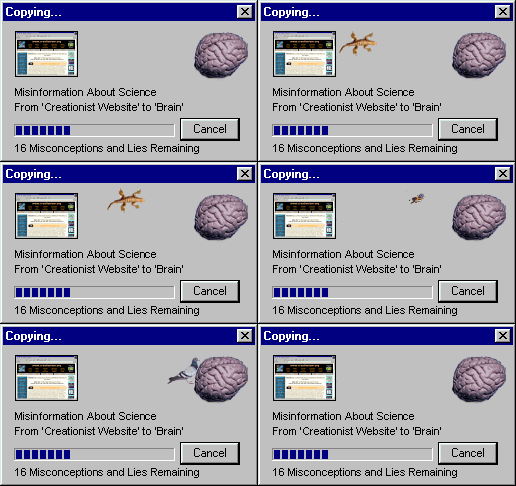
More often, the decision is made emotionally, on a subconscious level, long before we ever start thinking about it. After the decision has been made deep within the bowels of our emotional lizard brains, our higher-order, monkey-brain reason is invoked–not to evaluate the decision, but to justify it.

One consequence of this emotion-first decision-making process is confirmation bias, a process of selective evaluation where we tend to exaggerate the value of anything which seems to support our ideas, and to devalue or discard anything which contradicts our ideas. It’s a powerful process that ends up making the decisions we’ve already made and the things we already believe all but immune to the light of disproof, no matter how compelling the disproof may be.


I’ve written before about how the brain is really not an organ of thought so much as an apparatus for forming beliefs, and how it has been shaped by adaptive pressure to b remarkably resilient at forming, and holding on to, beliefs about the physical world.

The adaptive pressures that gave rise to the belief engine within our heads don’t necessarily select in favor of organisms that generate correct beliefs, for reasons I talked about there. But the beliefs that we form do serve a purpose, and sometimes, it’s an emotional purpose.

The things a person believes can reveal a lot about that person’s underlying emotional processes. Beliefs often reflect, in a garbled and twisted way, the buried perceptions and the emotional landscape of those who profess them. Even the most outrageous, clearly absurd beliefs can be quite sincere, and otherwise sane, rational people will adopt insane, irrational beliefs if those beliefs serve some emotional function.

Looked at in this way, a lot of patently absurd beliefs begin to make a kind of sense. They’re distorted funhouse mirror projections of an underlying emotion, twisted out of all rational shape, and clung to through a powerful set of mental processes that make them seem attractive, even obvious.

The idea that Obama is a Muslim terrorist, ridiculous as it is, is an expression of an emotional state: “I do not identify with this person, he seems alien and strange to me, and I am afraid that he will not make decisions that reflect my needs.”

The notion, sometimes seen in a few of the more extremist corners of radical feminism, that all heterosexual sex is always rape becomes an expression of an emotional state: “When I have had sex, I have felt disempowered and violated by the experience.”

The idea that the government staged the attacks on the World Trade Center is a twisted-up, garbled expression of an emotional state: “I am afraid that my nation’s government is corrupt and evil, and is willing to resort to any means, however extreme, to achieve its own ends.”

This is why these beliefs are so vigorously resistant to debunking, even when the evidence against them is overwhelming. They are not assertions of fact in the way that many other statements are; they are assertions of emotional identity.

And they can not be treated as assertions of fact, even though on their face that’s what they look like.


If someone says “New York city is the capital of New York State,” that’s an assertion of fact. It’s easily countered; you can easily show him a map, or point him to Wikipedia, and say “No, the capital of New York State is Albany.” And, if he’s not mentally ill in some way, he’ll probably say “Really? I didn’t know that. Cool!”

But if someone asserts that Proctor & Gamble donates money to the Church of Satan, and you contradict him, he’s likely to respond with anger–in a way that he won’t if you tell him that Albany is New York’s capital. That’s because you’re not contradicting his assertion of fact; you’re telling him that his emotional identity is wrong.

And it’s important to understand that even if a particular belief is wrong, the emotional landscape supporting that belief might not be. Proctor & Gamble does not donate money to the Church of Satan, but what is that belief an expression of? One likely possibility is that the emotional state beneath it looks something like “I do not trust large, faceless corporations to have my interests at heart, and I am afraid that a society dominated by large, faceless corporations may not be responsive to my needs and my values.”

And you know what? That is a perfectly reasonable feeling to have. There very well indeed may be some truth to that idea, even though the specific beliefs that grow from this soil are twisted and misshapen.

Any attempt to debunk these ideas will never succeed if the debunking does not separate the idea from its emotional foundation. Furthermore, the fact that an idea grows from and is nourished by some kind of underlying emotional reality means that even the most otherwise skeptical, rational person can become attached to ideas that are patently false, and that person’s own tools of rational skepticism may not be able to evaluate, or even see, those ideas.

The challenges this notion poses to skeptics and rationalists is worthy of a post in its own right, and will be the subject of Part 2 of this essay.

On credulity

It should come as a surprise to nobody that the much-hyped “discovery” of a Bigfoot corpse in Georgia was revealed today to be a hoax. A common, cheap Halloween costume, some opossum entrails, a cooler, and a whole lot of overheated gullibility combined to form a perfect storm of stupid. Profitable stupid, to be sure, but stupid nonetheless.

The man who orchestrated this hoax, incredibly, has been caught doing Bigfoot hoaxes in the past…and yet, people still took him seriously.

Now, I don’t give a toss about Bigfoot. But I do think there’s an interesting lesson in here.

Folks want to believe in things like Bigfoot and the Loch Ness Monster and astrology and UFOs and the divine love of Our Savior Jesus Christ and a whole lotta other unlikely and sometimes downright nonsensical things. And in fact we may even be hardwared to believe them. Human knowledge is a history of two steps forward, one step back; we no longer believe that solar eclipses are caused by gigantic marauding dragons pursuing the sun across the sky, but we do believe that our office mates are snippy and the coffee maker is on the fritz because of the motion of a tiny, tidally locked ball of rock with a large iron core.

All these things, from Bigfoot to psychics, are woven together by the common thread of irrationality. And no matter how many times a conman gets caught with an ape mask and a handful of animal guts, folks can predictably be relied upon to say “Well, this particular guy was a shyster, but Bigfoot still exists!”

But I didn’t actually come here to talk about Bigfoot.

Instead, I came here to talk about physics.

How are the two related? Through the common languages of money and credulity.


The hottest area of venture-capital investment in the US right now is alternative energy. Solar power, wind power, thermoelectric power–if it involves getting energy without burning stuff, people will invest in it.

And it’s in this environment that anyone with a scientific-sounding yarn and a pair of brass balls can score millions.

The problem with the Georgia Bigfoot hoaxsters is that they set the bar too low. You might make a few thousand dollars duping folks who like to believe in big, hairy ape-men running around upstate Georgia, but if you really want to score the dough, you need to think bigger. And the notion of limitless power from tap water is not a bad place to start.

This is an old-school scam, of course–I remember reading a plot in the newspaper comic Gasoline Alley a couple of decades ago that centered on one of the main characters being scammed by an elaborate con involving a car that could run on water. And today the Web is littered with Web sites offering to sell gizmos, usually for hundreds of dollars, that promise you can boost your mileage by running your car on water.

Still small potatoes, though.

Oh, no. To score for real, you gotta aim your sites not at average consumers, but at venture capitalists themselves. And what better way than by claiming to have discovered that all of modern physics is completely wrong, and that you can get limitless power from tap water by creating an entirely new state of matter?


That is exactly what a guy named Randell Mills has done, and he’s scoring big. A while back, he claimed that he has discovered a new state of hydrogen, which he calls the “hydrino,” that involves moving the electron closer to the nucleus than the laws of physics permit. It makes no difference that the math doesn’t work, nor that the book he wrote on the topic appears to be equal parts flawed math and text plagarized from other textbooks. What’s important, as any good Bigfoot “researcher” knows, is that it sounds good–and more importantly, that it talks about things that people really, really, really want to believe in.

The second part can make up for a lot of flaws in the first. We really, really want to believe that the world has meaning and purpose, and to that end we are willing to accept a great deal, and not look too closely at things that support what we’ve already decided we’d like to be true.

And a great many people want this notion of the “hydrino” to be true.


Randell Mills has been talking about hydrinos for quite some time now. Nearly twenty years, in fact. And he’s proven to be remarkably skilled at piggybacking his notion onto whatever other ideas happen to be getting attention at the moment.

When “cold fusion” was all the rage, he proposed that it worked because the hydrogen in the water was being converted into hydrinos, and the hydrinos were what was fusing. No real explanation for why this should be, mind you; but that’s a minor matter. The publicity is what’s important.

Now, with the price of oil high and alternative-fueled cars in the news, he’s proposing that fuel cells that work on hydrinos could provide limitless energy from tap water–and he’s scored fifty million dollars of venture capital funding to that end.

Never mind that in nearly two decades he’s never made this idea work. Never mind that current models of the behavior of hydrogen atoms have been verified experimentally over and over again. Never mind, even, that he’s been promising a major breakthrough since 1991, a breakthrough that’s always just a little bit of money away.

He keeps bringing in the money because investors want to believe.

And not just for obvious reasons.


Yes, it is true that the lure of owning the one invention that will bring an end to the era of Big Oil is powerful. Yes, it is true that anyone who wins on alternative energy is likely to win in the billions, at least. And yes, it is even true that the next big invention is likely to be surprising and to come from an unpredictable place.

But there’s another reason that Mills is so successful at scamming folks, and it has to do more with sociology than with technology. We all want to believe we can run our cars on water, but we also very much hate and fear science, and we all want to be able to laugh at those pointy-headed, superior scientists in their white lab jackets and say “Ha! You were WRONG! Ha, ha, ha!”

Randell Mills doesn’t exist in a vacuum. His success is very much a product of anti-intellectualism. We simply don’t like science, we don’t like the people who do it, and we want to give a giant “fuck you” to the people we hate so much. What better way than to buy into a gizmo that lets us drive cars on water and also proves all those complicated scientific theories are wrong?

And it’s not a stretch, really. Most folks are only dimly aware of hat an “atom” is, and haven’t the faintest idea of what a “ground state” is. Why not believe that it’s possible to shrink a hydrogen atom way down smaller than it’s supposed to be? And as long as we’re believing that, why not also believe that you’ll get a whole lot of power to run your car by doing it? Hey, it could happen, right?

Fifty million dollars in venture capital later, the math still doesn’t work and the idea is still bunk, but when you start with investors who don’t have the background to understand why the idea is bunk, but are itching to be able to say they helped knock a lot of know-it-all eggheads off their pedestals…well, the result really shouldn’t be surprising, I suppose.


I spend a lot of time talking about credulity and gullibility. Sometimes, people ask me why I, or anyone else, should care. What’s the harm in folks who believe blindly in Bigfoot? Who cares if people believe in things without evidence?

Randell Mills is the answer to that question. Credulity has a price. Sometimes, the price is financial; gullibility and anti-intellectualism allow people to be manipulated into parting with cash; they make for easy marks. Sometimes, the price is in human lives. Anti-intellectualism is what lets people believe that chlorinated water is bad.

All these things are related. And in the rush to believe what we want to believe, in the desire to be seduced by someone who will tell us the things we really want to hear, we sometimes forget to check our facts.

Some thoughts on computer security and credulity

So recently Business Week magazine ran an article about keylogger software being used in espionage. Essentially, defense contractors are being tricked into infecting their computers with keylogger malware, sent in targeted emails that appear to come from the Pentagon and other governmental sources.

The thing I find interesting about this, and also about things like the Storm and Kraken worms, is that they don’t take advantage of security flaws or vulnerabilities. They don’t attack holes in a computer’s operating system or applications, and they don’t rely on technical exploits of programming errors. These attacks all rely on tricking the victim into deliberately, intentionally infecting himself.

For that reason, I don’t think there’s a technological solution. The solution to a human gullibility problem isn’t in better programming or more elaborate firewalls; it’s in user education. No matter how sophisticated and bulletproof a security system is, there’s no defense against a person who deliberately chooses to permit someone through it.

But when it comes to the Intertubes, folks don’t get that.


If we had a situation where a criminal walked into a bank and, without weapons or violence, tricked a security guard into opening the vault for him and handing him all the money inside, we would not say “Oh, we need to build bigger vaults with thicker doors and more complicated locks!” It’s obvious to anyone who thinks about something like that that a bigger door or thicker walls won’t prevent someone from tricking a gullible guard into unlocking the door.

Yet with computer malware, we tend to jump on technological solutions. Someone in China tricks an American defense contractor into deliberately installing a key logger on his computer, and everyone says “We need tighter computer security and more computer defenses.” Which is as pointless and ineffectual as saying “we need thicker bank vault walls” if someone persuades the guard to intentionally, deliberately unlock the vault door and hand him the money.

What we need isn’t better computer security; better computer security will not and can not address this kind of problem. What we need is less gullible people.


A few weeks back, someone posted an ad on Craigslist saying that they were moving suddenly and they needed to get rid of everything in their house, including their horse. They said that the house would be unlocked and anyone who wanted to could come and take anything they liked. Hundreds of people showed up and ransacked the house, even taking light fixtures and plumbing fixtures.

Needless to say, the Craigslist ad was bogus. Some people had robbed the house earlier, then posted the ad to conceal the evidence of their robbery.

Of course, the police showed up, but what was most interesting was how indignant the folks who ransacked the house were. They were angry and upset that the police tried to stop them. Many of them waved printouts of the Craigslist ad around, as if it justified what they were doing. They genuinely, sincerely believed that the ad on Craigslist meant they were doing nothing wrong.

That’s the mentality a lot of folks–including folks who ought to know better, including defense contractors–have. They truly believe that if an email says it is from someone they know and they should download and run the attached program, it must be OK to do. They sincerely think that if they see it in an email, it can not possibly be false. And that gulllibility makes them easy to dupe.


These are not idiots. If a person walked up to them on a street and said “I live at 423 Main Street but I have to move in a hurry, so go into that house and take anything you like,” they’d be like “Yeah, right.” If someone walked into their office and said “I’m from the pentagon, take this CD and run the program that’s on it,” they’d never in a million years do it.

But because it’s on the Intertubes, somehow it gets past their bullshit filters, and they suspend their ordinary skepticism. And I think that’s really, really interesting.


One of my all-time favorite books is Why People Believe Weird Things: Pseudoscience, Superstition, and Other Confusions of Our Time, by Michael Shermer, who’s one of my personal heroes. I met him briefly at a science fiction convention last October, and he’s just as amazing in person as he is in print.

One of the things he talks about, and one of the things I’ve written about as well, is the idea of the brain as a “belief engine,” a tool for forming beliefs about the physical world. As a tool for survival, the brain works amazingly well, but survival pressures have tended to shape and mold it in such a way that its default state is to accept ideas uncritically rather than reject them. For our early hunter-gatherer ancestors, the consequences of accepting a false belief (“keeping this magic stone in my pocket will help me ward off evil spirits”) were generally less dire than the consequences of rejecting true beliefs (“a leopard is dangerous to me,” “keeping upwind of my prey will cause my prey to escape more often”), and so we have developed these amazing brains that find it much easier to accept than to reject ideas.

On top of that, our brains are so highly optimized for efficient and rapid pattern recognition that they can tend to see patterns even where none exist (“when I updated to OS X 10.4.11, my hard drive failed; the update was responsible for the failure”).


I wrote an essay about the belief engine a while back. I think that it applies to things like Internet hoaxes and Trojan-horse malware in part because we are wired by selective adaptation to accept ideas uncritically, but we are also taught from a young age when that kind of uncritical acceptance is dangerous.

Everyone (well, almost everyone) learns from an early age not to trust strangers. So if a stranger stopped us on the street and said “I live in the house at the end of the block but I have to leave, so walk on in and take whatever you like,” there’s no way we’d believe him. But we aren’t taught to distrust the Internet.


To make matters worse, I think the Internet confuses people by messing with the signs we have been taught to accept to mark trustworthy people and institutions. We are taught to separate folks within our sphere of trust from folks outside of it, but we are not taught that this trust doesn’t extend to the Internet.

So, for example, most of us trust our mothers. If we receive an email and it’s got Mom’s “from” address on it and claims to be a greeting card, we’ll likely download it and run it without a second thought, because we trust Mom. What we haven’t been taught is not to trust the From: address on any email. People don’t realize how easily that is faked; the email is trusted because it bears the mark of being from a person inside our sphere of trust, but that mark itself is untrustworthy.

Same deal for a defense contractor who receives an email that claims to be from his Pentagon contact. Because the email carries a mark of a person inside the sphere of trust, the email is accepted.

Phishing scams rely on that, too. We mostly trust our banks, and we are familiar with what our bank Web site looks like. So we associate things like the bank’s logo and the bank’s Web site layout, which are familiar and comforting, with that feeling of trust. We so strongly associate things like the bank’s logo witht he bank itself that just the appearance of the bank’s logo can make whatever it’s attached to seem trustworthy.

In contemporary society, this is intentional; businesses do a lot of work and spend a lot of money to associate things like logos with the business, and to attach the logo to our emotional response. But what that means is the logo and the familiarity of the Web site layout make us trust the fraudulent phishing site. These things are more important than, say, the padlock that shows a secure connection, or the URL of the site, because we have not been taught about those things but we have been taught to associate the logo with our feelings of trust in the bank, so that makes us fall for the scam Web sites, and we voluntarily turn over information that otherwise we would be unlikely to give to anyone.


So again what happens is that we see the Internet as a technological construction, and we seek technological solutions to security problems, when perhaps it might be more effective to see the Internet as a social construct, and teach people “never trust an email from anyone” or “never trust a Web site that does not show a padlock on it” the same way we teach people “don’t talk to strangers” and “don’t give your bank account number to people you don’t know.”

I’m not saying there’s no need for technological security, mind you. There are still folks who exploit technical flaws in computers, or who attack computers using technical attacks like DNS cache poisoning or DNS rebinding attacks. Securing computer networks is still a necessary thing to do, and on that score the Internet as it now exists gets pretty dismal marks.

But what gives the Internet its power is the way people use it, not the hardware that makes it up. It is a social construct; it’s essentially nothing more than a communication medium. And any time you have communication, you have the potential for cons and fraud. I really do think that we have not yet, as a society, learned to extend the same degree of distrust to the Internet as we have to things in “real life,” and as a result the natural tendency for us to believe rather than disbelieve is easily exploited on the Internet.

Look at me, still talking when there’s Science to do!

In which Franklin chokes your friends list…scroll, my byatches! Scroll!

PART I: THE RANT

Every other year, the National Science Foundation does a survey of Americans’ understanding of basic principles of science and basic facts about the physical world. And every other year, the results are disappointing. In 2006, the last year of this exercise in the humiliation of the human species, we learned that about 70% of American adults do not understand what the scientific method is; 60% of American adults believe in psychics and ESP; half of Americans believe that antibiotics kill viruses; and nearly a quarter of all Americans(!) say that the sun moves around the earth, rather than the other way around.

It’s depressing, it is.

And the results from 2006 actually, if you can believe this, show some improvement over results from 2004 and 2002.

The numbers keep getting more miserable, too. A whopping 66% of American adults reject evolution, for example; more on that in a bit.

When these results are combined with other results from surveys on American ideas and beliefs, the gloom deepens. Various polls by CNN purport to show, among other things, that 80% of surveyed American adults believe the US government is hiding knowledge of space aliens, and 70% of American adults still believe that Saddam Hussein played a role in the attacks on the World Trade Center.


This level of anti-intellectualism in US society beggars belief. And it does a lot more than just make us look bad.

Some kooky, anti-intellectualist ideas, such as the notion that NASA faked the moon landings, are frustrating, but in the overall scheme of things not terribly important of and by themselves. Other ideas, such as the conspiracy theory that claims the government staged the World Trade Center attacks, reveal a deep-seated suspicion of government that’s so strong it overrides reason.

But some of these ideas are actively harmful. The ignorance of American adults about antibiotics and viruses means that many folks are inclined to take antibiotics when they can not do any good; overuse of antibiotics can lead to the development of antibiotic-resistant strains of bacteria which are a threat to the public health. Worse, the notion that vaccination is a “myth” used by evil scientists and doctors to “keep people sick” can cause people to refuse to vaccinate their kids, which leads to a susceptible population that offers childhood diseases a handy reservoir.

The “evil scientists” refrain is one that seems to be a common theme in the general voice of American anti-intellectualism. We’re not exactly sure what science is, but we’re sure that the people who do it are bad, motivated by dark, sinister goals of–I don’t know, keeping people sick or something. Whether it’s these anti-vaccination activists talking about the AMA or Greenpeace spouting uninformed bullshit about genetic engineering that they know isn’t true (says who? The founder of Greenpeace, no less), an active antipathy of science and scientists is the backdrop against which all of this anti-intellectualism is arrayed.

We even see this in American pop culture.

Video games like Half-Life and Resident Evil start with the same premise: a group of scientists, working together in a secret facility, brings about calamity and disaster; the solution to the problems they create is to go in and shoot stuff with a big gun.

Or a rocket launcher. Or a flamethrower. Or a railgun. Some of the things you use to shoot stuff with are pretty cool. But I digress.


PART II: The Problem

Americans are, by and large, woefully unequipped for rational, analytical thinking. The most basic tools of cognitive bullshit detection are simply not part of people’s toolkits; as a result, the most preposterous of ideas will sail through the minds of many folks unchecked, like a railgun through tissue paper.

Deepak Chopra, a minor star in the constellation of anti-intellectualism, once reacted to the idea that consciousness and personality are emergent phenomena from the physical processes of the brain by arguing that since brains are mostly made of water, saying that a brain is capable of consciousness without some outside spiritual force is like saying a bucket of water is capable of consciousness. This argument is, of course, utterly absurd; it’s a bit like saying since concrete is mostly sand, we can build skyscrapers out of sand. (The other stuff in there, and the physical structure, is important too, Deepak!) his argument was made only slightly more ridiculous when he then went on to say that yes, a bucket of water actually is conscious.

Water appears to be an obsession among certain parts of the New Age spiritualist crowd. One guy actually believes that water responds to human emotions and reads Japanese, and he’ll sell you a cure for cancer based on this “discovery.” If you have six hundred dollars in your wallet and a hole in your head, anyway.


I wish I was making this up, really I do. But, yes, there are folks who believe water has an emotional state. This idea came forth in the public consciousness through the movie What the Bleep Do We Know, a film that does for anti-intellectualism what Die Hard did for action-adventure flicks.

In this marvelous (for some value of “marvelous”) movie, we learn (among other things) that water “absorbs” human emotions. There’s this guy, you see, who turns out to be a friend of the producer, and he says that you can write emotionally-charged words on paper and wrap the paper around glasses of water, then you can freeze the water, you see, and the emotional “energy” will be absorbed by the water and change the crystals. Negative emotions, see, produce ‘ugly’ crystals; positive emotions produce ‘pretty’ crystals. This actually sounds plausible to enough folks that this guy sells a wide range of products, from books and CDs about emotional water to geometrically “clustered” water (at $35 a bottle) to gadgets that put your personal emotional energy into your food and water in order to make it better for you.

This shambling wreck of a movie communicates its message in an indirect way, by exploiting its audience’s fuzzy understanding of basic scientific processes and principles. It leads its viewers to factually incorrect conclusions by presenting factually accurate statements with careful framing intended to create inferences that aren’t true; for example, it talks about quantum mechanics and how the presence of an “observer” can influence a quantum state, then talks about the way our minds and emotional states can influence our immune system, and leads the reader to draw the conclusion that our minds can directly affect the physical world on a quantum level (which is not correct) without actually saying so directly.

To do this, it relies on ambiguities and fuzzy grasp of scientific terminology. Folks believe they know what the word “observer” means; when they hear it, they think of a person standing there looking at something. To a scientist, though, a person is not an observer; an observer is any particle which interacts with the observed system in a way that’s thermodynamically irreversible. The image that springs to mind when folks hear the word “observer” is wrong; the movie counts on this to lead the audience to a conclusion that is also wrong.

Profitable, though. The machines that program “emotional energy” into your water will set you back about $2500 US (plus tax and shipping).


One of the biggest problems facing anyone who cares about science and reason is the fact that folks sincerely believe they understand the concepts they’re grappling with, even when they do not. One thing I’ve seen is that everyone everywhere believes, truly believes, that he understands both quantum mechanics and evolutionary biology, while in reality, they don’t.

Nowhere is the gap between a person’s perceived understanding of a subject and the actual tenets of the subject as irritating as it is with evolution. I have met many people who passionately reject, even hate, the idea of evolution, but I have not yet met one who can explain what evolution is.

The list of misconceptions about evolutionary biology is endless. I could talk for days about the number of things folks think evolution says that it doesn’t, but then both you and I would be here for days, and I’m sure neither of us wants that. So in no particular order, some of my favorites:

– Evolution says there is no god. False; evolution says nothing abut god whatsoever, any more than astronmy, low-temperature physics, or agriculture say anything about god. Evolutionary biology (and geology and physics and astronomy and chemistry and astrophyscis and…) says that the world is more than six thousand years old, but it is silent on the subject of god.

– Evolution says that one species can change into another species, like a cow can change into a horse, but this has been proven false because there are no half-cow, half-horse creatures running around. Again, false; evolution says something completely different, which is that a a group of organisms that’s isolated and subject to adaptive pressure can and will change over time, to the point where it no longer belongs to the same species as the originals…but this process is extremely gradual, and does not at any time result in the birth of a creature halfway between one species and another. Eventually, given the right conditions, the right adaptive pressure, and the enough time, an initial population of cows might give rise to organisms that fill the same ecological niche that horses fill now, but a half-cow, half-horse will never exist.

-Evolution is about survival of the fittest; an organism that gets a mutation will spread it if the mutation helps it survive, and will not spread it if it doesn’t. Evolution relies on good mutations happening; the fact that there are bad mutations proves it doesn’t work. False; evolution is about the propagation of traits that allow the organism which holds them to reproduce. It doesn’t rely on mutation in the X-Men sense of the word; what it needs are a population whose members are different from one another, it needs for those variations to be inheritable, and it needs for those variations to determine, to some extent, reproductive success. That’s it.

If an organism has tentacles, and some have longer tentacles than others, and the ones with longer tentacles are more likely to reproduce, then over time the average tentacle length in the species will increase. It’s important to understand that a particular trait does not need to kill its inheritor to be selected against, and does not need to increase the odds of survival to be selected in favor of. It only needs to have an effect on reproduction. Even a tiny one. A trait that makes its possessors die younger but increases the odds that they will bear offspring by 0.001% will still be selected in favor of. Sometimes, the things that cause an organism to be more likely to reproduce don’t necessarily have anything to do with survival at all!

– For a structure to evolve, it must arise from simpler structures. If the eye evolved, it couldn’t evolve all at once. We should see creatures with half an eye. True; and we do. Very simple creatures like parasitic roundworms don’t have eyes; they have eyespots–simple clumps of cells slightly sensitive to light. That’s it. More advanced invertebrates have cup-shaped eyespots–a tiny improvement since they can get a general sense of the direction light is coming from, but still not an eye. Squid have round eyes lined with light-sensing cells, but they act like pinhole cameras–there is just a hole in front. No iris, no lens, no cornea, no eyelid. More complex fish have a lens but still lack a cornea or eyelid. Reptiles like snakes have an eye with a lens and cornea, but no lid–the eye is behind a special transparent scale. And so on.

– Science says we are more highly evolved than other organisms. False; evolution is not goal-directed, and every species, including ours, continues to be subject to adaptive pressure all the time. The virus that causes HIV, which evolves very quickly, could reasonably be said to be “more evolved” than we are!

– Evolution says all life is random, but if you mix chemicals at random, you don’t get life. False, and very annoying; it’s hard to understand where the notion of “evolution = random” even comes from, it’s so far off the mark. Evolution is about preserving structures and about natural selection, which is a most decidedly unrandom process. When you mix a bowl of chemicals, or parts of a watch, there is no mechanism that preserves increases in order; yet this is exactly what inheritance does.

– Science says that things go from an ordered state toward greater and greater states of disorder. Evolution violates thermodynamics. Which is what happens when folks take one thing they don’t understand, thermodynamics, and apply it to something else they don’t understand, biology. Entropy and disorder increase in a closed system, but this planet is not a closed system. If you add energy to a system from the outside, order in that system can go up. The earth has energy coming in from the outside…from the sun.

Ignorance about a topic leads to misunderstanding and misinformation about that topic. Sadly, though, it also leads to an inability to assess how much one knows about a topic, so those who most profoundly misunderstand something, like evolutionary biology or the Van Allen radiation belts (those bugaboos that the moon landing hoax nutters like to trot out as “proof” that visiting the moon is impossible), the less likely one is to know that they don’t understand it.

Which leads into…


PART III: WHAT TO DO ABOUT IT

“But I’ve done the research!” folks will wail, when one attempts to say that, no, vaccination isn’t a myth, or yes, the World Trade Center was brought down by commercial aircraft, or no, NASA didn’t fake the moon landings.

“I’ve done the research!” In fact, someone once told me this while trying to argue that vaccination is a hoax perpetrated by evil doctors. “I’ve done the research, and I know it’s true!”

This person does not know what the “immune system” is or how it works. She does not know the role that various parts of the immune system play in fighting disease. She does not know the difference between a virus and a bacteria, nor does she know the basic theory by which vaccines operate. So I think it’s reasonable to say that she has not, in any way, “done the research” to gain the cognitive tools necessary to evaluate claims about immunology.

This is something one sees often–people who, sincerely and without intentional deceit, believe they have “done the research” to support some proposition about which, even after the “research” has been done, they actually know absolutely nothing. The majority of folks–including, I bet, some people reading this right now–believe that looking for arguments which support one’s idea is “research.”


There’s a book I like to talk about. It’s called How We Know What Isn’t So: The Fallability of Reason in Everyday Life. It’s a very, very dry book; the author’s writing has the charm and wit of a robot wearing a pair of knit booties…but it’s an extraordinarily informative book. A chapter of the book is dedicated to the tendency of folks, when trying to support or refute an argument, to look only as far as the first idea that supports their position but no further. People believe this is “research”–you look for someone who says something that appears on the surface to support your position, then look no further than that.

I think this idea of “research” is one that our educational system does nothing to dispel. I’m sure most of you reading this have at one point or another been told to do a “research paper,” and most likely you were told that “research” means finding a list of folks who agree with your position, then citing those folks in the appropriate way. Guess what? That’s not research. When you do this, you will tend to look no deeper than the initial arguments that support your idea, and you certainly won’t investigate the validity of those arguments.


A wonderful example of this approach to “research” just recently popped up in a conversation I was involved in about the notion that pornography “causes” violence and rape. There are two factoids that the folks who see a casual relationship between porn and rape like to trot out, and you’ll see the littered all over anti-porn Web sites. Both factoids are statistical. The first is that Alaska has the highest per-capita rate of readership of men’s magazines in the nation, and also the highest per-capita incidence of violence, including rape, in the US. The second concerns Oklahoma City; in 1985, the city closed 150 porn shops and violent crime, including rape, decreased dramatically, while rising elsewhere in the state.

On the surface, these arguments might seem convincing. Deeper investigation, though, causes them to fall apart.

You see, Alaska has the highest per-capita readership of men’s magazines in the country. It also has the highest incidence of alcoholism, and the second highest rate of unemployment. Both alcoholism and unemployment are strongly and positively correlated with violence; higher incidence of both are tied to higher incidence of violent crime. When one controls for other factors such as unemployment and other statistical correlaries to violence, one actually finds a negative correlation between porn and violent crime; that is, higher rates of porn correlate, unintuitively, to lower rates of rape and violence.

The Oklahoma City claim is also flawed–or at least, incomplete. The two facts as stated are true: in 1985, Oklahoma City shut down their porn stores, and subsequently, incidence of violence and rape decreased. But further investigation reveals a lot was going on in Oklahoma City at the time: namely, in response to a homicide rate that was one of the worst in the nation, Oklahoma City introduced a number of sweeping anti-crime measures. They hired more police (itself statistically correlated to decrease in violent crime); started their first narcotic detection unit; and initiated a purge of corruption and fraud in the police departments. A reasonable person might conclude that these factors played a role in the subsequent reduction in crime.


There is a lesson here. Skepticism applies first and most importantly to arguments which support one’s ideas. The scientific method is fundamentally a technique of doubt; a scientist tries to disprove his idea, not prove it; the more it resists debunking, the more faith can be placed in it. Research does not consist of finding arguments in support of one’s idea. To “do the research,” look for facts that do not support your idea. Place value only in ideas which resist your most vigorous efforts to debunk them. If you believe that vaccination is a plot, and you read a book that says vaccination is a plot, you have not done the research.

This is a learned cognitive tool. That’s bad news and good news. It’s bad news because it does not come naturally; in fact, it’s precisely the opposite of what our instincts tell us to do. It’s good news because, really, it’s a simple tool; anyone can learn it. And that one tool opens the door to obtaining a whole new cognitive toolkit of bullshit detectors.

Maybe there’s hope for us after all.

Oh, for God’s sake…

…all the rhetoric about “revolution” and how he’s different from all the others, and Ron Paul is just another anti-intellectual, anti-science creationist nutjob. Are there any Republican politicians anywhere who aren’t ignoramuses?

What is it about Texas?

Is the entire state insane? Retarded? Just really really dumb?

OK, so as most everyone on the Internets knows by now, the fine citizens of Waco, Texas booed Bill Nye for saying that the moon reflects the sun’s light and doesn’t produce light of its own. One woman reportedly hauled her kids from the auditorium and shouted “We believe in God!” or some such thing.

Well, okay, that’s Waco, the smelly end of the Bible Butt Plug.

So, today I got a spam email advertising a stock–you know, typical stock pump-and-dump scam. Get about six or eight of ’em a day. Only…

Only this particular stock scam spam originated from a computer with an IP address of 70.248.29.2.

A compromised Windows PC running some virus or other, you say? Oh, my no. 70.248.29.2 is www.webbcountytx.gov — the official site of the county government of Webb County, Texas.

Apparently, the fine citizens of Texas know as much about server security as they do about cosmology.

(Note: nobody from Texas was harmed in the making of this post.)

Mixed feelings on Global Orgasm Day

So, as many of you may already know, today is Global Orgasm Day–a day in which we can all show our fundamental unity by getting off.

Now, don’t get me wrong here. I’m strongly in favor of orgasms. I mean really strongly in favor of orgasms. I like a good orgasm–or two, or three, or seventeen–as much as the next guy, and probably rather better than most. The idea of a “Global Orgasm Day” sounds great to me.

In fact, dare I even say it, I think that maybe a Global Orgasm Day shows a certain failure of imagination. I might humbly suggest a Global Orgasm Week, or–hell, let’s be wild!–even a Global Orgasm Month.

But the idea that there is some kind of “science” behind the Global Orgasm Day, and that this Global Orgasm Day can make the world a more peaceful place? C’mon.

I mean, here it is, right from the Web site:

The Global Consciousness Project (http://noosphere.princeton.edu), runs a network of Random Event Generators (REGs) around the world, which record changes in randomness during global events. The results show that human consciousness can be measured to have a global effect on matter and energy during widely-watched events such as 9/11 and the Indian Ocean tsunami. There have also been measurable results during mass meditations and prayers.

The Zero Point Field or Quantum Field surrounds and is part of everything in the universe. It can be affected by human consciousness, as can be seen when simple observation of a subatomic particle changes the particle’s state.

We hope that a huge influx of physical, mental and spiritual energy with conscious peaceful intent will not only show up on Princeton’s REGs, but will have profound positive effects that will change the violent state of the human world.

Seems to me someone’s been drinking too much Kool-Aid. I mean, seriously. This half-baked, lame-ass, uneducated, superstitious gobbledygook is what people these days call ‘science’? Jesus Hypothetical Christ on a three-legged camel! Someone’s started spouting quantum physics without actually, y’know, learning anything about quantum physics. If this is the sort of rubbish that the common man (or woman) on the street actually accepts as “science,” then I fear for the future of us all.

Look, orgasms are good. Orgasms are fun. I daresay orgasms can even change the world; if Bill Clinton woke up every Monday knowing he was going to get a blowjob from Monica the following Wednesday, seems to me he’d be less likely to put his finger on the button that blows us all to smithereens on Tuesday.

But, c’mon. There’s no need to wrap orgasms up in this ridiculous dressing of pseudoscientific babble and ridiculous nonsense in order to justify them. Orgasms don’t need validation. There doesn’t have to be this notion of “saving the world” to make an orgasm fun and healthy. Orgasms are fun! They are not quantum events that are going to unify to change the energy vibration of the global fucking energy field or some such bullshit; they’re just fun! Go out, get off, don’t wrap it all up in this pathetic junk-science rubbish!