This is what happens when I clean out the closet

So I was digging through a bunch of boxes in the closet last night, and I found a box with some “experimental” T-shirt designs that I never ended up marketing on my T-shirt site.

Since I’m in the process of closing down that site, i didn’t feel like adding these T-shirts to the site, particularly since some of them are quite literally one-of-a-kind (in the “I only created one of them” sense of the word). So, instead, I figured I’d offer them up to you, my LJ-reading friends.

Several of these shirts were the result of an experiment using reflectorized ink. This ink is very cool (but ultimately way, way, waaaay too expensive) that looks gray in normal ambient light, but changes color depending on the angle you view it from and glows a blazing white when you shine a light directly on it. The ink uses the same principle that things like reflectorized tape and reflectorized paint uses, and it stands up to washing, but it turned out to be just too damn expensive to make these shirts.

I found one “Identity Zero” shirt, size XL, that’s printed with reflectorized ink. I took several pics of it to try to convey what it looks like. The pics don’t really do it justice, but you can get some sense of how it looks flat gray under normal light and bright white under a beam of direct light (in this case, the camera flash):

EDIT: The Identity Zero shirt is sold already. Damn, that didn’t take long!

I also found a gray “Goddess” shirt, size L, printed with the same ink. Depending on how it’s viewed, the logo on the front, which shows the three aspects of the Goddess, is darker than the shirt (if you look at it head on), is almost the same color as the shirt and disappears (if you look at it sideways or in low light), or blazes white (if it has a beam of light projected on it):

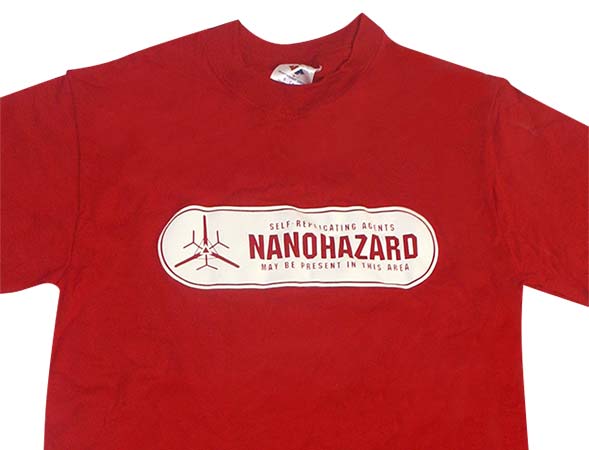
Next up is a single Nanohazard shirt, size S, printed in white ink on a red shirt (instead of white on black like the others). EDIT2: This one is gone now, as well.

I also found some conventional white-on-black nanohazard shirts in some sizes I ultimately ended up not carrying (two Medium and two Small).

And finally, I found some shirts printed in reflectorized ink with a logo that says “Satan Inside” in a parody of the “Intel Inside” logo. I printed these up before discovering that the laws which protect parody of copyrighted work don’t extend to trademarks (in the US, copyright and trademark are entirely separate things). I have one XXL, one XL, and 2 M of this shirt:

So I’m making these shirts available for $10 each. First-come, first-served. I’ve set up a special ordering page here; make sure you tell me in the “Special Instructions” section which shirt and size you want!!

Actual IM conversation

HER: we all have our weaknesses

ME: Yeah. Mine’s twenty-foot armored mechanical killing machines.

HER: I mean weaknesses as in downfalls, not as in “things I simply cannot see without needing to have them”

Some thoughts on bringing down barriers

On another forum I read, a person had asked for help with a poly situation he was confronting.

Seems that his wife of many years had just started exploring the notion of having a partner outside their marriage (with his knowledge and blessing), and her new lover had managed to do some things with her sexually that totally blew her out of the water and circumvented some barriers that had always been present in their marriage.

The person posting about this was very distressed and upset about it, to the point where he was considering asking his wife to cut things off with her new lover.

And I think that’s really interesting. Because upon reading his post, my first thought was “Dude! ROCK! You just hit the poly lotto jackpot! This is exactly one of the best things that can happen in a poly relationship!”


See, here’s the deal. If one of my partners has an amazing, mind-blowing, life-altering sexual experience with some other guy, particularly an mind-blowing, life-altering sexual experience that brings down some barrier or opens some new door (and yes, this has happened), I’m all like, awesome!

For me, one of the many (many!) benefits to polyamory is that it improves my sex life.

And I don’t mean “improves my sex life” in the sense of “lets me sleep with a bunch of women,” but rather “improves my sex life” in the sense of “offers new avenues of exploration and new ways to find intimacy with my lover.”

See, no matter how many things you can think of to do sexually (and as a seasoned, veteran pervert, I can think of quite a few), and no matter what you explore with your lover, the fact is that there will always be things that didn’t occur to you and there will always be things that you don’t explore. That’s the way it goes; as human beings, we can not possibly ever do it all–not even if we live to be a thousand years old.

Because of that, there will always be doorways that we don’t see.

This is especially true in relationships where some kind of barrier exists between the people involved. These barriers might take many forms–perhaps issues with relaxing and letting go during sex, perhaps problems with sexual communication or expectations, whatever.

When some new lover arrives on the scene, and explores something new or finds some way to bypass those boundaries, everyone wins. If one of my partners has a lover who gives her this awesome experience, then she has something she can take back into her relationship with me–“Hey Franklin! Check this out! If you do this, and then this and then this over here, then my body does this amazing thing! Isn’t that cool?”

But more importantly, if someone is able to communicate with one of my lovers on a level that I never have, or finds a way around some kind of barrier that’s always existed between us, then that person has just offered a gift of incalculable value. He’s just created a roadmap to greater intimacy with my partner, by showing both of us that this barrier can be circumvented, and showing us how.

Now, it’s true that some issues between people might be specific and unique to them. Even so, sometimes all it takes to begin to work on them anew is the feeling that it is possible to have a sexual relationship in which this whatever-it-is problem doesn’t exist; funny thing about people is that when you show them something’s possible, often that’s all it takes for them to find a way to do it.

Plus, y’know, I really dig my partners, and I like when they’re happy.

So to me, when a lover has some amazing, mind-blowing experience with someone else, that’s a cause for celebration, rather than fear and angst. That seems to be a minority opinion, though–and that’s a damn shame. Seems to me life is just a whole lot better when you’re not all like “I have to be the best lover my partner has ever had or OMFG FAIL and I’m now worthless as a human being and she doesn’t need me any more and brain weasel brain weasel brain weasel.”

Future Plans, and Life Changes

(One of the very few friends-locked posts you’ll see in this journal, largely because I haven’t talked about these issues with the folks at the company I work with yet, and don’t want to incite any premature panic.)

So. Atlanta. Not really crazy about it.

I moved to Atlanta several years ago because the electronics company I’m a minority partner in relocated its headquarters here. Since that time, the company has encountered several financial crises, gone through a lot of employees, and just generally made a right mess of things internally. The company’s survival has been touch and go for a while, and on several occasions they’ve been late paying me or haven’t paid me at all.

Now, that’s not really as big a problem as it might have been. I’ve invested a tremendous amount of time and effort into the various other projects I have going–my Web sites, Onyx, stuff like that–and they mostly pay the bills these days. I’m not really dependent on the electronics company for my living. (It’d be nice if my stock in the company were worth more than the paper it’s printed on, but that’s a different issue.)

Had I known three years ago what I know now, I don’t think I would ever have moved to Atlanta. I don’t like that all my relationships are long-distance, I don’t like that I’ve never really been successful in building a community here, and I don’t like Atlanta.

That’s more or less irrelevant now, though. Water under the bridge.

What’s more relevant is I’ve finally reached the point where I can’t abide the idea of staying here any more. So, when my lease is up in June, I’m heading to Portland, Oregon, where I will be living with zaiah (at least that’s the plan) and where I feel I already have more of a community than I have in Atlanta.


My goal from this is nothing short of a complete, ground-up rebuilding of my life. I don’t like the way it looks right now, so I’m going to change it. The goals for the move:

– Not working in an office any more. I want to do 100% of my work completely online (including the work I do for the electronics firm; ideally, I’ll still be doing Web programming for them), whether that be consulting, Web dev, my own Web site, or whatever. That by itself frees up all the other things I’d like to be able to do.

– Spending more time traveling. It sucks having all of my relationships be long-distance; I’d like the freedom to be able to say “You know what? I want to spend the next four weeks with dayo” or “I want to spend some time living with figmentj” and have that be possible.

– Spending more time in poly/BDSM/sexblogging activism, including having a higher profile at conventions, retreats, and that sort of thing. For example, I’ve received about a half-dozen invitations to the Sex 2.0 convention this May in DC, and I won’t be able to go–I’d like to have the ability to attend next year. Ditto for things like SxSW, Loving More, Dragon*Con, and the like.

– A living arrangement that will better accommodate an extended local poly network. zaiah and I would like to create a home that can allow for multiple live-in or near-live-in relationships, should those opportunities present themselves.

– A much more active involvement in local BDSM and poly communities. This is something I had in Tampa but don’t have here.

I’m really excited about moving, and I’m looking forward to having a lot more freedom to travel. Now if only these next few months would pass quickly!

Some Thoughts on Body Modification, Ethics, and Self

In response to this post I made about the intersection of disability and transhumanism, illicitlearning posted a link to a YouTube video on exactly the same subject, that discusses some facts I wasn’t aware of.

The entire video is over an hour long, so for that reason I’m not going to embed it here. I do recommend that anyone interested in ethics, body modification, transhumanism, functional changes to the body, agency, bioethics, or the ownership of the self watch it, however. It’s probably not safe for work–there are pictures and descriptions of forms of body modification some folks might not approve of–but it’s good to watch regardless.

You can find the YouTube video here.

The person in the video is Quinn Norton, a journalist who’s long been interested in both body modification and transhumanism. She’s one of the people who first experimented with subdermal rare-earth magnet implants that I talk about here.


One of the things that surprised me to learn from this video is just how profoundly fucked-up our system of bioethics–and I use the term “ethics” in there only loosely–is in this country.

We have the capability to do some really neat things, and we’re on the cusp of learning to do some even cooler things. We can, for example, exploit the brain’s plasticity to create new senses (as with the aforementioned implanted magnets) or to map one sense onto another (as with experimental devices that allow people to see by mapping images onto the tongue with electric currents).

We’re closing in on more interesting things still. For example, one area of nanotech research involves respirocytes, which are tiny machines designed to do what red blood cells do by carrying oxygen to and taking carbon dioxide away from the cells of our body. The trick is that they are thousands of times more efficient, and if they work as projected, would allow someone injected with them to do things like hold their breath for half an hour, run at full speed without breathing for ten or fifteen minutes, and even survive with their heart stopped for thirty minutes or so.

And you know what? All this stuff is considered “unethical”–and much of it is illegal.


Before I get off on the rest of this rant here, I’d like to start with a basic premise from which the entire rest of my argument against this sort of nonsense flows, and that is the value of agency.

Agency–the notion that each of us is a self-determining, self-aware individual, uniquely positioned to choose for ourselves what we do with our own bodies–is, I believe, the most basic of all moral principles, and the one from which all other moral principles flow. Things that we all agree are immoral, such as murder, kidnapping, rape, or torture, ultimately grow from the notion of agency. Each of us is responsible for the consequences of our decisions (else there can be no morality), and each of us has the ultimate right to control of our own bodies (the right which is violated when another person deprives us of our liberty or our life).

In the final analysis, I do not believe any credible system of ethics can ignore or diminish the principle that the first and most basic of all moral principles is the idea that we have the right to choose for ourselves what we do with our bodies.

So. Onward.


According to the American Medical Association’s Code of Ethics, there are many techniques and procedures that are considered “unethical” across the board. Among these are “augmentation” technologies–technologies intended or designed to provide someone with greater-than-human-normal abilities or senses.

An example? Cochlear implants. These implants are often used to cure one of the most common forms of deafness, and for this use, they are considered both legal and ethical. The implant is a tiny electronic gadget implanted deep in the ear anal, and connected directly to the auditory nerve. They’re implanted into tens of thousands of deaf patients to restore hearing.

But…

A cochlear implant which offers a deaf person some kind of new ability or functionality that a “normal” person does not have is considered unethical across the board. For example, a cochlear implant that had BlueTooth functionality, to allow its user to directly access a cell phone or a computer? Unethical. An American doctor who implanted such a thing would lose his license. A cochlear implant designed to be implanted in a person with normal hearing, to extend the range of his hearing? Also unethical.

And it gets worse.

In the United States, it is considered a breach of medical ethics for a plastic surgeon to change someone’s appearance outside the socially accepted standards of physical beauty.

Read that again and think about it. In the United States, it is considered a breach of medical ethics for a plastic surgeon to change someone’s appearance outside the socially accepted standards of physical beauty. Medical ethics are dictated by socially accepted standards of physical attractiveness. It is perfectly legal, and perfectly ethical, for a plastic surgeon to put silicone into a woman’s tits to make them bigger (because social standards of beauty favor big tits), but it is considered unethical (and in most places, illegal) for a plastic surgeon to do something like pointed ears; a surgeon who does so risks loss of his license, prison, or both.

Which is pretty damn stupid, if you ask me.


In practice, what that means is the folks who want to get many kinds of body modifications done, from aesthetic mods like pointed ears to functional mods like implanted magnets, must go to unlicensed body-mod artists without formal medical training, who are not medical doctors and who do not have access to anaesthetics, antibiotics, or other basic medical tools. All because the results either give them some functionality outside the “human norm” or take their appearance away from “socially accepted standards of beauty.”

The people who practice the art of body modification live under constant threat of legal action. In some states, such as California, they are considered “unlicensed medical practitioners” and are subject to arrest and prosecution if they are caught. In other states, such as Oklahoma, a person willing to do something as simple as tattooing must pay a $100,000 cash bond to do so legally (and that’s actually a concession to fans of body art; until 2006, tattooing was illegal everywhere in the state.

Now, you might not be into tattoos or pointed ears. Personally, I think they can look cool on the right person, but whatever. That’s not the point. The point is that we as a society have determined that you should only be able to control the way your body looks if the result is what other people would find attractive, and I frankly think that’s an appalling and immoral approach to the question of medical ethics.

Look, this is really simple. My body belongs to me; your body belongs to you. Our appearance is not subject to vote. And yet that’s exactly what we have–a system whereby if enough people think that something (big tits) is attractive, then plastic surgeons are ethically permitted to give women big tits, but if there aren’t enough people who think something else (pointed ears) is attractive, then plastic surgeons are barred from giving folks pointed ears.

It’s stupid enough to live in a society that tells people, every day, in a hundred thousand different ways, that there’s only one way you are “supposed” to look, but to write that notion into professional ethics and law is stupid beyond belief. We claim to be a society that values plurality, diversity, and individual control over our own lives, yet in the single most basic, fundamental form of individual control of all, individual control of our own bodies, we have adopted a herd mentality and then elevated that heard mentality to the level of ethical absolute.

“I like big tits, so doctors are permitted to perform dangerous and massively invasive surgery to give women big tits. I don’t like pointed ears, so doctors are not permitted to perform relatively trivial, simple procedures to give people pointed ears.” Someone explain to me exactly how this is “ethical”? When was it, exactly, that common tastes dictated ethics?

And those standards of “socially acceptable beauty” are themselves toxic and unrealistic. A lot of folks might not like the thought of people getting pointed ears, but how do you explain the saga of Melanie Berliet, an attractive 27-year-old model and Vanity Fair writer, who for her piece on cosmetic surgery visited three plastic surgeons, who complied a lengthy, expensive, and medically invasive list of “improvements” they recommended for her? A lot of people talk about how toxic and unrealistic social standards of female beauty are, but when you take it to the ludicrous extreme of thinking that a very attractive woman by ay standards could benefit from surgical “improvement,” but that functional or unconventional body modification is inherently wrong, what exactly does that say about social standards?

Folks, this is fucked up beyond all human reckoning.


A great deal of the current legal landscape regarding body modification, particularly “enhancement” and “human norms,” can be traced to the opinions of a few people, notably among them Leon Kass and Francis Fukuyama.

These two people were among the eighteen appointed by George W. Bush to the president’s Council on Bioethics when Bush took office. The Council on Bioethics is an Administrative cabinet designed to advise the President on the ethical issues surrounding medicine and biotechnology, and as such its goal, at least nominally, is to act as an ethical voice in considerations including legislation, regulation, and research funding in biotechnology.

And who, exactly, are these people?

Leon Kass, the head of the Council under Bush, is an ardent foe of new biotechnology, particularly research involving human reproduction, longevity, and augmentation. He is the architect of Bush’s stem-cell research ban, and lobbied Congress unsuccessfully to pass a ban on research aimed at improving human lifespan on the grounds that death is “necessary and desirable end” and “Christians already know how to live forever.” He opposes in-vitro fertilization on the grounds that it is an affront to human dignity (an argument which I must admit makes no sense at all to me) and that it obscures moral truths about the essence of human dignity (which basically sounds like handwaving: “It seems yucky to me, so I’ll blather about moral truth to conceal the fact that I have no cogent arguments save for the fact that it seems yucky to me”).

In fact, Kass even explicitly acknowledges this “yuck factor.” He calls it “the wisdom of repugnance,” and says that anything we see as “yucky” is, on its face, inherently immoral–by which definition, things like organ transplants (derided with disgust as “doctors cutting up corpses and sewing bits of dead people into live people” when it first started to develop). Many things seem yucky when they are new, but with familiarity come to be recognized as the lifegiving boons that they are.

Francis Fukuyama is a political economist who somehow believes that his knowledge of politics and economic issues makes him fit to hold a cabinet-level position on the ethics of biotechnology. He has written a book, “Our Posthuman Future,” in which he labels transhumanism as the most dangerous idea that has ever developed. He’s also noteworthy for another popular book, “The End of History and the Last Man,” in which he argues that the progression of history is over and that free-market democracy is the ultimate of all political and social systems. He’s one of the leaders of the neoconservative movement, and was one of the architects both of the Reagan Doctrine and of the Iraq war.

Now, you might think it strange that a free-market neocon who favors individual and free-market choices would argue that people should not be free to choose to modify themselves if they want to, and that the free market should not be permitted to offer that choice. Honestly, I’ve never been quite able to wade through his logical contortions in supporting this notion, but they seem to come down to “I want modern American democracy to be the be-all and end-all of human development, and radical new biotech that offers to change human beings too much might upset that notion and lead rise to new social and political systems that I can’t even imagine, and I think that would be bad, so we should ban any new biotechnology that could upset the applecart.”

Which strikes me as being a bit like a Roman senator saying “Rome is the pinnacle of human economic and political triumph, so we should ban any new technologies that might lead folks away from the Roman model of civilization.” And that, were it put into reality, would mean that you and I would not be having this conversation, since an instantaneous globe-spanning communication network was most definitely not part of the Roman model.

What Mr. Fukuyama doesn’t realize is that history never ends. The United States is no more the end of history than the Roman Empire was, and that’s a good thing.


It seems to me that these people–tho opponents of transhumanism, the ethics board of the American Medical Association–live in a tiny, conformist world, terrified of change and intolerant of diversity. It’s ethical to change someone’s appearance, but not if the change doesn’t match conventional standards of beauty. It’s ethical to tell women that they need bigger tits and fuller lips, but it’s not ethical to let them make their own choices about their bodies. It’s ethical to implant a device to let a deaf person hear, but not if it lets him hear better than I can.

The bionic man from the TV show The Six Million Dollar Man is, under our current legislative and ethical system, considered an abomination, and the doctors who worked on him would in real life lose their jobs, even if they improved his standard of living. We should help the disabled, but not, y’know, too much.

In the United States, we have long associated “morality” with “sex.” This nation can boast such moral luminaries as Charles Keating, the anti-porn moral crusader who made movies and advised President Reagan on moral issues before embezzling $1.2 billion dollars from a savings and loan under his control, touching off a nationwide financial crisis that threatened to rob working families of their lifes’ savings…but he was deeply concerned with morality, you see.

Even in bioethics this association continues. We have a medical community whose ideas about medical ethics are predicated on the fact that any change that makes a woman more fuckable to the general population is good; any change that makes a woman less fuckable to the general population is bad.

We are also deeply fearful as a society. We shun the disabled and favor medical technology that makes them more like us–but only so long as it keeps them in their place and doesn’t make them, y’know, better than us.

At each step along the way, we construct ethical systems that are the antithesis of agency, that seek to take away control of our bodies from each individual and instead place that control at the mercy of the common, socially accepted standard of beauty.

And I think that it’s about time we start re-thinking that approach to morality.

And as long as I’m posting videos today…

….here’s a great one from over on anansi133‘s blog.

“Disabled” and “not disabled” are not binary states, and increasingly, we’re learning to make the distinctions irrelevant. I think we’re approaching the time when replacements to parts of our body, instead of being clunky and inferior in every way to the original, are actually improvements; this is already happening in some specific niches, such as in track and field, where the International Olympic Committee is reluctant to allow legless athletes to compete with normal athletes because of the perception that sprinting prosthetics are superior to natural legs, and give the nominally “disabled” athlete an unfair advantage.

Personally, I’d like to see an athletic event similar to the original Can-Am racing event, designed to push technology right up against its limits; the rules might be something like “any augmentation or prosthetic is permissible as long as it does not contain its own power source and is powered completely by the body of the athlete who wears it.” I bet we’d see some really interesting stuff (four-second hundred-yard dash, anyone?). But I digress.

Anyway, I think the intersection of disability and transhumanism is kind of fascinating, and I find it interesting that it may end up being nominally “disabled” people who lead the way.

“I don’t care what you are. I care what you DID.”

So last night I was reading my friends list, and ran into the video I’ve posted below on drjon‘s journal.

Now, this video is about racism, but touches on a really important idea that I think extends way, way beyond conversations about race. On the subject of racism itself, I have little to add beyond what the video already says, so I’ll leave that alone.

The video is by a guy who calls himself Jay Smooth. He has a Web site and a YouTube channel, and he’s articulate and smart and funny and before you know it I’d been sucked down the Intertubes and had wasted two hours watching all his stuff.

So thanks, drjon, that’s two hours I’ll never have back.

Anyway, the video is short and is worth watching, and I’ll put it here so you can see what I’m talking about before I move on to the point that extends beyond racism and race.

The distinction between “what he did” and “what he is” is important. It’s something that trips us up as human beings all the time. It’s the thin edge of the wedge that leads to mind-reading behavior, false assumptions, broken expectations, and all manner of other ills that plague us. And it’s a really, really easy mistake to make.


Human beings are a storytelling species. We tell ourselves stories all the time, every day, without even being aware of it. These stories help us to try to make sense of the actions of other people. Indeed, we even invent stories that we tell ourselves in order to explain our own behavior, as vividly illustrated in one famous series of studies of people whose corpus callosum had been split.

A quick recap for folks who are not neurology geeks: The corpus callosum is a thick bundle of nerves that connects the left and right hemispheres of the brain. If this is damaged or cut, as used to be done to treat a certain kind of epilepsy, the hemispheres can’t communicate directly with each other. Each hemisphere controls one-half of the body and sees one-half of the visual field, but language usually exists only in one hemisphere, not both; when the corpus callosum is cut, it’s almost like you have two different brains in one body, but only one of the two can talk.

Scientists have had a ball studying folks like this; it’s great fun. One common experiment involved showing things designed to provoke a reaction to the right hemisphere, which usually lacks language, then asking the person why he was reacting the way he did; the left hemisphere had no clue what the right hemisphere was seeing, but the person would nevertheless offer up all kinds of stories to explain his reaction. An even better experiment involved showing different images to the two hemispheres, such as a snowbank to the right hemisphere and a chicken to the left hemisphere, and then asking the person to point with his left hand at an object relevant to the thing he was seeing. The right hemisphere controls the left hand, so the right hemisphere, which was seeing an image of a snow bank, would point to a snow shovel. The left hemisphere, which was seeing a chicken, had absolutely not the foggiest idea why he was pointing to the shovel, but when he was asked “Why did you point to a shovel?” he’d say “Well, because I see a chicken, and you need to use a shovel to clean up chicken manure.”

In other words, he invented a story that was total fabrication to explain his own actions, without even being aware that he was inventing a story.


We all do this, all the time, and unless we guard against it, it can really distort our perceptions of other people. Every time we say “So-and-so did this because so and so is a ___”, we’re falling into this trap.

The fact is, unless we are mind readers (or unless someone actually explicitly says why he did something), our stories about other people’s motivations are just that–stories. We fabricate these stories based on our own projections and our own ideas.

Worse, we’re not even fair about it.

In the book How We Know What Isn’t So: The Fallibility of Human Reason in Everyday Life, Thomas Gilovich talks about the self-serving nature of the stories we tell. Sociologists love this stuff, and (naturally) have done a number of experiments illustrating this, by asking people who’ve done something why they did it, and then asking people who are watching someone else do the exact same thing why that person did it.

Invariably, people will offer situational explanations for their own behavior–“I did it because of the situation I was in”–but will offer personal explanations for other people’s behavior–“He did it because he is a worthless, good-for-nothing bastard who doesn’t care about me.”

For example, we’ve all cut someone off in traffic, and we’ve all seen someone cut us off in traffic. If you ask a person “Why did you just cut that guy off?” the person will probably offer you a situational explanation, like “The sun was in my eyes, and all the glare on the windshield made it impossible for me to see him.” But if you ask that exact same person “Why did that driver just cut you off in traffic?” that person will probably say “Because he is a reckless, careless idiot who doesn’t give a damn about anyone else on the road.”

In other words, to get back to the video, people don’t talk about what that other driver did, they talk about what that other driver is.


That’s a dangerous road to walk down, talking about what other people are. Projections of the motivations of others can get you in trouble fast.

But we do it all the time. And it’s not just with other drivers; we do it in politics, in relationships, everywhere.

“You voted for McCain because you’re a religious zealot who wants to see the government overthrown and replaced with a totalitarian militant theocracy.” “Oh, yeah? You voted for Obama because you’re an anti-capitalist tree-hugger who wants to destroy private enterprise!” This is what happens when we think we can tell what people are by looking only at what they did, and it’s an embarrassment.

Now, yes, there are right-wing religious zealots who want to overthrow the American government and replace it with a religious theocracy, and they probably did vote for McCain. And there are anti-capitalist left-wingers who want to destroy free enterprise, and they probably voted Obama. But assuming that you can peek into someone’s head and ascertain their motives just from this is kinda silly. Especially when you yourself had much more rational reasons for whatever vote you cast, right?

The sun was in your eyes, but that other guy is a jerk. Same thing.


My sweetie figmentj and I even talked about this recently. It can be very difficult to separate what a person does from what that person is even when that person is a close friend or a lover, and failing to do so can certainly add to unnecessary pain. “You don’t call me because you are indifferent to me” is very different from “you don’t call me because you don’t like talking on the phone,” and the former is much more hurtful than the latter. While it’s true that a person’s priorities are often reflected in their behavior, and it’s also true that a person who doesn’t care about you is in fact unlikely to call, there’s a long leap from that to “because you didn’t call, you don’t care.” (In fact, the train of thought that goes “A person who doesn’t care about me won’t call me; you are a person who doesn’t call me; ergo, you don’t care about me” is a problem in its own right, because it commits the fallacy of affirming the consequent. Devilishly slippery, this stuff is.)

And it presents itself in other ways, too. “My lover just checked out that hottie who walked into the store. That means my lover is a faithless bastard who doesn’t really love me!” The stories we tell sometimes say more about our own internal fears and insecurities than about the person we’re telling them about.

So, yeah. It’s about what people do, not about what people are. And if you want to change what people do, the best way to do this is to keep the conversation away from what they are.