New poster: Relationship Skills, Take 2

Since I offered up the first go-round of a poster design promoting relationship skills I’ve found to be incredibly valuable in happy, successful relationships, I’ve received a great deal of helpful feedback.

I’ve redesigned the poster, taking a lot of that feedback into account. It’s been tightened up considerably, some of the principles have been changed, the design has been tinkered with, and generally it’s been greatly improved by your thoughts and comments. So, thanks!

Here’s the new version:

I’ve also created an entry for it on my online store; you can actually order copies of it now! The poster is 16″ x 20″ (smaller than the Map of Human Sexuality, which is a monster), and printed on very heavy semi-gloss paper. Barring any major last-minute edits, it will be going in for printing tomorrow, which means I will be able to start shipping it early next week.

Some thoughts on courage

I hear you will not fall in love with me
because I come without a guarantee,
because someday I may depart at whim
and leave you desolate, abandoned, grim.
If that’s the case, what use to be alive?
In loving life you love what can’t survive:
and if you grow too fond and lose your head,
it’s all for nought–for someday you’ll be dead.

— Erica Jong, To X. (With Ephemeral Kisses)

This post started out as a reply to one of the comments in my first go-round of the relationship skills poster I’m working on.

I believe courage is among the most valuable traits any person can have. It’s a trait I look for in a potential partner. One of the things I say often, and included on the poster, and one of the things I believe it would have been most helpful for me to have learned a long time ago, is “life rewards people who move in the direction of greatest courage.”

Every time I say that, I’m always taken a bit by surprise by the amount of resistance I get to it. I hear a lot of objections to this idea, and the objections are usually couched in terms that frankly don’t make a lot of sense to me. It seems like when I talk about life rewarding courage, the idea I’m trying to communicate ends up vastly different in its interpretation. I started to write a response about what I mean when I say that life rewards courage, but I thought it deserved a blog post of its own.

First, let me talk about what I mean when I use the word “courage.”

Courage is not the absence of fear. If we never felt fear, there would be no need for courage; indeed, without fear, the idea of courage would be meaningless. We as a species never experience the emotion of fluntillation, for instance, so talking about making a virtue of bandestility in the face of fluntillation makes no sense. Courage isn’t in what you do when you are fearless; it’s in what you do when you’re fearful.

Courage does not mean recklessness. It does not mean acting on impulse or without intent. Recklessness is sometimes easier than real courage; when you’re reckless, you may act without considering the risks or consequences of your actions, and when you don’t consider the risks of your actions you might be less afraid of them. The kind of courage I’m talking about is not blind, impulsive recklessness, but action that comes from calm deliberation.

Courage is not desperation. A person with nothing to lose has nothing to fear.

Someone in the conversation that followed the first go-round of the relationship poster used the argument that a person who hits on a hundred women a day might succeed in finding sex partners in the short term, but will likely eventually run out of people to hit on and also end up being socially ostracized.

I find this argument a little baffling. It is not lack of courage that prevents me from hitting on a hundred people a day; it’s the fact that hitting on a hundred people a day wouldn’t succeed in getting me the kind of relationship I value. Hitting on every woman I see would not be an act of courage, because I don’t want a relationship–or sex, for that matter–with every woman I see.

Which brings up what courage is.

Courage is making decisions that take you closer to what you want, or to the person you want to be, even when you’re scared. Courage is not allowing fear to be in the driver’s seat. Courage is talking to the person you are interested in, even though you’re aware that you may be rejected.

Courage is saying “I will reach for what I want” rather than saying “I have been hurt before, and I don’t want to be hurt again, so I’m not going to risk it; I’m just going to sit here and do nothing.” Courage is saying “This new thing you’re doing scares me; it makes me feel unsure and insecure, but I will support you in it anyway” rather than “This thing you’re doing scares me; I forbid you to do it.”

I have tried both approaches. Moving with courage more often results in me having the life that I want to have than allowing my fears to control my actions does. Relationships with people who move with courage are more satisfying to me than relationships with people who don’t.

Now, sure, moving with courage is not always rewarded. Again, if there were no possibility of hurt or loss, there would be no virtue in courage. Yes, you might reach out for what you want and come up short. You might be rejected. You might be hurt. Absolutely.

But what’s the alternative? Never reaching for what you want? Always backing down in the face of fear? Never choosing the harder path? What does that gain, other than a life lived from cradle to grave by the path of least resistance?

If one person reaches for the relationship she wants ten times, and is rejected nine of those times, and another person never reaches for what he wants for fear of rejection, which of them has been more rewarded? The person who was hurt but now has the life she wants, or the person who has never been hurt but also never been happy?

Life rewards people who move in the direction of greatest courage. Yes, moving with courage means running the risk of being hurt. But hiding in the corner, afraid to take a chance, also hurts; it’s just that it hurts all the time, so you become less aware of it.

And being hurt isn’t the end of the world. Broken hearts mend. Indeed, I’ve written in the past about the value of having your heart broken; often, it’s in the way we deal with pain and loss that the best inside us has the chance to blossom.

To live a life built on a foundation of fear, in the end, breaks far more than just a heart. It destroys any chance of having anything worth keeping. Moving with courage means risking pain; but failure of courage means risking everything.

Courage is not fearlessness, or recklessness, or desperation. It is choosing who you want to be, deciding what kind of life you want to have, and then moving toward that even when it’s scary. It is not rewarded every single time; we do not always get what we want, and sometimes, we get hurt. Courage is in living the life we want in spite of that. If there is any other way to be happy, I have not found it.

Some thoughts on parasites, ideology, and Malala Yousafzai

This is Malala Yousafzai. As most folks are by now aware, she is a 14-year-old Pakistani girl who was shot in the head by the Taliban for the crime of saying that girls should get an education. Her shooting prompted an enormous backlash worldwide, including–in no small measure of irony–among American politicians who belong to the same political party as legislators who say that children ought to be executed for disrespecting their parents.
I’ve been reading a lot lately about what seems to be two different and at least theoretically unrelated things: parasitology and ideology, specifically religious ideology. This might seem to have nothing to do with Malala Yousafzai’s shooting, but it really isn’t.

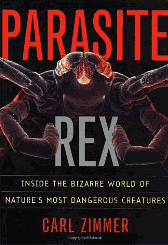
When I say I’ve been reading about parasitology, what I mean by that is my Canadian sweetie has been reading to me about parasitology. Specifically, she’s been reading me a book called Parasite Rex, which makes the claim that much of evolutionary biology, including the development of sexual reproduction, is driven by parasites. It’s been a lot of fun; I never knew I’d enjoy being read to so much, even though the subject matter is sometimes kinda yucky.

What’s striking to me is that these things–religious ideology and parasitology–are in some ways the same thing in two different forms.

Parasites make their living by invading a host, then using the host’s resources to spread themselves. To this end, they do some amazing manipulation of the host. Some parasites, for instance, are able to alter a host’s behavior to promote their own spread. Sometimes it’s as crude as irritating the host’s throat to promote coughing which spreads hundreds of millions of virus particles. Other times, it’s as bizarre and subtle as influencing the host’s mind to change the way the host responds to fear, in order to make it more likely that the host will be eaten by a predator, which will then infect itself with the same parasite. In fact, parasitologists today are discovering that the study of life on Earth IS the study of parasites; parasites, more than any other single factor, may be the most significant determinant in the ratio of predator to prey biomass on this planet.

Religious ideology would seem to be a long way off from parasitism, unless you consider that ideas, like parasites, spread themselves by taking control of a host and modifying the host’s behavior so as to promote the spread of the idea.

This isn’t a new concept; Richard Dawkins coined the term ‘meme’ to describe self-replicating ideas decades ago.

But what’s striking to me is how direct the comparison is. The more I learn about parasites, the more I come to believe that parasites and memes aren’t allegories for each other; parasites ARE memes, and vice versa.

We tend to think of parasites like toxoplasma as being real things, and ideas like the salvation of Jesus Christ as being abstract concepts that don’t really exist the same way that real things do. But I don’t think that’s true.

Ideas exist in physical form. It might be as a series of symbols printed in a book or as a pattern of neural connections stored inside a brain, but no matter how you slice it, ideas have a physical existence. An idea that does not exist in any physical way, even as neuron connections wired into a person’s head, doesn’t exist.

Similarly, parasites are information, just like ideas are. A strand of DNA is nothing but an encoded piece of information, in the same sense that a series of magnetic spots on a hard disk are information. In fact, researchers have made devices that use DNA molecules to store computer information, treating banks of DNA as if they were hard drives.

In a sense, ideas and organisms aren’t different things. They are the same thing written into the world in different ways. An idea that takes control of a host’s brain and modifies the host to promote the spread of the idea is like a parasite that takes control of a host and modifies it to spread the parasite. The fact that the idea exists as configurations of connections of neurons rather than as configurations of nucleotides isn’t as relevant as you might think.

We can treat ideas the same way we treat parasites or diseases. We can use the tools of epidemiology to track how ideas spread. We can map the virulence of ideas in exactly the same way that we map the virulence of diseases.

Religion is unquestionably a meme–a complex idea that is specifically designed to spread itself, sometimes at the host’s expense. A believer infected with a religious ideology who kills himself for his belief is no different than a moose infected with a parasite that dies as a result of the infection; the parasite in both cases has hijacked the host, and subverted the host’s own biological existence for its own end.

The more I see the amazing adaptations that parasites have made to help protect themselves and spread themselves, the more I’m struck by how memes, and especially religious memes, have made the same adaptations.

Some parasitic wasps, for example, will create multiple types of larva in a host caterpillar–larva that go on to be more wasps, and larva that act as guardians, protecting the host from infection by other parasites by eating any new parasites that come along. Similarly, religious memes will protect themselves by preventing their host from infection by other memes; many successful religions teach that other religions are created by the devil and are therefore evil, and must be rejected.

We see the same patterns of host resistance to parasites and to memes, too. A host species exposed to the same parasites for many generations will tend to develop a resistance to the parasites, as individuals who are particularly vulnerable to the parasites are selected against and individuals particularly resistant to the parasites are selected for by natural selection. Similarly, a virulent religious meme that causes many of its hosts to die will gradually face resistance in its host population, as particularly susceptible individuals are killed and particularly resistant individuals gain a survival advantage.

Writers like Sam Harris and Michael Shermer talk about how people in a pluralistic society can not really accept and live by the tenets of, say, the Bible, no matter how Bible-believing they consider themselves to be. The Bible advocates slavery, and executing women for not being virgins on their wedding night, and destroying any town where prophets call upon the citizens to turn away from God; these are behaviors which you simply can’t do in an industrialized, pluralistic society. So the members of modern, industrialized societies–even the ones who call themselves “fundamentalists” and who say things like “the Bible is the literal word of God”–don’t really act as though they believe these things are true. They don’t execute their wives or sell their daughters into slavery. The memes are not as effective at modifying the hosts as they used to be; they have become less virulent.

But new or mutated memes, like new parasites, always have the chance of being particularly virulent. Their host populations have not developed resistance. In the Middle East, in places where an emergent strain of fundamentalist Islam leads to things like the Taliban shooting Malala Yousafzai, I think that’s what we’re seeing–a new, virulent meme. islam itself is not new, of course, but to think that the modern strains of Islam are the same as the original is to think that the modern incarnations of Christianity are akin to the way Jesus actually lived; it’s about as far off the mark as thinking a bird is a dinosaur. They share a common heritage, but that’s all. They have evolved into very different organisms.

And this particular meme, this particular virulent strain of Islam, is canny enough to attack its host immune system directly. The Taliban targeted Malala Yousafzai because she favors education for women. Education, in many ways, provides an immunological response to memes; it is no accident that Tammy Faye Bakker famously said that it’s possible to educate yourself right out of a personal relationship with Jesus Christ. It’s no accident that Fundamentalism in all of its guises tends to be anti-intellectual and anti-education.

I’m not saying that the meme of religion (or any other meme) is inherently bad, of course. Memes have different strains; there are varieties of any large religion that are virulent and destructive to their host population, and other strains that are less virulent and more benign.

But with parasitic ideas as with parasitic biological entities, it is important to remember that the goal of the parasite is not necessarily the same as the goal of its host. Parasites attempt to spread themselves, often at the host’s expense. the parasite’s interests are not the host’s interests. Even a seemingly benign meme, such as a meme that says it is important to be nice to each other in order to gain an everlasting reward in heaven, might harm its host species if it siphons away resources to spread itself through churches that might otherwise have been used to, for example, research new cures for cancer. At the more extreme end, even such a benign meme might cause its adherents to say things like “We as a society don’t need to invest in new biomedical nanotechnology to promote human longevity, because we believe that we will live forever if we abide by the strictures of this meme and help to spread it through our works.”

Virulent memes tend to be anti-intellectual, because education is often a counter to their spread. Malala Yousafzai was targeted because she represents the development of an immune response to a virulent, destructive meme that is prevalent in the environment where she was born.

New poster: Relationship Principles (I wish I had learned in kindergarten)

On a mailing list I read, I recently wrote an article summarizing the basic things about relationships that I wish I had learned in elementary school. Several folks have suggested I make it into a poster. Here’s a first go-round of a poster version, which I plan to have printed if there’s enough interest. Let me know what you think!

The principles themselves are:

You can not expect to have what you want if you do not ask for what you want.

Just because you feel bad doesn’t necessarily mean someone did something wrong.

Just because you feel good doesn’t necessarily mean that what you’re doing is right.

Integrity matters—not for the people around you, but for you.

Life rewards people who move in the direction of greatest courage.

An expectation on your part does not incur an obligation on someone else’s.

When you feel something scary or unpleasant, talk about it.

Your partners add value to your life; treat them preciously.

Make sure your partner’s heart is safe in your hands.

The easiest way to attract people with the qualities you desire is to be the sort of person that someone with those qualities finds interesting.

People are not commodities.

There are a whole lot of things your partner will do that are Not About You.

Different people express love in different ways; learn to recognize the way your partner speaks of love, so that you know it when you see it.

Don’t treat people the way you’d have them treat you; treat them the way they’d have you treat them.

Pay attention.

We are all born of frailty and error; it is important that we forgive one another’s failings reciprocally.

Being in a relationship that does not meet your needs is not necessarily better than being alone.

Love is abundant.

It is not necessary to be the best at everything, nor even the best at anything; alone of all the people in the world, only you bring your unique mix of qualities to the table.

Relationships entered into from conscious choice are often more rewarding than ones entered into out of default assumptions.

Don’t play games, especially with other people’s hearts.

The things you think are important when you’re theorizing about relationships are not always the things that turn out to be important.

Be flexible.

A relationship with a partner who chooses, every day, to be with you is more satisfying than a relationship with a partner who is with you because he or she can’t leave.

Real security comes from within.

People are not need fulfillment machines.

Don’t look to others to complete you.

Change is a part of life.

Occasionally, you will feel awkward, uncomfortable, or both; that’s normal, and not something to be feared.

We are all lousy at predicting how we will respond to new or unfamiliar situations.

When you hurt someone—and you will—suck it up, take responsibility for it, and do whatever you can to make it right.

There will be times when relationships end; it doesn’t mean they were a failure, or that the other person is a bad person.

Your heart will, at some point, almost certainly be broken, and that’s okay; you will survive, and find love again.

Feelings are not fact.

Fear of intimacy is the enemy of happiness.

The times when compassion is the most difficult are the times when it’s most necessary.

Don’t vilify those who hurt you; they are still people, too.

It is possible to deeply, profoundly love someone to the bottom of your heart and still not be a good partner for that person.

Being uncomfortable is not , by itself, a reason not to do something.

It is almost impossible to be generous or compassionate if all you feel is fear of loss.

The world is the way it is, not the way we want it to be.

Life’s song is filled with beauty and chaos and joy and sorrow and pain and uncertainty and ecstasy and heartache and passion; to fear any of these things is to fear life.

Benchmarks for Good Relationships

On another forum I read, the subject of how to tell whether or not a relationship is a good one–benchmarks, if you will, for positive, vibrant relationships–was raised.

I put some thought to the question of creating benchmarks for good relationships, and came up with this set:

1. Am I striving to treat others with compassion, even when it’s hard? Am I being treated with compassion?

2. Does this relationship offer me the opportunity to grow and develop in the way that feeds me and makes me happy? Does it offer the same opportunities to all the other people involved?

3. Am I moving with courage in this relationship? Are the people around me moving with courage?

4. Does this relationship help me to be the best possible version of myself? When I look around at the other folks involved, do I see the best of them?

5. Can I say whatever I need to say, whenever I need to say it, and have a reasonable expectation that I will be heard and understood? Am I creating an environment where everyone else can tell me what they need to say, even if it’s something I don’t want to hear, and I will hear it?

6. Is this relationship fair to everyone concerned? Not “fair” as in “everyone gets the same thing,” but “fair” in that “everyone has a hand in the relationship, everyone’s voice can be heard, and everyone has the ability to help build the things that make their parts of it happy and healthy.”

7. Does this relationship give all the people involved the opportunity and support they need to pursue their joy?

This is a first stab at the question of defining benchmarks for good relationships. I think there might be some things I’m missing. Opinions? What would a list of benchmarks for healthy relationships look like to you?

The Geek Social Fallacies of Polyamory

In the unlikely event that you may not be aware of them, the Geek Social Fallacies are a list of flaws in reasoning about relationships which are altogether depressingly common in geek social groups.

It’s not surprising that they exist; though it’s less true now than it was, say, twenty years ago, it’s still a fact that many self-identified “geeks” grow up as social outcasts, and create communities that express their own quirks and dysfunctions because of that.

I’ve been pondering some pondering thoughts about how the same idea might apply to polyamorous people, and I think there is a loose correlation between the Geek Social Fallacies and the Poly Social Fallacies. Don’t get me wrong; the poly community, by and large, is awesome, and I scarcely form close friendships with anyone outside of it any more. But we are prone to our own social quirks and dysfunctions. So, here’s a first stab at drafting the Poly Social Fallacies:

Poly Social Fallacy #1: Polyamorous People Don’t Get Jealous

If we were to meet someone who claims immunity to an emotion like, say, disappointment, or sadness, or frustration, or doubt, we’d probably look at her like she’d just sprouted an extra head or two. Yet when people in the poly community claim an “immunity” to jealousy, often we’ll just nod and say “Yes, that’s awesome, you’re a Good Poly Person.”

Even when they feel jealousy but refuse to acknowledge it for what it is. Which is, I have to admit, something I’ve been guilty of myself when I started doing the non-monogamy thing.

Jealousy is merely a feeling, nothing more. Like all emotions, it’s part of the normal and varied landscape of the human condition. Some people may feel it more easily than others, and some people may go through long periods of time without ever encountering a situation that triggers it, but that’s not the same thing.

As with all emotions, it’s a way for the parts of our brain that don’t have language to communicate with us. Sometimes, what those bits of our brains are communicating might be “Hey, there’s an inconsistency here; there’s something hinkey that might mean my needs aren’t being met” and other times it’s “RAAAARGH! PROTECT TERRITORY! MUST SMASH INTERLOPER TRYING TO TAKE MY PROPERTY!”…but it’s not something that being polyamorous somehow confers an immunity to, any more than being into motor sports magically makes one immune to disappointment.

Carriers of this fallacy can do all sorts of destructive things, from acting out in passive-aggressive ways while refusing to confront the reality of what they’re feeling, to attempting to impose all sorts of micromanaging controls on their partner’s behavior in the name of “setting boundaries.” A better solution is honesty: “Hey, tI’m feeling jealous. That doesn’t mean I’m a bad person, or that you have done anything wrong, but it does mean I’d like to talk about this.”

Poly Social Fallacy #2: Polyamory Is More Evolved

This particular fallacy isn’t unique to polyamory; members of any sexual or relationship subculture often feel like they Have It Figured Out, and that if only their particular thing could be recognized for how brilliant it was by the MainStream Culture, everyone’s lives would be better off.

This is often a reaction to being marginalized by mainstream culture. When you’ve grown up not fitting in with the people around you, finding a community where you DO fit is such an overwhelming relief that you want to spread the joy you feel far and wide.

And, to be fair, the poly community does espouse many values–communication, honesty, communication, problem-solving, communication, negotiation, and communication–that would benefit anyone in any sort of relationship. (Just imagine how much better off the characters in any romantic comedy would be if they would only talk to each other!)

But carriers of this fallacy run off the rails in two directions: first, by assuming that just because someone is monogamous, it must mean they don’t have these skills; and second, by assuming that just because they are polyamorous, it means they do.

It’d be marvelous if membership in the poly community came with these relationship skills. And some folks do seem to feel that that’s how things work–woohoo! Im polyamorous, and poly people are good communicators! That means I’m a good communicator! Go me!–but even a casual look around the poly landscape will show that it doesn’t quiiiiite work that way.

More to the point, there is no single relationship model that works for everyone. Just like monogamy doesn’t work for all of us, polyamory doesn’t work for all of us either. There are monogamous people who are monogamous because monogamy is the most natural fit for them, not because they’re knuckle-dragging Neanderthals who are merely accepting cultural defaults because they have not yet received the blessings of polyamorous Enlightenment.

Poly Social Fallacy #3: The Core Relationship Before All

Valuing relationships is a reasonable thing. Wanting to protect a relationship is a valid measure of respect for the value it brings. Believing that it’s OK to do anything, commit any act, or hurt any person so long as the core relationship remains is unhealthy.

I recently encountered a great example of this fallacy in action. A woman declared that, because she had once been in a situation where her partner didn’t take care to meet her needs when he started a relationship, she realized that the only ethical way to have relationships was to abandon any new partner the moment her husband expressed the slightest discomfort. Her reasoning, you see, was that it is unethical to hurt people, and therefore the only right thing to do was to end any relationship that she was involved in the instant it looked like her husband might have any problem with it at all–because she would never be so cruel as to hurt someone else.

Carriers of this social fallacy venerate their existing relationship to the point where they either don’t acknowledge or simply don’t care about anyone else’s pain. Any new partner is an expendable commodity; any amount of hurt or heartbreak inflicted on any number of people is justified if it “protects” the “primary” relationship.

Sometimes, learning new skills and adapting to new situations is uncomfortable. Sometimes, it’s necessary to accept that a bit of discomfort is OK; it doesn’t mean the End Of Everything. And ethical behavior always recognizes that callously inflicting pain on others–any others–is something to be avoided wherever possible.

Poly Social Fallacy #4: Relationships Are Transitive

This particular social fallacy can take two forms, each pernicious in its own way.

The less common form it takes is the notion that if my partner is sexually or romantically involved with someone, that means I have a right to be involved with that same person, too. It’s sometimes seen by established couples, especially couples new to polyamory, as the perfect solution to jealousy; if I am having sex with the same person my partner is having sex with, then there’s no reason to be jealous, right? (We should all live in a world where emotions like jealousy are so rational…but then they wouldn’t be emotions, would they?)

The more common form is “My partners should all be friends with each other.” While it’s nice when that happens, and it’s definitely true that the members of a poly group should be able to be in the same room with each other and to interact pleasantly without bloodshed, it’s not necessary that everyone be best friends merely because they fancy the same person.

Both forms of this fallacy, taken to their (il)logical conclusion, lead to a creepy place that denies people their own autonomy: If you are to be involved with person X, you are now obligated to like/be intimate with/be friends with/have sex with person Y.” Eww! People make their own choices in friends and lovers for their own reasons; it’s rare indeed that someone will be okay with being told how they must relate to someone merely because they fancy someone else. Trying to dictate how people relate to one another is inappropriate social behavior, regardless of whether we’re talking about friends or metamours or lovers.

Poly Social Fallacy #5: Partners Do Everything Together

Relationships almost always need a certain amount of alone time if they are to grow and thrive. When we first start out in polyamorous relationships, having a partner go off and spend time alone with someone else can feel threatening; it can feel like an exclusion. So why not simply do everything together, all the time?

Unfortunately, this can constrain a relationship. It can also create Drama, when someone feels that his or her needs for intimate, one-on-one time aren’t being respected.

It is rare in the extreme that two different relationships develop in the same way and the same direction at the same rate at the same time, even in situations where three people are all romantically involved with each other. It’s reasonable that there will be times that two of the three will do something on their own, whether it’s have sex or take a walk in the garden, and this is not a reflection on, or an exclusion of, the third person.

Taken to its extreme, this social fallacy can lead to some pretty bizarre places, like “I know I get home from work an hour later than you two do in the evening; I don’t want you doing anything interesting at all (or even “I don’t want you spending time together”) until I get home.”

Breakfast Cereal for Kittehs!

Look! They make a breakfast cereal named after my little kitten, my precious little honey bunches of shai-hulud!

BDSM Ethics Part 2: Some Thoughts on Making the World Better

In Part I of this essay, I wrote some initial thoughts about the BDSM Pledge Web site. To recap briefly (as if I am ever brief): The BDSM Pledge site is an attempt by Kink.com, a producer of BDSM-related porn, to start to codify a set of guidelines for responsible, ethical BDSM.

This is not really a new idea, of course. Folks have been thinking about how BDSM is distinct from abuse for at least as long as there have been words for consensual BDSM. A lot of folks have coalesced around two short, bumper-sticker-sized expressions: “SSC” (for “Safe, Sane, and Consensual”), and “RACK” (for “Risk Aware Consensual Kink”). They both have the notion of consent in common, but after that, things go a bit off the bend.

The RACK folks like to point out that no activity, from whipping your lover to climbing a stepladder with a hammer in your hand, is really entirely ‘safe,’ and ‘sane’ is often in the eye of the beholder. The SSC folks, on the other hand, see the notion of risk-aware consensual kink as overplaying consensuality to the point where it leads into some decidedly questionable territory; if two folks decide they have a cover-the-submissive-in-chum-and-drag-him-through-shark-infested-waters fetish, does that mean the unfortunate outcome is okay because they both knew the risks and were on board with the idea?

Honestly, I see both points. It makes sense to me that both SSC and RACK are reaching toward something that’s simple in conception but slippery in the details: different people have different tastes, there is no such thing as perfect safety, and as long as the folks involved understand that and aren’t being totally reckless with one another’s safety, there’s value in letting people get down to it.

But I don’t think SSC or RACK are, by themselves, sufficient for ethical BDSM. In fact, I think they’re both so narrow in focus that they miss something really important: There is more to ethics than what you and your lover get up to in the bedroom (or attic or kitchen or dungeon, as your tastes may dictate).

It’s one thing to be ethical to your partner, your confidant, and/or the source of your nookie. It’s an entirely different thing to be ethical toward members of your community, even ones you don’t like, and toward the great mass of humanity as a whole. After all, we as human beings are arguably hard-wired to behave very differently toward people in our inner circle than we are toward acquaintances or strangers. One of the failings I see in many conversations about ethical BDSM is that the discussions tend to focus on the ways we behave toward our partners, but not on the ways we behave toward folks we aren’t involved with. I think that’s a shortcoming of ideas like RACK and SSC; a code of ethics needs to be broader in its scope.


I’ve written before about how we in the BDSM community tend to talk the talk about consent, but we often don’t walk the walk. I have seen behavior at BDSM events and play parties which I think violate the ideas of consent and autonomy, in ways large and small–swatting the ass of that cute submissive who walks by, wrongly believing that just because she’s a submissive so that makes it OK; disregarding people’s boundaries because it’s an acceptable thing to do (after all, isn’t the point of BDSM to challenge people’s boundaries? Right?); even full-on sexual assault. Granted, no community is perfect; take any group of people (folks interested in BDSM, folks with red hair, folks with medical degrees, folks who drive Toyotas) and if it gets sufficiently large you’ll find some bad actors.

But it’s particularly worrisome, to me, to see people behaving poorly in the BDSM community, precisely because the BDSM community claims to value consent so highly.

Consent is the cornerstone of what we do. Consent is the defining element that separates us from abusers. Yet, in spite of that, I have seen far too many examples of non-consensual behavior in the BDSM community for my liking, and more to the point, I’ve seen non-consensual behavior tolerated. That’s something that a code of ethics needs to address.

When we talk about people behaving unethically in the community, it’s surprising how many times it seems that everyone knows who the bad actors are. There’s a good essay on this topic called The Missing Stair over on The Pervocracy. When something bad happens in any community, far too often everyone already who the perpetrators are. The bad actors are like a missing step in a staircase, in that when you become accustomed to jumping over that step, you can forget how dangerous the missing step actually is.

A comprehensive set of ethics must include not only ethical treatment of our partners, but also ethical treatment of other people in the community. And, as an important element of that, it must include creating a community that does not shelter people who behave badly.

I’ve seen the BDSM community close ranks behind a member who sexually assaulted submissive women in the community, without their consent; I’ve seen how people who came forward to talk about the assault were ostracized. This is something that simple slogans like “Safe, Sane, and Consensual” or “Risk Aware Consensual Kink” don’t address. Ethics means more than “I will only engage in consensual behavior toward others;” I think it also extends to “I will not excuse non-consensual behavior on the part of others in my community,” too.

I read recently about sexual assault that took place at Burning Man, and one of the things that struck me about the story was the commenter who said “I’m sure this guy [the rapist] knew someone out there… where were they to keep him in check?”

Which, I think, misses the point. In any community, it is not the responsibility of the people who know the bad actors to keep them in check. It’s everyone’s. If you’re there, that means it’s yours. If I’m there, that means it’s mine.

It is incredibly difficult to intervene when we see something bad happening. It’s easy to ignore evil; it’s easy to rationalize non-intervention. Someone else will do something, we say. It’s not my job to police the community. Where are his friends? They should be the ones to keep him in check. I don’t even know this guy; why should I be the one to step in?

And so, nobody does. The missing stair goes unfixed.


So, let’s get down to the meat of the issue. If I were to invent a set of ethical guidelines for BDSM, what would it include? It’s important to understand that ethics go beyond simply taking responsibility for our own actions; they also extend to not standing idly by while other people behave unethically. And, most importantly, any reasonable code of ethics must include the idea that each one of us bears responsibility for making our community an ethical place.

So I were to invent a set of ethical guidelines for the BDSM community, it would probably look something like this:

• In my interactions with partners, I recognize that their ongoing participation is voluntary, even in total power exchange or M/s style relationships. I recognize the agency of my partners, and I understand that the moment I attempt to do things to a partner that he or she no longer wishes to participate in, or that a partner attempts to do to me that I don’t wish to participate in, we have moved away from BDSM.

• I recognize that my tastes are not shared by everybody, and other people’s tastes may not be shared by me. Because of that, I respect the agency of the people around me. They are more than simply a role; I will not make assumptions about what is and is not permissible to do with someone simply because that person identifies as “at top” or “a bottom” or “a submissive” or “a dominant,” without actually considering that not everyone regards these roles to have exactly the same meaning.

• I acknowledge that unethical behavior is something that can happen in my community, and when it does, that is a reflection not only of the person who is committing the unethical acts, but also on me, and on the rest of my community. I can be judged positively on my willingness to intervene against unethical acts, or negatively on my willingness to look the other way.

• Consent is the cornerstone of ethical behavior. Even small violations of consent are unethical acts. Therefore, I will make consent a priority. Sloppy attitudes about consent, such as swatting the ass of any attractive submissive who walks by, or barking orders to anyone who presents as submissive regardless of whether or not any sort of relationship exists, are not acceptable.

• In addition, I will expect the rest of my community to step up and make it clear that sloppiness about consent isn’t OK. There’s a Geek Social Fallacy that says “Ostracizers are always evil.” This fallacy needs to be recognized for what it is. Folks who behave inappropriately need to be told they are behaving inappropriately. It needs to stop being ignored. A person who witnesses inappropriate or non-consensual behavior in the community and does nothing about it, becomes complicit in it. It is not evil to take a stand against people who behave inappropriately. If I am the person witnessing inappropriate behavior, it is my responsibility to be the person who steps forward.

• I will not behave with hostility toward people, especially women and most especially submissive women, who come forward to report abuse. (When my friend was raped–and let me make clear that this was not an edge case, a fuzzy boundary thing, or an after-the-fact buyer’s remorse thing, but a he-physically-restrained-her-and-put-his-penis-in-her-vagina rape–the amount of backlash she experienced when she came forward to talk to other people about it was astonishing. And not just from self-described dominants or from men; the number of women who responded with some variant of ‘well, if you were REALLY a TRUE submissive then you wouldn’t have problems with this’ was just amazing.) I will make it my responsibility to build a community in which this kind of thing is not acceptable. I recognize that people who engage in victim-blaming and rationalization are part of the problem; whether it is their intent or not, they are providing cover for abusers.

• It is an unfortunate fact that abusers can exist at any level within a community, even among community leaders. This creates a particularly difficult situation, because when abuse done by a community leader surfaces, there can be a powerful incentive to look the other way. Rationalizing is astonishingly easy to do. “Well, I wasn’t there and so I don’t know what REALLY happened, and I’ve hung around with this guy and he seems like an OK dude to me, so you know, maybe there’s nothing really to it, I bet she’s just causing drama…” If I learn about inappropriate behavior in the community but do nothing about it, I become complicit in it.

• Reputation and references alone are not necessarily reliable indicators of a person’s character. When a community punishes abuse victims from coming forward and shields abusers, then says “If you want to protect yourself, just see what other people have to say!” the result is to create an environment that makes it almost impossible to spot the bad actors. Of course people who have had bad experiences aren’t going to come forward and say so; the price is too high. The result is a situation like the one my friend experienced where she asked a lot of folks around the community about her attacker and got glowing reviews, even though he was a serial abuser…because the community is so hostile to people who talk about abuse that none of his previous victims came forward.

• Affirmative consent is important. If someone does not say “it is OK for you to put your penis in me,” I will not put my penis in that person. It’s not enough that she didn’t say “no, you can’t put your penis in me.” I will not assume that simply because I haven’t been forbidden to do something, that means it’s OK to do it. (This does not necessarily mean that it’s not OK to play with consensual non-consent, of course. I personally am a big fan of consent play and consensual non-consent. I talk to my lovers about it before doing it; it is absolutely possible to have affirmative consent to engage in consent play.)

• It is my responsibility to be compassionate and receptive if I am told of abuse within the community. There are significant barriers to disclosure, both institutional in the community and personal in the shame that tends to follow sexual assault. I will not add to these barriers. I will not become part of the reason that victims feel they can not step forward.

• Consent for activity A does not imply consent for activity B. Consent to a light spanking scene does not imply consent to a singletail scene. Consent to being tied up does not imply consent to sexual intercourse. At the end of the day, if person A puts his penis in person B without permission, anything that happened in a BDSM context up to that point is utterly irrelevant; it’s assault and it’s not OK.

• There needs to be less trivializing and minimizing when assault happens. “So he fucked you after you agreed to be tied up. That’s not REALLY rape; I was assaulted in an alley by strangers, and that’s far worse than what you experienced!” is not OK. While it is part of human nature to do this, and identifying with the attacker and minimizing other people’s victimization are part of the defense mechanisms we employ against abuse, this kind of minimization of poor behavior creates an environment where poor behavior is tolerated. A policy of no tolerance for assault, violent or not, in the BDSM community is an important part of ethical BDSM.

• On the flip side of the same coin, it is important to understand that if I am assaulted, the assault is not OK even if I did agree to be tied up first, or even if I did agree to play with this person first. People who are assaulted will often tend to trivialize their own experience. Better policing of the community, less tolerance by members of the community for assault, and better education for what constitutes assault are all important.

• It is not OK to play the “shoulda game.” When my friend was assaulted, a lot of folks came forward to say “well, she shoulda done this” or “you know, she shoulda done that.” When the “shouldas” are about things that happen before the assault (“well, she shoulda got more experience with him before she agreed to let him tie her up,” “well, she shoulda said ‘no’ more plainly”), it’s just plain old-fashioned victim blaming. When the “shouldas” are about things that happened after the assault, they’re a form of abdication of responsibility. After the assault, I heard one person in the community who is generally an otherwise decent bloke say “Well, she shoulda gone to the police after it happened,” and then used that as an excuse not to support her, but to support the attacker instead. We can’t expeect victims to follow some script that we make up in our heads and then withdraw support from them if they don’t follow that script. The community needs to be better at policing itself and enforcing standards of acceptable behavior regardless of whether or not people who are assaulted respond to the assault the way we think they should.

Many of these ideas center around the way we conduct ourselves in our community rather than simply in private. This is necessary, both to create a vibrant, healthy community that does not shield abusers, and to help ensure that our community is not targeted as a haven for abusers by the outside world. Whether we like it or not, and whether we agree with it or not, when members of our community behave poorly, it is a reflection on all of us…particularly if we fail to step up and stop it.


My buddy edwardmartiniii has written an essay on the value of policing our social groups in order to create ethical spaces. He also has some suggestions about fixing the problems we see around us. I have linked to these before, but I think it needs to be mentioned again. If we are to do what it is we do ethically and with compassion, these are important ideas.

To that end, I now wear a blue button on my jacket. That button is a reminder to myself: if I am to be an ethical, compassionate human being, it is not enough that I do no evil. I must also choose not to look the other way when others do evil within my community. If I want a community that does not offer a haven to abusers, it is my responsibility to make that happen.

Frustrations

What I Wanted To Do This Week

• Write.

What I Did This Week

• Helped zaiah through the death of her horse.

• Mixed and poured slightly over half a ton of concrete by hand.

• Broke into a house and kidnapped a timber wolf to protect her from someone who was abusing her, resulting in wolf-paw prints in freshly-poured concrete.

• Dealt with a broken washing machine. So. Much. Water.

• Replaced wiring in the bedroom walls.

• Got sawdust all over the clothes in the closet during the rewiring job. Good thing we have a washing machine…oh, wait.

• Installed a new washing machine, carefully lifting it over fresh, still-curing concrete.

• Painted new hardware for the windows.

• Dealt with police officers and K-9 dogs tramping through our back yard searching for a suspect.

• Re-painted window hardware that a police officer stepped on while the paint was still wet.

• Had a difficult conversation with a good friend who did something hurtful to me.

• Learned I now need reading glasses.

A do-over on this week would be nice.