Exploring the Great White North, Part 2: Morlocks and Navies

Before I go too much further into the tale of our adventures in the savage, icy badlands of Canada, there is a small detail which I feel I should clarify.

The cities in Canada are not literally built in the clouds.

There is a common belief that they are; tales of Canada’s sprawling cloud-cities permeate the folklore of nearly every industrialized nation. These tales, like many legends, have some small basis in fact. Seen from a distance, the grand cities of the Canadian steppes do appear to be floating on clouds.

We learned during our trip why this is. The cities of Canada are divided into two parts: the upper portion, with glittering skyscrapers and shopping malls and small outdoor cafes and little sushi places tucked away into business districts, much like you might find in any other city in any other place.

Beneath these parts of the cities, down in the earth where it is perpetually dark, lie the subterranean hearts of Canada’s civilization, where the Morlocks run the strange and ancient machinery essential to the places above.

These dark and mysterious caverns, the foundations of Canada’s cities, emit vast quantities of steam from the enormous, arcane machinery that supplies the parts above with water and electricity and powers the defensive grid. When you combine this with the fact that Canadian cities are almost always built atop natural hills or elevations, in order to provide better protection from Kurgan attack, it becomes easy to see how the casual observer, weary and snowblind, might believe the cities are actually floating on clouds. You can’t actually build a city on clouds in a literal sense; clouds are made of water vapor, a transient and altogether unsuitable foundation for heavy construction of any sort.

zaiah and I found ourselves deep beneath the city, in the Morlock’s territory, as we attempted to leave Canada Place and head back ’round toward the scenic parts of town.

Canada Place, as it turns out, is the main connection between the two Vancouvers, the one that glitters in the sun and the perpetually dark subterranean place of mystery and nightmare. We followed a path behind the building, which descended sharply and then widened into a broad street leading down into the heart of darkness.

Here you can see some of the vast pillars supporting the city, and the eerie red glow of the vast furnaces that supply the ancient machinery with steam. I fear this photograph fails to convey the oppressive nature of this strange place, gentle readers, as I was forced to use a very long exposure in order to record any trace of the details of the place, and thus it appears much brighter than it actually is.

We walked for about half a mile, along the wide passageway where huge trucks carrying coal and other raw materials thundered by. Giant turbines in the ceiling, which I was unable to capture on film, sat poised in readiness to fill the tunnel with cleansing flame should any unauthorized persons dare to venture down this far. As we walked, seeking any doorway or narrow access shaft that might return us to the sunlight and fresh air above, our every step was haunted by the fear of a clanking metal security machine stepping in front of us to challenge us with “Identification, Citizen!” In such an eventuality, we knew we would have little choice but to aim for the eyestalk and run.

Finally, after much searching, we found an accessway that, with many twists and turns of narrow steps, brought us back to the world of light. We were fortunate that the shaft we’d stumbled upon led directly into a construction site; it appeared to be long forgotten, reopened only accidentally and therefore unguarded.

The construction crews paid us no attention. Hearts still pounding, we climbed up onto the sidewalk and tried our best to blend in with the throngs of afternoon businesspeople sipping their lattes. We hurried along the moment we were out of sight of the tunnel we’d climbed through and left the busy sidewalks, circling around behind the business district. There we passed by the fields where, many hundreds of years from now, after the machine uprising, when nothing remains of this city save for her enormous and barely-charted sewers, human beings will no longer be born, but grown.

So it came to pass that we made our offerings of bus fare and blood to a Kurgan driving his bus in that direction, and soon found ourselves walking in a pleasant breeze along the docks that ring the island.

We arrived at exactly the right time of year, as it turned out.

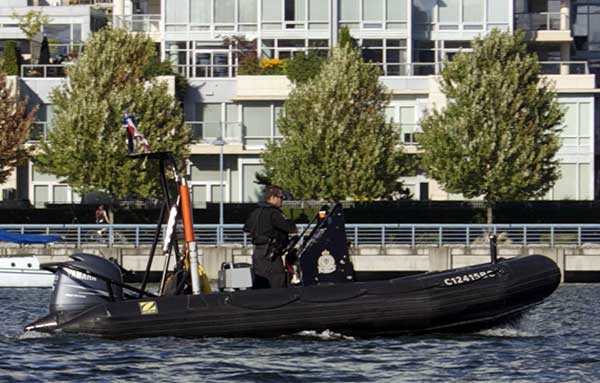
The Royal Canadian Navy was hosting its annual fund-raising, during which citizens are permitted to rent some of Her Majesty’s naval fleet for private excursions in the glittering water surrounding the island. As we walked along the dock, zaiah pointed out this vessel, the Limited Offensive Unit Probably a Bad Idea.

This vessel, equipped with the latest Man-Powered Rotary Reciprocating Dual Thruster Units, looked to us to be a fine way to explore Canada’s territorial waterways, so we resolved to rent it at once.

We negotiated an exchange of currency with a man wearing an “Obey” T-shirt, and set off.

The first thing we noticed as we paddled furiously away from the dock was the…no, wait, I take that back. The first thing we noticed as we paddled furiously away from the dock was that the man in the Obey T-shirt had placed many safety supplies into a small plastic chest, but neglected to give the chest to us. We turned around and paddled back to retrieve it, in the event we encountered some unfortunate incident that might otherwise have led to our certain doom.

The second thing we noticed as we paddled furiously away from the dock was the strange piles of rock carefully erected along the stony shore, offerings to the temperamental denizens of the deep waters, who are loathe to grant safe passage along her surface without these ritual tokens of submission.

At this point, I must pause to reveal that we were on that day the source, no doubt, of many interesting stories the Vancouverites exchanged with one another. I don’t know if it was the fact that we were both out in deep water paddling our small craft like mad, or the fact that your humble scribe was once again wearing bunny ears, but we were for whatever reason the source of much waving and pointing, and many shouted words drown out by the constant thrashing of our pedal-powered propellers.

So agitated by our unlikely presence did the Vancouver citizens become that another naval vessel, the Rapid Offensive Unit Unconventional Use of Weapons, was quickly dispatched to check us out.

Upon determining that we were an unarmed American woman accompanied by a man in bunny ears paddling our way around the False Creek sound and therefore unlikely to pose a threat to the safety and security of Her Majesty’s State, we were left to continue our journey in peace, though the continued reactions of Her Majesty’s subjects reminded us that there would be many a story around cozy campfires that night that started with “Hey, you aren’t going to believe what I saw this afternoon!”

We made our slow way beneath one of two bridges that span False Creek. This bridge, erected during the famous Art Deco era in Canada’s dim past, still bears the reminder of an ancient part of Canada’s history, now nearly forgotten by the youth of today.

Time was when balconies like the one you see here could be found on every bridge in Canada’s western half. According to the history books, when the Canadian government negotiated its treaty with the bridge-trolls that inhabited this part of the continent, these balconies were provided as a service to the trolls. Each morning, as the sun came up, the trolls would ascend to these balconies to announce the tolls for crossing the bridge that day, their low, guttural cries of “One copper! One copper!” or “Three copper! Three copper!” informing the tradesman what it would cost to do business on the other side of the bridge.

The trolls are long extinct now, disease and destruction of their natural habitat having been too much for them to adapt to. Architects today still sometimes include these balconies when they design modern bridges, though they do so only for tradition’s sake, without fully understanding why.

As we traveled farther along, we paddled by the enormous concrete Canadian Palace of Culture and Sport, erected at the same time as the Vladimir Lenin Palace of Culture and Sport was being built in Tallinn, Estonia, during Vancouver’s short-lived attempt to reach out across the Iron Curtain and recognize that ancient Medieval city as her sister in spirit.

Once, Canada’s athletic elite gathered here to compete for the honor of leading the front lines in the regular campaigns against the Kurgan raiders. Today, it is used as a storage depot for concrete, making it, on the whole, rather more successful than the edifice that sits crumbling to ruin in Tallinn.

We saw this graffiti painted on the side of the structure.

I must confess, Gentle Readers, that though my knowledge of Canada and her ways has been vastly expanded by our travels there, I have absolutely no idea what it means.

But Apple is evil! Some thoughts on how economies work

I’m still in the process of writing about my experiences with my Android phone, which will see at least two more sections (on the OS itself and on T-Mobile). The short version is I started with an iPhone, got rid of it for a 4G Android phone, decided that Android just doesn’t have it going on, and am switching back to the iPhone.

Now, one thing I’ve seen repeated many times since I’ve started talking here and elsewhere about my Android experiences is a common refrain: It’s not about the phone. It’s not about the operating system, or user experience, or call quality, or ease of use. An iPhone is a bad choice because Apple is an evil company.

With no disrespect intended for any of the dozen or so people who’ve said this to me: I find that to be a remarkably silly thing to say, but not for the reasons you might expect. I’ll get back to that in a minute.


First, before I get into that, let me start by destroying a childhood myth that we all learn in school.

When you make a product for sale, you do not determine the price of your product in the marketplace by taking the total cost of making it, adding some percentage to the cost of making it that represents your profit, and then selling it at that price.

An astonishing number of people seem to believe that this is how the price of goods is arrived at, and I am constantly surprised by how many folks believe it’s true. That isn’t the way it works at all.

When you sell a product in the marketplace, you price it at the absolute tippy-top highest price the market can bear. Then, you drive the cost of making it as low as is humanly possible, using whatever means you can. The difference between the highest price the market will bear and the lowest cost you can make them for is your profit.

Everything is priced this way: cell phones, computers, cars, winter jackets, tea, pencils, small remote-controlled toy helicopters, batteries, electric razors, suitcases, light bulbs, plywood, sofas, dishwashers (and the dishes and detergent you put into them), stereo systems, ice cream, gasoline, you name it.

“But Franklin!” I hear you cry. “What about competition? If I can get my cell phone or my ice cream from many different places, they will compete with each other on price until they have arrived at the lowest profit margin they can accept!”

Which is true, in the same world where unicorns cavort with dragon whelps over fields of cotton candy.

Yes, businesses will sometimes compete with one another on price, to a limited extent, in order to create market share. But let me let you in on a secret: It is better for me to capture only 40% of the market and make a profit of $50 a widget than to capture 90% of the market and make only $3 a widget.

Companies know this. Industries develop a sense of what their expected profit margin ought to be, and then compete on price only so long as it doesn’t erode that. The supply-demand curve they taught you in grade school? It’s rubbish. It doesn’t account for the fact that when consumers expect to pay a certain amount for something, they’ll keep paying that amount even if the cost of production falls. It doesn’t account for the fact that consumers will often rate a product as more desirable if it carries a higher price, even if the quality is exactly the same as a lower-priced item. It doesn’t account for the fact that supply and demand do not exist in a vacuum, nor for the fact that demand is not infinitely elastic, nor for the fact that demand depends on many factors, quite a few of which have nothing to do with supply.

It also doesn’t account for the fact that supply is not always responsive to demand, for reasons that may range from capitalization costs to the fact that low availability can create that air of increased desirability I just mentioned.

Even supposedly “commodity” goods like oil and wheat are not priced according to the strict laws of supply and demand; things like futures and derivatives can change their price even when supply remains exactly the same. (If there is a sudden increase in trading for oil futures, for instance, the price of oil may rise even though the production of oil is completely unchanged and the demand for oil hasn’t budged one bit.)

So when people say things like “You’re stupid to buy an iPhone; if you get a high-end model, you’re paying $100 for $20 worth of additional flash memory,” they’re speaking from a profound ignorance of how any market system works. Sorry, Mr. Savvy Consumer, but you do that same sort of thing all the time, when you buy anything from tennis shoes to lumber.


So back to Apple’s supposed “evil.”

It is deeply silly to say “I’m not going to buy an iPhone because Apple is an evil company.” Not because it’s false, but because it’s trivially true. Well, duh. Of course Apple is an evil company. Apple is ruthless, anticompetitive, and sociopathic. This is not a terribly profound insight. Yes, Apple is an evil company; in other news, the sky is up and water is wet.

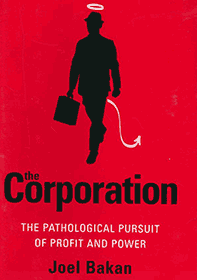
Apple is an evil company because every successful multinational corporation is evil.

They have to be. The laws governing and regulating corporations pretty much guarantee that any publicly-traded corporation must be sociopathic in nature. Any company, large or small, doesn’t succeed by leaving money on the table if it doesn’t have to; public corporations are legally obligated to seek maximum return for their shareholders, by whatever means are available to them. A corporation that has the opportunity to increase revenue or lower costs and fails to do so can be sued by its shareholders.

Let’s look at Google, the company whose motto is “Don’t Be Evil.” They make an operating system that is touted as being “open,” that is supposedly “open source,” and that anyone can use to make a smartphone, right?

Right. And those unicorns in cotton candy land just love it.

The reality is rather different; Android is not really “open” in any meaningful sense of the word, and Google is as big a bully as Apple, but less public about it. Google, for example, recently forced Acer to cancel a smartphone built around a rival operating system, threatening to cut Acer off from source code and revoking Acer’s right to use Android if it didn’t comply.

You know how anyone is free to download and build the Android source code? Well, err, that applies only to older versions, and even then only to some parts of the Android code base, excluding Google’s apps that run atop it. You know how anyone can use Android on their mobile phone? Well, err, the name “Android” is trademarked, so you have to license the use fo the name from Google…and how many consumers going to buy an Android phone that’s advertised as running an “Android-like operating system”?

That gives Google considerable leverage. So much that they can tell a hardware maker “We demand you cancel your phone that uses a rival operating system” and the handset maker will comply so fast that journalists will still show up for the product launch and end up milling around an empty hall.

Yes, Apple is an evil company. Google is an evil company. Microsoft is a company of such breathtakingly creative evil that even the Department of Justice is effectively powerless to reign it in, no matter how egregiously it has broken the law. If you find yourself with warm, fuzzy feelings about any globocorp, it is only because that globocorp has paid good PR money to program you with those feelings. To believe anything else is naivety in the face of overwhelming evidence.

Those underpaid workers making iPads in Foxconn factories? They’re making gizmos for Dell and Cisco and Microsoft and HP and Motorola and Nokia and Samsung and Intel, too…and under working conditions that the folks making sneakers for Nike would give their right arm to enjoy.

Of course, not all evil is created equal. The evil of Google and Apple might reach farther than the evil of Nike, but the evil of Nike is probably a lot more serious for those on the pointy end of it. As evil as Nike is, it’s a whole lot less evil than the Wall Street companies that crashed the economy (and then blamed the wreckage on “poor people buying homes that were too expensive”), or the company you likely bank with if you use a large bank.

Me? I use a small, local credit union. And I’m still buying an iPhone.

Exploring the Great White North, Part 1: Of Raids and Raiders

So it came to pass that on Labor Day, or Labour Day in the modern language of Canada, zaiah and I ventured to take a train ride up to the frozen wilds of our northern neighbor to visit her.

I was not quite sure what to expect. I’ve heard the stories, of course: fierce raiders riding armored polar bears, carrying evil spears fashioned from ice; the great floating cities in the clouds, their perimeters patrolled by armed police riding the backs of furred, horned wyverns; the enormous, heavy tomes, their pages made of thin sheets of iron hammered from fallen meteorites, containing all the wisdom of the Elders in the nearly-forgotten language of the ancients. But I’d never seen any of these wonders with my own eyes, so it was with both fear and excitement I boarded the train, carefully stowing my borrowed polar bear saddle above the seat.

We arrived in the Wildlands in due course, bourne there by the great machine of iron and thunder, and within minutes of setting foot on Canadian soil our problems began.

Those of you familiar with the writings of your humble scribe are no doubt aware that I am often prone to wearing bunny ears in public. This is a not-atypical photograph, showing me in my everyday, about-town ears, which are equally at home during a formal evening in a fancy pub or while traveling the rugged, rocky slopes of America’s midwest.

So it will be no surprise to many of you that I was wearing bunny ears–indeed, these very same bunny ears–on the trip up to the frozen north.

Canadian customs officials, whose numbers today are carefully selected from the most savage of the Kurgan raiders (about whom I shall speak more later), with only those who best their competitors in savage hand-to-hand combat too terrible to write about here allowed to win the honor of protecting the border from their unkempt southern neighbors, were not amused by the ears.

Not at all.

I was questioned about them, at great length and by at least three different people, before zaiah and I were taken into a small room for additional screening.

Now, I am loathe to go to the hardware store, much less to a strange and distant land, without my bunny ears. The story of the ears is too long to recount here, though I will try to sum it up without too much damage to this narrative. The ears are a gift, or perhaps an inheritence, from my London sweetie emanix, who I met while standing in line waiting for an elevator (or as they say in the native British tongue, a “lift queue”) at a convention of perverts, sodomites, and other fine folks. She was, as regular readers will recall, dressed as an Easter bunny and passing out candy at the time. Since strangers have the best candy, I immediately accepted her offer. Fast forward a few years, a couple trips abroad, and an orgy in a castle in the south of France, and the torch has well and truly been passed. So to speak.


The source of my woes

Anyway, there we sat, just moments from disembarkation, sitting in a small room under the cold and watchful eyes of three people in bulletproof vests, who grilled us both about our motivations for making the long and dangerous trek into the icy plains of Canada with bunny ears. They demanded a list of every place I had lived for the past twenty years, whereupon they announced they would do a background check on me in all of them.

During this time, the lovely Eve, the namesake of the woman who chose knowledge over obedience, sat (or, rather, stood) outside the gate waiting. I was forbidden, in the strictest possible terms, to make any attempt to contact her, or in fact to use my cell phone at all.

Eventually, and grudgingly, they let us through. The entire ordeal took even longer than the unfortunate time I made the mistake of telling a British customs officer I was traveling to the UK to visit my girlfriend, which is, apparently, right up there with “I just came back from Columbia with thirty-seven kilos of the finest diamond-grade Bolivian blow ever to choke an elephant” and “I will avenge my people!” on the list of Things You Never Tell A Customs Agent. But I digress.

Customs behind us, we passed through the great hall into the lands of Canada, where I stood blinking, bag in one hand and bear saddle in the other, looking for our transport.

The saddle turned out to be unnecessary, as it appeared Vancouver was a Cosmopolitan enough city to have heard about and embraced the wonders of internal combustion. We loaded up into a Honda of some description or another–or perhaps it was a Toyota–and made our way past the barges laden with animal pelts and the street vendors hawking rhubarbs and small cursed figurines with glittering ruby eyes toward the home of someone who had graciously offered to accommodate us during our travels. (It turns out, in a strange twist of the-world-is-smaller-than-you-know, that her friends were companions of a woman I met in London at emanix‘s birthday party. The world is small, and strange, and really quite amazing.)

The next morning, we rose to brave the twisted ways of the Vancouver public transit system.

Now, I have used public transit in at least five countries. I have ridden a streetcar in Poland that was ancient before the sun was born. I have navigated London’s tube and lived to tell the tale, thanks to the warning to mind the gap. But I was not quite ready for what we discovered when we boarded the bus in Vancouver.

Vancouver’s public transit drivers, like Canada’s customs agents, are drawn by and large from the ranks of disaffected Kurgan tribesmen, unsatisfied with the raider’s life, which leaves too little opportunity to wreak violence upon the rest of Canada’s people. Those who fail to win the coveted spots at the border crossings often become bus drivers, where they greet requests for navigational aid or questions about the fare with the traditional cry “Hark’on dûl goth Khan dok’tôl Akan gol’Kosh Trk’han,” which translates roughly as “With my ax I shall destroy all that you love.” The bus drivers of the greater metro area belong to many different clans, which wage ceaseless war with one another in the dead of night along lonely, deserted streets while the city sleeps.

We learned from an unfortunate fellow passenger to stand quietly and pay attention, leaping from the bus as it crossed the intersection where directions, scribbled in strange glyphs on a large sheet of runed paper called a “map,” instructed us to depart.

We stopped at a charming cafe to collect lunch, then walked to Canada Place to sit beneath the sun and eat. The view from our benches was quite spectacular, with the banner of Canada’s dominant tribe fluttering gaily in the breeze:

There is a secret horror lurking in the design of Canada Place, a grim reminder of an ancient evil, which I will get to in a moment.

Our repast complete, we journeyed forth once more to visit Vancouver’s Police Museum, an excellent place for zaiah and I to amuse ourselves with tales of law enforcement throughout the ages .

The history of law enforcement is the history of weaponry. So it is probably no surprise that the most interesting part of the Vancouver Police Museum, by far, is its weapons room, entry into which is permitted only under escort through a large, locked steel door.

There is also, in another, much larger part of the building, a display of improvised and more exotic weaponry, most of which is made up of all manner of strange and lethal variations on the theme of “I will hit you with this until you die.” There were handmade spears, and flails, and whips, and a spring steel cobra (a fine weapon I was introduced to by a friend of mine in my misspent college days); blowguns, and shivs, and butterfly knives; brass knuckles, and clubs, and axes with curved handles. It was an inspiring display, which made me long to disappear into my workshop for a few days and come out with a doomsday weapon that I could use to hold the moon for ransom. Ah, those glorious days of my youth…but again, I digress.

In front of the museum is a rather…peculiar statue, commemorating the pledge made by Canada’s law enforcement officers to be the friends of small, strangely-proportioned, bipedal space aliens with oddly-configured heads and tiny hands whenever they might be in need:


Vancouver’s finest, known throughout galactic sector R-4 as a friend of any being in need

Rumo(u)r has it that a pod person once saved the police commissioner’s life, during a massive and unlikely conspiracy involving time travel and wildly improbable space aliens who look like crosses between sentient ivy and lingerie models. The next Men in Black movie will reportedly be based loosely on this story.

Our visit done, and reluctant to board a bus again, zaiah and I chose instead to walk the streets of the city, to better learn her customs and culture. Our wanderings brought us over a grand, soaring bridge, where we found this message spray-painted on the pavement, a chilling reminder of the Kurgan raiders who to this day live deep in the Wilds and stage occasional incursions into the civilized parts of the country.

Through messages like this, they seek to remind Canada’s citizens of their grisly practices of ripping the hearts from the chests of their enemies, lest the citizens become too complacent.

On the other side of the bridge, we spied the stylized peaks of Canada Place from the other side.

There are few alive today who remember the days of old, when Canada was known mainly for her hordes of ravening wildmen, who set sail in small, fast warships to plunder up and down the Western coast of the United States in search of treasure and women.

Though the design of this building seems innocent to modern eyes, there was a time when the sight of peaked sails just like these, traveling from over the horizon, would strike terror in people for hundreds of miles along the coast, as they signaled another assault from the Canadian longboatmen. This is why to this day nearly every city on the Western seaboard is still surrounded by tall, thick stone walls, with peaked watchtowers along the coastal side. Once, those towers were practical rather than ornamental; from them, watchers would stand guard, day and night, endlessly scanning the ocean for the first sign of those curved white sails, ready to sound the alarm that would bring men and boys rushing to arms to try, hopeless as it might be, to repel the invaders.

There are few who still remember; today these peaks do not bring the terror they once did. But I will confess, Gentle Readers, that when I saw the building, there across that narrow inlet of water as we crested the bridge, a chill crossed over my heart. It was soon gone; I know, in the rational part of my brain, that there is no longer any reason to fear that Canada will return to her warlike ways. But perhaps that fear has passed into the collective unconscious, a faint echo in our DNA of the trials we once faced from the rampaging northmen of the sea.

We faced a different trial on our way back from this place, one born of dangers subterranean rather than seafaring. But that part of my tale will have to wait until next time.

Some Thoughts on Morality and Power

If someone walks up to you and starts talking to you about good morals and the importance of morality, what’s the first thing you think of?

If you live in the US, odds are pretty good that anyone who wants to talk morality with you is actually talking about sex. How to do it, where to do it, when to do it, in what position to do it, who to do it with…the term “morals,” especially in political discourse, has come to be a synonym for “sex.”

And if the person talking to you is a conservative Evangelical, ten will get you twenty that somewhere in that conversation about morals, you’re going to hear about sex with a partner who’s the same sex as you are–something that seems to be right down at the bottom of the Pit of Immoral Behavior, just slightly below pedophilia and at least two and a half yards beneath genocide on the relative Scale of Morality.

And that’s really weird.

Or at least, it seemed really weird, until I thought about it for a bit.


The word “immoral” isn’t used to describe people very often these days. At least, it isn’t used to describe heterosexual, monogamous, married cisgendered people very often in the court of political discourse. It’s still quite popular among some segments of the conservative religious community, but it generally gets applied to sodomites, gay and bisexual people, transgendered folks, and other folks who don’t fit tidily into the prescribed box of sexual norms…with occasional side-branches directed at atheists, of course.

In the late 1800s, notable cynic Ambrose Bierce defined the word “immoral” to mean “Inexpedient. Whatever in the long run and with regard to the greater number of instances men find to be generally inexpedient comes to be considered wrong, wicked, immoral.”

And I submit that the laser focus on sex that we see in almost any popular political or religious dialog has at its heart a very potent expediency indeed, because it serves to distract us from true immorality, and causes us to focus on that which doesn’t really matter to the betterment of some very evil people indeed.


Take Pat Robertson.

No, I don’t mean take him out behind the chemical shed and shoot him; I mean take him as an example. Pat Robertson has made himself a very wealthy, powerful, and influential man by talking endlessly about morality. Or, more specifically, talking about sexual morality: sex before marriage (he’s against it), homosexuality (against), gay marriage (against), non-traditional sexual unions (against), sex work (against, even though he admits to having employed the services of prostitutes), oral sex (surprisingly, for…as long as it’s between a married man and his wife. He’s silent on the subject of whether or not they can have onlookers watching the act.).

And yet, for all his preaching about morality, Pat Robertson is by any reasonable standards of decency an astonishingly, breathtakingly evil man.

Pat Robertson has yet to meet a wealthy foreign dictator he doesn’t like, at least when it’s economically expedient. He cozied up to Liberian strongman, sex trafficker, and war criminal Charles Taylor in exchange for a gold mining contract in Liberia. He owns African Development Company, a corporation which snuggled up to Zaire’s warlord Mobutu Sese Seko to win rights to so-called ‘blood diamonds’ mined by slave labor.

Or look at “Family Values” candidate and politician Newt Gingrich, who divorced his first wife after an affair, married his mistress, then divorced her to marry his second mistress. Said second mistress, who is still married to him, is apparently spending her time these days doing fundraising for the Romney campaign…on a platform of (wait for it) family values.

Gingrich, despite being a serial adulterer, is perceived by many folks on the right as being “moral,” presumably because hey, he ain’t gay. Yet to anyone who believes that morality lies in treating others with compassion, he is unquestionably an evil man.


This is not a new observation, of course. Many of the people who talk the loudest about “morality,” on both sides of the political divide, are deeply and profoundly evil. Mahatma Gandhi was quoted as saying “I like your Christ, I do not like your Christians. Your Christians are so unlike your Christ.” It’s not exactly a revelation that those who use talk of morality, particularly religious morality, in the public sphere are very often deeply immoral people.

Which is where Ambrose Bierce comes in.

It is not simple hypocrisy that explains the prevalence of evil among those who speak of morals. It is not that we are all born of frailty and error and each of us relates imperfectly to those around us.

It is, rather, a calculated and deliberate expediency.

Pat Robertson, Newt Gingrich, and all their ilk are evil people, consumed by a desire for power and wealth. They do not hide this at all. But there is a dilemma. In a Third World country, powerful strongmen can do pretty much whatever they like, without needing to justify themselves to anyone. But in an industrialized nation, maintaining power and wealth often requires maintaining the general goodwill of the people. How to do that, then, when you are a serial adulterer? How to do that when you own a mine that uses slave labor?

The answer, brilliant in its simplicity and obviousness, is to change the public dialog about what it means to be good, and what it means to be evil.

An evil man can gain the favor of generally good people, if he can set the tone of the dialog about good and evil. If he can redefine “evil” so that, rather than meaning “exploiting slave labor in Third World countries to become fabulously wealthy” it means “having sex in the wrong way,” he not only can deflect attention from his own evil, he can short-circuit the conversation about his own evil before it even begins.


When this image dominates the public dialog about morality, someone is being snookered.

We have come to a place where “morality” means “sex” because that state of affairs is expedient to powerful, wealthy men who want to be able to indulge their lust for wealth and power unchecked.

According to the Bible, it is the love of money which is the root of all evil. It is not premarital sex, nor gay marriage, nor the burning question of whether or not married couples are allowed to give head.

Yet among the Religious right, discussion of money is strangely absent from the morality debate. The beginning and end of morality revolves exclusively around who one has sex with, and under what circumstances.

That didn’t happen by accident. That isn’t a coincidence. It happened because evil men set out, systematically and deliberately, to focus the lens of morality away from their own evil.

Every time we accept this definition of morality, every time we allow the conversation about morality to get bogged down in irrelevant sexual minutia, we work in the service of these evil men.

All sin lies in treating one another poorly. Rather than talking about the morality of gay sex, perhaps we should talk about the morality of slavery. Perhaps, if we re-focus our dialog about morality onto the evil that those who campaign on platforms of morality and virtue do, we will begin to see a better world. I would far rather that Pat Robertson divest himself from his blood diamonds and give the vast wealth he created from slave labor to the poor, than see him continue to hold influence by talking about how immoral we are if we don’t have sex the same way he does.

Complicit in a Complicity

Since I first moved to Oregon, one of the things I’ve been most struck by is the quantity and quality of the scenic natural beauty around here, which the state leaves carelessly lying all over the place. It’s been part of life since the move, so it’s fitting that when zaiah and I decided to have a commitment ceremony, we would do it in a place that had a particular abundance of it lying about.

The place we chose was the ruins of an old stone cottage in a large park here in Portland. This particular park has a ruined stone cottage a short hike from the road, that we thought might make a lovely place for a gathering of friends and family.

We first started mooting the idea of a commitment ceremony about a year or so before it happened. One of the things that was important to both of us was the idea of a ceremony that wasn’t just about the two of us, but that was about our entire extended networks. Being part of a polyamorous network can be a bit tricky, sometimes, in that there is a tension between dividing up into couples and honoring all of the people who are important to you. zaiah and I wanted a ceremony that showed our commitment to each other, but also to the people we have chosen to make part of our families.

Even the name we chose, borrowed from figmentj, was an expression of the fact that this is something that involves all of us. Rather than a commitment ceremony, we opted to call it a “complicity,” and to make everyone who attended an accomplice in our union.

Not everyone in our extended networks was able to show up. In particular, my sweeties emanix and figmentj weren’t able to be there. A lot of people did make the trek out to Portland, though, including my entire Florida network–people I don’t get to see nearly often enough.

We gathered together and hiked out to the ruins of the stone cottage. Along the way, we passed over a small foot bridge where someone unknown had written good wishes on strips of masking tape and placed them on the path.

I have no idea who wrote this, or why, but I think these are good sentiments.

As I’ve mentioned, Oregon is known for the abundance and exuberance of the scenic natural beauty it manufactures and scatters about the landscape. Even the walk up to the stone cottage was drenched in it, which can be a bit disorienting for folks from places like Florida, where scenic natural beauty is kept tightly guarded and is sold in small parcels by licensees of the Disney corporation. The Florida part of the network paused along the way to recover from the onslaught of gorgeous, which they had developed little natural resistance to.

That’s my sweetie joreth, her boyfriend and my former archnemesis turned apprentice datan0de, my partner Shelly, datan0de‘s wife femetal, redheadlass, and her partner zensidhe. These are folks who have been my family for a decade or more, datan0de‘s attempts to eradicate me, destroy the world, and crush all of you beneath the massive iron treads of his robotic war machines notwithstanding.

When they had recovered sufficiently, we finished the journey out to the stone cottage. We’d tried to be selective in the number of folks we’d invited to this part of the Complicity, but it was still a bit of a tight fit.

My friend edwardmartiniii graciously agreed to oversee the whole shebang, and did an absolutely fantastic job of it. Here, he is seen at the start of the Complicity asking for volunteers to be given over to the Great Old Ones, so as to appease them and call down their blessing of protection upon all who attended. My friend Amanda volunteered; I’m sure going to miss her.

KIDDING! I’m kidding. Of course I jest. There were no sacrifices to gods ancient or modern; for one thing, where would we even find a virgin these days?


Why yes, don’t mind if I do!

One fo the central parts of the ceremony involved passing out dollar coins, which everyone made a positive wish on and then placed in a container. As people left, they drew out a coin, to bring into the world with them with a wish for good things.

I like the idea of mindfully passing out something which represents a desire for good. The wish itself may not have any material effect on the coin–there is no metallurgic Transubstantiation at work here–but the idea that this represents something is a powerful one, I think.

A part of the ceremony that we’d planned for quite some time was the creation of human Langdon charts, using lengths of rope to indicate the connections between the various people there.

What we hadn’t really counted on was the size and complexity of the network, and how much space (and rope!) it would require. Plus, with not all of our sweeties in attendance, it would have been impossible to create a full chart anyway.

But we were able to map out bits of it. Here are zaiah and I with the Florida part of the Squiggle:

We also did Langdon charts centered only on certain parts of the network. Here’s zaiah‘s Portland portion of the network:

Here’s the bit that centers on me, with the partners who were able to make it (emanix and figmentj, you were both sorely missed!):

It’s fascinating to me how human communities of all sorts tend to follow the same structure. If you map romantic connections in poly networks, or business contacts on Linkedin, or friends networks in a large company, you see the same patterns emerging: most folks have small numbers of connections, with a smaller number of people forming large numbers of connections that act as bridges between different groups. There’s something really interesting lurking somewhere in there. I’d love to make some software that lets people easily and quickly create charts of their poly networks, and then analyzes the network and puts the data into a database somewhere.

I still like the idea of doing photographic Langdon charts. I’d very much love, if everyone in my network could ever get together in one place, to do a photo that shows all of us. Perhaps if I suddenly find myself receiving a suitcase full of cash from shadowy government figures in exchange for, like, foiling a plot to hold the moon for ransom or something, I will fly all of us out to Easter Island to do a picture with all those funky statues of giant heads. Or, less ambitiously, maybe I’ll just register www.humanlangdonchart.com or something. (Anyone know a good database programmer?)

But I digress.

I won’t say that I am lucky to live the life I do. I don’t think that’s accurate, for reasons that I outline here. But I will say that I am profoundly grateful for, and humbled by, the people who I have chosen to be my family, and who have chosen me as well. These are all people who, every day, make my life richer simply by being who they are.

Of Android, iOS, and the Rule of Two Thousand, Part I

A year and change ago, I traded in my iPhone 3G for an Android phone.

I blogged about my initial experience and first impressions of Android here. The phone I got was a then top-of-the-line HTC Sensation 4G, which was at the time I got it T-Mobile’s flagship Android phone. And for a short while, I quite liked it.

A lot can change in a year. When the new iPhone comes out in a couple of weeks, I plan to jump back to iOS and never look back.

Before I go any further, I should take a moment to step back and talk about how I feel about computing devices. I’ve been using computers since the days of the TRS-80; I got my first computer in 1977. And computer Holy Wars have been around for just as long. Back then, it was the TRS-80 vs. the Apple II vs. the Commodore 64; today, it’s Windows vs. Mac vs. Linux. Same song, different dance. What’s amazing to me is that even the arguments haven’t changed very much.

A lot of it, I reckon, comes from good old-fashioned need for validation. When you get a computer or a smartphone, you’re actually buying into an entire ecosystem, one that has a relatively high cost of entry (it takes time–quite a lot of it–to learn an operating system, and if you buy any software, you’re locked in at least to some extent to your choice. Sure, you can do what I do and run Mac OS, Windows, and Linux side by side in virtualization, but doing that has a significant barrier to entry of its own; it’s not what typical home computer users do.)

It;s hard to admit that when you’ve just spent a lot of dosh on a new box and crawled up that painful learning curve to teach yourself how to use it, you might have made a mistake. So people validate their choices, largely by convincing themselves of how awful the alternative is.

I’ve been using (and programming) Microsoft-run boxes since the days of MS-DOS 2.11 and Macs since System 1.1. In that time, I’ve developed a principle I call the Rule of 2,000, which put simply says that anyone with less than 2,000 hours’ worth of actual, real-world, hands-on experience with some platform or operating system is completely unqualified to hold an opinion about it, and anything they say about it can be safely disregarded.

So now I have a years’ worth of Android experience under my belt. What have I learned from it? Well, I’m glad you asked.


PART I: THE HARDWARE

Let’s start with the phone itself. My HTC Sensation, on paper, looks a lot better than an iPhone. It has a larger screen, a significantly better camera than what was available from Apple at the time, a replaceable SD-Micro card that means upgrading storage is quick and easy to do, and a 4G LTE data connection. By the specs, it is a phone significantly superior to the iPhone at the same time.

One of the problems that computer–and, lately, cell phone–Holy Warriors have never quite grasped, though, is that technical specs don’t tell the whole story. In fact, tech specs by themselves don’t make for a compelling product at all, except perhaps to a handful of rabid geeks. Steve Jobs grokked this. Geeks don’t.

The HTC Sensation suffers from a number of design flaws, probably the result of engineering choices designed to keep costs down.

When you hold a Sensation and an iPhone, the Sensation feels cheap. It has a removable cover, which allows easy replacement of the battery…but the cover isn’t especially tight and doesn’t fit as well as it could, making the phone feel a bit creaky. It’s plastic rather than metal and industrial glass. Geeks will claim that the packaging doesn’t matter, but they’re wrong; even the most hardcore geek would be unlikely to buy a computer housed in a plain cardboard box.

More importantly, though, I am currently on my third HTC Sensation, in a bit over one year.

When I got the Sensation, zaiah urged me to pay for the unlimited replacement warranty, and I’m glad I did. The phone has failed twice on me, both times in exactly the same way. First, the GPS starts acting flaky, taking longer and longer to acquire a signal. Then, the phone starts getting really hot when the GPS radio is on. Finally, the GPS radio fails completely, and any attempt to run a program that uses the GPS causes the phone to either freeze so hard I had to take the battery out to reset it, or crash and reboot.

I quickly got accustomed to seeing these screens in this order:

Those of you who have met me in person know that I have the navigational sense of a drunken baboon on acid; when I don’t have GPS, it is a Very Big Deal. The second phone’s GPS finally failed completely while I was on my way to a distant city a couple hours’ drive from home to meet with a new sweetie, and probably cost me at least an hour and a half spent with her…but I digress.

You will note that the signal bars in these screenshots are all over the map. This has been an unending part of my experience with Android, though I think it’s more down to T-Mobile than to Android itself. T-Mobile advertises full 4G coverage in Portland, and that’s technically true, though there are more holes in that coverage than there are in Ayn Rand’s understanding of American history. I can be traveling down Stark street right outside my house and go from awesome signal to no signal and back again in the span of six blocks. At one friend’s house, I have zero coverage, but at the corner shop down the street, I have four bars. WTF, T-Mobile?

Now, it’s possible I’m a statistical fluke and there’s nothing intrinsically wrong with the GPS radio in the Sensation. However, when I took the second failed phone into the T-Mobile store to request a replacement, the bearded hipster behind the counter told me his Sensation had the same fault as well, so I doubt it.


WAIT FOR IT…WAIT FOR IT…

An issue this phone has always had since Day 1 is a perceived sluggishness and general, overall lack of responsiveness.

I’m not 100% sure if this is a hardware or software issue. Certainly, the processor and RAM in this phone were both much better than in my iPhone 3G, so it should have plenty of grunt for a fluid UI. Yet using this phone often feels like trying to wade through frozen molasses in zero G. I saw, and still see, these messages frequently:

I tried rather a lot of faffing to make the phone more responsive (using a task killer to kill unnecessary processes and services, that sort of thing), and never got it to be good. The update from Android 2 to Android 4 was supposed to take care of a lot of this issue, but it would seem that “taking care of the issue” really meant “putting a prettier wait icon on the dialog.” (That’s Android 4 in the middle, up there.)

This is, I think, down to both hardware and software; a lot of the UI in iOS is hardware accelerated, because Apple makes the hardware and therefore can be sure that it will have the GPU to support hardware acceleration.

One interesting thing about Sense, HTC’s user interface: When you touch the screen, background processes and background updates to the UI are totally suspended. This means that, for example, when you start to slide from one panel to the next, the clock freezes. It also means you can’t do screen captures when you have your finger on the screen–something that’s actually significant, and that I’ll get to in part 2 of this piece, where I talk about the software.


OH, WHO’S A DIRTY PHONE? YOU ARE! YOU DIRTY, DIRTY PHONE!

Most of the time, I keep my phone in my pocket.

As it turns out, with the Sensation, that’s not a very wise thing to do.

The Sensation, like nearly every other smartphone I’ve used, has a little wake/sleep button on the top. You press it to wake the phone up. With the Sensation, the button’s mechanism is part of the back case, which wraps around the top; the button is just a little bit of plastic that presses down on the actual switch, mounted to the phone’s circuit board.

The plastic bit isn’t well sealed against dust and debris. When I say “isn’t well sealed,” what I mean by that is “isn’t sealed at all.”

Now, maybe the engineers who designed it have Class 5 cleanrooms in their pants. I don’t know. I do know that my pants are a considerably less clean environment.

In practice, what that means is that little bits of dust and grit get into that button, gradually rendering it inoperable. There’s a ritual I have to go through every couple of months: take the back off, blow all of the crap out of that little button, put the back on again. This is not something I experienced with my iPhone, despite years of carrying it in some astonishingly grungy pockets.

Even if you do have a Class 5 cleanroom in your pants, you’re still not well-advised to carry your Sensation there, because of an odd quirk the phone has which I’ve never been able to figure out.

Well, perhaps it’s less a quirk than a habit. Every so often, usually a few times a week, the phone will suddenly start heating up, until it becomes uncomfortably warm. All three of my Sensations have done this.

I’ve never found a pattern to it. It can happen when the cell signal is weak or strong. It can happen when the phone is on 4G or WiFi. It happens with no discernible background activity going on. There seems to be no rhyme or reason to it. I’ll just be riding in the car or sitting in front of the computer watching Netflix or hanging out with a bunch of friends, and wham! My pants are scorching hot. Rebooting the phone usually, but not always, solves the problem.


Technical specs do not, of and by themselves, make for desirable hardware. I really, really wish more people understood this.

Most of my complaints about the hardware of the Sensation come down to the same thing: attention to detail. Whether it’s attention to detail in the switch or attention to detail in the user interface, detail matters.

Geeks love hardware specs. DGeeks drool over the newest processor with twenty-four overclocked turboencabulators per on-die core and hardware twiddlybits with accelerated inverse momentum. And I think that’s a problem, because they don’t get that hardware specs by themselves aren’t enough.

Attention to detail is harder. It’s not enough to have the fastest possible processor in your phone, if the user interface is sluggish. It doesn’t matter if the phone has a shiny OLED backlight if dirt and grit keep getting into it because nobody paid close attention to the little plastic button on top.

Android is in a lot of ways the triumph of the geek over the designer. True Believers like to brag that Android outsells iOS phones because the geek cred of Android is so much better; personally, I suspect that it might have something to do with the fact that you can buy an Android phone for about $75 without a contract, and get one for free with a contract, from a large number of different places.

But that’s not really the issue. The issue, as I see it, is that my Sensation is clearly a superior phone on paper to my old iPhone, but the experience of owning it has left a very bad taste in my mouth.

Detail matters. Little things matter. The Android contingent of the Holy Warriors had an opportunity to make me a convert, and they failed.

In the next part, I’ll talk about the software, and how even after several major revisions, Android still has some things it can learn from iOS.

Apple v. Samsung: Nickelgeddon and Number Illiteracy

In case you haven’t seen the news that’s been lighting up the tech sector these days, Apple recently sued Samsung for multiple patent violations concerning Samsung’s cell phones allegedly knocking off iPhone design and technology, and won, to the tune of $1 billion in fines.

There’s a rumor going around the Internet that Samsung is planning to pay the fine in nickels, shipping, or so it’s said, 30 trucks to Apple’s headquarters stuffed full of small change.

Now, that sounds wildly implausible to me, on a number of levels. First, it seems like getting one’s hands on a billion dollars’ worth of nickels would be an extraordinarily difficult thing to do. Second, it seems to me that a billion dollars’ worth of nickels would occupy one hell of a lot more than 30 trucks.

One of the things I often complain to zaiah about is something I call ‘number illiteracy’. As soon as anyone starts talking about numbers higher than a thousand or so, people’s eyes glaze over and that little drop of drool forms on the corners of their lips. A million, a hundred million, a billion…these all seem like synonyms for “really big” to a lot of folks. Hence folks complaining about the money spent on the Mars Curiosity rover without realizing that we Americans spend about the same amount on Halloween candy every October…but I digress.

Just for giggles, I did a rough, back-of-the-envelope estimate of what it would take to pay a billion dollar fine in nickels.

A billion dollars in nickels is 20 billion nickels, or roughly 64 nickels for every man, woman, and child in the entire United States. That is almost the entire number of nickels in circulation; the total number of nickels that exists is estimated by the Treasury Department to be around 25 billion or so.

A nickel weighs a sixth of an ounce, so 20 billion nickels weighs in at 208,333,333 pounds, or 104,167 tons, give or take a few hundred pounds. In the United States, a tractor trailer rig traveling on public roads is permitted to weigh no more than 80,000 pounds (gross) by law. A typical tractor trailer rig weighs in at roughly 20,000 pounds, leaving no more than 60,000 pounds for cargo. (From a quick Google search, it seems most commercial truckers won’t haul more than 50,000 pounds, but since I know fuck-all about shipping I’ll be generous and go with the 60,000 pound limit.)

At 60,000 pounds per truck, a billion dollars in nickels would require 3,473 trucks. Since a semi trailer is 53 feet long (not including the cab), the trailers, lined up end to end with no cabs, would make a row roughly 35 miles long.

I did a quick Web search to see what the shipping cost would be. From Samsung’s US headquarters to Cupertino, home of Apple, the cheapest rate I could find on my quick-and-dirty search was $503 per half ton, or $104,792,002 for the whole shebang. That’s about $105 million in shipping charges, though I bet a job this size might qualify for a bulk discount.

So now you know.

Edited to add: When zaiah and I first talked about the problem of sending a billion dollars in nickels, we were driving and didn’t have easy access to Google, so we made an even rougher back-of-the-envelope calculation, using guesswork, imagination, and the XKCD “if I can throw it, it weighs about a pound” rule. I can throw four rolls of nickels, so I guessed that four rolls would be about a pound.

The first approximation of an answer we came up with, which we figured might be within half an order of magnitude or so of the right answer, was 4,000 trucks. Later, with Google and a calculator and a lot of legwork, we came up with what you see above. So, go us!

Science is cool!

This…is a real animal. It’s called a Tardigrade, and it’s a (barely) macroscopic animal about half a millimeter long. It has eight legs and can survive exposure to hard vacuum. It belongs to a sister phylum to arthropods, though these guys technically aren’t arthropods.

This particular image comes from The Scientist, where it’s a finalist in their annual science image contest.

The next time you’re watching Star Trek and you see a supposedly ‘alien’ species that’s really just a white 21st-century human with a wrinkly nose, think about the amazing diversity of body plans right here on Earth, and then think about how profoundly unlikely that would be.

If homophobic Christians read the Bible, what would the world look like?

When i lived in the South, I will admit I used to eat at Chick-Fil-A all the time. I was dimly aware that they had some sketchy religious leanings or something, and they tended to hire only surrealistically white people to work in their restaurants, but hey, the sandwiches were good.

Well, not really good. But at least better than much of the mediocre fast-food stuff you could get at, say, Taco Bell or Burger King.

I wish I could say that I was surprised to learn that Chick-Fil-A has bought into the virulent strain of anti-gay nonsense that seems to have the self-described Christian conservative bits of society in such a frenzy, but I’m really not. Like I said, I was dimly aware that ther was some kind of right-wing religious something something at play.

But the media attention about Chick-Fil-A and gay marriage got me to thinking. Most self-described Christian conservatives base their opposition to gay marriage on two Bible verses. Leviticus 18:22 reads:

Thou shalt not lie with mankind, as with womankind: it is an abomination.

Leviticus 20:13 says:

If a man also lie with mankind, as he lieth with a woman, both of them have committed an abomination: they shall surely be put to death; their blood shall be upon them.

The rest of Leviticus goes on to say similar things about cutting your beard, wearing clothes made of different fibers, eating shellfish, having sex with a woman on her period, letting different kinds of cattle graze in the same field, and executing women if their husbands cheat on them they cheat on their husbands (seriously, it’s there, Leviticus 20:10).

Most Christians don’t follow these rules, arguing that Jesus made them irrelevant except the ones about homosexuality because those are totally different from the shellfish ones because of reasons, and some will even quote a third Bible verse, Romans 1:26-27, to justify banning gay marriage:

Because of this, God gave them over to shameful lusts. Even their women exchanged natural relations for unnatural ones. In the same way the men also abandoned natural relations with women and were inflamed with lust for one another. Men committed indecent acts with other men, and received in themselves the due penalty for their perversion.

But the Bible, both old and new testaments, actually spends a whole lot more time talking about divorce than it does about homosexuality. Both testaments are very, very clear that divorce is never permitted, and that those who divorce and remarry are guilty of adultery, a sin forbidden by the Ten Commandments, and with the penalty of death according to the old testament…

Um, wait a minute, didn’t we recently see a serial divorcee running on some kind of pro-family, conservative Christian platform?

In fact, the Bible even claims that Jesus, who never spoke about homosexuality at all, had plenty to say about divorce, in Matthew 5:31-32:

And it was said, ‘Whoever sends his wife away, let him give her a certificate of divorce’; but I say to you that everyone who divorces his wife, except for the cause of unchastity, makes her commit adultery; and whoever marries a divorced woman commits adultery.

The Bible has Jesus speaking the same message many more times, in Mark 10:2 and Luke 16:18, for example.

So I wonder…

What would the right-wing Christian pronouncements look like if they actually applied the same thinking on divorce to their supposedly “Bible-based” blatherings about homosexuality? What would happen if you took their hysterical anti-gay screeds and replaced the word “homosexual” with the word “divorce”? It seems a fair substitution; the same moral, Biblical justifications for opposing homosexuality even more strongly apply to divorce, after all.

I started Googling Christian proclamations about homosexuality, which…well, if you have ever felt the need to go trolling on a motorboat down an open sewer, doing that sort of Google search will give you a similar experience. And I took “homosexuality” and replaced it with “divorce.” The results were…interesting.

Clicky here to see what happens!