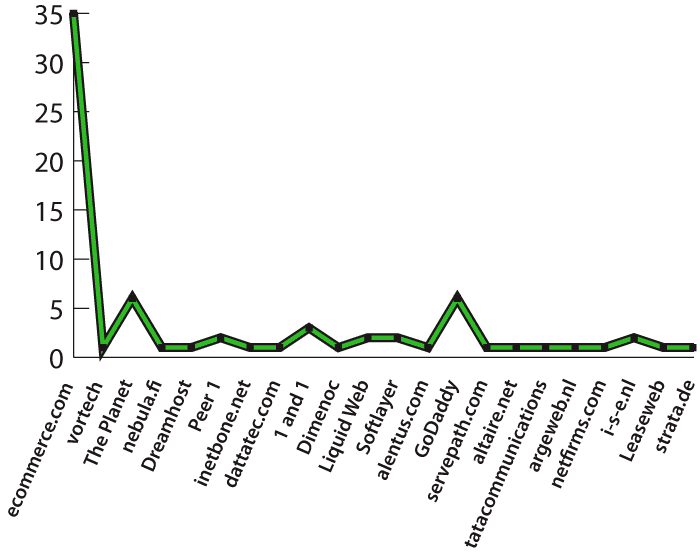
Another day, another massive computer hack attack

Note: followup to this post at http://tacit.livejournal.com/325770.html

I run quite a number of WordPress blogs: weeklysextips.com, the Whispers blog at symtoys.com, the Skeptical Pervert blog (which I haven’t actually started doing anything yet, as I haven’t started my podcast yet), and so on.

These blogs all run comment spam filtering software, because automated WordPress comment spam is a big problem with any WordPress blog. A lot of the automated comment spam contains, of course, redirectors to malware, mostly disguised as porn links.

I occasionally trawl through the spam comments on my blogs; it’s an amazing early warning system to see what the malware writers are up to these days. Recently, I found a spate of malware spam advertising URLs hosted on a Web site called nashville.net; the spam promised all sorts of free sexual delights if I would but go to such Web addresses as

http://www.nashville.net/profile/3nz5lxzvocvcd
and
http://www.nashville.net/profile/jetttoland59

and so on.

I did some poking around on Nashville.net and discovered that it has been compromised like a Senator with a gambling addiction; at the moment, it’s hosting somewhere around 4,200 phony profiles, all of which are redirectors to sites that try to download malware. Each phony profile leads to the same place: a URL at

http://sexsuite.ru/stds/go.php?sid=14

which is a traffic handling Web site that works the same way that the traffic redirector sites used by malware networks I’ve talked about before do.

So I decided to be a good citizen and drop a line to the owner of nashville.net, and his Web host, letting him know he’d been massively breached.

That’s when things got interesting.


The Web site nashville.net is a “community site,” a small niche social networking site hosted by an outfit called Ning.

Parsing input: nashville.net
Routing details for 8.6.19.68
“whois NET-8-6-19-0-1@whois.arin.net” (Getting contact from whois.arin.net )
Found AbuseEmail in whois abuse@ning.com
8.6.19.0 – 8.6.19.255:abuse@ning.com
Using abuse net on abuse@ning.com
abuse net ning.com = postmaster@ning.com, abuse@ning.com, abuse@level3.com

Ning is a personal social networking site founded by the guy who started Netscape, Marc Andreessen. It basically lets you create your own mini MySpace or LiveJournal or whatever you like–a small social networking platform aimed at whatever niche you want. It’s had a checkered past, and has struggled to make money; three days ago, Ning announced that it would become pay only and would cancel its free services. It also fired 40% of its staff.

But that’s not the really interesting part.

The really interesting part is that it looks like all of Ning, with all the social networks and online forums it hosts, has been pwn3d from balls to bones.

A search for some of the exact words and phrases used by the virus redirectors on nashville.net, one of Ning’s social networking sites, produces 1,060,000 results…and as near as I can tell, they are all on Ning.

Now, a conspiracy theorist might come up with all kinds of conspiracies to explain this–disgruntled employees, knowing what was coming, leaving the back door open; executives of a foundering company, desperate for cash, turning a blind eye to Russian malware writers; whatever. I suspect that the reality is what it always is–incompetence, someone asleep at the switch, management that doesn’t appreciate security and doesn’t want to pay for it…the same sorts of things that seem to be behind this sort of thing almost every time.

But if you use Ning, or you know someone who does, my advice is to leave.

Some thoughts on choosing relationships

One of my sweeties has a policy never to get involved with someone who has never had his heart broken. She believes quite strongly that there are certain things about yourself that you can only learn when your heart is broken, and that having your heart broken is the only way to discover whether or not you’re the sort of person who can pick himself up, put himself back together, and move on with courage and joy, or if you’re the sort of person who is destroyed by it.

I think there’s some value to that notion, and I’ve written about it in my journal before, though I don’t use it as a rule.

A few years back, I had a really painful breakup with a woman I fell very hard for and then, after investing a great deal in the relationship, discovered was a very poor partner for me. That relationship really brought home for me a lesson that I knew intellectually but didn’t know emotionally, which is this:

It is possible to deeply, sincerely love someone and still not be a good partner for that person.

That relationship also caused some nontrivial damage to one of my other relationships, and ended up changing the course of my life in ways that I still feel. I can’t say that if I had to do it over, I would never have gotten involved with that person at all, though I can say that I would have made different choices about what to do with that connection. But I digress.

There’s a socially sanctioned myth that says that love conquers all. It’s a deeply and profoundly silly thing to believe; love is a feeling, and a feeling can no more solve problems than it can refinish the sofa or put a new circuit breaker box in the attic. A feeling can impel action, can influence the way you make choices, but it can’t, of and by itself, do anything on its own. And making a relationship work requires more than just a feeling. It requires that the people involved make choices that are compatible and work toward a common end–which is extraordinarily difficult to do when those people have different goals, different priorities, different expectations, or even different internal templates about what they want their lives to look like. No matter what they feel.

And the feeling of love isn’t the only thing that influences our decisions. Other feelings, like fear or anxiety or anger, have a vote, too, and it’s not always the feeling of love that casts the deciding vote–even when that love is genuine.


The lesson that I can really, deeply love someone and we can still not be good partners for each other was probably the most expensive relationship lesson I’ve ever learned, and it’s completely rearranged my approach to choosing partners.

The approach I used to use, and I suspect the approach that many people use, was to keep a sort of internal list of “dealbreakers” that I’d refer to whenever I met someone who seemed interesting to me and who seemed interested in me. I’d kind of run down the list–Is she monogamous? Nope. Is she giving me the psycho vibe? Nope. Does she hold conservative religious ideas? Nope. All the way down the list, and if I didn’t hit a dealbreaker the answer would be “Cool! We should totally start dating!”

That isn’t the way I work any more. The dealbreaker approach “fails closed;” it assumes that if no dealbreakers are hit, then we should start a relationship, so if something later comes up that I didn’t know was a problem…well, I find out about it after I’ve already started to invest in a relationship with this person.

The approach I use now isn’t to keep a list of dealbreakers. Oh, there are some, to be sure; I’m not likely to date someone with a history of violence against her past partners, for example. But instead of keeping a list of dealbreakers these days, I keep a list of things that I actively look for–things that light me up in another person.

If I meet someone who seems interesting, and seems interested in me, I am more likely to ask the question “Does this person really light me up inside and bring out joy in me?” than “Does this person have some disagreeable trait that I don’t like?” That approach tends to “fail open”–the default is *not* to start a relationship unless there’s something very special about the person, rather than to start a relationship unless there’s something disagreeable about her.

That approach takes care of a lot of “dealbreakers” on its own, because a person who has the qualities that really shine isn’t likely to have the qualities that would be dealbreakers for me. For instance, a person who has demonstrated to me that she favors choices that demonstrate courage and integrity isn’t likely to be a liar.

It’s more than just taking the dealbreakers and flipping them on their heads, though. There are a lot of qualities on my “must have” list that wouldn’t have been reflected on my “dealbreaker” list.

So all of this is kind of a longwinded way to get to the qualities that DO light me up about someone. The things that really attract me to a person, without which I’m unlikely to want to start a relationship with her, include things like:

– Has she done something that shows me she is likely, when faced with a difficult decision, to choose the path of greatest courage?

– Has she done something that shows me that, when faced by a personal fear or insecurity, she is dedicated to dealing with it with grace, and to invest in the effort it takes to confront, understand, and seek to grow beyond it?

– Does she show the traits of intellectual curiosity, intellectual rigor, and intellectual growth?

– Has she dealt with past relationships, including relationships that have failed, with dignity and compassion?

– Is she a joyful person? Does she value personal happiness? Does she make me feel joy?

– Does she seem to be a person who has a continuing commitment to understanding herself?

– Does she seem to be a person who values self-determinism?

– Does she approach the things that light her up, whatever those things may be, with energy and enthusiasm? Does she engage the world and the parts of it that make her happy?

– Does she seem to demonstrate personal integrity?

– Is she open, honest, enthusiastic, and exploratory about sex?

– Does she communicate openly, even when it’s uncomfortable to do so?

There are probably more; the things that attract me to a person are in some ways a lot more nebulous than my old list of dealbreakers used to be.

In some ways, the approach I use now is an approach that relies on a model of relationship that’s based on abundance, not on starvation. A person who holds a starvation model of relationship, in which relationships seem to be rare and difficult to find, is not likely going to want to use an approach that fails open, on the fear that if he doesn’t take a relationship opportunity that presents itself, who knows when another person might express interest? If relationships seem rare, then why not jump at an opportunity if there seem to be no dealbreakers standing in the way?

The approach of seeking positive reasons to start a relationship, rather than looking for reasons NOT to start a relationship, means that I say “no” to opportunities that come by more often than I say “yes.” I have found that, for whatever reason, I tend to have a lot of opportunity for relationship, so there may be something to the notion that I have adopted this model of relationship because I can afford it.

But I do believe that holding an abundance model of relationship tends to make it true. I think that people who hold a starvation model of relationship often seem to be always searching for a partner, and that can really be off-putting; whereas in an abundance model, if you simply live your life with enthusiasm and joy and instead of seeking partners you seek to develop in yourself the qualities that you desire in a partner, then other people will tend to be drawn to you and relationships will be abundant.

I call Godwin!

Godwin’s Law holds that in any conversation on the Internet that gets heated enough, eventually someone on one side of the issue (whatever it may be) will compare the people on the other side to Nazis. As soon as a reference to Nazis comes into play, according to convention, the conversation is deemed to be over and whoever mentioned the Nazis has lost.

I would like to propose that this same rule be applied in the real world, and furthermore, I would like to suggest that Us magazine be declared the world’s first losers. Apparently, there’s some Hollywood star in some kind of broken, dysfunctional relationship with some guy who cheats on her a lot. And, since she’s cute and sexy, he’s wrong. (Which he is anyway, but not for that reason, though I digress).

Anyway, we stopped at a truck stop on the way back from Atlanta to Tampa last night, where I found this gem. Us magazine, I hereby invoke Godwin and declare you the loser:

Sexual Informatics: Non-Monogamy

I’ve been told, many times, that the word “polyamory” is not really necessary, as it’s simply a synonym for “open relationship” or “swinging” (or, depending on the person talking to me, “cheating”). This idea seems to assume that there’s really only one kind of non-monogamy, which is kind of silly.

I started thinking lately about the various ways in which a relationship can be non-monogamous, and the intersections between different sorts of non-monogamy, and after tinkering around with the notion for a while I’ve come up with this diagram.

A relationship can be non-monogamous without being open; cheating relationships, polyfidelitous relationships, and religious polygyny are all examples. I’ve made polyamory and swinging separate and nonoverlapping here, though of course a person can be polyamorous and also be a swinger (they’re two different behaviors engaged in by the same person, just as a person can be a swinger and also be a cheater, and so on).

BDSM throws a monkeywrench into the issue because there are so many ways that people involved in BDSM can be non-monogamous. I’ve seen people who play at play parties with other folks but don’t do so outside play parties and don’t form relationships; that sort of arrangement overlaps with swinging. I’ve seen various flavors of polyamorous and polyfi BDSM relationships. I’ve seen closed-group non-monogamy that isn’t quite polyamory and looks more like closed-group swinging, though God knows there’s some overlap between closed-group swinging and polyfi; I’ve known closed group swingers whose groups stay stable for longer than most marriages do. And there’s a sliver of non-monogamous BDSM relationships that don’t intersect with anything else; “I’ll arrange a gang bang for you and you’ll LIKE IT,” ferinstance.

And then there’s con sex, which overlaps with a whole lot of other stuff. But someone could probably write an entire book about con sex. And now that I think about it, I’d probably read it.

Profiteering from affiliate programs, the Russian organized crime way

I have a Formspring.me account. If you’re not familiar with it, Formspring is a Web site that you can use to receive anonymous questions from people, which you can then answer in a way that lets everyone read your answers.

It’s actually pretty cool. My Formspring account is here, and I kind of enjoy answering random questions from folks. If, y’know, there’s something you want to ask.

Anyway, a few days ago I got this message posted anonymously to my Formspring:

Hey, I am posting anonymous because I don’t want you to know who I am but I found a nude image of you online.You may have to login to see it, but here’s the link: nudeimagedatabase(DOT)t35(DOT)(DOT)com/nude_image_549(DOT)html replace all the (DOT) with .

Now, first thing I thought was Russian mob spreading computer malware–Zlob or Asprox or something, right? I mean, seriously, it’s got their thumbprint all over it.

Turns out that’s not what it was, though. What it was is something a little more convoluted, and it exposes a weakness in Web sites that have a pay-for-signups affiliate program business model.

We're about to get technical here…

Quote of the Day

…because I can’t seem to get to sleep just yet…

”If the world were merely seductive, that would be easy. If it were merely challenging, that would be no problem. But I arise in the morning torn between a desire to improve the world and a desire to enjoy the world. This makes it hard to plan the day.”
— E.B. White

Linky-Links: Careless Women, Architecture, and More

Once again I have 40-something tabs open in my browser and my computer is s lowing to a crawl, so you all know what that means! Time for another dump of Linky-Links into my LiveJournal, for your viewing pleasure.

First up, we have some scans from the 1938 Dating Guide for Single Women. And a treasure trove of useful advice it is, for some value of “useful.”

Careless women never appeal to gentlemen. Remember that, ladies. As a completely unrelated side note, I am not a gentleman.


Next up: One of the most beautiful, and most expensive, properties in New York City, the Brooklyn Tower Clock Penthouse, a three-floor, $25 million condo in what used to be an old clock tower.


On the subject of sexual informatics (which will be a whole new wing of my Xeromag site once I get it moved to the new server) is this brilliant flowchart of Medieval sexual morality, which sad to say I did not create, but wish I had.


In the surrealist humor department, we have Sleep-Talkin’ Man, home of the midnight sleep-talking ramblings of a particularly…eccentric individual. “You’ve got to save the curtains! Save the curtains… They hold so many secrets.”


And finally, a blog post about Light Art Performance Photography, in which one opens the shutter on a camera, and then uses LEDs or lighted batons or whatever to paint with light on the canvas of a nighttime scene. The results are quite lovely, and quite labor-intensive.

Some thoughts on game-changers

In the poly community, there are many folks who hold on very tightly to the notion of a prescriptive hierarchy, in which one relationship is designated as being The Primary One, to which all other relationships must be subordinate.

I think there are a lot of reasons that people might want to do this–insecurity, fear of losing a partner’s time or attention, a sense of entitlement, even a good old-fashioned idea that a person can “really” only love one other person, so if someone falls in love with a new partner, that must mean the old relationship suffers.

And, I’ve made no bones about the fact that I am highly skeptical and deeply suspicious of such arrangements, I don’t think they tend to work in the real world, and I think they’re often unnecessarily and pointlessly cruel to third parties entering such an arrangement.

But today I’d like to take a slightly different tack, and talk about the game changer.

The game changer is the relationship that comes along and turns everything upside down. It’s the relationship that changes the familiar landscape of life, rearranging the furniture in new and unexpected ways. Game changing relationships are rare, but when they happen, they happen like tornados, leaving a trail of upset applecarts in their wake. (Damn, did I really just type that? Ahem.)

Game changing relationships cause people to pull up stakes and move to the other side of the country. They make people do things they never thought they’d do: die-hard opponents of marriage might find themselves in wedlock, otherwise reasonable men could end up watching chick movies starring Sandra Bullock. They are unpredictable and chaotic, and when they happen things change.

Any relationship brings the possibility of a game changing event. Even small things can become game changers; my sweetie zaiah says, rightly, that if Shelly or joreth were to move to Portland, that would almost certainly become a game changer for me.

And game changers are scary.

A game-changing relationship is a very uncomfortable thing, if you are happy with the way things are now and you like your life the way it is. The prospect that your partner might meet someone and start a relationship that changes all that can seem upsetting at best, and downright destructive at worst…and just to make matters even more uncomfortable, it can change things for you in ways you can neither predict nor control and you might not even benefit from. Something that changes your partner’s life in wonderful and amazing ways might change your life in ways that are rather less wonderful and amazing.

Every relationship your partner starts could create change that is wonderful for him but disruptive for you; you might end up dealing with all of the fallout but none of the reward. That’s a very real possibility, and it’s reasonable to be concerned about it.

So it might feel very compelling to seek reassurances that things won’t change when your partner starts new relationships, or at least won’t change in ways that you don’t like. It can feel very reassuring to extract a pledge from your partner that you will always have some measure of control, by being able to tell him to end any new relationship that he starts or by being told that you will always come before anyone else.

The psychological security that these agreements give is powerful, no doubt about it. But is it real? I believe that it is not; it’s an illusion, and not even a very good one.

Game changers change things. That’s kind of the definition. They upset existing arrangements. People confronted with a game-changing relationship will not be likely to abide by old rules and agreements; the whole point of a game-changing relationship is that it reshuffles priorities and rearranges lives.

They can happen even in monogamous relationships. Few people get married with an idea “You know, I think it’d be really cool to cheat on my partner and be unfaithful in this relationship. As soon as we get back from our honeymoon, I think I’ll start hitting up the bars.”

They can happen in ways that have nothing to do with romantic relationships. A promotion at work, a pregnancy, a car accident, someone getting fired, a death in the family–all these things can be game-changers that permanently and irrevocably alter lives in ways that can’t be predicted. (I’ve read that financial stress is the single most common reason for divorce, even more common than infidelity, and I can believe it. Nobody wants to say “Hey, I’ll marry you as long as we don’t have problems with money,” but financial problems are far more potent game-changers than most folks realize.)

We don’t usually hear about people saying “I want veto power over any job you take or promotion you get.” People talk about things like career changes or job relocations with their partners, and if they’re reasonable they listen to their partners’ feedback, but it’s a bit rare to hear someone say “I have the right to veto any job my partner has unilaterally and without discussion,” and we might scratch our heads a bit if someone insisted on that kind of veto power.

We all implicitly understand, at least on some level, that life is full of change, and sometimes that change isn’t what we asked for. We all understand that no promises of “forever” can really stand up to the #39 bus with bad brakes that careens through the front of the house and puts someone in a coma. These are the risks we take when we open our hearts to someone else; anyone who can’t take the risk shouldn’t play the game. Relationships aren’t for cowards or sissies.

Yet when it comes to other relationships, the emotional calculous changes. Whether it’s insecurities that whisper about how everyone in the world is prettier, smarter, and more deserving than we are, or the social fable that says romantic love connects us to only one other person at a time, or the idea that every new connection our partner makes is something that takes away our specialness (as though specialness were a currency sitting in a bank account somewhere, available in limited quantities with substantial penalties for early withdrawal), relationships seem uniquely able to push our buttons and create a fear of loss.

So we try to insulate ourselves from that fear by creating the illusion that no matter what happens, we will be in control. This idea of control is powerfully seductive. It’s one of the reasons that people are often more afraid of flying than of driving, even though driving is far more dangerous; we feel more in control in a car, even though if someone runs a red light and broadsides us, our real control over that situation is pretty much nonexistent.

“Yes, you will always be #1” is true until it isn’t, and there is no rule that can change that. If someone comes along who your partner genuinely does love more than he loves you, whatever that means…well, his priorities are unlikely to remain with abiding by the agreements he’s made with you.Game-changing relationships change things; that’s what they do. They change priorities, and that means they change rules. Expecting an agreement to protect you from a game changer is about like expecting a river to obey a law against flooding.

I can understand the desire not to lose what you have because your partner meets someone new; that’s rational and reasonable. What is neither rational nor reasonable, though, is attempting to build structures such that your partner can have other relationships but they will change nothing for you. In fact, it has been my experience that the more rigidly you try to box up relationships to prevent them from changing anything, the more likely things are to break.

There is a different approach, but it requires courage. At the very least, it requires the courage to tell yourself “My relationships can change, and that is OK; my partner and I can still build things that will make us both happy even if they don’t look exactly the way they do now.”

That’s the starting point. From that point, the next step is to say “Even if things change, I have worth; my partner will seek wherever possible to make choices that honor and cherish our connection, whatever changes may come, because I add value to his life. My goal is to build a connection with my partner that is resilient enough to last through change, flexible enough to accommodate change, and supportive enough to create a foundation that welcomes change, without fear or doubt. Change is the one essential feature of life; what I have now I will cherish, and what we build tomorrow I will also cherish, and I will do so without fear.”

Like I said, it takes courage. Letting go of the idea that the way things are now is the way they should always be is gutsy.

But then, life rewards courage. The game-changer that turns everything upside down might just leave you in a better place than you are now; you might find that rearranging the furniture makes the room even more appealing to you. The illusion of control that rules give you is false; the real control you have is the control you exercise as a partner, not a dictator. It comes from working together to express the things you need even while change is happening all around you, not by trying to prevent change at all.

Cat fight!

And no, it’s not what you’re thinking.

We have a little tiny kitten living with us. The kitten and Liam have a…dynamic relationship. But it’s all in good fun, really! After they play, they fall asleep in each other’s…err, paws.

Click here to go Aww!