Electricity? It’s a mystery!

From The Pharyngula blog comes this little gem, a page from a Fundamentalist Christian textbook about electricity.

Now, anyone who’s read my blog for any length of time will know I’m no fan of right-wing religious zealots. But occasionally they manage to surprise me. Sadly, they tend to surprise me by not even rising to the bar of my already abysmally low expectations; no matter how bad, how ignorant, how credulous, or how dishonest I think these guys are, they somehow manage to be worse.

Here’s the page, scanned from a fourth-grade home-schooling textbook on science (click for a larger version):

This kind of thing is the reason I cringe whenever I hear the phrase “home schooling.” I know there are home schoolers who aren’t ignorant Fundamentalist boobs, but damn, they sure do seem to be a small percentage.

The notion that someone can spout nonsense like “We can not even say where electricity comes from. Some scientists think the sun may be the source of most electricity. Others think that the movement of the earth produces some of it” interspersed with Biblical passages and call the result a science textbook is, to me, beyond belief.

A part of me wants to think that whoever wrote this nonsensical tripe was deliberately lying, because the notion that the author genuinely doesn’t know what electricity is, and furthermore can’t be arsed to look it up on Wikipedia or something, blows my mind. But, no, I do think it’s at least possible that whoever wrote this passage sincerely believes what he wrote.

Taken in a larger context, though, it doesn’t matter whether or not he believes it, or understands enough basic science to understand what electricity is. (“We cannot say what electricity itself is like”? Seriously?) The goal of this book is not to educate the reader about science; indeed, I think the goal of any home-schooler using this material is not to educate their child about science.

No, the goal is something very different. It’s twofold, really. The most obvious intention here is to present the world in a way that makes it as opaque as possible, while simultaneously denigrating the ability of science to make any sense of it; science, in the minds of the Fundamentalists who write and teach drivel like this, is a haphazard conglomeration of a bunch of competing wild-ass guesses about the way things might work, each of which has no real basis in fact. Some scientists think our electricity was produced in the sun; others think that some of it might have come from the movement of the earth. (As a person in the dismal movie Jesus Camp says, “science doesn’t prove anything.”1)

The second aim of this textbook is something more subtle. There is an axiom among many religious Fundamentalists that we can never know something which we do not observe directly. This argument pops up in Creationist arguments with depressing frequency; since we can not go back and directly observe, as a firsthand eyewitness, the creation of the earth or the advent of life, we can never know how it went down; ergo, all ideas about what might have happened are equally likely. And since only one of those ideas has the imprinteur of God, that’s the most likely one. All the other ideas are merely idle speculation; since we can’t go back and see it happen, we can’t actually say we have any evidence for it. Only eyewitness evidence2 matters.

And on those counts, I think this passage does precisely what it intends to do.


1 Which might be true from a particular perspective, in the sense that the scientific method seeks hypotheses which are falsifiable, and model is only as good as the next data point which contradicts it. But the Fundies who spout “science doesnt prove anything” mean something quite different; they’re basically saying that science is not useful as a tool to understand the physical world. And that blatantly isn’t so.

2 Or the scribblings of a bunch of barely literate Bronze Age tribesmen which have been shuffled around, rearranged to suit various political factions several times throughout history, and then badly tanslated into a succession of languages, presumably.

In light of the ongoing debacle in the Gulf…

…and in honor of the often hysterical BP Cares Twitter feed, I would like to most humbly propose a new logo for British Petroleum. Something that can redefine their brand in this troubled time, and present a more unified corporate action plan to the public.

Why the Ten Commandments Suck

For as long as I can remember…even, truth be told, back when I was a kid and still religious–I’ve always had a problem with the Ten Commandments.

People hold them up like they are some sort of amazing moral code that would make the world a better place, if only folks would follow them. And some of them are not bad, really. But honestly? If you set out to make ten rules of conduct that’d make the world a better place, the Ten Commandments really aren’t very good. They read like a hasty and poorly-thought-out first draft, scribbled on the back of a napkin at a greasy all-night diner rather than handed down from the divine lips of a burning bush and carved by an act of supernatural will onto tablets made of stone.

So let’s look at ’em, shall we?

#1: I am the Lord your God. You shall have no other gods before me.

Okay, fine, we get it. The god of Abraham is a jealous god. In fact, the formal name of that god is not “Jehovah” or “Elohim” or “YHVH” but “Jealous,” according to Exodus 34 (“Take heed to thyself, lest thou make a covenant with the inhabitants of the land whither thou goest, lest it be for a snare in the midst of thee: But ye shall destroy their altars, break their images, and cut down their groves: For thou shalt worship no other god: for The Lord, whose name is Jealous, is a jealous God”).

Now, one might argue that this commandment, if it were followed, would make the world a better place, or at least one less fraught with religious warfare; if everyone is following the same god, there’s no religious strife, right?

Well, no. Protestants and Catholics, Catholics and Jews, Protestants and Jews, Protestants and Muslims, Muslims and Jews–they all find plenty of reason to beat one another up even though they nominally have the same god.

And what’s so great about a god who’s insecure, anyway? I’d give this one a miss completely.

#2: Thou shalt not make thee any graven image, or any likeness of any thing that is in heaven above, or that is in the earth beneath, or that is in the waters beneath the earth.

This is the one that everyone gets wrong. The Catholics, who have a rich and proud tradition of idolatry, ruled that this rule applies only to idols, but the language is pretty clear…no likeness of any thing. The original intent was to prohibit ALL representational art–an intent that portions of the Muslim community still follow today.

No representations. Virtually the entire Western world totally ignores this. Lose it. Next:

#3: Thou shalt not take the name of the LORD thy God in vain; for the LORD will not hold him guiltless that taketh his name in vain.

Another one that nobody gets right.

The ancient Israelites had a very deep set of beliefs about the power of a name (why do you think the Genesis story features Adam naming all the animals so prominently? It was a symbolic way of giving Adam power over them.) To “take the name” of someone is to call yourself that thing; if I take the name of my neighbor, it’s identity fraud. Vanity is pride. If I take the name of the Lord in vain, it means to call myself god (or, presumably, an agent thereof) out of pride.

It does not mean to say “goddamnit,” goddamnit.

But even if it did, seriously, there’s a lot more evil done in the world than folks saying “goddamnit.” Wasting ten percent of the entire moral code on this seems quite a waste to me. Lose it. Next:

#4: Remember to honor the Sabbath, and keep it holy.

Except that the Sabbath is…err, Saturday.

But what exactly does this mean? In Atlanta, it means you can’t sell beer on Sunday until the afternoon, because Jesus don’t drink beer ’til twelve o’clock, but that’s about it. Now, I can get behind the notion of having a day that’s reserved for not working, especially in a Bronze Age slave society–hell, everyone needs a day or two off. But again, reserving 10% of a universal moral code for this?

#5: Honor thy father and mother that thy days be long in the land which the Lord gives thee.

No.

Seriously, no. Even as a 5-year-old, I thought this was a terrible rule. Now, as an adult, I think it’s even worse.

Honor and respect are always earned. They are never automatic. I’ve met waaaaaay the fuck too many parents who do not deserve honor–parents who abuse their kids, parents who neglect their kids, parents who rape and sexually violate their kids.

This becomes ESPECIALLY odious when you consider that it’s a one-way street; parents are nowhere commanded to treat their children with respect, and not, y’know, rape and abuse them. Any just system of morals has to apply both ways. It cannot place bounds on the behavior of one group toward another while also tacitly permitting the second group carte blanche with the way they treat the first. This rule is fucked-up and poorly conceived from the get-go. More on it in a bit.

#6: Thou shalt not kill.

I have no problem with this one.

Nobody I know actually takes it as a given; everyone I’ve ever personally met, without exception, carves out exceptions and limitations. Like in self-defense, for instance, or defense of another. Or in war. Or if the other person is gay, or has brown skin. Or if the other person has been convicted of a capital crime, or has brown skin and lives in Texas, which is pretty much the same thing. Or when the spirit of the Lord fills him to plant pipe bombs in women’s clinics, that the Lord may blow people into bloody scraps, in His Divine Mercy.

I think the world might be a better place if people applied fewer exceptions to this rule, actually.

#7: Thou shalt not commit adultery.

Back in the days of the ancient Israelites, only women could commit adultery; if a married man slept with a woman not his wife, that was considered fornication, not adultery. The Ten Commandments were written by–err, handed down by men. They condemn only adultery specifically. Coincidence? I think not.

In any event, I can get behind the notion that it is wrong to betray the trust of a person to whom you have pledged your love. Betraying the trust of another person sucks, and it’s wrong.

But adultery, whether narrowly or widely defined, isn’t always a betrayal of trust. There can be and are people who genuinely don’t mind if their lovers have other lovers. I’m one of them. Any reasonable universal code of morality has to recognize that not everyone is the same, seems to me. More on this one in a bit, too.

#8: Thou shalt not steal.

A good start. I’d like to see language that makes it plain this applies not only to direct theft, like at the point of a gun, but also to any deliberate attempt to defraud, either a person or a group of people, through direct or indirect means (I’m looking at you here, Enron). This can and should explicitly be extended to contract fraud, price-fixing, securities fraud, pension-skimming, Ponzi schemes, bribery, counterfeiting, forgery, license fraud, kickbacks, insurance fraud, investment fraud, and so on, which are all theft in my book, and deserve to be explicitly identified as such.

#9: Thou shalt not bear false witness against thy neighbor.

Thou shalt not bear false witness period. Police officer who lied under oath at zaiah‘s traffic court hearing, I’m especially looking at you.

It’s interesting to me that Biblical morality does not prohibit lying; only bearing false witness, a very narrow and specific type of lying. While I am reluctant to go so far as to outlaw every form of falsehood, I think this rule could be expanded a bit.

And finally:

#10: Thou shalt not covet thy neighbor’s wife. Thou shalt not covet thy neighbor’s house or fields, nor his male or female slaves, nor his ox or ass, or anything that belongs to him.

You know, the notion of thought crime has always smelled a little rancid to me. I can see not stealing one’s neighbor’s goods, but not wanting them? That’s reaching. First, because we don’t really have a good grasp on controlling what we want; I desire an iPhone 4, but I hardly think that makes me a menace to society. Second, because detachment from desire as a general principle leads, I think, to stagnation; sometimes it’s desire that gives us the impetus to accomplish something.

Ixnay.


So out of ten commandments, we have five that I’d lose completely, a couple more that have serious problems, and some fine-tuning on the rest.

Just as important as what the Commandments say is what they DON’T say. For a list of supposedly divinely inspired moral absolutes, they sure do leave a lot of room of some pretty reprehensible stuff.

Like using violence, torture, or threat against another person, say. Or unlawfully depriving other people of what is theirs without actually stealing it…say, by burning down someone’s house. Or depriving other people of their life, property, or dignity on the basis of racism, sexism, xenophobia, and so on. Or engaging in corruption as part of a civic, religious, social, police, or government institution.

Or running forced labor camps like those in North Korea, where people convicted of a crime are punshed “to the third generation.”

Or, y’know, engaging in slavery, that appalling and horrific institution of evil which the Bible nevertheless accepts and condones.

So here’s a Ten Commandments as I might find it more palatable:

#1: Thou shalt not have, keep, or deal in any slaves; nor indentured servants, nor any other kind of unpaid serf; nor shalt thou traffic in human beings as chattel for any purpose.

#2: Thou shalt not deprive any person of the liberties thou claims for thyself, on the basis of that person’s religion, nor race, nor creed, nor ethnicity, nor language, nor sex, nor sexual identity, nor gender identity, nor parentage, nor occupation, nor caste.

#3: Thou shalt not hold the transgresses nor infractions of the law against any individual save for those who committed those transgresses, or caused by act of will the transgresses to be committed; thou shalt not hold the sins of the father against the son, nor of the aunt against the niece.

#4: Thou shalt not use torture, nor threat of torture, in any way for any means, whether to interrogate or to coerce any statement from any person.

#5. Honor thy family, and treat them with respect and compassion, if thou expects respect and compassion in return. Thou shalt not commit any abuses upon those in thy care, nor abuse others, but shall instead seek to treat all persons with the respect and compassion thou feels is thy due; and to acknowledge that we are all family.

#6: Thou shalt not kill, nor justify killing in the name of any god who thou dost worship; for surely any such god does not deserve thy worship. Thou shalt not commit violence upon another. Thou shalt return violence for violence only as a last resort, and only to the extent necessary and no more.

#7: Thou shalt not betray the covenants of thy relationships with thy spouse or spouses, or thy lovers or romantic partners.

#8: Thou shalt not steal, nor deprive of others their possessions or property by any unlawful means, direct or indirect. Thou shalt not extort, nor seek through violence, trickery, coercion, graft, extortion, falsehood, scam, or misrepresentation to obtain that which belongs to another.

#9: Thou shalt not bear false witness against thy neighbor, nor seek through falsehoods or misrepresentation, direct or indirect, to manipulate, control, or coerce other people.

#10: Thou shalt not deprive unlawfully thy neighbor or any other person of his property, his money, or anything else which belongs to him, by taking it for yourself, by destroying it, or by otherwise maliciously preventing him from using it. Thou shalt not poison nor pollute thy neighbor’s land or his fields, or the air he breathes.

Honestly, I think my version is a lot better than the first draft in the Bible.

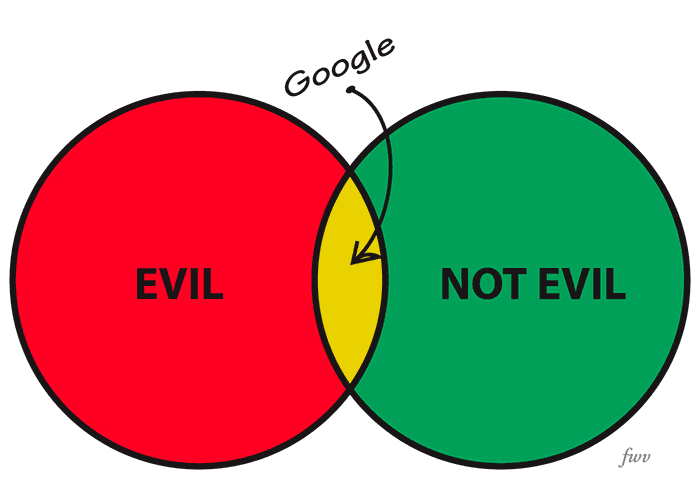
Is this evil?

When you buy a phone, especially a smart phone, you don’t really have a lot of control over what software goes on your phone or how your phone is used.

That’s a fact. It’s always been that way, and it will likely continue to be that way for the foreseeable future.

Apple has taken a lot of (well-deserved, in my opinion, and I say this as an iPhone user) shit for their weird app control-freakery. No porn, no apps developed using tools other than Apple’s own Xcode, no apps they find “controversial” or “offensive”…and the whole app approval progress is as opaque as Glenn Beck’s sense of ethics.

So a lot of folks are turning to Google’s Android phones, in the misguided and poorly-founded belief that the fact part of the Android stack is open source somehow means Google doesn’t exercise just as much control over the platform. This despite the fact they have on a few occasions now refused to host apps that various telcos have asked them not to.

I’m not in the market for a new smartphone, so I’ve been watching the whole thing from the sidelines. But something did catch my eye recently, and it’s got me thinking down a path that zaiah thinks is evil.

Last week, a security researcher released a Google app that claimed to be a preview of the new Twilight film–you know, the one about lame-ass sparkly vampires or something, written by a conservative Mormon woman who wanted a nice Christian alternative to the evil witchcraft that’s woven all through the Harry Potter saga like evil anchovies on the pure pizza of God, so she wrote about stalking and violence and rape instead. Because, of course, the main theological debate facing scholars in the dawn of the 21st century is “who would Jesus rape?” But I digress.

Anyway, the app secretly contacted his server in the background and downloaded (innocuous) code. He wanted to see how easy it would be to persuade people to download an Android app that could install a rootkit, and how easy it would be to get such an app onto the Google app marketplace.

The answers turned out to be “a whole lot” and “easier than opening a bag of Cap’n Crunch, apparently.

When Google found out, they vaporized all the copies of his app from all the Android smartphones out there.


Now, Apple also has a remote-kill switch. This is part and parcel of the state of the smart phone biz. A smart phone carrier or software vendor can reach out remotely and vaporize apps or files from your phone, without you being able to do anything about it. That’s the way it is.

But when Google vaporized this research app, the researcher discovered something interesting–Google also has the ability to remotely ADD an app to a user’s phone without the user knowing it. Google can remotely install software on Android phones over the air.

And that opens an interesting can of worms, oh yes it does.

The courts have ruled on several occasions that a company that has the ability to do something may be compelled to do it by a court order, whereas it is far more difficult to compel a company that does not have the capability to do something to add that capability.

Take Amazon and the Kindle (please!). Amazon revealed that it can remotely nuke a book from Kindles all over the world when someone started selling bootleg copies of George Orwell’s 1984, and Amazon reached out and wiped them.

Amazon then tearfully confessed that doing so had been an error in judgment and swore it would never do it again, but at this point they no longer have that option. Since they have demonstrated the ability to do it, the next time someone’s intellectual property is stolen and distributed for Kindle, the rights holder may be able to get a court order to force Amazon to nuke the offending files whether Amazon wants to or not.Amazon made that bed and might not have a choice about sleeping in it.


So here’s the conundrum I’m pondering. Since Google has the ability to remote install apps, what would happen if Google were forced by court order to use it? What would that do to the cell phone industry? Would people start staying away from Android in favor of other platforms without that ability? More important, would it lead to social dialog over what kind of power we should be willing to cede to the phone operators?

I’m considering writing an Android app that runs in the background and sends the GPS coordinates of the phone to a server every few minutes. I am also thinking about approaching a bunch of police departments and saying “I’ve written this app. I will not distribute it to anyone except law enforcement. If you get a court order to put it on someone’s phone, I’ll give it to you and you can compel Google to install it remotely.”

Might not ever get used. But the first time it did get used, I have a feeling it’d generate quite a shitstorm. And open a conversation that I think probably needs to happen.

zaiah says that doing this would be evil. What say you, Oh Interwebs?

Some Thoughts on Common Assumptions about Radical Longevity

Whenever I talk about the notion of radical longevity–essentially, finding ways to stop the aging process and with it the inevitability of death–I’m always surprised at the amount of resistance that idea encounters.

Some of the resistance comes from a fear of overpopulation, which I don’t think is supported by historical observation. One of the things we tend to see whenever a society becomes more prosperous and more long-lived is declining birthrate. Worldwide, longer lifespan is coupled very tightly to lower birthrate; many industrialized countries, in fact, actually have negative population growth, offset only by immigration. As the world advances in standard of living and in longevity, there’s no reason to believe birthrates won’t continue to decline.

Some of it is based on the notion that many people don’t seem to want to live forever. That’s fine; I’m quite fond of the notion that people should be able to choose, if they like. If a person doesn’t want to live for two hundred or five hundred or a thousand years, that seems perfectly reasonable to me, even if I don’t share that choice. I don’t advocate that anyone be forced to live forever; and on the flip side of the same coin, I’d appreciate if folks not advocate that I be forced to have a lifespan that’s only 70 or 80 years or whatever.

But some of it, I’m convinced, is due to the influence of some religious ideas that I think are both self-contradictory and toxic; and they’re ideas which have so subtly engrained themselves in American society that they’re held even by people who don’t consider themselves religious at all.


An objection I sometimes hear when I talk about increasing human lifespan is “What makes you think you deserve to live longer?” And that argument floors me every time I hear it.

It is interesting to me how common the notion that longer life is something that must be “earned” is. It’s an idea with deep roots in Christianity, of course; the promise of heaven for the righteous and hell for the wicked directly couples a person’s good behavior to the offer of eternal life. And there’s no doubt that Christian Protestant traditions have planted very deep roots indeed into the soil of American society. Libertarianism, for example, could be argued to be the little more than the Puritan work ethic dressed in modern language.

But curiously, this argument seems to be very limited in its scope. We rarely hear that people need to earn the right to live for 70 years, in spite of the fact that this is a good 30 years longer than the average life expectancy at the turn of the 20th century; apparently, sufficiently small and incremental extensions to lifespan escape the “you have to justify your life in order to earn this privilege” clause.

And effectively, that’s what the argument is: a presumption that an effectively unbounded lifespan is a privilege, not a right, and therefore something to be revoked upon insufficient demonstration of worth.

Taken to its (il)logical conclusion, one might postulate that if we start from the premise that long life is something that only the sufficiently righteous have earned, we might propose a system whereby people at the age of 20 or so–the nominal lifespan of early humans in nomadic hunter/gatherer societies–are tested on their worth, with those being deemed insufficiently worthy being taken out behind the chemical shed and shot. They might, I don’t know, even be seen as a resource, with their remains being liquified and fed to the living or something.

Yet I’ve never heard anyone, even those who say “What makes you think you deserve to live forever?”, propose such a thing. It seems that long life must be earned, but only up to a point; before that point, it’s a right, not a privilege.

And that’s where the whole philosophy falls apart.


It seems to me that many religions, particularly Christian religions, hold on the one hand that eternal life is something that must be earned, but cling on the other to the idea that life itself is sacred and that all living people (with some limitations and exclusions that vary from denomination to denomination, and may include gays, lesbians, heretics, atheists, convicted criminals, and/or brown people) have an intrinsic right to life.

This right to life is promoted most directly and actively when it comes to children and infants, with some folks believing so strongly in this essential right that they feel called upon to defend it by planting pipe bombs and shooting doctors.

And all of this strikes me as being a bit contradictory.

You see, from my perspective it looks a bit odd to say that life is something sacred, which is the most basic and most sacrosanct of all human rights–but only in limited quantities, to be determined by the average longevity of the folks around you plus perhaps a decade or two; anything more than that is a privilege to be earned. So presumably a Medieval artisan who declared his desire to live to be a hundred years old might be met with “What makes you think you deserve to live that long?” whereas a modern American might only be asked the same question if his desire were to be to reach, say, two or three hundred.

But what really gets me is the number of folks of no particular religious leanings, and occasionally even folks who identify as entirely atheistic, have bought into this notion. Life is precious, sure, but only if as it doesn’t last past a certain sell-by date, which is never clearly enumerated but definitely seems to be greater than 100 years or so. A person wanting to live for a hundred and sixty years might get a few raised eyebrows; a person wanting to live for a thousand will almost certainly be asked “how have you earned it?”

It seems to me that if life has intrinsic value, then the pursuit of that which frees us from the ravages of old age, the indignity of encroaching enfeeblement, and the ultimate insult of death must necessarily be a virtue; whereas if life is something which must be earned in order to be justified, then it seems entirely consistent and logical to make it an ongoing thing, perhaps with regular tests, and give an exemption only to those too young to have yet begun to work toward earning it.

But what you can’t do is have it both ways.

If you believe as I do that every death is a travesty, the permanent loss of a unique perspective on the universe, then even asking a question like “What have you done to earn it?” becomes an appalling insult. But then, I would say that I fall firmly in the “life is sacred” camp, perhaps even more than the folks who proclaim this principle on the part of some god or gods. And unlike those folks, I don’t attach an expiration date to the preciousness of life.

Email: The Next Brute-Force Attack Frontier

A few days ago, I got emails from a group of folks who said I’d sent them spam. This happens from time to time, as spammers tend to forge the “From” addresses in the spam emails they send.

A couple of those folks were kind enough to forward me samples of the spam emails with full headers, and as it turns out, they did in fact come from my email server, though with a Ukranian IP address.

It would seem there’s a spam group in Eastern Europe that is doing brute-force attacks on large numbers of email addresses, attempting to find the passwords for IMAP and SMTP accounts. I have an AOL email address whose password, foolishly, was a dictionary word–an uncommon word, to be sure, but a dictionary word nonetheless. This is the password that was compromised.

Since then, I’ve heard of a couple other folks who’ve had the same thing happen to them. Legitimate email accounts without highly secure passwords breached, apparently in brute-force attacks, and then used to send large volumes of spam.

So the lesson here: Choose secure email passwords! If your email account password is weak, it may end up being compromised.

He’s so CUTE!

Last Friday, we found this guy running around in the street. I went out and made friends with him, then we kept him in the back yard and gave him food and water ’til we could look for his owners. He didn’t have a collar or tags, and we couldn’t find an online lost dog report, so we brought him in to the vet to see if he had a microchip.

No dice.

So we brought him to a shelter. They found his owners the next day, but his owners didn’t want him back. I hate people who don’t take care of their pets–especially one as sweet and loving as this guy. Shelter says they will have no problem placing him. Preferably with a family who will actually care about him.

Mt. Hood in the spring

Yesterday evening, we headed out to go shopping for new light fixtures and more concrete for the house. Portland is often rainy, but last night was beautifully clear, and we stopped by the side of the road so I could snap this pic of Mt. Hood.

Franklin’s First Law of Communication

I’m sure most of the folks on my flist are probably at least passingly familiar with Godwin’s Law, which states “As an online discussion grows longer, the probability of a comparison involving Nazis or Hitler approaches 1.”

It’s been my observation over the past few years, and particularly over the past few months, that a similar law applies to any conversation about radical honesty within a relationship. I’ve participated in quite a few entirely separate conversations on the subject of communication on entirely different forums with entirely different people, and in nearly every case, someone somewhere has argued against the notion that a person ought to be able to share anything at all with a romantic partner in the same way.

So I’d like to propose a new law, which states: As an online discussion about communication or radical honesty grows longer, the probability that someone will say “Well, you don’t tell your partner every time you take a shit, do you?” approaches 1.

I’d further like to propose a corollary which says that the person making the comment about excretory functions, by making that statement, has demonstrated conclusively that he or she does not understand the value of open communication. Namely, that it’s not about telling your partner every minute detail of your life, it’s about being ABLE to talk to your partner about any subject whatsoever, without the feeling that there are certain topics that you Dare Not Broach for fear of Bad And Dramatic Things.