When we are young

When we are young, we imagine dragons and elves, magic and wizards, heroes swooping down on flying carpets to save the day. As we grow, we long to see these things. We long to catch a glimpse of a dragon soaring over the mountains at sunset, to see with our own eyes the magic of the elves.

We are told that there is this thing called “science,” and science takes away magic. Science says there are no wizards, no elves, no magic carpet rides, no dragons spreading their wings in the last rays of the sun. And it hurts.

For many, the impulse is to reject this thing called “science,” this destroyer of dreams, so that we can live, if even only a little bit, in the world of magic and make-believe.

But for those who do not do this, for those who want to see the world for what it is, science offers us more than our imaginations. Instead of dragons and elves, instead of wizards and magic, we are offered a universe that is ancient and huge and strange beyond our dreams. We are offered a place where galaxies gigantic beyond our comprehension collide in ferocious cataclysms of creation and destruction, where strange objects that can never be seen tear holes through the fabric of space and time, where tiny things flit around and appear in two places at once. We are offered magnificent weirdness far stranger than the paltry ordinariness of wizards and dragons–for what are wizards but men with a litany of parlor tricks, and what are dragons but flying dinosaurs with matches?

Some who reject science still see, however vaguely, the faint glimmers of the wonder that it offers, and so they seek to appropriate its fancy words to fuel their imaginings of dragons and elves. “Quantum!” they cry. “Quantum thus-and-such, which means magic is real! We make the world just by looking at it; we are rightfully the kings of creation!”

And when told that their crude and fuzzy grasp of this hateful thing called “science,” this shatterer of dreams that comes in the light of day to steal their dragons away, says no such things, but actually something else, they react with derision, and scorn, and contempt. “Science,” they say, “is just opinion. It is religion, full of popes and magistrates who declare reality to be what they want, and not what I want.”

For them, I feel sad. In their desire to wrap themselves up in the imaginations of youth, they turn their backs on things far more fantastic than they can dream.

I love science. It does not steal magic away from us; it shows us magic far more awesome than we could ever otherwise know.

Boston Chapter 10: Pets and Cats and Pets and Cats

As we closed in on Cincinnati, bearing down on the city like…err, two people in a car packed full of stuff, Hurricane Irene bore down on Boston like a a violent, tropical, cyclonic storm of the western North Atlantic, having wind speeds of or in excess of 72 miles per hour and powered by a thermocline along the boundary layer between ocean water and air.

Normally, ordinary reasonable people will, when faced with the prospect of a hurricane, attempt to leave the place it’s approaching. We two, however, as even the most casual of observers may by this point in this tale be able to infer, are neither ordinary nor reasonable.

Our original plan had been to arrive into the delightful care of the pet lesbians late that evening, then spend the entire next day exploring Cincinnati with them before departing on the last leg of our journey to Boston the following morning. After our encounter with the Guatemalans, though, all semblance of planning had been utterly demolished, and even the few remaining tattered scraps of our intentions were soon to be blown away by Irene’s fierce winds.

As Cincinnati’s city lights loomed in our windscreen…

Okay, okay, you got me. That’s a lie. A blatant, dirty, filthy lie. Cincinnati’s skyline at night is hardly capable of looming over a chihuahua puppy with an inferiority complex. The only way to get its skyline to loom involves the use of a helicopter, a telephoto lens, and about six hours in Photoshop. Seen from Interstate 75, the glittering vista of Cincinnati is something of a damp squib. I’m sure it’s a lovely city and all, but the approach turned out to be…well, let’s just say I’ve seen more sparkle during a drag king burlesque show at a science-fiction convention. But no matter.

Ahem. Back to the story. While Claire maneuvered the car into Cincinnati’s warm if homely embrace with the precision and grace that is the hallmark of everything she does, a man’s disembodied voice on the radio kept us updated on Irene’s progress along the Eastern seaboard. According to NOAA projections, which are usually better than tea leaves but not quite as good as a bookie’s spread on the Red Sox game, the hurricane had scheduled its arrival to correspond almost to the hour with hours…confirming a deeply-held suspicion that I’ve had for quite some time, which is that major meteorological events generally happen in order to inconvenience me.

So we determined, in defiance of any sort of reason or common sense, to alter our plans so as to arrive in Boston ahead of the hurricane, the better to appreciate Nature’s wrath from the inside. The reasoning seemed sound at the time–if we got there ahead of the hurricane, at least we wouldn’t be driving through it, right? I mean, that makes some kind of sense, right?

Sadly, it meant cutting short our stay with the pet lesbians and departing early the next morning.

I will confess to being a bit testy about this as I had quite looked forward to spending some quality time in Cincinnati. We arrived at the home of the pets rather late, where we were greeted by two highly adorable but groggy women (reassembled from a pile of kittens under our gaze) and their two cats, Calcifer and Mei Mei. This is what they look like in human form (this picture was actually taken at a con some time ago, rather than during the trip, but it’s a good likeness):

Now, at this point it might be necessary to segue for a moment into the matter of naming cats.

I, personally, have always wanted to own a cat named Loki. zaiah objects strongly to this plan, even going so far as to declare it a hard limit; she will not, she says, share her home with a feline named after a trickster god, on the idea that this might be painting a target that is perhaps a bit too appealing for the whims of Fate to pass up.

As for me, I have the Kanji character for Chaos tattooed on my body, so at this point, I am probably well beyond concerns about self-preservation from the fickle affections of uncaring Fate. I blame it on Youthful Indiscretion, as I hear that’s what one does. zaiah, however, has not been so rash, and so is more concerned with avoiding the gaze of Fate.

Anyway, I bring this up because the pets have two pets: a cat named Calcifer and a cat named Mei Mei, as I mentioned.

This is Mei Mei.

Now, one might argue that perhaps living with a pair of demons in feline form is not the best path to take in the spirit of not wanting to paint a huge target on one’s self for the entertainment of the fates. Technically, I suppose, only Calcifer is a demon (and a minor one at that), though Mei Mei means “sister” and one could infer that the sister of a demon is also a demon, or at least half-demon if the sister is a step-sibling, unless perhaps the sister was adopted, which I suppose might be possible given that I’m not aware of any policies forbidding cross-planar demonic adoptions in Cincinnati’s legal code, though I’m also not aware of any adoption agencies that place the unholy spawn of demonic forces from the Pit…but I digress.

The two of them and their cats greeted us, and made us comfortable in a bedroom with a slanting floor. We chatted for a time (much too long, really considering the lateness of the hour and their schedule the following morning, but I swear it wasn’t my fault…they’re both much too interesting NOT to talk to!).

They were gone on some mysterious errand when we woke the next morning, or perhaps they had reverted back to being a pile of kittens and were watching from somewhere just out of sight. We packed up the car–a task made, it must be said, considerably easier by the absence of our traveling companion, who presumably at this point was grooving in Nashville with her Chinese-speaking Guatemalan companions, or doing whatever it is one does in Nashville while in the company of one’s Chinese-speaking Guatemalan companions, which is an experience outside the realm of knowledge of your humble scribe. It was with considerable sadness, at least on my behalf, that we set out for Boston, racing the fury of Mother Nature to see who would get there first.

As it turned out, Mother Nature has a short attention span.

I’ve been in many hurricanes in my time. It’s inevitable, really, when one lives in Florida, which I did for many of my formative years. I’ve strong memories of driving through the jaws of a fearsome hurricane on the way back to Tampa from Atlanta, on account of some poorly-considered scheduling on the part of the DragonCon staff, who unwisely chose to make the convention coincide with a hurricane. I know what hurricanes look like, so I speak with authority when i say that Irene was a bit rubbish.

The trip into Beantown turned out to be effortless, as all the freeways into town were utterly deserted. The lanes leading out were jammed bumper-to-bumper with folks fleeing Mother Nature, but we were just about the only folks heading into town; it looked, all in all, rather like a scene from a made-for-TV zombie apocalypse movie, only with fewer walking dead and a bit more rain.

Not a lot of rain, mind. When we arrived at the home of Claire’s friend, with whom we had arranged to stay a night before she moved into her new digs at the edge of the Tufts University campus, the rain was falling in patchy gusts from a sky that looked as if it was trying to be sullen but couldn’t quite manage it, much as a young child who wants to be cranky but has just finished a cupcake and two ice cream cones and isn’t quite sure she remembers why. Occasional gusts of wind whipped the leaves around, but didn’t quite work up enough enthusiasm to separate them from the trees.

We ventured out in search of cheap Mexican food, and witnessed an especially vigorous gust of wind that toppled a plastic sign out in front of some store or other, but overall I had the feeling that Mother Nature was really just phoning it in. And I have to admit I felt a little let down. I mean, I gave up a day in Cincinnati, and the way I see it, it was the least she could do to acknowledge that sacrifice with something that was worth rushing into town for. Stinging rain whipping out of a darkened sky, angry bolts of lightning tearing apart the firmament, gale-force winds making the buildings shudder straight down to the foundations…hell, at least an unexpected thunderclap or two would have been nice.

But no. A bit of insincere wind and occasional sprays of light rain do not, in my book, warrant a mad rush away from spending time with the pets. Mother Nature clearly didn’t respect me or my needs, I feel, and I am still a trifle annoyed at her for it.

Why We’re All Idiots: Credulity, Framing, and the Entrenchment Effect

The United States is unusual among First World nations in the sense that we only have two political parties.

Well, technically, I suppose we have more, but only two that matter: Democrats and Republicans. They are popularly portrayed in American mass media as “liberals” and “conservatives,” though that’s not really true; in world terms, they’re actually “moderate conservatives” and “reactionaries.” A serious liberal political party doesn’t exist; when you compare the Democratic and Republican parties, you see a lot of across-the-board agreement on things like drug prohibition (both parties largely agree that recreational drug use should be outlawed), the use of American military might abroad, and so on.

A lot of folks mistakenly believe that this means there’s no real differences between the two parties. This is nonsense, of course; there are significant differences, primarily in areas like religion (where the Democrats would, on a European scale, be called “conservatives” and the Republicans would be called “radicalists”); social issues like sex and relationships (where the Democrats tend to be moderates and the Republicans tend to be far right); and economic policy (where Democrats tend to be center-right and Republicans tend to be so far right they can’t tie their left shoe).

Wherever you find people talking about politics, you find people calling the members of the opposing side “idiots.” Each side believes the other to be made up of morons and fools…and, to be fair, each side is right. We’re all idiots, and there are powerful psychological factors that make us idiots.


The fact that we think of Democrats as “liberal” and Republicans as “conservative” illustrates one ares where Republicans are quite different from Democrats: their ability to frame issues.

The American political landscape for the last three years by a great deal of shouting and screaming over health care reform.

And the sentence you just read shows how important framing is. Because, you see, we haven’t actually been discussing health care reform at all.

Despite all the screaming, and all the blogging, and all the hysterical foaming on talk radio, and all the arguments online, almost nobody has actually read the legislation signed after much wailing and gnashing into law by President Obama.

And if you do read it, there’s one thing about it that may jump to your attention: It isn’t about health care at all. It barely even talks about health care per se. It’s actually about health insurance. It provides a new framework for health insurance legislation, it restricts health insurance companies’ ability to deny coverage on the basis of pre-existing conditions, it seeks to make insurance more portable..in short, it is health insurance reform, not health care reform. The fact that everyone is talking about health care reform is a tribute to the power of framing.


In any discussion, the person who controls how the issue at question is shaped controls the debate. Control the framing and you can control how people think about it.

Talking about health care reform rather than health insurance reform leads to an image in people’s minds of the government going into a hospital operatory or a doctor’s exam room and telling the doctor what to do. Talking about health insurance reform gives rise to mental images of government beancounters arguing with health insurance beancounters about the proper way to notate an exemption to the requirements for filing a release of benefits form–a much less emotionally compelling image.

Simply by re-casting “health insurance reform” as “health care reform,” the Republicans created the emotional landscape on which the war would be fought. Middle-class working Americans would not swarm to the defense of the insurance industry and its über-rich executives. Recast it as government involvement between a doctor and a patient, however, and the tone changed.

Framing matters. Because people, by and large, vote their identity rather than their interests, if you can frame an issue in a way that appeals to a person’s sense of self, you can often get him to agree with you even if by agreeing with you he does harm to himself.

I know a woman who is an atheist, non-monogamous, bisexual single mom who supports gay marriage. In short, she hits just about every ticky-box in the list of things that “family values” Republicans hate. The current crop of Republican political candidates, all of them, have at one point or another voiced their opposition to each one of these things.

Yet she only votes Republican. Why? Because she says she believes, as the Republicans believe, that poor people should just get jobs instead of lazing about watching TV and sucking off hardworking taxpayers’ labor.

That’s the way we frame poverty in this country: poor people are poor because they are just too lazy to get a fucking job already.

That framing is extraordinarily powerful. It doesn’t matter that it has nothing to do with reality. According to the US Census Bureau, as of December 2011 46,200,000 Americans (or 15.1% of the total population) live in poverty. According to the US Department of Labor, 11.7% of the total US population had employment but were still poor. In other words, the vast majority of poor people have jobs–especially when you consider that some of the people included in the Census Bureau’s statistics are children, and therefore not part of the labor force.

Framing the issue of poverty as “lazy people who won’t get a job” helps deflect attention away from the real causes of poverty, and also serves as a technique to manipulate people into supporting positions and policies that act against their own interests.

But framing only works if you do it at the start. Revealing how someone has misleadingly framed a discussion after it has begun is not effective at changing people’s attention because of a cognitive bias called the entrenchment effect.


A recurring image in US politics is the notion of the “welfare queen”–a hypothetical person, invariably black, who becomes wealthy by living on government subsidies. The popular notion has this black woman driving around the low-rent neighborhood in a Cadillac, which she bought by having dozens and dozens of babies so that she could receive welfare checks for each one.

The notion largely traces back to Ronald Reagan, who during his campaign in 1976 talked over and over (and over and over and over and over) about a woman in Chicago who used various aliases to get rich by scamming huge amounts of welfare payments from the government.

The problem is, this person didn’t exist. She was entirely, 100% fictional. The notion of a “welfare queen” doesn’t even make sense; having a lot of children but subsisting only on welfare doesn’t increase your standard of living, it lowers it. The extra benefits given to families with children do not entirely offset the costs of raising children.

Leaving aside the overt racism in the notion of the “welfare queen” (most welfare recipients are white, not black), a person who thinks of welfare recipients this way probably won’t change his mind no matter what the facts are. We all like to believe ourselves to be rational; we believe we have adopted our ideas because we’ve considered the available information rationally, and that if evidence that contradicts our ideas is presented, we will evaluate it rationally. But nothing could be further from the truth.

In 2006, two researchers at the University of Michigan, Brendan Nyhan and Jason Reifler, did a study in which they showed people phony studies or articles supporting something that the subjects believed. They then told the subjects that the articles were phony, and provided the subjects with evidence that showed that their beliefs were actually false.

The result: The subjects became even more convinced that their beliefs were true. In fact, the stronger the evidence, the more insistently the subjects clung to their false beliefs.

This effect, which is now referred to as the “entrenchment effect” or the “backfire effect,” is very common among people in general. A person who holds a belief who is shown hard physical evidence that the belief is false comes away with an even stronger belief that it is true. The stronger the evidence, the more firmly the person holds on.

The entrenchment effect is a form of “motivated reasoning.” Generally speaking, what happens is that a person who is confronted with a piece of evidence showing that his beliefs are wrong will respond by mentally going through all the reasons he started holding that belief in the first place. The stronger the evidence, the more the person repeats his original line of reasoning. The more the person rehearses the original reasoning that led him to the incorrect belief, the more he believes it to be true.

This is especially true if the belief has some emotional vibrancy. There is a part of the brain called the amygdala which is, among other things, a kind of “emotional memory center.” That’s a bit oversimplified, but essentially true; when you recall a memory that has an emotional charge, the amygdala mediates your recall of the emotion that goes along with the memory; you feel that emotion again. When you rehearse the reasons you first subscribed to your belief, you re-experience the emotions again–reinforcing it and making it feel more compelling.

This isn’t just a right/left thing, either.

Say, for example, you’re afraid of nuclear power. A lot of people, particularly self-identified liberals, are. If you are presented with evidence that shows that nuclear power, in terms of human deaths per terawatt-hour of power produced, is by far the safest of all forms of power generation, it is unlikely to change your mind about the dangers of nuclear power one bit.

The most dangerous form of power generation is coal. In addition to killing tens of thousands of people a year, mostly because of air pollution, coal also releases quite a lot of radiation into the environment. This radiation comes from two sources. First, some of the carbon that coal is made of is in the naturally occurring radioactive isotope carbon-14; when the coal is burned, this combines with oxygen to produce radioactive gas that goes out the smokestack. Second, coal beds contain trace amounts of radioactive uranium and thorium, which remain in the ash when it’s burned; coal plants consume so much coal–huge freight trains of it–that the resulting fly ash left over from burning those millions of tons of coal is more radioactive than nuclear waste. So many people die directly or indirectly as a result of coal-fired power generation that if we had a Chernobyl-sized meltdown every four years, it would STILL kill fewer people than coal.

If you’re afraid of nuclear power, that argument didn’t make a dent in your beliefs. You mentally went back over the reasons you’re afraid of nuclear power, and your amygdala reactivated your fear…which in turn prevented you from seriously considering the idea that nuclear might not be as dangerous as you feel it is.

If you’re afraid of socialism, then arguments about health reform won’t affect you. It won’t matter to you that health care reform is actually health insurance reform, or that the supposed “liberal” health care reform law was actually mostly written by Republicans (many of the health insurance reforms in the Federal package are modeled on similar laws written by none other than Mitt Romney; the provisions expanding health coverage for children were written by Republican senator Orrin Hatch (R-Utah); and the expansion of the Medicare drug program were written by Republican Representative Dennis Hastert (R-Illinois)), or that it’s about as Socialist as Goldman-Sachs (the law does not nationalize hospitals, make doctors into government employees, or in any other way socialize the health care infrastructure). You will see this information, you will think about the things that originally led you to see the Republican health-insurance reform law as “socialized Obamacare,” and you’ll remember your emotional reaction while you do it.

Same goes for just about any argument with an emotional component–gun control, abortion, you name it.

This is why folks on both sides of the political divide think of one another as “idiots.” That person who opposes nuclear power? Obviously an idiot; only an idiot could so blindly ignore hard, solid evidence about the safety of nuclear power compared to any other form of power generation. Those people who hate Obamacare? Clearly they’re morons; how else could they so easily hang onto such nonsense as to think it was written by Democrats with the purpose of socializing medicine?

Clever framing allows us to be led to beliefs that we would otherwise not hold; once there, the entrenchment effect keeps us there. In that way, we are all idiots. Yes, even me. And you.

If People Approached Monogamy The Way They Approach Polyamory

One of the frustrations of being part of the poly community is the number of folks who are already partnered and who want to try polyamory for the first time, but who approach the notion of opening their relationship in a way that makes experienced poly folks cringe. Often, it seems that these folks expect concessions from any person who wants to join their relationship that they would never have expected, or been willing to accept, from one another when they first met.

Now, to some extent that’s natural. There’s a learning curve to any relationship style, and we live in a society that deluges us with so many fairy-tale images of how relationships are “supposed” to go that the idea of stepping outside of those normal social paradigms can leave one feeling hesitant and a bit overwhelmed. Folks who already have a relationship want to try to make sure they don’t damage that relationship as they explore polyamory, but often in doing so they inadvertently set up their newfound poly relationships to fail.

If typical monogamous relationships were approached the way some folks approach poly, it might look something like this:

New poly couple
We have an amazing relationship and we want to make sure that nothing comes between us. So we only date as a couple. We’re looking for a bisexual partner who will date both of us. Since I’m a guy and my partner is a woman, as long as you’re bisexual that shouldn’t be a problem, right?

Monogamous equivalent
My friend Bill and I have been friends since high school. We have an awesome friendship, and we want to make sure that nobody gets between us. If you want to have sex with me, you have to have sex with Bill, too. Since I’m a guy and Bill is a guy, as long as you’re a heterosexual woman you won’t mind having sex with both of us, right?

New poly couple
We have a veto relationship. If someone tries to damage or undermine our relationship, we can use our veto to make sure we stay strong. This is important to make sure that new people respect our relationship.

Monogamous equivalent
My mom gets the final say over any of my girlfriends. If you try to undermine our family, my mom can tell me to dump you and I’ll do it. If you object to that idea, it means you don’t respect my mom. I would never date anyone who doesn’t respect my mom.

New poly couple
My existing relationship is always Primary. It will always take precedence over any secondary. If you date me, you have to agree to be a secondary relationship. That doesn’t mean you’re not important; it just means that my partner always comes before you.

Monogamous equivalent
I take my job very seriously. If you want to be in a relationship with me, you will always take a back seat to my work. It’s not that you’re not important; it’s just that my career is more important than you are.

New poly couple
Our families don’t know that we’re poly. They want us to be monogamous. It would kill them if they found out. All our friends are monogamous too. So if you date one of us, you have to be in the closet.

Monogamous equivalent
My family is Amish. All my friends are Amish. I’m not Amish, but I don’t want any of my friends or family to find out. If you date me, you will never be allowed to meet my family (or if you do, I won’t tell them who you are). You will never be allowed to meet any of my friends (or if you do, I won’t tell them who you are). I will not acknowledge my relationship with you. You will not be allowed to talk about me to any of your friends.

New poly couple
I am looking for a new sister-wife for a polyfidelitous family. My sister-wives must all be faithful to me. We will all be part of a close, nurturing family.

Monogamous equivalent
I am looking for a new Best Friend. If you become one of my Best Friends, you will not be allowed to have any other friends. You will be expected to be emotionally close to all my other Best Friends, though.

New poly couple
We want to make sure that we avoid jealousy when we explore poly. So we will only do things as a couple. Any sex or any activity that we do with a new person will only be done with all of us together.

Monogamous equivalent
My friend Bill and I have been buddies for a long time. I don’t want Bill to get jealous if I have a new girlfriend, so whenever we go on dates, Bill will come along with us. If I take you out to the movies, Bill will be there too. The only way that you and I can spend time together is if Bill comes along.

New poly couple
We are looking for a third to move in with us and who will want to be part of our family and share a life with us. Our third will get to share in all the love that we have, and will be a part of our family in a committed relationship.

Monogamous equivalent
I know we’ve never been on a date, but I’m really looking for a husband, not a boyfriend. Let’s go out for coffee. If we click, you can move in with me tomorrow and we’ll get married on Tuesday. I already have the gown, and I’ve picked out the perfect flower arrangement. I have the marriage contract filled out in my top desk drawer at home. You just need to sign it and notarize it. What do you say?

New poly couple
We want to make sure that our relationship stays secure and we don’t feel threatened when we explore polyamory, so we sat down with each other and we worked out a list of rules about how we will do polyamory. Here’s a contract that spells out all our relationship agreements.

Monogamous equivalent
I have been thinking about it for months, and when I have a girlfriend, I’ve decided exactly how I want it to be. So I sat down and wrote on a piece of paper just exactly how our relationship will go. Here’s a list of all the dates we will have and the things we’ll do on those dates. For your convenience, I’ve made up a schedule that has all the times and places for our dates. After we’re finished with the dating phase, here’s a list of all the things we’ll do once we’ve decided to commit to each other. Look, I made a copy for you!

Boston Chapter 9: When Guatemalans and Nature Attack

We had a plan, honest we did.

It was a simple plan, too. There wasn’t any of the “When NATO realizes the futility of resistance, they will peacefully turn over control of the free world to me” complexities of most of my plans. Our simple plan was to leave St. Louis and head toward Cincinnati, where we would meet with the pet lesbians late in the evening. From there, we would…

Okay, let me back up a bit.

zaiah and I have a pair of pet lesbians. We met them a couple of years back, as regular readers may already know, when they were couch-surfing their way down the West Coast. Owing to an unfortunate (for them) or very fortunate (for us) confluence of events, their plans in Portland had fallen through at the last moment, and a mutual friend had phoned me up and said “There’s a couple of people who really need a place to stay for a night or two, can you give them crash space?”

They are, it is fair to say, two of the most adorable people currently alive today. In fact, they are so adorable that, rumor has it, when nobody’s looking they turn (in some quantum observer-locked loop kind of way) into a pile of kittens. I mean, just look at the two of them! This level of awesome should not be attempted by anyone save trained professionals.

So zaiah and I have unofficially officially adopted them, kinda. When they heard about our cross-country trip, they offered us crash space in Cincinnati, and since spending time with them is something that’s awesome under any circumstances, I jumped at the chance.

So it was with sadness but also joy that I left St. Louis behind, knowing that as each passing mile brought us farther away from City Museum, it took us closer by the same degree to Cincinnati. We had planned to stop for dinner in Louisville, Kentucky, before reaching our destination, and to linger the following day, taking in the delights of Cincinnati in the company of two of the most delightful people I have ever met.

I have but one picture of Louisville. My memories of the place extend scarcely beyond this; for all I know, Louisville itself extends scarcely beyond this. Perhaps it is not even a real place; perhaps it exists in a kind of limbo, a psychological space where one’s companions are carried away by Guatemalans, a psychic residual trace left after the actual memories are erased. But I am getting ahead of myself.

Fate, it seemed, had other plans.

The first wrinkle was Hurricane Irene, also heading toward Beantown and scheduled to arrive about when we did. The second was the Guatemalans.

Irene demolished our plans in her wet and windy way. It started when we hit Louisville, where we arranged to meet with some friends of our traveling companion Erica. We decided to eat at The Old Spaghetti Factory, which was perhaps our undoing; never trust decisions made at any establishment which features non-working replicas of trolley cars prominently in its decour, as my dear old grandmum used to say.

The first sign that trouble was afoot came when Erica excused herself to receive a telephone call. She returned after a considerable delay (and the arrival of our food, which anyone familiar with The Old Spaghetti Factory’s general level of service is no small measure of time at all) with news that her parents feared for her safety in the face of the oncoming hurricane and wanted her to abandon her odyssey with us at once. The arrival of her friends, a pair of mild-mannered and agreeable Chinese-speaking Guatemalans, happened at approximately the same time, such that they, too, were aware of her family’s proclamation.

They had, apparently, at least to the best of your humble scribe’s ability to put together a cohesive narrative from three separate conversation threads, one of them being made by a person quite visibly upset, journeyed themselves from Nashville to Louisville just for the purpose of dining with us. The notion that Erica was to cease her travels with us forthwith posed something of a logistical dilemma, as it left her with no means for returning home from that particular place.

Her friends offered to help with the logistics by giving her a ride with them back to Nashville, which would take her some small distance, I suppose, back toward Portland, but not by so much as to make a significant difference, logistically speaking.

She discussed this possibility, or at least I infer that she discussed this possibility, with them at some length. As the discussion took place largely in Chinese, a language which is, I fear, entirely opaque to your humble scribe, I do not feel entirely comfortable vouching for the contents of the conversation. They could, for all I know, have been talking about nuclear fusion, which is something I’ve been meaning to write about in this very blog, or anime, or indeed even the cost of hiring a professional assassin on the open market (something which I also must confess to having entirely no knowledge of at all), or automotive repair, or découpage, or just about anything else, I reckon.

The meal progressed, bills were settled, and our traveling companion bade us farewell with the news that she would be taking up the offer of a lift to Nashville in the company of her friends.

I am not sure, to this very day, quite how that went, as the two of them had arrived in a two-seat car. My knowledge of geography is almost as limited as my knowledge of spoken Chinese, so I can not venture a guess about the practicality of traveling from Louisville to Nashville on the lap of a Guatemalan gentleman. Some weeks later, well after the conclusion of the journey through which I am so laboriously making my way, it came to my understanding that she had in fact returned to Portland, though I can not speak to the hows of this. At this point, as we bid our goodbyes in the parking lot, her path diverged from ours, and she passed from this story.

Our stay with the pet lesbians was to be similarly impacted by Irene, but that will wait for the telling of the final part of our tale.

Call out for information: Web shopping carts

I have a Web client who runs an online store. This client has a merchant account and is using a self-hosted Web site and self-hosted ecommerce package/shopping cart called Zen Cart.

Unfortunately, Zen Cart sucks balls, for a number of reasons. It’s slow to be updated (it’s currently at version 1.5, the first update in two years; the progress report on Version 2.0, “Beta Release Postponed Indefinitely,” was made on May 27…of 2009.

My client has gotten fed up with the limitations of this shambling mound of shit and is looking for a new shopping cart solution. The requirements in a new shopping cart are:

– Open source and free or reasonably priced. Shopping carts such as Magento that are priced on a “you must pay this much per year” are not acceptable.

– Must be able to work with Authorize.net and Virtual Merchant as credit card transaction processors

– Must work with PayPal

– Must have a robust and easy-to-use templating system. A system where the template is a complete HTML file with special tags for “insert content here” is preferred. (Seriously, what’s up with all these Baroque, piecemeal templating systems that so many ecommerce and CMS packages use?)

– Must have a very flexible coupon code system that allows great versatility in coupons. For example, “This coupon takes $120 off Product A and/or $160 off Product B,” “This coupon gives you $50 off when you buy Product Z, Y, and W together,” and “This coupon gives you $50 off your total order plus free shipping if you buy Product K plus two accessories.”

– Should be background scriptable. For example, I should be able to click on an “Add one to basket” button on a static HTML page that is not part of the shopping cart, and have the product added to the user’s cart without leaving that HTML page.

– Should allow a user to check out without creating an account, if she desires.

– Must allow for a wide variety of shipping methods (including USPS and FedEx real-time shipping), shipping to many international zones, and by-unit or by-weight shipping prices.

– Must allow ease of updating. Here’s a tip for software designers who need to be smacked: If your upgrade instructions say “In order to update and preserve your customizations, first download a distribution copy of your version of the product and run diff on it to make a list of all the differences between your installed version and the distribution version. Then, open the files in the new version, and…” You. Suck. This is actually the reason so many OS Commerce storefronts are trivial to hack: installing security patches is a protracted nightmare that makes getting a double root canal without anesthesia sound downright attractive.

– Must pass PCI/DSS compliance.

– Edited to add: Integration with SugarCRM would be really, really nice too.

So, any takers? Anyone got a self-hosted cart you like? Shopping carts (other than Zen Cart and the wretched pile of hyena vomit called OS Commerce) to avoid?

Polyamory: Some Thoughts on Rules

I generally am not a fan of rules-based relationships, particularly in polyamory. I have found, throughout all of my relationships, that they tend to work best when not governed by a codex of regulations that would make a bureaucrat blush.

Often, when I say that, folks will look at me as though I’ve sprouted an extra head. “How can you have a relationship without rules?” I’ve been asked by poly folks. “I mean, sure, that’s all well and good if you just want anarchy, with people running around doing whatever they want with no commitment, but you can’t build real relationships that way!”

Which is a bit of a head-scratcher to me, because it sounds quite a lot like a monogamous person telling a poly person “How can you have a relationship without monogamy? I mean, sure, that’s all well and good if you just want anarchy, with people running around shagging whoever they want with no commitment, but you can’t build real relationships that way!”

It’s a normal human thing, I suppose, to see the world in polar terms: if there is no monogamy, then that means promiscuity and indiscriminate shagging; if there are no rules, then that means anarchy and chaos. But that isn’t really the case.

What do you mean, that isn’t really the case? Rules are how we set out boundaries. Without rules, there’s nothing to keep people from stomping all over us!

I tend to see a big difference between “rules” and “boundaries.” To me, a rule is something that a person imposes on another. “I forbid you to have un-barriered sex with any other person” is a common example. It is a statement of intent to assert control over the actions of another.

Boundaries are things we put on ourselves. “In order to protect my sexual health, I reserve the right to discontinue having sexual intercourse with you if you have unbarriered sex with any other person” is an example.

They might have the same outcome, but theiy’re very different in philosophy. To me, the key difference is the locus of control. With rules, I am assuming control over you. I am telling you what you must do or setting out what you are forbidden to do. With boundaries, I outline the way your choices affect me, without presuming to make those choices for you, and let you make your choice accordingly.

But without rules, how can I make sure that my partner will do what I need him to do in order to feel safe?

You can’t.

With or without rules, you can’t. People can always make their own choices. Rules, as anyone who’s ever been cheated on knows, are only as good as a person’s willingness to follow them, which means rules are only as good as the intent of the person on whom they’re imposed.

If a person loves you and cherishes you, and wants to do right by you, then it’s not necessary to say “I forbid you to do thus-and-such” or “I require you to do thus-and-such.” All you really need to do is communicate what you need to feel taken care of, and your partner will choose to do things that take care of you, without being compelled to.

On the other hand, if your partner doesn’t love and cherish you, and doesn’t want to do right by you…well, no rule will save you. The rules might give you an illusion of safety, but they won’t really protect you.

So what? Isn’t it enough that a rule makes me feel better? What’s wrong with that?

There is, I think, a hidden cost to rules, which doesn’t often get discussed in the poly community: the effect those rules have on other people.

Often, people in polyamorous relationships–especially people just starting in polyamory–seem to embrace the idea that whatever happens, as long as the original couple survives, the relationship is being successful. Regardless of its effect on anyone else who may be romantically involved with one or both of the original couples. Because of that, the rules tend to be created only between the original couple, with little or no input from anyone else, and more imprtantly, little or no thought to the impact on those rules on others. The viewpoint of any third parties is rarely considered.

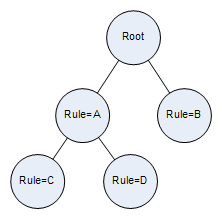
Because of that, there’s seldom an acknowledgement that any rule which forbids person A from doing X is potentially a rule which deprives newcomer C from activity X. You see this most strongly in rules such as “I forbid you to have sex with any new partner in the Monkey with Lotus Blossom and Chainsaw position, because that’s my favorite position” or “I forbid you to go to Clayton’s House of Clams with any other date, because that’s the restaurant where we had our first date” or “I forbid you to sleep over at a partner’s house because I never want to have to give up sleeping beside you.”

Each of these is made without any thought to what it costs a third person–what if a new person happens to be quite fond of the Monkey with Lotus Blossom and Chainsaw position, or Clayton’s House of Clams? Why should the new person always be forced to give up sleeping with a partner simply because person A never will?

Because that’s the way it is! Why should some new person be allowed to trump my needs and stomp all over me? Why shouldn’t a new person respect my needs?

Ah. And there we get down to the heart of the matter.

People pass rules because they feel that those rules are necessary in order to meet their needs. Rules don’t get passed at random; I have yet to meet a person who makes up rules by rolling dice or drawing words out of a hat.

Whenever someone proposes a rule, I make it a habit to ask myself three questions:

1. What is the purpose of this rule?
2. Does the rule serve the purpose it is intended to serve?
3. Is this rule the only way to serve this purpose?

I can’t overstate enough how valuable it is to think about this.

Often, in my experience, people use rules as indirect, passive ways to try to get their needs met. Instead of clearly articulating the need, such as “I have a need to feel special and valued by you,” they will think of something that makes them feel special and valued, and then pass a rule to say “I require you to do this thing” or “I forbid you to do this thing with others.” We in the poly community often talk about “communicate, communicate, communicate,” but to me, communication requires the willing to discuss difficult issues, such as the direct needs that we have, rather than just second-order issues, like “Forbidding you to do this is important to me.”

Let’s take a non-hypothetical example of a rule that I’ve seen some poly folks do: “I forbid you to take any date to Clayton’s House of Clams.” And let’s look at it within the context of these three questions.

1. What is the purpose of this rule?

If Alice tells Bob “I forbid you to go to Clayton’s House of Clams with anyone else,” what is she actually saying? It could be “I feel like my value to you depends on exclusivity.” It might be “I am afraid that if you do the same things with someone else that you do with me, you won’t need me any more and you will abandon me.” Chances are pretty good, though, that Alice, in making this rule, is feeling so overwhelmed by her fear that her needs aren’t being met, she hasn’t spared any thought at all for Cindy, who she’s now denying the Clayton’s clam experience to.

2. Does the rule serve the purpose?

If Alice is right, if Bob doesn’t truly value her and there’s nothing special about her, then forbidding Bob to go to Clayton’s House of Clams with his date won’t actually ensure that Bob doesn’t abandon her. If Cindy turns out to be “better” (whatever that means) than Alice, then Bob’s gone, clams or no clams. If Bob genuinely DOESN’T see value in Alice, the relationship is doomed and no rule will save it. By saying “I forbid you to go to Clayton’s House of Clams,” Alice is–at best–buying herself a false sense of security that is masking her underlying fear of abandonment, preventing her from confronting it directly.

3. Is this rule the only way to serve this purpose?

If Alice is actually afraid that Bob doesn’t value her and will abandon her if he does the same things with a new date that he does with her, then it seems to me that Alice is actually better served by confronting that fear directly, and asking directly for Bob’s help in feeling valued. There might be a lot of ways that can happen…by spending more quality time with Alice for instance, or by letting Alice know how he values her, by setting aside “date nights” with Alice, all sorts of things. The underlying need actually has nothing to do with clams at all.

So what? I was here first. Why shouldn’t a new person respect my rules, even if there are other ways to do things?

“Respect” is a slippery, tricky word. It’s kind of like “freedom”–everyone thinks they know what it means, but when the rubber meets the road, few folks actually agree on a definition.

To me, respect has to be mutual. If Alice is demanding respect from Bob’s new sweetie Cindy, that can only come if Alice in turn respects the notion that Cindy is a grown adult with her own needs and desires, and she, too, deserves a shot at having a voice in the relationship. Imposing rules by fiat on other people and then demanding respect from those people is all the rage (I hear) among leaders of North Korea, but can feel a bit yucky when we’re talking romantic relationships.

But more pragmatically, because I try to be pragmatic, setting up a situation in which one person imposes rules which another person is expected to follow is often a setup for failure. At best, it leads to rules-lawyering; “Well, we didn’t actually eat AT Clayton’s House of Clams, we ordered our clams to go and then ate out on the lanai!”

At worst, it sets up a relationship with a certain amount of tension and conflict baked in. If you see your partner’s other partner as a source of stress, if you set up rules to govern that other person’s behavior, then already you’ve started out on a basis of conflict–because you’ve created an environment where if you want the newcomer never to eat at Clayton’s with your sweetie and the newcomer’s desire is to get down with those tasty, tasty clams on a date with your sweetie, there’s an irreconcilable difference there. Someone’s desire is going to get trumped, and you’re playing the “respect” card to try to make sure it’s not yours.

By talking directly to needs rather than rules–“I need to feel valued and special by you”–we create a framework where competition is less likely. If it’s about feeling valued and unique, and it’s not actually about the clams at all, leave the poor clams out of it!

Now, some cases are more clear-cut than others. Rules around safe sex practices are extremely common in poly relationships; in fact, I’ll warrant that exceptions are pretty thin on the ground.

But even there, it pays to be careful. Open communication is important, because sometimes, even seemingly clear-cut rules with reasonable, necessary purposes can mask deeper things.

For example, let’s look at a rule “No unprotected sex with other partners.”

1. What is the purpose of this rule?

If Alice tells Bob “I don’t want you to have unprotected sex with anyone else,” most likely there’s a pretty good reason for it. The purpose of this rule is plain on the face of it: to protect Alice’s sexual health, as well as the health of everyone Alice is involved with.

2. Does the rule serve the purpose?

Yes. The data on disease transmission and barriers is unambiguous.

3. Is this rule the only way to serve this purpose?

Oh, boy. Now we get into a pickle.

There are other ways that this goal can be achieved. STD testing is an effective one. Sexual health is not an issue if the people involved have no STDs to begin with; they don’t spontaneously appear out of thin air.

But sometimes, folks may insist on barriers not entirely because of STD concerns, but also out of a feeling that it’s a mark of exclusivity, or because they feel more special if they are the only fluid-bonded partner. And sometimes, concerns about STDs can be a cover that masks those feelings. (This isn’t a hypothetical example, by the way. It’s actually happened in my romantic network.)

It takes a lot of courage to admit things like this. Talking openly about what’s really going on below the surface is scary, and hard, and involves making ourselves vulnerable.

But we poly folks talk all the time about how important communication is. It’s even more important that we actually do it. Even when it’s hard. Especially when it’s hard.

And sometimes, letting go of the notion that rules are important is a way to do that, as scary as that sounds.

Boston Chapter 8: A Rooftop Made of Awesome

By this point in our trip, as we lingered in St. Louis, I believed I had seen the most awesome thing ever. Perhaps not the most awesome thing that could exist, mind you; but certainly the most awesome thing that did exist.

That was, I must confess, a failure of imagination on my part. I was, even now, still a little bit naive. We had not yet, you see, gone on to the roof of City Museum.

We also had neglected, in our eagerness to explore the awesome candy bar made of awesome (metaphorically speaking), to notice that our traveling companion Erica was not to be seen–a harbinger, as it turned out, of what awaited us in Louisville. But more on that later.

At some point–I think it might have been when we were exploring a tunnel made of mirrors whose entrance was an enormous clockwork bank vault door about twelve feet across–we got a text from our wayward traveling companion.

That tunnel is pretty cool, by the way.

So is the snack bar, which includes among other things a set of chairs made out of old bumper cars, and a lot of secluded little cubbyholes with unexpected furniture in them..

But I digress.

We met with her downstairs, between the gigantic fish sculptures whose mouths opened into tunnels up to the ceiling and the main entrance whose walls were decorated with antique circuit boards, and after some discussion, we decided to check out the wonders on the rooftop.


The roof to City Museum is accessed via an elevator whose shaft is filled with windows, which you get to via an entrance flanked with nude statues of women supporting the world atop their heads. (On these, I have little to say, as I had always been led to believe that that role was filled with elephants riding on the back of a great turtle…but I digress.)

Peering over the edge of the rooftop is an interesting experience. It is not often that one sees an airplane and a bus protruding from the side of a building, with tunnels made of rebar extending both around and through them.

Peering around the roof is even better. There’s a Ferris wheel, bolted to the highest point of the roof; and an enormous slide which towers from the platform with the giant metal praying mantis on it, that swoops down to the fountain that spits water at passers-by. The slide has a tunnel atop it, so those who eschew prosaic things like staircases can, if they wish, climb back up the hard way.

We ended up riding the giant slide by the praying mantis several times. It’s a mind-bogglingly terrifying climb up, at least for anyone with even a residual trace of the ancient fear of heights which lurks in the recesses of our dim collective unconscious. Which means, naturally enough, that it’s a total blast to do.

It’s so high that even sitting at the entrance to the slide can induce a bit of virtigo.

I have video of myself sliding down this slide a speed somewhere between “ridiculous” and “insane,” which I have not yet found the time to upload to YouTube.

We also spent quite a lot of time on the ferris wheel, which in addition to being bolted to the top of a skyscraper had also, apparently, been modified to spin rather faster than is traditional for this particular variety of carnival ride. Again, hella fun.

The view from the top is quite lovely.

The rest of the roof is decorated in a kind of “industrial wasteland meets Disney World” motif, only cooler. We scampered about for a time, like visitors in Kubla Khan’s domain.

Alas, our taste of the bliss which awaits the righteous in the world beyond was all too brief. We still had a lot of ground to cover, and the pet lesbians to reach before nightfall. So we made our reluctant departure. On the way out through the parking lot, I looked up, nothing with some sorrow an array of fascinating structures we hadn’t had the opportunity to explore.

We returned to the car and resumed our journey to Boston, on our way toward our next milestone with the pet lesbians and, before that, the Guatemalans who would abscond with one of our party. That story will be told next time.