Journal is back to normal!

Or at least at the perigee of its eccentric orbit around normalcy, in any event.

The comments have been restored, and the zillions of messages that got inadvertently splattered all over everyone’s friends page have been removed. Thanks to a considerable effort on the part of LJ support, the blog is more or less back where it was.

Here’s the status of the move to WordPress:

– The WordPress importer absolutely does not work, full stop. It will import posts, but it will not import comments correctly; roughly one in every 20 comments is imported to the wrong post. Since I have about 22,000 comments, that makes quite a mess of things.
– I have found a Perl script which exports an entire LiveJournal into a WordPress backup file. However, it’s quite buggy and finicky. Among other things, it removes formatting from posts which contain lj-cut tags.
– The blog is up and running in its new home, but about 2/3 of the posts have bad formatting. I am currently debating which would take less time–going through and reformatting every post by hand, or attempting to fix the bugs in the Perl export script. Right now, “hitting myself in the face with a hammer” sounds better than either one.

I have a lengthy list of posts I want to make, and I’m still stalled on working on any of them. Between this head cold and the blog getting scrambled, it’s been a frustrating few weeks.

Trying to move…

I’ve been a LiveJournal paid member since 2001, and now I think the time has come to move my blog.

I’ve been working on this project behind the scenes for several weeks, which is why I haven’t been posting lately. My goal is to move to a self-hosted blog, probably running WordPress, and to have posts over there automatically be crossposted here (for those of you who still use LiveJournal).

In theory, that would make the move seamless. The entire blog would be on franklinveaux.com and also here at LiveJournal, and comments would be synced so that people could comment here or there.

In practice, it’s turning out to be a problem. The LiveJournal WordPress importer is buggy; when you move a large blog like mine, it tends to import comments attached to the wrong posts. There seems to be a subtle bug in the regex that parses the LiveJournal XML feed, and I suck at regex, so I can’t fix their bug myself.

So for now I will continue to blog here, while I work on getting the blog copied over there.

Why am I moving?

LiveJournal has, increasingly, been creating problems for me. They have a really difficult time getting the spam problem under control (for a while, I was averaging more than two hundred spam comments per day, though that has slowed). Paid accounts are expensive for what you get. And worse, there is now some question about what it even means to have a “paid account” any more–the devs are apparently moving to a model where the friends feed is radically different and the notion of “paid accounts” will give way to a model where users pay for specific features of LiveJournal.

So, I think it’s time to move. I’ve allowed my paid account to expire, and I’ll keep you posted on what happens as I sort out how to transplant eleven and a half years’ worth of blogging to a new home.

A Christmas Kitten

So it came to pass that zaiah and I went camping in Puget Sound for our seventh anniversary last week.

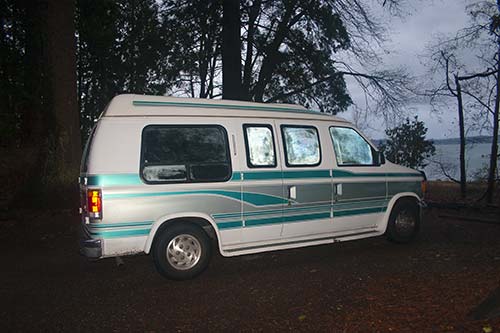
We took the new conversion van, which I traded my 2-seat Honda del Sol for on the spur of the moment a couple of months back. I have always loved little 2-seat sports cars, and on many occasions throughout the years I’ve been informed that this particular taste perhaps isn’t the most practical for a person in polyamorous relationships. zaiah and I were driving past a used-car lot one evening, and saw the van for about the same price as the book value on my car, so we went in with a del Sol and came back with a van.

Anyway, we went camping in Puget Sound because there’s a Tonkinese breeder in that area, and we’d been talking to her about getting a male cat from her to breed with my kitten, Kyla. He was old enough to come home with us the same weekend as our anniversary, so off we went.

The Tonkinese cats she breeds are just beautiful. Anyone who’s never met a Tonk is missing out. They are beautiful, intelligent, fearless cats who are very people-focused. This was what greeted us when we arrived. Our new kitten, Beryl, is the blue solid on zaiah‘s lap.

The first night with us, Beryl insisted on sleeping in bed with us. Under the covers, snuggled up, and purring. He spent most of the night nestled on my legs, preventing me from moving.

Then he moved up to snuggle into my armpit.

When Iwoke up, he crawled onto my lap and refused to let me stand, keeping me stapled to the bed by sitting on my lap and not moving.

zaiah installed hanging cloth shoe shelves in our closet, which we use to store socks and sweaters and so forth.

I should have realized that he was a climber when this became his preferred place to sleep any time we were not in bed.

We are still in the process of finishing our room, which we have been building onto the house for the past several months. The walls have not yet been painted, and the trim and baseboards are not installed yet.

The new bedroom has a ladder up to a loft we’ve constructed, which we’re using as a home office. The ceiling in the bedroom is quite high, so the ladder into the loft (which is bolted to the wall) is twelve feet tall.

Did I mention that the cat is a climber?

zaiah and I were up in the loft one day, getting ready to watch Law & Order on the computer, when we heard a crash and a frantic scrambling down below. The cat was trying to climb the ladder.

“Oh, that’s so cute!” I said. I got my cell phone and took a picture.

Then I went back to the loft.

A second later, the cat was up there with us.

He sprang onto the computer keyboard (starting the movie playing in the process) and then sat on my lap as if to say “I’m here! Aren’t I clever?”

And he is. This is the most talkative, most athletic, most determined, most curious, and most intelligent cat I’ve ever owned. That is a very dangerous combination, as it turns out.

The next night, I woke to the sound of claws scrambling on metal. I grabbed my camera and fired off a bunch of shots as the kitten climbed up into the loft.

As I’m typing this, at this exact moment, the kitten is sitting on my lap. In the loft.

Living with him is going to be…interesting.

Stopping by the side of the road…

zaiah and I spent the last four days camping near Puget Sound to celebrate our seventh anniversary, and to pick up the new addition to the household: a tiny blue Tonkinese kitten who will be a breeding tom for my kitten Kyla.

On the drive, we passed the ruins of an old house just off the interstate and (naturally) had to pull over to take care of it. The house is located in someone’s back yard, so after we’d hopped off the interstate, we knocked on the door and asked the gentleman living there (a retired engineer) if we could take pictures of it. He agreed, and away we went.

Unfortunately, it was biting cold, so we couldn’t linger. I did get some interesting shots, though. I love this kind of ruin!

Clicky here to see more!

The Apocalypse Is Coming! (…again)

In less than three weeks, the end of the world will happen.

Or, rather, in less than three weeks, a bunch of Mayan-prophesy doomsdayers will wake up and, if they have any grace at all, feel slightly sheepish.

The Mayan epic calendar is set to expire on December 21, or so it seems, and a lot of folks think this will signal the end of the world. They really, truly, sincerely believe it; some of them have even written to NASA with their concerns that a mysterious Planet X will smash into Earth on the designated date. (There seems to be some muddling of New Age thought here, as the existence of this “planet X,” sometimes called Nibiru, is a fixture amongst certain segments of the New Age population, its existence allegedly described in ancient Sumarian texts.)

It’s easy to dismiss these people as gullible crackpots, uneducated and foolish, unable to see how profoundly stupid their fears are. But I’m not so sure it’s that simple.

Apocalyptic fears are a fixture of the human condition. The Mayan doomsday nonsense is not the first such fearful prediction; it’s not even the first one to grab recent public attention. Harold Camping, an Evangelical Christian, predicted the end of the world on October 21, 2011…and also on May 21, 2011, September 7, 1994, and May 21, 1988. He got enough folks worked up about his 2011 predictions that many of his followers sold their belongings and caravanned across the country warning people of the impending Apocalypse.

These kinds of predictions have existed for, as near as I can tell, as long as human beings have had language. Pat Robertson has been in on the action, predicting the Great Tribulation and the coming of Jesus in 2007. These fears are so common that a number of conservative politicians, including Sarah Palin, believe that the current generation is the last one the world will see.

Given how deeply-woven these apocalyptic fears are in the human psyche, it seems to me they speak to something important. I believe that, at least for some people, such fears of impending doomsday actually offer protection against an even deeper fear: the fear of irrelevance.


My readership being what it is, I bet the percentage of you who recognize this picture is probably higher than the percentage of the population as a whole who recognize it.

This is part of the Standard of Ur, an artifact recovered from archaeological digs from the site of Ur, one of the world’s oldest cities, in what is now present-day Iraq.

Ur was likely first settled somewhere around 3800 BC, or roughly six thousand years ago, give or take. That puts its earliest settlement at about the start of the Bronze Age, plus or minus a century or so. The Agrarian Revolution was already well-established, but metallurgy was fairly new. When it was built, it was a coastal city; that was so long ago that the land itself has changed, and the ruins of Ur are now well inland.

You’ve probably at least heard of Ur; most public schools mention it in passing in history classes, at least back when I was a schoolkid. Unless you’re a history major, you probably don’t know much about it, and certainly don’t know a whole lot about life there. Unless you’re a history major, you probably don’t think about it a whole lot, either.

Think about that for a minute. Ur was a major center of civilization–arguably, the center of civilization–for centuries. History records it as an independent, powerful city-state in the 26th century BC, more than a thousand years after it was founded. People were born, lived, loved, struggled, rejoiced, plotted, schemed, invented, wrote, sang, prayed, fished, labored, experienced triumph and heartbreak, and died there for longer than many modern countries have even existed, and you and I, for the most part, don’t care. Most of us know more about Luke Skywalker than any of the past rulers of Ur, and that’s okay with us. We have only the vaguest of ideas that this place kinda existed at some vague point a long time ago, even though it was among the most important places in all the world for a total of more than three thousand years, if you consider its history right up to the end of the Babylonians.

And that, I think, can tell us a lot about the amazing persistence of apocalyptic doomsday fears.


When I was a kid, I was fascinated by astronomy. I wanted to grow up to be an astronomer, and even used a little Dymo labelmaker to make a label that said “Franklin Veaux, Astrophysicist” that I stuck on my bedroom door.

Then I found out that some day, the sun would burn out and the earth would become a lifeless lump of rock orbiting a small, cold cinder. And that all the other stars in the sky would burn out. And that all the stars that would come after them would one day burn out, too.

The sense of despair I felt when I learned that permanently changed me.

Think about everything you know. Think about everything you’ve ever said or done, every cause you believe in, every hero and villain you’ve ever encounter, every accomplishment you’ve ever made.

Now think about all of that mattering as much to the world as the life of an apprentice pot-maker in Ur means to you.

It’s one thing to know we are going to die; we all have to deal with that, and we construct all kinds of myths and fables, all sorts of afterlives where we are rewarded with eternal bliss while people we don’t like are forever punished for doing the things we don’t think they should do. But to die, and then to become irrelevant? To die and to know that everything we dreamed of, did, or stood for was completely forgotten, and humanity just went along without us, not even caring that we existed at all? It’s reasonable, I think, for people to experience a sense of despair about that.

But, ah! What if this is the End of Days? What if the world will cease to be in our lifetimes? Now we will never experience that particular fate. Now we no longer have to deal with the idea that everything we know will fade away. There will be no more generations a thousand or ten thousand years hence to have forgotten us; we’re it.


Just think of all the advantages of living in the End Days. We don’t have to face the notion that not only ourselves, but our ideas, our values, our morality, our customs, our traditions, all will fade away and people will get along just fine without us.

And think of the glory! There is a certain reflected glory just in being a person who witnesses an epic thing, even if it’s only from the sidelines. Imagine being in the Afterlife, and having Socrates and Einstein and Buddha saying to us, “Wow, you were there when the Final Seal was broken? That’s so cool! Tell us what it was like?”

Human nature being what it is, there’s also that satisfaction that comes from watching all the world just burn down around you. That will teach them, all those smug bastards who disagreed with us and lived their lives differently from the way we did! As fucked-up as it may be, there’s comfort in that.

Most of us, I suspect, aren’t really equipped to deal with the notion that everything we believe is important will probably turn out not to be. If we were to find ourselves transported a thousand, two thousand, ten thousand years from now, assuming human beings still exist, they will no doubt be very alien to us–as alien as Chicago would be to an ancient Sumerian.

They won’t speak our language, or anything like it; human languages rarely last more than six hundred years or more. Everything we know will be not only gone, but barely even recognized…if there’s anything left of, say, New York City, it will likely not exist much beyond an archaeological dig and some dry scholarly papers full of conjecture and misinformation. For people who live believing in tradition and hierarchy and authority and continuity, the slow and steady evaporation of all those things is worse than the idea of death. Belief in the End Times is a powerful salve to all of that.

Given the transience of all human endeavor, it makes a certain kind of sense. The alternative, after all, is…what? Cynicism? Nihilism? If everything that we see, do, think, feel, believe, fight for, and sacrifice for is going to mean as much to future generations as the lives of the citizens of Ur four thousand years ago mean to us, what’s the point of any of it? Why believe in anything?

Which, I think, misses the point.

We live in a world of seven billion people, and in all that throng, each of us is unique. We have all spent tens of billions of years not existing. We wake up in the light, alive and aware, for a brief time, and then we return to non-existence. But what matters is that we are alive. It’s not important if that matters a thousand years from now, any more than it matters that it wasn’t important a thousand years ago; it does matter to us, right here, right now. It matters because the things we believe and the things we do have the power to shape our happiness, right here, and if we can not be happy, then what is the point of this brief flicker of existence?

Why should we fight or sacrifice for anything? Because this life is all we have, and these people we share this world with are our only companions. Why should we care about causes like, say, gay rights–causes which in a thousand years will mean as much as campaigns to allow women to appear on stage in Shakespeare’s time? Because these are the moments we have, and this is the only life that we have, and for one group of people to deprive another group of people the opportunity to live it as best suits them harms all of us. If we are to share this world for this brief instant, if this is all we have, then mutual compassion is required to make this flicker of awareness worthwhile. This, ultimately, is the antidote to the never-ending stream of apocalyptic prophesy.

On the Care and Feeding of Giraffes


Image: Luca Galuzzi, Wikimedia Commons

I am in love with a dragonslayer.

Not all dragonslayers, as it turns out, are knights in shining armor. The dragonslayer I love is a giraffe.

Her name is Shelly. She is not an ordinary person; one does not generally become a dragonslayer if one is content to travel from cradle to grave by the path of least resistance. And I have been in love with her for quite a number of years.

It’s interesting, and sometimes a bit intimidating, to be romantically linked to a hero of yours. We met at a gathering of polyamorous folks in Florida a very long time ago. We started dating a short while after that. I didn’t know then that she would become a dragonslayer, but she did tell me early on in our relationship that she is a giraffe.

By this point, you can be excused, gentle reader, if you have absolutely no idea what I am talking about. Allow me to backtrack a moment to explain.

Shelly, this person I love very much, is not, as I have mentioned, an ordinary sort of person. Not being an ordinary sort of person often leads to loneliness, and loneliness leads to sadness; we are social animals, after all. Many years ago–long before I met her–she talked to a therapist about feeling alienated and isolated from the people around her. The therapist listened patiently, then explained that there was absolutely nothing wrong with her; she wasn’t alienated because she was broken, she was alienated because she was a giraffe surrounded by alligators. “Find other giraffes,” the therapist told her. “You’ll be fine.”

It’s easier to find giraffes nowadays than it used to be. Back before the Internet exploded all over the world like an overripe grape in a hydraulic press, locating a community of non-traditional, non-monogamous, sex-positive people was a bit like finding a hundred-dollar bill lying on the ground; sure, it was theoretically possible, and every now and then you heard of someone who knew someone who talked to someone who’d totally heard of it happening to someone else, but it wasn’t exactly something that you could count on to meet the household budget.

When Shelly and I met, we recognized each other immediately. I didn’t know, back then, what that would mean.


I wrote a while ago some meandering thoughts on the tenuousness of the connections that drift by us, and how these slender threads–the accumulations of entire lifetimes of choices made and random chance–can profoundly change our lives.

My relationship with Shelly changed me more than my experiences with any other person I’ve had in my life, arguably including my parents.

When we met, I was still married to a monogamous partner, someone for whom polyamory really wasn’t a good fit. We had spent quite a lot of time trying to navigate the tricky waters of balancing the needs of a person who can’t be happy within monogamy with the needs of someone who can’t be happy without it, and more often than not, it was other partners I got involved with who bore the brunt of that.

Shelly has a way about her. That way usually starts with her raising a finger, a slightly puzzled look on her face, and saying “I have a question.” Invariably, the questions that follow completely rearrange your mental landscape. “I have a question,” she might say. “If you say that you want to love other people, why do you bring them into a situation where it is not safe for them to love you back, because you can be ordered to end the relationship at someone else’s will?” Or “I have a question. If you say you value having other people in your life, why don’t you value their agency?”

There’s one very important lesson I learned about being involved with her: If you are to be romantically linked to Shelly, you had better have your house in order. She will not easily accommodate the thousand little compromises that many people make when they try non-monogamy, the little rules and rituals that reinforce insecurity and avoid difficult change. If she finds a weak place, an area where for the sake of convenience some little unintended cruelty has become written into the fabric of a relationship, she will push on it. Band-Aids over unresolved problems do not work for her. Feelings swept under a carpet will be dragged into the light. That’s the first rule of being involved with Shelly: commitment to honesty and self-knowledge. You don’t get to say everything is OK when things are not OK, and you don’t get to make compromises that exclude other people.

It was the relationship with Shelly that finally let me see how hurtful, for all those years before I met her, my rules and treaties with my monogamous wife had been to my other partners. It was Shelly’s insistence that I deal with that hurtfulness that brought me to the choice that I could no longer be a party to hurting others that way.


This is the ring I wear on my left hand. Shelly has one identical to it.

After we’d been together for several years, Shelly felt the call to become a dragonslayer. I have written about that here. One of the things she and I share in common is the fact that we both do not accept the idea of death. One of the things that makes her a better human being than I am is that she has made the decision to spend the entirety of her life fighting it.

She returned to school, to seek a doctorate that would allow her to do research in the field of radical longevity. She sacrificed a tremendous amount to do so, including moving away from where we had been living together to pursue her education. She made the decision and, just like that, both of our lives changed.

That is the second rule of Shelly. She has fortitudes of will that would astonish Winston Churchill. She is remarkably flexible in many ways, but when she has resolved to do something, wild dogs will not budge her. She is one of the strongest people I’ve ever met.

She went off to school. The company I was a minority partner in–one which would later implode in a fiery economic flameout that often happens, I’m told, when one puts engineers in charge of financial decisions–moved to Atlanta, and I went with it. We remained family, but the nature of our relationship changed.

That’s the third rule of Shelly. You don’t get to dictate what a relationship with her will look like. She is who she is; to love her means to accept that. She is neither flighty nor uncommitted; quite the opposite, in fact. She commits to the things that are important to her with ferocity. But she does not prefer the comforting illusion to the uncomfortable truth. People change. Shelly is not a person who hides from that change; she will not retreat into comforting routines.


Shelly does, and always will, hold a place in my heart, no matter what happens. There have been other people in her life while we have been together–people who sought to dictate only one kind of relationship with her, people who tried to impose restrictions on the way her heart will work. When they could not have what they wanted, they have chosen to fall out of her life.

It’s a poor choice, in my opinion. Being close to Shelly is incredible. I can not fathom why someone would that up simply because they could not impose rules on her about who she was permitted to love or how. But then again, I also may be part giraffe myself.

Caring for a giraffe, of course, requires special skills. One does not raise a giraffe the way one would raise an alligator or a puppy or a water buffalo. Here, as with all things that are important, flexibility matters; one can not toss scraps of raw chicken at a giraffe the way one might do with an alligator and then say there is something wrong with the giraffe because it does not thrive.

The biggest part of the care and feeding of Shelly I have discovered is simply developing the skill to listen to her when she talks about what she needs. Her needs in relationship, I have found, are generally quite modest, and easy to care for; but being heard is top among them.

Another is expectation management. Expecting Shelly to accommodate choices made for the sake of avoiding unpleasant reality is never likely to succeed. She has, more than anyone else I know, a commitment to emotional integrity that does not permit patching or working around problems like insecurity or fear. Almost all the practical skills I’ve learned about going under the bed, grabbing the monster that lives there, dragging it out into the light, and making it pay rent I’ve learned from her. Being involved with Shelly is not for the faint of heart.

And if her needs are not being met, she will let you know.

Funny things, needs are; when they aren’t being met, they can feel bottomless. In some relationships they are met more effortlessly than others; and in poly relationships, it can be very tempting to point to someone who’s needs aren’t being met and say “What’s wrong with you? Why are you so miserable? Why can’t you just be happy, like Sally over there is?” when the reality is that Sally is happy simply because her needs are being met.

Call this the Fourth Rule of Shelly: if her needs aren’t being met, she will be unhappy. She is not an unhappy person; she is, however, far less likely to sit in a corner and quietly suck it up if her needs aren’t met.

That is, as it turns out, a feature, not a bug…at least if you want relationships built on a foundation of absolute, unwavering emotional integrity.

Which, the cynic in me whispers, is the one thing many folks are not really prepared for. Perhaps that is one of the things that differentiates an alligator from a giraffe? Perhaps alligators prize relationship stability ahead of emotional integrity?

In any relationship, there will be times when chaos slips in through some neglected back door or some little crack in the ceiling. It happens. We are all born of frailty and error. I have, as I’ve gone about this business of placing my heart in other people’s hands and accepting their hearts in mine, learned that when those moments occur, there is often an instant, right at the start, when we make a choice. It’s a tiny choice, that happens in a fleeting instant, sometimes too fast for us to register, but it’s there: the instant when we choose compassion, or when we sigh, feel frustrated, and head down the path of “God damn it, I had plans to watch Friends on TV tonight and then maybe wash the dog–anything that’s more fun than dealing with human beings who have needs–and now here you are asking for my support with something, and and and why can’t you just be more convenient?

Compassion, in case it needs to be said, is better.


I am fortunate beyond measure to have connected with Shelly, and I feel blessed to have her as part of my life. Thank you for being who you are.

You are not “a poly:” Dan Savage runs off the rails

I want to like Dan Savage.

Really, I do. He’s witty and irreverent and often the things he says are right on the money.

But every now and then, he says something that leaves me scratching my head and wondering what color the sky is on his planet. He has in the last few years backtracked from the notion that there’s no such thing as bisexuality (a claim that seems so absurd on the face of it that it’s hard for me to understand why it still has any currency whatsoever), but when it comes to polyamory, it’s hard to find anything to like about his ideas.

Recently, he penned a column in which he asserted point-blank that polyamory is not an orientation:

Poly is not a sexual identity, PP, it’s not a sexual orientation. It’s not something you are, it’s something you do. There’s no such thing as a person who is “a poly,” just as there’s no such thing as a person who is “a monogamous.” Polyamorous and monogamous are adjectives, not nouns. There are only people—gay, straight, bi—and some people are in monogamous relationships, some are in open relationships, some are in polyamorous relationships, some are in monogamish relationships, some are in four-star-general relationships. These are relationship models, PP, not sexual identities.

What’s most interesting about this is that it mirrors almost precisely the attitude of folks who believe that homosexuality is an activity, not an orientation–that there is no such thing as “a gay” or “a straight” but merely those who engage in homosexual activities and those who don’t. Dan Savage’s words would be right at home in Ministry Today Magazine, which ran an article that claimed something similar about sexual orientation:

The language of “orientation” has allowed us to relinquish our responsibility for specific behaviors, to psychologize our conduct and to label each other as drunkards, abusers, adulterers, liars, homosexuals and so on, based on the sins we are most likely to commit. This system is convenient both for those who do not struggle with any of the sins that happen to be “socially-unacceptable” at the moment and for those looking for an external excuse for their sinful behavior.

This notion is a standard part of gay “conversion therapies” as well, many of which make claims such as “There is no such thing as a homosexual man” and “There are no homosexuals, there are only people with homosexual problems.”


Ideas like this are founded in a worldview that is remarkably resilient in the face of contradictory evidence. No matter how many people claim to have been born gay, religious conservatives hang on to the notion that there is no such thing as a homosexual; no matter how many people claim to be polyamorous, there are folks who stubbornly cling to the notion that polyamory is something we do rather than something we are.

Now, in a twisted kind of way, there is something like a kernel of truth to this. There are only people, and some are in gay relationships, and some are in straight relationships, and some have had partners of various different sexes, sexual identities, and gender identities…but in a sense, all of these things might be described as “activities.” A gay man is, presumably, physically capable of sexual contact with a woman; a straight man is physically capable of sexual contact with another man.

Similarly, people who are strongly polyamorous are physically capable of having only one romantic partner, and people who are nominally monogamous are physically capable of having multiple lovers.

But such a view is facile. A gay man might possess the physical capability of having sexual intercourse with a woman, but what that ignores is that man might not be capable of being happy in a sexual relationship with a woman. It will probably feel on some level deeply unsatisfying, if not downright unnatural, for a gay man to have a relationship with a woman; and such a relationship would not satisfy the basic needs he has, just like a relationship with another man would likely be profoundly unsatisfying to a straight man.

The same is true of polyamorous relationships. I could no more be happy in a monogamous relationship than I could be in a relationship with another man; such a relationship would feel, on a basic level that seems to have nothing to do with conscious choice, deeply unnatural, constricting, and wrong to me.

I’ve always been this way. There has never been a time in my life when monogamy made any sense to me, much less seemed like a desirable thing. As a young child, I could not understand the fairy tales about the princess choosing between two princes; since princesses live in castles, it seemed like there was plenty of room for both of them! When I started becoming aware that boys and girls were different, it baffled me why I would be expected to want a partner who belonged only to me.

Some folks argue that the existence of bisexuality proves there’s no such thing as innate sexual orientation. This claim makes little sense; the fact that some people are not strongly “wired” one way or the other does not prove that there’s no such thing as people who are. (In technical terms, this argument commits the inductive fallacy of division; the idea that innate tendency toward an exclusive sexual orientation exists in humans does not necessarily imply that every single human has such innate exclusive sexual orientation.)

Similarly, the fact that some folks seem to be able to move between polyamorous and monogamous relationships does not demonstrate that, for other folks, a tendency toward monogamy or polyamory is an immutable factor in their psychological makeup. There are people who can only be happy in same-sex relationships, people who can only be happy in opposite-sex relationships, and people who can (to various degrees with various partners) be happy in relationships with a wide range of partners of sexual identities and orientations. Similarly, there are people who can only be happy in polyamorous relationships, people who can only be happy in monogamous relationships, and people who, under the right conditions and with the right partner(s), be happy in a number of different relationship configurations.

All of this seems obvious to me.


Now, to be fair, I have a bit of an advantage here. I am completely, absolutely, irredeemably straight; no matter how hard I try, the notion of having another male lover simply does not work for me, even as an abstract thought experiment. (That’s a bug, not a feature; it means there’s an entire realm of sexuality I am cut off from, and I resent that.) This makes it easy for me to understand that there might be people who are gay and feel the same way I do about having an opposite-sex partner.

Similarly, I am and have always been polyamorous; it is not possible for me to function in a monogamous relationship and be happy, any more than it would be possible for me to function in a same-sex relationship and be happy; therefore, it’s not difficult to imagine that there are people who feel the same way about monogamy.

Dan Savage isn’t polyamorous…but he isn’t monogamous, either. He’s described himself as “monogamish,” which as near as I can tell means something like “potentially sexually open in some limited ways.” My impression is that he doesn’t feel strongly compelled to polyamory or monogamy; ergo, he doesn’t have the personal experience that such strong compulsions exist. We all tend to re-create the world in our own image. Perhaps he can be excused for thinking that there’s no such thing as “a polyamory” or “a monogamy,” since he personally seems to be neither of those things.

But just as the existence of bisexuality does not prove that sexual orientation is a myth, the existence of people who can take or leave monogamy doesn’t prove that relationship orientation is a myth.


Ultimately, in a moral sense, it doesn’t much matter whether things like sexual orientation or relationship orientation are innate. Well, I mean, it does in the sense that the more we understand about who we are as a species, the better that is…but from a moral or legislative standpoint, it seems to me that simply acknowledging the fact that there are a lot of different people in the world and not everyone has the same needs would go a long way toward increasing human happiness.

That’s a tough sell, though. There are many people intent on hanging onto the notion that there is one “right” way to be. The notion that sexual orientation is innate is a powerful one because it plays to our sense of fairness; if it’s an unchangeable part of who we are, rather than an action that we do, then discriminating against people who are this way is a bit like discriminating against people based on the color of their skin or the place where they were born or some other factor outside their control.

I personally think that our genes influence our behavior a whole lot more than we’re comfortable acknowledging. Hell, I’ve written before that a mutation of a single nucleotide in a gene that codes for a receptor in our brains can radically alter our sexual behavior. It really doesn’t seem like a stretch to me that the interactions of our genes will create huge implications for who we love, how we love them, and what form our relationships take.

I doubt that there’s a “poly gene” or a “gay gene.” Unless you’re talking about peas, genetics is almost never that straightforward; almost everything you learned about genetics in elementary school is a grotesque oversimplification. I mean, hell, we have standard poodles, and the color of their fur is determined by some really complex interactions of no fewer than nine genes. Nine genes, just for their fur color!1 Attributing complex high-order sexual behavior to just one gene seems…silly.

But that doesn’t mean that sexual and relationship orientations don’t exist, nor that they are not determined by our biological makeup. It just means that there’s not one gene that flips the switch from straight to gay or from monogamous to polyamorous.

It’s more complex than that. And I wish people like Dan Savage would acknowledge that.

1 In case you’re wondering, the genes are referred to as C (the gene for producing melanin); S (pigmentation distribution; there are several mutant alleles, which produce different patterns of spotting, such as Irish spotting and piebald spotting); A (agouti) and E (extension), which affect the proportion of pigmentation (mutant alleles produce lighter or stronger pigmentation, and the interaction of these genes produces browns, reds, and yellows in dogs); B, which controls the size of melanin pigmentation granules (dogs with the mutant gene will be brown rather than black, unless the gene occurs in combination with mutant A and/or E alleles); D, the “dilute” gene, which changes the intensity of pigmentation (and in combination with A and E can result in white or cream colored dogs); R (Rufus), a gene which can cause expression of red and which works in combination with A and E can produce the range of reds from apricot to Irish Setter red); G, a gene that causes coat color to change over time and is responsible for “blue” coat color (which starts out black and fades as the dog matures); and a partially dominant gene called V, which controls coat color in a complex way that produces silvers and silver-greys but which can also lead to coat fading that resembles blues. All of these genes can occur in just about any combination and with dominant or recessive alleles; for instance, BBeevv results in an apricot poodle, unless there is a double recessive mutation of the R gene present, in which case the poodle will be red…if there isn’t a recessive D gene at play, which can turn that apricot or red into cream, but not the same cream that you get with BBeeVv, a combination that looks the same but produces different color combinations in the offspring…you get the idea.

Of Android, iOS, and the Rule of Two Thousand, Part II

In part 1 of this article, I blogged about leaving iOS when I traded my iPhone for an Android-powered HTC Sensation 4G, and how I came to detest Android in spite of its theoretical superiority to iOS and came back to the iPhone.

Part 1 talked about the particular handset I had, the T-Mobile version of the Sensation, a phone with such ill-conceived design, astronomically bad build quality, and poor reliability that at the end of the year I was on my third handset under warranty exchange–every one of which failed in exactly the same way.

Today, in Part 2, I’d like to talk about Android itself.


When I first got my Sensation, it was running Android 2.3, code-named “Gingerbread.” Android 3 “Honeycomb” had been out for quite some time, but it was a build aimed primarily at tablets, not phones. When I got my phone, Android 4 “Ice Cream Sandwich” was in the works, ready to be released shortly.

That led to one of my first frustrations with the Android ecosystem–the shoddy, patchwork way that operating system updates are released.

My phone was promised an update in the second half of 2011. This gradually changed to Q4 2011, then to December 2011, then to January 2012, then to Q1 2012. It was finally released on May 16 of 2012, nearly six months after it had been promised.

And I got off lucky. Many Motorola users bought smart phones just before the arrival of Android 4; their phones came with a written guarantee that an update to Android 4 would be published for their phones. It never happened. To add insult to injury, Motorola released a patch for these phones that locked the bootloader, rendering the phone difficult or impossible to upgrade manually with custom ROMs–so even Android enthusiasts couldn’t upgrade the phones.

Now, this is not necessarily Google’s fault. Google makes the base operating system; it is the responsibility of the individual handset manufacturers to customize it for their phones (which often involves shoveling a lot of crapware and garbage programs onto the phone) and then release it for their hardware. Google has done little to encourage manufacturers to backport Android, nor to get manufacturers to offer a consistent user experience with software updates, instead leaving the device manufacturers free to do pretty much as they choose except actually fork Android themselves…which has led to what developers call “platform fragmentation” and to what Motorola Electrify, Photon and Atrix users call things I shan’t repeat in a blog as family-friendly as this one.

But what of the operating system itself?

Well, it’s a mixed bag of mess.


When I first got my Android phone, I noted how the user interface seemed to have been designed by throwing a box of buttons and dialogs and menus over one’s shoulder and then wired up wherever they hit. System settings were scattered in three different places, without it necessarily being obvious where you might find any particular setting. Functionality was duplicated in different places. The Menu button is a mess; it’s filled with whatever the programmer couldn’t find a better place for, with little thought to good UI design.

Android is built on Linux, an operating system that has a great future on the desktop ahead of it, and always will. The Year of Linux on the Desktop was 2000 was 2002 was 2005 was 2008 was 2009 was 2012 will be 2013. Desktop aside, Linux has been a popular server choice for a very long time, because one thing Linux genuinely has going for it is rock-solid reliability. When I was working in Atlanta, I had a Linux Gentoo server that had accumulated well over two years’ continuous uptime and was shut down only because it needed to be moved.

So it is somewhat consternating that Linux on cell phones seems rather fragile.

So fragile, in fact, that my HTC Sensation would pop up a “New T-Mobile Service Notice” alert every week, reminding me to restart the phone. Even the network operators, it would seem, have little confidence in Android’s stability.

It’s a bit disappointing that the one thing I most like about Linux seems absent from Android. Again, though, this might not be Google’s fault directly; the handset makers and network operators do this to themselves, by taking Android and packaging it up with a bunch of craplets of spotty reliability.

One of the things that it is really, really important to be aware of in the Android ecosystem is the way the money flows. You, as a cell phone owner, are not Google’s customer. Google’s customer is the handset manufacturer. You, as as a cell phone owner, are not the handset manufacturer’s customer. The handset manufacturer’s customer is the network operator. You are the network operator’s customer–but you are not the network operator’s only customer.

Because of this, the handset maker and the network operator will seek additional revenue streams whenever they can. If someone offers HTC money to bundle some crap app on their phones, HTC will do it. If T-Mobile decides it can get more revenue by bundling its own or someone else’s crap app on your phone, it will.

Not only are you not the customer, at some points along the chain–for the purposes of Google ad revenue, say–you are the product being sold. Whenever you hear people talking about “freedom” or “openness” in the Android ecosystem, never forget that.

I sometimes travel outside the US, mainly to Canada these days. When I do that, my phone really, really, really wants me to turn on data roaming.

There are reasons for that. When you roam, especially internationally, the telcos charge rates for data that would make a Mafia loan shark blush. So Android agreeably nudges you to turn on data roaming, and here’s kind of a sticking point…

Even if you’re connected to the Internet via wifi.

It pops up an alert constantly, and by “constantly” I really do mean constantly. Even when you have wifi access, it pops up every time you switch applications, every time you unlock the phone, and about every twenty minutes when you aren’t using the phone.

Just think of it as Google’s way to help the telcos tap your ass that revenue stream.

This multiple-revenue-streams-from-multiple-customers model has implications, not only for the economics of the ecosystem, but for the reliability of your phone as well. And even for the battery life of your phone.

Take HTC phones on T-Mobile (please!). They come shoveled–err, “bundled”–with an astonishing array of crap. HTC’s mediocre Facebook app. HTC Peep, HTC’s much-worse-than-mediocre Twitter client. Slacker Radio, a client for a B-list Internet radio station.

The presence of all the various crapware that comes preloaded on most Android phones, plus the fact that Android apps don’t quit when they lose focus, generally means that a task manager app is a necessary addition to any Android system…which is fine for the computer literate, but less optimal for folks who aren’t so computer savvy.

And it doesn’t always help.

For example, Slacker Radio on my Sensation insists on running all the time at startup, whether I want it to or not:

Killing it with the task manager never works. Within ten minutes after being killed, it somehow respawns, like a zombie in a George Ramero movie, shambling after you no matter how many times you shoot it:

The App Manager in the Android control panel has a function to disable an app entirely, even if it’s set to launch at startup. For reasons I was never able to understand, this did not work with Slacker. It was always there. Always. There. It. Never. Goes. Away. You. Can’t. Hide. From. It.

Speaking of that “disable app” functionality…

Oh, goddamnit, no, I don’t want to turn on data roaming. Speaking of that “disable app” functionality, use it with care! I soon learned that disabling some bundled apps can have…unfortunate consequences.

Like HTC Peep, for instance. It’s the only Twitter client for smartphones I have yet found that is even worse than the official Twitter client for smartphones. It loads a system service at startup (absent from the Task Killer screenshots above because I have the task killer set not to display system services). If you let it, it will download your Twitter feed.

And download your Twitter feed.

And download your Twitter feed. It does not cache any of the Twitter messages you read; every time you start its user interface, it re-downloads the whole thing again. The result, as you might imagine, is eyewatering amounts of data usage. If you aren’t one of the lucky few who still has a truly unmetered data plan, think twice about letting Peep have your Twitter account information!

Oh, and don’t try to disable it in the application control panel. If you do, the phone’s unlock screen doesn’t work any more, as I discovered to my chagrin. Seriously.

The official Twitter app isn’t much better…

…but at least it isn’t necessary to unlock the damn phone.

All this crapware does more than eat memory, devour bandwidth, and slow the phone down. It guzzles battery power, too. One of the default Google apps, Google Maps, also starts a service each time the phone boots up, and man, does it hog the battery juice…even if you don’t use Maps at all. (This screen shot, for instance, was taken at a point in time when I hadn’t touched the Maps app in days.)

You will note the battery is nearly exhausted after only four hours and change. I eventually took to killing the Maps service whenever I restarted the phone, which seems to have improved the HTC’s mediocre battery life without actually affecting Maps when I went to use it.

Another place where Android’s lack of a clear and consistent user interface–

AAAAARGH! NO! NO, YOU PATHETIC FUCKING EXCUSE OF A THING, I DO NOT WANT TO TURN ON DATA ROAMING! THAT’S WHY I SAID ‘NO’ THE LAST 167 TIMES YOU ASKED! SO HELP ME, YOU ASK ME ONE MORE TIME AND I WILL TIP YOU STRAIGHT INTO THE NEAREST EMERGENCY INTELLIGENCE INCINERATOR! @$#%%#@!

Sorry, where was I?

Oh, yes. Another place where Android’s lack of a clear and consistent user interface is its contact management, which is surely one of the more straightforward bits of functionality any smart phone should have.

Android gives you, or perhaps “makes you take responsibility for,” a level of granularity of the inner workings of its contact database that really seems inappropriate.

It makes distinctions between contacts which are stored on your SIM card, contacts which are stored in the Google contact manager (and synced to the Google cloud), and contacts which are stored in other ways. There are, all in all, about half a dozen ways to store contacts–card, Google cloud, T-Mobile cloud, phone memory card. They all look pretty much the same when you’re browsing your contacts, but different ways to store them have different limitations on the type of data that can be stored.

Furthermore, it’s not immediately obvious how and where any particular contact is stored. Things you might think are being synced by Google might not actually be.

And worse, you can’t, as near as I was ever able to tell, export all your contacts at once. Oh, you can export them, all right; Android lets you save them in a .vcf file which you can then bring to another phone or sync with your computer. But you can’t export ALL of them. You have to choose which SET you export: export all the contacts on your SIM card? Export all your Google contacts? Export all your locally-saved-on-the-phone-memory-card contacts?

When I was in getting my second warranty replacement phone, I asked the technician if there was an easy way to take every contact on the phone and save all of them in one export. He said, no, there really isn’t; what he recommended I do was export each group to a different file, then import all those files to my Google contact list, and then finally delete all the duplicates from all the other contact lists.

It worked, but seriously? This is stupid user interface design. It’s a user interface misfeature you might not ever encounter if you always (though luck or choice) save your contacts to the same set, but if for whatever reason you haven’t, God help you.

Yes, I can see why you might want to have separate contact lists, stored and backed up separately. No, that does not excuse the lack of any reasonable way to identify, sort, and merge those contact lists. C’mon, Google engineers, you aren’t even trying.

And speaking of brain-dead user interface design, how about this alert?

What the fuck, Google?

Okay, I get it, I get it. WiFi sharing uses a lot of battery power. The flash uses battery power. Android is just looking out for my best interests, trying to save my battery…

…but don’t all the Fandroids carry on about how much better Android is because it doesn’t force you to do what it thinks is best for you, it lets you decide for yourself? Again I say, what the fuck, Google?


So far, I have complained mostly about the visible bits of Android, the user interface failings and design decisions that demonstrate a lack of any sort of rigorous, cohesive approach to UI design.

Unfortunately, the same problems apply to the internals of Android, too.

One early design decision Google made in the first days of Android concerns the way it handles screen redraws. Google intended for Android to be portable to a wide range of phones, from low-end phones to full-featured smartphones, and so Android does not make use of the same level of GPU acceleration that iOS does. Instead, it uses the CPU to perform many drawing tasks.

This has performance and use implications.

User interface drawing occurs in an application’s main execution thread and is handled primarily by the CPU. (Technically speaking, each element on the screen–buttons, widgets, and so on–is rendered by the CPU, then the GPU handles the compositing.) That means that applications will often block while screen redraws are happening. On HTC Sense, for instance, if you put a clock on the home screen and then you start switching between screens, the clock will freeze for as long as your finger is on the screen.

It also means that things like populating a scrolling list is far slower on Android than it is on iOS, even if the Android device has theoretically better specs. Lists are populated by the CPU, and when you scroll through a list, the entire list is redrawn with each pixel it moves. On iOS, the list is treated as a 2D OpenGL surface; as you scroll through it, the GPU is responsible for updating it. Even on smartphones with fast processors, this sometimes causes noticeable UI sluggishness. Worse, if the CPU is interrupted by something else, like updating a background task or doing a memory garbage collect, the UI freezes for an instant.

Each successive version of Android has accelerated more graphics functions. Android 4 is significantly better than Android 2.3 in this regard. User input can still be blocked during CPU activity, and background tasks still don’t update UI elements while a foreground thread is doing so (I was disappointed to note that in Android 4, the clock still freezes when you swap pages in HTC Sense), but Android 4’s graphics performance is way, way, waaaaaaay better than it was in 2.3.

There are still some limitations, though. Because UI updates occur in the main execution thread, even in Android 4, background tasks can still end up being blocked while UI updates are in effect. This actually means there are some screen captures I wanted to show you, but can’t.


One place where Android falls down compared to iOS is in its built-in touch keyboard. Yes, hardcore geeks prefer physical keyboards, and Android was developed by hardcore geeks, which might be part of the reason Android’s touch keyboard is so lackluster.

One problem I had in Android 2.3 that I really, really hoped Android 4 would fix, and was sad to note that it didn’t, is that occasionally the touch keyboard just simply does not work.

Intermittently, usually once or twice a day, I would bring up an app–the SMS messenger, say, or a notepad, or the IMO IM messenger, and I’d start typing. The phone would buzz on each keypress, the key would flash like it does…but nothing would happen. No text would be entered.

And I’d quit the app, and relaunch it, and everything would be fine. Or it wouldn’t, and I’d quit and relaunch the app again, and if it still wasn’t fine, I’d reboot the phone, and force quit Google Maps in the task manager, and everything would be fine.

I tried very hard to get a screen capture of this, but it turns out the screen capture functionality doesn’t work when your finger is on the touch keyboard. As long as your finger is on the keyboard, the main execution thread is busy drawing, and background functions like screen grabs are blocked.

Speaking of the touch keyboard, there’s one place iOS really shines over Android, and that’s telling where your finger is at on the screen.

That’s harder than it sounds. For one, the part of your finger that first makes contact with the screen might not be where you think it is; it’s not always right in the middle of your finger. For another, when your finger touches the screen, it’s not just a single x,y point that’s being activated. Your finger is big–when you have a high-resolution screen, it’s bigger than you think. A whole lot of area on the touch screen is being activated.

So a lot more deep programming voodoo goes on behind the scenes to figure out where you intended to touch than you might think.

The keys on an iPhone touch keyboard are physically smaller on the screen than they are on an Android screen, and Android screens are often bigger than iOS screens, too. You’d think that would mean it’s easier to type on an Android phone than an iPhone.

And you’d be wrong. I have found, consistently and repeatably, that my typing accuracy is much better on an iPhone than an Android phone, even when the Android phone has a bigger screen and a bigger keyboard. (One of my friends complains that I have fewer hilarious typos and bizarre autocorrects in my text messages now, since I switched back to the iPhone.)

The deep voodoo in iOS appears to be better than the deep voodoo in Android, and yes, I calibrated my touch screen in Android.

Now, you can get third-party keyboards on Android that are much better. The Swiftkey keyboard for Android is awesome, and I love it. It’s a lot more sophisticated than any other keyboard I’ve tried, no question.

But goddamnit, here’s the thing…if you pay hundreds of dollars for a smart phone with a built-in touch keyboard, you shouldn’t HAVE to buy a third-party keyboard to get good results. Yes, they exist, but that does not excuse the pathetic performance of the stock Android keyboard! It’s like saying “Well, this new operating system isn’t very good at loading files, but that’s not a problem because you can buy a third-party file loader.” The user Should. Not. Have. To. Do. This.

And even if you do buy it, you’re still not paying for the amount of R&D that went into it. It’s a losing proposition for the developer AND for the users.


My new iPhone included iOS 6, which feels much more refined than Android on almost every level.

I would be remiss, however, if I didn’t mention what a lot of folks see at the Achille’s heel of iOS: its Maps app.

Early iPhones used Google Maps, a solid piece of work that lacked some basic functionality, such as turn-by-turn directions. When I moved to Android, I wrote about how the Maps app in Android was head, shoulders, torso, and kneecaps above the Maps app in iOS, and it was one of the best things about Android.

And then Android 4 came along.

I don’t know what happened to Maps in Android 4. Maybe it’s just a problem on the Sensation. Maybe it’s an issue where the power manager is changing the processor clock speed and Maps doesn’t notice. I don’t know.

But in Android 4, the cheery synthesized female voice that the turn-by-turn directions used got a little…weird.

I mean, it always was weird; you should hear how it pronounces “Caesar E. Chavez Blvd” (something Maps in iOS 6 pronounces just fine, actually). But it got weirder, in that it would alternate between dragging like a record player (does anyone remember those?) with a bad motor and then suddenly speeding up until it sounded like it was snorting a mixture of helium and crystal meth.

It was a bit disconcerting: “In two hundred feet, turn llllllllllleeeeeeeeeeffffffffftttttttt oooooooooonnnnnnnnn twwwwwwwwwwwwweeeeeeeeeeennnnnnnnttttyyyyyyyy–SECONDAVENUEANDTHENTURNRIGHT!” There was never a rhyme or reason to it; it never happened consistently on certain words or in certain places.

Now, Maps on iOS has been slammed all over Hell and back by the Internetverse. Any mapping program is going to have glitches (Google places a street that a friend of mine lives on about two and a half miles from where it actually is, in the middle of an empty field), but iOS apparently has a whole lot of very silly errors.

I say “apparently” because I haven’t personally encountered any yet, knock on data.

It was perhaps inevitable that Apple should eventually roll their own app (if by “roll their own” you mean “buy map data from Tom Tom”), because Google refused to license turn-by-turn mapping to Apple, so as to create a product differentiation point to make bloggers like me say things like “Wow, Google’s Android Map app sure is better than the one on iOS!” That was a strategy that couldn’t last forever, and Google should have known that, but… *shrug* Whatever. Since Google lost the contract to supply the Maps app to Apple, they took a hit larger than their total Android revenue; if they want to piss it away because they didn’t want Apple to have turn-by-turn directions, I think they really couldn’t have expected anything else.

In part 3 of this thing, I’ll talk about T-Mobile, and how they’re so hopelessly dysfunctional as a telecommunication provider they make the North Korean government look like a model of efficiency.

Freedom? I do not think that word means what you think it means

Since last week’s election, in which Mitt Romney was so confident of victory that he didn’t bother to write a concession speech, but lost by the largest electoral vote margin since 1996, there has been a picture floating around on conservative blogs and Web sites mourning the results. It looks like this:

There are a bunch of variants on it, of course, but the basic theme is ‘liberty weeping because this terrible thing happened.’

This particular image first started making the rounds after September 11, 2001, and it’s been recycled to express dismay over the conservatives’ non-preferred guy winning the election.

It is also, I think, an ironically appropriate image…but perhaps not in the way the conservatives who are using it might intend.


The Statue of Liberty was dedicated in October of 1886. The Civil War had only recently ended,and Reconstruction was in full swing. On the day the Statue of Liberty was dedicated, the requirement that you had to be a landowner in order to vote had only been abolished six years ago. Naturalized US citizens were still not permitted to vote. Blacks had only first been offered the vote sixteen years earlier, and many barriers faced any black man attempting to exercise that right; it would be another 79 years before the Voting Rights Act allowed blacks to vote in every state.. Women were still more than three decades away from being allowed to vote. The poor were still barred from voting by poll taxes, and would be for another 78 years. Native Americans were still 38 years from being enfranchised.

When the Statue of Liberty was dedicated, interracial marriage was a crime in all but 21 states. Every state, without exception, had sodomy laws barring homosexual sex. It would be 76 years before the first state, Illinois, decriminalized consensual sex acts between members of the same sex, and more than a century (117 years, to be exact) before Lawrence v Texas invalidated the remaining sodomy laws in the United States.

At the time the statue was dedicated, Jim Crow laws were gaining ground in the South; the first such laws had been on the books for eleven years, and within two years of the dedication, laws in every single Confederate state would enforce segregation of blacks and whites in public areas. It would be another 78 years before the last of these laws was dismantled.


So this, then, is the America into which the Statue of Liberty was born: a segregated America, in which women were not permitted to vote; an America in which blacks could vote in theory but seldom in practice; an America in which the poor were kept from the polls and homosexuality was punishable by hard labor or, in a handful of states, death; an America in which interracial marriage was forbidden in most states.

An America, in short, in which the notion of a black President of mixed-race ancestry who championed equal opportunity of gays and women would be an unthinkable abomination.

So it is appropriate, I think, that the image of a weeping Statue of Liberty should be so popular among conservatives. This is, after all, the America they would have us return to.

Mitt Romney found it impossible to believe that he could lose because he was incredibly popular with the only electorate he believed mattered: white men.

Buzzfeed has an interesting series of maps that show what the election would have looked like without universal suffrage. The maps are broken down by year: how the election would have gone in 1850, when only white men could vote; in 1870, when white men and some black men could vote; in 1920, when women could vote; and so on. Obama does not win until 1970, when the voting age was lowered to 18.

Among white men, Romney was a sure bet. His campaign forgot that white men aren’t the only voters that matter.

None of this is a surprise to the political right, of course. In 2001, after George W. Bush’s bitterly contested election, Ann Coulter said on television, “I think women should be armed but should not vote… women have no capacity to understand how money is earned.” In 2003, she said “It would be a much better country if women did not vote. That is simply a fact. In fact, in every presidential election since 1950, except Goldwater in ’64, the Republican would have won, if only the men had voted.”

This idea is taken to an even more surreal conclusion by a blogger on the Christian Men’s Defense League Web site, who writes:

Women want to delay marriage as long as possible so they can ‘have it all,’ and usually ‘have it all’ means ‘have as much hot alpha sex as possible without any consequences.’

[A]ll the Obama administration had to do was scare them that Mitt Romney was going to take away their birth control and their access to abortion. The fear for them is that, without birth control and abortion, they might actually get pregnant and have to give birth. That is scary not simply because of the economic burden of having a child (since, hey, they can get all kinds of cash and prizes if that happens), but because if that happened then everyone would know they’re sluts, and their image as daddy’s pure little snowflake princess goes out the window. […] Admittedly, the desire to slut it up isn’t the only factor in the gender gap. America has a fiscal problem primarily because women want free stuff without ever having to work.

Women vote, and minorities vote, and the nation’s government looks different than it would if only white men voted. The Statue of Liberty must surely feel out of place, living in a world so alien to the one in which she was born.


A common narrative among the folks using this image of a weeping Statue of Liberty is that Romney’s defeat means “the end of freedom.”

I’m not sure what this means. It sounds like dog-whistle language to me–coded language that means something other than what the words would suggest, the way “state’s rights” is coded language for racism and segregation.

The “freedom” that was lost when Romney lost certainly isn’t freedom from government interference in one’s private life; the Republicans during this election cycle frequently advocated massive government intrusion in almost every area of sexuality, from the availability of contraception (something else that would have been unthinkable when the Statue of Liberty was built) to endless nattering about the fine grades of rape (“violent” rape, “legitimate” rape, “real” rape–as opposed, presumably, to the sort of faux-rape that occurs when you just wanted to have sex with a woman who didn’t want to have sex with you). In a world in which women didn’t vote, the numerous and well-documented Republican gaffes about rape would not have been gaffes at all.

Nor is it any other variety of freedom I can identify. It isn’t freedom of speech, nor economic freedom (Republicans since Reagan have often played the ‘welfare queen’ card, creating a strange alternate reality in which black women become fabulously rich by having lots of children, yet have involved us in ruinously expensive wars that they have not funded while using tax breaks and corporate welfare to siphon vast quantities of public money upward to the wealthy). Nor is it freedom of religion; conservatives in the US are among the most religious strata of society, but only if that religion is their own particular form of Protestant Christianity.

As near as I can tell, the “freedom” they cherish is the freedom to oppress; the freedom to keep minorities in their place, the freedom to promote religious ideas in the political sphere without dissent, the freedom to control access to women’s reproductive services.

I’m not sure if those are the freedoms that the Statue of Liberty represents, but it seems clear that many people would prefer to live in the world as it was when that statue was erected.

The Birth of a Meme, or, Why I love the Internet

As the American electorate went through the motions of choosing a candidate of someone else’s choosing this week, the Internetverse was alive with political commentary, flames, racial epithets, and all the other things that normally accompany an American campaign season.

At the height of the election, Twitter was receiving 15,107 tweets per second…an eyewatering amount of data to handle, especially if you’re a company with little viable revenue stream other than “get venture capital, spend it, get more venture capital.”

Some of those tweets were tagged with the #romneydeathrally hashtag, and for a few days, how the Internet did shine.

If you do a search on Twitter for #romneydeathrally, you’ll find some of the finest group fiction ever written. The Tweets tell a strange, disjointed account of a political rally straight out of Lovecraft, with bizarre rites taking place on stage and eldritch horrors being summoned to feed on the crowd.

The hash tag went on for days, the Internet hive-mind creating an elaborate communal vision of a dark supernatural rally filled with horrors.

I even got in on the action myself:

Eventually, it caught the attention of the media. The Australian Hearld Sun ran an article about the hash tag that painted an interesting narrative of the meme:

In further evidence that Democrats are winning the social media war, hundreds of people have taken to Twitter to “report” on a fictional event where Republican Presidential hopeful Mitt Romney has called upon satanic powers in a last ditch effort to swing the election in his favour.

DigitalSpy has their own take on the meme, also saying Twitter users are talking about Mitt Romney calling upon Satanic powers.

When H. P. Lovecraft references get labeled as “Satanic powers,” I weep for the lost literacy of a generation…but I digress.

By far the most bizarre response to the meme was posted by Twitter user @nessdoctor over on Hashtags.org with the title “Twitter Users Threaten Mitt #RomneyDeathRally”. According to Ms. Doctor,

The hasthag #RomneyDeathRally trended after tweets spread placing Presidential candidate Mitt Romney (@MittRomney) of the Republican party under the light of resorting dark satanic techniques to win the upcoming US national elections on November 6, 2012.

This is, of course, a nasty hashtag and while its purveyors insist it’s for humor (and sometimes it is), it is done in bad taste. […]

There were also posts that threatened to kill Romney, with some even threatening to join domestic terrorism and attack the White House and the people in it if Romney sits as president.

The article has been rewritten a number of times; at first, it stated that the hashtag was all about threats to kill Romney and his family, then it made the strange claim that the hash tag came about after rumors had spread that the Romney campaign was trying to use Satanism to win the election. For a while, the article had screen captures of threats against Romney with a caption claiming the threats were part of the #romneydeathrally hash tag; that claim has since been dropped. I have no idea what the article will say if you, Gentle Readers, should visit it.

But where did it come from? (I’ll give you a hint: it didn’t start because of rumors of Satanism.)

Like most Internet memes, the #romneydeathrally hashtag craze started small. On November 4, Mitt Romney held a campaign rally in Pennsylvania. For whatever reason, the rally was late getting started, it was cold, and some people who were there complained on Twitter that Romney campaign staffers were refusing to permit them to leave the rally, citing unspecified “security” concerns.

Some of these tweets were picked up by reporters covering the event.

It didn’t take long to turn into a public relations disaster. Some folks started talking about the “death rally” that you could never leave on Twitter, and the #romneydeathrally hashtag was born.

Naturally, the Internet being what it is, it really didn’t take long for some folks to decide they’d ride that train to the last station:

And, inevitably, Lovecraft got involved. Because if there’s one thing you can count on about the Internet, it’s por–okay, if there are two things you can count on about the Internet, one of them is that the Internet will always insert references to Lovecraft and Cthulhu wherever it possibly can.

And thus the meme was born.

It had nothing to do with threats on Romney, nor with rumors that the Romney campaign was dabbling in Satanism. Instead, it was the Internet doing what the Internet does: seizing on something that happened and taking it to an absurd conclusion.

The Romney Death Rally was a PR own-goal for the Romney campaign, sparked by staffers doing something really stupid at a rally.

There are two lessons here. The first is that if you’re a prominent politician and you’re hosting a rally, it’s probably a bad idea to refuse to allow people to leave. People have cell phones, and Twitter, and some of them will complain, and their complaints might be heard.

The second, though, is less about politics than it is about news reporting. For the love of God, if you have a journalism degree, you should be able to recognize a reference to the Cthulhu mythology when you see it.