Polyamory: So What Is Couple Privilege, Anyway?

I’ve been chewing on this post for more than two years now.

Part of the problem is that it’s a daunting subject; one could easily write a book on the subject of couple privilege and how it plays out in relationships. Another is that a lot of otherwise well-meaning folks tend to get freaky-deaky about the P word; it’s perceived as an accusation or an attempt at guilt-tripping, because we all like to think of ourselves as basically fair and decent people, and the notion that we benefit from advantages that we haven’t earned is an uncomfortable one.

Part 0: Privilege: What is it?

Put simply, when you talk about people or societies, a ‘privilege’ is any advantage that one person or group has over another that hasn’t been specifically earned.

It’s a simple idea that’s complicated and fraught with land mines in practice. Part of the reason for that is that privilege is invisible to those who have it. If you are in a privileged position, it doesn’t seem like you have advantages over other people; it just seems like the Way Things Are. People don’t consciously assert privilege. People don’t get up in the morning and think “Wow, as a heterosexual white guy, I think I’ll go out and oppress some women and minorities today!” Privilege is insidious because it is structural; privileged people get advantages without having to consciously think about them.

Click for an introduction to privilege; if you’re familiar with the concept, you can probably skip this.

Spam of the day: With heat showers!

Most of the spam I get these days is in Spanish. Sometimes, it’s in English. Occasionally, it’s in Russian. Very occasionally, it’s in Arabic. And every so often, it looks like it’s in Russian that was translated into English via Google Translate.

Take, for example, this spam, which I reproduce below for your viewing pleasure unedited save for the reply email:

Subject: You I really liked

Hello Solitary heart!!!

I am a girl with beautiful name Julia, me 27 years. Dream to find the person for serious and long relations! I have interested your profile, since I seem that you search for such relations! Now I shall tell little about itself. I very cheerful and communicative, attractive girl. My growing forms 170 cm, my weight forms 57 kilograms. Much love to read the books, listen the classical music, walk on autumn wood and communicate with interesting people. If I have interested you, that anxiously waits your letter and photographies on my e-mail : m———c@yandex.ru With heat showers! Julia.

Best wishes,
Juliya

I am grateful for Juliya’s concern for the well-being of my romantic life, since truly do I search for such relations, it must be said.

I’m not quite sure, though, what “with heat showers” means. Google Translate renders this back into Russian as “С тепло души,” though of course I haven’t the foggiest notion what that might mean either.

I imagine it to be part of a lengthy blessing of travel in ancient Russian folklore, a ritual to prepare the hero for a journey of particularly perilous peril: “With this ox blood and this stone ax I bless thee, my son. Now go, and bring honor upon our clan, with heat showers.”

You have a package! Surprise, it’s the W32/Kuluoz malware!

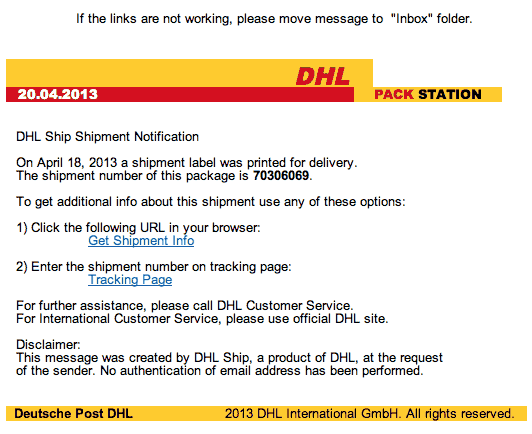
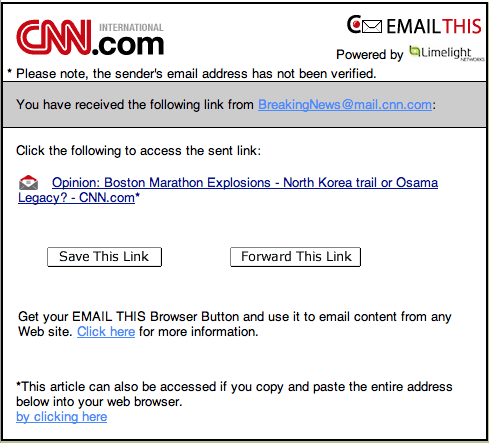
About three months ago, I got an email telling me that my FedEx package couldn’t be delivered. The body of the email told me that the UPS courier tried to deliver it, and that it would be sent back if I didn’t click on the attached link.

Naturally, as I wasn’t expecting a FedEx pacakge, and given that FedEx presumably knows it isn’t UPS, I knew immediately that clicking the link was a Very Bad Idea…at least on an unsecured Windows box. Sure enough, clicking it downloaded a Windows executable, which VirusTotal identified as W32/Kuluoz, a backdoor command-and-control software that also attempts to download other malware.

I reported the site hosting the malware and forgot about it.

Then, things started to change.


I’ve been getting more and more copies of this email lately; I’m now averaging several a week. The silly error and grammar mistakes have been fixed, and the emails now look quite polished. Here’s an example I received a couple of days ago:

The “Print Receipt” link leads to http://www.123goplus.com/components/.wye6fb.php?receipt=831_1493393532

CAUTION *** CAUTION *** CAUTION

The links in this blog post ARE LIVE as of the time of writing this. If you attempt to visit them with a vulnerable Windows computer, they WILL try to download malware to your computer. DO NOT visit these links if you don’t know what you’re doing!

The site 123goplus.com belongs to a company that produces business cards and similar printed pieces in Montreal, Canada.

$ whois 123goplus.com

Whois Server Version 2.0

Domain Name: 123GOPLUS.COM
Registrar: GODADDY.COM, LLC
Whois Server: whois.godaddy.com
Referral URL: http://registrar.godaddy.com
Name Server: NS1.MTLEXPRESS.CA
Name Server: NS2.MTLEXPRESS.CA
Status: clientDeleteProhibited
Status: clientRenewProhibited
Status: clientTransferProhibited
Status: clientUpdateProhibited
Updated Date: 06-jan-2013
Creation Date: 06-may-2006
Expiration Date: 06-may-2014

>>> Last update of whois database: Thu, 14 Mar 2013 22:32:30 UTC <<< Registrant: Pierino Pezzi 8630 Perra #3 Montreal, Quebec H1E5M8 Canada Administrative Contact: Pezzi, Pierino creationexpress@yahoo.com
8630 Perra #3
Montreal, Quebec H1E5M8
Canada
+1.5142741616

Technical Contact:
Pezzi, Pierino creationexpress@yahoo.com
8630 Perra #3
Montreal, Quebec H1E5M8
Canada
+1.5142741616

Domain servers in listed order:
NS1.MTLEXPRESS.CA
NS2.MTLEXPRESS.CA

The site 123goplus.com is running an outdated, insecure copy of the popular Joomla content management software, which has been hacked to have the malware downloader on it. (Joomla is a common target for this kind of attack. If you run Joomla on your Web site, and you don’t keep on top of security patches religiously, it’s a certainty that you will be hacked–it’s not “if,” it’s “when.”)

Here’s where things get cool.

Visiting this URL from a Mac browser or a Linux browser returns a 404 Not Found page, presumably to fool folks like me into thinking that the problem has been fixed.

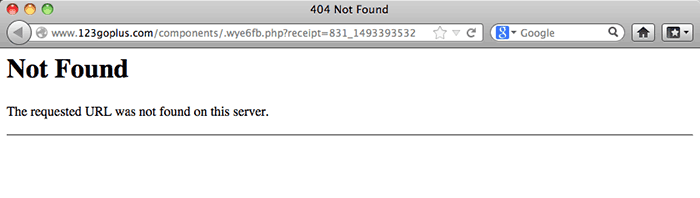
Visiting the URL http://www.123goplus.com/components/.wye6fb.php without the “?receipt=831_1493393532” at the end also returns a 404 error; presumably, that code identifies a target that the email has been sent to. The 404 error looks like this:

But hang on! Let’s go to http://www.123goplus.com/fghfghghf and see what a REAL 404 error looks like on this server:

See the difference? The 404 error that you get when you go to the malware dropper is phony. The malware dropper is there, and it does live at that address.

If you visit the malware dropper with your browser user-agent set to, say, Internet Explorer 6 (God help you), you won’t see an error message. Instead, it will download a .zip file called “PostalReceipt.zip”.

I have downloaded several copies of this file from several different compromised hosts over the past couple of months, all of them from nearly identical FedEx emails.

The payload sites vary. Many different sites have been hacked and used to download this malware: 123goplus.com, yourinternationalteam.com, youknowlee.com, theqcontinuum.com, canyonlakeboatstorage.com.

In every case, the site is running an outdated, insecure copy of WordPress or Joomla. The hackers hack the site (which is trivial to do), place a PHP script that downloads the malware, then send out a bunch of these phony emails about a non-existent FedEx package, hoping to trick people into clicking the link.

Most of these sites remain infected, weeks or months after being reported to the ISPs, because either the ISPs don’t care or the ISPs aren’t paying attention to the fact that the malware scripts return phony 404 pages. (GoDaddy and OVH, I’m especially looking at you here.)

The people behind this attack are adapting the malware rapidly. I downloaded three samples of the PostalReceipt.zip file, one on January 25 aqnd two on January 30, and they differ from one another. VirusTotal identifies the earliest one as W32/Kuluoz, the second as W32/Kuluoz.B, and the third as W32/Kuluoz.3.


There are some interesting things about this attack.

The group–and I bet it is a group–of criminals responsible for this attack are taking care to cover their tracks and to keep abuse teams from removing the malware from infected sites. Each spam email contains a code at the end of the malicious URL, and the URL returns a phony error message if it doesn’t see a valid code.

The virus downloader script is smart enough to examine the browser user-agent to see what kind of computer and what Web browser the victim is using. If it sees a browser or a computer that it can’t exploit, it returns a fake error message.

Only if it sees a vulnerable browser does it attempt to download the malwarewhich then surrenders the computer to the control of the hackers.

The malware droppers are installed, probably automatically, on sites running insecure WordPress or Joomla software. The phony 404 error messages slow down the Web hosting companies’ response, so the malware droppers stay active for long periods of time.

I’ve said it before, and I’ll say it again: If you run a Web site that uses a content managemet or blogging or ecommerce package, you *** ABSOLUTELY *** MUST *** check periodically for software updaes and install them immediately. (When a software update comes out, the organized crime gangs that do this kind of attack will analyze it and figure out what security holes it patches. Within days, they will start taking over any Web site that hasn’t installed the update.)

The fact that malicious scripts will cloak themselves behind fake error messages means that you can never trust that a problem has been fixed just because you see a 404 error if you try to look at a suspicious URL.

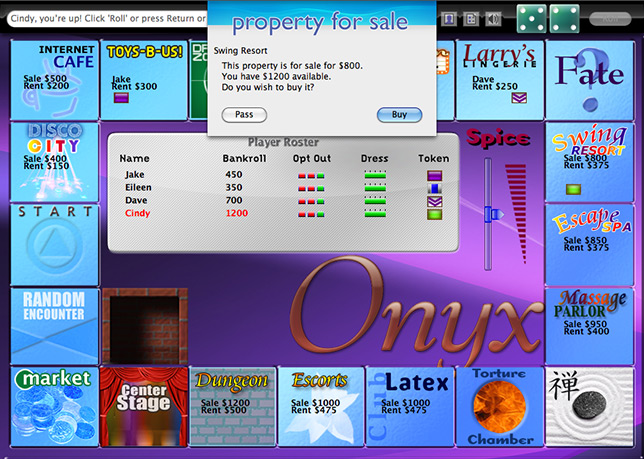
Onyx, the Game of Sexual Exploration, version 3.5 now available!

  • New Optional Rules
  • New Resizeable Gameboard
  • New Special Squares
  • New Actions
  • Newly Redesigned Graphics
  • New Roles
  • Improved Card Editor
  • Free Update for Registered Users!

Finally, after many months of coding, the new version of my sex game Onyx is ready! This new version is a significant overhaul, and contains tons and tons of new features and new game-play mechanics. It also contains lots of new actions (coming up with lists of hundreds of sexy things that people can do to each other is harder than it sound!).

To celebrate, I’m offering a special discount on registration if you want to play the full version. Of course, the free version is still free, and Onyx 3.5 is a free upgrade for registered users.

Check it out!

Fuck Comcast right in their stupid EAR. And also, polyamory!

I am on TV right now. Or, at least, I think I am. I don’t know, because Comcast is the most miserable tech company I’ve ever had to deal with.

Err, actually the second most miserable, but only by a nose.

Some time ago, i got contacted by producers from the Oprah Winfrey network. They were shooting a segment of “Our America” about polyamory. I pointed them to some friends of mine, who they liked so much they set up a camera crew in their house for weeks. They also filmed a smigeon of zaiah and I, and… Anyway, I was curious to see how it all turned out.

The show was set to air today, something I didn’t realize ’til this afternoon. So zaiah went down to the Comcast Worker’s Dormitory, Public Relations Orifice, and Meat Processing Plant to pick up a cable box. We plugged it in. Went through a lengthy process on Comcast’s miserable Net-site to “activate” the box, whatever that means. Web site said “OK, now activating your cable box, please wait 45 minutes.”

Which is a little weird; in 45 minutes, Russian organized crime can infect 250,000 American PCs with malware, so taking 45 minutes to program a cable box seems inefficient. But whatever.

Then the Web site said “Success! Your cable box has been activated.”

It lied.

Connect the box to the TV, nothing. Okay, bad cable maybe? Go outside the house, in the rain, diddle with the cable connection. Nothing. Replace the cable. Nothing. Run a known-good cable through the window into the house. Still nada.

Take the cable connector out of the wall. Looks good. Replace the cable that came with the cable box, the one that goes from the wall to the box. Still nada.

Call tech support. “No problem, we’ll reset your cable box. Should take ten minutes.”

10 minutes later, I’m 10 minutes older but no closer to working cable.

Move the cable box around the house in a bizarre game of whack-a-cable-outlet. Nothing works anywhere. (Seriously, who uses cable any more, anyway?)

OWN is not available streaming over the Internet; presumably, Oprah, who is, like, the richest woman in he world or something, isn’t getting enough fees to allow Net streaming.

Okay, back on the phone with tech support. “We can’t see your cable box.”

Uh…

Okay, fine. Move it to a different cable outlet. “We still can’t see it. You’re on a TV show, you say? About polyamory? What’s that?”

The inevitable “what is polyamory?” conversation over, we start playing this whack-a-cable-outlet game again. No matter where we go, the tech says “I sill can’t ping your cable box.”

Go back online to Comcast’s miserable activation page on Comcast’s miserable Web site. “You have 1 cable device (1 not activated).”

Apparently, it will tell you “activation successful” even if the device in question is disconnected, turned off, shot repeatedly with a 12-gauge, and buried in a lead-lined box outside of Roswell, New Mexico beneath a crumpled up ball of aluminum foil and two empty cans of baked beans. When the Web site says “activation successful,” that doesn’t mean that the activation was successful, you see…it simply means that enough time has passed that the Comcast Central Babbage Engine should have been able to align the gears and pulleys to the right configuration to activate the box.

zaiah is still on the phone with the tech this whole time, while our dinner slowly turns to charcoal and then catches fire on the stove. The tech is being really patient (and curious), but nothing works.

Finally, I yank the cable out of the cable modem, which we know works on account of I was able to communicate through the web-net on the Internet-tubes to the Babbage engine that runs Comcast’s Net-site, and plug it straight into the cable box.

“Oh,” chirps the tech, “your cable box is defective. Please bring it to your nearest Comcast cable Box Redemption Center and place it on the redemption line.”

Which might have explained why when zaiah picked it up from the Comcast Worker’s Dormitory, Public Relations Orifice, and Meat Processing Plant the person-unit behind the counter mentioned casually as if in passing that she’d plug the box in and make sure the blinkenlights came on because “we’ve had a bunch of bad boxes lately.”

So after four plus hours of work, we were unable to see the show. We had several friends over who were also on the program, because, like, who the fuck has cable nowadays anyway?

If you could even begin to feel one one-hundredth of the depth of my frustration and rage at Comcast right now, your monitor would catch fire.

The Cucumbers of Wrath: “Fairness” in Poly Relationships

This video, which was presented in a TED talk about moral reasoning in animals, shows two monkeys who have each been trained to perform a simple task (handing a researcher a rock) in exchange for a reward (a bit of food).

In the experiment, the researcher could give the monkey a bit of cucumber or a grape as a reward. Monkeys given cucumber rewards were quite happy…unless they saw another monkey being given a grape for the same task. When that happens…well, see below.

The things these monkeys are feeling translate directly into the things that can trip us up as human beings when we’re involved in non-monogamous relationships of all sorts.


OF GRAPES AND CUCUMBERS

The notion that relationships have “cucumbers” (things that help feed the relationship, but aren’t necessarily fun or thrilling) and “grapes” (exciting things that are fun to do) seems straightforward.

The problem, naturally, is that what constitutes a “cucumber” and what constitutes a “grape” can be highly subjective, and can change depending on where you happen to be in the relationship configuration.

For instance, to me some of the most delicious grapes of life are also some of life’s most mundane things: the day-in, day-out living with a partner, doing all the tasks and chores that add up to shared intimacy and a shared life together. I’ve had relationships where I live with my partner and we spend our time doing dishes, watching Netflix, and snuggling on lazy Saturday mornings, and relationships where I see a partner perhaps once a year for a wild frenzy of hot kinky group sex in a French castle.

Don’t get me wrong, the hot kinky sex in a French castle is a grape, no doubt about it. But for me, relationships where I spend time just quietly sharing a life with a partner are incredibly rewarding, and it’s far easier to build intimacy with that kind of shared life than with one week a year spent together. No matter how much fun that week happens to be. With a partner I see seldom, the time spent with that partner can look like an intense whirlwind of nonstop fun, because we have to pack all our relationship time into a very small space. It doesn’t account for the long periods of time spent apart, when the relationship is barely fed at all, with grapes or cucumbers. (I am a person whose love language is touch; it is harder to meet that need long distance.)

To a person who has that day-in, day-out living together, the weekend trips to a faraway land can look like grapes, and the doing of dishes and moving of furniture looks like a dull and unappetizing cucumber. On the other hand, to the partner who only gets my time in small dribs and drabs, the shared experiences of a life spent together looks like a plump, sweet, delicious grape. And so each person sees nothing but cucumbers in front of them, while the other person has an entire plateful of grapes.

GRAPES AND HIERARCHY

When you look at your own plate and see nothing but cucumbers, while it seems like someone else gets entirely 100% grape,it’s reasonable to feel like the monkey in the video up there. And when we feel like that, often our first impulse is to want all the grapes for ourselves.

It gets worse if we feel that we’re entitled to all the grapes, or that someone else might steal our stash of grapes.

Since I’ve been thinking about polyamory in terms of grapes and cucumbers, it has occurred to me that often, the rules and hierarchies imposed in prescriptive relationships, particularly prescriptive primary/secondary relationships, seem calculated to make sure that all the grapes belong to one partner and other partners are metered out nothing but cucumbers.

This can sometimes even go so far as “grape hoarding”–fencing off particularly tasty grapes to make sure nobody else comes near them. (Examples of grape hoarding might be forbidding a partner to go to a certain restaurant with another partner, say, or forbidding a partner to spend any holiday or vacation time with another partner.) Even sharing a grape with someone else can make us feel like that poor monkey on the left, if we feel that grape belongs to us by right. When our monkey emotions get monkey going, someone’s likely to get things flung at them.

The impulse to want to keep our grapes and make sure nobody else takes them isn’t just a human thing, or even a primate thing. Dogs do the same thing; a dog trained to do a trick to get a reward who sees the other dog get that reward for nothing may stop doing the trick.

SEPARATING THE GRAPES FROM THE CHAFF

What are the grapes in a relationship? I’ve been thinking about that ever since my sweetie showed me this video.

Kinky group sex in a Medieval castle is definitely a grape, don’t get me wrong. Intense experiences that form lifelong memories are very tasty indeed.

But focusing on those kinds of grapes, I think, makes me lose sight of the grapes I get every day–the grapes that it’s easy to disregard because I have so many of them. I’ve resolved to be more conscientious about valuing the grapes that I have, the ones I might otherwise take for granted.

If I were to make a list of the grapes I’m blessed with, it would include kinky sex in castles and trips to exotic places, no doubt. But it would also include:

  • Being able to wake up nearly every morning with my partner.
  • Having my partner close enough to touch, almost all the time.
  • Curling up on a rainy afternoon with my partner, snuggling beneath warm covers.
  • Building a private language from a shared history of experience.
  • Having someone next to me while I deal with all the various ways I have to hold back entropy.
  • Being able to plan with someone
  • Working on projects with a partner.
  • Creating with a partner.
  • Having a partner who sees me, who really get me and understands me.

So I do very much like the trips to see my distant sweeties, but I wish they were closer. I enjoy vacation time spent with far-flung lovers, but I would not trade those experiences for living with a partner. At the end of the day, if I had to choose, I would give up the vacations for having the people I love close to me all the time.

And that might be the real test of what’s a grape and what’s a cucumber: Would you choose to trade places with the person you see getting all the grapes? If the vacation experiences seem like such tasty grapes,would you trade a life spent together for a distant, vacation relationship?

How about you, O readers? What are your grapes and what are your cucumbers?

The Adventure Van

I am a bad polyamorous person.

I’m not bad in the sense that I don’t talk to my partners, or in the sense that I want to control my partners, or in the sense that I want to have veto over who my partners have sex with. I’m bad in the sense that there lives, deep within my breast, a deep and passionate love for tiny, wildly-impractical two-seat sports cars.

I have, for many years, owned nothing but tiny, wildly-impractical two-seat sports cars. It has created problems for me on more occasions than I can remember, where I needed to go somewhere with more than one of my partners and the only car available was a two-seat sports car.

This has been the background source of much relationship stress for rather a long time. Fate, it seems, has finally conspired to get me to do something about it.

It started with a trip to a friend’s house to help her celebrate her birthday. We had the bad fortune to head out toward her place just as rush hour was starting on a Friday evening, and got to the interstate on-ramp to discover a parking lot.

Right next to the on-ramp is a used car place. In the parking lot of the used-car pace was a conversion van, with a sticker in the window advertising…

…the same Blue Book value of my Honda del Sol, a tiny, wildly-impractical two-seat sports car.

zaiah and I joked that it would make a much better poly vehicle than the del Sol. Then we joked about it again. Then we thought about it. Then we said “Hmm.” Then we said “Hmm” again.

I will spare you the details, which I’m sure you can probably imagine, and cut straight to the chase: We pulled into the dealer’s lot in a tiny, wildly-impractical two-seat sports car, and pulled out in a conversion van.

Which has, I feel compelled to say, a bed in the back.

All my life, I’ve always wanted to own a vehicle with a bed in the back. They don’t make tiny, wildly-impractical two-seat sports cars with beds in them, so that deep desire has never been satisfied. Until now.


I’ve written about game-changing relationships before in this very blog. Swapping my del Sol for a conversion van has been a game-changing relationship.

Since making this exchange, zaiah and I have taken it camping twice. In fact, it’s safe to say that owning a conversion van makes a significant difference in one’s quality of life in many ways.

Having a van makes camping a much more comfortable proposition, as it turns out. Not to diss on anyone who enjoys roughing it in the Great Outdoors, mind, but a queen-sized bed with a memory foam topper is actually a considerable step up from a sleeping bag in a tent in terms of creature comforts. Not to mention available positions for sex.

Not long after the exchange, we were invited by those very same friends whose party we were attending on that fateful evening to go sledding…or, as we call it in the language of my people, “Oh god oh god we’re all going to die.” (Kidding! I’m kidding! Nobody died. We ended the sledding with no more than a cracked rib and a mild concussion between us.) As it turns out, it’s easier to fit sleds in a van than in a tiny sports car.

As it also turns out, sledding technology has advanced in leaps and bounds since I was a child, but sled steering technology has been all but lost.

I soon started personalizing the van. My friends DO kick ass. For the Brotherhood!

On our most recent trip, zaiah spotted the ruins of an old timber mill, long abandoned and turning to rust. We stopped, parked next to the “No Entry” sign, and I ducked under the “No Trespassing” and “Danger – Keep Out” signs to take photos photos, which I will likely be posting soon.

A lesson I’ve already learned from our adventures: Temperate coastal rainforests are soggy. Very, very soggy.

The Pacific Northwest doesn’t really understand beaches.

I grew up in Florida. I know what beaches are. Beaches are endless vistas of glittering sand, over which the surf rolls constantly. Seagulls circle overhead. The sun beats down on sand castles and little brightly-colored canopy tents.

In the Pacific Northwest, they apparently heard that “beaches” are places where the ocean meets the shore, but they were a bit hazy on details beyond that. Beaches here are rocky, with enormous boulders standing among piles of small round pebbles, while the rough surf pounds anyone who dares venture too close into oblivion. Oh, and it’s also bitterly cold.

So, not unlike the beaches I’ve seen in Great Britain, really.

One nice thing about camping in winter: you get the whole campground to yourself. Seriously, on our first trip, we were literally the only people there. Even the park ranger had the sense to be elsewhere. I woke thinking the Second Coming had happened and we’d somehow been missed. (It’s an easy mistake to make. Angels pouring out their Seals, the armies of darkness sweeping over the land, the Final Judgment…there’s a lot going on! It’s surprising how easy it is to overlook a couple of yahoos out camping in a van in the dead of winter. Who camps in winter?)

Shh! We’re hiding! Bet you can’t see us!

A rest area late at night. It looks so homey! It’s like a miniature house on wheels. A house without a bathroom. Or a kitchen. Or Internet access. But it has a bed! And that, by itself, means that when we’re camping in it, our standard of living is probably higher than most of humanity for most of human history.

Does this officially make me a pornographer?

Quite some time ago, I got involved in an IM conversation with a friend who had asked me the question “Why on earth would someone want to be a submissive in a BDSM relationship? What would the submissive possibly get out of it?”

After thrashing around for a while trying to find an answer, I decided to write a short story about BDSM from the point of view of a submissive.

The person I was talking to really liked the story, and suggested that I should write more erotica.

So I started writing on Literotica, and the things I wrote became very popular–much more so than I would have expected. (For a very brief time, a few years back, I had the most read and the highest-rated story on the site.)

So I kept at it, and write a pair of eBooks about a relationship between a highly repressed woman and the man who married her in order to train her as a sex slave. These eBooks got so popular on Amazon that they’re paying my rent now.

And now, they’re actually real, things-you-can-feel, dead-tree books.

Imagine my surprise.

Anyway, I have some promotional copies of these books, which I’ve made available on my Web site as a two-book set. Which, if you like, I will autograph for you under my pen name. Check it out!

Polyamory, Monogamy, and Ownership Paradigms

On another forum I read, someone made a complaint that folks in the poly community tend to see monogamy in terms of ownership and control; that is, for many poly folks, monogamy is about owning your other partner, while polyamory is more egalitarian, treating other people as fully actualized human beings.

And, sadly, I’ve encountered poly folks who do believe that. The misguided notion that polyamory is “more evolved” than monogamy comes, in many cases, from the assumption that monogamy is inherently rooted in ownership and polyamory is inherently egalitarian.

As with many preconceptions, it’s possible, if one squints hard enough, to see where this idea comes from. There’s nothing inherently wrong or controlling about monogamy per se; monogamy, by itself, is not necessarily disempowering or ownership-based.

But there is some truth to the notion that monogamy as a cultural norm comes with a set of social expectations that are deeply planted in the soil of ownership of others.

People in our society are expected to believe not just in monogamy, but in a whole set of social expectations that comes along with it. People say things like “you let your wife spend time with other men?” or “you let your husband talk to his ex?” as though it is natural and expected that we should be able to control who our partners interact with. People say things like “I would never allow my partner to masturbate” or “I would never permit my partner to fantasize about other people” as if it is normal to control our partners’ bodies and minds.

Not every monogamous person does this, of course. But these ideas are very commonly attached to our social expectations of monogamy; monogamy as a social institution began in cultures in which ideas of ownership were deeply embedded, and those ideas have proved very tenacious.

There’s a problem, though, in that polyamory is not necessarily any better.

People who live outside the cultural mainstream love to believe that they have escaped the petty social norms that enslave all the other sheeple still trapped in the spider web of normative behavior. In reality, though, cultural ideas have an insidious way of seeping into us even when we’re aware of them. Simply knowing that we were raised in a climate of ownership assumptions about sex and love doesn’t make us immune to internalizing them. In fact, many, many people in the poly community cling just as strongly to paradigms of ownership and control as they believe all those poor “unevolved” monogamous folks do–they simply manifest differently, that’s all.

I’ve been putting some thought to the sneaky ways that social expectations can creep into relationships even when they’re outside the social mainstream. Here are some examples I’ve come up with.

Control paradigm Egalitarian paradigm
I let you have other partners. This is a privilege I grant you. I can tell you who, under what circumstances, when, and how you may have other partners. You are a human being with the right to make your own choices about having other partners. I will tell you what I am comfortable or uncomfortable with, and trust you to make choices that honor and cherish our relationship.

I let you have sex with other people. This is a privilege I grant you. I can tell you how you may or may not have sex or otherwise control the timing or manner of your sexual activity. You have an intrinsic right to make choices about your sexuality. I will communicate you what I am comfortable or uncomfortable with, because I trust you to make choices that honor and cherish our relationship.

My sexual health is your responsibility. I will set limits on your behavior to ensure that you only engage in sexual activity that meets my sexual risk limits. My sexual health is my responsibility. I will communicate to you my sexual health boundaries, risk limits, and concerns. Because your risk limits and concerns may not match mine, you are free to make whatever choices with your own sexual health that you like. If your behavior exceeds my threshold of risk, I have the right to change the sexual relationship between you and I, including adding barriers or even ending it entirely. If having a sexual relationship with me is something you value, you can make choices to remain within my levels of acceptable risk.

I may fetishize your other sexual partners for my gratification. I have the right to tell you how to or not to have sex and/or demand the intimate details of your sexual activites for my sexual gratification. Your sexual activity with other people and your other partners are not merely for my sexual gratification. I will accept your right to choose sexual activities that you and your other partner find fulfilling, and that you and your other partner have a right to privacy about your own intimacy.

If I am sexually attracted to your other partners, it is your responsibility to share them with me. You have an obligation to provide me with access to your partners if I want it.

Your other partners are human beings. As they are not your property, it is not your obligation to make them sexually available to me.
My sexual partners are mine. You are not permitted to express an interest in them; if I want to keep them to myself, this overrides the wishes or desires of both you and my other partners. My other sexual partners are human beings. As they are not my property, I do not have the right to "keep" them; they are people, not things, capable of making their own decisions about sexual intimacy and partner choices.

My fears, insecurities, and jealousy are your responsibility. I have the right to control your behavior and/or the behavior of your other partners in order to manage my fears and insecurities. My fears, insecurities, and jealousy are my responsibility. I have the right to communicate with you about them, and to ask for your help in dealing with them. Because you love and cherish me, you will work with me to help me when I am afraid or insecure. These feelings do not give me the right to dictate your choices, however.

I have the right to ensure that you may have other partners only to the extent that your other partners do not affect me or our relationship. I may limit or control your other relationships so as to make sure they do not affect me. I understand that there are many uncertainties in life. Everything from a new job to being fired to illness to family of origin problems to being hit by a runaway bus may affect our relationship together. When your other partnerships affect me in a way that concerns me, I have the right and the responsibility to communicate with you about it, so that we can work together to address my concerns.

Your other relationships exist only on my say-so and only for so long as I permit. I have the right to order you to terminate any of your other relationships if I feel it is necessary or desirable. Your other partners are people with needs and feelings; they have have the right to explore and develop their relationship with you, to be supported by you, and to expect that their relationship with you will continue for so long as it benefits you and them. I may reasonably expect that they will respect the relationship between you and I; they may reasonably expect that I will respect the relationship between you and them.

Understanding my needs is your responsibility. If you fail to meet my needs or expectations, even if I have not made them explicitly clear, you have wronged me, and I have the right to control your behavior so as to ensure they are met. Understanding my needs is my responsibility. Communicating my needs with you is also my responsibility. You can not be expected to meet any needs of mine that you are not aware of. I may ask for your help in making sure I am taken care of, and trust that you value me and want to take care of my needs.

The relationship between me and your other partner is your responsibility. I may require that you arrange meetings between us, that you keep the other person separate from me, that you ensure I am comfortable with your other partner, or otherwise make it your responsibility to manage the relationship between us.

The relationship I have with your other partner is our responsibility. As I am an adult and your other partner is an adult, it is on each of us to negotiate what kind of relationship we want to have with each other.
I permit you to have other relationships only so long as they are subordinate to me. The people with whom you develop relationships have needs and feelings, and have just as much right as I have to asking your help in meeting them. Should our needs run into conflict, we can come together to communicate and negotiate as adult human beings; I may not claim authority over another human being merely because I met you first.

I have the right to control your emotional engagement with other people. This includes the right to tell you that you may not experience certain emotions (for example, you may not fall in love with another partner) and/or the right to control the extent to which you feel emotions with others.

Your emotional experience is one of the most fundamental parts of who you are as a person. I recognize that it is impossible for us as human beings to place arbitrary controls on our emotions.
I have the right to control how far and to what extent you become entangled with other people. For example, I may forbid you to become financially entangled with other partners. Decisions about how to conduct your life can only be made by you. Realistically, whatever promises you have made and whatever rules I have made, there is nothing short of a shotgun and a length of chain that compels you to stay with me. I have the right to expect that you will uphold agreements you have made with me, and I have the right to expect that your decisions will account for the responsibilities you have incurred with me. Beyond that, I can not realistically lay claim to your autonomy; even if I want to, it is not possible for me to compel your decisions.

I have the right to control your expressions of love, affection, or feelings for others. I may forbid you to give gifts to other partners, do errands with other partners, use certain pet names with other partners, or have certain experiences with other partners. The way you express love is one of the most intimate of all choices you can make. Attempts to dictate how you may or may not do this are not only extremely intrusive, they may undermine the foundations of your other relationships. As long as you express the love you feel for me with me, it is not necessary for me to control your expressions with others.

My emotions are your responsibility. If I feel something that I don’t want to feel.this is your fault, and I may limit your behavior as a result. My emotions are my responsibility. Even when they are surprising or unpleasant, they belong to me. I have the reponsibility to communicate with you about my emotions, and I may ask for your help in feeling loved and supported by you.

I have the right to define your other relationships. As adult human beings, you and your other partners have the right to define your relationship for yourselves.

I have the authority to place your other relationships in a hierarchy of my choosing. As adult human beings, you and your other partners have the right to determine the shape of your relationship. I have the responsibility to communicate my needs to you; as long as you are able and willing to work with me to meet those needs, the ordering of your other relationships is a decision between you and your other partners.

Agreements between you and I are binding on any other partners you may have.

All the people involved have a right to negotiate any agreements that may affect us.

I’m sure there are more. What are your experiences?