
As I move into my sixth decade of life, I’m posting a series of stories from my past. This is part of that series.
Behold the BeBox.
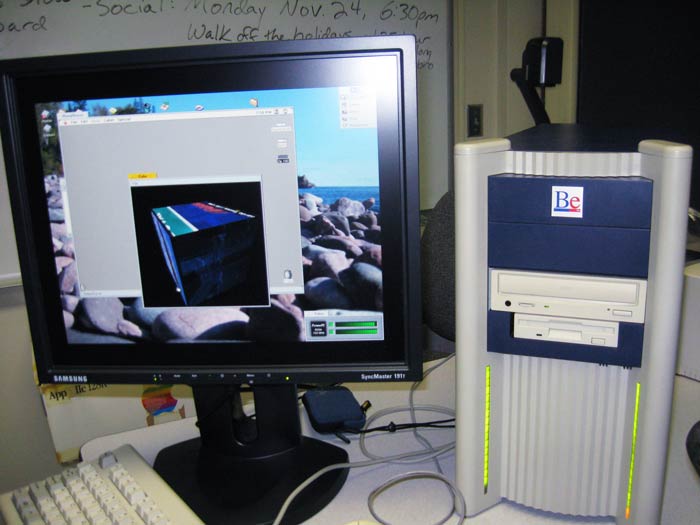
Image by Mazzmn, Wikimedia Commons
Computer history buffs will recognize it immediately. It came to market just before Steve Jobs returned to Apple, and was built around multiple PowerPC processors. It ran an operating system called BeOS, which was neither Windows nor macOS compatible, but was totally its own thing—a vaguely sorta Unix-flavored thing that also was not Unix and could not run Unix software.
The BeBox was unveiled with a splash at MacWorld Boston in 1996. I was there when it was announced, on a stage in the exhibit hall, with snazzy music and lights and a general dog and pony show. Be wanted to sell hardware but also license BeOS, so they showed off the computer, and BeOS running on Mac clones, which were still a thing back then.
I remember it quite clearly, because I made the presenter a bit angry.
After the presentation, he opened the floor to questions. So I, being the smartass I am and also a bit annoyed at the predictability of the crash and burn that was to come, raised my hand and said “How long until you realize there’s no room in the personal computer market for a new hardware platform between Wintel and Apple, stop selling hardware and pivot to a software-only company, and then go out of business?”
I got some laughs and some grumbling from the audience, and an angry scowl from the presenter.
Computer history buffs know how the story ended, of course.
In 1997, Be Inc. announced that it was wrapping up production of the BeBox computer, and would henceforth be a software-only company, licensing BeOS to others. They sold a few licenses to Power Computing and tried to get Apple to buy BeOS to use as the basis for the next-generation macOS. Apple passed, instead buying NeXT and using its operating system, NeXTSTEP, as the core of their operating system, which they called OS X.
In 2000, Be stopped trying to compete as a desktop operating system and pivoted to BeIA, an embedded version of BeOS for Internet appliances and embedded systems. In 2001, Palm Inc. bought Be Inc. to use BeIA for its PalmOS devices. In 2003, Palm Inc. spun off its PalmOS group as a different company, PalmSource. In 2004, PalmSource announced PalmOS Cobalt, built atop BeIA, which was built atop BeOS.
It went nowhere, so in December 2004, PalmSource abandoned PalmOS Cobalt and bought a Chinese Linux firm, building yet another Palm operating system atop Linux that also went nowhere.
PalmSource, which is now kind of still in existence under the name Access Systems Americas, still owns BeOS to this day. BeOS is no longer available, but the open source community is working, slowly, on Haiku, an operating system that looks like BeOS and will run all seven or so BeOS applications ever written, because…well, I honestly don’t know why they’re doing it.