The difficulty lies in the fact that I can tolerate only a narrow range of temperature. Anything above or below that range is pain.
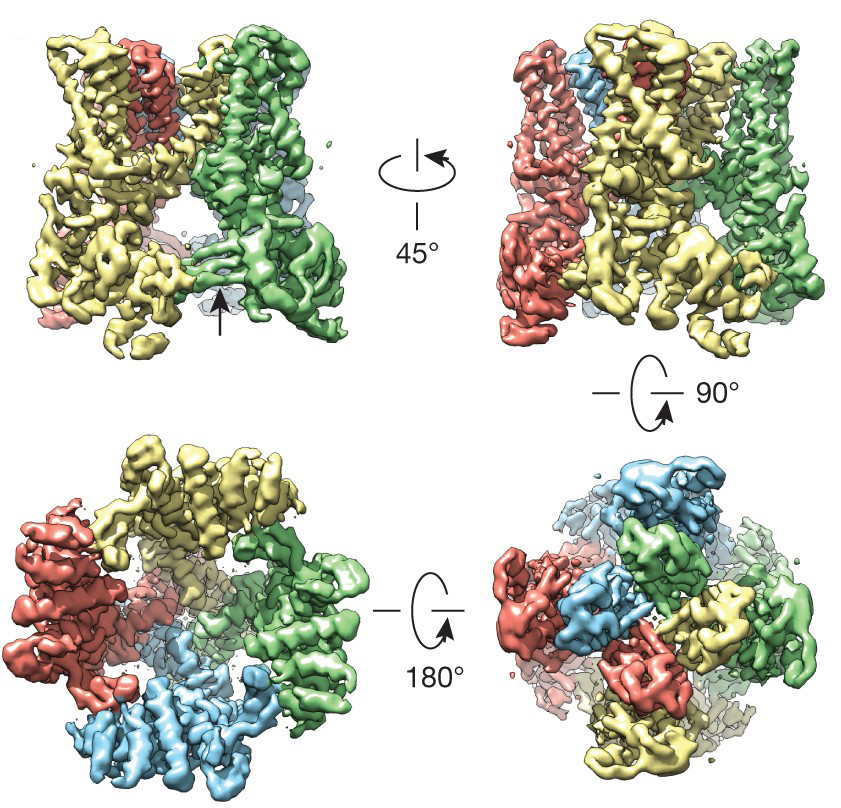
I inherited this trait from my mom, along with her resistance to local anesthetics. It has a name, in fact: “congenital thermal allodynia.” It’s caused by a genetic anomaly of genes that direct production of a class of receptor protiens called “transient receptor proteins,” or TRPs, particularly receptor called TRPA1 (which activates in response to cold) and TRPV1 (which activates in response to heat).
TRPV1, the sensor that makes painfully hot things painfully hot
Simplified, handwaving over details, many TRPs respond to changes in temperature, allowing ions to flow through into the nerve cells the receptor proteins are attached to if temperature goes above or below a threshold. When these receptors are found on pain nerves, triggering them results in pain. The temperature-sensing receptors produced my body aren’t formed correctly, so the heat-sensitive receptors trigger at too low a temperature and the cold-sensitive receptors at too high a temperature; a shower that’s perfectly fine for someone else is painfully hot for me, and cold showers are unbearable agony.
That’s the background part I.
So.
Some time ago, I severely burned my foot by dropping a kettle of boiling water on it, which is how I discovered that boiling water burns are just about the only things that suck worse than kidney stones.
The hospital gave me a shot of morphine, which did nothing except make me throw up, and prescribed oxycodone, which also did nothing but make me throw up. Finally, in desperation, I tried cannabis edibles, which I found worked far better than opiates on pain—cannabis was the only thing that made followup viits to the burn clinic tolerable.
That’s the background part II.
Incidentally to this, I also learned that cannabis edibles quench the thermal allodynia. It was, I must say, quite an amazing thing to be able to take a nice warm shower and have it, astonishingly, be a pleasant experience.
For the first time, I really understood what people mean when they talk about enjoying a hot shower.
Fast forward a few years, and I discovered, also quite by accident, that cannabis edibles put me in my body. Normally, my experience of the world is that I live in a ball behind my eyes, connected to and driven around by a meat machine that I can feel, sure, but that isn’t really me. The first time I ever had the experience of completely inhabiting my body was after an experiment with psilocybin mushrooms some years back; and boy, lemme tell you, the experience that I, the me that I am, reached all the way to the floor was fascinating.
I learned earlier this year that small doses of cannabis edibles, about 1.25mg of THC and 1mg of CBD, will induce the same thing.
I also learned, entirely by accident, that a low-dose cannabis edible plus a Mike’s hard lemonade will put me entirely in my body but also make the experience extremely unpleasant.
That’s the background part III.
Now that you know the background, allow me to get to the point of this essay, in which your humble scribe and his Talespinner decide to do “Science!”, and instead accidentally do real, honest-to-god Science!
So first, the “Science!”
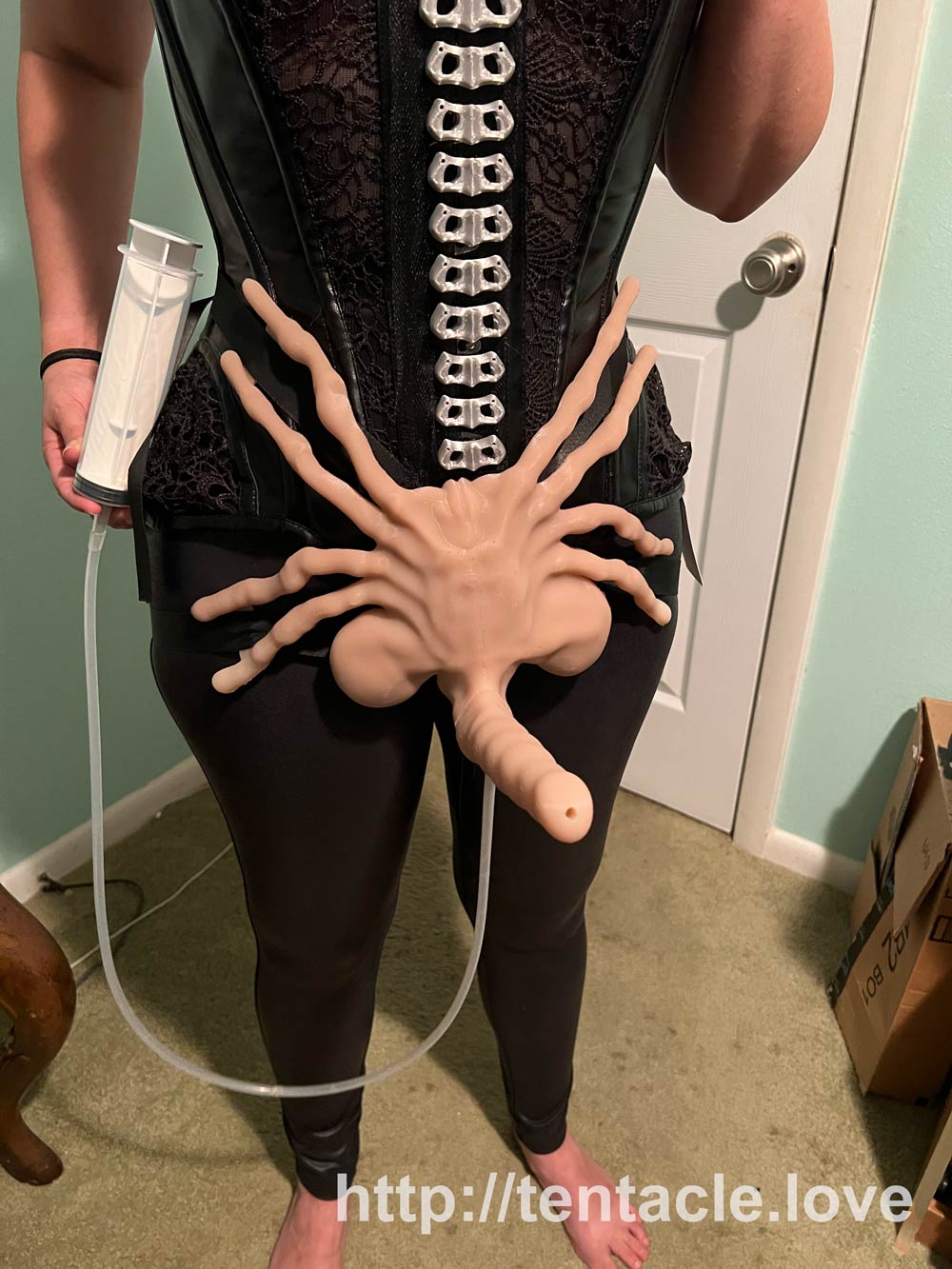
Those of you who’ve followed the adventures chronicled herein may be aware that for the last three years I’ve been hard at work on various xenonorph-themed sex toys, most notably the Xenomorph Hiphugger Strapon.
I made a xenomorph hiphugger for my Talespinner as well, and also I’ve been working on a xenomorph facehugger gag, which I brought with me to Springfield.
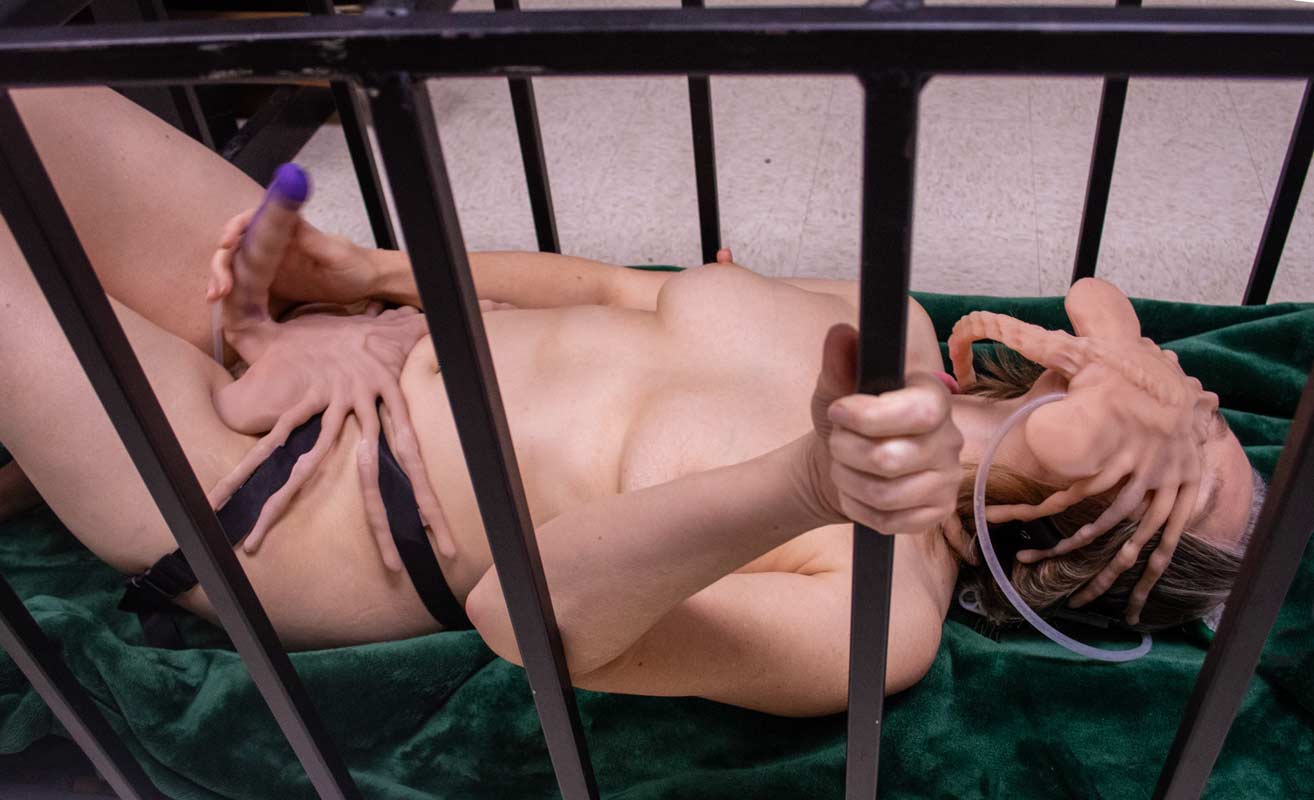
Two nights ago, my Talespinner and I attended a play party a a local dungeon, at which she played the role of a captive experimental subject caged and parasitized by xenomorphs.
A great time was had by all—you know it’s a party when the facehuggers come out—and so, the next day, we decided to bring out the facehuggers again.
Being that it was close to New Year’s Eve, we got a bottle of aggressively mediocre spiced rum, nowhere near as good as the rum we had in Barcelona, but adequate to the task of toasting the end of an objectively shite year.
And in the name of “Science!”, my Talespinner suggested we replicate my accidental findings with cannabis and alcohol, because, as all reasonable people know, replicability is the foundation of both “Sicence!” and Science!
And so it came to pass, Gentle Readers, that your humble scribe took a low-dose edible and a shot of mediocre rum, his Talespinner strapped a facehugger alien to her hips, and we were off to “Science!”
I won’t disturb you with the details of what happened next, as they would..err, disturb you. However, I will tell you that what we learned was the experience of being in my body was overall quite pleasant.
Until I crawled, exhausted and spent, beneath the blankets.
And the cold blankets were…I won’t say agonizing exactly, but certainly agonizing-adjacent.
Here is where we move from “Science!” to actual bona-fide Science!
It seems that alcohol doesn’t actually make my perception of fully inhabiting my body unpleasant. Rather, what one recreational chemical giveth, the other taketh away. Where cannabis removes the thermal allodynia, alcohol brings it back. And the combination of extreme—some might even say unreasonable—temperature sensitivity and being more consciously aware of my body than I otherwise am is an experienced not to be missed, unless you can miss it, in which case I suggest you do.
I spent some time this morning scratching my head about this, as I would not expect, at first consideration, alcohol to affect transient receptor proteins.
I finally dod a Google Scholar search while we were on our way to the store to purchase tools for minor alien penis surgery, when what to my wondering eyes should appear, but an NIH article directly on point about this:
And so it came to pass, Gentle Reader, that our attempts to get jiggy with alien hiphugger parasites and recreational intoxicants actually resulted in a finding supported by genuine empirical Science!, namely that cannabinoid molecules can suppress congenital thermal allodynia, a result reversible by concomitant administration of ethanol.
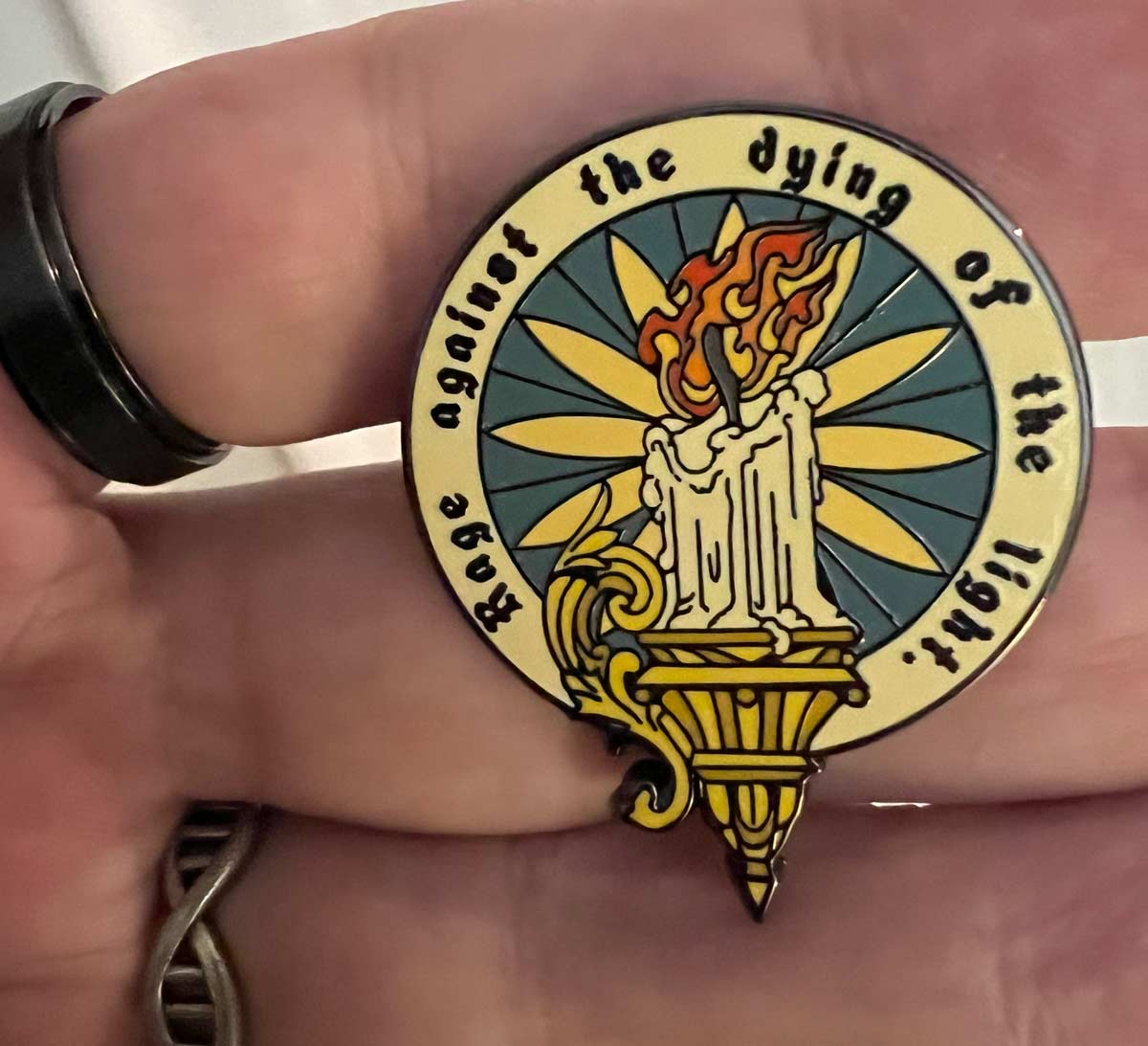
When I arrived in Florida a few weeks ago to help care for my mom, who was in the last stages of terminal cancer, Facebook showed me an ad for a pin. I ordered it on the spot. It arrived yesterday, on what would have been my mom’s birthday.
For anyone who doesn’t recognize it, it’s from a poem called Do not go gentle into that good night, by Dylan Thomas, whose first stanza reads:
Do not go gentle into that good night, Old age should burn and rave at close of day; Rage, rage against the dying of the light.
I’ve talked a lot about my mom’s wisdom. It was a quiet, understated thing; she had a knack for comprehending the world in ways subtle and deep. When I was growing up, she used to tell me, “information by itself almost never changes attitudes.” She understood that we are not rational creatures, we are rationalizing creatures, prone to making decisions for emotional or tribal reasons and then pressing our rational selves into service to justify our choices.
Other things she told me countless times:
“Education is not the solution if ignorance is not the problem.”
“We are predisposed to believe what we wish were true or what we’re afraid is true.”
“Never ask a question whose answer you don’t want to know.”
Even more than her sometimes pointed wisdom, though, I remember she was always, always there for me, without fail. If there was one thing I could count on absolutely, without question, as surely as the rising sun at the end of night, it was that she’d be there without fail. I never for even a millisecond, at any time in my life, doubted her love. Not once.
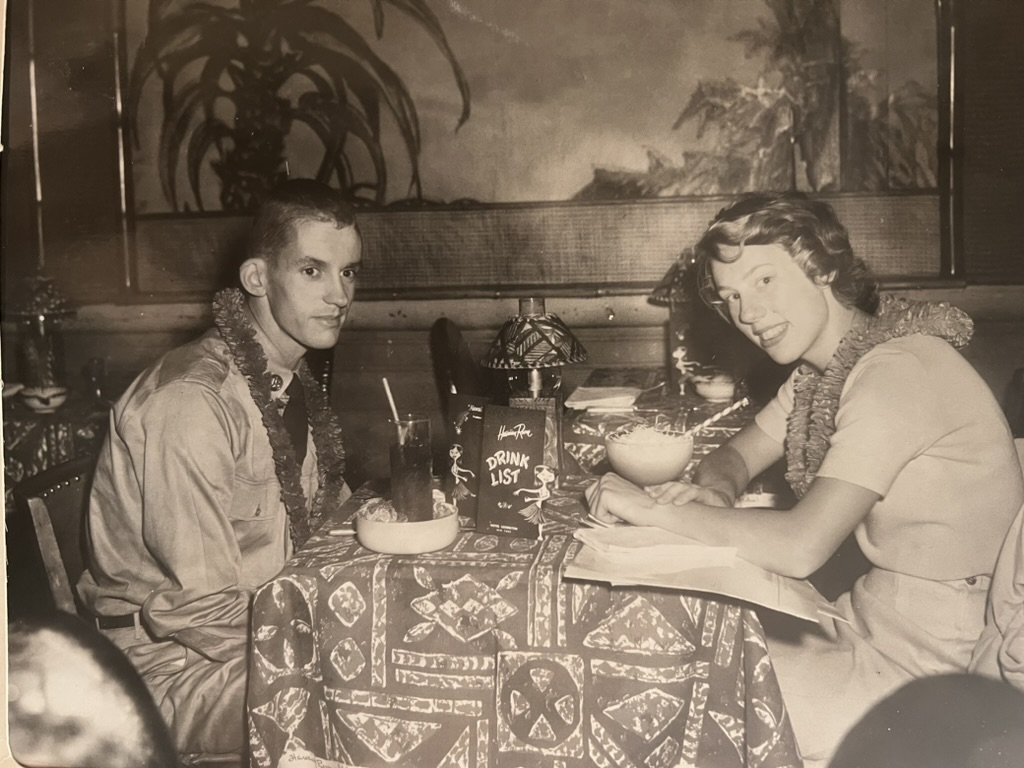
My mom and my dad on a date, six years before I was born.
I remember one night many years ago, when I was 18 or 19, driving to Ft. Lauderdale in my notoriously unreliable ’69 VW Beetle to visit friends. The car broke down at about 2AM four hours from home, so I called my mom from a pay phone. Without the slightest hesitation, without lectures or rancor, she got up, dragged her ass the four hours to come rescue me, then the next day took me to a repair shop for the part I needed to fix it and drove me right back down again.
She was always that way. That sort of cast-iron knowledge that someone always has your back is probably the single greatest gift you can ever give someone growing up.
My mom was diagnosed with cancer in November 2022, thirteen months almost to the day as I type this. She tolerated chemo poorly, though she was not one to go gentle into that good night, and stuck with it no matter how miserable it made her.
In the end, it wasn’t enough.
I came down to Florida a few weeks ago to help my dad care for her. At the end, she needed round-the-clock care, so my dad and I alternated in twelve-hour shifts.
In the tiny hours of the night last week, she started having difficulty breathing. I called 911. She’d been in and out of the hospital several times, so I didn’t know this would be the last time she’d ever be home.
The hospital confirmed the cancer had spread to her lungs and brain. A few days later, the doctors took her off life support.
She died at 9:36 in the morning on December 15, 2023, four days before her birthday. We (my dad, my sister, and I) were in the car on the way to the hospital to see her when she passed.
That night, when I called 911, I don’t think any of us knew it was the end. We knew the end was near, of course, but she’d had other crises, other storms she’d weathered.
I’ve been thinking about that a lot this week, as I go through a million little things I never imagined having to deal with—arranging for the home hospice care people to come and pick up the hospital bed, resetting her iCloud passwords, all the various ways we close the threads of a life. (The truck is titled in my mom’s name but my dad isn’t on the title, something my sister is dealing with.)
You never know.
Someday, there will be a last time you see the moon through the trees. Someday, there will be a last time you hug the people close to you. Someday, there will be a last time you hear a bird sing, a last time you have your favorite dessert, a last time you feel the sun on your face.
You might not know when that is. It might have already happened.
You are an anomaly. Yes, you. The odds of your existence are incomprehensibly small. You trace your lineage directly across the billions of years to a primitive, single-celled organism, and any tiny disruption of that slender thread would erase your existence. Had your parents gone to the movies that night, you would not be here.
You have these brief moments under the sun, and that is a gift beyond price—beyond imagining. Somehow, you beat odds so great your brain literally cannot comprehend them, and of the trillions of potential beings that might exist, here you are.
These few moments are all you will ever have. Cherish them, because there will be a last time for everything.
Right now, as I type this, I’m in Florida helping care for my mom. My dad and I have been doing 12-hour shifts with her, because she needs round-the-clock care. Between that and all the thousand things around the house that need tending to that my dad isn’t able to, I haven’t been sleeping much.
Last night at about 5am my mom started having trouble breathing, so I called 911. We just heard from the hospital 10 minutes ago. The cancer has spread to her lungs and brain. She really wanted to make it to her birthday in 6 days. The doctors don’t think she’ll make it.
So I’m not maybe the best person to talk about loving life right now.
And yet…
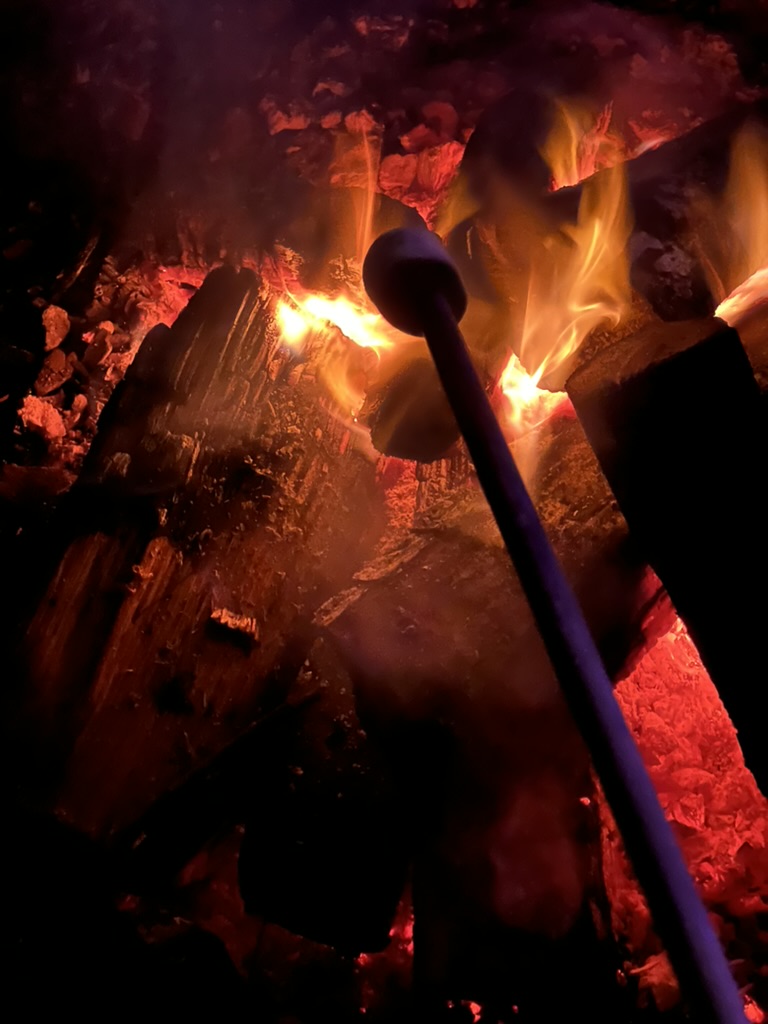
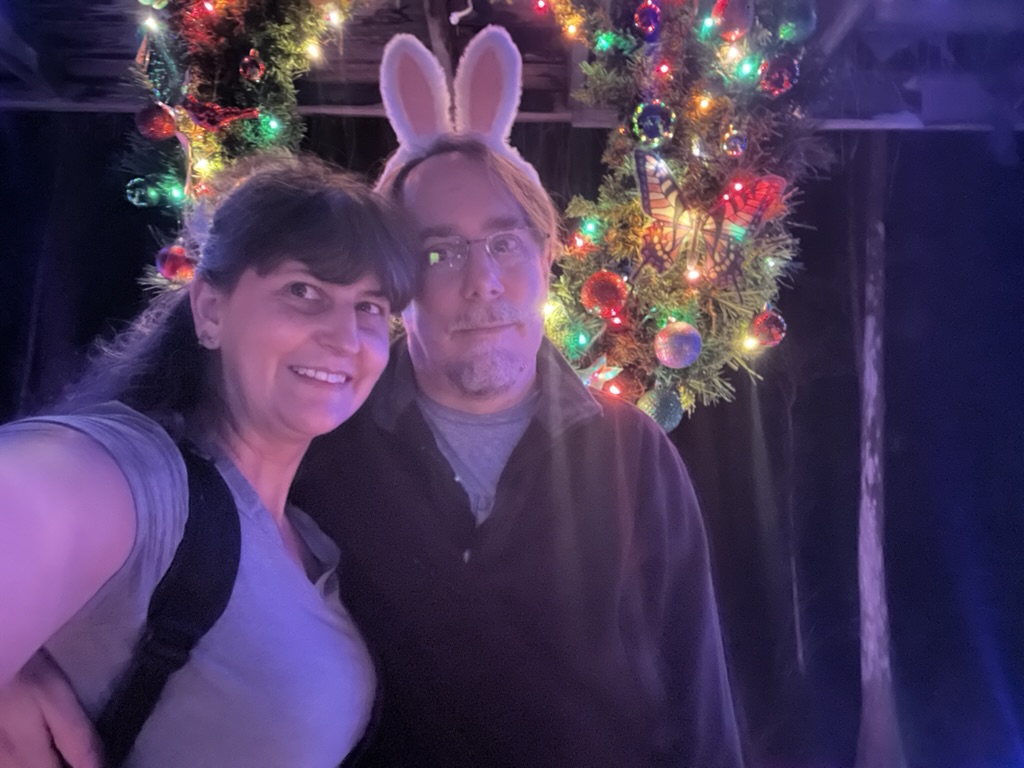
A few days ago, my wife and I spent a couple of hours at the Festival of Lights in Cape Coral. They had hot cocoa and a campfire with marshmallows.
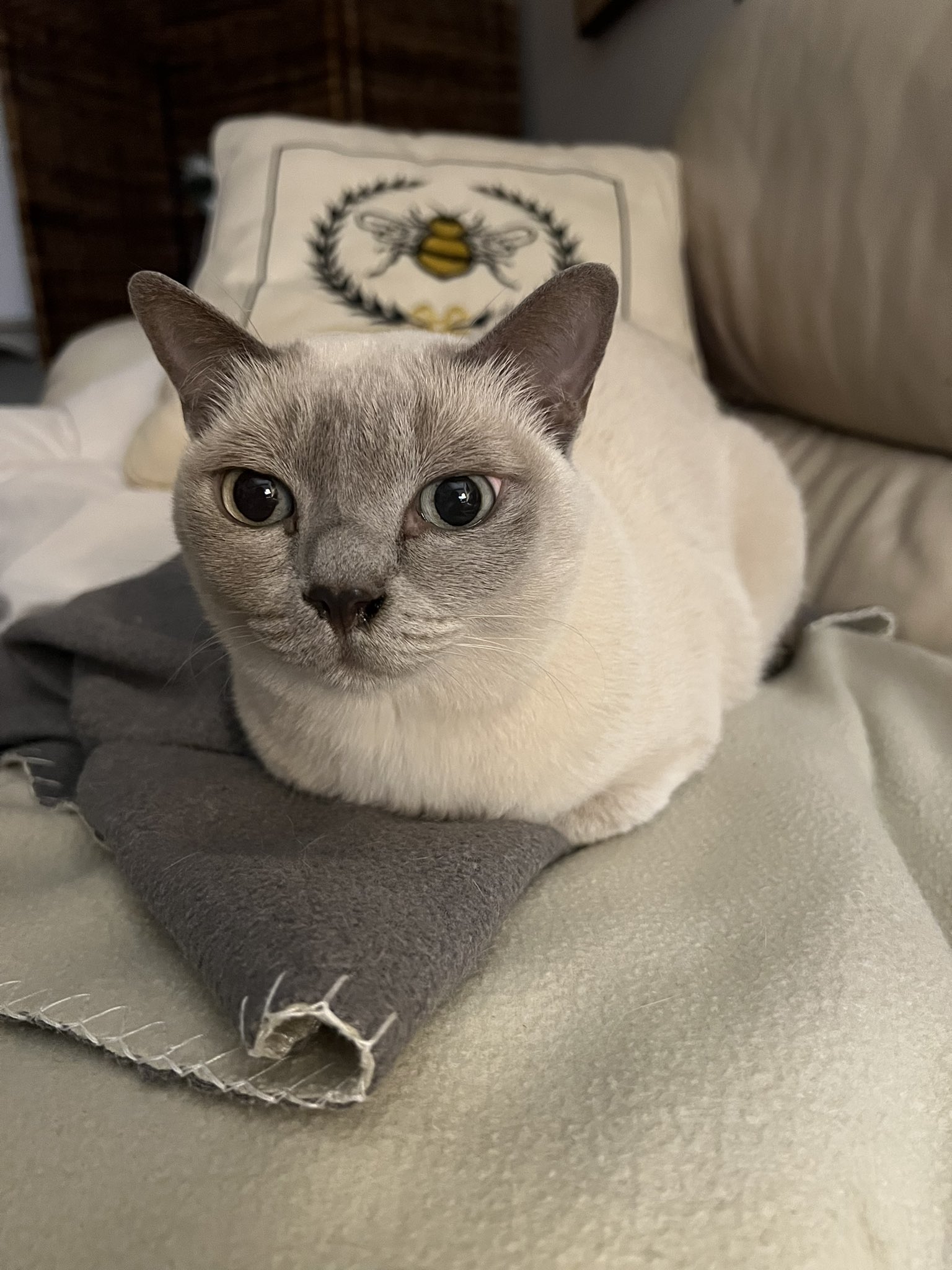
When I stumbled out of bed this morning (well, technically this afternoon), the first thing that happened was my mom’s cat sat at my feet, meowed at me, and headbutted me to say hi.
Right at this very moment, I’m looking out the window onto my parents’ patio, where three squirrels are chasing each other across the screen roof, and it’s delightful.
I was born just barely early enough to see humanity walk on the moon—-some of my earliest childhood memories are sitting in front of a B&W TV watching the Apollo launches. Odds are good I will see humanity walk on Mars. Isn’t that amazing?
I am surrounded by love. I’m spending Christmas with my Talespinner. My life is filled with creativity and joy—I write books with some of my lovers, my wife and I created the Borg Queen xenomorph parasite cosplay from an idea she had three years ago, I’m teaching myself CNC machining and laser engraving.
I live in a time of unprecedented peace and prosperity in human history. We can fly through the air. Every day, we learn more about the universe.
This photo:
was taken by a probe that landed on a comet. We have the capacity to launch a probe that can travel for years and then arrive precisely on a small rock traveling at 84,000 miles per hour, which is about like a person in Boston shooting a rifle and hitting a golf ball in midair in Moscow. (Bizarre how many people think science is “just another belief system,” eh?)
And, I mean, I get it. The world isn’t all roses. Right now, far too many people in my country are too uneducated in history to recognize when they’re being lied to by yet another populist grifter selling them the same old tired lie that all their failures are the fault of somebody else.
We have a political party that takes gleeful, sadistic delight in mendacious cruelty, and a voting populace that sincerely believes it’s okay to vote for the Leopards Eating People’s Faces Party because surely the leopards won’t eat their faces—only the faces of the Mexicans and the gays and the trans people, right?
There is pettiness, and cruelty, and meanspiritedness. There are people who make voting choices because they want to hurt other Americans just to own the libs.
But viewed on a large enough scale, the moral arc of the universe bends toward justice. We may be in the “one step back” part of the “two steps forward, one step back” cycle, yet this too shall pass.
I keep, on my phone, a list of books I want to write. There’s something wrong with it; somehow, every time I finish a book, I discover the list has grown longer, not shorter. (Side note: You can tell someone’s an amateur whaen they say “I don’t want to show my book to an editor or publisher because I’m afraid someone will steal my idea.” Nah bruh, ideas are worthless, and we all have too many ideas of our own to be interested in yours. The bitter truth of writing is it’s almost impossible to get anyone interested in your book in the first place!)
One of the books on the to-be-written list is a nonfiction work titled A World of Sh*t: Normalizing bad design and lazy craftsmanship. Because man, there’s a ton of it out there.
The way I imagine the book’s title
As I sit here in my parents’ house in Florida, I find myself particularly annoyed by the bad, lazy, incompetent, “we didn’t think this through” design around me.
There’s a term that describes a lot of this crap: “psychic litter.” The expression was coined by David Joiner in the 1990s, to describe small acts of immorality that fall beneath the threshold of conscious awareness.
Take, for example, the Windows installer. It takes a while to install Windows, especially older versions. A lot of that time is spent building the Registry. The Windows installer designers could have pre-built a Registry in the installer itself, which would save almost half an hour on each install, but chose not to because it would mean taking an extra half an hour of their time to build the installer. So rather than spending the half an hour on their end, they chose to waste thousands of man-hours of other people’s time.
This kind of selfishness and lack of care is the essential beating heart of a lot of sh*t design.
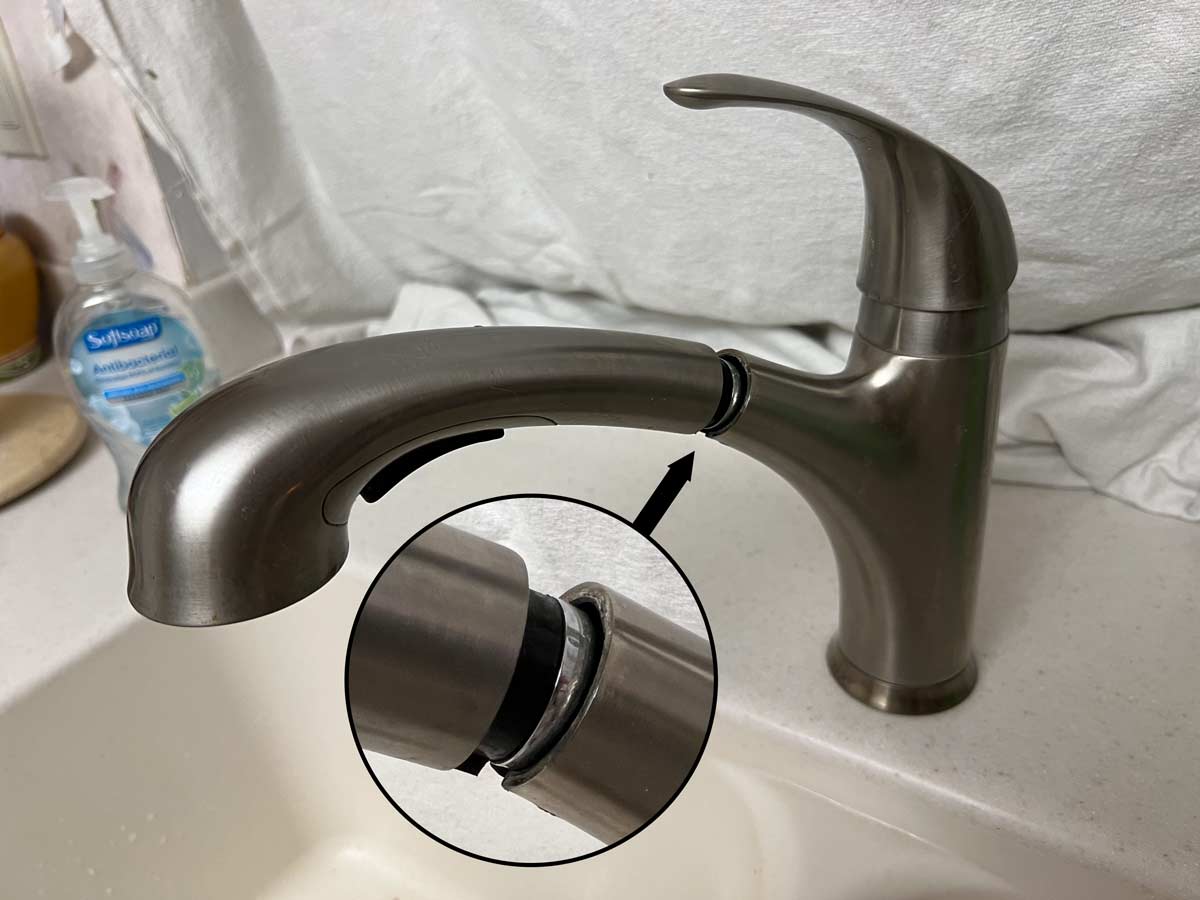
Take my parents’ kitchen faucet (please!).
It’s pretty. It’s sleek.
It doesn’t move.
You literally cannot rotate it between the two sinks, which is, you know, one of the most basic of all faucet functions. It doesn’t turn. At all. They have two sinks, but you can only use the faucet with one of them.
Worse, it’s also a sprayer; the entire faucet removes. Clever, except that it does not, and has never, docked correctly. It has a plastic ring on the faucet that fits a plastic sleeve on the base, but the ring is too large; it doesn’t fit. (I imagine the fact that it’s a sprayer is the reason it can’t rotate, and that would be absolutely perfect for a three-armed user.)
And then there’s this marvel of engineering:
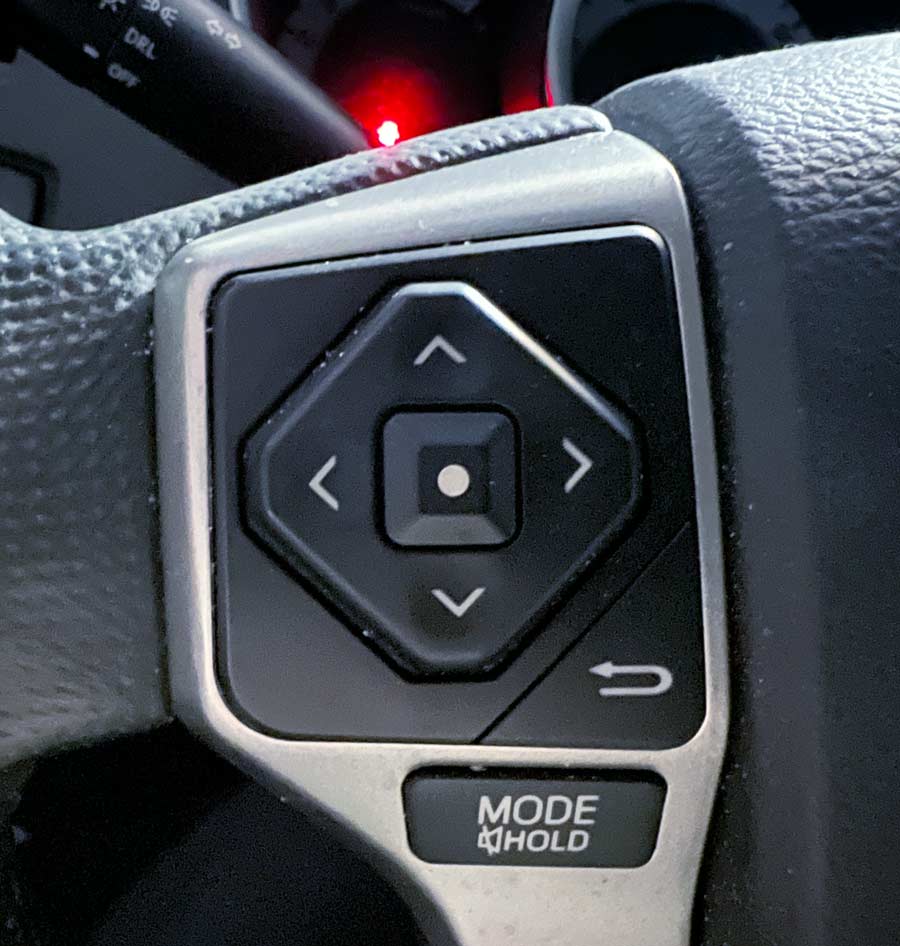
This is the steering-wheel-mounted remote for the car stereo in my parents’ truck, a Toyota Tacoma.
Steering-wheel-mounted remotes for a car stereo are a brilliant idea. And they’re really not that complex. They move the most often-used functions to a place where you need not look away from the road or take your hands off the steering wheel to use them.
This control has four primary buttons: left, right, up, down. Now, thinking about what it’s supposed to do (work a CD player/Bluetooth combo), you might reasonably expect that left and right go to previous and next track, and up and down raise and lower the volume.
And you’d be 100% wrong.
Left skips back 10 seconds in the current track. (Yes, seriously.) Right skips forward 10 seconds. Up goes to the next track, down goes to the previous track.
What about volume? How do you adjust the volume?
You don’t. There are no volume controls on the steering wheel. To change the volume, you have to take your hands off the steering wheel.
Yes, you read that right. They literally believed that forward 10 seconds/back 10 seconds was so important it should be on the steering wheel, but volume? Eh. Who uses the volume controls, anyway?
Every single digital music player I’ve ever used, from the Radio Shack Compact Disc Player CD-1000 my parents got in 1984 to my iPhone today, uses left and right arrows for previous and next tracks. But whatever Toyota intern who designed the car stereo controls, having apparently never used or indeed seen an entertainment sound system before, had his own ideas, and somehow, somehow it passed all the design review steps. Somehow, someone signed off on manufacture.
Skip ahead ten seconds yes, volume control no.
And here’s the thing:
The world we live in today, our world of marvels and miracles, is filled with examples like this.
It’s hard not to believe that the vast majority of industrial designers are anything but lazy and barely competent, unwilling or unable to put any effort into their job (and it certainly feels like they never use the things they design). From consumer electronics to furniture to software to clothing, we live in a universe of shit.
My jacket has a zipper edged by a hem that is exactly the right width to catch the slider as it moves. It is not possible to zip or unzil the jacket without the hem catching the slider at least three times.
Someone designed that. It went through several review steps before it was released to manufacture. And yet, neither the designer nor any of the peple resonsible for reviewing the design ever put the jacket on. (I’m serious when I say you cannot zip or unzip it without catching the slider. Even one test would’ve been enough.)
We live, we exist in a world of sh*t. We don’t pay attention to the way design impacts our lives, and as a result, trivial design failures—failures that can easily be corrected in minutes during the design stage—waste countless person-years of time. In some cases, like car stereos with cluttered or counterintuitive layouts, they kill people.
And we as a society are remarkably okay with that.
I’m not sure what changed, but in the last five years or so, I’ve found it increasingly difficult not to notice shitty design all around me. And once you’ve started to see it, it snowballs. You can’t un-see it.
I would like to live in a world where perhaps people cared about design more. But the problem seems to be getting worse, not better.
My parents live near a golf course whose owner walked away from it in 2006, after someone discovered high levels of toxic metals in the soil, and it turned out rehabilitation would be far more expensive than the place was worth.
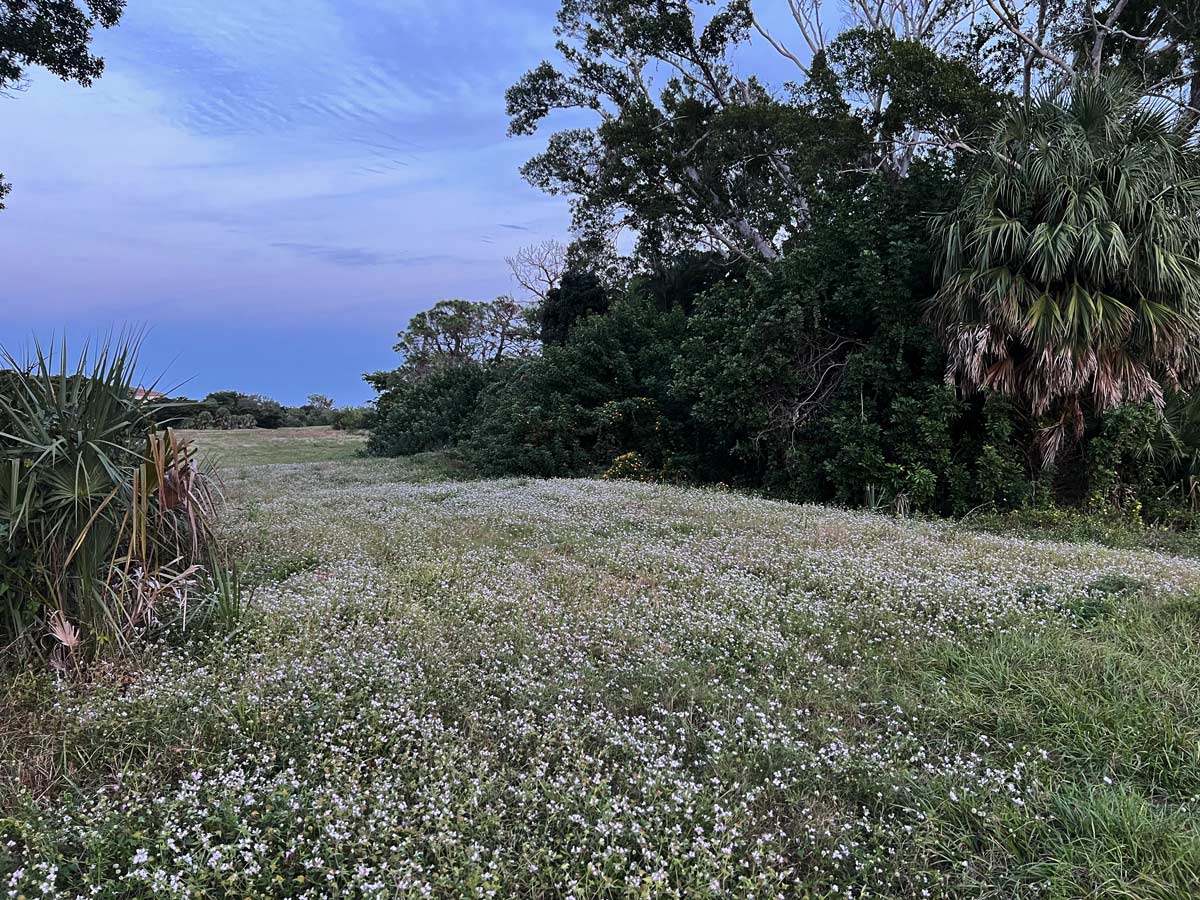
For the last decade and a half or so, the place has been quietly returning to nature. Driven by restlessness, I spent some time wandering around it just before sunset this evening…and man, what an odd experience that was.
A fairway left alone for over a decade turns into…something else.
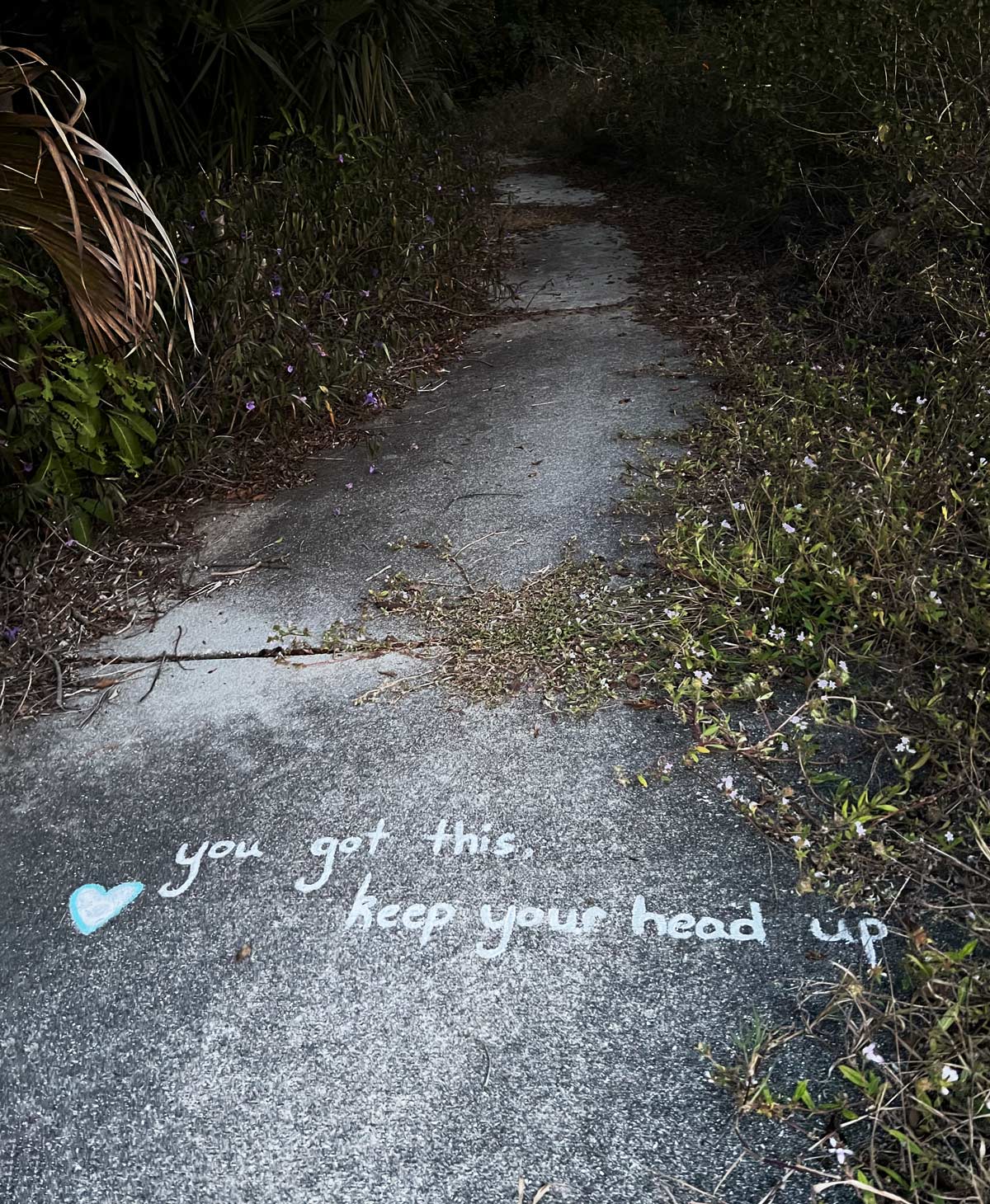
The remnants of the old golf cart trails still exist, slowly being reclaimed by the ground.
Apparently I’m not the only one who thought to walk the trail. Someone before me left a message of…hope, I guess?
I think it’s hope. Or maybe it means there’s a boss fight down this trail, who can tell?
This bit is actually quite lovely.
It’s been deserted long enough some of the trees have fallen.
I stayed out later than I intended, until the sun settled behind the trees. I hate Florida—the weather, the bugs, the politics, the stubborn and mendacious stupidity that clings to the state like a bad smell—but the sunsets, those are spectacular.
I think I will return tomorrow. There’s a peacefulness there I really appreciate right now.
So, some of you likely know I’ve been stalked over the past few years by an online stalker who has, among other things, created fake social media profiles in my name and used them to send rape and death threats to folks who follow me on social media. (Please, no speculation about who the stalker is.)
A week ago yesterday, the stalking escalated. I’ve been documenting the stalking, both publicly and privately, so I want to record the latest escalation here where everyone can see it.
I had an unexpected conversation with Portland PD a week ago last Tuesday, as I prepared to fly down to Ft. Myers to help care for my mom, who is in end-stage terminal cancer. It seems my stalker created a fake email account in my name, which he or she used to send an email to Portland police saying I was hearing voices commanding me to kill my wife. (They contacted her as well.)
I explained the stalking situation to them, and told them I’d filed a police report about it some time ago. They found my report and man, I’m really glad I filed it, because it instantly changed the tenor of the conversation.
Portland PD has referred the matter to their cybercrimes unit (I didn’t realize Portland has a cybercrimes unit, but apparently they do).
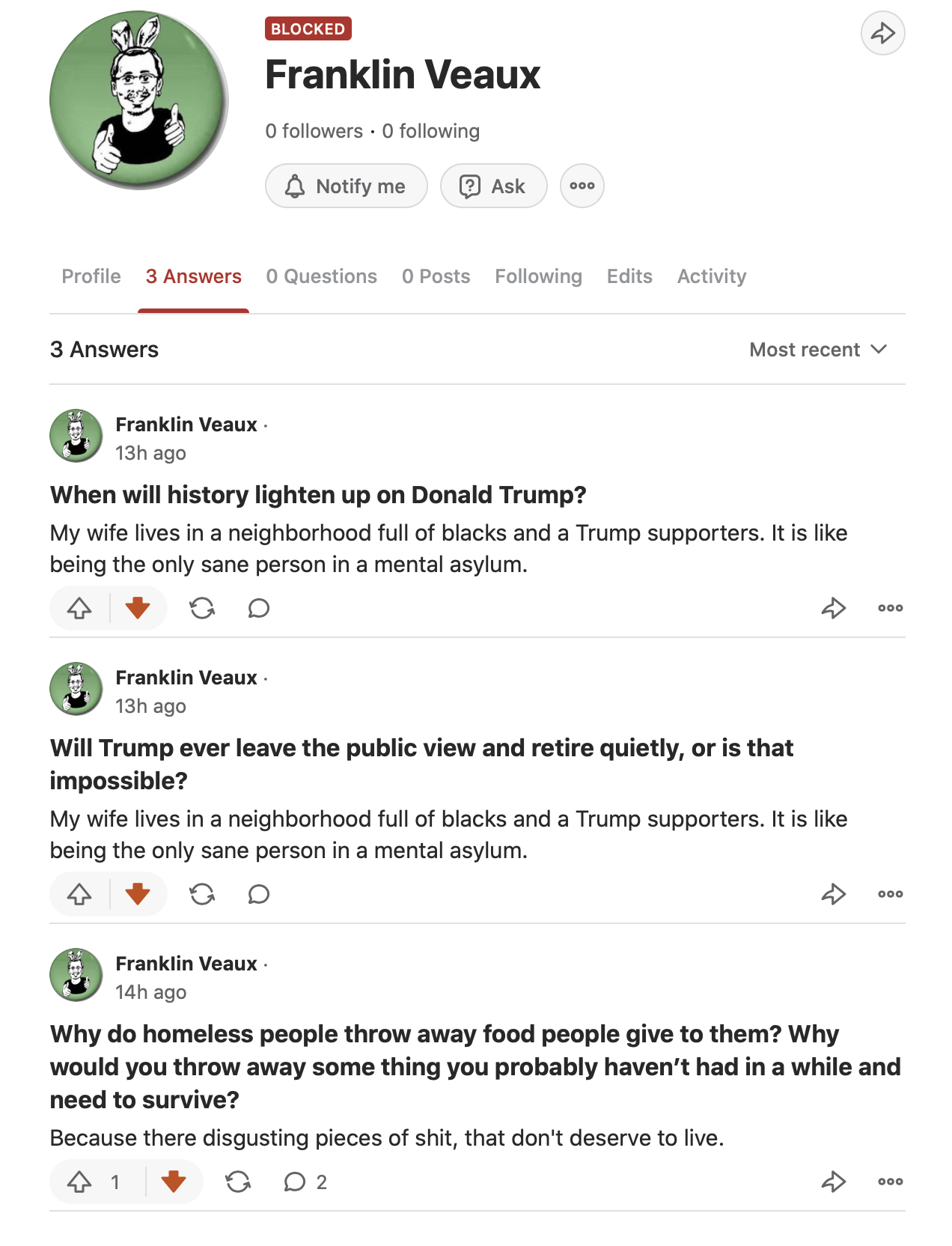
It’s been a weird ride. So far, the stalker has limited himself or herself to creating accounts that look like mine, using my name and avatar, and then using them to send threatening PMs to folks who follow me, or post public social messages trying to smear me:
(Note that this profile has no followers and nobody following it.)
People’s reactions are…weird. Some Facebook user flat-out said it isn’t happening and I’m lying about it because, direct quote, “men don’t get stalked, women do” (yes, seriously).
This new thing is an escalation. Fortunately, there’s now a pattern of law enforcement contact over this, and I think going forward I’m probably going to file a new police report with every single new incident.
Meanwhile, if you should happen to receive a rape or death threat, or some other harassing message from “me,” please check the profile carefully.
On Quora I’m Franklin-Veaux, no numbers, spaces, or other characters. On Twitter, Facebook, Instagram, and Threads, I’m franklinveaux, all one word, all lower case, no numbers or other characters.
Should you receive, or see, any of this harassment, I’d greatly appreciate if you let me know. I’m collecting as many examples as I can and turning them all over to Portland PD.
[Note: This entry originally started out as an answer on Quora.]
So apparently there’s a dude named Russell Brand. I will admit, Gentle Readers, that I don’t know who he is, except that apparently he does standup comedy and such, and apparently his YouTube videos have been demonetized after he was accused of sexual assault.
Now, I will freely confess to knowing somewhere between zip and fuckall about him, his life, or the accusations. That’s not actually what this essay is about. Instead, I’d like to dive into the murky world of social media, monetization, and the ethics we as a society choose to live by.
I wrote the first version of this essay when a Quora user asked if YouTube has the legal right to demonetize Brand as ‘punishment’ for being accused of assault. Which is completely the wrong question. Punishment is something one does as retribution for an offense. Punishment is about the person being punished. YouTube doesn’t care about him, it cares only about its own brand. He’s not being removed so that YouTube can punish him, he’s being removed because not removing him hurts Google’s cash flow. (Google, naturally, owns YouTube.)
Does YouTube have a legal right to do this? Yes.
Does YouTube have a moral right? Well…that gets complicated. Buckle up, long essay is loooooong.
The legal part is straightforward, so I won’t spend a lot of time on it. When you create a YouTube account and click I Agree, you have signed a legally binding, court-enforceable contract with Google. That contract gives Google the absolute, unlimited, unilateral right to demonetize you or kick you off their platform for any reason or no reason. YouTube’s servers are private property owned by Google, they are not a public forum or a public space, and you are not the customer, their advertisers are the customer.
In the eyes of the law, this is what clicking “I accept” means. If you don’t like the contract, don’t sign. (Image: Scott Graham)
Legally and morally, you have no right to use YouTube or its servers. You are granted a limited, revokable permission to use private property belonging to Google under certain conditions, and that permission can be withdrawn at any time for any reason.
Legally, it’s open and shut. Nothing to see here, move along.
Ethically?
I think an argument can be made that it’s ethically dodgy. Trouble is, the ethical argument isn’t the one people are making.
First off, anyone who tells you “First Amendment my constitutional rights!” in any discussion about social media is an imbecile, and you can safely disregard any ignorant bleatings that issue forth from their pie-hole. You have no Constitutional right whatsoever to use someone else’s stuff for free.
“But it’s a public forum!” No, it isn’t. Shut up, you’re embarrassing yourself. It’s a private server, owned by a corporation and maintained at that corporation’s expense. You have no right to be there.
“But it gives big tech companies too much power!” And? And so? People who own communications media have always had that much power. Social media is, in fact, way more democratized than newspapers or television stations, and guess what? You have no right to march into a television studio and demand they broadcast whatever you want them to on the six o’clock news, or to demand that Time Magazine publishes your manifesto on toothbrush design.
Google data center. This is private property. You have no right to use this for free.
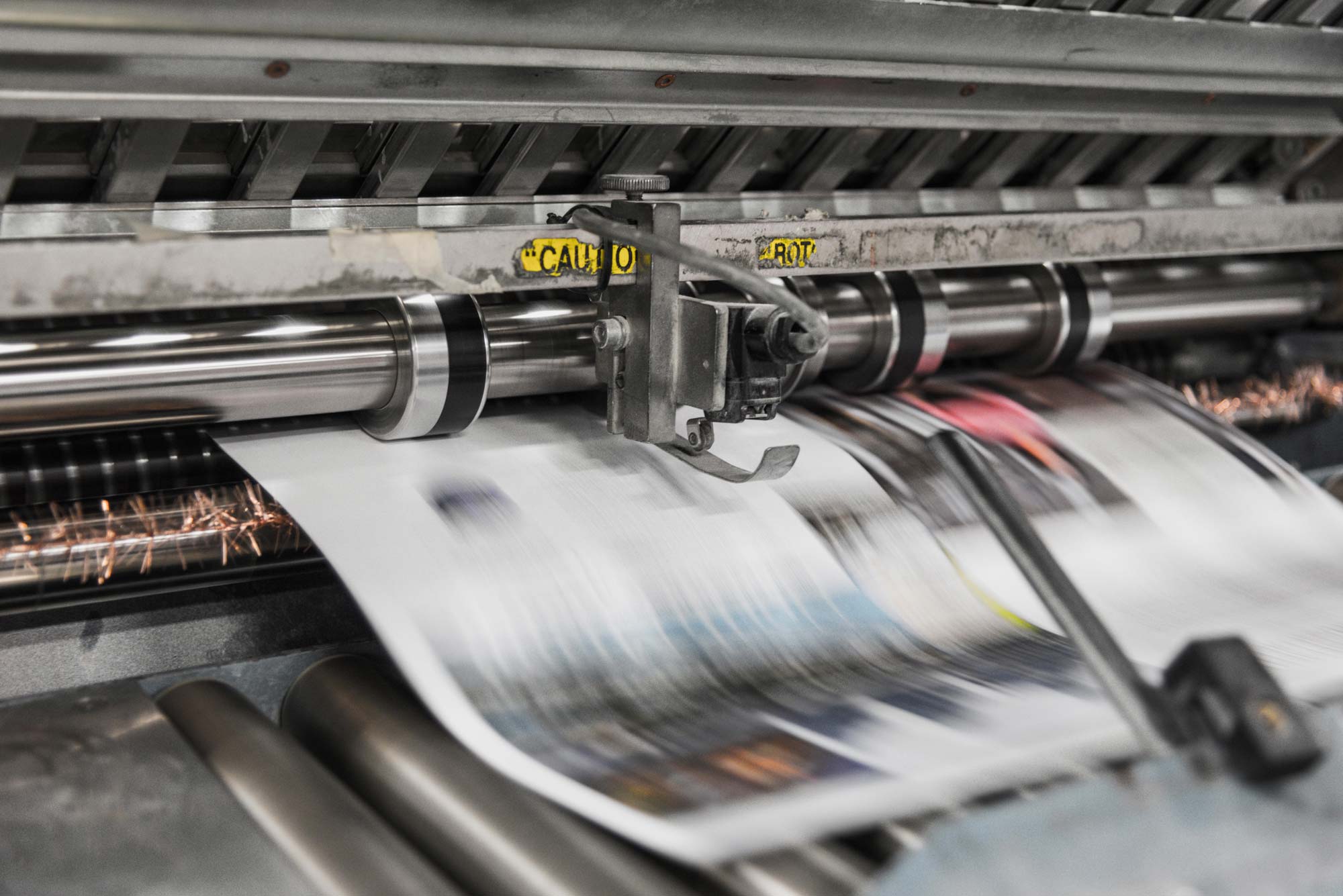
Magazine printing press. This is private property. You have no right to use this for free. (Image: Bank Phrom)
People who own media set the rules for what that medis will carry. That’s the way it’s always been, that’s the way the Founding Fathers intended it to be (many of them were media owners themselves!), and government regulations telling media owners they have to carry your stuff is an infringement on their First Amendment rights.
The actual ethical argument is way, way more subtle, and it’s not about the Constitution, it’s about the kind of society we want to live in.
So liberals and conservatives, as part of the tedious ongoing culture war designed to distract attention from the fact that the conservative party in the US no longer has a party platform or legislative agenda, have latched onto this idea of “cancel culture” as a stick to beat each other with.
Ironic, since liberals and conservatives both do it. It’s just that when they do it, they’re imposing their ideology by force on other people, but when we do it, we are making society safer by choosing to spend our money in ways that promote the ideals we want to see.
It’s asinine because all the folks engaging in this argument, left or right, are liars. They may see themselves as genuinely good people, but they’re still liars. And the thing about seeing yourself as a good person is, you stop watching yourself. You stop asking yourself ethical questions. Once you’ve accepted that you’re a good guy, it follows that what you’re doing must be right, because you’re a good guy, and good guys do the right thing. It’s written on the tin!
I’d far rather be trapped all night in a dark basement with someone who questions his own moral worth than someone utterly convinced he’s on the side of the angels, hands down.
But I digress.
The actual ethical issue is the issue of mob rule: the tyranny of torch and pitchfork.
Why does Google revoke YouTube monetization for someone who’s been accused of something bad? Because if they don’t, advertisers will harm their revenue.
Why would advertisers harm their revenue? Is it because the corporations buying the ads are all fed from the milk of human kindness, motivated above all things by the desire to bring justice to the world?
Ah HA ha ha ha ha ha ha ha ha ha ha ha ha ha ha ha ha ha ha ha ha ha ha ha ha ha ha ha ha ha ha ha ha ha ha ha ha ha ha ha ha ha ha ha ha ha ha ha ha ha ha ha ha ha ha ha ha ha ha ha ha ha ha ha ha ha ha ha ha ha ha ha ha ha ha ha ha ha ha ha ha ha ha ha ha ha ha ha ha ha ha ha ha ha ha ha ha nope.
It’s because advertisers fear an angry backlash if they don’t.
Why do advertisers fear an angry backlash if they don’t?
Because the Internet allows people to come together in flash mobs to punish the transgressors on a moment’s notice, and punish those standing next to the transgressors, and punish those who are insufficiently righteous in their zeal against the transgressors, and those who stand next to those who are insufficiently righteous in their zeal against the transgressors, and those who are peripherally associated in any way with anyone associated with the transgressors.
And these Internet flash mobs are fast. Much faster than the speed of Truth or Reason. In fact, in many corners it is considered morally wrong to suggest that maybe people ought to slow down to the speed of reason.
Just like Google has the right to decide you can’t use its servers for free for any reason or no reason, you have the right to decide you won’t buy Happy Pawz Cat Litter™ for any reason or no reason…including that you saw an ad for Happy Pawz Cat Litter™ on a YouTube video about cello tuning and you hate cello music. Or you don’t like the person in the video, or the person who made the video, or the person the video is about. Whatever. Your money, your rules.
And you have the right to tell other people “I really don’t care for Happy Pawz Cat Litter™ and I don’t think you should buy it either.”
So far, so good.
The place it runs off the rails is when “I won’t support X for reason Y” becomes “I will make sure nobody supports X for reason Y, and anyone who disagrees with me is Clearly Evil and must be punished too.”
In other words, it’s about locus of control. I will control how I spend my money: totally okay. I will control how you spend your money: Abusive, bullying, and toxic.
This is often framed as a liberal vs conservative thing. It’s not. It’s an authoritarian vs self-detemining thing.
No matter how pure your intentions or righteous your cause, if you deprive others of the ability to disagree with you, you are a bully.
And that’s the greatest secret of the Internet: it empowers bullies in ways no other technology ever has.
This, but electronically, is the ethical issue (image: egoitz)
Russel Brand may well be a terrible person. If you don’t want to support him, that’s cool. If you believe nobody should support him, that’s cool. If you believe Google shouldn’t give him money for his YouTube content, that’s cool.
If you believe everyone else must think as you do, that’s not cool.
People really struggle with this, because at the end of the day, bullying feels good. There’s a reason it’s such an enduring part of the human experience. And bullying in the name of a virtuous cause? That feels awesome. It feels righteous. You’re Striking A Blow Against Evil! You’re making the world a better, more just place!
You can build utopia if only you can foce everyone to harass, shun, and exclude the people you think should be harassed, shunned, and excluded! Why won’t people see that we will all become more egalitarian and empowered if everyone would just do as I say??? What is wrong with them?
So that’s the world Google lives in: if they monetize the wrong people, there’s a real chance their advertisers will be harassed. I mean, think what happened when radio stations continued to play the Dixie Chicks when the torches and pitchforks crowd started the crusade against them—managers of radio stations were stalked, their families received rape and death threats.
Building Utopia by finding the right people to threaten and bully, amirite?
Now, I will admit I have a dog in this fight. I woke up a while back to discover that a person posing as a journalist had put up a website where a bunch of people claiming to be exes of mine—some exes, some not, some people I’ve never been in the same room with except in passing at a convention or something—were claiming to have been abused by me. It’s a…weird and unsettling experience to have people saying that more exes have come forward with tales of abuse than the total number of exes you have.
Anyway, as a result of that, owners of indie bookstores have been harassed for hosting book events with my co-author and me. People close to me have been threatened. A BBC reporter wrote a book on polyamory, and ended up being harassed after someone started a rumor that I actually wrote the book and used his name. He used to do a podcast; that ended when his co-host was harassed to the point she didn’t feel safe associating with him any more. Even though you can look up his name and yes, he’s actually a well-known and well-established British reporter…who is, in fact, not me.
And most bizarre of all, someone started an Internet rumor that I secretly run a polyamory conference put on by a British non-profit in London, and as a direct result, people scheduled to speak at that conference received a barrage of death threats in a coordinated campaign so serious, the non-profit canceled the conference. A conference that (it shouldn’t be necessary to point out but I’ll say it anyway) I do not run, profit from, or in any other way have connection with—as is easily verifiable because it is, err, run by a British nonprofit, and like all British nonprofits, its managers, members, and finances are all public record.
Not that pitchfork mobs are known for, you know, doing their research.
So I have firsthand experience with this kind of crap.
Now, absolutely none of this has anything to do with whether Russel Brand is a good person or not, whether Russel Brand is guilty or not, or whether Russel Brand deserves (for whatever value of “deserves” one might use) a platform or not.
The point is, it’s totally 100% ethical to say that you won’t spend your money with anyone who supports people you don’t like. Your money, your rules.
There is an ethical issue here. The ethical issue isn’t “but the First Amendment! Freeze peach!” The ethical issue isn’t “but public forum!” The ethical issue isn’t “but Big Tech has too much power!” Anyone yapping about that can forever be ignored.
The ethics are that we live in a world where if your radio station plays music from someone that the Internet horde doesn’t like, your managers will be stalked, their families threatened with rape and dismemberment, and venues that host their concerts will receive bomb threats.
The ethics are that we live in a world where this sort of thing is so common, and so normalized, and so rationalized, that companies would rather preemptively cut people off if it seems like there’s a possibility that the Internet horde might pick up the pitchforks and torches.
I do absolutely 100% see that as a problem. In fact, I’ll even go one step further and say it might be one of the defining social problems of the modern age, a direct consequence of populism and a sense of entitlement common on all sides of the political spectrum that says “I have the right to send rape and death threats if I think my cause is righteous and just enough—I am doing good with every rape threat I send, I am building a better society one rape and death threat at a time.”
I often wonder how someone sits down at a computer and types out an email describing how they’re going to murder someone on another continent they’ve never met, then clicks Send, dusts off their hands, and says “Today I did the right and just thing, look what a good person I am!”