If Other Shows Used Star Trek Dialogue

I recently added a whole new section on writing tips and techniques to the Xeromag site, the largest new wing on the site in many years. One section of this new wing talks about how to write dialogue, and in one of those articles, I diss Star Trek: Voyager.

Yes, Star Trek in general has awful dialogue, and Voyager takes shitty dialogue to a whole new level. There, I said it. Sue me.
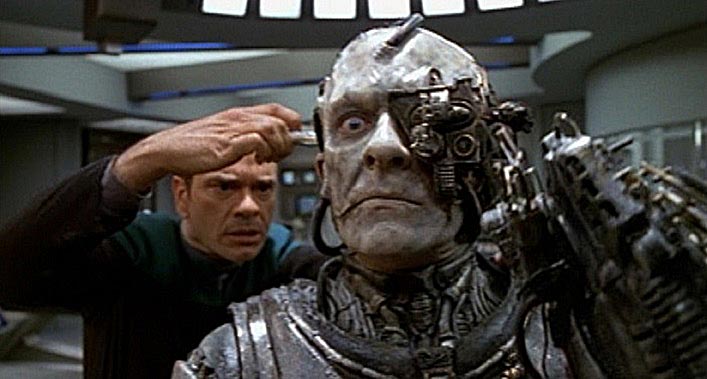
I got a question from a person who shall remain nameless (you know who you are) about what’s wrong with the dialogue in Voyager. And the thing is, Voyager dialogue is so shitty it’s kind of set the tone for the whole series, so if you simply point out an example of bad dialogue, people look at you blankly and say “what’s wrong with that?” It’s like the dialogue is such crap, we’ve lost our frame of reference because we don’t believe it’s even possible for the dialogue not to be crap.

“You are beautiful when you’re scanning.” That’s actually a line from Voyager.

There’s a specific and pernicious form of crap, though, that particularly sets my teeth on edge. I don’t mean just stilted, hamfisted dialogue, though of course Voyager has that in spades.

I don’t even mean “reroute the current flow through the turboencabulator to produce a transreversed pulse from the tachyon field emitter,” though Star Trek in general and Voyager in particular are legendary for their technobabble. (“Somehow, the energy emitted by the singularity shifted the chroniton particles in our hull into a high state of temporal polarization”? Seriously?)

What really gets up my nose is the “as you know” speech. This happens when character A tells character B something they both already know, but the viewer doesn’t. As you know, Captain, the Treaty of Blinkenmuunchen forbids the use of transreversed tachyon field pulses in an inhabited star sector…”

This…is not how people talk. And it’s a clumsy tool for exposition.

So: What would it sound like if scriptwriters for other TV shows wrote dialogue this way?

Columbo: Detective, we have a photo of the suspect from a traffic camera! As you know, sir, a traffic camera is an automated photographic recording device affixed to a stationary pole, usually at an intersection. It is activated by the operation of a remote automatic trigger that causes it to fix a photographic record at that instant. Unfortunately, it won’t tell us where the suspect went, as it records only a single frame.

Breaking Bad: We’ve found a new dealer for our drugs! As you know, the drugs we manufacture are considered contraband, which means their sale is prohibited by law. We have the facilities to manufacture them, but we require the assistance of others to carry them to distant places and make them available for sale. Since this process is a violation of Federal and state laws, we will have no recourse to the justice system if our dealer refuses to abide by the terms of our agreement, so we must screen our dealers carefully.

Game of Thrones: Chaos is a ladder. And as I’m sure you know, Varys, a ladder is a simple tool that can be used to climb from a low place to a high place. So what I’m saying is that I believe political chaos can be used to climb higher in the sociopolitical hierarchy. This is a linguistic construction known as a “metaphor.”

Sherlock: I’m not a psychopath, I’m a high functioning sociopath. Do your research. And as I’m sure you know, “research” is a systematic procedure or process by which one can check their ides against a rigorous body of source materials and conclusions.

NFL Sunday Night Football: Passing interference, 15-yard penalty. As I’m sure you know, a yard is a unit of measure, equivalent to three feet. This should not be confused with a yard that is an area of open ground in front of a house or other structure, commonly planted with grass, even though we are currently standing on an area of open ground covered with grass.

As you doubtless know by now, the “as you know” speech makes your characters look like idiots. That’s on top of being unnatural dialog. Don’t do it.

Yes, men are losing rights* in the age of feminism

[Note: This essay originally started out as an answer on Quora.]

If, God help you, you ever read incel or “men going their own way” forums, which I have done, you frequently find a complaint—

Well, hang on, wait. You frequently find many complaints, because that’s pretty much all the incels and MGTOW folks do: whine and complain. One of those complaints you’ll often see is that “men are losing their rights” thanks, of course, to those evil feminist women, hell-bent on stripping men of their natural God-given rights.

The standard answer to this particular whine is, of course, “egalitarianism doesn’t mean you lose your rights, it means women gain rights.” Which is true as far as it goes, but the fact is, yes, men have lost rights because of feminism. In fact, you can look at the changing legal landscape in the United States over the past century and point to specific legal rights men once had that they don’t any more, directly because of feminism.

Photo by author

I was born in the 1960s, so I’ve lived through the rise of modern feminism.

Men have lost rights, both legal and civil, due to the rise of women’s rights.

Here’s a partial list of rights and privileges I as a man have lost just in my lifetime due to women’s rights:

  • The right to rape my wife without being prosecuted. Before 1974, marital rape was legal in every state. It was banned in Delaware and Maryland in 1974, but remained legal in other states until 1993.
  • The right to control my spouse’s money. Until the early 1960s, women could be barred from opening bank accounts at all without a male co-signer. Until 1974, married women could be barred from opening a bank account; the bank account was always in the man’s name, and the man had control. Until 1974, women could be barred from having a credit card in their own name.
  • The right to sexually harass at work. Until 1980, sexually harassing women in the workplace was legal.
  • The right to have certain jobs reserved only for men. Until 1970, it was legal for employers to reserve certain jobs as “men only” even if the sex of the person in the job had nothing to do with the job. Advertising designer, newspaper reporter, and many other jobs were frequently reserved as “men only.”
  • The right to hire only single women. Before 1960, many employers banned married women—you had to be single to get a job, and you were fired if you got married.
  • The right to control estates. Until 1971, women were banned from administering estates and could be passed over for inheritance at the whim of the estate administrator.
  • The right to prosecute women as “public scolds.” Until 1972, men could take legal action against women for “being quarrelsome or public scolds.” The last public scold law was struck down in 1972.
  • Control over women’s housing. Until 1974, landlords could refuse to rent to women.
  • Control over women’s healthcare. Until 1976, laws in many states said that a woman could not seek certain forms of healthcare without the signature of their husband or a male guardian.
  • Control over women’s money part II: Until 1981, married men in Louisiana has complete control over their wives’ money and property under a law called—get this—the Louisiana Head and Master Law. It was finally struck down in 1981.

How do I, as a man, deal with that?

Simple: I don’t want to rape my wife. I don’t want to control her money, control her doctor’s visits, or have her arrested as a scold.

In other words, why am I losing my rights? Because the rights I’ve lost are rights that men should never have had in the first place.

That’s the pesky asterisk in “men are losing rights*”. And it’s a different argument than “ha ha ha LOL shut up you haven’t lost any rights.” Men have lost rights. Unpacking why, and whether we shoud’ve ever had them to begin with, is a different conversation, and one I think we need to be willing to have if we are to deconstruct the weird entitlement of the manosphere.

Things that Get Up My Nose

I spend a lot of time on Quora dishing on conservatives, but here’s something that is absolutely endemic among my fellow liberals that absolutely gets on my last nerve.

Way, way too many liberals are more obsessed with moral purity than any Southern Baptist could ever be. Way too many of my fellow liberals are obsessed with absolute moral purity to the point where any disagreement whatsoever becomes an opportunity to summon the torches and pitchforks.

Liberals, especially in matters of social justice (however variously that may be defined), have an unfortunate habit of seeing anyone who agrees with them 98% not as an ally, but as a 2% enemy. And that 2%? Purge it with fire!!

Actual photo of a typical North American liberal whose fellow liberal has just expressed a minor difference of opinion.

It’s as if we liberals fundamentally do not accept the idea that any disagreement can ever arise from a legitimate difference of opinion, priority, or even fact. No, no way. Any disagreement, any difference however slight, can only be active, willful, malicious evil.

Liberals love the fire of righteous anger. We’re addicted to how it feels. Grabbing the torches and pitchforks and setting off on some zealous crusade makes us feel like we’re doing something. And that makes liberals incredibly easy to manipulate. We all have to virtue-signal and signpost our righteous purity, all the time. The insistence on ideological purity creates an atmosphere of fear and oppression, because at the end of the day nobody is pure enough. This fear and oppression leads to dogpiles and mob rule, because nobody wants that zealous rage directed at themselves.

Conservative authoritarianism is blind, mindless allegiance to a person, however corrupt and obviously self-serving. Liberals sneer at conservative authoritarians, but liberals tend to fall victim to an equally blind, uncritical allegiance, not to a specific person, but to group norms and presumed virtues. One Polynesian person on Tumblr complained once that the hashtag #poly made it hard for her to find other Polynesian Tumblr users because polyamorous people used it instead, and from that moment on it was torches and pitchforks for any polyamorous person who self-described as “poly” rather than “polyam” in any context anywhere, on or off Tumblr, because if you call yourself “poly” you are disrespecting disempowered communities of color.

Marshall University professor Greg Patterson ran into this for talking about filler words in different languages. “Filler words” are words that you insert as pauses in a sentence when you’re thinking. “Uh” and “um” are the most common filler words in English.

A common filler word in Chinese is 那个, pronounced “nà ge”. One group of students complained that this sounded too similar to the English N-word, and that, direct quote,

There are over 10,000 characters in the Chinese written language and to use this phrase, a clear synonym with this derogatory N-Word term, is hurtful and unacceptable to our USC Marshall community. The negligence and disregard displayed by our professor was very clear in today’s class. […] We were made to feel “less than.” […] We are burdened to fight with our existence in society, in the workplace, and in America. We should not be made to fight for our sense of peace and mental well-being at Marshall.

Professor Patterson was removed from the class.

Part of the issue is that Patterson is liberal himself, and as much as liberals love going after conservatives, we save a special and particularly fiery rage for fellow liberals who we believe have transgressed our ideology, regardless of how specious that belief might be.

Part of the issue is that Patterson did not immediately grovel. In liberal circles, it is axiomatic that any fellow liberal accused of any transgression is automatically and self-evidently guilty, always, and the only appropriate response is immediate and unconditional apology.

Any other response is always and self-evidently proof of guilt. Denial? Proof of guilt. Confusion? Proof of guilt. Anger? Proof of guilt.

And part of the issue is that nobody wants to be in the line of fire. Once the torches-and-pitchforks mob has been unleashed, everyone is a potential target. Anyone standing too close to the offender is a target. Anyone who voices any support for the offender is a target. Anyone who fails to denounce the target is a target. Anyone who doesn’t denounce the target strongly enough is a target.

If you’re a faculty member and you get a complaint like this, you damn well better remove the professor, regardless of how you feel. If you don’t, you become the next new target. “Look at this faculty dean, supporting institutions of entrenched racism at our university! We’re going to go to the administration! We’re going to go to the alumni!”

So what happens is you make a reasoned, considered, and perfectly rational decision to do as the mob says, because you come to the reasoned, considered, and perfectly rational decision that you don’t want your own life upended by the mob.

Too many liberals are addicted to the feel of this righteous virtue. It feels good. I know; I’ve been there, I’ve felt it. It’s heady. It’s intoxicating. It lets you feel powerful when you’re confronted with the hopeless pervasiveness of institutionalized injustice.

You can’t stop the structural, institutional racism that permeates the American social fabric, but goddamnit, you can do something about this professor that said something you might’ve heard as a slur! And that feels good. It feels powerful.

In a sense, we liberals sacrifice our own as an antidote to the intractability and powerlessness of the injustice around us. It’s dangerous, especially if you’re part of a disenfranchised subcommunity, to attack the institutional structures of oppression head-on. So turning on your fellows becomes a safety valve, a way to deal with the rage and despair you feel every day.

The fifth horseman of the relationship apocalypse

If you’re at all familiar with the world of the relationship self-help insustry, you’ve probably heard of the Gottman Institute, an “evidence-based research institute” that explores romantic relationships.

The Gottmans claim to be able to predict with a high (greater than 93%) degree of accuracy which married couples they see are headed for divorce. Leaving aside the issue of selection bias—healthy couples are less likely to seek relationship counseling—they claim to have identified four factors they call the Four Horsemen of the Relationship Apocalypse: Criticism, Contempt, Defensiveness, and Stonewalling. Once those become part of a relationship dynamic, stick a fork in it, it’s over.

Now, I tend to be deeply skeptical of quantifying relationship dynamics. Which is not to say there aren’t certain dynamics that can be recognized, it’s just that there tend to be a lot more of them than a lot of relationship gurus think, with quite a bit more nuance and overlap than folks who like pigeonholing are perhaps comfortable with.

For example, I do think different people express love in different ways, and it’s important to recognize the ways you express and receive love. I don’t think there are five love languages, though. I think there are a lot more than five.

But I digress.

The relationship landscape once the apocalypse comes. (Image: Catalin Pop)

And so it is with the Four Horsement. I don’t disagree for a second that once these dynamics start to dominate a relationship, it’s done.

I just think this particular apocalypse is heralded by more of a posse. There are more than four dynamics that herald the end of things.


I got to thinking about this when I fell down a rabbit hole reading about zygote development a couple days back (as one does). Not because of evolutionary psychology or any of that silliness, but because vertebrate embryology follows a predictable pattern. Ontogeny recapitulates phylogeny and all that jazz.

That got me to thinking about hyenas, which got me to thinking about an ex from long ago, which got me to thinking about warning signs I should’ve seen but didn’t.

So a bit of history. Back in 2006, when I was still living in Tampa and dating a woman named Shelly, we went to Busch Gardens together and watched the hyenas, which inspired a blog post about the nature of beauty.

Brief recap: A lot of people who look at the hyena exhibit were like “man, those are sume ugly dogs.” But of course, hyenas aren’t dogs; they’re not even close to dogs. They’re more related to cats and mongooses than they are to dogs. If you judge the hyena by the beauty standards of a dog, of course they’ll seem ugly—they’re quite poor approximations of a dog. If you look at them for what they are, they’re quite lovely in their way.

A photo from that day, back when my digital camera was really rather shitty

They look a bit like dogs, especially in the shape of their faces (which are much more canine than feline), because of convergent morphology—a process by which creatures living in the same environment with the same general lifestyle will tend to converge on an optimized shape for that environment and lifestyle. Orcas and sharks diverged a very long time ago, but converged on the same basic shape. Ditto for creodonts and carnivores—there were bear-like and cat-like creodonts, even though they weren’t all that closely related to modern cats and bears. (And don’t even get me started on crabs—ultimately everything wants to be a crab).

Our relationship was still rather new at that point—we’d only been together five years—and I clearly remember saying that hyenas were a great example of convergent morphology, and Shelly saying something along the lines of “one of the things that I love about you is that you’ll use expressions like ‘convergent morphology’ in eveyday conversation, not because you’re trying to show off but just because that’s you.”

I remember it so clearly in part because something particularly jarring that happened a few years later, after she’d starting a monogamous fellow who was okay with her shagging other women but didn’t like her playing with other penis-bearers, so she told me that we would no longer be lovers “but,” she assured me, “we will always be partners and always be family.”

We’d gotten somehow on the subject of evolutionary biology—I don’t remember how—when I described something as an example of convergent morphology and she rolled her eyes and said (paraphrasing) “Why do you have to use expressions like that instead of just saying they evolved to look the same?”

It’s quite jolting when someone you love tells you that a thing they once really liked about you is a thing they find annoying. It tends to stick in the memory.


I think this is a fifth horseman. (How many horsemen are there? I don’t know; I’m not even sure it’s a useful exercise to try to list them all.) This isn’t the only time I’ve seen it, of course, but it’s the first time I ever experienced it.

In the start of a relationship, some people have a tendency to find everything about their new partner amazing and beautiful.

This isn’t universal, of course. Right now, Eunice and Joreth and I are reading Dorothy Tennov’s book Love and Limerence: The Experience of Being In Love with an eye toward doing an episode of our podcast, The Skeptical Pervert, about limerence. None of the three of us is particularly limerent, but the book definitely describes this phenomenon—obsessing over every detail of the object one feels limerence for, finding all of them uniquely enchanting. The book describes one person’s experience of limerence this way:

“Once I fall, really fall, everything about her becomes wonderful, even things that would otherwise mean nothing at all are suddenly capable of evoking curiously positive reactions. I love her clothes, her walk, her handwriting (its illegibility would seem charming, or if it were clear and readable, that would be equally admirable), her car, her cat, her mother. Anything that she liked, I liked; anything that belonged to her acquired a certain magic.”

That magic can, it seems, fade when the limerence fades.

Now me personally, I think limerence sounds absolutely awful, and I’m grateful I don’t experience it. (Which is not to say that I don’t have problems of my own, of course. I tend to accept red flags when I shouldn’t, thinking of them as quirks that help make this person who they are, something I’ve spent quite a lot of time working on with my therapist. But that’s a whole ’nother essay altogether.)

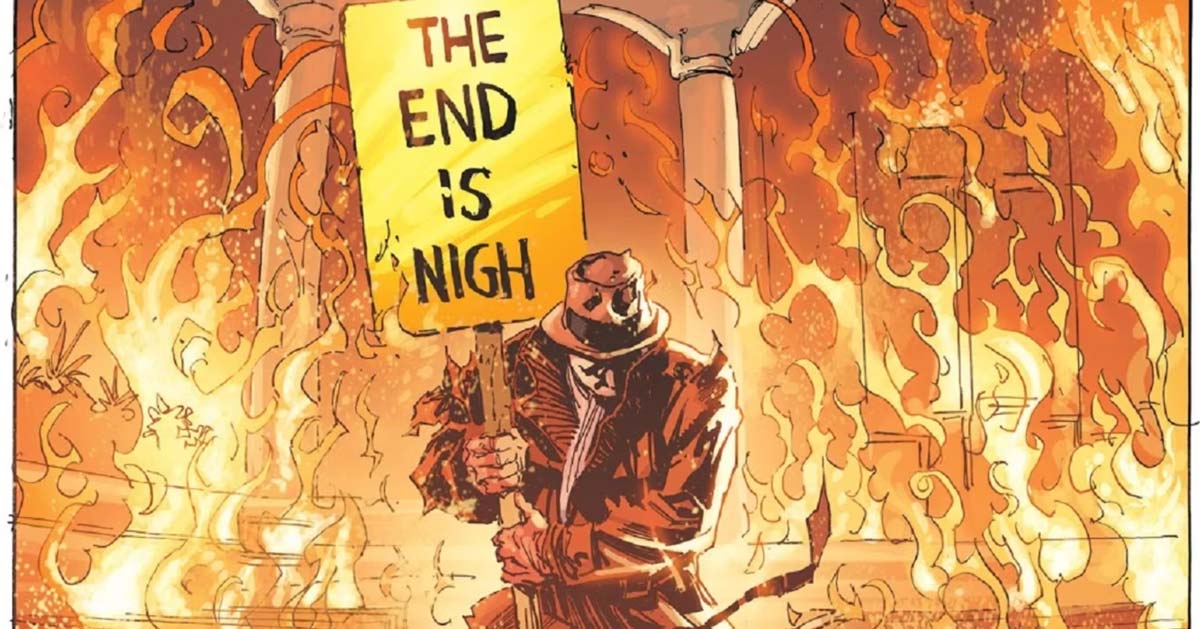
I don’t want to go into whether or not limerence is itself a long-range advanced scout for the Horse Posse of the Apocalypse (I think it might presage problems down the road, though I could be wrong), but I definitely think that when the day comes a thing you once found delightful about a lover now exasperates you, the end is, as Rorshach might say, well and truly nigh.

There’s a thing I’ve seen where creeping disenchantment begins to overcome a relationship, perhaps when someone is annoyed or frustrated, and all the things that were once sparkly and delightful become irritating. Many people project their present state into the past, losing touch with the way they once felt and assuming that their emotional state now is the way Things Always Were.

I can’t imagine what it must be like for such a person to square in their head that present emotion with past action. Regardless of where it comes from, though, that is definitely one of the Stampeding Herd of the Apocalypse, and it might, I think, be productive to be aware of it when it happens.

I don’t necessarily have a solution, mind. But if you see this happening in oyur relationship, take note: the wheels are coming off, and if you don’t do something to change your trajectory, you’re likely headed for a crash.

“The thing that makes you a good lover,” she said, “is that you listen to me when I tell you what I want, and you believe what I say.”

The second-sexiest organ of the human body. (Photo: Taisiia Shestopal)

We’d just finished a quite lengthy and vigorous round of fun, involving a crop, a gold-toned Sharpie marker, and several hours of vigorous and sweaty activity, during which I did at least two things I’d never tried before. (As a side note, I love the incredible, almost incomprehensible vastness of the human sexual experience. Even after decades of highly exploratory, experimental sex, there are still vistas unvisited, experiences untapped. I remember, ages ago, seeing a social media post by some naive dudebro who complained that sex was boring to him because “I’m eighteen years old and I’ve done it all.” No, my dude, you haven’t. If you lived to be eight hundred years old, and you did something different in bed every night for that entire time, never repeating the same thing twice, you’d still not have time to do it all. But I digress.)

I was surprised, at first, when she said it. “Listening to what I want and believing what I say” doesn’t seem like it should be that high a bar to reach. I mean, this is basic, preliminary stuff, right? It’s a bit like saying “the thing that makes you a wonderful cook is you turn on the stove,” right?

But the more I unpacked it, the more sense it made. It turns out this one weird trick is both more effective and more difficult than really it ought to be.

The result.

Okay, so if just listening to someone talk about what they want and believing them is key to being a good lover, why don’t more people do it?

For starters, most of us are indoctrinated from an early age to surround sex with walls of shame and fear. Especially women. Women who know and advocate for their sexual desires are “tramps,” “hos” (or among the less literate, “hoes”), “sluts,” whatever. I’ve seen people—sexually insecure guys, to a one—ask questions over on Quora like “my girlfriend said she wants to do [$Thing], does that make her a slut?” Not once or twice, but over and over. This is, apparently, something that a lot of guys have a great deal of anxiety about. Dude, chill, don’t you want a lover who, you know, likes sex?

And of course the flip side of that, the people who are frightened that they’ll be judged if they ask for what they want, that what they want makes them “weird” and therefore unacceptable.

“I want to try 69 in bed, but I’m afraid my boyfriend will think I’m weird.” ”Is it weird that I want to tittyfuck my girlfriend?” “I have fantasies about having sex while I’m tied up, does that make me weird?” “Is it weird I like feet?” “Is it weird I like having my nipples sucked?” The Internet is filled to overflowing with questions like this, and it breaks my heart.

A good general rule of thumb: If you’re worried about being “weird,” you will never be good at sex. Just imagine if we applied this level of fear to anything else: “I want to try sushi, is that weird?” “If I want to take my girlfriend to a Thai restaurant, will she think I’m weird?”

Now, these aren’t new observations. But still, the level of fear and shame around sex is a tragedy. People agonize over whether or not their tastes are too far outside the pale for any lover to accept them, and at the same time agonize that their penis isn’t big enough for them to be good in bed. My dude, no, you aren’t a good lover because you have a colossal dong, you’re good in bed because you know every lover is different, every person has different tastes, and you communicate openly about sex.

Who knew, right?

So, I mean, it’s one thing to identify the problem, but it’s another to propose a solution. The problem is long-term indoctrination into a cult of secrecy and shame. You don’t overcome a lifetime of those lessons just by waking up and saying “okay, I’m going to be open about sex now.”

So allow me to propose a solution.

Woman with sex toy

My Talespinner and I met, as people often do, online. Early on in our acquaintance, we talked about our sexual fantasies, and spent endless hours exploring fantasy worlds together.

I don’t mean in the sense of “What are you wearing? Ooh, I’d love to bend oyu over right now.” I mean in the sense of constructing fictional characters and settings together, and exploring what happens to those characters, often in graphic detail. In other words, using the first sexiest organ of the human body.

The nice thing about telling interactive stories about fictional characters is it’s a safe, fun way to explore the places where your fantasy worlds overlap. (In fact, we had so much fun doing this, we ended up creating a shared-world fantasy about characters in a dystopian society that my co-author Eunice started participating in. Shared-world anthologies are fun!)

If you’re uncertain about your creative or wirting skills, reading erotica to each other, or even just putting snippets of erotica that really works for you, is another way to do the same thing. You create a space apart from the real world where it’s possible for you and your partner(s) to share your fantasies and explore the interesting bit of the Venn diagram, the place where they overlap.

And who knows? You might just find that while you were busy feeding your anxiety that your partner would think you’re “weird,” they were just as weird as you.

Which, of course, brings us back around to the “listen and believe what I say” thing.

It’s important to choose partners who don’t hear something out of whatever they imagine “ordinary” to be and say “eww, isn’t that weird?” But it’s just as important to be that person.

If you want to be a good lover, you will never get there by hearing something that surprises you and saying “eww, that’s weird.” You can’t expect your partner to share if oyu don’t make it safe to share. (Yes, I know, hashtag #ShouldBeObvious, but here we are.)

And finally, while we’re on the subject of #ShouldBeObvious, here’s a radical thought: Your lover knows more about their turnons and kinks than you do. If they say something gets them off, or they really want to try something, that might just mean—work with me here, a lot of folks seem to find this hard to believe, but it might just maybe perhaps mean that thing gets them off, and they really want to try it.

I know, right?

Everyone says communication is important to a good relationship. Part of that is, well, believing what your partner says. After all, that person is the world’s leading expert on being that person.

A Xenomorph Hiphugger Strapon of your very own!

Whilst the extended polyamorous netowork and I were in Barcelona, we took time out from seeing the Sagrada Familia and doing…um, other stuff to take a ton of photos of the xenomorph sex toy prototypes.

I’m still working through the mass of photos, bit by bit, but in the meantime I’ve actually put the hiphugger strapon up for sale!

That’s right, now you can order your very own hiphugger, for all your xenomorph ovipositor violation needs.

These things each take about three days of fussy, fiddly work to make, so for the foreseeable future I will only make one of them a month. First come, first served, and yes, they’re expensive.

If you order one, I’ll make it specifically for you, in whatever color you like.

We had a ton of fun doing the photo shoot, and got pics of some other xenomorphic goodness as well, including the xenomorph pacifiers and nipple pasties. (Yes, I made xenomorph pacifiers and nipple pasties. What can I say? My parents brought me to see Alien when I was, like, 12 or so, and it scared the holy hell out of me for the next thirty years.)

Now my nightmares are yours too. You’re welcome.