Ever since I was in high school, I’ve suffered severe allergies, a trait I inherited from my dad. Pollen, ragweed, animals, dust mites, you name it, I’m addicted to it. For most of my life, I’ve had a persistent low-grade cough from about April to about October.
And nothing I’ve ever tried has worked, except Benadryl, which knocks me out for 14 hours. Not Allegra, not Claritin, not fexofenadine, nothing.
In 2018, I discovered Xyzal (levocetirizine), a once a day antihistamine that, by some miracle, actually worked. For seven glorious years, I’ve been mostly allergy-free, mostly.
Fast forward to last month, when out of the blue I started getting hives on my arms and sides out of nowhere. Careful, systematic experimentation revealed the culprit to be levocetirizine, which still works but makes me break out.
So I quit taking it.
Big, big mistake.
It turns out levocetirizine is physically addictive. And I’ve taken it every single day for seven years.
It also turns out that you’re not supposed to discontinue long-term use abruptly. Apparently once daily for seven years qualifies as “long-term use.”
The withdrawal from levocetirizine is absolutely brutal—anxiety, insomnia, headaches, difficulty breathing, nausea, fatigue, irritability, shortness of breath…I got the whole package, including some of the withdrawal effects WebMD calls “uncommon.”
I’ve been off it for a month now. According to WebMD, I have about 2-4 weeks of withdrawal left.
But hey, at least I’m also having allergy attacks again.
I am in London as I write this, sitting in a lover’s flat overlooking the London city skyline. I was here when I learned the news of the 2024 Presidential election—that hate won over love, bigotry over compassion, spite over benevolence.
I understand the sick despair many of us feel in the pit of our stomach right now. Dark times hover on the horizon. I don’t believe the people who voted so resoundingly against the better angels of our nature realize yet what they’ve done. Some of them likely never will, and for those who do, it will be too late.
I’m not here to analyze what happened, or rail against the stubborn streak of vicious, ugly racist misogyny that has long been part of the American spirit. Others are already doing that, some of them quite eloquently, and I do believe there’s value in understanding what happened, but that is not the most important thing right now.
It’s vital to understand going forward, though I think the answer is grubber, more sordid, and more banal than we might otherwise hope: there has always been this vicious streak of mean-spirited, ugly anti-intellectualism embedded deep in the American national character, that has been with us from the start. It has never changed, and it likely never will in our lifetimes. We are simultaneously the land of can-do optimism and sleazy, seedy execration. These are the two faces of the American civic character, and this week, the ignorance won.
But I want to remind everyone reading this that there is hope. Like the dawning of the sun after a night of terror, this too shall pass.
I do not wish to trivialize what is to come. Many people will suffer. My trans and nonbinary friends are terrified right now. Two nights ago, a great many decent Americans discovered just how badly their country hates them, just how deep the ugly river of xenophobia flows through the American psyche.
There will be suffering. There will be blood. There will be ugliness, and violence, and hopelessness, and despair. I do not want to minimize any of the grotesqueries we all see on the horizon.
I will, instead, invite us all to take a deep breath, and remember that the course of history is neither straight nor smooth, but it does tend, in the long term, toward peace and justice.
We have been here before. We have, as a nation, been worse before. We were built on the foundation of slavery and we have never truly stepped away from it. Yet we have made progress, and we will again. It might not seem like it now, but this is a setback, not the end of all things.
I would especially like to remind those of us who feel most betrayed by our fellow citizens, those who voted against their own interests purely out of spite and desire to hurt, not to do the oppressor’s work for him.
I still remember the first time this country elevated this vicious, narcissistic, racist, sexist, conman, this tumor on the American psyche, to the highest office the first time. I remember how the shockwaves echoed through my own personal life, how a person I once loved became a bitter, angry, sullen echo of herself, how she told me directly that she was abrasive and prickly to me simply because, in her words, she felt overwhelmed with hopelessness and despair, and I was the only safe place for her to dump that poisonous emotional sewage.
I learned only a few days ago from a person in my life I love dearly that there’s a name for this. It’s called “lateral violence.” Those who feel oppressed, who feel ground down by an enemy far too dangerous and powerful to fight, release their anger and fear and frustration on one another, tearing into each other with a viciousness that it is not safe to direct outward.
Many of us will do that over the coming year. I would like to invite us all not to do the oppressors’ work for them, not to become a participant in our own subjugation.
This has always been a peculiar and pernicious weakness of those of us on the progressive side, this tendency to turn on our own. Tim Minchin expressed this beautifully:
It cannot, it cannot be okay if the intention of progressives—which I assume it is—is progress forward into a future of more empathy and understanding for more people, it cannot be that the primary mechanism by which we’re going to make that progress is the suppression of empathy and understanding for anyone who doesn’t align with our beliefs. It cannot be that unmitigated expression of furious outrage will somehow alchemize into a future of peace and love.
I understand the impulse toward despair and the anger that it brings. I understand that anger, lacking a safe outlet, is all too easily directed at those around us who are like us, those we think have failed the cause, have not done enough to fight oppression (or perhaps have not fought it in the “right” way).
I understand, too, where this leads.
We cannot do this. We must not do this. The story is not over. The storm will end. We must not, in our rage and hopelessness, turn on one another.
Now, more than ever, if we are to survive what is to come, we must, we absolutely must, support each other. That is the way we get through this. Not by adopting the tools and mindset of our enemy, not by doing our enemy’s work for him, not by tearing each other down because we don’t know where else to direct our feelings, but by holding each other, supporting each other, loving each other. Love does not triumph over hate by becoming hate.
The the arc of the moral universe is long, as MLK Jr said, but it bends toward justice.. This path is never as straight nor as swift as we would like, and sometimes for every three steps forward there is one backward.
It’s okay to feel rage, despair, all those other things. I feel them too. We have a choice: we can use them to lift each other up or tear each other down.
I don’t believe in New Years resolutions. But I have, today, this moment, made a resolution for the next four years.
My resolution is that I will do everything in my power to act with greater kindness, greater compassion, greater benevolence and empathy and grace. I will not allow those who despise these things to destroy them in me. I will not do the oppressor’s work for him. I will not be complicit in my own eradication.
JRR Tolkien believed—indeed, this is one of the central moral lessons of his works—that good triumphs over evil not because good is stronger than evil, but because good works with itself while evil works against itself. We do not defeat bullies by becoming bullies ourselves. That, I think, is our blueprint forward.
I’ve posted this image on my blog before. It is vital to remember it now.
After almost three years of effort, I finally had my last dental appointment yesterday. In honor of the journey, my dentist wore bunny ears during that last session.
It started with a failed crown. That in itself shouldn’t have turned into a three-year nightmare, but gather ’round, Gentle Readers, for a harrowing tale to send chills down the spines of the most manly of men.
The crown was old; I got it in 1998 or 1999. Apparently these things don’t last forever (who knew?); they’re usually rated for fifteen years and this one lasted 25, so yay for that, I guess?
Anyway, I took the broken crown to my dentist, who looked at it, peered into my mouth, probed around a bit, said “hmm” a lot, then said something you never want to hear from a healthcare professional:
“We don’t deal with this kind of situation here. You’ll need to go somewhere else.”
Now, we’re talking about what ought to be, in the scheme of things, a rather simple and straightforward procedure (ha ha ha as if, just you wait), not the sort of medical condition where a doctor gets to name a new disease, so I found this…peculiar. But, referral in hand, I made an appointment with a new dentist.
They too looked at the broken crown, poked around for a bit, said “hmm” a lot, took a whole bunch of X-rays, said “hmm” some more, took a different kind of X-ray, said “hmm,” and then my dentist called another dentist over, who looked at all the X-rays, said “hmm,” then said “I’m going to call someone else to have a look at this.”
That is when I knew, Gentle Reader, that Something Was Up.
The new guy showed up, looked at the X-rays, said “hmm” several times, and then said “okay, so, Mr. Veaux, you see…”
The problem was not the crown that failed, but the one next to it. I’d had a root canal in…goodness. Um, 1996, maybe? Somewhere thereabouts.
In this world, there are people who take pride in their work, people for whom it’s not just the money but the satisfaction of a job well done. The guy who did that root canal…wasn’t that sort of person.
The X-ray showed a small void, a gap between the crown on that tooth and the tooth itself.
It also showed a large piece of a broken tool lodged inside the tooth.
And it showed that the dentist had, and as I type these words I did not know this was possible, missed one of the tooth roots completely, which had, of course, become infected.
They had a meeting, in which they discussed whether they wanted to re-do the root canal by taking off the existing crown, drilling through the existing crown, or (and yes, this actually came up as a possibility) drilling through the bottom of my jaw into the tooth, which is apparently a procedure that, God help them, some people actually undergo.
Then my mom was diagnosed with cancer, so both my sister and I started flying back and forth between home and Florida to help my dad care for her.Which pretty much scuttled most of my ability to plan multiple dental visits.
My mom died after a thirteen-month battle, the last few months of which were just awful beyond belief.
When I returned once more unto the breach of this dental misadventure, I had The Talk™ with my dentist, and with the dentist called in to re-do the root canal. The Talk™ looks like this:
Just so you know, I am highly resistant to local anesthetics. It’s a genetic trait, I inherited it from my mom. It is much harder than you think to get me numb, and it takes a long time, and it wears off quickly. So, be warned.
I always tell them. They never listen at first. “Oh, don’t worry, I can get you numb,” each new dentist says, “it won’t be a problem.”
Narrator: “It was a problem.”
The guy they called in to handle the root canal took nearly an hour, and seven ampules of lidocaine(!!), before he declared himself ready.
He went in through the existing crown, which was something of an ordeal involving several fascinating smells, including one I could almost swear smelled like smoke, and rather a lot more “hmm” and “that’s interesting” and “I wonder if…” than I am, generally speaking, entirely comfortable with from someone who is placing medical instruments in any part of my body.
Apparently, from what I gather, the tooth had an extra root, which I didn’t even know was a thing that could happen, and that explains why the previous guy back in the 90s missed it but doesn’t explain why he left a broken bit of tool inside the root canal (they didn’t give me a copy of the X-ray, more’s the pity, because it’s freaky and I’d love to horrify you, Gentle Reader, with it).
After rather a lot of work, he pronounced himself satisfied, and I was back on track, only this time with replacing two crowns rather than one.
I be-bopped off to Springfield to spend time with my Talespinner, then returned to tilt once more at the windmill, when my dentist took a whole new set of X-rays on account of, you know, I’d been away for thirteen months helping care for my mom, and decided that a third crown, also from the mid 90s or somewhere thereabout, was separating from the tooth and thus was well past its use-by date.
I will spare you the details of the last seven months, even though Fate did not spare me, because unlike Fate I have a conscience. Suffice to say that seven months, a detached temporary crown, and three thousand dollar in out-of-pocket expenses later, I have been given a clean bill of health, and my dentist sent me off from yesterday’s appointment with a celebratory pair of ears of his own.
Which I, and the entire rest of the office, found charming.
Now the days spread before me, my calendar has no dental appointments on it, and I breathe in and say to myself, “is this what normal feels like?”
Some while ago, I answered a question over on Quora about whether or not it’s okay to pirate a video game if you can’t afford it. I write for a living, which of course means I take intellectual property seriously. Also, I write for a living, which means I don’t have very much money.
So, as you might imagine, I answered no, it’s not okay to steal other people’s work, even if you can’t afford to buy it, and as an example I used Starfield, the massive single-player role-playing game from Bethesda.
I like Bethesda games. I have, as of the time of writing this, sunk over 1,990 hours into Skyrim and 1,570 hours into Fallout 4. I’ve itched to play Starfield since I first heard of it, but at seventy bucks for the “normal” game and a hundred bucks for the “premium” version, I was like nah.
So, Quora being what it is, one of the kind folks over there bought me a copy, and another friend on Quora gave me a machine that could play it.
Which was amazing.
I now have about 225 hours in Starfield, and it’s so, so close to being a good game, but it just…isn’t.
All the ingredients are there for a truly amazing game except one: the game designers forgot to make it fun.
It’s an innovative game. It’s a pretty game, in places (and in places it’s howlingly bad). It has a bunch of cool, well-thought-out design ideas. It’s just not fun.
So, let’s do a deep dive into why Starfield misfired so badly. Caution: Long essay is long.
Part 0: WTF is Starfield?
It’s Skyrim in space. Seriously, it’s Skyrim in space.
If you know and love Skyrim, you’ll largely know what to expect. You, a blue-collar miner in the ass end of the explored universe, come across a Cosmic Mystery™ that catapults you on an adventure. Along the way, you’ll team up with companions who will guide you (and maybe marry you), you’ll engage in countless battles, and you’ll develop strange powers never before seen, only instead of gaining powers from long-forgotten ancient temples you explore with the aid of your trusty bow and an overpowered Sneak skill, you’ll gain powers from long-forgotten ancient temples you explore with the aid of your trusty laser gun and an overpowered Sneak skill.
You’ll also gather resources to build outposts on widely-scattered planets, rather than gathering resources to build settlements in widely-scattered parts of Boston.
Honestly, this sounded like pure pixelated crack cocaine to me. (Did I mention I’ve over a thousand hours in both Skyrim and Fallout 4?) Take a mashup of Skyrim and Fallout and put them in SPAAAACE!!!!!™? Sign me the hell up! What’s that you say? I can design and build my own spaceships too? You already had me! Let’s do it!
And yet…and yet…
Somehow, it manages not to be nearly as interesting as Skyrim or Fallout. It’s huge—a hundred worlds with endless procedurally generated terrain to explore—but it feels tiny. The main city in Starfield, New Atlantis, is the largest city Bethesda has ever created, but it feels stifling.
So what went wrong?
Part 1: The Bits that Work
Before I do a deep dive into the parts that went off the rails, I want to acknowledge that there’s a lot to like.
The spaceship crafting is amazing.
This is my ship, Anopheles.
This is a ship I have in one way or another been working on for forty years. Back in my high school days, I played in a Traveller pen and paper role-playing game (remember that? The game where you could die during character generation?) with my best friend down the street and the rest of my friends circle. We flew around in Anopheles, named for the mosquito that carries malaria—a tiny, heavily-armed five-person ship, fast and light, with no armor but a hell of a punch.
Later, after university, I ran a hard-SF GURPS Space game for about five or six years, in which the players explored the Rich Cluster, a small globular star cluster with about a dozen habitable worlds all quite close to each other, in which the players flew around getting involved in weird political messes in Anopheles—you got it, a tiny, heavily-armed five-person ship named after the mosquito that carries malaria.
My Starfield ship was again a tiny, heavily-armed craft with a long spine projecting from the front that carries a bunch of particle beam weapons that chew through much larger, more heavily-armed spacecraft.
I had endless fun designing this ship, building it, upgrading it, improving it.
A fair bit of Starfield involves space combat, and the Starfield ship to ship combat system is complicated, with many different classes of weapons (lasers, missiles, railguns, particle beams) that you assign to different mouse buttons. Some weapons are good against shields, some against the enemy hull. You can fire at the enemy in general or target different systems (engines, FTL drive, shields, weapons). You need to use different weapons at different times—projectiles, for example, are effective against a ship’s hull but ineffective against shields, so you use lasers against the shields until they’re down, then switch to—
Ha ha ha ha ha ha ha, I’m kidding.
I mean, that’s how it’s supposed to work, and during combat you’re supposed to think about how you allocate power between different weapons sysstems and engines and shields and such, but as soon as you figure out that particle beam weapons work against shields and ships, you just stop faffing about with all that, put the biggest reactor you can on your ship, load it down with particle beam weapons, and tear through ships four times your size like they’re tissue paper.
The companions are really well done.
At the start of the game, you end up joining a group called Constellation, intent on uncovering the mysteries of the universe. Many of the companions you can choose from are Constellation members, but they’re all different.
The companion characters’ personalities are nuanced, subtle, and complex. The first companion you travel with is so well done that I ended up not starting an in-game romantic relationship with her because she reminded me in subtle ways of the judgmental bossiness of a real-life ex enough to give me the shivers.
Instead, I ended up marrying Andreja, the introverted, possibly-on-the-spectrum badass with the secret past.
Andreja is BAE. And if you marry her, the wedding gift she gives you is amazing. Not, like, in a game mechanics way, but symbolically.
Fallout allows you to romance multiple characters who are all, apparently, totally on board with you having more than one lover. Not so in Starfield, where monogamy is apparently Very Much A Thing and romancing one character means no more nookie from others unless you divorce first. Limitless technological advancement, suburban 20th century American values.
Some of the quests are amazing.
As with Fallout 4, the companion you choose to travel with can give you quests. The quest you get from Sarah starts out seeming pretty predictable, and about halfway through I was rolling my eyes, certain I knew how it would end…but the game surprised me. It’s really well done and handled with exquisite care.
The quest Entangled has you flipping back and forth between two different timelines after an accident in a research facility. It’s nothing like any quest I’ve played in a computer RPG before, it never stops being cool, and overall it’s an absolute blast.
The same corridor in the two different timelines in Entangled
There’s a whole series of quests centered on rising through the ranks of corporate spy/fixer at a megacorporation called Ryujin Industries that I can only imagine was as much marvelous fun to write as it was to play (tip: bump up your Stealth skill before you do it!).
Ryujin’s corporate HQ
The Music
I mean, it’s Inon Zur. Of course it’s good.
I personally like the Fallout 4 soundtrack better—there’s more variety, and the music is less ambient (the main theme and Of Green and Grey still give me chills), but seriously, that man could write music based on his shopping list and it would be amazing. The only video game music that has ever stuck with me like the soundtrack from Fallout 4 are the songs Nightsong and Outlaw Harbor C, both from World of Warcraft.
The “New Game+” system is…um.
I’m honestly not sure whether to put the NG+ system in the Bits That Work section or the Bits That Don’t. So let’s do this:
Part 1.5: New Game+
Starfield has this thing that happens, that Bethesda called “New Game+”, that lets you start a new game without starting a new game.
Okay, so (minor spoilers for the main story):
The game starts out with you, a lowly miner in a miserable backwater, carving out a mysterious possibly-alien artifact from the rock. The moment you touch it, you have a Cosmic Experience with lights and music and trippy visuals, and so you’re tasked to take the strange artifact to Constellation and that kicks off the main adventure.
As you collect more of these ancient maybe-alien artifacts, you find temples that grant you strange powers, and eventually you learn that the artifacts can be assembled into this nexus that lets you skip between alternate universes.
If you choose to leave the universe you’re in for a different universe, it’s like starting a new game: you start out at Constellation with no money, no possessions save for a really freaky-ass Starborn spaceship (because you’re Starborn now, a member of a rarified handful of people with the ability to cross between parallel universes), except that you keep your character level and all your skills and abilities.
Hence, New Game+. You’re starting a new game, only with on old character you’ve already developed.
The good: You can explore all the various ways to end different quests or all the various factions you can side with without actually starting a new game from scratch. Don’t like the way things turned out? Wish you hadn’t sided with that faction? Leave this universe behind for a new one, where nobody knows you and you haven’t done any quests, and start again! It’s a really cool idea.
The bad: Implementation sucks.
I was sad to leave behind Anopheles but eager to see what I could do with this really freaky alien Starborn ship that I got.
Answer: Nothing.
Nothing. You can’t upgrade it. You can’t swap out any parts of it, or customize it, or modify it. You can’t sell it. You can’t do anything with it except customize the furniture inside, and the layout is so weird there’s really not much you can do even with that. One of the coolest parts of the game, and it just doesn’t apply when you flip between universes.
So you’ll probably want to capture, buy, or hijack a ship in every new universe, just so you can, you know, play with the shipbuilding parts of the game.
The cities are all laid out exactly the same way in the alternate universes; every major non-procedurally-generated location is precisely the same. Yet for reasons I cannot comprehend, they act like brand new locations—you can’t fast travel to them without visiting them on foot first, even though they’re all the same.
You shift between universes with nothing. Not even your spacesuit or clothes. You’re given a new spacesuit to go with your new spaceship, but no clothes, no money, no weapons, no tools, nothing. I think it would be far more interesting if you shifted with your clothes, some money, and perhaps a limited amount of equipment—like fifty kilograms or twenty kilograms or whatever. Enough to take some things that you really like, but with a small enough limit you have to make choices.
In the game, the Starborn are all pretty universally assholes, and after you’ve played NG+ you can see why. When you can just blamf to a new universe to escape the consequences of everything you’ve done, the stakes suddenly get very, very low. It would be cool if consequences somehow followed you. In every universe, you keep getting harassed and attacked for no readily apparent reason by other Starborn who seem to think you’re “unworthy,” but there’s no rhyme or reason to it. Maybe if different factions of Starborn reacted differently to choices you made in the universes you left behind? Dunno, just spitballing.
Part 2: Why The Game Misfires
At this point, Bethesda has such a reputation for launching games in a buggy, half-finished state and fixing everything after it goes out the door that complaining feels like piling on.
But still:
It’s buggy it’s buggy it’s buggy oh my God it’s buggy
When I first got the game, it was unplayable. My game system is AMD Athlon/Radeon based, and for a while it would swear the graphic card drivers were outdated on launch every time, even though they most assuredly weren’t.
It would also crash about 25% of the time on loading screens between locations, until I learned to turn contact shadows off in the game settings, which mostly fixed it.
Later patches of the game gradually improved the stability, to the point where I now play for hours without a crash, but it took a while to get there.
While the game doesn’t crash constantly any more, the procedural generation still needs help. It has a weird habit of putting rocks and random boxes and other elements not touching the ground.
This kind of stuff happens very frequently. There are parts of the game where rocks are supposed to be floating in midair, because there’s an “antigravity element” in the game. This isn’t one of them.
Like most Bethesda games, there’s a crafting system. You can modify your weapons and spacesuits, craft pharmaceuticals, and make other items at various types of workbenches.
And the whole system is buggy AF. A workbench will often say that you can’t use it because someone else is using it even when there’s no human being within a light year of you. (Sleeping on a bed sometimes fixes it.)
Or it will say that a workbench is “obstructed” and can’t be used when it’s not. (Shooting the workbench with a gun sometimes fixes it—yes, I’m serious.)
Or you’ll go through the animation to use it and then just…stop, and you won’t be able to craft anything. (Again, shooting the workbench with a gun sometimes fixes it, no idea why.)
The lockpicking minigame
Fuck me, it’s annoying. I actively look for reasons not to pick locks.
Every Bethesda game has a lockpicking minigame. You stick something, whether that’s a lockpick or a bobby pin, into a lock and turn. There’s a “sweet spot” where if you position the lockpick right it opens, otherwise it sticks, and there’s a chance it might break the lockpick. Simple, self-evident the first time you do it, easy…and dull.
So Bethesda said “why not make the lockpick thing an actual game?”
Great idea. Terrible execution.
It’s tedious, it’s complex, there’s almost no on-boarding so you have no idea what you’re doing, and every time you try to pick a lock and give up in frustration you lose a lockpick…and in this game they’re scarce.
It’s not at all obvious how the lockpicking system works, especially when it gets complex with higher-difficulty locks—I’ve read a half dozen tutorials and I’m still often confused (as are other players, judging from the number of tutorials and the comments on them). I predict that it won’t be long until someone makes a mod to skip the lockpicking minigame. When they do, I’m installing it, assuming I ever decide to start playing again.
The outpost system
Jesus Christ on a three-legged tap-dancing camel, the system of establishing colonies on distant worlds is deeply broken—a confusing, poorly thought-out mess that’s the exact opposite of fun.
Fallout 4 introduced a settlement system, where you, the player, can build and secure little towns that attract settlers, build houses, plant crops, set up defenses, create supply lines between settlements, even set up artillary you can use to call down strikes for a certain distance around the settlements.
Starfield takes that system and makes it crappier in every single way.
The ensuckification of the settlement system knows no bounds. It’s complex, obtuse, requires investment of way too many skill points, and the player is thrown into it with no tutorial and no clear guidance whatsoever.
The idea is simple: Different planets have different resources, like iron and titanium and fluorine and whatever. You can land on just about any planet, plonk down a settlement, then place buildings, resource extractors, resource storage, walls, defenses, and so forth. Resource extractors will automatically mine resources, then transfer them to storage bays so you can come collect them later.
Each storage unit can only hold so many resources, though, and it gets tedious to come back and keep picking them up. If only you could make them available wherever you wanted!
Wait, you can!
Maybe. I mean, I think you can? I’m not really sure. I spent hours trying to figure it out and I still have no clue how it works.
You can set up in-system and interstellar shipping lanes between your outposts. Or rather you sorta can, there are ways to do it, but apparently they rely on loading your outpost with Helium-3 or something? That’s what all the online tutorials say, but I was never able to load Helium-3 into any of the transport ships; there’s a place where you supposedly do it, but whenever I clicked on it and hit the Interact key, nothing happened.
I was finally able to set up an outpost on a planet with Helium-3 and connect a Helium-3 extractor to the cargo ship pad instead of to a storage tank and I think that worked. I saw cargo ships come and go, but I have no idea if they actually moved any resources around.
There are dozens of tutorials on Starfield outposts and I read every one and still have no idea how to make it work. Apparently you can move certain resources in certain directions but you can’t link all your outposts to each other like you can link all your settlements together in Fallout 4. They have to be linked in a line, maybe? I don’t know.
While I was fumbling around with it, I somehow got an achievement:
2.6% of all players managed to link five outposts together. That tells me this part of the game is just as confusing to 97.4% of players as it was to me. I had a quest to link an outpost to a city, but I was never able to complete it successfully. Fukifino.
There’s absolutely no in-game explanation for how this works. None. Zero. Zip. I say without exaggeration or hyperbole that if a saboteur had somehow gained employment with Bethesda for the purpose of screwing up their next-gen AAA game, he could not have done a better job of cacking things up than what the game designers did with outposts in Starfield. It’s that bad.
“Poor on-boarding” and “completely opaque game mechanisms” are pretty much the hallmark of Starfield, which I gather from spending a lot of time Googling how to do things in the game put off a lot of players, like a whole lot.
Lord of the Rings is a movie about walking. Starfield is a game about running.
Hope you like big open spaces, because Starfield is the Game of Big. Open. Spaces.
When you play Skyrim or Fallout 4, they feel…dense. You get the sense that you’re actually in a place. Like, a physical place, with roads and shops and pathways through the landscape.
This:
is a pretty typical view from Fallout 4. (Yes, I play on an iMac, what of it?) You have a sense of place. This feels like a real environment. All those buildings? You can go to them, explore them, wander around in them. Every object in Boston was placed by a person.
Starfield gives you 100 planets to explore, but they’re all pretty much the same.
This is a procedurally generated map of a section of a planet in Starfield. It’s a big expanse of nothing with pre-formed buildings plonked down at random locations.
There’s about a dozen or so types of buildings that can be placed: an abandoned cryo lab, an abandoned weapons factory, an abandoned research tower, and so on.
Thing is, every single one of these buildings is identical. The abandoned cryo lab you find on one planet is exactly the same as the abandoned cryo lab you find on a different planet, down to the map, the location of chests, where the enemies are, the location of dead bodies, everything. If you’ve been in one abandoned cryo lab you have, quite literally, been in all of them.
And they’re scattered at random with no rhyme or reason, separated by kilometers and kilometers of empty space, no roads, no nothing. Just “okay, I think I’ll bould a research tower here.” “Yeah, I’m going to put a weapons factory two kilometers away.” “Cool. Is yours abandoned?” “Well, except for space pirates, yeah. Yours?” “Space pirates, yeah.”
You never get the sense you’re actually exploring a space. Even the main cities are just plopped down surrounded by identical buildings placed at random around them. At no time in my 200+ hours did I ever once feel “wow, cool, I am really in a different place!”
Here’s a procedurally generated planet. There’s a randomly placed building in front of me, identical to every other building of its type. 798 meters away is another randomly placed building. If I want to go from here to there, I…
…run almost a kilometer.
No, I can’t get in my ship and fly a kilometer. I have to run. Yeah, it takes as long as you think. You spend a lot of time in this game running across empty terrain from one building you’ve seen a hundred times already to a different building you’ve seen a hundred times already.
In other games, every location is different. You descend into a Dwemer ruin or a grand burial chamber inhabited by undead in Skyrim and they’re all different from each other. Here, you go to Abandoned Cryo Lab #117, pixel for pixel identical to all the other 116 Abandoned Cryo Labs you’ve been in, and filled with the same enemies in the same location…
…and oh, how you will come to hate the Abandoned Cryo Lab. It’s hands down the worst designed dungeon I’ve ever seen in any RPG. (This seems a popular opinion, by the way. One guy online talked about how he simply memorized a path through the Abandoned Cryo Lab and just speedruns through it whenever he finds one.)
The Sooper Sekrit Powers™ Minigame
In Skyrim, your character can unlock “shouts,” kind of like magic spells written in the language of the dragons. Every so often you’ll find a ruin with a “Word Wall” in it. The Word Wall has writing on it in the dragon language, and when you get close, a swirling light surrounds you and you learn a new spell.
Something almost identical happens in Starfield. Every now and then, you find an ancient temple. The ancient temple has a stargate ring-thing in it. You fly through it and you learn a new power, like the ability to alter gravity to fling enemies around, or make a duplicate of yourself in combat.
Pretty cool. Not new or groundbreaking, but pretty cool…
…except that from a gameplay perspective they fucked it up.
When you go into a temple, a Stargate SG1-style ring appears and gravity stops and you fly around. And then you get frustrated because you fly through the ring and nothing happens so you fly through the ring and nothing happens so you get bored and leave.
Then you go online, and you discover that there’s a lot of lens flare around a glowing ball hanging in space and you have to fly through that before you fly through the ring. Nothing in the game tells you that. Nothing. I have no idea how the first player figured it out.
But wait, that’s not really true. See, if you fly through the lens flare then fly through the gate, nothing happens. You have to fly through the lens flare five times (or sometimes four or sometimes twenty, I think it’s on a timer but I’m not sure) and then fly through the gate.
Seriously.
You have to do this over and over and over and over and over and over and over and over and over and over and over and over and over and over and over and over and over and over and over and over and over and over and over and over and over and over and over and over and over and over and over and over and over and over and over and over and over and over and over and over and over and over and over and over and over and over and over and over and over and over and over and over and over and over and over and over and over and over and over and over and over and over and over and over and over, every single time you find a ruined temple. Fly through the lens flare five times and then fly through the stargate and then kill me now please this is so fucking tedious it makes the lockpicking minigame feel like a luxury all-expenses-paid Hawaiian vacation please come back lockpicking minigame all is forgiven JFC.
I don’t know what game designer thought this would be fun, but that person needs therapy stat.
Oh, and then a dude comes out and says you’re not worthy so you shoot him.
The crafting system is completely broken
Fans of Skyrim and Fallout will by now not be surprised to know that Starfield lets you improve weapons and armor and spacesuits and such, just like you can in those other games, but once again they’ve bolloxed it up.
This one is a twofer. You get two, two, two game-mechanical misfires for the price of one!
When you go up a level, you get points you can put into various skills. These skills make you a better shot or let you use boost packs (which are really rather fun) or get more power from your ship reactor or repair ship damage in battle faster or whatever, and just like in previous games, if you want to be able to make the best weapon or armor mods you need to spend points in the skills that give you better access to those mods.
Unlike in Skyrim or Fallout, that’s not enough.
After you’ve spent those skill points, you still can’t do the thing until you also go to a research station and research how to do them. Spending skill points only unlocks the ability to do the research. Doing the research then gives you the ability to modify your gun or whatever.
You have to do this multiple times for each part of your weapon or armor you want to modify…
…and it costs a tremendous amount of resources to do that research.
Which you then have to do over and over again as you gain more levels and spend more points.
It makes modifying your gear incredibly expensive and time-consuming, for what is usually fairly modest gain.
But wait, it gets shittier!
You can find resources on planets you explore, like iron or titanium or whatever. And then you spend resources on research so you can spend more research on making new gunsights or making your spacesuit bullet resistant.
But…
…there is a limit to how much stuff you can carry. There is a limit to how much stuff your spaceship can carry. And holy fucknuggets are the resources heavy.
One of the very first mods released for Starfield, before even the ability to create mods in a sanctioned way had been introduced, was a mod that made resources weigh less because after you’ve spent six or seven trips going to and from your spaceship carrying hundreds of kilograms of resources, you get a bit sick of it. (Oh yeah, that’s a thing: a lot of storage chests in this game have weight limits. Man that gets frustrating fast. Resource management in this game suuuuuuucks. People complained about the same problem in Fallout 76 so the game devs were like “hold my beer.”)
Again, it almost feels like they were intentionally trying to take the fun out of the game.
Reeeeesources!!!
While we’re on the subject…
Fuck me, Bethesda, do you understand what a “spacesuit” does?
Okay, so. You’re running (and running and running and running and running) along a barren empty expanse of nothing, just like you’ve been doing for the past ten minutes, and you find a crack in the ground with argon gas coming out of it.
Never mind how inane that is, suspension of disbelief, yadda yadda yadda, roll with it.
Now, you’re in a spacesuit. I want to emphasize this. You’re in a spacesuit.
Argon is a resource, so you walk over to the crack and collect some argon. Cool!
Only now an alarm goes off and you start taking damage because caution danger poison gas poison gas get away.
Let me reiterate this one more time:
You.
Are.
In.
A.
Spacesuit.
You are in a spacesuit. On a barren and uninhabitable, maybe airless, moon. You’re wearing a spacesuit. A spacesuit is the thing you are in.
And somehow you’re being poisoned.
By this argon.
Which is an inert, noble, non-toxic gas.
While you are in, and I cannot emphasize this enough, a spacesuit. Like, the thing you wear in space.
I don’t even know how to even.
Consensus says: Not a sticky game
I genuinely don’t see myself playing this game for a thousand hours.
I’d planned to play the game long enough to get every achievement you can get, but I gave up with one achievement still to go: reach Level 100. I’m currently level 70something…76, maybe? And I just cannot see myself slogging through what it will take to get to level 100. Ugh.
When you get an achievement, for hitting certain milestones or completing certain quests, you’re also told how many other players have earned that achievement. And judged by that metric, things look…dire.
More than half of players quit before they reach level 25—a level which is, just for the record, not that hard to reach. A bit more than a third have completed thirty missions that you can pick up in any bar or pub.
Less than a quarter finish Entangled, what I think is the coolest quest in the game and one of the best I’ve played in any role-playing game…ouch.
Fifteen percent mod a lot of weapons, in a game where modding weapons is a core mechanic…unfff that’s gotta hurt. These numbers speak to me of a game that just plain cannot capture people’s attention the way Fallout and Skyrim do.
Amazon just released a TV show based on Fallout, which is really quite good. I…don’t see that happening with Starfield. There’s just not a lot of “there” there. The procedural generation stuff…I get it, I get what they were trying to do, really, I get it, but oh my God. There are too few types of buildings and they are all…the…same.
And way too much of this game just feels like a chore. Running back and forth and back and forth with armloads of resources, repeating the same minigames over and over again, and the incomprehensibly baroque outpost system that I still haven’t figured out despite being in that rarified 2.6% of players who get the outpost achievement…how did this not get caught early in the development cycle? This is not a newbie company. This is a company that has an absolute talent for producing fun, immersive, addictive games…why is this game so goddamn dreary?
There’s a new addon to the game due in the next month or two, and I’ve been waiting for it with bated…hahaha no, I literally haven’t thought about it since it came across my Steam feed.
Will I get it? If it’s $7.99, sure. If it’s $19.99, no. If it’s $30, as a quick Google search suggests is likely, not just no but hell no. I got the game as a gift and I just cannot see myself spending money to play it any more.
Now if you’ll excuse me, I think I’ll go roll a new character in Fallout 4.
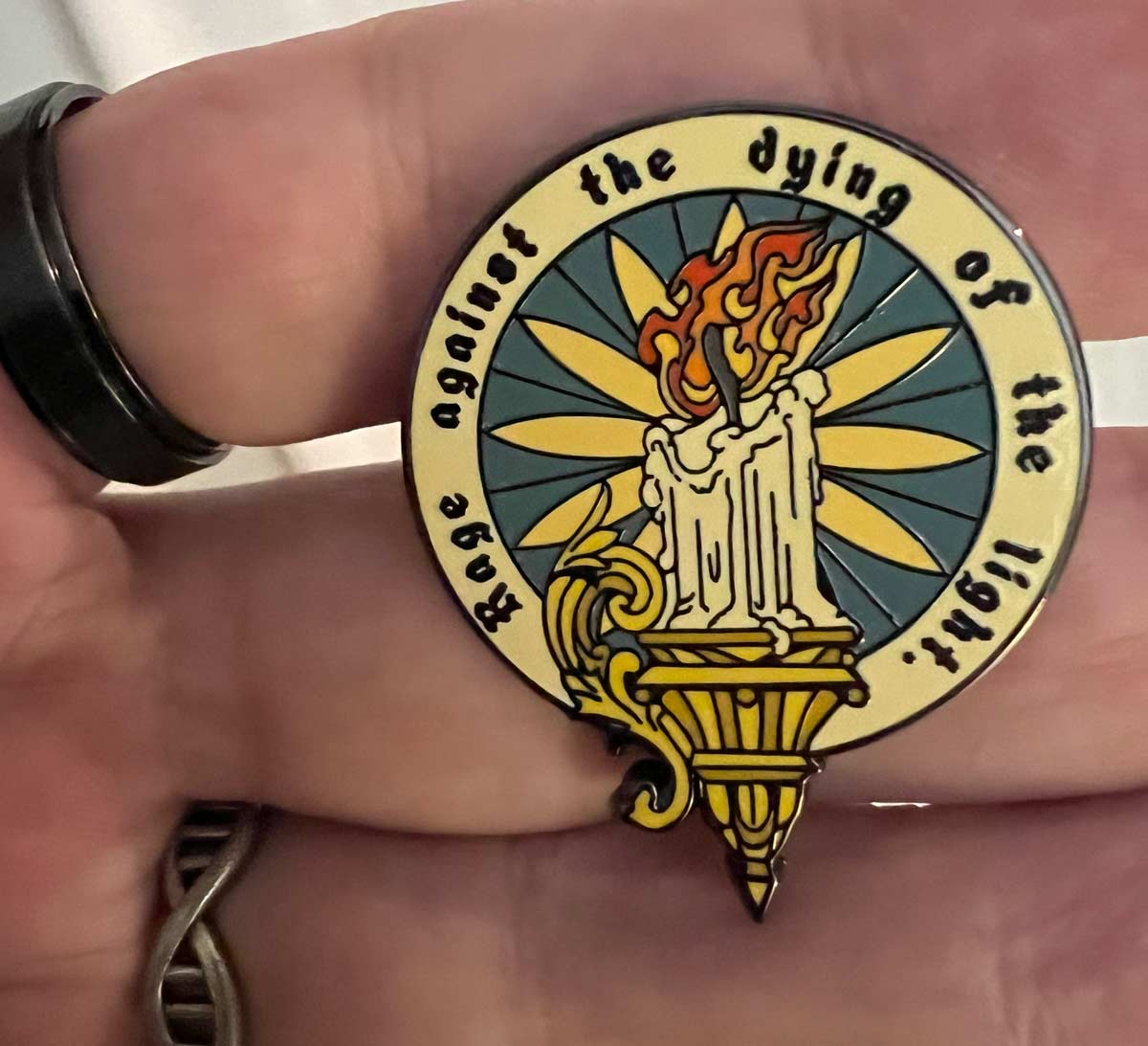
When I arrived in Florida a few weeks ago to help care for my mom, who was in the last stages of terminal cancer, Facebook showed me an ad for a pin. I ordered it on the spot. It arrived yesterday, on what would have been my mom’s birthday.
For anyone who doesn’t recognize it, it’s from a poem called Do not go gentle into that good night, by Dylan Thomas, whose first stanza reads:
Do not go gentle into that good night, Old age should burn and rave at close of day; Rage, rage against the dying of the light.
I’ve talked a lot about my mom’s wisdom. It was a quiet, understated thing; she had a knack for comprehending the world in ways subtle and deep. When I was growing up, she used to tell me, “information by itself almost never changes attitudes.” She understood that we are not rational creatures, we are rationalizing creatures, prone to making decisions for emotional or tribal reasons and then pressing our rational selves into service to justify our choices.
Other things she told me countless times:
“Education is not the solution if ignorance is not the problem.”
“We are predisposed to believe what we wish were true or what we’re afraid is true.”
“Never ask a question whose answer you don’t want to know.”
Even more than her sometimes pointed wisdom, though, I remember she was always, always there for me, without fail. If there was one thing I could count on absolutely, without question, as surely as the rising sun at the end of night, it was that she’d be there without fail. I never for even a millisecond, at any time in my life, doubted her love. Not once.
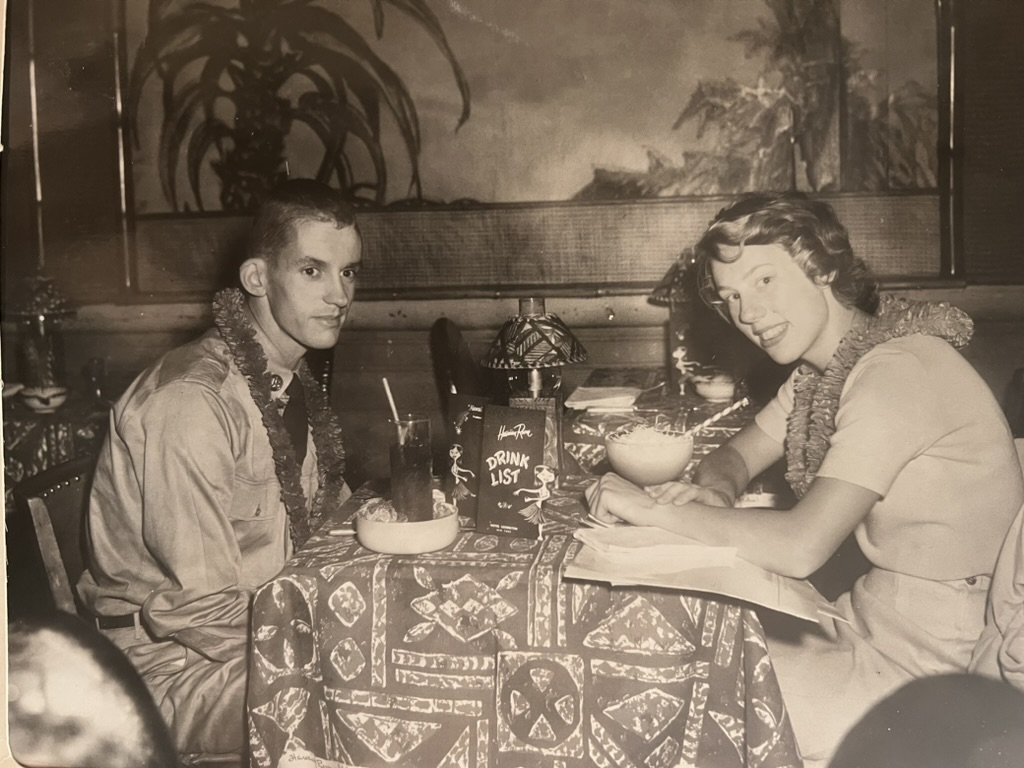
My mom and my dad on a date, six years before I was born.
I remember one night many years ago, when I was 18 or 19, driving to Ft. Lauderdale in my notoriously unreliable ’69 VW Beetle to visit friends. The car broke down at about 2AM four hours from home, so I called my mom from a pay phone. Without the slightest hesitation, without lectures or rancor, she got up, dragged her ass the four hours to come rescue me, then the next day took me to a repair shop for the part I needed to fix it and drove me right back down again.
She was always that way. That sort of cast-iron knowledge that someone always has your back is probably the single greatest gift you can ever give someone growing up.
My mom was diagnosed with cancer in November 2022, thirteen months almost to the day as I type this. She tolerated chemo poorly, though she was not one to go gentle into that good night, and stuck with it no matter how miserable it made her.
In the end, it wasn’t enough.
I came down to Florida a few weeks ago to help my dad care for her. At the end, she needed round-the-clock care, so my dad and I alternated in twelve-hour shifts.
In the tiny hours of the night last week, she started having difficulty breathing. I called 911. She’d been in and out of the hospital several times, so I didn’t know this would be the last time she’d ever be home.
The hospital confirmed the cancer had spread to her lungs and brain. A few days later, the doctors took her off life support.
She died at 9:36 in the morning on December 15, 2023, four days before her birthday. We (my dad, my sister, and I) were in the car on the way to the hospital to see her when she passed.
That night, when I called 911, I don’t think any of us knew it was the end. We knew the end was near, of course, but she’d had other crises, other storms she’d weathered.
I’ve been thinking about that a lot this week, as I go through a million little things I never imagined having to deal with—arranging for the home hospice care people to come and pick up the hospital bed, resetting her iCloud passwords, all the various ways we close the threads of a life. (The truck is titled in my mom’s name but my dad isn’t on the title, something my sister is dealing with.)
You never know.
Someday, there will be a last time you see the moon through the trees. Someday, there will be a last time you hug the people close to you. Someday, there will be a last time you hear a bird sing, a last time you have your favorite dessert, a last time you feel the sun on your face.
You might not know when that is. It might have already happened.
You are an anomaly. Yes, you. The odds of your existence are incomprehensibly small. You trace your lineage directly across the billions of years to a primitive, single-celled organism, and any tiny disruption of that slender thread would erase your existence. Had your parents gone to the movies that night, you would not be here.
You have these brief moments under the sun, and that is a gift beyond price—beyond imagining. Somehow, you beat odds so great your brain literally cannot comprehend them, and of the trillions of potential beings that might exist, here you are.
These few moments are all you will ever have. Cherish them, because there will be a last time for everything.
I keep, on my phone, a list of books I want to write. There’s something wrong with it; somehow, every time I finish a book, I discover the list has grown longer, not shorter. (Side note: You can tell someone’s an amateur whaen they say “I don’t want to show my book to an editor or publisher because I’m afraid someone will steal my idea.” Nah bruh, ideas are worthless, and we all have too many ideas of our own to be interested in yours. The bitter truth of writing is it’s almost impossible to get anyone interested in your book in the first place!)
One of the books on the to-be-written list is a nonfiction work titled A World of Sh*t: Normalizing bad design and lazy craftsmanship. Because man, there’s a ton of it out there.
The way I imagine the book’s title
As I sit here in my parents’ house in Florida, I find myself particularly annoyed by the bad, lazy, incompetent, “we didn’t think this through” design around me.
There’s a term that describes a lot of this crap: “psychic litter.” The expression was coined by David Joiner in the 1990s, to describe small acts of immorality that fall beneath the threshold of conscious awareness.
Take, for example, the Windows installer. It takes a while to install Windows, especially older versions. A lot of that time is spent building the Registry. The Windows installer designers could have pre-built a Registry in the installer itself, which would save almost half an hour on each install, but chose not to because it would mean taking an extra half an hour of their time to build the installer. So rather than spending the half an hour on their end, they chose to waste thousands of man-hours of other people’s time.
This kind of selfishness and lack of care is the essential beating heart of a lot of sh*t design.
Take my parents’ kitchen faucet (please!).
It’s pretty. It’s sleek.
It doesn’t move.
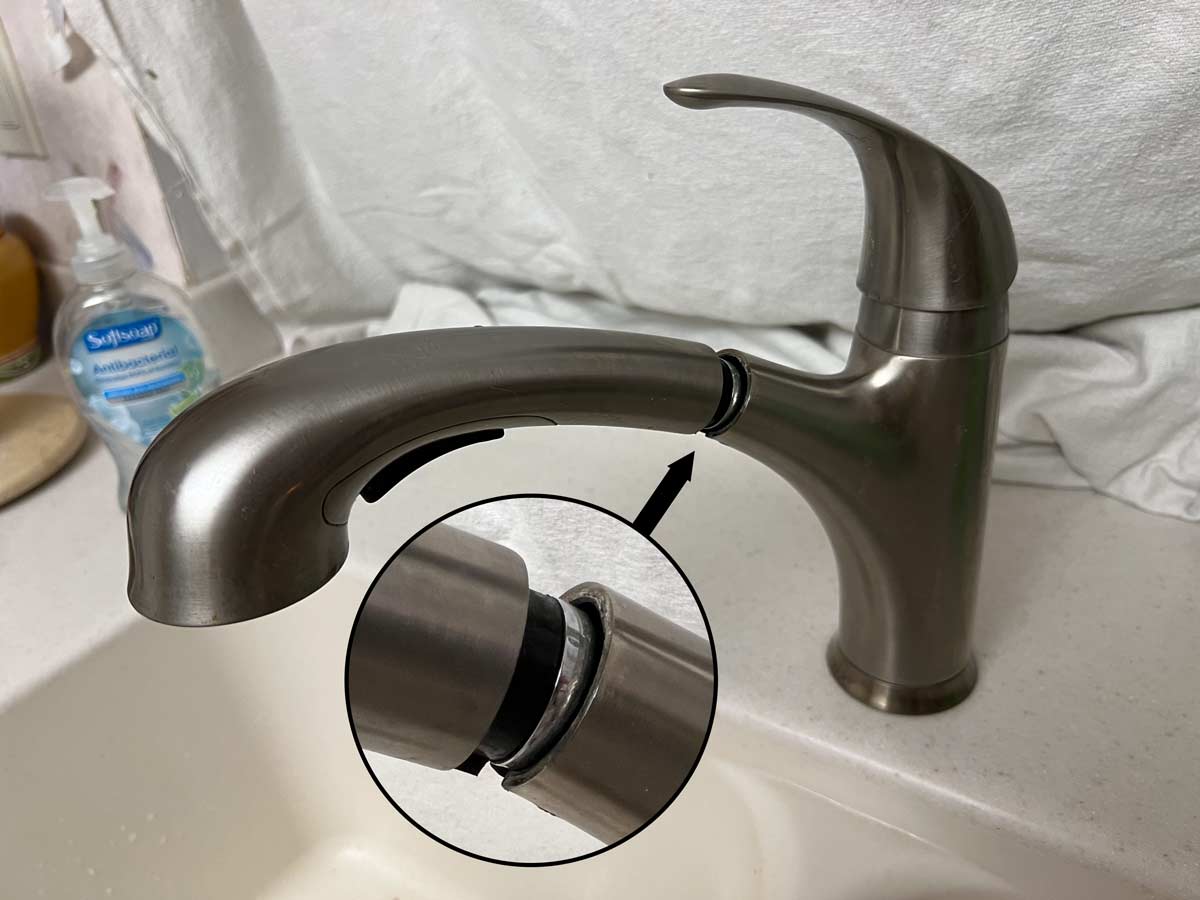
You literally cannot rotate it between the two sinks, which is, you know, one of the most basic of all faucet functions. It doesn’t turn. At all. They have two sinks, but you can only use the faucet with one of them.
Worse, it’s also a sprayer; the entire faucet removes. Clever, except that it does not, and has never, docked correctly. It has a plastic ring on the faucet that fits a plastic sleeve on the base, but the ring is too large; it doesn’t fit. (I imagine the fact that it’s a sprayer is the reason it can’t rotate, and that would be absolutely perfect for a three-armed user.)
And then there’s this marvel of engineering:
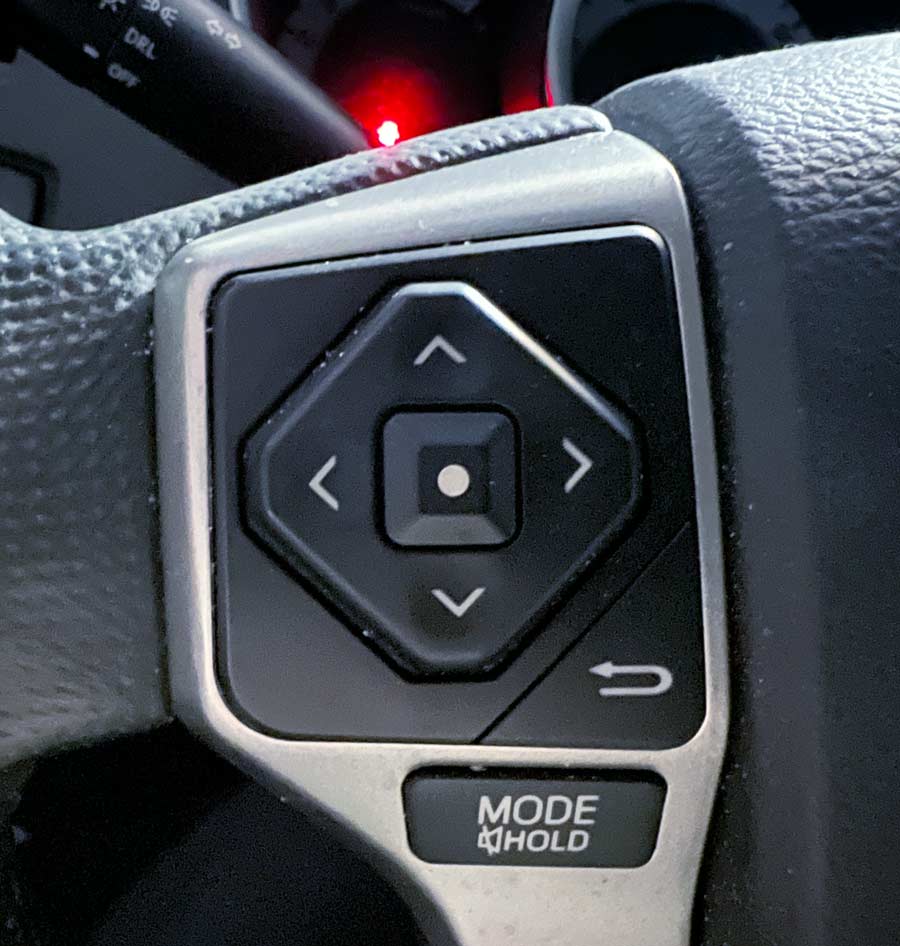
This is the steering-wheel-mounted remote for the car stereo in my parents’ truck, a Toyota Tacoma.
Steering-wheel-mounted remotes for a car stereo are a brilliant idea. And they’re really not that complex. They move the most often-used functions to a place where you need not look away from the road or take your hands off the steering wheel to use them.
This control has four primary buttons: left, right, up, down. Now, thinking about what it’s supposed to do (work a CD player/Bluetooth combo), you might reasonably expect that left and right go to previous and next track, and up and down raise and lower the volume.
And you’d be 100% wrong.
Left skips back 10 seconds in the current track. (Yes, seriously.) Right skips forward 10 seconds. Up goes to the next track, down goes to the previous track.
What about volume? How do you adjust the volume?
You don’t. There are no volume controls on the steering wheel. To change the volume, you have to take your hands off the steering wheel.
Yes, you read that right. They literally believed that forward 10 seconds/back 10 seconds was so important it should be on the steering wheel, but volume? Eh. Who uses the volume controls, anyway?
Every single digital music player I’ve ever used, from the Radio Shack Compact Disc Player CD-1000 my parents got in 1984 to my iPhone today, uses left and right arrows for previous and next tracks. But whatever Toyota intern who designed the car stereo controls, having apparently never used or indeed seen an entertainment sound system before, had his own ideas, and somehow, somehow it passed all the design review steps. Somehow, someone signed off on manufacture.
Skip ahead ten seconds yes, volume control no.
And here’s the thing:
The world we live in today, our world of marvels and miracles, is filled with examples like this.
It’s hard not to believe that the vast majority of industrial designers are anything but lazy and barely competent, unwilling or unable to put any effort into their job (and it certainly feels like they never use the things they design). From consumer electronics to furniture to software to clothing, we live in a universe of shit.
My jacket has a zipper edged by a hem that is exactly the right width to catch the slider as it moves. It is not possible to zip or unzil the jacket without the hem catching the slider at least three times.
Someone designed that. It went through several review steps before it was released to manufacture. And yet, neither the designer nor any of the peple resonsible for reviewing the design ever put the jacket on. (I’m serious when I say you cannot zip or unzip it without catching the slider. Even one test would’ve been enough.)
We live, we exist in a world of sh*t. We don’t pay attention to the way design impacts our lives, and as a result, trivial design failures—failures that can easily be corrected in minutes during the design stage—waste countless person-years of time. In some cases, like car stereos with cluttered or counterintuitive layouts, they kill people.
And we as a society are remarkably okay with that.
I’m not sure what changed, but in the last five years or so, I’ve found it increasingly difficult not to notice shitty design all around me. And once you’ve started to see it, it snowballs. You can’t un-see it.
I would like to live in a world where perhaps people cared about design more. But the problem seems to be getting worse, not better.
So, some of you likely know I’ve been stalked over the past few years by an online stalker who has, among other things, created fake social media profiles in my name and used them to send rape and death threats to folks who follow me on social media. (Please, no speculation about who the stalker is.)
A week ago yesterday, the stalking escalated. I’ve been documenting the stalking, both publicly and privately, so I want to record the latest escalation here where everyone can see it.
I had an unexpected conversation with Portland PD a week ago last Tuesday, as I prepared to fly down to Ft. Myers to help care for my mom, who is in end-stage terminal cancer. It seems my stalker created a fake email account in my name, which he or she used to send an email to Portland police saying I was hearing voices commanding me to kill my wife. (They contacted her as well.)
I explained the stalking situation to them, and told them I’d filed a police report about it some time ago. They found my report and man, I’m really glad I filed it, because it instantly changed the tenor of the conversation.
Portland PD has referred the matter to their cybercrimes unit (I didn’t realize Portland has a cybercrimes unit, but apparently they do).
It’s been a weird ride. So far, the stalker has limited himself or herself to creating accounts that look like mine, using my name and avatar, and then using them to send threatening PMs to folks who follow me, or post public social messages trying to smear me:
(Note that this profile has no followers and nobody following it.)
People’s reactions are…weird. Some Facebook user flat-out said it isn’t happening and I’m lying about it because, direct quote, “men don’t get stalked, women do” (yes, seriously).
This new thing is an escalation. Fortunately, there’s now a pattern of law enforcement contact over this, and I think going forward I’m probably going to file a new police report with every single new incident.
Meanwhile, if you should happen to receive a rape or death threat, or some other harassing message from “me,” please check the profile carefully.
On Quora I’m Franklin-Veaux, no numbers, spaces, or other characters. On Twitter, Facebook, Instagram, and Threads, I’m franklinveaux, all one word, all lower case, no numbers or other characters.
Should you receive, or see, any of this harassment, I’d greatly appreciate if you let me know. I’m collecting as many examples as I can and turning them all over to Portland PD.
So a couple weeks back, I ended up hospitalized for three days after seven hours of sex.
Not because of the sex, mind, though that would make for a much more interesting story. After we finished, I started feeling what I thought was indigestion, and…
Hang on, wait, lemme back up. I was in Missouri, because…
No, wait, not back far enough.
I started out in Florida. My mom was diagnosed with cancer last November, so I’ve been spending a fair bit of time shuttling back and forth between Portland and Florida, as I help my dad care for her.
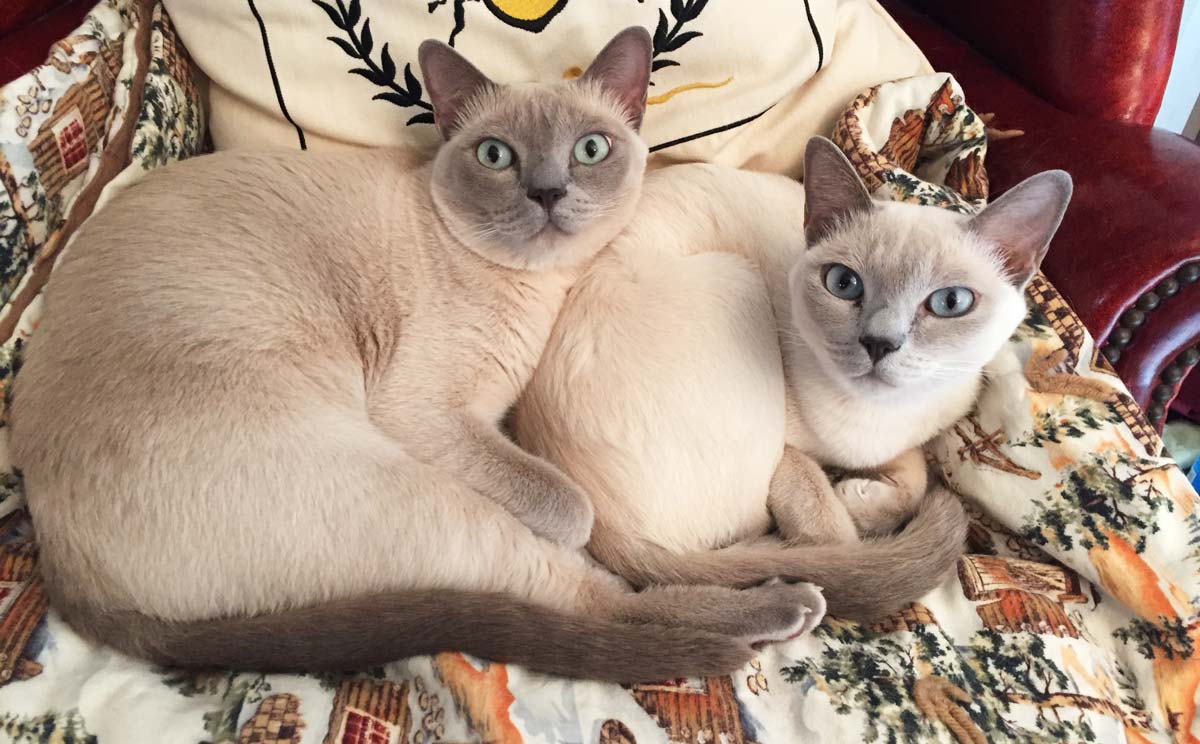
And not incidentally take tons of photos of her cats, which, and I say this purely objectively, are two of the most gorgeous felines ever to grace humanity with their presence. I mean, look at these two!
That’s Thelma (right) and Louise (left), and those names should give you a hint as to their attitudes and general disposition.
Anyway, I went to Florida in September, and from there flew to Springfield, MO to see my Talespinner and attend a sci-fi con with her. One of the cool things about being a writer, I can work from anywhere I have an Internet connection.
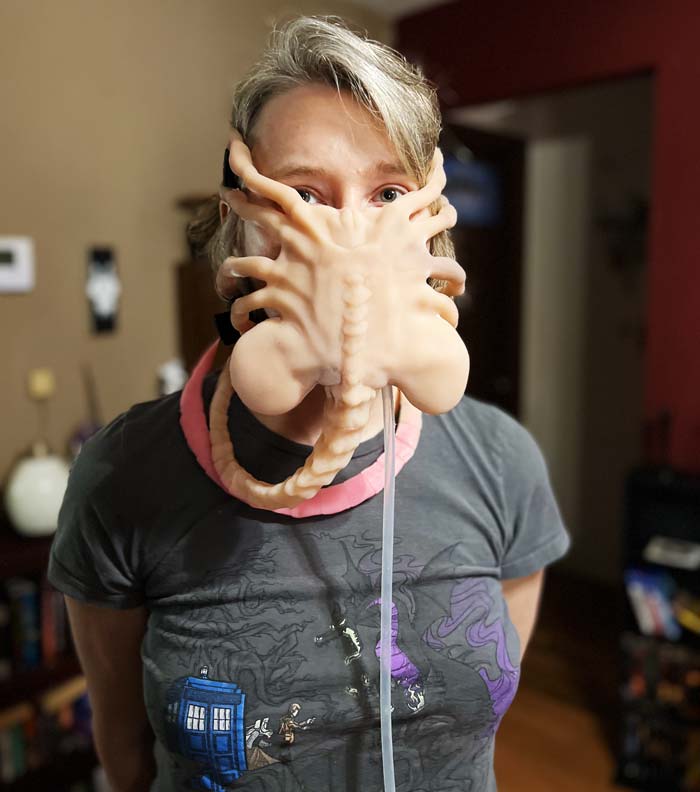
At first, all was good. No, scratch that, all was lovely. We had a wonderful time, that included a seven-hour marathon sex session during which we gave the xenomorph facehugger gag a thorough shake-down test cruise (verdict: it works splendidly but still needs a few design tweaks).
After that and some Chinese takeout, I started feeling a bit yucky. Yucky enough that we set out at 2AM for some Rolaids at the local Kum & Go, which, hand to God, is actually what they call convenience stores in Missourt.
The Rolaids didn’t work. In fact, in the span of about three hours I went from “I think I have indigestion” to spewing blood from both ends, quite literally. It was…distressingly disgusting.
So, long story short, I ended up in the hospital. For three days. While they put an endoscope down my throat and discovered a tear in my esophagus and a hole in the lining of my stomach. Both of which they fixed, but yeah, that was even more unpleasant than you probably think.
Side note: they shot me full of Dilaudid, which is injectable hydromorphone, think heroin but less kind and fuzzy. That honestly sucked almost as bad as the spewing-blood part. I will never understand why people use opioids recreationally. Dear God.
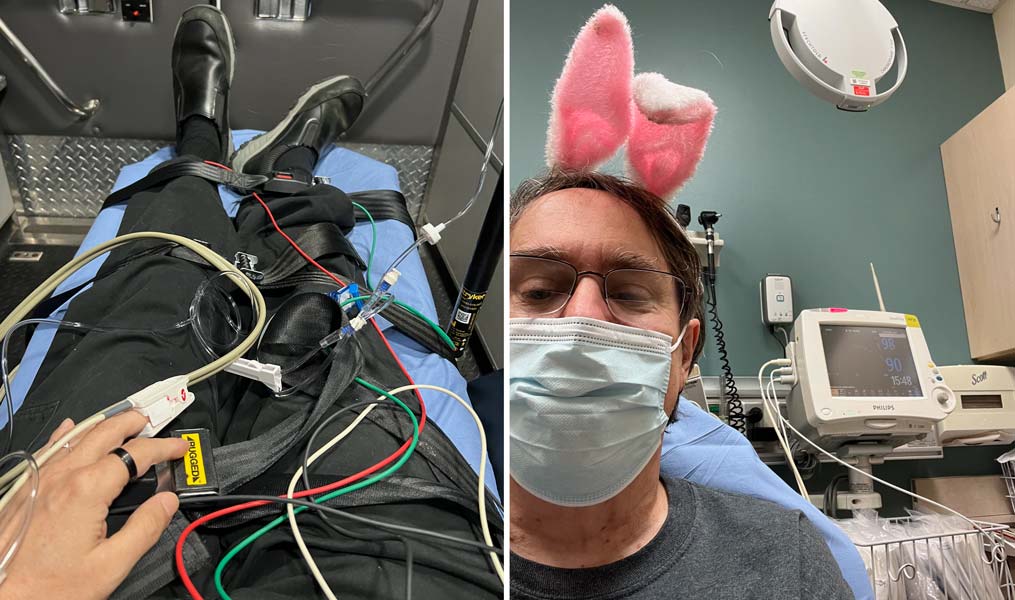
Anyway, I got to ride in an ambulance! Not as much fun as TV makes it seem. The guy riding in the back with me spent most of his time on his phone.
The doctors aren’t entirely sure what caused the malfunction, though the leading hypothesis is a bad reaction to a drug my Portland doctor put me on to control nightmares from complex PTSD. So, y’know, that’s a thing.
Still, a successful trip both to Florida and to Missouri, hospital stay notwithstanding. Apparently I have a $17,000 hospital bill heading my way, because I live in a savage country with a healthcare system optimized for profit, and there’s some question about whether or not my insurance will cover it, so that’s also a thing.
Had a blast at the sci-fi con. Think I’ll probably attend rather a lot of cons in 2024.
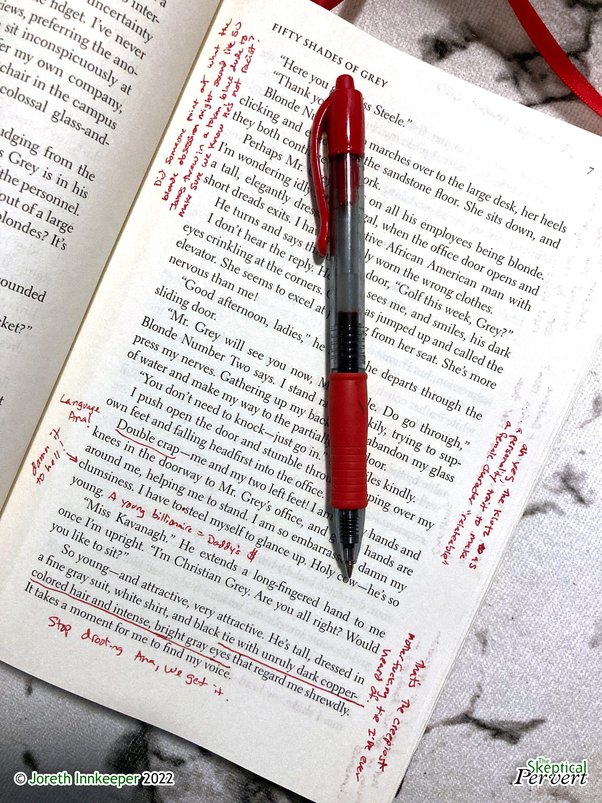
For a recent episode of the Skeptical Pervert podcast, Joreth read 50 Shades of Grey at Eunice and me.
I tried to read it when it came out and couldn’t get past the second or third chapter at all. Eunice was blisfully ignorant of the horrors that lurked within. So we made an entire episode of the two of us reacting in horror, specifically to the scene where Christian and Ana negotiate the terms of their relationship (and Christian violates Ana’s consent multiple times during the consent negotiation, which was…special).
Anyway, in the process of re-acquainting herself with the contents of that book, Joreth took a literal red pen to its pages, which you can see here.
And also, check out the podcast. We think it’s rather fun!
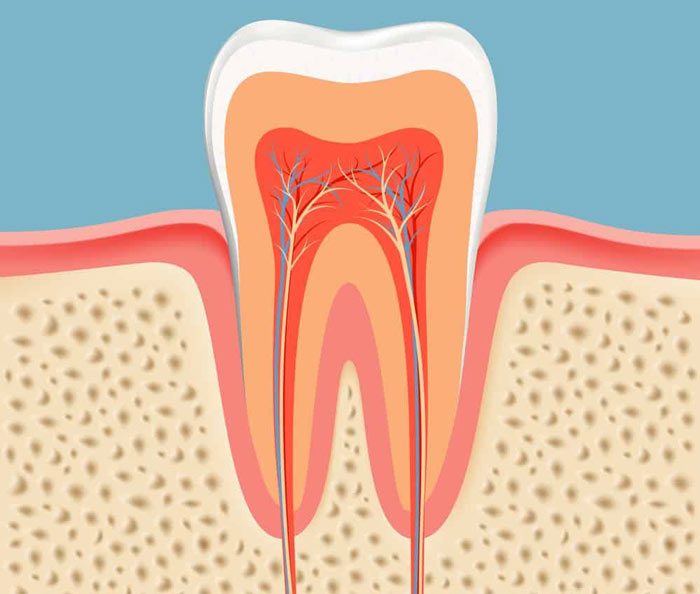
Well, technically, I suppose, it’s a drawing of a tooth. (ce n’est pas une dent.) Still, it gets across the idea. A tooth has a particular shape vaguely like this, and, as all fools know, a tooth (at least the ones in the back) has two roots.
So gather ’round, it’s time for a story.
Let’s set the Wayback machine to, like, 1999 or so. I had a root canal done on one of these. A root canal is a rather unpleasant procedure in which a hole is drilled in the top, the nerve inside and down the roots is reamed out and then filled in with…well, I don’t know what it’s filled in with. Concrete, maybe. Something. And then a crown is stuck on the top.
Anyway, I had this done, and for years afterward every visit to a dentist was kind of a variation on the same theme:
Dentist: *takes X-rays.*
Dentist: *looks at the X-rays*
Dentist: “Ah, I see a root canal. Wait, hang on, there’s a weird shadow. It looks kinda like…hmm, not an abcess, it’s just…what is that?”
Dentist: *hammers on my tooth with a little metal thing*
Dentist: *Touches my tooth with an ice cube*
Dentist: “Does that hurt?”
Me: “Nope!”
Dentist: *shrugs* “Huh, weird. Whatever.”
That’s our backstory. Our tale takes place yesterday, when I’m in an office working on having a crown (a different crown) replaced because it’s failed. Cue the normal X-rays, “hmm that’s strange,” only this time, something changes.
This time, I have a dentist whose mind is fueled by the desire to Know. A dentist not content to shrug and say “weird, whatever.” A dentist illuminated by the blazing light of curiosity that dragged our ancestors from the trees and sent them across the savannah to invent tools like spears and slings and particle accelerators, all because “¯\_(ツ)_/¯” isn’t a good enough answer. He’s like, weird, something strange here, let’s look further.
Now, molars have two roots. Everyone knows this. One tooth, two roots.
Except that he does a bunch of X-rays from different angles and guess what? Fuck me dead, that tooth I got the root canal on, it has three roots.
Three. Roots.
And the dentist who did the root canal, he missed that.
Loooong story short, over the past twenty-something years, that unfilled third root has been quietly accumulating cruft like old FORTRAN code, and now they need to fix it.
But apparently they don’t want to remove the crown—not sure why, but for whatever reason they have to leave the crown on, which is made of metal by the way, drill through it, and re-do the root canal.
Anyway, my dentist was all “This is way above my pay grade, you’re gonna need a specialist for this. Oh, if they can’t drill straight through the crown, the other option is to go at it from underneath, which means they drill a hole through your jaw into the bottom of the tooth, fix the root, then put a bone graft in the hole.” Which, I mean, I’m no medical professional, but that sounds straight out of a Stephen King novel. “The Toothening,” something.