Some thoughts on consent

With the state of California passing a new law defining an Affirmative Consent standard for public colleges and universities (and the wonderful commentary about it on the Yes Means Yes blog), the recent firing of radio personality Jian Ghomeshi over his sex life (which he claims is targeting him for participation in BDSM, though several women are alleging that he abused them non-consensually under the guise of BDSM), everyone all over the Internet is talking about consent these days.

And as seems to happen when everyone all over the Internet talks about something, a lot of folks are getting it wrong.

I’d like to think consent is something we all understand. And, in most situations, we do. A lot of folks are flapping their mouth-parts about how we can never really truly get consent for sexual activities because men and women are just so different and don’t understand each other, but seriously, that’s a load of bullshit. Bullshit with extra spicy smell-o-riffic chunks.

If you take sex out of the equation, we all understand consent pretty well. If you invite someone out to dinner and he says “well, you know, I’d love to, but I kinda have this other thing going on that day,” we know he’s said “no,” even though he hasn’t used the word “no.” If we ask someone whether we can use her bike or not and she says “listen, I really don’t know that I feel comfortable with that arrangement,” we know she hasn’t consented. And if she says “The combination on the bike lock is 5678, I need it back before class on Tuesday,” we know that she has, even though she didn’t say the word “yes.”

We get this. It’s part of the most basic, rudimentary socialization.

But for some reason, when it comes to sex, otherwise grown, mature adults start thrashing around, as if they lack the social graces of a reasonably well-socialized 6-year-old.

Some of this might be down to living in a culture that just plain doesn’t teach us about what consent is. I wish I would have understood this stuff better myself, back when I was still sorting out all this interpersonal-relationship stuff.

But a big part of the reason, I suspect, lies in the way we think about sexual consent. We get what consent is outside the world of sex, but when it comes to sex, we act like the purpose of consent is to follow a checklist of procedures designed to let us do what we want without getting in trouble. Otherwise intelligent, reasonable adults, for example, have asked if California’s new law means students on California campuses will need to get written permission to shag. (The short answer is ‘no,’ but folks who so profoundly don’t understand what consent is that the question seems reasonable to them, might want to think about doing just that.) Someone on my Twitter timeline asked ‘what if two people have sex but neither one of them gave affirmative consent–who’s at fault there?’ (The answer is if neither of them gave affirmative consent, then no sex act took place. For a sex act to take place, someone had to initiate the contact of the slippery bits, and that initiation is an act of consent.1) People–again, otherwise intelligent people who appear at least savvy enough to work a computer–have said things like ‘if nobody said no, that’s consent, right?’ (No. We’re conditioned strongly not to say ‘no,’ as in the “well, you know, I’d love to, but I kinda have this other thing going on that day” example above.)

Consent is not a checklist you go through in order to be cleared to do what you want, the way a fighter pilot goes through his checklist before being catapulted off the deck of an aircraft carrier (“Afterburners, check! Flaps, check! Condom, check! Let’s fuck!”). The purpose of consent isn’t to tell you what you can get away with; the purpose of consent is to make sure you and your partners are both on the same page and both enjoying what’s going on.

Consent isn’t something you get once, at the start of the proceedings. It’s ongoing. This is important, because it means the idea of getting written consent up-front to hanky-panky is entirely missing the point. Consent exists in the moment, and it can always be revoked as soon as someone no longer likes what’s happening. Even if I sign a form in triplicate, duly notarized, saying I want to shag you, if we get down to business and I change my mind, I have the right to say ‘stop.’

It’s not hard to get consent, really it isn’t. It simply means paying attention to your partner, checking in. It doesn’t have to ‘spoil the mood’ or ‘interrupt the flow’ or any of those other things the masses of people who don’t understand consent are apt to complain about. Consent doesn’t even have to be verbal. If you go in to kiss someone and she leans back, that’s not consent. If she meets you halfway, it is. We know this. Most of us are really good, in non-sexual contexts, of figuring out the difference between a ‘yes’ and a ‘no’ even without hearing those specific words. We just forget, when it comes to sex.

Seriously, this shouldn’t be that hard. The key elements of consent are:

  • Is the other person into what you want to do? Pay attention to verbal and nonverbal cues. If you don’t know, ask. Don’t focus on what you want the answer to be; focus on what the answer is.
  • Is the other person still into it while you’re doing it? Pay attention to verbal and nonverbal cues. If you don’t know, ask.
  • Is the other person having fun? Pay attention to verbal and nonverbal cues. If you don’t know, ask.

There’s a point in here: consent isn’t something you get so you can have fun, consent is about making sure everyone is having fun. If you don’t care whether your partner is having fun, well, then, perhaps one explanation is you’re a terrible person and you oughtn’t be interacting with anyone in any capacity until you learn that other people are actually real. Oh, and by the way, consent is valid only if it’s informed; if you’re withholding information, lying, misleading, or manipulating other folks to get check marks in those ticky-boxes, you’re not really getting consent at all. I shouldn’t have to say this. It pains me that I feel I do.

Now, bad sex happens. It’s a fact of life. Bad sex doesn’t (necessarily) mean consent was violated.2

But it pays–it really, really does–to remember that consent is ongoing. If the person you’re with suddenly goes all withdrawn and unresponsive, and that’s not part of the particular fetish you’re exploring, perhaps it’s a good idea to check in, you know?

There’s a depressing part of all these discussions about consent, and that is the widespread cultural narrative that allegations of coercion, assault, or abuse are likely to be vindictive women making up stories to entrap and punish blameless men.3 It’s so entrenched that it’s hard to see any woman reporting sexual abuse who’s not immediately attacked all over the Internetverse for it…which would seem to fly in the face of all logic and reason. (Because any woman who talks openly about sexual assault is likely to be attacked vigorously and aggressively, it’s difficult to imagine the motivation of someone to invent such a tale. What’s her goal…to see how many people will call her a liar on YouTube?) And while we’re on the subject, “innocent until proven guilty” doesn’t mean “everyone who reports being sexually assaulted is a liar until proven otherwise.” This shouldn’t need to be said, but there it is. (And just for the record: If you’re one of those folks whose first reaction to learning about allegations of sexual abuse is “she’s making it up,” shame on you.)

This seamy dark side to the consent conversation comes, I think, from the notion of consent as a list of ticky-boxes you check off before you get down ‘n’ dirty. If you went through the pre-flight checklist and ticked off all the things on the list, you should be golden, right? So what’s she doing making all this fuss afterward? She consented, right?

This is also something we get when it comes to issues of consent outside the bedroom. If a roommate offers to let us borrow the bike all week, then on Wednesday says “sorry, mate, but my car’s in the shop, I need the bike after all,” we know that she has the right to do this. I can’t help but think if we were to apply exactly the same standards to sexual consent that we apply to consent to borrow a roommate’s bicycle, a whole lot of people would be a whole lot happier. Yes, your roommate might fabricate a story about how you stole her bike…but really, what are the odds? I mean, seriously? And someone reporting bike theft isn’t even subject to the same explosive blowback as someone reporting sexual assault!

Now, I will admit I’ve made some assumptions in all this. I’m assuming that you’re genuinely good-intentioned and you value the idea of consent. There is a group who benefits from making consent seem muddier and more difficult than it is; the same group also benefits from reflexive thoughts of “She’s making it up!” whenever a report of abuse surfaces. I’ll give you three guesses who’s in that group.4

It’s possible to participate in all kinds of sexual activities with all sorts of partners under a wide range of different circumstances and not ever end up being accused of assault. It’s not even that difficult, really. All it takes, at the end of the day, is remembering that there’s more than one person involved, and checking in with the other folks to see how they’re doing. You don’t need to get it in writing. You don’t need to involve lawyers and witnesses. You just need to pay attention. If you’re shagging someone you’ve never shagged before and you aren’t sure how to read their signals and body language, use your words! I promise it’s not hard.5

Far from spoiling the mood, it can even be hot. “You like that, hmm? You like when I touch you there? You want more? Tell me you like it.”

Seriously. Give it a try some time. Keep in mind, it’s not about getting someone else to let you do what you want. It’s about two (or more!) of you doing things you all like to do.

Oh, and if someone comes to you with a story about being sexually assaulted? Here’s a strategy: In absence of clear and compelling evidence to the contrary, believe them.


1 Absent some other form of coercion, anyway. It isn’t consent if someone gives you head to get you to stop beating her. Lookin’ at you here, Mr. Ghomeshi.

2 Though one of the things that separates people who are good at sex from people who are bad at sex, I think, is the former sorts of people pay attention to their partners as a matter of course.

3 It’s a narrative that hurts men too, by the way. Imagine the blowback if you’re a guy who’s reporting being sexually assaulted…and yes, it does happen.

4 And if you need all three, you might be a terrible person.

5 If you can’t use your words about sex, maybe you might benefit from addressing that problem before the next time you have sex, ‘kay?
Sex tech: Update on the dildo you can feel

A few months back, I wrote a blog post about a brain hack that might create a dildo the wearer can actually feel. The idea came to me in the shower. I’d been thinking about the brain’s plasticity, and about how it might be possible to trick the brain into internalizing a somatosensory perception that a strap-on dildo is a real part of the body, by using sensors along the dildo connected to tiny electrical stimulation pads worn inside the vagina.

It’s an interesting idea, I think. So I blogged about it. I didn’t expect the response I got.

I’ve received a bunch of emails about it, and had a bunch of people tell me “OMG this is the most amazing thing ever! Make it happen!”

So I have, between work on getting the book More Than Two out the door and preparing for the book tour, been chugging away at this idea. Here’s an update:

1. I’ve filed for a patent on the idea. I’ve received confirmation that the application has been accepted and the process is started.

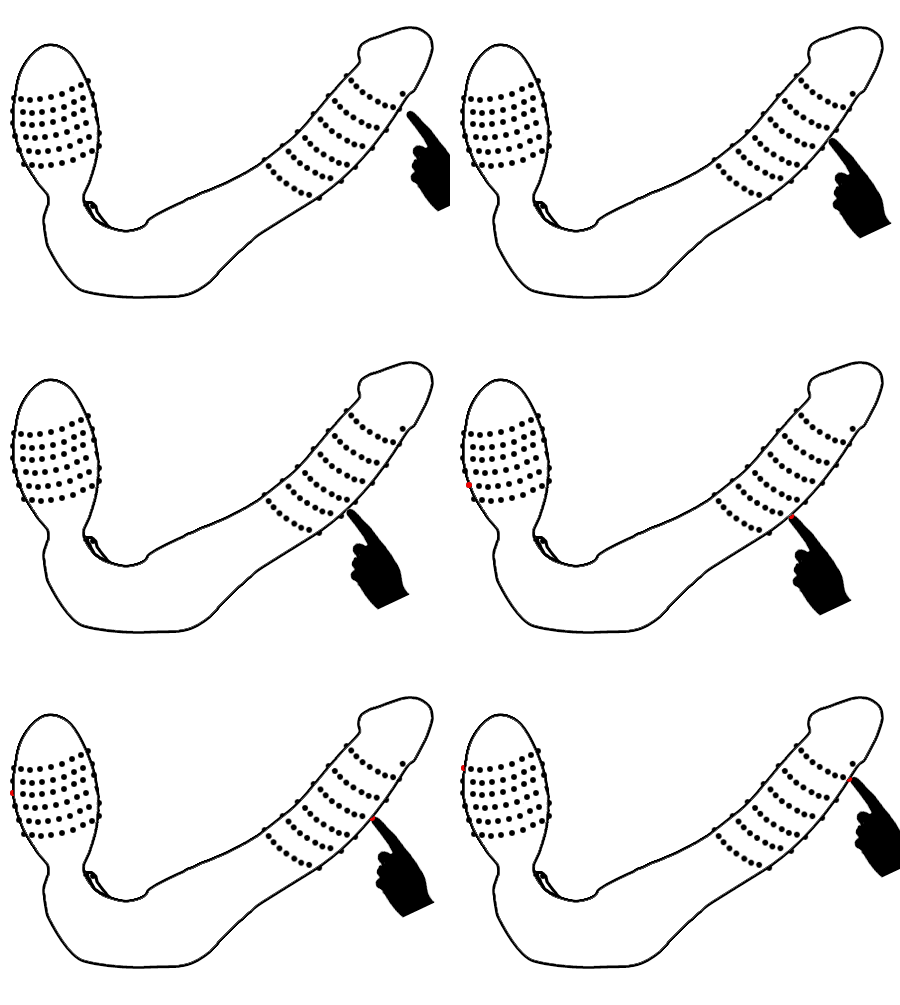
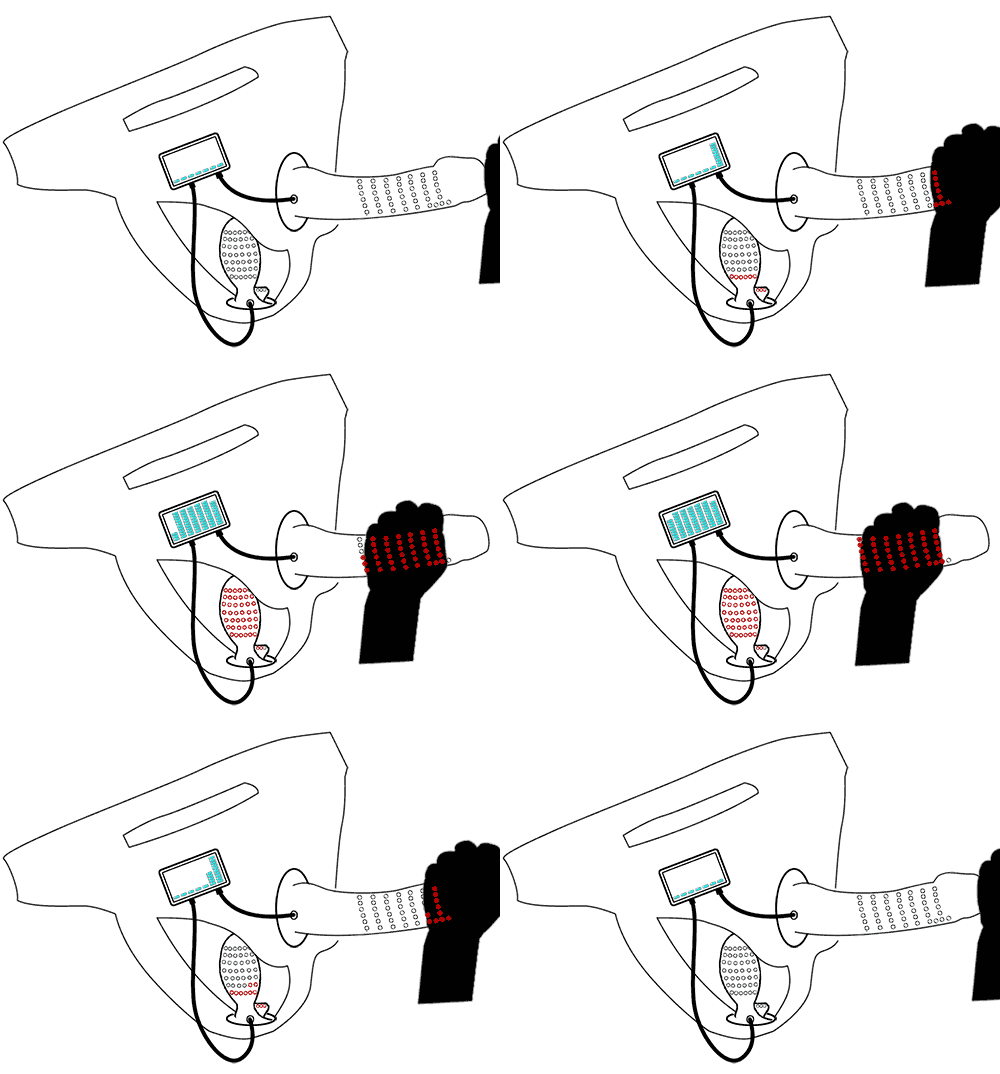
2. I’ve talked to an electronics prototyping firm about developing a prototype. Based on feedback from the prototyping firm, I’ve modified the initial design extensively. The first version I’d thought about was based on the same principle as the Feeldoe; the redesign uses a separate dildo and harness, with an external computer to receive signals from the sensors in the dildo and transmit them to the vaginal insert. The new design looks, and works, something like this. (Apologies for the horrible animated GIF; art isn’t really my specialty.)

3. The prototyping firm has outlined a multi-step process to develop a workable, manufacturable device. The process would go something like:

Phase 1: Research and proof of concept. This would include researching designs for the sensors on the dildo and the electrodes on the vaginal insert. It would also include a crude proof-of-concept device that would essentially be nothing more than the vaginal insert connected to a computer programmed to simulate the rest of the device.

The intent at this stage is to see if the idea is even workable. What kind of electrodes could be used? Would the produce the right kind of stimulation? How densely arranged could they be? How small could they be? Would the brain actually be able to interpret sensations produced by the electrodes in a way that would trick the wearer into thinking the dildo was a part of the body? If so, how long would that somatosensory rewiring take?

Phase 2: Assuming the initial research showed the idea to be viable, the next step would be to figure out a sensor design, fabricate a microcontroller to connect the sensors to the electrodes, and experiment with sensor design and fabrication. Would a single sensor provide adequate range of tactile feedback, or would it be necessary to multiplex several sensors (some designed to respond to light touch, others to a heavier touch) together in order to provide a good dynamic range? What mechanical properties would the sensors need to have? How would they be built? (We talked about several potential designs, including piezoelectric, resistive polymer, and fluid-filled devices.) How would the sensors be placed along the dildo?

Phase 3: Once a working prototype is developed, the next step is detail design and engineering. This is essentially the process of taking a working prototype and producing a manufacturable product from it. This includes everything from engineering drawings for fabrication to choosing materials to developing the final version of the software.

So. That’s where the project is right now.

The up side? I think this thing could actually work. The down side? It’s going to be expensive.

I have already started investigating ways to make it happen. If we incorporate in Canada, we may be eligible for Canadian financial incentives designed to spur tech research and development.

The fabricating company seems to think the first phase would most likely cost somewhere around $5,000-10,000. Depending on what’s learned during that phase, the development of a fully functional prototype might run anywhere from $50,000 to $100,000, a lot of which hinges on design of the sensors, which will likely be the most challenging bit of engineering. They didn’t even want to speculate about the cost of going from working prototype to manufacturable product; too many unknowns.

I’m discussing the possibility of doing crowdfunding to get from phase 2 to 3, and possibly from phase 1 to 2. It’s not likely that crowdfunding is appropriate for the first phase, because I won’t have anything tangible to offer backers. Indeed, it’s possible that I might spend the initial money and discover the idea isn’t workable.

Ideally, I’d like to find people who think this idea is worth investigating who can afford to invest in the first phase. If you know anybody who might be interested in this project, let me know!

Also, one of the people at the prototyping company suggested the name “Hapdick.” I’m still not sure how I feel about that, but I do have to admit it’s clever.

Want to keep up with developments? Here’s a handy list of blog posts about it:
First post
Update 1
Update 2
Update 3
Update 4
Update 5
Update 6
Update 7
Update 8
Update 9

Robot sex machines? Yes please!

Of all the deadly sins, my favorite by far is Lust. In fact, I’m actually a bit rubbish at all the other ones, so great is my fondness for Lust. I am also a huge fan of mixing sex and tech. So when I saw a crowdfunding campaign for a “robotic blowjob machine,” as you can probably imagine, I had to get on board with it. Women generally seem to benefit the most from the intersection of sex and technology, so the notion of a sex robot for men had more than passing appeal to me.

The campaign was a success, and I recently received in the mail one “Autoblow 2,” the robotic sex machine whose marketing campaign advertises “unlimited blowjobs on demand.” (Seriously.)

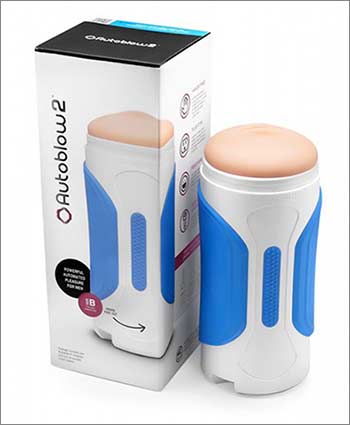
It’s an interesting-looking piece of kit:

Not quite as stylish, perhaps, as the new wave of vibrators from companies like Lelo and JimmyJane, but hey, I’ll take it.

This thing has two parts: the base, which contains a motor that moves a pair of spring bands covered with little rollers up and down, and a sleeve that inserts into the base. The sleeves come in several sizes, and are made of this really bizarre soft silicone material that flops about and feels kinda squishy. (Materials science is an avenue of human endeavor that has, until now, rarely been applied to the pursuit of the ultimate orgasm, more’s the pity. For hundreds of years, leather, stone, wood, and ivory represented the state of the art for Things To Make You Come, so I’m pleased to see improvements in this area.)

Still, when the time came to put my willie in this thing, I will admit I was a little apprehensive. I looked dubiously at it for a bit, until my sweetie zaiah said “oh, give me that” and took it away from me. She squirted some lube into the “insert willie here” end and stuck it over my junk.

No robotic blowjob machine would be complete without a speed control, and sure enough, there’s a little knob on the bottom that makes it go. She turned it on and it whirred to life, stroking mechanically away.

Now, I’ve had some amazing blowjobs from some exceptionally talented partners, so honesty compels me to admit this gadget does not really feel like a blowjob. It’s a fair approximation, I suppose, considering the formidable engineering challenge that a real blowjob simulator would face, but it isn’t quite up to a true blowjob experience. A double-blind face-off between this thing and genuine oral sex would, I suspect, be rather lopsided.

However, even if it doesn’t quite capture the true essence of the oral arts, this robotic sex machine does feel good. Really, really good. I was surprised, in fact. I cranked it up to maximum speed and, yeah, it did exactly what it says on the tin.

I am normally multiply orgasmic; it’s not uncommon for me to get off half a dozen times or more during sex. But this thing…well, when this thing got me off, it was intense and it got me off for good. I was done when I finally stopped screaming.

At which point I discovered a design flaw. The little control knob on the bottom? It’s little. As in, really difficult to find in a hurry when you’re gasping and panting and your body’s still shaking. I tried to yank it off my junk, but my partner grabbed me by the wrist. “No,” she said, and held it there until I found the control.

Which, naturally, brought up a really interesting idea, because I’m a kinky motherfucker and there’s no innocent pleasure I can’t find a way to corrupt with wicked thoughts.

A lot of women quite like the notion of forced orgasms, and it’s pretty easy to do, really–there are entire Web sites dedicated to the high art of the forced orgasm, but when you get down to brass tacks all it really takes is a bit of rope and a Hitachi magic wand. It’s more difficult to find ways to do the same thing to a person with an outie rather than an innie…

…at least until now.

This thing feels good on its own, no question about it, but a bit of rope, perhaps a blindfold, a gag if you don’t want to wake the neighbors, and this gadget can be so much more. Tie your guy down, set this thing going, and wait. You probably won’t have to wait to long. If my brief experience is any indication, the results should be pretty…um, dramatic.

You can find this robot blowjob machine here. (Full disclosure: I liked it enough I signed up as an affiliate.) Get one for yourself or that guy in your life you want to tie down and make scream give the gift of pleasure! You’ll be making the world a happier place and encouraging new high-tech sex toys for men, both of which I think are laudable goals.

Sex Tech: Adopting the Brain’s Plasticity

Some while ago, I read an article about a gizmo made of a black and white video camera attached to a grid of electrodes. The idea is that you wear the electrodes on your tongue. Images from the video camera are converted into patterns of electric signals on the electrode, so you “see”–with your tongue–what the camera sees.

Early users of the prototype gizmo would wear a blindfold and then try to navigate around just by the electrical impulses on their tongues. What’s most interesting is not only were they able to do this, but they reported that, after a while, their memories were not of sensations on their tongues, but of seeing a fuzzy, black and white image.

The brain is wonderfully plastic, able to interpret new kinds of sensory input in amazing ways. It can rewire itself to accommodate the new input; in fact, the tongue-electrode thing is being commercialized as a device for the blind.

As I do, when i first heard about this, I naturally thought “how can this be used for sex?” And I think it has fantastic potential.


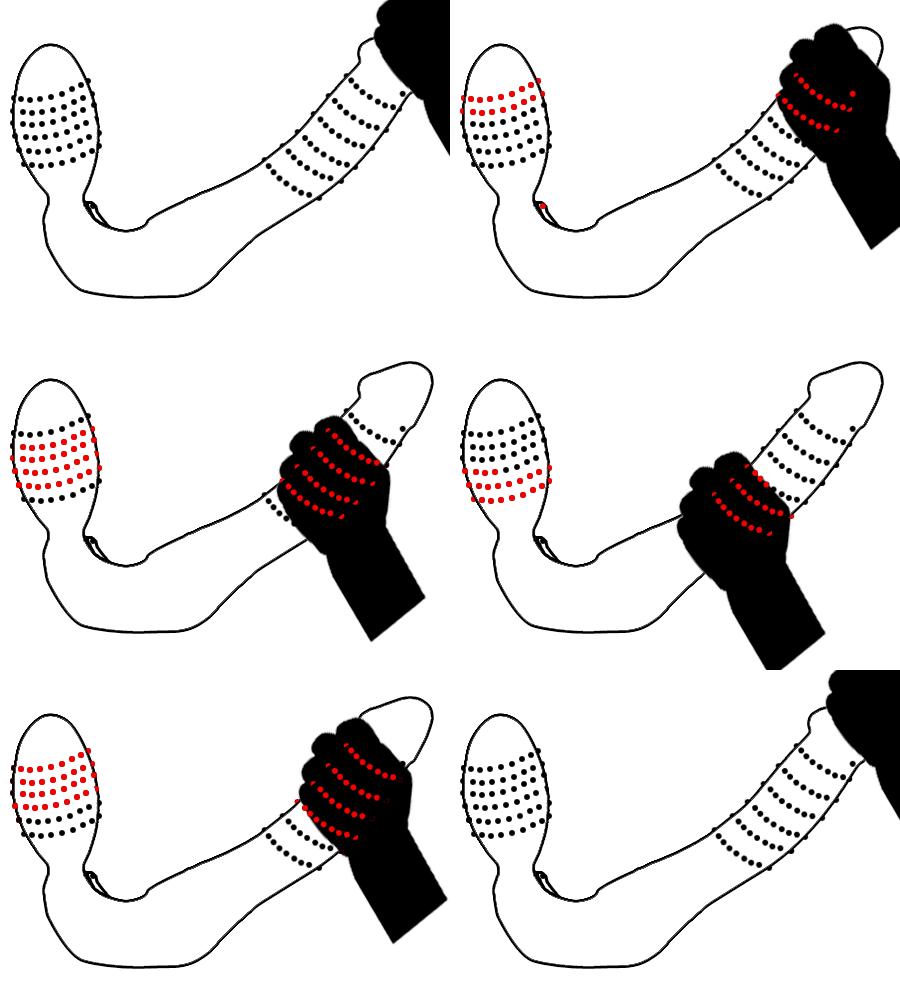
Imagine, if you will, a wearable dildo, rather like the Feeldoe, that’s designed to have one end inserted in the vagina. Only imagine that we take the same kind of electrodes used in the tongue-camera device, and send signals to the electrodes not from a video camera, but from small touch sensitive sensors mounted just below the skin of the dildo.

These sensors would be mapped onto the electrodes so that when something touches the sensor, you’d feel a corresponding signal from the corresponding electrode.

I’m not an artist, but I made a couple of crude animations to illustrate the idea:

What would happen?

I believe that after a period of adjustment, this dildo would be incorporated into the brain’s somatosensory perception. The brain would, in essence, modify its model of the body to accommodate the dildo–it would, rather quickly I suspect, cease to be perceived as a thing and become perceived as a part of the body. Stimulation of the dildo would begin to feel like stimulation of yourself.

And isn’t that an interesting idea.

The neural density in the walls of the vagina isn’t as great as the neural density of the tongue. I don’t think that’s a problem, though; the neural density of the shaft of the penis isn’t as great, either.

One potentially interesting twist on this notion is to map the most sensitive part of the penis, the underside just below the glans, onto the most sensitive part of the body–the clitoris. The sensors of the shaft would map onto electrodes in the bulb worn inside the vagina, except this part, which would map onto the clitoris–mapping the sensitivity of a natural penis.

Another potentially interesting thing to do is to make the sensors on the dildo pressure sensitive, with firmer touches creating stronger impulses from the electrodes.

Now, there’s a lot of experimentation between this idea and a real device. I don’t know the neural density in the walls of the vagina, but it would impose a limit on how many electrodes could be placed on the dildo. Would there be sufficient density to be able to create a fine tactile sense? I think the answer is probably “yes,” but I’m not sure.

I’m also not sure how much processing would be required. I’m guessing not much; certainly much less than is required with the vision sense. The tongue-vision thing is trying to do something far more complicated; it’s trying to register sufficient information to allow you to navigate a three-dimensional world. A circle seen by the camera might be a lollipop right in front of your face or a billboard far away; because the tongue has no way to represent stereo imagery, there’s no way to tell. So the processor has to allow the operator to be able to zoom in and out, to give the user a sense of how far away things might be. It has to be able to adjust to different lighting conditions.

The dildo, by way of contrast, merely has to respond to physical touch, which maps much more easily onto the array of electrodes. It’s pretty straightforward; if something’s not touching a particular sensor, its electrode isn’t producing a signal. The amount of processing might be low enough to allow the processor to be housed inside the dildo, making the device compact, and not requiring it to be tethered to any electronics.

I think this thing could be hella fun. It would allow people born with vaginas to have a remarkably good impression of what it’s like to be born with a penis.

In a world where I had infinite free time, I’d put together a crowdfunding campaign to try to build a working prototype. Even without infinite time, I’m considering doing this. Thoughts? Opinions?

Want to keep up with developments? Here’s a handy list of blog posts about it:
First post
Update 1
Update 2
Update 3

Some thoughts on love and sacrifice

I recently encountered, during the normal course of my regular trawling across the width of this thing we call the Internet, an essay posted on the Psychology Today Web site. The article is a rejection of the notion that adultery is okay (an argument made by a different essay on a different site) and, as far as that goes, I have no quarrel with it. If you’re going to make a promise of sexual fidelity, keep it. If you can’t,renegotiate the relationship or end it.

But the problem comes near the essay’s end, where the author says:

More generally, the author doesn’t seem to appreciate that the value of commitment is based in part on the value of what is given up for it. Of course, sexual desire has a unique pull on most of us. But promises of fidelity would mean much less if we were promising to give up something we didn’t want! The fact that most of us want sex so much is why it means so much when we promise it to just one person…

And I find this argument to be very problematic indeed.

I reject this premise wholeheartedly. I do not–I cannot–buy the notion that in order for something to be valuable, we have to sacrifice something in order to have it.

This idea is one of the malignant gifts bequeathed on us by our Puritan ancestors, who believed it so passionately they never saw the hypocritical self-contradiction in it (they yearned for an afterlife in which there is no want, no suffering, and everything is perfect forever, and they thought the way to get there was by rejecting what you want, by suffering, and by working against basic human happiness…something they regarded with suspicion at best and hostility at worst.)

I think, rather, that the value of a thing is not what we give up in order to have it, but instead whether that thing is an authentic expression of who we truly are.

There is nothing noble in denying who you are in order to get something you want. Just the opposite: that is the most craven sort of commerce, exchanging truth for gain. We rightly deride dishonesty in politicians and businesses; we understand that pretending to be something you’re not in order to get votes or money is a perfidious act. Why don’t we understand the same thing about love?

There is no virtue in exchanging your true self for the affections of someone else. Love admits no such cynical transaction. Love is most meaningful when those who love us know who we truly are and love us anyway. It is not about what we can make those we love give up; it is about how we can help those we love be the most genuine, the most honest versions of themselves.

We do not make an act of fidelity meaningful because we don’t want to do it. We make an act–any act–meaningful when it most truly represents who we are, when it most honestly shares what we actually desire. Believing that sex is valuable because we pledge it to one person when we really want to do just the opposite is the most crass kind of commoditization of both sex and love. Matters of the heart are not about artificial scarcity and transactional gain.

Some thoughts on rape culture

A couple of days ago, someone on a (closed) Facebook group I belong to posted a link to a blog post about rape culture.

And, predictably, one of the first comments to that link was along the lines of “this is just another attempt to say that male sexuality is bad.”

It doesn’t even really matter where the linked blog post is (though if you’re interested, it’s here); the “you’re just demonizing men” reaction comes up on any conversation I’ve ever seen about rape culture, as sure as night follows day. And it’s annoying.

It seems to me that if that’s your take-away from discussions about rape culture, you aren’t paying attention.

Male sexuality is not inherently evil, and acknowledging that rape culture is a thing isn’t the same as “demonizing male sexuality.” This seems obvious to me, yet it’s a persistent trope: saying that we have a culture that normalizes, trivializes, and to a large extent even excuses sexual violence is conflated with demonizing male sexuality, as if, I don’t know, male sexuality were somehow inextricably tied to rape or something.


I personally have never met any women who believe that male sexuality is tied to rape, though I keep hearing from other men about that’s what “feminists think”.

When I see a trope become that deeply embedded in a conversation about something, I tend to wonder who it benefits. I definitely think there are men who benefit from this trope. There are some men who want to conflate “discussing the cultural component of sexual violence” with “demonizing all male sexuality.” These men want you to read articles like the blog post that led to all this and respond with “you’re saying men are evil! You’re saying all men are rapists!” That’s the interpretation they want you to have.

There are two kinds of men who want you to have that response: rapists, and men who want power over women.


Not all men are rapists.

There is, for some people, a knee-jerk response to any conversation about rape culture that goes “You just think all men are rapists!” That isn’t what this (and articles like it) say. What they say is that women have to act like all men are potentially rapists, because rapists don’t wear a special hat or have a special handshake or anything.

A strange man is probably not a rapist, but he might be. Since there’s no telltale signal that lets you tell a rapist from a not-rapist, women have to assume that a stranger could potentially be a rapist, simply out of self-preservation. A common analogy here is that not every strange dog will bite you, but it’s usually a good idea not to approach every strange dog you see with reckless abandon–because some of them might bite you, and you have no way of telling which.

Rapists and men who want power over women are quite pleased when people deflect conversations about rape culture with “you’re just saying male sexuality is evil,” because it shuts down conversation about the reality of rape culture…and that suits them just fine. It allows things to continue on exactly as they are–which is to say, allows society to continue blaming victims of rape for their own attacks (“did you see what she was wearing??!), allows rape victims who come forward to continue being disbelieved, allows the courts to continue under-prosecuting rape.

All of this serves the needs of men who rape and men who want to control women, and the only side effect (other than the fact that, y’know, women are marginalized) is that some men are treated like they might possibly be a rapist.

You’re a guy, and you don’t like it? You don’t like the idea that women who don’t know you might respond as though you are a potential rapist, even though that’s something you would never, ever, do? Do something about it! Do something to make our society less welcoming to rapists. Don’t trivialize rape. Don’t whine “but what about false accusations?” when women talk about how claims of rape are rarely taken seriously. Don’t treat tape as a punch line.

Look, this is not rocket science. If you’re a guy, you have a disproportionate amount of power, even if you personally don’t feel like it’s true. It’s not enough to say “Well, I’m not a rapist, and I don’t trivialize rape, so I don’t like it when women treat me like I might be a rapist!” You have to do more. You have to stand up to the people around you who do trivialize rape. You have to stand up to people who are rapists–yes, I’m talking to you, and yes, statistically, unless you live as a hermit in a one-room cabin in Montana you probably know at least one rapist in your social circle. Even if you don’t know who he is.

You don’t like the implications of discussing rape culture? Don’t dismiss those discussions; that doesn’t serve anyone except rapists. Do something about it.

Onyx, the Game of Sexual Exploration, version 3.5 now available!

  • New Optional Rules
  • New Resizeable Gameboard
  • New Special Squares
  • New Actions
  • Newly Redesigned Graphics
  • New Roles
  • Improved Card Editor
  • Free Update for Registered Users!

Finally, after many months of coding, the new version of my sex game Onyx is ready! This new version is a significant overhaul, and contains tons and tons of new features and new game-play mechanics. It also contains lots of new actions (coming up with lists of hundreds of sexy things that people can do to each other is harder than it sound!).

To celebrate, I’m offering a special discount on registration if you want to play the full version. Of course, the free version is still free, and Onyx 3.5 is a free upgrade for registered users.

Check it out!

I Love Sex and I Vote

A short while ago, i blogged that I was dusting off my “I Love Sex and I Vote bumper sticker in honor of Rush Limbaugh and the Religious Right’s appalling, savage attack on women.

I made the bumper sticker back in the early days of the George W. Bush Presidency, convinced that the right-wing’s attack on women generally and sex specifically was about as bad as it could get. I’m sorry to report that I was very, very wrong on that count.

Since I re-blogged the bumper sticker and the “I Love Sex and I Vote” icons that go with it, I’ve had a request to make the icons available in different sizes. I’ve also had several readers email or message me to ask if I would be willing to make more than just a bumper sticker with the logo on it.

So I’m pleased to announce I’ve set up a CafePress shop with all sorts of things featuring this logo, in addition to the bumper sticker. I’ve also put the original (100 by 100 pixel and 80 by 80 pixel) icons, as well as two new icons with a blue border available in a lot more sizes.

I think it’s important this election cycle to take a visible stand that slut-shaming is not an acceptable part of our society. It’s time to push back against people who believe that it’s okay to shame people, especially women, for the “crime” of enjoying sex.

Feel free to use the icons below for whatever you’d like.


350 x 350 pixels


250 x 250 pixels


200 x 200 pixels


150 x 150 pixels

          
100 x 100 pixels

          
80×80 pixels

Women’s rights and GLBT rights are human rights

Note: I’ve started posting most of my writings about sex, culture, and society over to the Promiscuity Keepers Web site. The most recent post is an essay about why I, as a cisgendered straight man, care about the political assault on women’s rights and GLBT rights. Here’s a teaser:

Before I get started, though, let me say this: I am a white, cisgendered heterosexual man. That puts me in a uniquely privileged position; since I will never be pregnant, the assault on women’s right to choose doesn’t affect me directly. Since I am straight, the assault on the rights of gays and lesbians doesn’t affect me directly. Since I am a man, I am almost never the target of slut-shaming. I am, in other words, not the target of the campaign against women and gays that’s playing out on the airwaves and in the ballot boxes all over the United States right now.

But in a way, that’s kind of the point, because even though I am not the target of the attacks on women and gays, they still very much affect me. The thing is, these are not assaults on women’s rights or gay and lesbian rights; they are assaults on human rights. I am not gay and I am not a woman, but I am a human being. It would be a mistake for me to think that these things don’t affect me directly.

Let’s look at contraception. The debate over whether or not women should have easy access to contraception has turned into one of the defining issues in the current political discussion. Last October, presidential candidate Rick Santorum said “One of the things I will talk about, that no president has talked about before, is I think the dangers of contraception in this country. Many of the Christian faith have said, well, that’s OK; contraception is OK. It’s not OK. It’s a license to do things in a sexual realm that is counter to how things are supposed to be.” …

Want to see more? Read the whole post here!

Up your bumper, Rush Limbaugh

Some time ago, before Rush Limbaugh and his buddies launched their all-out assault on women in their effort to give the Democratic party a landslide victory this November, I created a bumper sticker over at Cafepress: “I (heart) Sex and I Vote”.

I abandoned Cafepress years ago. However, this sentiment seems far more relevant and necessary today than it did back then, so I’ve set up the store again.

So, here it is again. If you’d like to show Rush’s fans how you feel about sex, click here!

I’ve also created icons suitable for LiveJournal, Twitter, and other blogs and forums from the same design, which you are free to download and use however you’d like:

100×100 pixels

80×80 pixels