Home Improvement, the Old House Way

With summer fast approaching, I figured it was probably time to dig the window air conditioner out of the garage and set it up in the house. Fortunately, this is an easy task, usually requiring no more than ten minutes at the most, assuming you stop for a Mountain Dew halfway through. (And assuming it takes two minutes to get the Mountain Dew and another five to drink it.)

Since I’m feeling generous, I figured I’d share some of my famed goodwill and write this handy-dandy three-step guide to hanging a window air conditioner in a 1940s-era house, just in case it was too complex a job for someone on my flist to handle.

How to Hang a Window Air Conditioner in Three Easy Steps

Step 1: Take the air conditioner out of the box.
Step 2: Try to open the window.
Step 3: Realize it was painted shut some time during the Nixon administration, then again during the Ford, Reagan, Bush Sr., Clinton, and Bush Jr. administrations.
Step 4: Go to Home Depot and buy a razor knife.
Step 5: Cut the eighteen layers of paint along the inside AND the outside of the window.
Step 6: Raise the window an inch.
Step 7: Realize that the runner is also coated in eighteen layers of paint, half of which are probably lead based.
Step 8: Swear.
Step 9: Scrape paint.
Step 10: Scrape more paint.
Step 11: Muscle the window open.
Step 12: Place the air conditioner on the window sill.
Step 13: Attempt to plug in the air conditioner.
Step 14: Realize that the outlet immediately below the window is an old-fashioned 2-prong outlet rather than a 3-prong outlet.
Step 15: Swear.
Step 16: Go to Home Depot for a new wall outlet.
Step 17: Remove the face plate from the outlet.
Step 18: Discover old-fashioned 2-conductor cloth-covered aluminum wire with no ground lead behind the cover.
Step 19: Swear.
Step 20: Run an extension cord to the other outlet in the room, which thankfully is a modern 3-prong variety.
Step 21: Become suspicious.
Step 22: Plug a circuit tester into the 3-prong outlet.
Step 23: Discover that it may in fact be three prong, but it is not actually grounded.
Step 24: Swear.
Step 25: Remove the cover from the second outlet.
Step 26: Discover that the outlet is broken in the back, with exposed conductors that are dangerously close to touching one another.
Step 27: Swear.
Step 28: Return to Home Depot for more outlets.
Step 29: Rewire all of the outlets in the room. Remember to pull ground leads. (I hear this is important.)
Step 30: Plug a circuit tester into the outlets.
Step 31: Discover, much to your surprise, that the outlets now test good.
Step 32: Plug in the air conditioner.

And now, sit back and luxuriate in the modern technological miracle of climate control, basking in the knowledge of a 3-step, 10-minute job well done in only six hours and 32 steps!

Iron Man 2 in a Nutshell

I tried to avoid seeing this movie, really I did. Alas, in the end my own human weaknesses undid me; I was invited to it by a cute girl (and her boyfriend) and we all know the rest.

Iron Man 2 is a very Marvel Superheroes story–by which I mean bland, predictable, non-threatening, conservative, and more or less badly writte. The story goes something like this:

WARNING! Plot spoilers below!

Anton Vanko: I can teach you to make an arc reactor out of snow and empty vodka bottles.
Ivan Vanko: Cool. (He FEEDS his BIRD)
(Anton Vanko DIES)
Ivan Vanko: Nooooooooooooooo!! Do not want!
(He FEEDS his BIRD)
(He makes an ARC REACTOR out of SNOW and EMPTY VODKA BOTTLES)
(He EMPTIES some more VODKA BOTTLES)
(He FEEDS his BIRD again)
Tony Stark: Yo! You love me, I love me, let’s party!
Tony Stark’s Medical Gizmo: LOL surprise buttsecks. You are dying of palladium poisoning!
Tony Stark: Oh, crap.
Science Consultant: Wait, what? Palladium is an inert metal, like gold and platinum. It isn’t tox–
Jon Favreau: STFU.
Gwyneth Paltrow: I look like crap in this movie. Plus, I’m boring. And I have the charisma of a dead fish. What happened to my career? I used to do cool, quirky movies like Sliding Doors and Shakespeare in Love.
Tony Stark: I will make you CEO of my company.
Gwyneth Paltrow: Okay.
Tony Stark: I like Scarlett Johansson.
Garry Shandling: Give us the Iron Man suit.
Tony Stark: No.
Garry Shandling: Yes.
Tony Stark: No. I created world peace!
Audience: Wait, what? You’re just one guy. You mean to tell me that people who aren’t afraid of an aircraft carrier are afraid of just one guy?
Jon Favreau: STFU.
Tony Stark: I hate Justin Hammer.
Justin Hammer: I hate Tony Stark. Plus, I’m lame.
Tony Stark: I like car races.
Ivan Venko: I like car races.
(Ivan Venko WALKS ONTO THE RACE TRACK and CHOPS UP CARS)
(Tony Stark’s Driver RAMS IVAN VENKO with an ARMORED LIMOUSINE)
Tony Stark: Give me the suitcase!
Gwyneth Paltrow: No!
Tony Stark: Hit him with the car again! Break his legs!
Ivan Venko: You will not break my legs.
Tony Stark: Hit him with the car again! Pulverize his pelvis!
Ivan Venko: You will not pulverize my pelvis.
Tony Stark: Hit him with the car again! Break his back!
Ivan Venko: You will not break my back.
Tony Stark: Wait, what? Why?
Ivan Venko: Because this movie has PG rating.
Hit-Girl: My movie Kick Ass has an R rating. By this point in MY movie, I’ve killed more people than Mr. Blonde in Reservoir Dogs, and I’m, like, eight years old or something.
Jon Favreau: STFU.
Tony Stark: Give me the suitcase!
Gwyneth Paltrow: No!
Tony Stark: Give me the suitcase!
Gwyneth Paltrow: Okay.
(Tony Stark takes the SUITCASE, which unfolds and unfolds and unfolds into an IRON MAN SUIT)
Dr. Seuss: You TOTALLY stole that effect from my Star-Bellied Sneetches machine.
Tony Stark: Now I will kick your ass.
(Tony Stark FAILS to kick Ivan Venko’s ASS)
Tony Stark: Nice try. If you would have rerouted the turboencabulator through the main deflector dish, you would totally have pwn3d me.
Ivan Venko: Hello! My name is Ivan Montoyavich. Your father killed my father. Prepare to die.
Tony Stark: Did not.
Ivan Venko: Did so.
Tony Stark: Nuh-uh.
Ivan Venko: Uh-huh.
(The dialog WEDGES for a while, like a last-minute rewrite done by a summer intern in CRAYON)
Tony Stark: This dialog sucks. I’m out of here.
Justin Hammer: I will give you a bird if you give me Iron Man suits.
Ivan Venko: I will give you Iron Man suits.
(JUSTIN HAMMER gives IVAN VENKO a BIRD)
Ivan Venko: I will not give you Iron Man suits.
Justin Hammer: Wait, what?
Ivan Venko: I will give you killer robots.
Justin Hammer: Okay.
Tony Stark: Is this party jamming or what?
Gwyneth Paltrow: No.
Tony Stark: Is this party jamming or what?
Don Cheadle: No.
Tony Stark: Is this party jamming or what?
Scarlett Johansson: No.
Samuel L. Jackson: Stop eating donuts.
Tony Stark: Okay.
Samuel L. Jackson: Join my team.
Tony Stark: No.
Samuel L. Jackson: Scarlett Johansson is hot. Join my team.
Tony Stark: Her costume needs more cleavage. No.
Scarlett Johansson: This is a PG movie.
Tony Stark: Crap.
Samuel L. Jackson: You need me.
Tony Stark: Do not.
Samuel L. Jackson: Do so.
Tony Stark: Do not.
(The dialog WEDGES again)
Samuel L. Jackson: This dialog sucks. I’m out of here.
Howard Stark: I totally knew fifty years ago that you’d get blown up in the Middle East, end up with shrapnel in your heart, and then surgically implant an arc reactor in yourself. I have the secret to stop you from dying of palladium poisoning.
Tony Stark: Cool.
Howard Stark: Also, I’m Walt Disney.
Tony Stark: Wait, what?
Howard Stark: Anton Vanko helped me invent the arc reactor. I kicked him out of the country because he wanted to make money.
Audience: Wait, what? Aren’t you, like, a bajillionaire industrialist?
Howard Stark:
Tony Stark: Tell me the secret so I don’t die.
Howard Stark: No. I’ll just put a bunch of hidden clues in this big model train set. I sure hope nobody throws it away.
Tony Stark: I brought you strawberries!
Gwyneth Paltrow: I hate strawberries.
Scarlett Johansson: See me radiate an air of mystery and cunning, like Adam Sandler radiates fart jokes?
Tony Stark: Awkwardly, with bad comedic timing?
Scarlett Johansson:
Scarlett Johansson: Yes.
Tony Stark: I don’t like your paperweight.
Gwyneth Paltrow: I like my paperweight.
(The dialog WEDGES again.)
Gwyneth Paltrow: This dialog sucks. I’m out of here.
Scarlett Johansson: This dialog sucks. I’m out of here.
Tony Stark: Hey, look! An old model train set!
(Tony Stark cuts his HOUSE in half with a PARTICLE ACCELERATOR)
Computer Voice: You just created a new element.
Audience: *facepalm*
Science Consultant: Compound. Not element. Compound.
Tony Stark: I just cut my house in half with a particle accelerator. I can call it what I want, four-eyes!
Michael Bay: I want to cut a house in half with a particle accelerator! And then make it EXPLODE!
Megan Fox: You are SO lame. Who do I have to blow to get off of the cast of Transformers 3?
Justin Hammer: Give me killer robots.
Ivan Venko: No.
Justin Hammer: Give me back my bird.
(He TAKES Ivan Venko’s BIRD and his PILLOWS and his SHOES)
Ivan Venko: I’m going to enjoy watching you die, Mr. Hammer.
Justin Hammer: I’m not going to die. PG movie, remember?
Ivan Venko: Crap.
Justin Hammer: Love me, love me.
Crowd of people: You are SO lame.
Justin Hammer: I have killer robots!
Crowd of people: Cool.
Tony Stark: ‘Sup.
Don Cheadle: Yo.
(The KILLER ROBOTS go crazy. They shoot BOMBS and ROCKETS and stuff. Nobody DIES.)
Justin Hammer: I totally didn’t see that coming.
Audience: We totally did.
Scarlett Johansson: Driver, take me to Justin Hammer’s place. I will get undressed in the back of the car.
Driver:
Scarlett Johansson: You can’t see my tits. This is a PG movie.
Driver: Crap.
Scarlett Johansson: Too bad. They’re magnificent.
The Internet: We know.
(Scarlett Johansson KICKS a bunch of people’s ASSES. Since this is a PG movie, they all live.)
Scarlett Johansson: Hey Tony, there’s another killer robot chasing you.
Obi-Wan Kenobi: That’s no killer robot, it’s a space station!
Ivan Venko: I will kill you now.
Tony Stark: Nuh-uh.
Don Cheadle Nuh-uh.
(Tony Stark and Don Cheadle HIGH-FIVE and knock Ivan Venko over)
Ivan Venko: I will blow up myself and all the killer robots and I will kill you and Gwyneth Paltrow and thousands of other people.
Tony Stark: Nuh-uh. This is a PG movie.
Ivan Venko: Oh, cra–
(He BLOWS UP)
Gwyneth Paltrow: I don’t like being CEO.
Tony Stark: Let us have a romantic moment full of bad chemistry and awkward dialog, like Padme and Anakin in that one Star Wars movie.
Gwyneth Paltrow: Okay.
(They have a ROMANTIC MOMENT filled with BAD CHEMISTRY and AWKWARD DIALOG)
Gwyneth Paltrow: This sucks. I’m calling my agent. I need to get out of this movie.
Tony Stark: Too late. Movie’s over.
Gwyneth Paltrow:
Tony Stark: How do you think I feel? I’m a womanizer who never gets laid and a killing machine who never kills anyone.
Don Cheadle: That was the worst romantic interlude I’ve seen since that one Star Wars movie. I’m out of here.
Audience: So are we.

Because sex is a lot like astrophysics…

In the study of stellar evolution, there is this concept called the main sequence, a well-defined band that you see whenever you survey all the stars in the sky and plot their color on one axis and their brightness on the other. Not all stars fall into the main sequence, but the vast majority do; there’s even a lovely image of the graph here.

It seems the same is true of relationships. Stellar evolution and stellar nucleosynthesis map with remarkable fidelity onto relationships, I’ve observed, with a plot of “intensity of relationship” (as a function of emotional investment and expectation of continuity) vs. “sexual boundaries” showing patterns startlingly similar to the main sequence. At least to me.

So for example if you plot sexual boundaries horizontally and relationship intensity vertically, you might see something like this:

The sexual boundaries increase from left to right, with the classifications as:

A: Anything goes. Unbarriered, unprotected, full-on squishy fluid-bonded sex.
B: Barriers for anal and PIV sex
O: Unbarriered oral; no penetrative sex.
F: Fisting and/or fingering without barriers; barriers for anything else.
G: Gloves for fingering; no wet and squishy contact, even manual, without them.
P: Pants stay on; above-the-pants contact allows.
M: Makeout partners–no removing of clothing.

Now, not all the partners one can have fall in the main sequence. Along the top of the graph, we see partners distributed in Type Ia and Type Ib classifications: these are people you will schedule regular orgies with or a regular BDSM play relationship with, which may or may not involve sex (directly) but do involve a high level of emotional investment and commitment. Some of these folks might even be considered “family.”

If you’re part of the sex-positive community, you might go to orgies or play parties on a regular basis, and see the same folks over and over. These are folks you don’t necessarily have squishy sex with, but you might have some sort of irregular or semi-regular play/makeout relationship with. There’s not necessarily a high level of emotional investment, but you notice when you show up to a party and they aren’t there.

Type IV partners are most commonly found in poly relationships. These are the “Too Complicated To Explain” partners–they’re not necessarily partner partners, and they’re not necessarily part of the family, but they’re not not partners either…

A branch from the main sequence sometimes occurs for metamours, who a person might have some sort of sexual relationship with, but might not continue if that person’s partner breaks up with that person, but then again, sometimes these relationships do continue on their own, and…yeah, it’s complicated. Past a certain point, it’s not always clear from a single partner whether that person is main sequence or metamour.

A scattering of partners exist with a high level of sexual contact but a low level of relationship investment. These partners tend to scatter along the Friends with Benefits and One-Night Stand axes.

Brilliance! Pure brilliance!

The thing about the Internet is that no matter how long you surf and how many sites you visit, there’s always something really awesome and cool that you just haven’t stumbled across yet.

There’s also a phenomenal amount of teh dumb, to be sure. In that way, the Internet is, as the saying goes, like a herd of performing elephants with diarrhea — massive, difficult to redirect, awe-inspiring, entertaining, and a source of mind-boggling amounts of excrement when you least expect it.

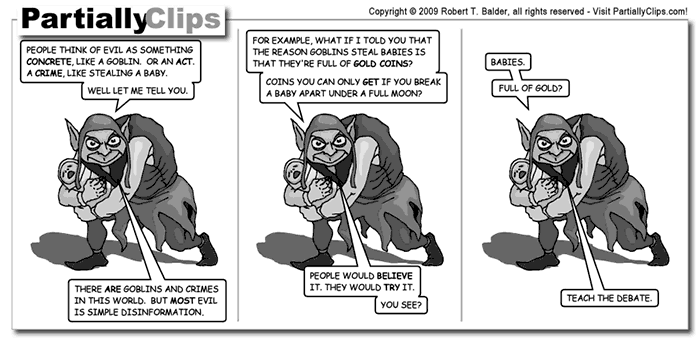
But still. There’s a lot of really cool stuff out there. Like PartiallyClips, a clip-art Webcomic that devoured my entire afternoon recently. I ended up reading every single one of them.

Some of my personal favorites:

A few more, with a special bonus comic for datan0de

How to create a religion

Have you ever thought about all the world’s religions, looked at how downright goofy they are, and thought “Hey! I can do better than that!” Have you ever wanted to start your own religion, and go down in history with men like Joseph Smith (minus the part about getting shot in a prison cell), Paul of Tarsus (minus the bit with the beheading), or L. Ron Hubbard?

Well, look no further! Here’s an easy, step-by-step guide to building a religion of your own.

Step 1: Start General

“There is a divinity and this divinity created the universe.” People are natural storytellers, and people are naturally curious about where they came from, where the stars came from, and where the ground they’re standing on came from. But, people are also lazy, and don’t want to spend years learning about the physical properties of the universe, or the mathematical models that describe the formation of the heavens and the earth. “God did it” is an easy explanation that appeals to folks, and you’ll find that people will accept it wholeheartedly without one single shred of evidence.

Step 2: Work from the general formation of the universe to human beings

People want to believe they are special. People adopt worldviews that are inherently self-centered; if you tell a bunch of folks that god made the universe, people are going to want to know if god made them. “God made the universe with a set of immutable natural laws and then those laws took over to form, over many millennia, us” just isn’t satisfying for most people. It’s not a good story.

You want to tell folks that your god made them specifically. This, too, you will find accepted without question or proof; people are already halfway to believing it before you even begin, because it’s a damn good yarn that appeals to their inherently self-centered worldviews.

Plus, you’ll find it useful for the next step.

Step 3: Since god created human beings, he must have had a reason for doing so, right?

Human beings are inherently prone to promiscuous teleology–the tendency to believe that things happen for a purpose. It’s not enough for us to look for the explanation about how things came to be; we also want to know why. This appears to be a side effect of a hyperactive sense of agency, which has a positive survival value; we see agency because it helps keep us alive. It’s easy to mistake a shadow for a burglar, but people rarely mistake a burglar for a shadow!

Anyway, appealing to this sense of purpose will help reinforce your religion in the minds of the people you talk to. It’s a great shot of self-esteem; “God has a plan for me!” It helps personalize your religion by appealing to people’s inherent self-centeredness. And it’s massively helpful in establishing the creeds you’ll be using a bit later.

The notion that your god has a purpose for humanity makes the next step logical and easy to swallow:

Step 4: Since god has a purpose in creating us, there must be a right and wrong way to live. The right way to live is in accordance with this purpose; the wrong way is in defiance of it.

This is a step that’s surprisingly subtle in its ramifications. Anyone who believes that your god had some reason for creating human beings is going to find this easy to believe also; you won’t have to sell this point. And it opens the door to all sorts of distractions you can easily use to deflect conversation away from anyone who wants to challenge the assertions you made in the first three steps. Just bring up the philosophical idea of “free will,” assert that your god wants us to live according to his plan of our own choice, and any inconvenient conversations that start to head too close to “Well, how do you KNOW god created the universe?” will quickly become bogged down in the semantic morass of free will and determinism. You can trap the conversation in this mire for decades.

But, now you have a problem. Now you have to figure out some kind of way to codify what the right way to live is, because people are going to want to know. So far, you’ve been able to skate along without offering even the tiniest scrap of evidence that ANYTHING you say is true; people will believe you because they want to believe you. But once you start telling folks what the right way to live is, people are going to want to know how you know.

This is a problem that’s never been completely solved; look at all the other religions and you’ll see that folks really like to bicker about this stuff. But there is a solution that works well enough to get you by, and that is:

Step 5: Tell people that your god writes books.

Books are awesome. You can claim that your god gave the book to you by divine revelation without also leaving the door open to other folks saying they’ve had revelations that contradict yours, because where’s the book? You don’t have to remember all the various tenets of your religion, because hey, they’re in the book. You can fend off challenges to your authority by referring back to the very book that you wrote to begin with. It’s brilliant!

It doesn’t even have to be a very good book. It can be filled with contradictions (your god created the world, then created man, then did some stuff, then man got lonely, then your god created woman; no, wait, your god created man and woman at the same time). It can make assertions that are provably false (the Native Americans are a lost tribe of Israel). Doesn’t matter. All you really need is a story that sells the book–some kind of tale that’ll help people accept that the book is actually written by your god.

A story involving magical plates made out of gold hand-delivered to you by an angel is good. If your imagination fails you, though, you can always just say that you sat down and thought about it really hard and it came to you.

Step 6: Sell the books by preying on natural human drives

We’ll use two emotions here that are often called ‘negative,’ but as we’ll see, thinking of these as negative emotions is nonsense! They’re positively wonderful for helping you to get people to believe what you want them to believe.

The first is fear. In your book somewhere, you have to say that people who don’t believe this book will have bad things happen to them. This is a must. It doesn’t matter what the bad thing is, provided it’s bad enough.

If you’re a traditionalist, burning forever in a lake of fire is good. So is being ground beneath a wheel or being torn apart by demonic dogs. If you’re more modern, you can talk about how mysterious spiritual entities will be drawn to unbelievers and clog their thetan energy or something.

People tend to fear death, so playing on that fear is brilliantly successful; you can do it directly, by telling folks that anyone who doesn’t believe your book will die; or indirectly, by telling them that they don’t really die, but if they don’t believe your book they’ll come back to life in an undesirable form.

I recommend the latter, because it gives you a natural hook into the other emotion you’ll want to use, which is greed. Tell people that they can have things they want and they will be happier if they believe your book. Again, you can do this directly, by saying that people who believe your book will never die but will instead go on to a wondrous place where the streets are made of gold, they will have stables full of hot women who want to fuck them, and they’ll be able to create worlds of their own if they like; or do it indirectly, by describing how people who believe your book will become successful and wealthy. (They might not, but that doesn’t matter–if you’re doing this properly, you will! Should someone tell you “I believed your book and I haven’t become rich,” you need only say “God is testing you.”)

By this time, people will believe your book because they’ll be too damn scared not to.

You might think that people would say “Wait a minute–you mean your god prepares pits full of fire and razor-clawed wolves to tear us apart because he has a plan for us and wants us to be happy? How on earth does that make sense?” But you’d be surprised.

Step 7: Lay down the rules

This is trickier than it sounds.

A natural beginner’s mistake to make is to set down a bunch of rules for people’s lives that will cause them to act the way you want them to. Remember, though, you’re dealing with human beings, and human beings are notoriously resistant to changing the way they behave, even when they think that behaving the wrong way will cast them straight into a burning pit full of lava and body thetans.

And also, people are excellent rationalizers, who are very crafty at making up reasons why rules they don’t like don’t apply to them.

So you have to be careful. You can’t just write a bunch of rules without thinking about what the folks yu’re talking to are already doing.

Successful religions succeed because they do not try to set morality; they instead cater to the various prejudices, bigotries, and moral beliefs that people already have.

If you live in a slave society, you will not gain any traction if your book says that god thinks slavery is wrong. More likely, you’ll get arrested as a public nuisance.

Similarly, if you live in a racist society, you won’t gain any followers by telling people that god says blacks and whites are equal. if you live in a society where women are second-class citizens, you’re not going to get too far by saying that god wants men to treat women well. You can’t just go making new rules willy-nilly; even if you’ve sold people on all these ideas so far, they’re going to balk at actually changing their moral code.

So, the professional instead makes a list of all the various prejudices that the people around him already have, then writes the book to justify those existing prejudices. That way, your book becomes an easier sell.

Don’t worry that the prevailing cultural prejudices will change over time. Nobody’s actually going to read your entire book anyway; only the parts of it they like. If you write in your book that your god thinks that slavery is a pretty neat idea, and then centuries from now slavery is abolished and people start believing that it’s morally wrong or something, they won’t say “But wait, this book says that god is OK with slavery! That must mean that god is immoral!” Instead, they’ll simply stop reading those parts of your book. It’ll be like a little secret, you know?

If you find yourself in a place where you’ve run out of ideas about what sorts of rules to write about, write about sex. There’s always someone doing some sex stuff that his neighbors don’t like. You can milk that for thousands of pages, if you want to.

Step 8: Sell the book

If you’ve written the book correctly, this step is already halfway done. Make sure you feature prominently in the book or (better yet) in the story about the book in some way. Making up stories about your lineage helps.

You don’t really have carte blanche to write whatever rues you like into the book, but there’s nothing stopping you from putting a few things in there to benefit you. If you sell yourself and sell the rules that benefit you at the same time, you’re golden.

It’s important to sell yourself in the book because remember, folks will believe that the book was written by your god. If the book makes you out to be special, that will give you legitimacy, and your legitimacy will help you get folks to accept that the book was written by your god. It’s win-win!

At this point, you’re basically done. It’s important not to get too ambitious, though. A good messenger of god knows his limits; if you make a practice of boinking all the townspeople’s wives like Joseph Smith did, there’s bound to be talk. Similarly, if you try bringing your book and its rules into places that have different prevailing prejudices like Paul did, you may come to a sticky end, which is what usually happens to moral leaders who try to lead rather than follow the morality of their flock.

Instead, I advise stepping away from the day-to-day management of your religion once it becomes established. Let the faithful manage the enterprise; they’ll really believe it, so they might even work for free. You can distance yourself from any messes they manage to get into while still collecting generous stipends from your religion. Play your cards right, and by the time you die, you, too, may have a $600,000,000 ranch in California!