Poly Geeks Gone Wild

So, what happens when you get a bunch of polyamorous geeks together at a party? Someone starts charting relationship configurations, and someone else starts wondering how many possible relationship configurations there are in a particular group, and someone else gets out a calculator and a sheet of paper, and…

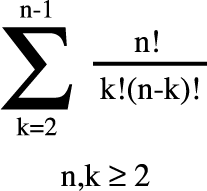
As it turns out, the equation that will tell you for any size group of people n how many possible relationship configurations (couples, triads, and so on) are possible within that group is pretty complicated. It took a lot of work and many sheets of paper, and the considerable brainpower of a couple people with degrees in mathematics, but the equation is:

This will tell you for any group of people n how many possible relationship configurations exist in that group.

And the number goes up fast. Scary fast. For n=9, there are 502 possible relationship configurations in that group. The number of people in the Squiggle I belong to is 15; I haven’t calculated the number of possible relationship configurations exist in such a group.

I think I’m going to make this formula into a T-shirt.

Whew! Back from FPR…

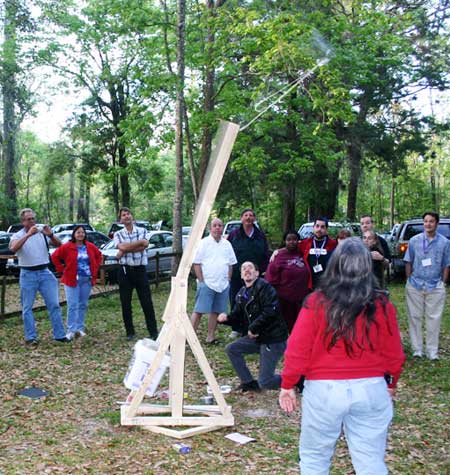
Much to post about, but most of it will have to wait. In the interim, however, I will tease you with this picture of the trebuchet I designed for the communication and conflict management workshop:

There is also a movie of the trebuchet firing here (3.5 MB direct download).

Whee!

Trebuchet habeo.

Nisi pecuniam omnem mihi dabis, ad caput tuum saxum immane mittam.


Next weekend is the Florida Poly Retreat. I am signed up to do two workshops: one on jealousy management, and one on the design and construction of a trebuchet, a type of Medieval seige engine capable of throwing 300-pound boulders through a castle wall.

Trebuchets are cool.

This weekend, I’ll be designing and constructing hte trebuchet that’ll be used in the workshop. Originally, I had planned to build a six-foot trebuchet with an eight-foot throwing arm, capable of hurling a projectile the size and weight of a bowling ball about fifty yards or so. Shelly and smoocherie both, sadly, nixed that idea–Shelly because she was horrified at the safety implications of such a device, and smoocherie because the facility evidently doesn’t have enough space to be chucking bowling balls around.

So, alas, I’ve had to scale back a bit. I’m designing a trebuchet about three feet high, designed to toss golf balls or tennis balls around. Which is very sad, because tossing a golf ball is so much less fun than tossing a bowling ball. I think it would be fun to use an old-fashioned steel lawn dart as the projectile, but I don’t think you can buy those any more. (I certainly haven’t seen them in years…which, now that I think about it, is probably a good idea. Who the hell thought that throwing five-pound, sharp steel darts high in the air was a fun family game? No way THAT could go wrong…bit I digress.)

There’s actually a bit of accidental history behind this particular workshop. During the first Florida Poly Retreat in 2003, Shelly and I and some various other people found a pile of scrap wood at the facility, and I decided to use that and duct tape to make a quick, improvised trebuchet.

Well, actually, that’s not quite true. The device we ended up making was technically a mangonel–it was powered by a combination of a small counterweight and human muscle, a design first pioneered by the Mongols, who used caputured enemies as slaves to operate their mangonels, and built versions that could be disassembled quickly and carried on horseback which they used as antipersonnel devices rather than as seige engines…but again, I digress.

Anyway, the FPR in 2003 was arguably the first nationwide polyamory meeting to arm itself. We test-fired the mangonel by using it to fire the flashlights that were giveaways at the retreat, that projectile being necessitated because (a) it had a lanyard designed to be worn around the neck, removing the need for a firing sling on the weapon, and (b) it was dark by the time we were finished, so we needed a projectile that could be seen at night.

The finished engine worked far better than I had anticipated; by the time we got the firing mechanism worked out, it was hurling the flashlights about three times farther than I’d estimated. Which was great fun, as you can probably imagine.

Anyway, it’s been something of a standing joke since then–Florida Poly Retreat, the only polyamorous gathering to have seige equipment! So when smoocherie approached me with the idea of doing a formal workshop this time around, hey, who was I to say no?

The trebuchet workshop is being billed as a workshop on communication. Legendary cynic Ambrose Bierce described war as “untying with the teeth a political knot that would not yield to the tongue,” after all.

I plan to do a packet for the workshop that contains the plans, plus a writeup on the physics, theory of operation, and history of the trebuchet. For anyone who cares, this will be a HCW (hinged counterweight) design with a fixed throwing arm, and I’ll probably put it on wheels. If there is enough interest, I’ll probably make the packet available as a PDF from my Web site.

And now, off to Home Depot, the “Toys R Us” of the mad scientist and pervert communities.

Fun link o’ the Day: If Microsoft Redesigned the iPod Packaging

Apple doesn’t miss a trick when it comes to design. Their computers and consumer electronics tend to be stunningly beautiful–if you ever hold an iPod Nano you’ll see what I mean–and the same design sense carries through to their packaging, advertising, and other incidental design. I still have the box my iSight camera came in; it’s too beautiful to throw away. Hell, even the bags they give you your stuff in when you go to the Apple store are gorgeous.

But what would happen if the product packaging for the iPod, one of the most successful electronic devices ever, were redesigned by Microsoft?

This video seeks to answer that question.

Like life, it is funny because it’s true. Work-safe, with sound.

[EDIT]: The user who uploaded it to YouTube has now pulled it down. There is a direct download link to the .wmv file here. If that quits working, I’ve also mirrored it on my server here, but it’s an 18-megabyte download; please be kind to my bandwidth!

For those on my F’list who like Firefly and Battlestar: Galactica…

…from a link ganked from alem‘s journal…

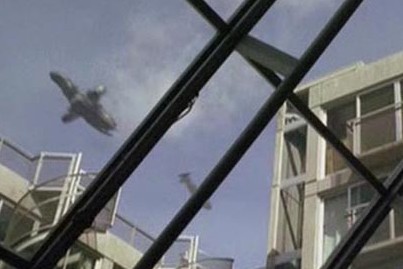
Seems the same effects company did the effects for both shows, and slipped Serenity into a scene from Battlestar: Galactica. Apparently, there’s an episode where a character is in a room overlooking a spaceport, and through the window you can see Serenity lifting off:

WARNING! DANGER! MAJOR GEEKINESS AHEAD!

So Shelly’s been trying to think of ways to study chemistry that aren’t mind-crushingly tedious, and we’ve started working on a chemistry game similar in some ways to trading-card games like Magic: the Gathering. Here’s what we’ve come up with so far:

The game is played with decks of cards, each of which represents an element. For example, there are oxygen cards, hydrogen cards, sodium cards, chlorine cards, and so on. Each player has one deck of cards.

Each player begins the game with twenty hit points.

Each player has a field in front of him, consisting of eight spaces where hydrogen and oxygen cards can be placed, and consisting of three slots in front of him where defensive molecules may be placed. All these fields are empty at the beginning of play.

Game play takes place in turns. On each player’s turn, that player does each of the following, in order:

1. The player may place up to three Hydrogen or Oxygen cards from his hand into the field in front of him. At no point may the field contain more than a total of eight cards.

2. The player may then create molecules by combining atoms which are not hydrogen or oxygen from his hand and combining them with hydrogen and oxygen atoms from his field to form molecules. These molecules may be used to neutralize any molecules which his opponent has previously played against him which continue to cause damage until neutralized (see below). The molecule thus formed and the molecule played against him are then discarded.

3. The player then builds defensive molecules by taking atoms which are not hydrogen or oxygen from his hand and combining them with hydrogen and oxygen atoms from his field to form molecules. For example, if a player has a Sodium atom in his hand, he may combine it with a Hydrogen and an Oxygen card from his field to form sodium hydroxide, NaOH, which is an alkali of Rank 3. This means that if it is in his defensive field, it neutralizes acids of up to Rank 3. A player may place no more than 2 defensive molecules per turn.

4. The player then builds molecules with which to attack his opponent by combining atoms from his hand which are not Hydrogen or Oxygen atoms with Hydrogen or Oxygen atoms from his field to form molecules. For example, if a player has a Sodium atom in his hand, he may combine it with a Hydrogen and an Oxygen card from his field to form sodium hydroxide, NaOH, which is an alkali of Rank 3. This means that if the player plays this molecule to attack his opponent, the molecule will do 3 points of damage immediately to the opponent, plus one additional point of damage per turn until it is neutralized. If the opponent has an acid of Rank 3 or higher in the defensive position, it is neutralized and both the NaOH and defensive molecules are discarded from the table, the defending player receiving no damage.

5. As soon as a molecule is played on a defending player, that player may immediately combine atoms from his hand with Hydrogen and Oxygen molecules from his field to counter the attacking molecule. For example, if the attacking player plays HCl, hydrochloric acid, an acid of Rank 3, the defending player takes 3 points of damage if he has no defensive molecules on the table which can neutralize acids. However, if he has a sodium atom in his hand and a hydrogen and oxygen in his field, he may immediately play NaOH to neutralize the HCl. In this case, he takes 3 points of damage, but the HCl and the NaOH are immediately removed from the table and he does not continue to take damage on subsequent rounds.

6. Some molecules are special; for example, fluorsulfonic acid (HSO3F), is a superacid of rank 4 which will inflict 4 points of damage on the defender, 2 points of damage on the attacker, and an additional 1 point of damage on each player on each turn thereafter until it is neutralized.

7. When the player no longer has enough atoms in his hand to form molecules, he then takes any damage from any remaining cards played against him that do periodic damage, and both players draw cards (if necessary) until they each have 7 cards in their hand. That player’s turn is then over and the next player’s turn begins this same sequence.

For the purposes of simplicity, organic compounds are not part of the game. Atoms in the decks include all the halogens, all the alkali metals, sulfur, nitrogen, and so on.

So…whaddya think? Too geeky?

I can’t log on to OK Cupid

Now, this might not ordinarily seem newsworthy, except that I can’t reach OK Cupid, either.

That, of itself, also isn’t newsworthy. What is newsworthy is the reason behind it, which has to do with corporate greed and very poor behavior on the part of some very big companies.

Two very big companies, to be exact. Level 3 Communications, an enormous and giddily spam-happy ISP, and Cogent Communications, an enormous and less spam-friendly ISP.

Cogent is pricing bandwidth very aggressively, and Level 3, they don’t much care for that. So Level 3 has ended its Tier 1 peering agreement with Cogent.

Essentially, in quick and hopefully not too technical terms, it means that two of the biggest carriers of Internet traffic are not speaking to each other right now. What that means is that the Internet has been split; for many end users, there is no way for people on one side of the divide to reach Web sites on the other, and vice versa. For example, right now most RoadRunner customers cannot reach OK Cupid.

Level 3 has been known to do this sort of shit before; in fact, there’s an article on Slashdot about it. Cogent is dealing with the problem by offering current Level 3 customers free connections to the Cogent network, on account of Level 3 being a bunch of mewling, lice-infested, pus-oozing filthy bastards and all.

Cogent Communications has released a statement about the issue. I can’t read it, because I’m on the wrong side of the divide and can’t reach Cogent’s servers.

By all accounts I’ve seen, Level 3 is being a bunch of right bastards here.

So if you’re having trouble reaching certain Web sites, that’s why.

Edit: Less than ten minutes after posting this, OK Cupid became reachable. Clearly, I should have complained sooner!

Okay, so I’m a geek.

But still: “Nano” does not mean “small,” guys!

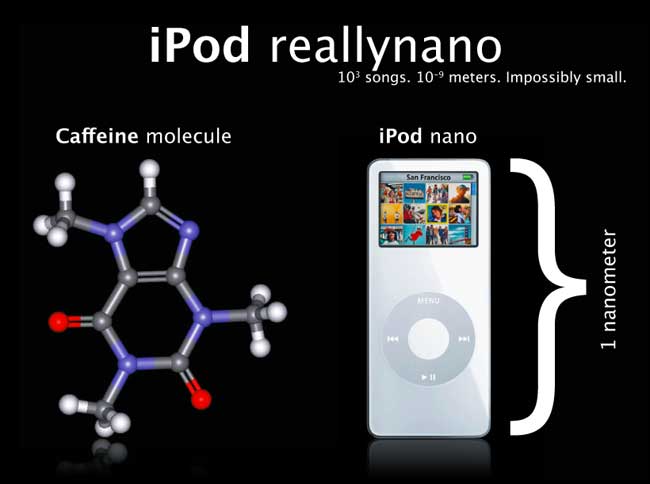
Shelly’s working on a speech for her speech class about nanotechnology. For the speech, she’s trying to get across the idea about just how small nanoscale objects really are.

So I’ve put together an image of what one might expect from a real iPod nano:

Sex and math, and sex

Ugol’s Law states that no sexual fetish is unique–that is, if something turns you on, then someone else, somewhere, is turned on by the same thing.

Shelly is currently in school, pursuing a degree in chemical engineering with an eye toward using it to get a doctorate in biomedical nanotechnology. More and more universities are offering graduate-level degrees in nanotechnology, mostly interdisciplinary degrees that bring together people from medical, physics, and chemical engineering backgrounds.

As you might imagine, her coursework involves rather a lot of math. And, as it turns out, Shelly is uncontrollably aroused by math. No, there isn’t a word for it (I looked), but math gets her hot. Really hot.

And she’s started doing her homework on my body, using a fine-point marker pen to work out problems on my back. Which is beyond hot. By the time she’s finished with her homework, she’s usually uncontrollably aroused and very aggressive. I won’t bore you with what happens afterward, except that it involves numerous implements, floggers, and other things which might offend those with delicate sensibilities. In fact, I went in to the office today with a complex problem in analytical geometry written on my back.

So it should come as no surprise, then, that the Intellectual Sexiness Test meme that’s been making the rounds these days says:

Blasphemy

I hate Linux.

There. I said it. Linux is rubbish; the emperor has no clothes.

Okay, it’s got some things going for it. As a server operating system, it’s very useful. It’s so much more secure than Windows that comparing the two is like comparing Fort Knox to a child’s piggy bank. For high-volume Internet server applications, it can’t be beat for the price.

But as a general desktop operating system? It’s bunk. Want to know why? Because there’s a dirty little secret about open source software…it’s made by amateurs!!!

And until those amateurs get their shit straight when it comes to installers, it will never beat Windows regardless of how many problems Windows has and how many security holes Windows suffers from.

So last night I tried installing Fedora Core 4 on one of Shelly’s computers. Fedora core 4 uses a graphical installer called anaconda, which is the worst pile of crap ever to disgrace a computr screen. Want to know why? It’s the user interface, stupid!

I’ve had problems with various Linux installers before–they’re all pretty and friendly and turnkey until the slightest unexpected thing happens, and then you find out that they’re poorly debugged and as fragile as a soap bubble, and when they crash, man, it ain’t pretty. See, writing installers isn’t all sexy and doesn’t give you street cred the way writing kernel software does, so nobody really wants to do it. It’s the castor oil of programming; people have this vaguue notion that installers are good, somehow, but nobody wants to get near them. And you get things like anaconda, which crash into exception traces and stack backtraces when they don’t like a particular brand of network card, or which don’t have even basic error checking and recovery.

Take the problems I had last night (please!). It took four tries to get the damn thing to install, even from media that had been verified and was known to be good.

The first problem was my fault, kinda. See, FC4 fits on four CDs. You run the installer, and when it’s done with a CD it pops out and asks for the next CD. You put the next CD in, click OK, and off it goes, and so on.

Well, when the installer asked for the third CD, I popped it in, and then (stupidly) clicked the OK button right away, before the CD finished spinnig up. Now, any other program I’ve ever used for any other operating system waits for the CD to finish spinning up, then does its thing. Not anaconda, oh my, no. Instead, if the operator foolishly hits the OK button before the CD finishes spinning up, he instantly gets an error message ‘The CD can not be read. Sorry, this error is fatal. Click here to reboot.” No “click here to try again”–no, that’d be too robust, and we don’t want Linux to be robust, do we?

The next three attempts to install met with similar fates. Even though I carefully waited until each CD finished spinning up before I hit OK, at three random times during the install, I got a message “A file could not be read or written. This may indicate a problem with the media, with the hard drive, or with your hardware. Sorry, this error is fatal. Click here to reboot.”

Yeah, it may indicate a problem with the media, or with the hard drive, or it may indicate that the goddamn installer is crap, with poor error checking and no error recovery.

Now, the Linux users of the world pride themselves on the overall robustness of their operating-system-cum-religion, yet write crap installers that fall down if the wind blows from the wrong direction.

I once had a problem with a Windows CD. The CD-ROM was defective from the factory; it had a scratch on it that caused some of the sectors to be unreadable. Want to know what happened when the installer hit that spot? Listen up, Linux boys, there’s a lesson in here for you. Ignore this lesson at your peril:

It displayed an error message saying “The CD could not be read. Click here to try again, or click here to cancel the install.”

“Click here to try again.” My goodness. What will those satanic Redmond monsters think of next? Retrying an operation that failed is just…it’s just…well, diabolical!

I finally got it to install, by holding my breath and making the proper incantations, but lordy, I have yet to be impressed.