
emanix the Chaosbunny in the back; the pet lesbians and your humble scribe down in front. Bunny ears not optional.

emanix the Chaosbunny in the back; the pet lesbians and your humble scribe down in front. Bunny ears not optional.
Sex for Science! Chapter 0
Sex for Science! Chapter 1
Sex for Science! Interlude
Sex for Science! Chapter 2
Sex for Science! Chapter 3
Sex for Science! Chapter 4
The English language has no word to describe the experience of watching a pierced, tattoed woman you’ve only just met have a huge, screaming orgasm, then pull off the electrodes for the EEG machine, roll over, and start talking about sex-based differences in brain activation during sexual arousal.
It has no single word, but there are three: “incredibly fucking hot.”
However, the story that leads up to a sleazy hotel room in Seattle with a laptop, an EEG, and the screaming orgasm I referred to earlier is quite long, and begins in San Francisco, about 809 miles south of that sleazy hotel room. More specifically, it starts (as these sorts of stories often do) with the MacWorld Expo, and also with a book about neuroscience called Mind Wide Open by Steven Johnson.
Personally, I blame my friend Scott, who invited me to drive down with him to MacWorld last January. It’s a straight shot, nine hours by car from Portland, or eleven if you stop along the way for photographs. We opted for the latter, as both of us had brought our DSLRs and he had an infrared filter that he thought might prove interesting. to play with.
Now, I do have to admit that I feel as if Hollywood has let me down. I’ve seen a number of Hollywood movies, so I felt I had a pretty good idea of what to expect from a road trip. You can imagine my surprise, then, when we had been on the road for almost four hours without so much as a single hilarious run-in with bungling bank robbers or Brazilian supermodels. The entire trip offered no bank robbers, amusing misunderstandings involving Homeland Security agents and local sheriffs, Russian gangsters, or international monkey smugglers at all, and only the briefest encounter with a Brazilian supermodel, in a subway station in midtown San Francisco. (That encounter TOTALLY didn’t go the way Hollywood led me to expect.)
It did, though, give us a chance to play with the infrared filter. We stopped at a scenic viewpoint north of Mount Shasta, a nominally dormant volcano in the Cascade mountain range. I took a couple of pictures, one normal and one with the infrared filter, from roughly the same spot. The CCD in my camera is not terribly sensitive to infrared; the normal image was taken at 1/250th of a second at f/13, whereas the IR image was shot at 30 seconds at f/8. I like the way that the infrared light easily penetrates all the haze in the air.


I’m not sure what the light-colored smudges are in the left center and left top of the frame. At first I thought they were artifacts like lens flare, but it’s possible they’re areas of cooler air between the camera and the mountain.
Infrared photography done, we continued down on toward San Francisco, and figuratively speaking toward a date with mad science.
There’s little to say about the MacWorld conference itself. MacWorld has become a bit rubbish over the past decade or so. It used to be one of the hilights of my year every year, but it never quite recovered from the Trade Show Slump of Death. These days, it’s a strange mix of small vendors, a smattering of big-name companies like Hewlett-Packard trying desperately to look relevant, and folks who have little to do with the Mac community at all.
I chatted for a while with a bored Russian goth girl (or she might have been Ukrainian–I still can’t tell the accents apart) at the Data Robotics booth and made fun of the immense New York Times booth, where a small group of old-media dinosaurs struggled to figure out a way to make money on the Web. The expo runs for three days, but we hit everything worth hitting in one longish afternoon.
That night, we were invited out to Porn ‘n’ Cupcakes by lapis_lazuli.
You’d think that porn ‘n’ cupcakes would make for a no-fail evening. As it turned out, the porn was a wash and the cupcakes were Vegan, so overall the Porn ‘n’ Cupcakes experience lack both the erotic titillation and the sweet, sweet sugary excess that one might normally expect from porn ‘n’ cupcakes.
The evening was a smashing success.
In fact, hanging out with lapis_lazuli and her partner was so much fun that I stayed up talking to them after Scott had called it a night, and the next day we played hooky from the expo to run around the city with them and spend a bit of time in the bowels of an old diesel submarine.
 There is (or rather, was–they’ve recently announced they’re going out of business) a BDSM-themed coffee shop called Wicked Grounds in San Francisco. They have some very cool furniture, including this rather fetching chair-cum-St.-Andrew’s-Cross thing (which I’d like to build an example of for myself). They also sell copies of my Map of Human Sexuality for sale there, but more to the point, they also have a table that they made by cutting apart one of the posters and laminating it down. Scott, whose photographic skills are considerably better than this image might suggest, got this iPhone pic of me sitting at that table.
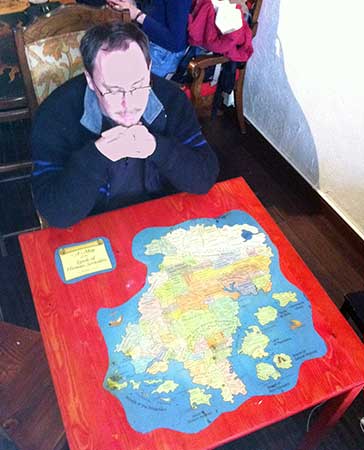
We elected to meet up with lapis_lazuli and her partner there, before setting out exploring the bits of San Francisco that aren’t the Moscone Convention Center. There are many of them, as it turns out, and quite a few of them are more interesting than the sad sad remnants of MacWorld.
One of them is the Pampanito, an old WWII-era diesel submarine that’s been turned into a museum.
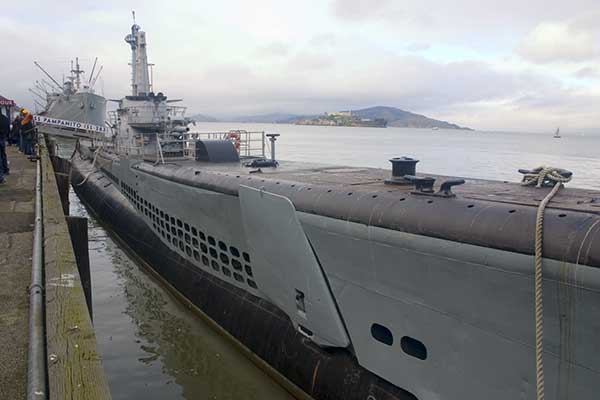
I think submarines are very cool, in a sort of “I would never, ever actually want to be a crew member on one” kind of way. I have not, however, been inside a submarine before.
lapis_lazuli‘s husband offered to bring us on the tour. It was, I have to say, sexy and fun and kind of a turn-on in a way that porn (badly read) ‘n’ cupcakes (all vegan) were not. Imagine the most primitive steampunk machinery you can, and then bring it kicking and screaming into reality, and you have a WWII submarine. It’s astonishing that these things actually worked.
Take this torpedo tube, for instance.
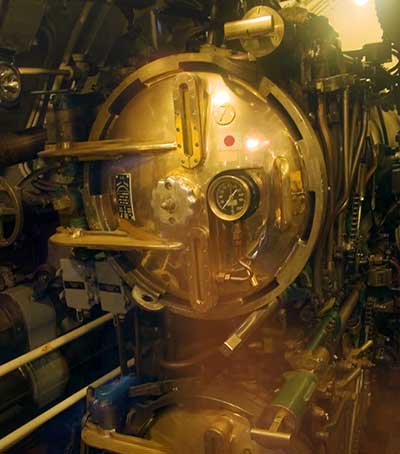
Shooting things with torpedoes is this craft’s entire raison d’être, but the process of doing that was incredibly baroque. Spin the knob, open the door, slide a torpedo down a rail into the tube, close it up, and then perform a series of arcane acts involving a startling number of levers and knobs and dials and little widgets on the ends of arms that move these hydraulic rams around…it’s amazing the war wasn’t over by the time you’re done. And it’s all made of brass!
The torpedoes themselves, well…
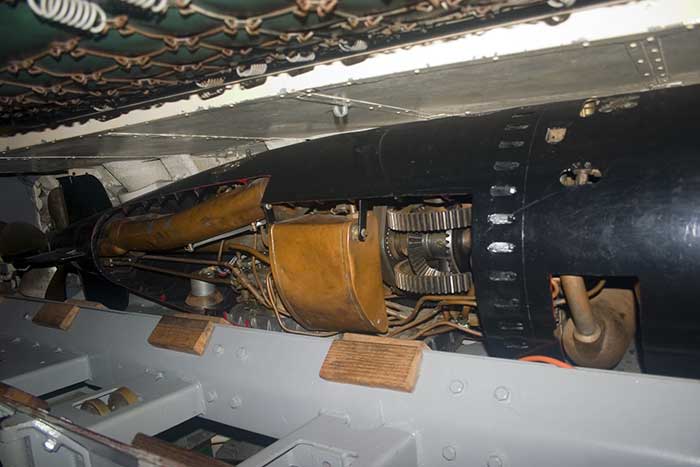
If I understand how they worked correctly, the torpedos burned alcohol for fuel in a burner which was used to heat water to steam. The steam then drove a steam turbine, which was connected by a shaft to a complex mechanical transmission that spun the propellors. A mechanical “computer” of sorts guided the submarine through a programmed series of turns that resulted in the torpedo (hopefully) hitting the target. Subs generally fired while they were on a roughly parallel course with the ship they were shooting at, rather than when they were facing the ship directly; the “firing solution” was the sequence of moves the torpedo would have to go through to catch up with and hit the ship.
Apparently, this actually worked, at least sometimes. It’s amazing what a little bit of ingenuity and nearly unlimited funding can accomplish.
Early submarines were diesel-electric jobs, using two four huge diesel engines (in this case, straight unmodified diesel train engines) to turn enormous electric generators that charged 200 tons of lead-acid batteries stored in the bottom deck of the sub. This control panel was used to control the flow of electricity from the generators into the batteries, and from the batteries into the sub’s engines.
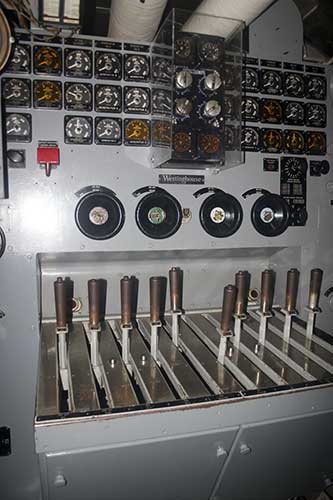
The levers moved gigantic rheostats, basically the same thing as the fan speed controller on your wall only five feet tall and six feet wide, all locked in a giant metal cage to keep crewmen from stumbling into them and going up like a fly in a bug zapper.
I say this again, with increasing astonishment: this actually worked.
Old tech, especially old tech involving huge levers and knobs and dials and stuff, gets me hot.
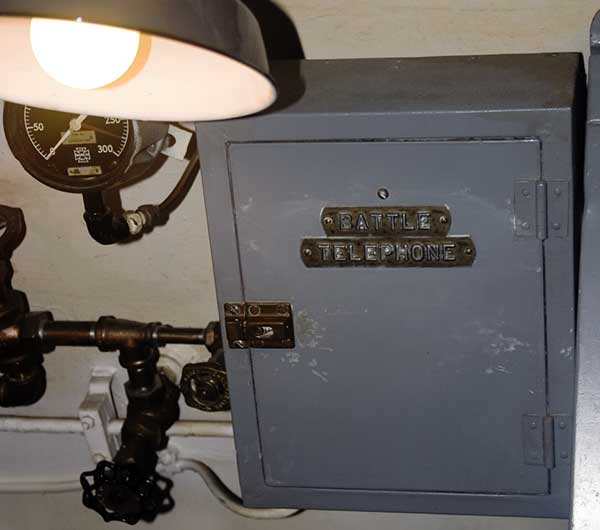
I include this photo because one day I will have live in a place that has a gray steel box mounted on the wall with a metal label reading “Battle Telephone” on it. With a big gauge and some valves next to it. Oh, yes, I will.
Now this…

This is the control room of the submarine.
It’s a bit less “Hunt for Red October” and a bit more “Someone threw a box full of dials and valves into the room and then bolted them down wherever they landed” than what I had expected. The thing in the foreground, which the camera was actually resting on for this quite lengthy exposure, is the combat table, which is basically a big glass light table that you can draw on with grease pens.
It’s appallingly primitive and beautiful and by the time we were here I was ready to pin lapis_lazuli to the wall and do things to her that are illegal in one hundred and seventeen countries plus the District of Columbia. Did I mention that old tech gets me hot?
All of this still doesn’t explain how I came to be in Seattle with a woman I’d just met who has tattoos of the structural formulas of various neurotransmitters tattooed on her body having a screaming orgasm while wired up to a computer, except perhaps in the sense that it set a baseline for general sexual arousal that would come into play during the trip home.
Which I’ll get to in the next post.
ZOMG. I’m trying to think of a balanced and reasonable way to describe the past several days. I’d say things like “best con ever” and “the most amazing five days a human being can ever hope to imagine in this life or the next,” but I don’t know if they really convey quite how I feel.
Unfortunately, I’m still totally exhausted (despite about twelve hours’ worth of sleep), and I’m nowhere near cogent enough to be able to write about Dragon*Con. So instead I’ll do something I generally don’t do, and just re-post messages from my Twitter account. The following text is probably not safe for work
“You don’t need magic for there to be majesty in the universe.”
Dr. Pamela Gay, Ph.D.
One of the hilights of this weekend for me was meeting a personal hero of mine. His name is James Randi, and he’s a stage magician, founder of the James Randi Educational Foundation, and the adversary of quacks, fakers, charlatans, and frauds of all kinds.
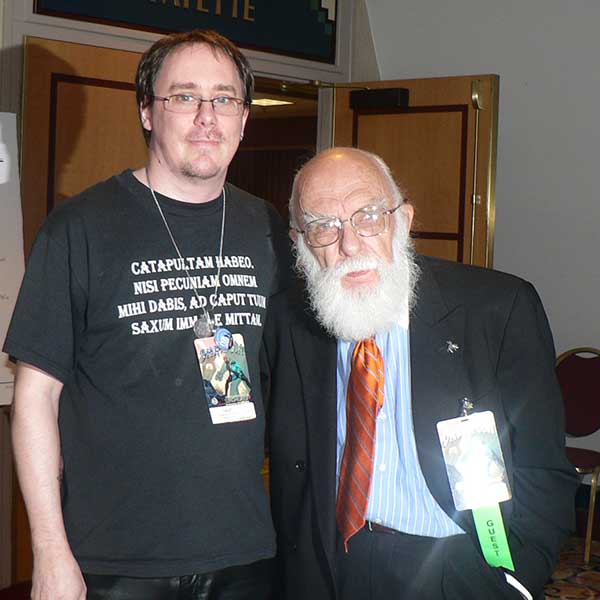
I first got hooked when I read his book Flim-Flam! Psychics, ESP, Unicorns, and Other Delusions, first published in 1982. It’s a scorching indictment of all sorts of phonies, fakes, and frauds, from so-called “psychic” and sometimes petty thief Uri “spoon-bender” Geller to “psychic surgeons” who pick the pockets of the desperate and gullible with a handful of chicken guts.
For many years now, Randi has offered a Million Dollar Challenge–a cool one million dollars to anyone who can demonstrate any psychic, paranormal, or otherwise outside the realm of conventional science under controlled conditions. The person making the claim, be it telepathy or dowsing or homeopathic “medicine” or precognition.
A lot of folks who claim to believe in these things don’t much cotton to the notion of actually testing them, and as a result there’s all kinds of objections to the challenge, ranging from “it’s impossibly biased” (in reality, it is the person who claims the ability or phenomenon, not the James Randi Educational Foundation, who designs the test and describes what constitutes a success) to the idea that Randi is somehow “anti-psychic” and his mere presence interferes with “psychic” abilities (Randi is never present at any of the tests, and he is not even informed when the tests are scheduled or where they take place) to the claim that the Foundation will always cheat to skew the results (the Foundation does not run or administer the tests; all tests are administered by a third party, often a university, that both the claimant and the Foundation trust).
In short, this guy has spent a tremendous amount of time and energy over the last couple decades in the thankless task of opposing fraud, gullibility, anti-intellectualism, ignorance, and credulity that poison and corrode reason and attack the foundation of post-industrial society. It is hard to overstate my admiration of this man; people of reason everywhere owe him a debt of gratitude.
Wen I first met him at Dragon, I had a sewing machine under my arm. That’s a whole different story, and one I shan’t go into in this post.
While looking for a place to sit in a jam-packed, standing-room-only food court:
David: It will all work out in the end.
Me: No. No, it won’t. Entropy pretty much guarantees that.
David: This isn’t a closed system.

slouchinphysics. World of Warcraft players will get the joke.
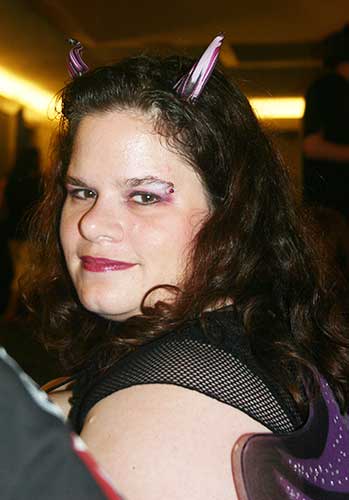
dayo. With horns. She’s so ky00t!

Shelly, and the coolest T-shirt EVAR.
Science is teh AWESOME!
The Geek Group, an organization founded by physicsduck, brought a pair of singing Tesla coils to Dragon. Tesla coils are cool–they’re scary high-voltage devices that make noise and shoot lightning bolts. Singing Tesla coils, which shoot lightning bolts and make music, are even cooler.
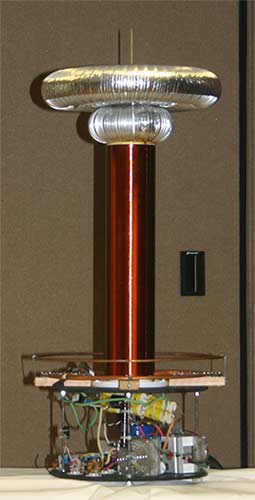

Tesla coils buzz when they operate. Essentially, what you do is you inject a current into the primary winding, which is a loop of wire at the base of the tall, skinny coil. This indices a current in the secondary winding, which is the tall, skinny coil. The current travels up the coil ’til it hits the top, then travels back down again. You inject another current into the primary winding, and it creates another, stronger wave of induced current in the secondary winding, which travels up the coil and then back down again, when you hit it again, and each time it gets stronger until finally it becomes strong enough to shoot lightning bolts out the top. (That’s the Reader’s Digest condensed version for non-geeks, anyway).
I’m assuming that making them sing involves changing the frequency of the voltage supplied to the primary winding, so that they buzz at a different rate. If that’s true, it suggests that there’s a limit to the range of tones you can squeeze out of the coil, because every Tesla coil has an optimum frequency (determined by the size and construction of the coil) for the primary voltage. Deviate from that frequency and the coil operates less efficiently; stray too far from it, and the coil doesn’t work at all.
In any event, these things are cool as hell to watch. Even if there does need to be more VNV Nation on the playlist.
Meet my archnemesis.
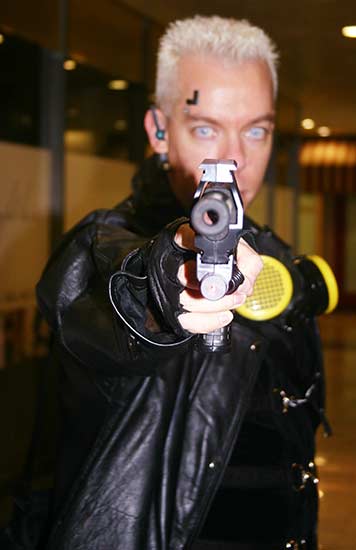
I lose more damn clones this way…