Evolution of the W32/Kuluoz malware scam

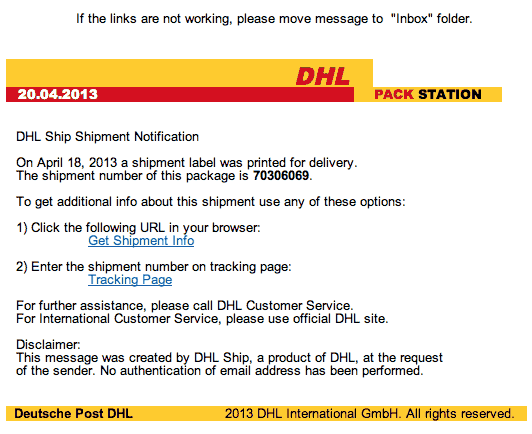
Well, boys and girls, it looks like the malware distribution I talked about here and here has morphed again. This morning, I started receiving emails that pretend to be DHL delivery notifications, rather than American Airlines ticket sales or FedEx notifications:

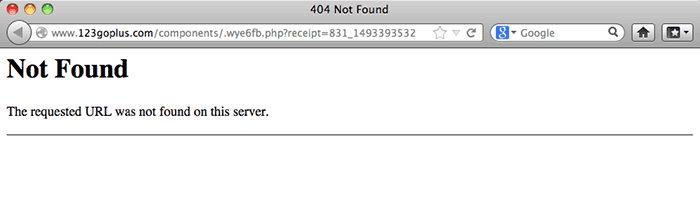
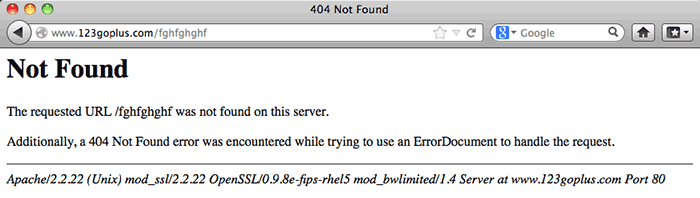
As before, the links take you to hacked WordPress or Joomla sites that will examine your browser user-agent. If you’re on a Mac or Linux computer, or you’re using a modern Windows browser, you’ll see a phony 404 Not Found error that looks like this:

If you’re using a Windows browser that has vulnerabilities, the link will download a copy of the W32/Kuluoz information and bank password stealing malware.

Stay safe out there.

Malware attacks after the Boston bombing

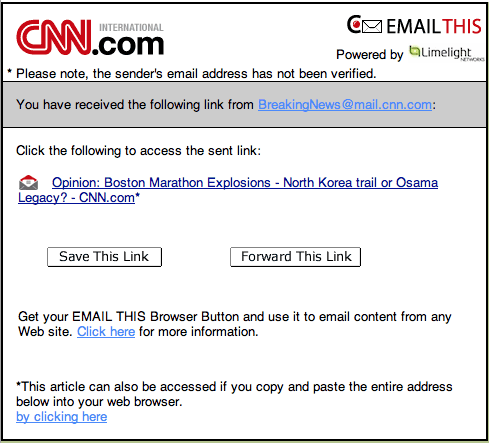
Yesterday, in the wake of the bombings in Boston, I received an email that looks like this in my inbox.

The links, needless to say, do not go to CNN. Instead, they lead to

http://playhard.by/bostoncnn.html

*** WARNING *** WARNING *** WARNING ***

This site IS LIVE as of the time of writing this. It WILL attempt to infect your computer with malware. DO NOT visit this site if you don’t know what you’re doing!

playhard.by is a hacked site hosted in Belarus. The URL in the email is a link to a file planted on the site that redirects visitors, using both JavaScript and a REFRESH meta tag, to

http://sub.piecedinnerware.com/complaints/messages_shows_mentions.php

This site is hosted by an outfit called Colo Crossing, a server colocation facility headquartered in the US. The domain was registered through (wait for it…) GoDaddy:

tacit$ whois PIECEDINNERWARE.COM

Domain Name: PIECEDINNERWARE.COM
Registrar: GODADDY.COM, LLC
Whois Server: whois.godaddy.com
Referral URL: http://registrar.godaddy.com
Name Server: NS17.DOMAINCONTROL.COM
Name Server: NS18.DOMAINCONTROL.COM
Status: clientDeleteProhibited
Status: clientRenewProhibited
Status: clientTransferProhibited
Status: clientUpdateProhibited
Updated Date: 19-nov-2012
Creation Date: 19-nov-2012
Expiration Date: 19-nov-2013

>>> Last update of whois database: Thu, 18 Apr 2013 21:42:55 UTC <<< Registrant: Jigar Kapadia B-32, Mani Ratna Raw House, Opp Sai Nagar New Gujarat Gas Road, Adajan Surat, Gujarat 395009 India Administrative Contact: Kapadia, Jigar contact@NewWaysys.com
B-32, Mani Ratna Raw House, Opp Sai Nagar
New Gujarat Gas Road, Adajan
Surat, Gujarat 395009
India
+91.9076026366

Technical Contact:
Kapadia, Jigar contact@NewWaysys.com
B-32, Mani Ratna Raw House, Opp Sai Nagar
New Gujarat Gas Road, Adajan
Surat, Gujarat 395009
India
+91.9076026366

The domain was registered last November, and put into service after the Boston Marathon bombing. (Interestingly, the HTML file that redirects to this site contains the following block of text:

Be sure you have a transfer reference ID. You will be asked to enter it after we check the link. Important: Please be advised that calls to and from your wire service team may be monitored or recorded.

Redirecting to Complain details… Please wait…

This suggests that an ordinary, garden-variety malware attempt, possibly something like a fake PayPal or bank transaction notification, was hastily modified to exploit the Boston attacks.

As per usual, if you receive any emails like this, do not be tempted to click on the links in them.

I expect to start seeing similar emails targeting the explosion at the fertilizer plant in Texas within the next 24 hours.

More on the W32/Kuluoz malware attack

A short time ago, I wrote about a malware attack in which hacked sites were being used to spread the W32/Kuluoz malware. Kuluoz is a password-stealing Trojan; when it’s installed, it scans your password files for Web browsers, password wallets, and so on looking for bank, PayPal, eBay, FTP, and other sites. People infected with Kuluoz may see their bank accounts emptied, their PayPal accounts drained, and if they use FTP to manage Web sites, their Web sites may be infected with the same malware.

Since I first wrote about it, the attack has changed and grown a lot more aggressive.

I saw the first sign of this attack on November 26 of last year. At the time, the attack was still quite crude: the victim would receive an email claiming to be from FedEx (though the body copy of the email said UPS) that had a message saying a package could not be delivered, and the victim would have to click a link to print out a receipt to pick the package up.

The link, of course, went to a hacked Web site being used to spread the malware. Clicking on the link would download a copy of W32/Kuluoz.B, regardless of what kind of computer the user was using. The first infected link I saw was

http://elbosquedelaherrezuela.com/wp-content/plugins/akismet/track.php?c003

hosted on Spanish Web host Arsys. The compromised site was running an outdated copy of WordPress; it has since been pulled down by the host.

In the time between last November and this March, the attack grew more sophisticated. The emails attempting to lure marks to hacked sites got more polished, and grew to resemble actual FedEx emails quite closely. The malware downloaders placed on hacked sites changed; they now examine the browser’s “user agent,” a header that tells a Web site what kind of computer you are using. If you’re on a Mac or Linux computer, you see a bogus “404 not found” error; only if you are on a vulnerable Windows browser does the hacked site download malware. And the malware itself changed rapidly as well; VirusTotal identified the first malware as W32/Kuluoz, but later downloads, with different file sizes and MD5 hashes, are identified as W32/Kuluoz.B or W32/Kuluoz.3.


Since I wrote the report last March, the attack has ramped up significantly and changed again.

At first, in November and December, I averaged 6 emails a month trying to get me to click on links. Now I’m seeing an average of more than 15 of these emails per day.

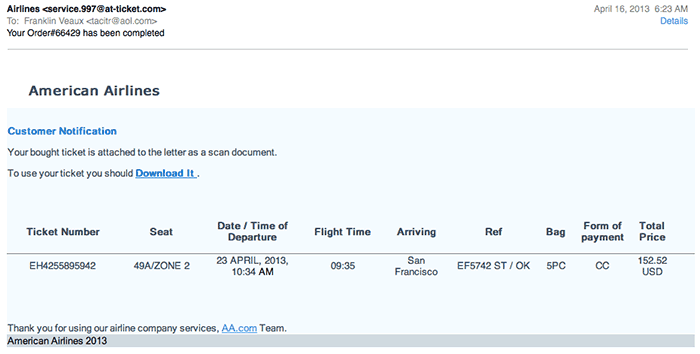
The emails themselves have changed, too. The fake FedEx emails, though I still get them occasionally, have become quite rare. Instead, the new wave of attacks involves emails that look like American Airlines ticket confirmation emails:

Needless to say, if you get an email that looks like this, DO NOT click on the link.


Right now, there is a hack attack of unprecedented scope and tenacity going on against WordPress and Joomla sites. The attack uses tens of thousands of compromised PCs to try to log in to WordPress and Joomla sites with the username “admin” and a vast number of common passwords. The attack is so severe that some Web hosting companies are reporting that WordPress and Joomla sites on their servers are slow to respond or not loading at all.

I believe that those hack attacks are related to the W32/Kuluoz malware distribution.

I don’t have any direct proof of that. The people attacking WordPress and Joomla sites are covering their tracks well, using botnets and IP spoofing to carry out the attacks.

But the circumstantial evidence seems strong. So far, every single compromised site I’ve seen that’s hosting the Kuluoz downloaders is running WordPress or Joomla. As time has gone on, the number of infected WordPress and Joomla sites has scaled rapidly. The recent wave of emails trying to lure people to infected sites coincides with the ramping up of attacks on WordPress and Joomla sites.

None of this is incontrovertible evidence. It could be coincidence–two different organized crime gangs attacking the same kinds of sites at the same time and ramping up their efforts coincidentally. But my gut says they’re related.


One of the most frustrating parts of this problem, for me, has been how slow Web hosting companies are to respond to reports that their systems have been penetrated and they are hosting computer malware.

I’ve compiled a list of statistics about infected Web hosting companies. Since November 26, I’ve started keeping track of which Web hosting companies are affected by the attack, and how long they’ve taken to remove a malware dropper once they’ve been notified it exists.

Not all Web hosts are created equal. Here, for example, is a graph showing the number of malware infected Web sites I’ve seen on various Web hosts since November, with the Web hosts identified by Spamcop:

The worst of the worst of the lot in terms of sheer number of virus droppers hosted, by a large margin, is GoDaddy.

Now, some ISPs host more Web sites than others, so if all ISPs were equally vigilant (or equally lax) about security you would expect to see larger hosting companies hosting more viruses than smaller companies. But this graph shows that isn’t really how it goes. Hostgator is larger than most the other hosting companies listed here, but has only a small number of malware-infected sites. Dreamhost and OVH are disproportionately represented for their size by a significant margin.


Another place where hosting companies are not created equal is in how speedily they remove malware droppers once they’re notified. The best Web hosting companies will do this within 24-48 hours, which to my mind is still quite a long time to leave a malware dropper active. When I’ve complained to Hostgator, arsys.es, and Lunarpages, for example, they’ve typically taken action quite quickly.

On the other side of the coin, some Web hosting companies take months to remove malware droppers…or don’t remove them at all.

I don’t know if it’s because they are easily fooled by the phony 404 errors or if they simply don’t care, but a number of Web hosting companies on this list appear unwilling or unable to deal with malware-infected sites at all.

The worst of these are Dreamhost (which has not removed one single malware site from its servers–every single one I’ve notified them of, without exception, is still active as of the time of writing this), GoDaddy (which used to be one of the top most responsive Web hosting companies, but no more; sites that they are notified of typically remain active on their servers for months, with one site I notified them of last December finally being taken down this April), OVH (which, like Dreamhost, appears not to deal with malware-infected sites at all), PrivateDNS.com (a site they were notified of in January is still active and spreading malware as of the time of writing this), and, sadly, Bluehost (which keeps emailing me to say the problem is resolved but the malware droppers remain active on their servers nonetheless).

Other ISPs on the Walk of Shame include 1 and 1 (which typically won’t remove a malware dropper until I’ve emailed them three or four times), Peer 1 (which has several malware droppers active for two months or more), and Calpop (which typically leaves malware droppers live for about six weeks after being notified).


Now it’s time for the practical bit.

If you have a WordPress or Joomla Web site, what can you do to keep it secure?

The two most important things you can do are to use very, very strong admin passwords and keep on top of security updates religiously. When a security update for a popular Web package is released, organized crime gangs will examine it and then roll the security holes it fixes into their automated exploit tools, because they know that most people don’t install them right away. If you don’t install a security patch within a day or two of its release, you run the risk of being pwn3d.

So, here’s a quick list of dos and don’ts to run a WordPress or Joomla site:

DO

  • Use strong passwords.
  • Install updates immediately.
  • Consider locking down your /wp-admin or Joomla admin directories with an .htaccess file that does not permit access without a password. If you don’t know how to use .htaccess files, there are some plugins that can do this for you. A WordPress plugin that can lock down your wp-admin directory is Bulletproof Security. A similar Joomla plugin is JHackGuard.
  • If you have more than one WordPress site, install InfiniteWP. This is a WordPress administration console that will notify you by email when any component of any of your WordPress sites needs to be updated, and allow you to update all your sites with one button click. It’s free.
  • If you create your own WordPress or Joomla themes, consider removing the WordPress or Joomla footers. Automated tools are used to scan for these so that the bad guys know what sites to attack.
  • Make sure you remove the /install directories when you install any CMS. (Joomla requires you to do this.)
  • Use a Web host that is proactive about security and responds quickly to abuse complaints.

DO NOT:

  • Assume you don’t have to worry about security because you have a tiny little site that nobody visits. The organized crime groups don’t care what your site is or how much traffic it gets. They use automatic tools that search through hundreds of thousands of Web sites a day searching for vulnerable sites. If you are vulnerable, you will eventually be cracked.
  • Leave your plugins or themes directories indexable. If you don’t know what that means, the easiest way to make sure you’re not indexable is to create an empty file called index.html in your plugins directory and your themes directory. This will keep people from getting a list of all the files in those directories, which they can use to search for vulnerabilities.
  • Set up a WordPress or Joomla Web site and then just walk away from it. If you are not actively maintaining it, take it down.

You have a package! Surprise, it’s the W32/Kuluoz malware!

About three months ago, I got an email telling me that my FedEx package couldn’t be delivered. The body of the email told me that the UPS courier tried to deliver it, and that it would be sent back if I didn’t click on the attached link.

Naturally, as I wasn’t expecting a FedEx pacakge, and given that FedEx presumably knows it isn’t UPS, I knew immediately that clicking the link was a Very Bad Idea…at least on an unsecured Windows box. Sure enough, clicking it downloaded a Windows executable, which VirusTotal identified as W32/Kuluoz, a backdoor command-and-control software that also attempts to download other malware.

I reported the site hosting the malware and forgot about it.

Then, things started to change.


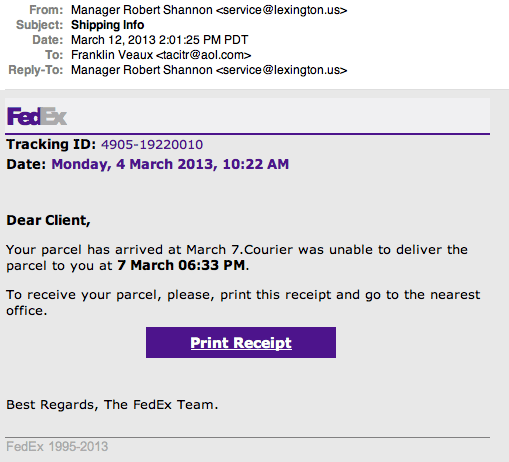
I’ve been getting more and more copies of this email lately; I’m now averaging several a week. The silly error and grammar mistakes have been fixed, and the emails now look quite polished. Here’s an example I received a couple of days ago:

The “Print Receipt” link leads to http://www.123goplus.com/components/.wye6fb.php?receipt=831_1493393532

CAUTION *** CAUTION *** CAUTION

The links in this blog post ARE LIVE as of the time of writing this. If you attempt to visit them with a vulnerable Windows computer, they WILL try to download malware to your computer. DO NOT visit these links if you don’t know what you’re doing!

The site 123goplus.com belongs to a company that produces business cards and similar printed pieces in Montreal, Canada.

$ whois 123goplus.com

Whois Server Version 2.0

Domain Name: 123GOPLUS.COM
Registrar: GODADDY.COM, LLC
Whois Server: whois.godaddy.com
Referral URL: http://registrar.godaddy.com
Name Server: NS1.MTLEXPRESS.CA
Name Server: NS2.MTLEXPRESS.CA
Status: clientDeleteProhibited
Status: clientRenewProhibited
Status: clientTransferProhibited
Status: clientUpdateProhibited
Updated Date: 06-jan-2013
Creation Date: 06-may-2006
Expiration Date: 06-may-2014

>>> Last update of whois database: Thu, 14 Mar 2013 22:32:30 UTC <<< Registrant: Pierino Pezzi 8630 Perra #3 Montreal, Quebec H1E5M8 Canada Administrative Contact: Pezzi, Pierino creationexpress@yahoo.com
8630 Perra #3
Montreal, Quebec H1E5M8
Canada
+1.5142741616

Technical Contact:
Pezzi, Pierino creationexpress@yahoo.com
8630 Perra #3
Montreal, Quebec H1E5M8
Canada
+1.5142741616

Domain servers in listed order:
NS1.MTLEXPRESS.CA
NS2.MTLEXPRESS.CA

The site 123goplus.com is running an outdated, insecure copy of the popular Joomla content management software, which has been hacked to have the malware downloader on it. (Joomla is a common target for this kind of attack. If you run Joomla on your Web site, and you don’t keep on top of security patches religiously, it’s a certainty that you will be hacked–it’s not “if,” it’s “when.”)

Here’s where things get cool.

Visiting this URL from a Mac browser or a Linux browser returns a 404 Not Found page, presumably to fool folks like me into thinking that the problem has been fixed.

Visiting the URL http://www.123goplus.com/components/.wye6fb.php without the “?receipt=831_1493393532” at the end also returns a 404 error; presumably, that code identifies a target that the email has been sent to. The 404 error looks like this:

But hang on! Let’s go to http://www.123goplus.com/fghfghghf and see what a REAL 404 error looks like on this server:

See the difference? The 404 error that you get when you go to the malware dropper is phony. The malware dropper is there, and it does live at that address.

If you visit the malware dropper with your browser user-agent set to, say, Internet Explorer 6 (God help you), you won’t see an error message. Instead, it will download a .zip file called “PostalReceipt.zip”.

I have downloaded several copies of this file from several different compromised hosts over the past couple of months, all of them from nearly identical FedEx emails.

The payload sites vary. Many different sites have been hacked and used to download this malware: 123goplus.com, yourinternationalteam.com, youknowlee.com, theqcontinuum.com, canyonlakeboatstorage.com.

In every case, the site is running an outdated, insecure copy of WordPress or Joomla. The hackers hack the site (which is trivial to do), place a PHP script that downloads the malware, then send out a bunch of these phony emails about a non-existent FedEx package, hoping to trick people into clicking the link.

Most of these sites remain infected, weeks or months after being reported to the ISPs, because either the ISPs don’t care or the ISPs aren’t paying attention to the fact that the malware scripts return phony 404 pages. (GoDaddy and OVH, I’m especially looking at you here.)

The people behind this attack are adapting the malware rapidly. I downloaded three samples of the PostalReceipt.zip file, one on January 25 aqnd two on January 30, and they differ from one another. VirusTotal identifies the earliest one as W32/Kuluoz, the second as W32/Kuluoz.B, and the third as W32/Kuluoz.3.


There are some interesting things about this attack.

The group–and I bet it is a group–of criminals responsible for this attack are taking care to cover their tracks and to keep abuse teams from removing the malware from infected sites. Each spam email contains a code at the end of the malicious URL, and the URL returns a phony error message if it doesn’t see a valid code.

The virus downloader script is smart enough to examine the browser user-agent to see what kind of computer and what Web browser the victim is using. If it sees a browser or a computer that it can’t exploit, it returns a fake error message.

Only if it sees a vulnerable browser does it attempt to download the malwarewhich then surrenders the computer to the control of the hackers.

The malware droppers are installed, probably automatically, on sites running insecure WordPress or Joomla software. The phony 404 error messages slow down the Web hosting companies’ response, so the malware droppers stay active for long periods of time.

I’ve said it before, and I’ll say it again: If you run a Web site that uses a content managemet or blogging or ecommerce package, you *** ABSOLUTELY *** MUST *** check periodically for software updaes and install them immediately. (When a software update comes out, the organized crime gangs that do this kind of attack will analyze it and figure out what security holes it patches. Within days, they will start taking over any Web site that hasn’t installed the update.)

The fact that malicious scripts will cloak themselves behind fake error messages means that you can never trust that a problem has been fixed just because you see a 404 error if you try to look at a suspicious URL.

Computer Security: Enormous Twitter Attack

A while ago, I received a spam email. The email came from an obviously hacked attack, and contained nothing but a Web URL.

This usually means either a phony pharmacy spam or a computer virus. Since I am interested in these things, and since I keep virtual machines with redundant backups so I’m not too concerned about malware, I followed it. It lead to a GoDaddy site which redirected to a PHP redirection script living on a hacked Web site which led in turn to a fake antiviurs page–a page that throws up a phony virus “warning” and prompts the mark to download an antivirus program to “fix” the problem. The supposed “antivirus program” is, of course, actually malware. Pretty run-of-the-mill stuff. I reported it to the Web hosts and moved on.

Then, a few days later, I started seeing Twitter posts that were just a URL. These posts led to a hacked site…which led to the same redirector, which then led on to the same malware sites.

Then I started seeing more. And more and more and more. And still more.

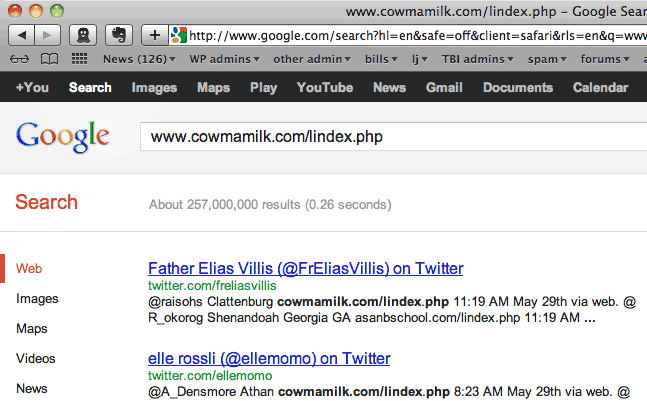
I did a Google search. Just one of the hacked sites, an Indian site called cowmamilk.com, had over 257 **MILLION** mentions on Twitter, which some quick investigating shows were coming from at least 500,000 Twitter accounts that were being used to blast the URL far and wide. 257 million searchable mentions for just a single attack URL!

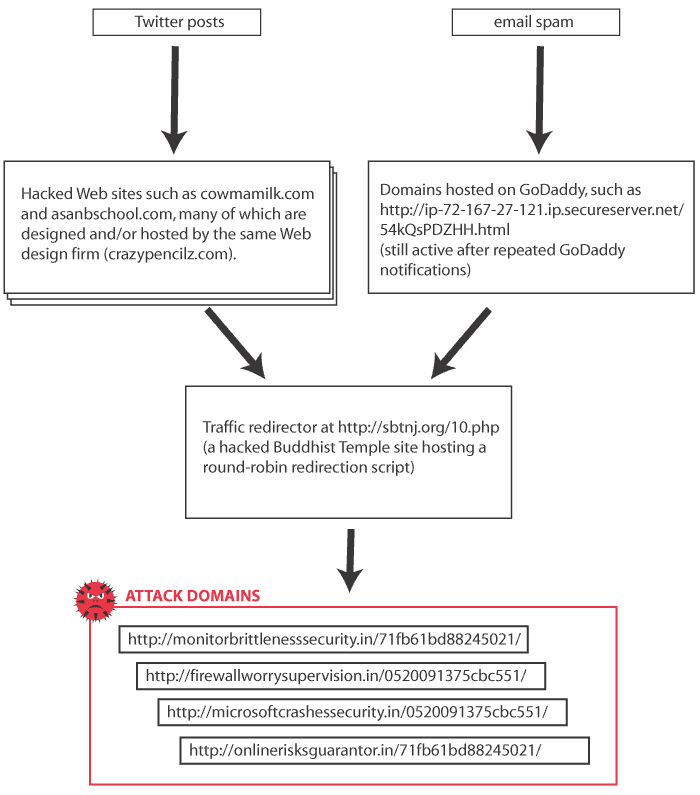
This is a huge scale attack, flooding Twitter with hundreds of millions of mentions of hacked Web sites that in turn redirect to a traffic handler which then sends visitors on to computer malware.

I did some more investigating, mapping out the patterns of redirections, visiting the sites again and again with my browser user agent set in different ways, watching what happened. After a while, I was able to build a map of the attack, which looks something like this:

And I found some really interesting things.

More technical details, as well as screen shots of the malware sites, under this cut. If you’re interested, clicky here!

Another day, another massive Dreamhost hack attack

A few months back, I wrote about a WordPress attack that affected a friend of mine. The hack was aimed at WordPress installs, and planted very subtle modifications to core WordPress files that redirected users to spam pharmacy sites.

At first, I thought the attack was aimed at unpatched WordPress sites, though my friend’s site was fully patched and updated. As I pursued the patch, I started noticing that a highly disproportionate number of the hacked sites were hosted on the same Web hosting provider my friend’s site lived on: namely, Dreamhost.

Dreamhost, as I observed later, seemed to be hosting quite a number of these hacked sites. And more worrying, the sites were generally fully patched, suggesting somesort of zero-day exploit against Dreamhost’s Web hosting servers.

I made note of it, fired off some emails to Dreamhost’s abuse team, and forgot about it.

Fast forward to today.

Today, I received a number of spam emails that used redirectors planted on hacked sites to redirect to a spam pharmacy page selling fake Viagra. More concerning, the site appeared to be attempting an exploit to download malware. It’s an exploit I’ve seen before, often used to distribute the W32/ZeuS banking Trojan.

In the spam messages I received, the redirect file had the same name: “jbggle.html”, So, curious, I did a Google search for sites with this filename in the URL and discovered quite a large number of hacked sites that redirect to the same spam pharmacy page:

http://cottinghamhuntingclub.com/images/fbfiles/avatars/gallery/jbggle.html
http://www.hesslerdesign.com/clients/alkarsteel.com/images/navigation/jbggle.html
http://theaquilareport.com/images/fbfiles/avatars/gallery/jbggle.html
http://view.ghava.org/cache/Inspiration/Moving_imagery/Stop_frame_animation/Kristofer_Strom/jbggle.html
http://ketchup-mustard.com/sketchbooks/jbggle.html
http://irenderer.com/photo/data/seasonal/1171063984/jbggle.html
http://hisdoulos.com/media/wpmu/uploads/blogs.dir/3/files/jbggle.html
http://bahiarestaurant.net/administrator/components/jbggle.html
http://www.mcc-studio.org/components/com_flexicontent/librairies/phpthumb/cache/source/jbggle.html

*** WARNING *** WARNING *** WARNING ***

All these URLs are live as of the time of this writing. All of them will redirect you to a spam pharmacy Web site which may also attempt to download malware on your server.

And interestingly, ALL of these Web sites is hosted by Dreamhost. Every. Single. One.

I strongly recommend that people steer well clear of Dreamhost. I have not seen this level of compromised Web sites on a single server since the zero-day exploit against iPower Web several years ago.

Dreamhost’s security team seems unwilling or unable to deal with this problem, which is quite disappointing for a large, mainstream Web hosting company.

Edited to add: Within minutes of this blog post going live, I received an email from Dreamhost’s security team that they had started examining the sites on their servers to remove these redirectors. It is not clear from the email whether or not they have identified the exploit being used to plant them, or indeed intend to do so.

More on the WordPress (and now Joomla) pharma hack attacks

Note: This post is a followup to the one here describing a coordinated attack on sites running WordPress.

My friend’s WordPress sites are still partly out of commission, following the sophisticated attack by pharma spammers that I talked about a few days back. Google has listed them again, though Google’s cache still shows some of the pharma spam. I’ve been continuing to investigate the attacks, and I’ve learned some new and interesting things about these attacks…including the fact that they are moving beyond WordPress and beginning to target another popular open-source platform, Joomla.

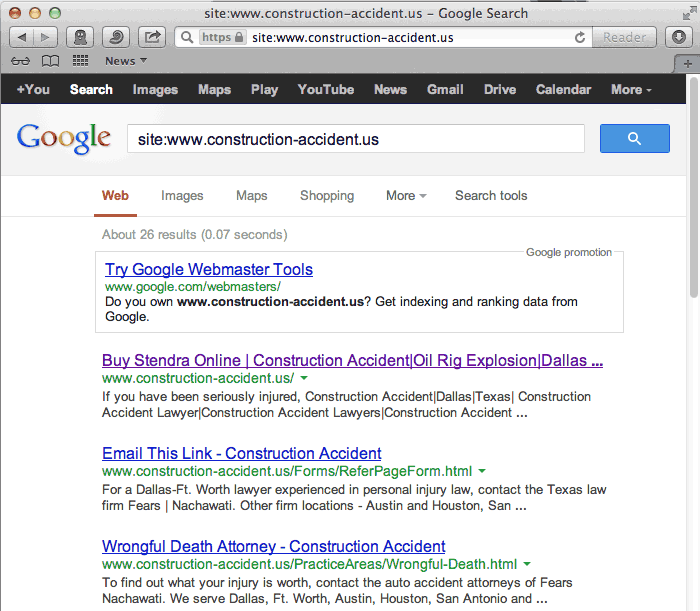
The first thing I did was start compiling a list of sites which have been compromised by this particular hack attack. To do this, I used Google’s site: command to get a listing of what my friend’s site looked like from Google’s point of view. The site: command can be used to get a list of how Google has indexed a site; for example, if you type

site:xeromag.com


into Google, you’ll see how it has indexed all the pages of my site. Next, I took unusual words and phrases from the pharma results in Google, and searched for those exact phrases. This gave me a list of tens of thousands of sites.

I then went down that list looking at each site. If I didn’t see any trace of the pharma spam keywords in the site, I did a second Google search, this time using that site and those same pharma spam keywords. I clicked on the Google link for those results and watched what happened. If I got redirected to a pharmacy page via a redirector at googl-analize.in, I knew it was the same attack, and I added that site to my list.

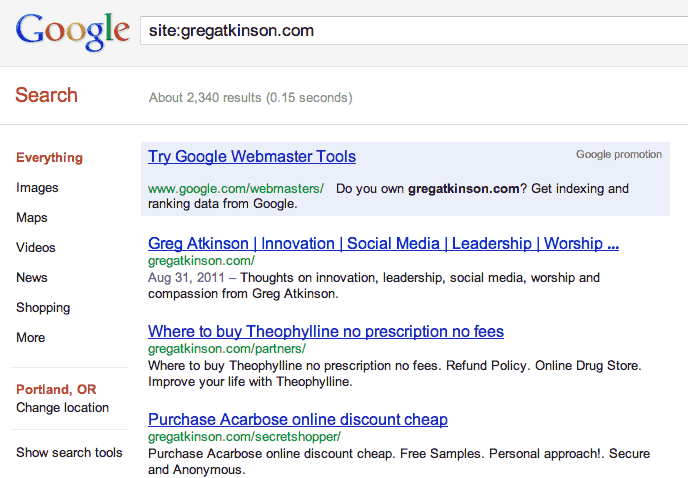
For example, here is what happens if you type

site:gregatkinson.com

(one of the hacked sites I found) into a Google search.

If you click on any of those links, you will not see any pharma spam. However, if you do the search AGAIN, this time using

theophylline site:gregatkinson.com

as your search term and you click on any of the links, you’ll be redirected to a pharmacy spam page.

Once I had built a list of affected sites, I then looked to see who their Web host was, and what content management software they were running. Nearly all of the sites were running WordPress, most of them fully updated and patched.

Nearly all. Not quite all, however. Some of the sites I found, I discovered, were running Joomla. This surprised me, and I think it helps rule out a zero-day exploit in WordPress as the attack vector. unless we are to believe that this one group of hackers has found and is exploiting identical zero-day flaws in both WordPress and Joomla and are attacking them the same way, which is possible but unlikely, I think the logical conclusion is that the attack vector is somewhere else.

Here’s the list of hacked sites that have all been attacked by he same person or persons who attacked my friend’s site that I’ve compiled so far:

www.corneliamarie.com (host: cloudflare.com)
truflun.net (host: bluehost.com)
www.leeloo.com.au (infected shopping cart too; using old WP) (host: netregistry.com.au)
www.amigosdaterra.net (host: dinahosting.com)
www.frankadam.be (host: dreamhost.com)
www.veryediblegardens.com (not using WP?) (host: dreamhost.com)
www.kevjumba.com (host: dreamhost.com)
www.sfpulpit.com (host: dreamhost.com)
gregatkinson.com (host: dreamhost.com)
www.insidetheperimeter.net (host: dreamhost.com)
www.cbringen.de (using Joomla) (host: oneandone.net)
www.lethbridgesoccer.com (running Joomla) (Currently broken; redirect still works) (host: dreamhost.com)
www.theestateofthings.com (using outdated WP version) (host: dreamhost.com)
www.swearimnotpaul.com (using outdated WP) (host: blacknight.ie)
www.usmlerockers.net (not using WP) (host: ning.com)
culturevulture.net (using Joomla) (host: serverbeach.com)
blog.fnac.es (using outdated WP) (host: ovh.net)
log.thedom.net (host: all-inkl.com)
www.wearethenest.com.au (host: netregistry.com.au)
bbh-labs.com (host: Amazon EC2)
copdlifeexpectancy.org (host: theplanet.com)
blogs.panasonic.com.au (host: ultraserve.com.au)
www.primeradio.lk (host: tailoredservers.com)
www.timecrystal.co.uk/blog (host: fasthosts.co.uk)
ccccnsw.org.au (host: netregistry.com.au)
amigosdaterra.net (running Joomla) (host: dinahosting.com)
www.www-sante.com (not using WP) (host: sivit.fr)
www.revolution.co.za (redirects to www.revolution-daily.com if not coming from Google pharma search) (using old WordPress version) (host: godaddy.com)
liga.es (host: ovh.net)
www.thesheaf.com (host: bluehost.com)
www.panamaturismo.com (host: nationalnet.com)
www.nativeco.com (host: mediatemple.net)
juanelear.com (host: serveraxis.com)
www.procrastinando.com.br (host: locaweb.com.br)
www.homofotograficus.com (host: theplanet.com)
www.mikelovesbeer.com (host: appliedi.net)
ozmonmedia.com (host: singlehop.com)
soloenmexico.com.mx (host: theplanet.com)
www.unreliablewitness.com (host: 34sp.com)

Unless otherwise noted, the sites are running current WordPress installs.

As of yesterday, each of these sites would redirect via www.googl-analize.in to pharma spam sites. However, interestingly, starting today I began noticing that the same sites were no longer redirecting through this site, but were instead redirecting through http://sliceblogz.com.

*** WARNING *** WARNING *** WARNING ***
The sites googl-analize.in and sliceblogz.com are live as of the time of this writing. It appears that visits to this site result in blank pages unless the http-headers are set exactly right. However, these are sites that are being used in current hack atacks against many Web sites. I do not recommend visiting them.


I also discovered something else interesting. When I did Google searches for the exact phrases used in the WordPressand Joomla pharma spam hack attacks, many of the results I got were blog comment spam on various blogs. The blog comment spam is pretty straightforward; it was just your average, run-of-the-mill “buy cheap drugs here” rubbish with a link to a Web site.

The blog comment spam linked to http://dwnloadz.in/idi.php?sid=25. I suspected that the blog comment spam was being done by the same hacker who was attacking WordPress and Joomla sites, based on the fact that the blog comment spam and the cloaked Google spam were using exactly the same phrases, including in some cases the same typographical errors and misspelled words.

Those suspicions were confirmed when I did a Whois lookup on both sites.

whois googl-analize.in

Domain ID:D5239480-AFIN
Domain Name:GOOGL-ANALIZE.IN
Created On:16-Aug-2011 08:12:26 UTC
Last Updated On:16-Aug-2011 08:12:27 UTC
Expiration Date:16-Aug-2012 08:12:26 UTC
Sponsoring Registrar:Directi Internet Solutions Pvt. Ltd. dba PublicDomainRegistry.com (R5-AFIN)
Status:CLIENT TRANSFER PROHIBITED
Status:TRANSFER PROHIBITED

Registrant ID:TS_16281729
Registrant Name:Anatoly Vasserman
Registrant Organization:N/A
Registrant Street1:main str. 1
Registrant Street2:
Registrant Street3:
Registrant City:Chelyabinsk
Registrant State/Province:
Registrant Postal Code:454047
Registrant Country:RU
Registrant Phone:+7.3517229247
Registrant Phone Ext.:
Registrant FAX:
Registrant FAX Ext.:
Registrant Email:anvsrmn@gmail.com

Name Server:NS1.REGWAY.COM
Name Server:NS2.REGWAY.COM

whois dwnloadz.in

Domain ID:D5093036-AFIN
Domain Name:DWNLOADZ.IN
Created On:07-Jun-2011 20:49:13 UTC
Last Updated On:07-Aug-2011 19:20:19 UTC
Expiration Date:07-Jun-2012 20:49:13 UTC
Sponsoring Registrar:Transecute Solutions Pvt. Ltd. (R120-AFIN)
Status:CLIENT TRANSFER PROHIBITED

Registrant ID:TS_16281729
Registrant Name:Anatoly Vasserman
Registrant Organization:N/A
Registrant Street1:main str. 1
Registrant Street2:
Registrant Street3:
Registrant City:Chelyabinsk
Registrant State/Province:
Registrant Postal Code:454047
Registrant Country:RU
Registrant Phone:+7.3517229247
Registrant Phone Ext.:
Registrant FAX:
Registrant FAX Ext.:
Registrant Email:anvsrmn@gmail.com

Name Server:NS1.REGWAY.COM
Name Server:NS2.REGWAY.COM

It seems pretty clear to me that the same person is responsible both for blog comment spam and also for these attacks on WordPress and Joomla. It also seems to me that this person is quite busy tending his network of hacked sites; the behavior of the sites (now redirecting via sliceblogz rather than googl-analize.in, for instance, shows that he is able to make changes to the sites he hacks after the attack code has been installed).

The sliceblogz site is protected by private whois registration. It seems unlikely, though, that “Anatoly Vasserman” is the attacker’s real name.


Yet another surprise came when I examined the code that the hacked sites fetch from googl-analize.in (and presumably now from sliceblogz.com. It’s difficult to get; the code in hacked sites that fetches the content does so using specially crafted HTTP headers, and the site returns a blank page if it doesn’t see those headers.

Fortunately, a friend of mine recently showed me how to use wget to create arbitrary headers. When Google indexes a hacked site, the modified code serves a special page to Google’s spider; here’s what it serves up.

Cut for technical stuff

WordPress Under Attack

Note: followup to this entry here

A couple of weeks ago, a good friend of mine who runs a number of WordPress blogs received an email from Google. The email told him that Google had delisted his entire site from its search engines for pharmacy spam.

Now, his site is a collection of short stories and blogs about movies he’s making, with sections about filmmaking and special effects on the cheap, so the notion that it was being used to distribute pharmacy spam was a bit…surprising. Especially when the site appeared just fine to anyone who visited it.

I offered to take a look at the site, and what I found is a complex, rapidly-evolving attack against WordPress installations that’s highly sophisticated, difficult to detect, and difficult to defend against. It is currently exploiting the most up-to-date version of WordPress with all current patches applied, and as of the time of this writing it’s still ongoing.


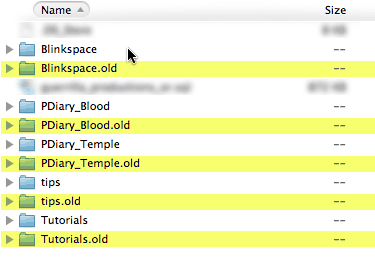
When my friend was first notified of being delisted from Google, he looked at his site using an FTP program. One of the very first things he noticed is that the WordPress install directories had all been duplicated, with the duplicates having “.old” appended to the name.

Careful examination of each WordPress install folder and its corresponding .old folder revealed a difference in a key file called “post-template.php”, which is part of the core of WordPress and lives in the WordPress wp-includes directory. This file is responsible for taking a blog entry from the database, formatting it, and passing it along to the template.

As of WordPress 3.2.1, the post-template.php file is supposed to be 42,164 bytes long. The post-template.php file in the hacked installs was more than twice as big–89,524 bytes long. I took a look inside the modified post-template.php file and found that it had been extensively modified by the addition of a great deal of heavily obfuscated code.

Cut for detailed technical analysis of the modified WordPress file

Welcome to Earthlink, where security is something we…wait, what does that word mean again?

Welcome to Earthlink LiveChat. Your chat session will begin in approximately 1 minutes. Feel free to begin typing your question.
‘Michael’ says: Thank you for contacting EarthLink LiveChat, how may I help you today?

Me: You have been hosting a “phish” page that is intended to steal sensitive financial information from people for more than two months.

Me: Repeated emails to your support and abuse addresses have been ignored.

Me: Months later, the phish site is still active on your network.

Me: Who do I need to call to get you to take responsibility and clean up your network?

Michael: What phishing site are you referring to?

Me: http://aolqr.com/_cqr/login/?Login=&Lis=10&LigertID=1993745&us=1

Me: Went live on June 18, first notified abuse about it on June 20, have since sent a number of emails to support and abuse addresses.

Michael: Have you tried to contact 1-800-955-0186?

Me: I have not. Is this standard accepted practice for notifying Earthlink of phish sites?

Me: Can you explain why your abuse and support email addresses don’t appear to be read?

Michael: What abuse address are you sending the reports to?

Me: abuse@earthlink.net, support@earthlink.net

Me: These are the abuse addresses defined in the ARIN Whois information and at abuse.net

Michael: I am not sure why our Abuse department has not responded, but it is best you contact the number I gave you

Me: OK, I will give them a call. Let me say, though, that I am extremely disappointed by Earthlink’s lack of responsiveness and willingness to permit this kind of flagrant network abuse.

Chat session has been ended by the agent.

Welcome to Earthlink LiveChat. Your chat session will begin in approximately 2 minutes. Feel free to begin typing your question.
Please hold for an agent. While you are waiting, please feel free to begin typing your issue in the box below. Try to be as descriptive as possible. Once an agent is assigned to the chat, click SEND to transmit what you have typed.
‘Michael’ says: Thank you for contacting EarthLink LiveChat, how may I help you today?

Me: I just spoke to you about the phish site you were hosting. The 800 number you gave me to call directed me to a recording telling me to use the support chat, and disconnected.

Me: So, your abuse email doesn’t work and neither does the phone number. Any other ideas?

Michael: Can you please try again

Me: Try the phone number again?

Michael: i am not sure why you cannot connect to the number I gave you, as we have persons right now ready to take your call

Michael: yes

Me: I’m calling right now, ending up in a voicemail system. I am not an existing customer, I have not recently placed an order.

Michael: What is the system asking you for?

Me: The phone number associated with my account.

Michael: Just provide your phone number

Me: I say “none,” and I hear a recording about “We are experiencing high call volumes. Please call back later or use our online support at support.earthlink.net”

Michael: Try 1-888-3278454

Me: Ah, now someone is on the phone.

Michael: great

Michael: Thank you for using EarthLink LiveChat. Should you need further assistance, please contact us again.

Chat session has been ended by the agent.

(A long and frustrating conversation ensues, in which I try to explain to a person whose native language is not English what a “phish” site is and what the Web domain in question is)

Guy on phone: I do not see anything on that Web site.

Me: The top level of aolqr.com doesn’t give you anything but a 403 Forbidden. You have to go to http://aolqr.com/_cqr/login/?Login=&Lis=10&LigertID=1993745&us=1 to see the phish.

Guy on phone: Please hold.

Bad hold music plays…

Guy on phone: What company are you working for?

Me: Huh?

Guy on phone: I have been instructed to ask, what company are you working for? What is the name of your company?

Me: I’m not working for any company. I’m trying to tell you about a phish site on your servers.

Guy on phone: Please hold.

More bad hold music plays…

Guy on phone: I have spoken to our engineering team. They have inactivated the Web site.

Me: *does a little dance*


Seriously? This is abysmal. A (quasi-)reputable Web hosting firm that allows phish sites to remain active for months on its network, doesn’t pay attention to abuse reports, and makes people call on the phone to report phish pages? Now that estdomains.com is no longer the bad guys’ go-to for one-stop Internet fraud, it’s nice to see a domestic company like Earthlink stepping in to fill the gap.

I suppose I shouldn’t attribute to malice what can adequately be explained by stunning, jaw-dropping, jesus-christ-you-have-got-to-be-kidding-me incompetence, but still. Past a certain point, any sufficiently advanced incompetence is indistinguishable from malice.

Welcome to Web 2.0

I don’t read TechCrunch.

For that reason, I’m always the last to know about hot new Web 2.0 dot-com startups. I usually don’t find out about them until I start seeing their names in Russian pill spam, or run across them when someone posts a link to a virus downloader promising hot free young Latvian girls in one of my blogs. I look at the spam link, Google the name of the company hosting the spam, and invariably discover that it’s the trendiest new dot-com property this side of the Great Firewall of China, with $42 million in venture capital in the bank and table tennis on the roof.

Some of these companies are more over-the-top than others. There’s a brand-new startup called Hipster.com which is–I swear I’m not making this up–offering new hires a years’ supply of beer to go with their $10,000 signing bonus.

What these companies never advertise for, it seems, are folks with a background in security.

And so, they get pwn3d, like the has-been startup founded by Marc Andreessen of Netscape fame called “Ning.” Ning was supposed to revolutionize social networking. After burning through all its capital with virtually nothing left to show for it, Andreessen bailed, and it is now little more than a shell for Russian virus downloaders, as I’ve mentioned before. The virus droppers I talked about a year and two months ago? Most of them are still active. Lights are on, but nobody’s home.

So it is with companies like Flavors.me and Box.net, started with equal parts naïveté and hope. I didn’t know about either company until I started getting pharmacy spam advertising URLs on their servers, and discovered with a quick Google search that they’re overrun with it.

Right now, as I type this, Box.net has about 40,000 Russian pharmacy redirectors living on its servers. I have a bit of a soft spot for Flavors.me, because I wrote them an email to let them know they have about 3,800 spam pharmacy redirectors on their site, and actually got an email back from a person who, according to her company profile, went to the same little liberal arts college I went to in Florida…but they still haven’t got a handle on the situation. I’ve been checking over the past few days, and the number of spam redirectors on their servers is, according to Google, increasing at the rate of about ten an hour, which probably means there’s a whole lot more that Google isn’t finding.

So in the efforts of public service, I’ve created this handy-dandy flowchart detailing the life cycle of a hot new Web 2.0 startup. This seems to be about the way that nearly all of them go–at least the ones that create a lot of buzz by spending a ton of investment capital and getting written up in TechCrunch before they even go live.

You can click on the picture for a much bigger version. Enjoy!