seinneann-ceoil last week.


seinneann-ceoil last week.
So, let’s say you were a fan of 80s music. And let’s say you weren’t terribly particular about which 80s music you liked; if it was recorded in the 80s, it’s all good.
And let’s further propose that you’re a fan of Metallica’s particular brand of pop-mental, too, while we’re at it.
Well, then, if this is you, rejoice! Your ship has arrived!
This video is a mashup of the Journey song “Don’t Stop Believing” set to the music of Metallica’s “Enter Sandman.” And that combination fits surprisingly well, for some value of “well” that means “for the love of God, make it stop! My ears are bleeding!”
So apparently, the vast, slowly capsizing shambles that is the Yahoo online empire has a dating and personals section.
I suppose I should have guessed that Yahoo has a dating and personals section. Everyone has a dating and personals section. The Onion has a dating and personals section. Hell, the Web site for the Southern Baptist Convention probably has a dating and personals section, though frankly I can’t be arsed to look, and it’d probably make my eyes bleed if it does.
The Yahoo dating and personals site recently ran an article that’s totally a testament to Yahoo as a whole, in a gruesome kind of way. The article is 10 things a good boyfriend won’t ask you to do, and boy, is it a doozy.
 Among the gems on this list of things you must never ask your girlfriend to do are things like #4, “Make him a sandwich,” or #5, “Change your relationship status on Facebook,” or my own personal favorite, #10, “Grow our hair long.”
And it seems to me that if these are the worst trials you ever face in your relationship life, then you’re doing pretty damn well.
I am firmly of the belief that it’s always OK to ask your partner for anything you want; indeed, I think that a whole lot of people might be a whole lot happier, and a whole lot of unnecessary suffering and angst might be avoided, if folks actually spent more time asking for the things they wanted and wouldn’t be so damn scared of doing it.
But I can kinda see where the article is coming from. The people who wrote it are making an assumption, and I bet it’s probably a fairly common one, that poisons and distorts their perceptions of what it is and is not OK to ask for.
It’s perfectly OK to ask your partner to make you a sandwich, or cut your hair, or even have a mad passionate kinky threesome with the captain of the Brazilian women’s volleyball team, provided that you don’t have an expectation that the answer must be “yes.”
And that is an important distinction, i think.
 Expectation will fuck you up.
If the Yahoo article had been titled “10 Things Your Boyfriend Shouldn’t Expect You To Do Just Because He Wants You To Do Them,” I wouldn’t have any complaints about it.
Now, before I keep going, I want to pause a minute and say that I don’t think that all expectations are necessarily wrong. There are many expectations that seem reasonable and healthy to me. I expect that my friends won’t punch me in the nose without provocation, steal my car, pee on my cat, or set fire to my sofa. I have an expectation that my romantic partners won’t drain my bank account and spend all the money on Mexican hookers and cheap booze.
And in a more general level, I find that life is a lot happier when I keep my expectations positive. I expect to be surrounded by love and intimacy; I expect the world to be filled with joy and abundance; I expect to be able to succeed at things I apply myself to.
So not all expectation is bad.
But still…
A couple of weeks ago, I was talking with a friend at a poly get-together about what factors make someone successful in finding relationship partners.
 His approach, he said, was not to approach anyone he found interesting, out of concern for how she might interpret it. He was worried about coming across as that creepy guy…you know the one I mean, the overbearing guy who stomps all over boundaries with heavy cast-iron boots, the guy who at best makes women cringe when he’s around and at worst radiates off stalker vibes for forty aces around him wherever he goes.
And that got me to thinking. Because when I find someone interesting and shiny, when someone catches my eye (or, occasionally, the back part of my brain) and makes me sit up and take notice, I generally say so. Even if that person is, say, a cute, smart server at a Pizza Hut who, when asked to define the word “orgy,” thinks about it for a while and then says that while an orgy in its simplest form is just a bunch of people all having sex in the same room, for her it carries connotations of cross-couple sex.
But I digress.
Anyway, I tend to be very open with people I find interesting; if I have a bit of a crush on someone, I’ll say “Hey, you’re pretty cool! I think I have a bit of a crush on you.” And I can’t really recall having a bad response to that.
So that got me to thinking about why it is that some people who do this seem to come across as creepy, and get negative reactions; and some people who do this don’t come across as creepy, and get positive reactions. I’ve been chewing on this for weeks, and talking to people about it, and I think that a lot of it comes down to expectation.
Now, not ALL of it is about expectation. I was talking about this with seinneann-ceoil while she was in Portland visiting me last week, and her take on it is that a lot of how people react comes down to matters of attitude and confidence.
 I actually met seinneann-ceoil in person for the first time when I was in Orlando after DragonCon/ We’d been talking online, and joreth and I had an opportunity to meet up with her in a coffee shop at a bookstore for a while. We talked for an hour or two, and about twenty minutes in I realized that she had that certain spark I really look for–smart, strong-willed, eloquent, able to take a position on something important to her and talk about it passionately. So as we were leaving, I told her, “You know, I think I have a crush on you. I really dig you and I’d love to stay in touch if that’s something you might like.” We stayed in touch, it was something both of us liked very much indeed (oh, yes, we did), and she came up to visit last week.
I believe that had I not said anything, we might have had an interesting couple of hours, talked for a while, gone our separate ways, and that would’ve been it. There is something to the idea that confidence is important; in fact, I talk about that so often in this journal that it’s nothing you all haven’t heard before.
Attitude is important too, no doubt about it. seinneann-ceoil says that there’s a huge difference between a person who feels attracted to someone and responds with joy (“Hey, here’s a cool person I feel I connect with, isn’t that awesome? I can’t wait to see if that person feels the same way about me, and we can see if there’s something the two of us can explore!”) versus someone who responds with trepidation (“I feel this connection with this person…what do I do? What if she doesn’t like me? What do I say? Should I say anything? Man, this really sucks!”). Treating other people as a source of wonder and opportunity is likely to be more successful than treating other people with fear and hesitancy.
And I totally, 100% agree with all of that. But it still seems like there’s a piece missing, and I think that piece is in the expectations we attach to other people when we tell them we fancy them.
 Shelly feels, and I agree, that people who say things like “I like you” or “I have a crush on you” often attach an implicit, unspoken expectation to the end of it: “…and I want you to do something about that, and I’ll be upset if my expectation isn’t met.” Even though it’s not said, that tacit expectation hangs in the air, tangible to the person hearing the “I have a crush on you,” and it creates discomfort.
She also says that that expectation gives no room for reciprocal interest; the expectation is that the person who hears “I have a crush on you” will return the feeling, regardless of whether or not it’s true.
And, most interestingly I think, she believes that when a person is attracted to someone because of some trait (beauty, say) that doesn’t make it easy to gauge reciprocity, the tacit expectation becomes even more uncomfortable. If two people talk for a couple of hours, it’s usually pretty simple to tell whether or not there’s any reciprocal interest at all; when one person spots a pretty young something something from across the room, it’s not.
Regardless of how the connection forms or whether or not it’s reciprocated, though, it seems that there is a clear difference between someone who says “I have a crush on you” with an unspoken “…and now I expect you to do something about it” and someone who doesn’t. As Zen as it sounds, if that expectation is there, it leaks out.
People don’t much cotton to having expectations imposed on them without their consent, it seems.
So a key ingredient to approaching people and expressing interest is to do it without the assumption that interest on your part constitutes an obligation on their part. I don’t know any way to fake that; in fact, I’m not even entirely sure exactly how unspoken expectations get communicated, but they do.
So, going back to the subject of reasonable and unreasonable expectations, it seems to me that expectations fall into one of three broad camps. There’s expectations we place on other people, expectations we place on the world at large, and expectations we place on ourselves. Any of the three can be positive or destructive.
For example, placing expectations on people simply because we like them is probably not cool, though expecting other people to treat us with a certain measure of respect as reasonable adults seems healthy and positive to me. “I expect that you will be fairly decent to me and not punch me in the nose without provocation” is probably good; “I expect that you will go out with me because I think your pretty” is probably bad.
Similarly, “I expect that I will be surrounded with opportunities for joy” is probably a healthy way to engage the world, at least for those of us not born in North Korean forced labor camps. (If that sounds like it’s coming from a place of privilege, it probably is, but not necessarily in the ways that you might think; studies have shown that people living in poor Third World countries like Nigeria are often happier than people living in First World countries, so the opportunities for joy are not necessarily available only to the wealthiest. That’s probably a topic for its own essay, though.) “I expect that I will have everything I want” is probably not so good.
When it comes to the expectations we place on ourselves, “I expect to be able to do well at the things that I work at” is, it seems to me, a positive and healthy thing. “I expect to be able to understand my own emotions and to be able to behave reasonably even when i am experiencing stress” also seems reasonable to me. “I expect to fail at everything I do” is probably not so good; and, on the flip side of the same coin, “I expect to succeed at everything I try the first time I try it” is probably not so good either. “I expect that I will never feel any negative emotion, and that if I do, I am a failure” is a particularly insidious and toxic one.
I’ve written before about why I am not a Buddhist, in that I think detaching one’s self from all desire and all expectation can make for passivity. But I think there’s something to the notion of detachment from expectation, at least from expectation that is unrealistic, imposes an unasked-for and non-consensual burden on others, or both.
And I think that once you’ve done that, telling someone you fancy “hey, I fancy you” has entirely different results.
seinneann-ceoil spent the last ten days or so here in Portland, where it is cold and wet, rather than in Orlando, where it is sunny and warm, and I think we had a good time in spite of the rain and the slop.
She’s very passionate about music, and listens to a lot of music I’ve never heard of. One of the bands she introduced me to while she was out here is called Gorillaz, and one of their songs has been stuck in my head ever since.
They have a YouTube channel and several videos up on YouTube. Unfortunately, they don’t permit embedding of their videos, which I for one think is a profoundly stupid misstep on their part.
I could rant at length about why it’s profoundly stupid for a band to disallow embedding their videos, and how putting a link in a blog will probably result in lower exposure, and how the business model for Internet videos is more about exposure to a new audience than it is about advertising revenue, and about how the ads are embedded in the video so advertising revenue is only minimally impacted by embedding anyway, or even about how it doesn’t matter to Google one way or the other because Google’s already won the online ad revenue game and is just allowing the Great Unwashed Masses to fight over the table scraps it’s too lazy to pick up off the floor, but I’m feeling kind of melancholy today and I just don’t feel like it.
Instead, I’ll talk about what I like about the band and the video.
I really, really like their music. A lot. It’s an interesting mix of different vocal styles, the music is kinda funky and kinda dancey, and the emotional tone of the song that’s been stuck in my head all morning matches my mood pitch-perfect right now.
The song is Feel Good Inc. and the video that accompanies it is an animation of a narow slice of a post-apocalyptic world that reminds me a great deal of Nelvana, the animation studio that did Rock and Rule and the animated bits of Pink Floyd The Wall.
I’d love to show you the video, but, like I said, embedding is disabled. The best I can offer is a link, which I highly encourage you all to check out. Gorillaz: Feel Good Inc.

I have a love/hate relationship with WordPress.
Actually, that’s not true. I like WordPress rather a lot, and I wish that more open-source projects had the finish, polish, and sophistication of WordPress. I own about a half-dozen Web sites that run it, and I’m overall very fond of it.
What I don’t like is the number of people who set up a WordPress install, then walk away from it and never install any updates or security patches. WordPress is a popular target for hackers, because it’s widely deployed and easy to find, and because so, so many people don’t keep on top of updates.
Which, frankly, baffles me. It’s incredibly easy to update–easier, in fact, than any open-source server software I’ve ever used. You log in to the admin area. It tells you “There is an update. Click here to install the update.” You click one button. Bang, that’s it! There literally is nothing else you have to do.
So, anyway, today I found yet another phony bank phish in my email. The phish pretends to be an HSBC Bank page, and it attempts to trick the gullible into handing out their bank account number and password. So far, so bog-standard.
*** WARNING *** WARNING *** WARNING ***
The URLs in this post are live at the time of this writing. They do not lead to malware sites, but they DO lead to phony bank phish sites.
The phish page in my email lives at
It’s a pretty bog-standard phish, a page living on a hacked server that collects personal financial information and then sends them off to the phishers via a php-to-email script.
The server that it lives on,
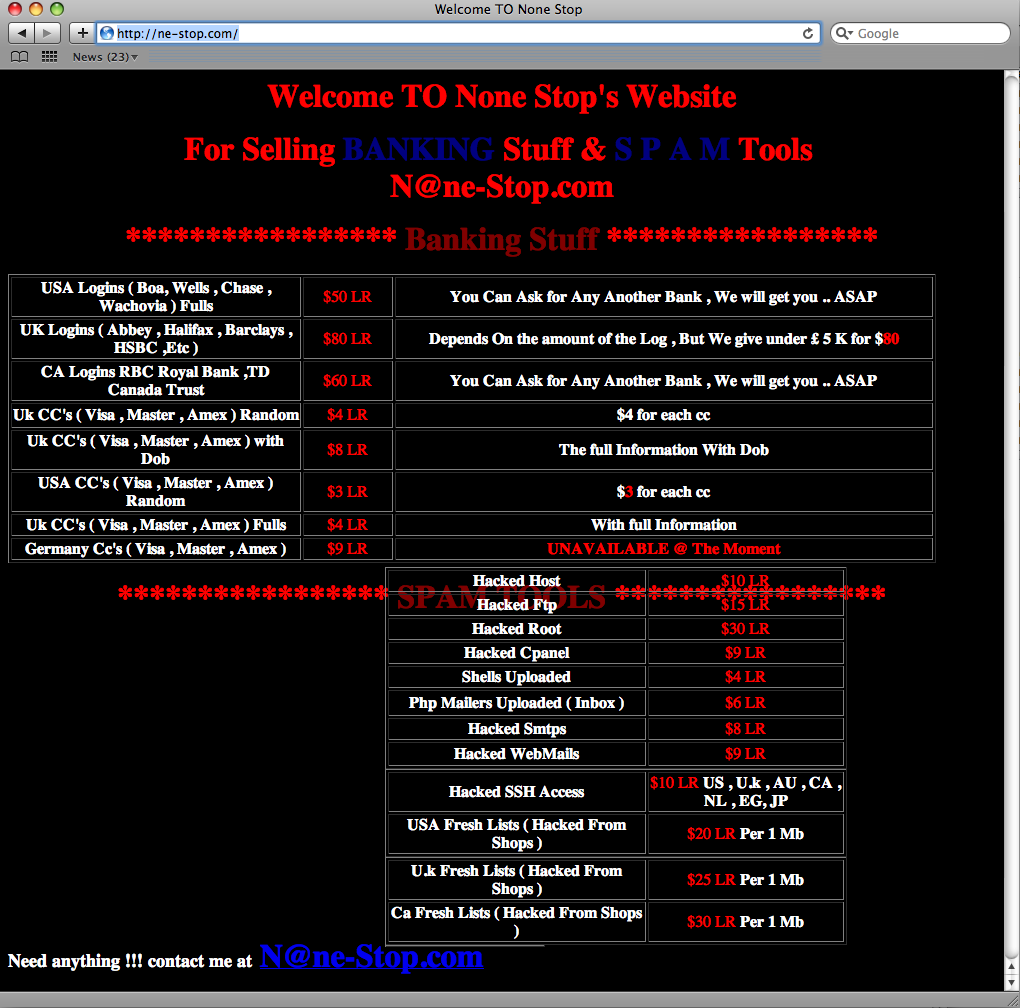
The site itself is completely defaced. The defacement left a hole big enough to drive a truck through, and the phishers put the phony bank page on the site after the person or group who defaced it hacked it and left it wide open. EDIT: The site defacer, who goes by the name “NONE-STOP,” is also a phisher who sells stolen credit card numbers, stolen bank account login information, and other stolen identity information. More at the end of this post.
The front page of the hacked site, as of the time of this writing, looks like this (click for larger):

I haven’t heard of NONE.STOP, whoever he/she/they are; as near as I can tell, there’s only one other site defacement (
Now is where it gets interesting, and where WordPress comes in.
Normally, when a site is defaced, the images that are used in the defacement are uploaded to the hacked server. Not in this case. In this case, the images used in the defacement are being remote loaded from another server.
A hacked WordPress install, that was set up a while ago, had a single test post added to it, and was abandoned.
Specifically, the images used in the defacement are being loaded from
and so on. The Web site
The site
$whois devriestree.com
Whois Server Version 2.0
Domain Name: DEVRIESTREE.COM
Registrar: GODADDY.COM, INC.
Whois Server: whois.godaddy.com
Referral URL: http://registrar.godaddy.com
Name Server: NS.NETVTECH.COM
Name Server: NS1.GEODNS.NET
Name Server: NS2.GEODNS.NET
Status: clientDeleteProhibited
Status: clientRenewProhibited
Status: clientTransferProhibited
Status: clientUpdateProhibited
Updated Date: 21-oct-2008
Creation Date: 19-oct-2005
Expiration Date: 19-oct-2010
Registrant:
NetVenture Technologies, Inc.
1490 S Military Trail
Suite 13E
West Palm Beach, Florida 33415
United States
Registered through: GoDaddy.com, Inc. (http://www.godaddy.com)
Domain Name: DEVRIESTREE.COM
Created on: 18-Oct-05
Expires on: 19-Oct-10
Last Updated on: 12-Jul-07
Administrative Contact:
DeVries, James j@netvtech.com
NetVenture Technologies, Inc.
1490 S Military Trail
Suite 13E
West Palm Beach, Florida 33415
United States
5613016666 Fax — 5618288035
Technical Contact:
DeVries, James j@netvtech.com
NetVenture Technologies, Inc.
1490 S Military Trail
Suite 13E
West Palm Beach, Florida 33415
United States
5613016666 Fax — 5618288035
Domain servers in listed order:
NS1.GEODNS.NET
NS2.GEODNS.NET
NS.NETVTECH.COM
The Web site at
Folks, seriously, update your WordPress installs. It’s automatic and effortless.
EDITED TO ADD:
The person who defaced the Web site and who is storing his images on hacked WordPress sites has a Web site of his own, through which he sells stolen credit card numbers, phish kits, stolen bank account information, and so on. His Web site is at
hosted by Hurricane Electric.
$whois ne-stop.com
Whois Server Version 2.0
Domain Name: NE-STOP.COM
Registrar: REGISTER.COM, INC.
Whois Server: whois.register.com
Referral URL: http://www.register.com
Name Server: NS1.HE.NET
Name Server: NS2.HE.NET
Name Server: NS3.HE.NET
Status: clientTransferProhibited
Updated Date: 12-jan-2010
Creation Date: 11-jan-2010
Expiration Date: 11-jan-2011
>>> Last update of whois database: Mon, 18 Jan 2010 07:57:57 UTC <<< Registration Service Provided By: Hurricane Electric Internet Services Contact: hostmaster@he.net Visit: hurricanenames.net Domain name: ne-stop.com Registrant Contact: Ladde Weiong Ladde Weiong () Fax: 125 Club Garden Road Sheffield, S11 8BW GB Administrative Contact: Hurricane Electric Internet Services Hostmaster he.net (hostmaster@he.net) +1.5105804100 Fax: 760 Mission Court Fremont, CA 94539 US Technical Contact: Hurricane Electric Internet Services Hostmaster he.net (hostmaster@he.net) +1.5105804100 Fax: 760 Mission Court Fremont, CA 94539 US Status: Locked Name Servers: ns1.he.net ns2.he.net ns3.he.net Creation date: 11 Jan 2010 11:56:14 Expiration date: 11 Jan 2011 11:56:14 As of the time of this writing, the front page of the site looked like this (click for larger):
No, I’m not going to write a review of the movie. There are reviews already posted all over the place, and for the most part, anything I could write in a review has already been said. Gorgeous scenery, check; incredible CGI characters, check; plot that’s very similar to Dances with Wolves, check; incredible, nearly obsessive-compulsive attention to detail, check; oodles of money, check.
Instead, I’m going to talk about just one thing about the movie, that really has nothing to do with the plot or the characters or the story. But first, I need to back up a bit. And by “a bit,” I mean “about thirty-five years.”
Back when I was a kid, I used to watch a whole lot of Saturday morning TV fare. And one day, when I was probably about six or eight years old or so, I caught a TV program about a group of people exploring space in a spaceship. This was, and is, a subject dear to my heart, and is just about bound to get my attention, so I watched it.

In the show–I don’t remember what it was called–there was a scene in which the captain ordered the crew to change course, so the navigator got out a slide rule and started plotting a new course. Now, I was about six or eight at the time, as I’ve mentioned; I didn’t yet have my first computer (in fact, microcomputers were still quite some number of years away, which probably dates me); I’d never even seen a computer, though I’d heard of them and knew that they were the size of basketball courts and used punched paper cards.
And still, that scene felt jarringly, obviously wrong to me. I had no idea what a computer might be like, and could not have hoped to describe what a computerized spacecraft might look like, but I knew that in the future, if we had faster-than-light spacecraft and we were voyaging to the stars, we were not going to be using slide rules.
 Early on in the movie Avatar, there’s a scene where the main character and several other newcomers to the planet load up onto a shuttle for their trip down to the surface. We see, very briefly, a shot of the shuttle’s flight deck as the flight crew fires it up and gets read to descend.
As the flight crew does their thing, the instruments come to life, surrounding the pilot with a holographic heads-up display of all this instrumentation and information. Later, as he makes his final approach, part of the heads-up display slides aside to give him an unobstructed view out the cockpit window. (I cant find a shot of that particular scene, more’s the pity.)
That is one of the places where this movie succeeds brilliantly, and it instantly makes every science-fiction movie that we’ve seen ’til now look like a bunch of blokes fumbling around with slide rules.
One of the things that separates good writing from bad writing is attention to detail. In the case of science fiction, one of the details that separates good writing from bad writing is an understanding of how people use technology.
Science fiction is not a good predictor of technology, of course; if the day comes when we have vehicles and spacecraft as capable as the ones in Avatar, they probably won’t look the same, and there will probably be all sorts of things the movie missed.
But on that day, I bet a shuttle pilot could watch Avatar and nod her head, and say “Yeah, I can see designing a cockpit like that,” without the same sort of jarring navigating-with-a-slide-rule thing I felt watching that TV show.
This is not true of most of the rest of science fiction. Take the new, “rebooted” Star Trek, for instance. The bridge of the Enterprise is pretty and all, but it seems to my eye to be lacking a certain…functionality.

Consoles that you have to stand behind. Flat, 2D control surfaces everywhere. Mechanical fixtures. Chairs without armrests. This is a set that was intended to be pretty, but was not designed with any sort of sense of how people in the future might actually use their technology. The first time I saw Avatar, that quick scene in the shuttle’s flight deck brought images of the Star Trek movie painfully to mind, and I cringed. There was an idea of “Yes, this makes sense, and why can’t other movies get this right?”
When I look at the bridge of the Enterprise now, it reminds me very strongly of the Lincoln Futura concept car, an outrageously expensive vehicle built in 1955 as a sort of exploration of how the future might go.
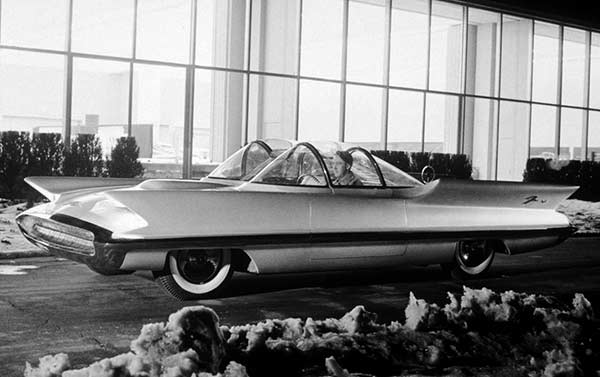
Apparently, the inability to think about how people interact with technology is not a failing unique to science fiction writers; the designers who thought this car up didn’t consider the possibility that perhaps two people who are riding together might want to…talk to each other.
Storytelling, especially science fiction, often succeeds or fails on the details, and in this particular case, these are details that Avatar does very well indeed.
So a few weeks back, zaiah and I went shopping, and found a bargain basement bin of B-movies (say that ten times fast!) for about five bucks each.
Some of the movies were cheesy old low-budget horror flicks that have been re-released on DVD by a company which uses a woman being ravished by a tentacle monster as their logo:
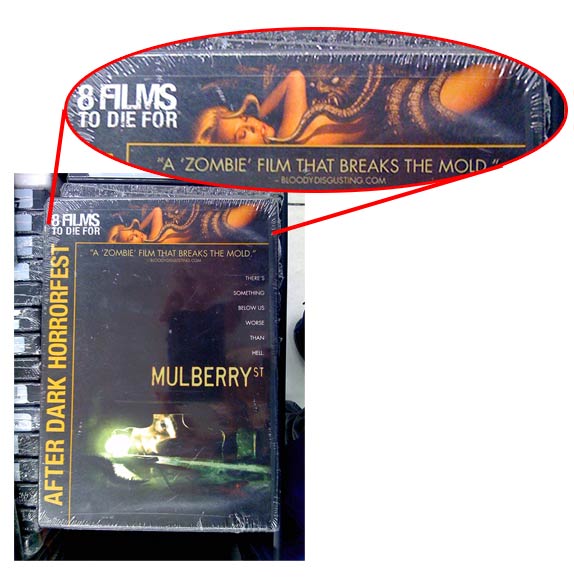
Now, I may be a purist, but I don’t think that anyone should be allowed to put a picture of a woman being ravished by a tentacle monster on the front cover of any DVD that does not actually contain scenes of a woman being ravished by a tentacle monster. That is DEFINITELY false advertising, it is.
I also think it’s kind of interesting that “woman being ravished by a tentacle monster” has apparently become kind of synonymous with “horror movie.” I <3 living in this society...