I’ve set up a Formspring account, which you can use to ask me anything!
Because you know you want to…
16

I’ve set up a Formspring account, which you can use to ask me anything!
I’ve just posted a quick rundown of the ten best things to put under the tree for the naughty people on your list over at weeklysextip.com — and I’m sure you’re all dying of curiosity to know what made the list. Check it out!
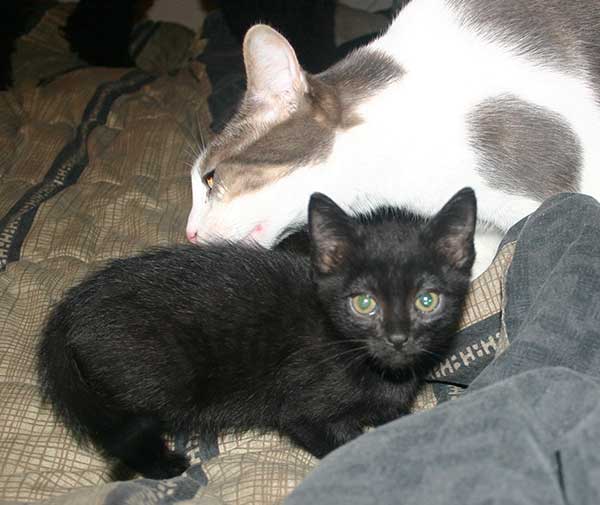
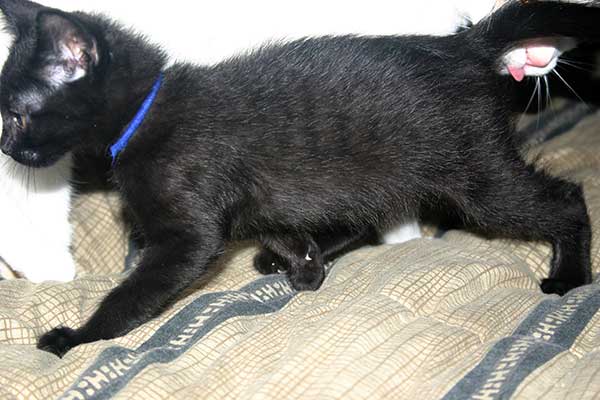
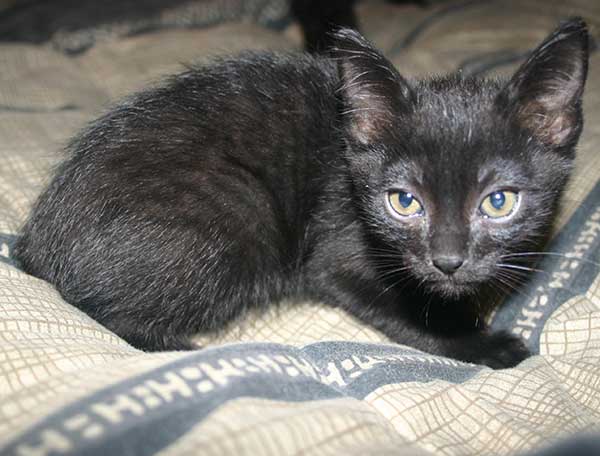
We have, through no fault of our own, kittens.
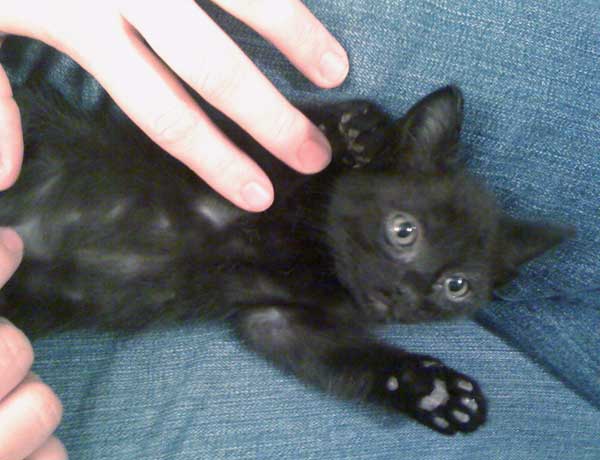
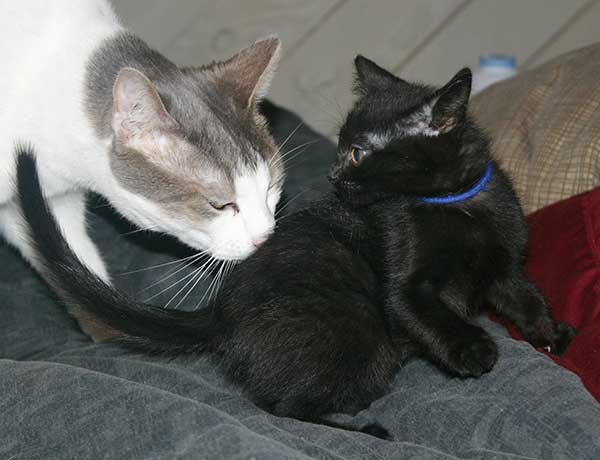
Six of them. All black. Five boys and one girl. One of the cats at zaiah‘s farm house got loose when she was in heat, and got knocked up almost instantly, so kittens! Six tiny fuzzy cute little tiny cute fuzzy little kittens!
They need homes. If you want one of these kittens, and you’re in or near Portland, let me know! My cat Liam, who is not included in this offer, loves them to death.
If you’ve ever run a small business, or done any accounting, you’re probably familiar with Intuit, the company that makes the popular QuickBooks accounting software.
Intuit does a lot of things other than QuickBooks, of course. They are also a business Web hosting company, a payroll tax service, a credit card merchant account company, a computer virus distribution network, and a marketing company, among other things. Not everyone knows about all the services they offer; in particular, their marketing and computer virus distribution services appear to be underrated.
Yep, you read that right. They distribute computer viruses.
Oh, not on purpose, I’m sure. They simply appear to run Web sites whose Webmasters don’t really seem to know a lot about Web security. Which would seem to be about par for the course these days, except that they..err, specialize in software that handles business financial information.
Which is a wee bit concerning, if you use Intuit and would like to feel reassured that they take the security of their network and servers seriously.
Now, to be fair, it’s not actually their main site that has the problem, at least not that I’ve seen so far. Instead, they run many “community” sites, and on some of these sites they appear to have a…relaxed approach to security and best practices.
*** WARNING *** WARNING *** WARNING ***
The URLs listed below are live as of the time of this writing. They WILL try to redirect you to sites that attempt to download malware onto your computer. DO NOT visit these URLs if you don’t know what you’re doing!
While cleaning out the contents of the spam trap on one of the WordPress sites I run, I spotted a large number of spam-trapped comments advertising FREE NUDE PICTURES with URLs of an Intuit-owned property,
This particular site, though, is overrun to a large degree even for sites that have security problems. The site itself allows users to create their own profiles, but it does not appear to sanitize the user-supplied profiles for things like JavaScript and it allows users to embed links and images in their profiles.
Which is, when you get right down to it, a recipe for disaster.
Anyway, the
A smattering of these profiles includes:
Some of these profile sites, unusually, redirect through TinyURL to to destination payload site; others redirect more conventionally, through traffic loader sites in a manner similar to the ones I’ve written about before.
The sites redirect through TinyURL or another traffic loader to several intermediates and eventually end up at a place such as
which offers free porn if you download a movie-player codec…which is, of course, a virus. (No free porn for YOU!)
Unsurprisingly, the payload site
In basic scope and layout, this is nothing but yet another Russian malware distribution network. There are only a few things about it that deviate at all from the bog-standard run-of-the-mill compromises I see every day. The first is that the compromised site is owned by Intuit, which makes me very nervous about how seriously they take computer security.
The second is that the phony profile pages that redirect to malware hide some of the redirection steps behind TinyURL redirectors such as
The third is that the phony profile pages are pulling images from various real porn sites. For example,
is grabbing a picture from
When I go to my taxes next year, I don’t think I’ll use Intuit.
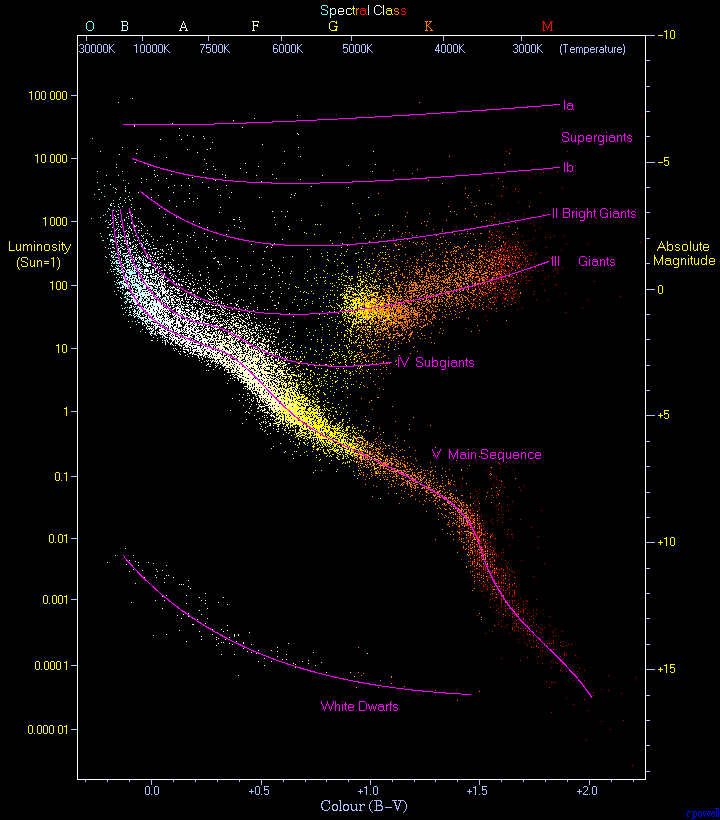
In the study of stellar evolution, there is this concept called the main sequence, a well-defined band that you see whenever you survey all the stars in the sky and plot their color on one axis and their brightness on the other. Not all stars fall into the main sequence, but the vast majority do; there’s even a lovely image of the graph here.
It seems the same is true of relationships. Stellar evolution and stellar nucleosynthesis map with remarkable fidelity onto relationships, I’ve observed, with a plot of “intensity of relationship” (as a function of emotional investment and expectation of continuity) vs. “sexual boundaries” showing patterns startlingly similar to the main sequence. At least to me.
So for example if you plot sexual boundaries horizontally and relationship intensity vertically, you might see something like this:
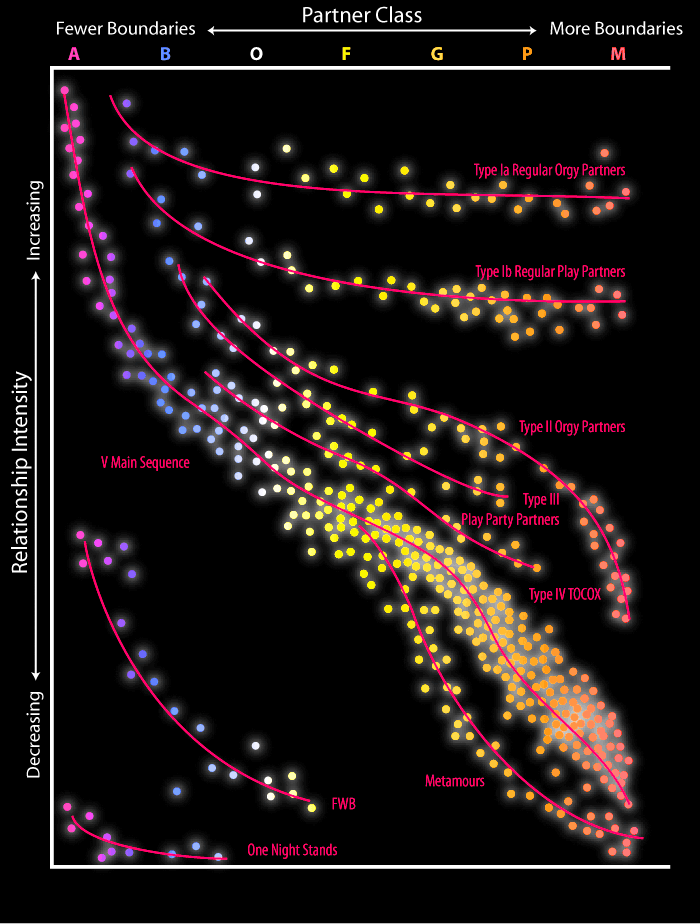
The sexual boundaries increase from left to right, with the classifications as:
A: Anything goes. Unbarriered, unprotected, full-on squishy fluid-bonded sex.
B: Barriers for anal and PIV sex
O: Unbarriered oral; no penetrative sex.
F: Fisting and/or fingering without barriers; barriers for anything else.
G: Gloves for fingering; no wet and squishy contact, even manual, without them.
P: Pants stay on; above-the-pants contact allows.
M: Makeout partners–no removing of clothing.
Now, not all the partners one can have fall in the main sequence. Along the top of the graph, we see partners distributed in Type Ia and Type Ib classifications: these are people you will schedule regular orgies with or a regular BDSM play relationship with, which may or may not involve sex (directly) but do involve a high level of emotional investment and commitment. Some of these folks might even be considered “family.”
If you’re part of the sex-positive community, you might go to orgies or play parties on a regular basis, and see the same folks over and over. These are folks you don’t necessarily have squishy sex with, but you might have some sort of irregular or semi-regular play/makeout relationship with. There’s not necessarily a high level of emotional investment, but you notice when you show up to a party and they aren’t there.
Type IV partners are most commonly found in poly relationships. These are the “Too Complicated To Explain” partners–they’re not necessarily partner partners, and they’re not necessarily part of the family, but they’re not not partners either…
A branch from the main sequence sometimes occurs for metamours, who a person might have some sort of sexual relationship with, but might not continue if that person’s partner breaks up with that person, but then again, sometimes these relationships do continue on their own, and…yeah, it’s complicated. Past a certain point, it’s not always clear from a single partner whether that person is main sequence or metamour.
A scattering of partners exist with a high level of sexual contact but a low level of relationship investment. These partners tend to scatter along the Friends with Benefits and One-Night Stand axes.
I’ve mentioned this before, but one of the things that baffles me the most when I say I want to live forever is the folks who say “Wouldn’t you get bored?”
The question totally boggles me. Bored? Who on earth has time to be bored? Life changes constantly. In the last two thousand years, we have gone from Bronze Age tribalism through the Iron Age, the rise and fall of the empire of Rome, feudalism, the Renaissance, the discovery of a new continent, industrialization, the rise of mass communication, to atomic power and the beginning of the exploration of the physical universe. In all of that, we have seen incredible changes in society, philosophy, science, art, engineering, customs, tradition, and knowledge. Who would say of a man born in the time of Jesus and still alive today, “But aren’t you bored?”
The question to me seems to show a projection of the present onto the future–I almost wonder if the folks who ask aren’t envisioning people commuting to work, stopping for lunch at McDonald’s, listening to Rush Limbaugh on the radio, heading home through rush-hour traffic to watch reruns of “Friends” on TV in the year 6,000. I think that’s particularly strange given that, in the memory of people who are still alive today, the United States has moved from a largely agrarian nation to a post-industrial nation, pausing along the way to split the atom, tame Niagra Falls, and put men on the frikkin’ MOON.
No, I don’t think I’d be bored.
In fact, I’ve started to make a list of some of the things I would like to live long enough to see–things for which a single “ordinary” human lifespan is insufficient. The next thousand years offers exciting prospects for the human species unmatched in the last ten thousand, and I want to see what happens. For example:
What will happen when we discover evidence of life elsewhere in the universe? Given the incomprehensibly vast scope of the physical universe, it seems profoundly unlikely that we alone live here. If the emergence of life is so unlikely that it happens even once out of ten billion solar systems, that would mean it’s everywhere–the physical universe is just that big. If, as seems more likely, it develops and takes a foothold anywhere that it is not prevented from doing so by the laws of physics, then it’s probably ubiquitous. What does it look like? How does it work? What would it mean to us to learn that we’re not alone? What form would it take? Where will we find it? What implications will it have for philosophy, religion, morality, our conceptions of ourselves? What will we learn from it? Will the knowledge that it exists make us feel more connected or more disconnected from the universe and from each other? Will we see life as being more sacred or less sacred?
Will we succeed in moving beyond our own fragile home on earth? Where will we go? What will we learn? How far will it be possible for us to extend our reach? How will we change in the process? Will knowing that we have left the only home humanity has ever had for its entire existence change our conceptions of ourselves, and in what way? How will we adapt?
What does a post-scarcity society look like? From the stone knives used by our earliest hominid ancestors to the Large Hadron Collider, everything we have ever built has been built in the same way–by taking the materials we find and heating, cooling, chipping, hammering, carving, cutting, and pounding away at them until they’re shaped to do the task we want. This crude method of building things, which has been refined only in degree but not in kind since the days of flint knapping and bearskins, necessarily means resource scarcity, because it is limited both by the natural raw materials available and by the man-hours of labor needed to fashion the raw materials into finished things. But what happens when we gain the ability to put things together on a molecular level exactly as we want to? Oh, then everything changes. Then it becomes possible to make just about anything–food, Ferraris, fuel, iPods, spaceships–from dirt and sunlight. No more scarcity means no more resource competition, no more competition between the “haves” and the “have nots,” no more division of nations into “first world” and “third world.” What will that mean for human society? How will it change the way we interact with each other? Who will be the first to figure out molecular assembly, and how will that affect everyone else? Is it true, as some folks say, that wars are fought for resources first and ideology second, and if so, will a post-scarcity society really make war obsolete? Or will we simply shift from competing for material resources to competing for ideas?
What happens when we gain the ability to control ourselves on a molecular level? Biomedical nanotechnology is a hot field of research, barely out of the starting gate–the state of the art right now is roughly at the state of the computing art during the time of Charles Babbage. We know it is possible to build machines that can change and repair living organisms on a cellular or molecular level–we just don’t know how to get there yet. But what happens when we do? What does a human society look like when you take away the inevitability of deterioration, aging, enfeeblement, and death? And more than that–what does it mean to be able to make modifications to to ourselves on the level of our DNA? When you give people the ability to change in that way, will you see a society of nearly-identical supermodels, or a society of people with orange fur and tails? Will we begin to enforce common standards of physical appearance, or will we start changing ourselves in all sorts of novel and interesting ways? If people can change their physical sex at will, and be completely functional in whatever their chosen physical sex is, what will that mean for gender differences? How will that affect society, when some of our most basic assumptions about what being human means become obsolete?
What happens when we remove the biological limitations on our brains and bodies? Human brains and human bodies do not have infinite capacity. Our brains are limited, both in terms of raw processing power and in terms of the concepts we are easily able to imagine and comprehend. Are there things about the physical universe that we simply do not have the capacity to understand, in the same way that a dog does not have the capacity to understand calculus? Are we nearing the limits of what we are able to understand about the physical world around us? What will it mean if we can re-wire our brains to add capacity? What will it mean if we can change our bodies to give ourselves abilities we lack now–the ability to breathe underwater, say, or to adapt to hostile environments? How much of what we consider our “humanity” is a consequence of our limitations and of the environment we live in? If we begin to diverge from one another in these ways, will we lose our ability to relate to one another, or will this simply serve to underscore the ways in which we are all connected? What will we learn about ourselves? What will we learn about the world we live in?
What happens when we encounter the first non-human intelligence? There are many ways this might come about; it could be an AI, a non-human race, even an animal that’s been modified to have a higher level of cognitive capability. How will seeing an intelligence that isn’t ours affect us? What will we learn about ourselves? Will we discover new ways of comprehending the universe? Will we discover blindness in our own way of thinking, and if so, how will we be better for it?
What kind of macroengineering projects are we capable of? The largest-scale engineering we’ve ever done is really, when you get right down to it, not that far above Stonehenge. But what happens when we become capable of building on a global scale, or larger? The Space Elevator is a good beginner’s macroengineering project, but what comes next? Will we be able to terraform planets? Build ringworlds? What will those things look like? How can they be done? How will they extend our capabilities as human beings? How will transforming the physical universe transform us? Will we encounter anyone else who is already building on this scale? What will that mean for us?
Now, to be perfectly honest, even if these things were not on the horizon, even if things would always be as they are now, I would still want to live forever. There is hardly a day that goes by that I don’t encounter something that is so mind-blowingly beautiful that it makes me grateful to be alive; the world just as it exists in this instant in time is so filled with wonder and beauty that I could live for thousands of years and never grow tired of it. There is so much joy to be had, all around, that I can’t quite fathom living in anything other than a perpetual state of awe.
…two more updates to two of my long-neglected side projects.
First, I’ve updated and tweaked the software on HackerSluts, which is my server-side RSS aggregator for sex blogs. Or, at least, sex blogs I know about. It’s kind of my own combination of Feedburner and Technorati but for sex and kink.
I’ve also made some user interface changes over at Weekly Sex Tip, which is a site I update with a new sex tip once per week. Err, exactly as the name suggests. The tweaks to the skin now allow you to choose a category and browse sex tips only in that category.
Whew! I almost feel accomplished.
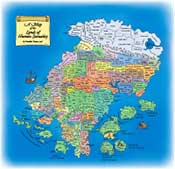
…an update to the interactive version of the Map of Human Sexuality.
Finally solved the single biggest problem with it, which was that you could not correct a mistake while you were creating a map. With the new version, you can now remove a pin if you accidentally place one in the wrong page…a simple idea that took a lot of head-pounding and hair-tearing to implement.
Next on the List of Things To Do is to make a login system so you can go back and update/change your map later.
And in honor of the revamped map software, I’ve created a new personal map that reflects some of the new things I’ve tried since doing the original!