The Adventure Van

I am a bad polyamorous person.

I’m not bad in the sense that I don’t talk to my partners, or in the sense that I want to control my partners, or in the sense that I want to have veto over who my partners have sex with. I’m bad in the sense that there lives, deep within my breast, a deep and passionate love for tiny, wildly-impractical two-seat sports cars.

I have, for many years, owned nothing but tiny, wildly-impractical two-seat sports cars. It has created problems for me on more occasions than I can remember, where I needed to go somewhere with more than one of my partners and the only car available was a two-seat sports car.

This has been the background source of much relationship stress for rather a long time. Fate, it seems, has finally conspired to get me to do something about it.

It started with a trip to a friend’s house to help her celebrate her birthday. We had the bad fortune to head out toward her place just as rush hour was starting on a Friday evening, and got to the interstate on-ramp to discover a parking lot.

Right next to the on-ramp is a used car place. In the parking lot of the used-car pace was a conversion van, with a sticker in the window advertising…

…the same Blue Book value of my Honda del Sol, a tiny, wildly-impractical two-seat sports car.

zaiah and I joked that it would make a much better poly vehicle than the del Sol. Then we joked about it again. Then we thought about it. Then we said “Hmm.” Then we said “Hmm” again.

I will spare you the details, which I’m sure you can probably imagine, and cut straight to the chase: We pulled into the dealer’s lot in a tiny, wildly-impractical two-seat sports car, and pulled out in a conversion van.

Which has, I feel compelled to say, a bed in the back.

All my life, I’ve always wanted to own a vehicle with a bed in the back. They don’t make tiny, wildly-impractical two-seat sports cars with beds in them, so that deep desire has never been satisfied. Until now.


I’ve written about game-changing relationships before in this very blog. Swapping my del Sol for a conversion van has been a game-changing relationship.

Since making this exchange, zaiah and I have taken it camping twice. In fact, it’s safe to say that owning a conversion van makes a significant difference in one’s quality of life in many ways.

Having a van makes camping a much more comfortable proposition, as it turns out. Not to diss on anyone who enjoys roughing it in the Great Outdoors, mind, but a queen-sized bed with a memory foam topper is actually a considerable step up from a sleeping bag in a tent in terms of creature comforts. Not to mention available positions for sex.

Not long after the exchange, we were invited by those very same friends whose party we were attending on that fateful evening to go sledding…or, as we call it in the language of my people, “Oh god oh god we’re all going to die.” (Kidding! I’m kidding! Nobody died. We ended the sledding with no more than a cracked rib and a mild concussion between us.) As it turns out, it’s easier to fit sleds in a van than in a tiny sports car.

As it also turns out, sledding technology has advanced in leaps and bounds since I was a child, but sled steering technology has been all but lost.

I soon started personalizing the van. My friends DO kick ass. For the Brotherhood!

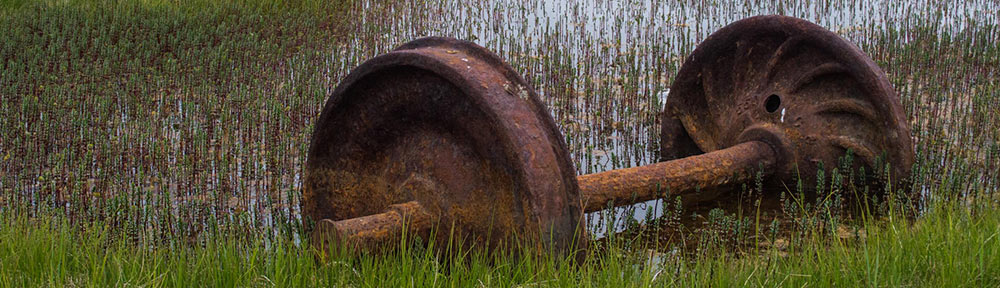
On our most recent trip, zaiah spotted the ruins of an old timber mill, long abandoned and turning to rust. We stopped, parked next to the “No Entry” sign, and I ducked under the “No Trespassing” and “Danger – Keep Out” signs to take photos photos, which I will likely be posting soon.

A lesson I’ve already learned from our adventures: Temperate coastal rainforests are soggy. Very, very soggy.

The Pacific Northwest doesn’t really understand beaches.

I grew up in Florida. I know what beaches are. Beaches are endless vistas of glittering sand, over which the surf rolls constantly. Seagulls circle overhead. The sun beats down on sand castles and little brightly-colored canopy tents.

In the Pacific Northwest, they apparently heard that “beaches” are places where the ocean meets the shore, but they were a bit hazy on details beyond that. Beaches here are rocky, with enormous boulders standing among piles of small round pebbles, while the rough surf pounds anyone who dares venture too close into oblivion. Oh, and it’s also bitterly cold.

So, not unlike the beaches I’ve seen in Great Britain, really.

One nice thing about camping in winter: you get the whole campground to yourself. Seriously, on our first trip, we were literally the only people there. Even the park ranger had the sense to be elsewhere. I woke thinking the Second Coming had happened and we’d somehow been missed. (It’s an easy mistake to make. Angels pouring out their Seals, the armies of darkness sweeping over the land, the Final Judgment…there’s a lot going on! It’s surprising how easy it is to overlook a couple of yahoos out camping in a van in the dead of winter. Who camps in winter?)

Shh! We’re hiding! Bet you can’t see us!

A rest area late at night. It looks so homey! It’s like a miniature house on wheels. A house without a bathroom. Or a kitchen. Or Internet access. But it has a bed! And that, by itself, means that when we’re camping in it, our standard of living is probably higher than most of humanity for most of human history.

Does this officially make me a pornographer?

Quite some time ago, I got involved in an IM conversation with a friend who had asked me the question “Why on earth would someone want to be a submissive in a BDSM relationship? What would the submissive possibly get out of it?”

After thrashing around for a while trying to find an answer, I decided to write a short story about BDSM from the point of view of a submissive.

The person I was talking to really liked the story, and suggested that I should write more erotica.

So I started writing on Literotica, and the things I wrote became very popular–much more so than I would have expected. (For a very brief time, a few years back, I had the most read and the highest-rated story on the site.)

So I kept at it, and write a pair of eBooks about a relationship between a highly repressed woman and the man who married her in order to train her as a sex slave. These eBooks got so popular on Amazon that they’re paying my rent now.

And now, they’re actually real, things-you-can-feel, dead-tree books.

Imagine my surprise.

Anyway, I have some promotional copies of these books, which I’ve made available on my Web site as a two-book set. Which, if you like, I will autograph for you under my pen name. Check it out!

Polyamory, Monogamy, and Ownership Paradigms

On another forum I read, someone made a complaint that folks in the poly community tend to see monogamy in terms of ownership and control; that is, for many poly folks, monogamy is about owning your other partner, while polyamory is more egalitarian, treating other people as fully actualized human beings.

And, sadly, I’ve encountered poly folks who do believe that. The misguided notion that polyamory is “more evolved” than monogamy comes, in many cases, from the assumption that monogamy is inherently rooted in ownership and polyamory is inherently egalitarian.

As with many preconceptions, it’s possible, if one squints hard enough, to see where this idea comes from. There’s nothing inherently wrong or controlling about monogamy per se; monogamy, by itself, is not necessarily disempowering or ownership-based.

But there is some truth to the notion that monogamy as a cultural norm comes with a set of social expectations that are deeply planted in the soil of ownership of others.

People in our society are expected to believe not just in monogamy, but in a whole set of social expectations that comes along with it. People say things like “you let your wife spend time with other men?” or “you let your husband talk to his ex?” as though it is natural and expected that we should be able to control who our partners interact with. People say things like “I would never allow my partner to masturbate” or “I would never permit my partner to fantasize about other people” as if it is normal to control our partners’ bodies and minds.

Not every monogamous person does this, of course. But these ideas are very commonly attached to our social expectations of monogamy; monogamy as a social institution began in cultures in which ideas of ownership were deeply embedded, and those ideas have proved very tenacious.

There’s a problem, though, in that polyamory is not necessarily any better.

People who live outside the cultural mainstream love to believe that they have escaped the petty social norms that enslave all the other sheeple still trapped in the spider web of normative behavior. In reality, though, cultural ideas have an insidious way of seeping into us even when we’re aware of them. Simply knowing that we were raised in a climate of ownership assumptions about sex and love doesn’t make us immune to internalizing them. In fact, many, many people in the poly community cling just as strongly to paradigms of ownership and control as they believe all those poor “unevolved” monogamous folks do–they simply manifest differently, that’s all.

I’ve been putting some thought to the sneaky ways that social expectations can creep into relationships even when they’re outside the social mainstream. Here are some examples I’ve come up with.

Control paradigm Egalitarian paradigm
I let you have other partners. This is a privilege I grant you. I can tell you who, under what circumstances, when, and how you may have other partners. You are a human being with the right to make your own choices about having other partners. I will tell you what I am comfortable or uncomfortable with, and trust you to make choices that honor and cherish our relationship.

I let you have sex with other people. This is a privilege I grant you. I can tell you how you may or may not have sex or otherwise control the timing or manner of your sexual activity. You have an intrinsic right to make choices about your sexuality. I will communicate you what I am comfortable or uncomfortable with, because I trust you to make choices that honor and cherish our relationship.

My sexual health is your responsibility. I will set limits on your behavior to ensure that you only engage in sexual activity that meets my sexual risk limits. My sexual health is my responsibility. I will communicate to you my sexual health boundaries, risk limits, and concerns. Because your risk limits and concerns may not match mine, you are free to make whatever choices with your own sexual health that you like. If your behavior exceeds my threshold of risk, I have the right to change the sexual relationship between you and I, including adding barriers or even ending it entirely. If having a sexual relationship with me is something you value, you can make choices to remain within my levels of acceptable risk.

I may fetishize your other sexual partners for my gratification. I have the right to tell you how to or not to have sex and/or demand the intimate details of your sexual activites for my sexual gratification. Your sexual activity with other people and your other partners are not merely for my sexual gratification. I will accept your right to choose sexual activities that you and your other partner find fulfilling, and that you and your other partner have a right to privacy about your own intimacy.

If I am sexually attracted to your other partners, it is your responsibility to share them with me. You have an obligation to provide me with access to your partners if I want it.

Your other partners are human beings. As they are not your property, it is not your obligation to make them sexually available to me.
My sexual partners are mine. You are not permitted to express an interest in them; if I want to keep them to myself, this overrides the wishes or desires of both you and my other partners. My other sexual partners are human beings. As they are not my property, I do not have the right to "keep" them; they are people, not things, capable of making their own decisions about sexual intimacy and partner choices.

My fears, insecurities, and jealousy are your responsibility. I have the right to control your behavior and/or the behavior of your other partners in order to manage my fears and insecurities. My fears, insecurities, and jealousy are my responsibility. I have the right to communicate with you about them, and to ask for your help in dealing with them. Because you love and cherish me, you will work with me to help me when I am afraid or insecure. These feelings do not give me the right to dictate your choices, however.

I have the right to ensure that you may have other partners only to the extent that your other partners do not affect me or our relationship. I may limit or control your other relationships so as to make sure they do not affect me. I understand that there are many uncertainties in life. Everything from a new job to being fired to illness to family of origin problems to being hit by a runaway bus may affect our relationship together. When your other partnerships affect me in a way that concerns me, I have the right and the responsibility to communicate with you about it, so that we can work together to address my concerns.

Your other relationships exist only on my say-so and only for so long as I permit. I have the right to order you to terminate any of your other relationships if I feel it is necessary or desirable. Your other partners are people with needs and feelings; they have have the right to explore and develop their relationship with you, to be supported by you, and to expect that their relationship with you will continue for so long as it benefits you and them. I may reasonably expect that they will respect the relationship between you and I; they may reasonably expect that I will respect the relationship between you and them.

Understanding my needs is your responsibility. If you fail to meet my needs or expectations, even if I have not made them explicitly clear, you have wronged me, and I have the right to control your behavior so as to ensure they are met. Understanding my needs is my responsibility. Communicating my needs with you is also my responsibility. You can not be expected to meet any needs of mine that you are not aware of. I may ask for your help in making sure I am taken care of, and trust that you value me and want to take care of my needs.

The relationship between me and your other partner is your responsibility. I may require that you arrange meetings between us, that you keep the other person separate from me, that you ensure I am comfortable with your other partner, or otherwise make it your responsibility to manage the relationship between us.

The relationship I have with your other partner is our responsibility. As I am an adult and your other partner is an adult, it is on each of us to negotiate what kind of relationship we want to have with each other.
I permit you to have other relationships only so long as they are subordinate to me. The people with whom you develop relationships have needs and feelings, and have just as much right as I have to asking your help in meeting them. Should our needs run into conflict, we can come together to communicate and negotiate as adult human beings; I may not claim authority over another human being merely because I met you first.

I have the right to control your emotional engagement with other people. This includes the right to tell you that you may not experience certain emotions (for example, you may not fall in love with another partner) and/or the right to control the extent to which you feel emotions with others.

Your emotional experience is one of the most fundamental parts of who you are as a person. I recognize that it is impossible for us as human beings to place arbitrary controls on our emotions.
I have the right to control how far and to what extent you become entangled with other people. For example, I may forbid you to become financially entangled with other partners. Decisions about how to conduct your life can only be made by you. Realistically, whatever promises you have made and whatever rules I have made, there is nothing short of a shotgun and a length of chain that compels you to stay with me. I have the right to expect that you will uphold agreements you have made with me, and I have the right to expect that your decisions will account for the responsibilities you have incurred with me. Beyond that, I can not realistically lay claim to your autonomy; even if I want to, it is not possible for me to compel your decisions.

I have the right to control your expressions of love, affection, or feelings for others. I may forbid you to give gifts to other partners, do errands with other partners, use certain pet names with other partners, or have certain experiences with other partners. The way you express love is one of the most intimate of all choices you can make. Attempts to dictate how you may or may not do this are not only extremely intrusive, they may undermine the foundations of your other relationships. As long as you express the love you feel for me with me, it is not necessary for me to control your expressions with others.

My emotions are your responsibility. If I feel something that I don’t want to feel.this is your fault, and I may limit your behavior as a result. My emotions are my responsibility. Even when they are surprising or unpleasant, they belong to me. I have the reponsibility to communicate with you about my emotions, and I may ask for your help in feeling loved and supported by you.

I have the right to define your other relationships. As adult human beings, you and your other partners have the right to define your relationship for yourselves.

I have the authority to place your other relationships in a hierarchy of my choosing. As adult human beings, you and your other partners have the right to determine the shape of your relationship. I have the responsibility to communicate my needs to you; as long as you are able and willing to work with me to meet those needs, the ordering of your other relationships is a decision between you and your other partners.

Agreements between you and I are binding on any other partners you may have.

All the people involved have a right to negotiate any agreements that may affect us.

I’m sure there are more. What are your experiences?

Journal is back to normal!

Or at least at the perigee of its eccentric orbit around normalcy, in any event.

The comments have been restored, and the zillions of messages that got inadvertently splattered all over everyone’s friends page have been removed. Thanks to a considerable effort on the part of LJ support, the blog is more or less back where it was.

Here’s the status of the move to WordPress:

– The WordPress importer absolutely does not work, full stop. It will import posts, but it will not import comments correctly; roughly one in every 20 comments is imported to the wrong post. Since I have about 22,000 comments, that makes quite a mess of things.
– I have found a Perl script which exports an entire LiveJournal into a WordPress backup file. However, it’s quite buggy and finicky. Among other things, it removes formatting from posts which contain lj-cut tags.
– The blog is up and running in its new home, but about 2/3 of the posts have bad formatting. I am currently debating which would take less time–going through and reformatting every post by hand, or attempting to fix the bugs in the Perl export script. Right now, “hitting myself in the face with a hammer” sounds better than either one.

I have a lengthy list of posts I want to make, and I’m still stalled on working on any of them. Between this head cold and the blog getting scrambled, it’s been a frustrating few weeks.

Trying to move…

I’ve been a LiveJournal paid member since 2001, and now I think the time has come to move my blog.

I’ve been working on this project behind the scenes for several weeks, which is why I haven’t been posting lately. My goal is to move to a self-hosted blog, probably running WordPress, and to have posts over there automatically be crossposted here (for those of you who still use LiveJournal).

In theory, that would make the move seamless. The entire blog would be on franklinveaux.com and also here at LiveJournal, and comments would be synced so that people could comment here or there.

In practice, it’s turning out to be a problem. The LiveJournal WordPress importer is buggy; when you move a large blog like mine, it tends to import comments attached to the wrong posts. There seems to be a subtle bug in the regex that parses the LiveJournal XML feed, and I suck at regex, so I can’t fix their bug myself.

So for now I will continue to blog here, while I work on getting the blog copied over there.

Why am I moving?

LiveJournal has, increasingly, been creating problems for me. They have a really difficult time getting the spam problem under control (for a while, I was averaging more than two hundred spam comments per day, though that has slowed). Paid accounts are expensive for what you get. And worse, there is now some question about what it even means to have a “paid account” any more–the devs are apparently moving to a model where the friends feed is radically different and the notion of “paid accounts” will give way to a model where users pay for specific features of LiveJournal.

So, I think it’s time to move. I’ve allowed my paid account to expire, and I’ll keep you posted on what happens as I sort out how to transplant eleven and a half years’ worth of blogging to a new home.

A Christmas Kitten

So it came to pass that zaiah and I went camping in Puget Sound for our seventh anniversary last week.

We took the new conversion van, which I traded my 2-seat Honda del Sol for on the spur of the moment a couple of months back. I have always loved little 2-seat sports cars, and on many occasions throughout the years I’ve been informed that this particular taste perhaps isn’t the most practical for a person in polyamorous relationships. zaiah and I were driving past a used-car lot one evening, and saw the van for about the same price as the book value on my car, so we went in with a del Sol and came back with a van.

Anyway, we went camping in Puget Sound because there’s a Tonkinese breeder in that area, and we’d been talking to her about getting a male cat from her to breed with my kitten, Kyla. He was old enough to come home with us the same weekend as our anniversary, so off we went.

The Tonkinese cats she breeds are just beautiful. Anyone who’s never met a Tonk is missing out. They are beautiful, intelligent, fearless cats who are very people-focused. This was what greeted us when we arrived. Our new kitten, Beryl, is the blue solid on zaiah‘s lap.

The first night with us, Beryl insisted on sleeping in bed with us. Under the covers, snuggled up, and purring. He spent most of the night nestled on my legs, preventing me from moving.

Then he moved up to snuggle into my armpit.

When Iwoke up, he crawled onto my lap and refused to let me stand, keeping me stapled to the bed by sitting on my lap and not moving.

zaiah installed hanging cloth shoe shelves in our closet, which we use to store socks and sweaters and so forth.

I should have realized that he was a climber when this became his preferred place to sleep any time we were not in bed.

We are still in the process of finishing our room, which we have been building onto the house for the past several months. The walls have not yet been painted, and the trim and baseboards are not installed yet.

The new bedroom has a ladder up to a loft we’ve constructed, which we’re using as a home office. The ceiling in the bedroom is quite high, so the ladder into the loft (which is bolted to the wall) is twelve feet tall.

Did I mention that the cat is a climber?

zaiah and I were up in the loft one day, getting ready to watch Law & Order on the computer, when we heard a crash and a frantic scrambling down below. The cat was trying to climb the ladder.

“Oh, that’s so cute!” I said. I got my cell phone and took a picture.

Then I went back to the loft.

A second later, the cat was up there with us.

He sprang onto the computer keyboard (starting the movie playing in the process) and then sat on my lap as if to say “I’m here! Aren’t I clever?”

And he is. This is the most talkative, most athletic, most determined, most curious, and most intelligent cat I’ve ever owned. That is a very dangerous combination, as it turns out.

The next night, I woke to the sound of claws scrambling on metal. I grabbed my camera and fired off a bunch of shots as the kitten climbed up into the loft.

As I’m typing this, at this exact moment, the kitten is sitting on my lap. In the loft.

Living with him is going to be…interesting.

Stopping by the side of the road…

zaiah and I spent the last four days camping near Puget Sound to celebrate our seventh anniversary, and to pick up the new addition to the household: a tiny blue Tonkinese kitten who will be a breeding tom for my kitten Kyla.

On the drive, we passed the ruins of an old house just off the interstate and (naturally) had to pull over to take care of it. The house is located in someone’s back yard, so after we’d hopped off the interstate, we knocked on the door and asked the gentleman living there (a retired engineer) if we could take pictures of it. He agreed, and away we went.

Unfortunately, it was biting cold, so we couldn’t linger. I did get some interesting shots, though. I love this kind of ruin!

Clicky here to see more!

The Apocalypse Is Coming! (…again)

In less than three weeks, the end of the world will happen.

Or, rather, in less than three weeks, a bunch of Mayan-prophesy doomsdayers will wake up and, if they have any grace at all, feel slightly sheepish.

The Mayan epic calendar is set to expire on December 21, or so it seems, and a lot of folks think this will signal the end of the world. They really, truly, sincerely believe it; some of them have even written to NASA with their concerns that a mysterious Planet X will smash into Earth on the designated date. (There seems to be some muddling of New Age thought here, as the existence of this “planet X,” sometimes called Nibiru, is a fixture amongst certain segments of the New Age population, its existence allegedly described in ancient Sumarian texts.)

It’s easy to dismiss these people as gullible crackpots, uneducated and foolish, unable to see how profoundly stupid their fears are. But I’m not so sure it’s that simple.

Apocalyptic fears are a fixture of the human condition. The Mayan doomsday nonsense is not the first such fearful prediction; it’s not even the first one to grab recent public attention. Harold Camping, an Evangelical Christian, predicted the end of the world on October 21, 2011…and also on May 21, 2011, September 7, 1994, and May 21, 1988. He got enough folks worked up about his 2011 predictions that many of his followers sold their belongings and caravanned across the country warning people of the impending Apocalypse.

These kinds of predictions have existed for, as near as I can tell, as long as human beings have had language. Pat Robertson has been in on the action, predicting the Great Tribulation and the coming of Jesus in 2007. These fears are so common that a number of conservative politicians, including Sarah Palin, believe that the current generation is the last one the world will see.

Given how deeply-woven these apocalyptic fears are in the human psyche, it seems to me they speak to something important. I believe that, at least for some people, such fears of impending doomsday actually offer protection against an even deeper fear: the fear of irrelevance.


My readership being what it is, I bet the percentage of you who recognize this picture is probably higher than the percentage of the population as a whole who recognize it.

This is part of the Standard of Ur, an artifact recovered from archaeological digs from the site of Ur, one of the world’s oldest cities, in what is now present-day Iraq.

Ur was likely first settled somewhere around 3800 BC, or roughly six thousand years ago, give or take. That puts its earliest settlement at about the start of the Bronze Age, plus or minus a century or so. The Agrarian Revolution was already well-established, but metallurgy was fairly new. When it was built, it was a coastal city; that was so long ago that the land itself has changed, and the ruins of Ur are now well inland.

You’ve probably at least heard of Ur; most public schools mention it in passing in history classes, at least back when I was a schoolkid. Unless you’re a history major, you probably don’t know much about it, and certainly don’t know a whole lot about life there. Unless you’re a history major, you probably don’t think about it a whole lot, either.

Think about that for a minute. Ur was a major center of civilization–arguably, the center of civilization–for centuries. History records it as an independent, powerful city-state in the 26th century BC, more than a thousand years after it was founded. People were born, lived, loved, struggled, rejoiced, plotted, schemed, invented, wrote, sang, prayed, fished, labored, experienced triumph and heartbreak, and died there for longer than many modern countries have even existed, and you and I, for the most part, don’t care. Most of us know more about Luke Skywalker than any of the past rulers of Ur, and that’s okay with us. We have only the vaguest of ideas that this place kinda existed at some vague point a long time ago, even though it was among the most important places in all the world for a total of more than three thousand years, if you consider its history right up to the end of the Babylonians.

And that, I think, can tell us a lot about the amazing persistence of apocalyptic doomsday fears.


When I was a kid, I was fascinated by astronomy. I wanted to grow up to be an astronomer, and even used a little Dymo labelmaker to make a label that said “Franklin Veaux, Astrophysicist” that I stuck on my bedroom door.

Then I found out that some day, the sun would burn out and the earth would become a lifeless lump of rock orbiting a small, cold cinder. And that all the other stars in the sky would burn out. And that all the stars that would come after them would one day burn out, too.

The sense of despair I felt when I learned that permanently changed me.

Think about everything you know. Think about everything you’ve ever said or done, every cause you believe in, every hero and villain you’ve ever encounter, every accomplishment you’ve ever made.

Now think about all of that mattering as much to the world as the life of an apprentice pot-maker in Ur means to you.

It’s one thing to know we are going to die; we all have to deal with that, and we construct all kinds of myths and fables, all sorts of afterlives where we are rewarded with eternal bliss while people we don’t like are forever punished for doing the things we don’t think they should do. But to die, and then to become irrelevant? To die and to know that everything we dreamed of, did, or stood for was completely forgotten, and humanity just went along without us, not even caring that we existed at all? It’s reasonable, I think, for people to experience a sense of despair about that.

But, ah! What if this is the End of Days? What if the world will cease to be in our lifetimes? Now we will never experience that particular fate. Now we no longer have to deal with the idea that everything we know will fade away. There will be no more generations a thousand or ten thousand years hence to have forgotten us; we’re it.


Just think of all the advantages of living in the End Days. We don’t have to face the notion that not only ourselves, but our ideas, our values, our morality, our customs, our traditions, all will fade away and people will get along just fine without us.

And think of the glory! There is a certain reflected glory just in being a person who witnesses an epic thing, even if it’s only from the sidelines. Imagine being in the Afterlife, and having Socrates and Einstein and Buddha saying to us, “Wow, you were there when the Final Seal was broken? That’s so cool! Tell us what it was like?”

Human nature being what it is, there’s also that satisfaction that comes from watching all the world just burn down around you. That will teach them, all those smug bastards who disagreed with us and lived their lives differently from the way we did! As fucked-up as it may be, there’s comfort in that.

Most of us, I suspect, aren’t really equipped to deal with the notion that everything we believe is important will probably turn out not to be. If we were to find ourselves transported a thousand, two thousand, ten thousand years from now, assuming human beings still exist, they will no doubt be very alien to us–as alien as Chicago would be to an ancient Sumerian.

They won’t speak our language, or anything like it; human languages rarely last more than six hundred years or more. Everything we know will be not only gone, but barely even recognized…if there’s anything left of, say, New York City, it will likely not exist much beyond an archaeological dig and some dry scholarly papers full of conjecture and misinformation. For people who live believing in tradition and hierarchy and authority and continuity, the slow and steady evaporation of all those things is worse than the idea of death. Belief in the End Times is a powerful salve to all of that.

Given the transience of all human endeavor, it makes a certain kind of sense. The alternative, after all, is…what? Cynicism? Nihilism? If everything that we see, do, think, feel, believe, fight for, and sacrifice for is going to mean as much to future generations as the lives of the citizens of Ur four thousand years ago mean to us, what’s the point of any of it? Why believe in anything?

Which, I think, misses the point.

We live in a world of seven billion people, and in all that throng, each of us is unique. We have all spent tens of billions of years not existing. We wake up in the light, alive and aware, for a brief time, and then we return to non-existence. But what matters is that we are alive. It’s not important if that matters a thousand years from now, any more than it matters that it wasn’t important a thousand years ago; it does matter to us, right here, right now. It matters because the things we believe and the things we do have the power to shape our happiness, right here, and if we can not be happy, then what is the point of this brief flicker of existence?

Why should we fight or sacrifice for anything? Because this life is all we have, and these people we share this world with are our only companions. Why should we care about causes like, say, gay rights–causes which in a thousand years will mean as much as campaigns to allow women to appear on stage in Shakespeare’s time? Because these are the moments we have, and this is the only life that we have, and for one group of people to deprive another group of people the opportunity to live it as best suits them harms all of us. If we are to share this world for this brief instant, if this is all we have, then mutual compassion is required to make this flicker of awareness worthwhile. This, ultimately, is the antidote to the never-ending stream of apocalyptic prophesy.

On the Care and Feeding of Giraffes


Image: Luca Galuzzi, Wikimedia Commons

I am in love with a dragonslayer.

Not all dragonslayers, as it turns out, are knights in shining armor. The dragonslayer I love is a giraffe.

Her name is Shelly. She is not an ordinary person; one does not generally become a dragonslayer if one is content to travel from cradle to grave by the path of least resistance. And I have been in love with her for quite a number of years.

It’s interesting, and sometimes a bit intimidating, to be romantically linked to a hero of yours. We met at a gathering of polyamorous folks in Florida a very long time ago. We started dating a short while after that. I didn’t know then that she would become a dragonslayer, but she did tell me early on in our relationship that she is a giraffe.

By this point, you can be excused, gentle reader, if you have absolutely no idea what I am talking about. Allow me to backtrack a moment to explain.

Shelly, this person I love very much, is not, as I have mentioned, an ordinary sort of person. Not being an ordinary sort of person often leads to loneliness, and loneliness leads to sadness; we are social animals, after all. Many years ago–long before I met her–she talked to a therapist about feeling alienated and isolated from the people around her. The therapist listened patiently, then explained that there was absolutely nothing wrong with her; she wasn’t alienated because she was broken, she was alienated because she was a giraffe surrounded by alligators. “Find other giraffes,” the therapist told her. “You’ll be fine.”

It’s easier to find giraffes nowadays than it used to be. Back before the Internet exploded all over the world like an overripe grape in a hydraulic press, locating a community of non-traditional, non-monogamous, sex-positive people was a bit like finding a hundred-dollar bill lying on the ground; sure, it was theoretically possible, and every now and then you heard of someone who knew someone who talked to someone who’d totally heard of it happening to someone else, but it wasn’t exactly something that you could count on to meet the household budget.

When Shelly and I met, we recognized each other immediately. I didn’t know, back then, what that would mean.


I wrote a while ago some meandering thoughts on the tenuousness of the connections that drift by us, and how these slender threads–the accumulations of entire lifetimes of choices made and random chance–can profoundly change our lives.

My relationship with Shelly changed me more than my experiences with any other person I’ve had in my life, arguably including my parents.

When we met, I was still married to a monogamous partner, someone for whom polyamory really wasn’t a good fit. We had spent quite a lot of time trying to navigate the tricky waters of balancing the needs of a person who can’t be happy within monogamy with the needs of someone who can’t be happy without it, and more often than not, it was other partners I got involved with who bore the brunt of that.

Shelly has a way about her. That way usually starts with her raising a finger, a slightly puzzled look on her face, and saying “I have a question.” Invariably, the questions that follow completely rearrange your mental landscape. “I have a question,” she might say. “If you say that you want to love other people, why do you bring them into a situation where it is not safe for them to love you back, because you can be ordered to end the relationship at someone else’s will?” Or “I have a question. If you say you value having other people in your life, why don’t you value their agency?”

There’s one very important lesson I learned about being involved with her: If you are to be romantically linked to Shelly, you had better have your house in order. She will not easily accommodate the thousand little compromises that many people make when they try non-monogamy, the little rules and rituals that reinforce insecurity and avoid difficult change. If she finds a weak place, an area where for the sake of convenience some little unintended cruelty has become written into the fabric of a relationship, she will push on it. Band-Aids over unresolved problems do not work for her. Feelings swept under a carpet will be dragged into the light. That’s the first rule of being involved with Shelly: commitment to honesty and self-knowledge. You don’t get to say everything is OK when things are not OK, and you don’t get to make compromises that exclude other people.

It was the relationship with Shelly that finally let me see how hurtful, for all those years before I met her, my rules and treaties with my monogamous wife had been to my other partners. It was Shelly’s insistence that I deal with that hurtfulness that brought me to the choice that I could no longer be a party to hurting others that way.


This is the ring I wear on my left hand. Shelly has one identical to it.

After we’d been together for several years, Shelly felt the call to become a dragonslayer. I have written about that here. One of the things she and I share in common is the fact that we both do not accept the idea of death. One of the things that makes her a better human being than I am is that she has made the decision to spend the entirety of her life fighting it.

She returned to school, to seek a doctorate that would allow her to do research in the field of radical longevity. She sacrificed a tremendous amount to do so, including moving away from where we had been living together to pursue her education. She made the decision and, just like that, both of our lives changed.

That is the second rule of Shelly. She has fortitudes of will that would astonish Winston Churchill. She is remarkably flexible in many ways, but when she has resolved to do something, wild dogs will not budge her. She is one of the strongest people I’ve ever met.

She went off to school. The company I was a minority partner in–one which would later implode in a fiery economic flameout that often happens, I’m told, when one puts engineers in charge of financial decisions–moved to Atlanta, and I went with it. We remained family, but the nature of our relationship changed.

That’s the third rule of Shelly. You don’t get to dictate what a relationship with her will look like. She is who she is; to love her means to accept that. She is neither flighty nor uncommitted; quite the opposite, in fact. She commits to the things that are important to her with ferocity. But she does not prefer the comforting illusion to the uncomfortable truth. People change. Shelly is not a person who hides from that change; she will not retreat into comforting routines.


Shelly does, and always will, hold a place in my heart, no matter what happens. There have been other people in her life while we have been together–people who sought to dictate only one kind of relationship with her, people who tried to impose restrictions on the way her heart will work. When they could not have what they wanted, they have chosen to fall out of her life.

It’s a poor choice, in my opinion. Being close to Shelly is incredible. I can not fathom why someone would that up simply because they could not impose rules on her about who she was permitted to love or how. But then again, I also may be part giraffe myself.

Caring for a giraffe, of course, requires special skills. One does not raise a giraffe the way one would raise an alligator or a puppy or a water buffalo. Here, as with all things that are important, flexibility matters; one can not toss scraps of raw chicken at a giraffe the way one might do with an alligator and then say there is something wrong with the giraffe because it does not thrive.

The biggest part of the care and feeding of Shelly I have discovered is simply developing the skill to listen to her when she talks about what she needs. Her needs in relationship, I have found, are generally quite modest, and easy to care for; but being heard is top among them.

Another is expectation management. Expecting Shelly to accommodate choices made for the sake of avoiding unpleasant reality is never likely to succeed. She has, more than anyone else I know, a commitment to emotional integrity that does not permit patching or working around problems like insecurity or fear. Almost all the practical skills I’ve learned about going under the bed, grabbing the monster that lives there, dragging it out into the light, and making it pay rent I’ve learned from her. Being involved with Shelly is not for the faint of heart.

And if her needs are not being met, she will let you know.

Funny things, needs are; when they aren’t being met, they can feel bottomless. In some relationships they are met more effortlessly than others; and in poly relationships, it can be very tempting to point to someone who’s needs aren’t being met and say “What’s wrong with you? Why are you so miserable? Why can’t you just be happy, like Sally over there is?” when the reality is that Sally is happy simply because her needs are being met.

Call this the Fourth Rule of Shelly: if her needs aren’t being met, she will be unhappy. She is not an unhappy person; she is, however, far less likely to sit in a corner and quietly suck it up if her needs aren’t met.

That is, as it turns out, a feature, not a bug…at least if you want relationships built on a foundation of absolute, unwavering emotional integrity.

Which, the cynic in me whispers, is the one thing many folks are not really prepared for. Perhaps that is one of the things that differentiates an alligator from a giraffe? Perhaps alligators prize relationship stability ahead of emotional integrity?

In any relationship, there will be times when chaos slips in through some neglected back door or some little crack in the ceiling. It happens. We are all born of frailty and error. I have, as I’ve gone about this business of placing my heart in other people’s hands and accepting their hearts in mine, learned that when those moments occur, there is often an instant, right at the start, when we make a choice. It’s a tiny choice, that happens in a fleeting instant, sometimes too fast for us to register, but it’s there: the instant when we choose compassion, or when we sigh, feel frustrated, and head down the path of “God damn it, I had plans to watch Friends on TV tonight and then maybe wash the dog–anything that’s more fun than dealing with human beings who have needs–and now here you are asking for my support with something, and and and why can’t you just be more convenient?

Compassion, in case it needs to be said, is better.


I am fortunate beyond measure to have connected with Shelly, and I feel blessed to have her as part of my life. Thank you for being who you are.

You are not “a poly:” Dan Savage runs off the rails

I want to like Dan Savage.

Really, I do. He’s witty and irreverent and often the things he says are right on the money.

But every now and then, he says something that leaves me scratching my head and wondering what color the sky is on his planet. He has in the last few years backtracked from the notion that there’s no such thing as bisexuality (a claim that seems so absurd on the face of it that it’s hard for me to understand why it still has any currency whatsoever), but when it comes to polyamory, it’s hard to find anything to like about his ideas.

Recently, he penned a column in which he asserted point-blank that polyamory is not an orientation:

Poly is not a sexual identity, PP, it’s not a sexual orientation. It’s not something you are, it’s something you do. There’s no such thing as a person who is “a poly,” just as there’s no such thing as a person who is “a monogamous.” Polyamorous and monogamous are adjectives, not nouns. There are only people—gay, straight, bi—and some people are in monogamous relationships, some are in open relationships, some are in polyamorous relationships, some are in monogamish relationships, some are in four-star-general relationships. These are relationship models, PP, not sexual identities.

What’s most interesting about this is that it mirrors almost precisely the attitude of folks who believe that homosexuality is an activity, not an orientation–that there is no such thing as “a gay” or “a straight” but merely those who engage in homosexual activities and those who don’t. Dan Savage’s words would be right at home in Ministry Today Magazine, which ran an article that claimed something similar about sexual orientation:

The language of “orientation” has allowed us to relinquish our responsibility for specific behaviors, to psychologize our conduct and to label each other as drunkards, abusers, adulterers, liars, homosexuals and so on, based on the sins we are most likely to commit. This system is convenient both for those who do not struggle with any of the sins that happen to be “socially-unacceptable” at the moment and for those looking for an external excuse for their sinful behavior.

This notion is a standard part of gay “conversion therapies” as well, many of which make claims such as “There is no such thing as a homosexual man” and “There are no homosexuals, there are only people with homosexual problems.”


Ideas like this are founded in a worldview that is remarkably resilient in the face of contradictory evidence. No matter how many people claim to have been born gay, religious conservatives hang on to the notion that there is no such thing as a homosexual; no matter how many people claim to be polyamorous, there are folks who stubbornly cling to the notion that polyamory is something we do rather than something we are.

Now, in a twisted kind of way, there is something like a kernel of truth to this. There are only people, and some are in gay relationships, and some are in straight relationships, and some have had partners of various different sexes, sexual identities, and gender identities…but in a sense, all of these things might be described as “activities.” A gay man is, presumably, physically capable of sexual contact with a woman; a straight man is physically capable of sexual contact with another man.

Similarly, people who are strongly polyamorous are physically capable of having only one romantic partner, and people who are nominally monogamous are physically capable of having multiple lovers.

But such a view is facile. A gay man might possess the physical capability of having sexual intercourse with a woman, but what that ignores is that man might not be capable of being happy in a sexual relationship with a woman. It will probably feel on some level deeply unsatisfying, if not downright unnatural, for a gay man to have a relationship with a woman; and such a relationship would not satisfy the basic needs he has, just like a relationship with another man would likely be profoundly unsatisfying to a straight man.

The same is true of polyamorous relationships. I could no more be happy in a monogamous relationship than I could be in a relationship with another man; such a relationship would feel, on a basic level that seems to have nothing to do with conscious choice, deeply unnatural, constricting, and wrong to me.

I’ve always been this way. There has never been a time in my life when monogamy made any sense to me, much less seemed like a desirable thing. As a young child, I could not understand the fairy tales about the princess choosing between two princes; since princesses live in castles, it seemed like there was plenty of room for both of them! When I started becoming aware that boys and girls were different, it baffled me why I would be expected to want a partner who belonged only to me.

Some folks argue that the existence of bisexuality proves there’s no such thing as innate sexual orientation. This claim makes little sense; the fact that some people are not strongly “wired” one way or the other does not prove that there’s no such thing as people who are. (In technical terms, this argument commits the inductive fallacy of division; the idea that innate tendency toward an exclusive sexual orientation exists in humans does not necessarily imply that every single human has such innate exclusive sexual orientation.)

Similarly, the fact that some folks seem to be able to move between polyamorous and monogamous relationships does not demonstrate that, for other folks, a tendency toward monogamy or polyamory is an immutable factor in their psychological makeup. There are people who can only be happy in same-sex relationships, people who can only be happy in opposite-sex relationships, and people who can (to various degrees with various partners) be happy in relationships with a wide range of partners of sexual identities and orientations. Similarly, there are people who can only be happy in polyamorous relationships, people who can only be happy in monogamous relationships, and people who, under the right conditions and with the right partner(s), be happy in a number of different relationship configurations.

All of this seems obvious to me.


Now, to be fair, I have a bit of an advantage here. I am completely, absolutely, irredeemably straight; no matter how hard I try, the notion of having another male lover simply does not work for me, even as an abstract thought experiment. (That’s a bug, not a feature; it means there’s an entire realm of sexuality I am cut off from, and I resent that.) This makes it easy for me to understand that there might be people who are gay and feel the same way I do about having an opposite-sex partner.

Similarly, I am and have always been polyamorous; it is not possible for me to function in a monogamous relationship and be happy, any more than it would be possible for me to function in a same-sex relationship and be happy; therefore, it’s not difficult to imagine that there are people who feel the same way about monogamy.

Dan Savage isn’t polyamorous…but he isn’t monogamous, either. He’s described himself as “monogamish,” which as near as I can tell means something like “potentially sexually open in some limited ways.” My impression is that he doesn’t feel strongly compelled to polyamory or monogamy; ergo, he doesn’t have the personal experience that such strong compulsions exist. We all tend to re-create the world in our own image. Perhaps he can be excused for thinking that there’s no such thing as “a polyamory” or “a monogamy,” since he personally seems to be neither of those things.

But just as the existence of bisexuality does not prove that sexual orientation is a myth, the existence of people who can take or leave monogamy doesn’t prove that relationship orientation is a myth.


Ultimately, in a moral sense, it doesn’t much matter whether things like sexual orientation or relationship orientation are innate. Well, I mean, it does in the sense that the more we understand about who we are as a species, the better that is…but from a moral or legislative standpoint, it seems to me that simply acknowledging the fact that there are a lot of different people in the world and not everyone has the same needs would go a long way toward increasing human happiness.

That’s a tough sell, though. There are many people intent on hanging onto the notion that there is one “right” way to be. The notion that sexual orientation is innate is a powerful one because it plays to our sense of fairness; if it’s an unchangeable part of who we are, rather than an action that we do, then discriminating against people who are this way is a bit like discriminating against people based on the color of their skin or the place where they were born or some other factor outside their control.

I personally think that our genes influence our behavior a whole lot more than we’re comfortable acknowledging. Hell, I’ve written before that a mutation of a single nucleotide in a gene that codes for a receptor in our brains can radically alter our sexual behavior. It really doesn’t seem like a stretch to me that the interactions of our genes will create huge implications for who we love, how we love them, and what form our relationships take.

I doubt that there’s a “poly gene” or a “gay gene.” Unless you’re talking about peas, genetics is almost never that straightforward; almost everything you learned about genetics in elementary school is a grotesque oversimplification. I mean, hell, we have standard poodles, and the color of their fur is determined by some really complex interactions of no fewer than nine genes. Nine genes, just for their fur color!1 Attributing complex high-order sexual behavior to just one gene seems…silly.

But that doesn’t mean that sexual and relationship orientations don’t exist, nor that they are not determined by our biological makeup. It just means that there’s not one gene that flips the switch from straight to gay or from monogamous to polyamorous.

It’s more complex than that. And I wish people like Dan Savage would acknowledge that.

1 In case you’re wondering, the genes are referred to as C (the gene for producing melanin); S (pigmentation distribution; there are several mutant alleles, which produce different patterns of spotting, such as Irish spotting and piebald spotting); A (agouti) and E (extension), which affect the proportion of pigmentation (mutant alleles produce lighter or stronger pigmentation, and the interaction of these genes produces browns, reds, and yellows in dogs); B, which controls the size of melanin pigmentation granules (dogs with the mutant gene will be brown rather than black, unless the gene occurs in combination with mutant A and/or E alleles); D, the “dilute” gene, which changes the intensity of pigmentation (and in combination with A and E can result in white or cream colored dogs); R (Rufus), a gene which can cause expression of red and which works in combination with A and E can produce the range of reds from apricot to Irish Setter red); G, a gene that causes coat color to change over time and is responsible for “blue” coat color (which starts out black and fades as the dog matures); and a partially dominant gene called V, which controls coat color in a complex way that produces silvers and silver-greys but which can also lead to coat fading that resembles blues. All of these genes can occur in just about any combination and with dominant or recessive alleles; for instance, BBeevv results in an apricot poodle, unless there is a double recessive mutation of the R gene present, in which case the poodle will be red…if there isn’t a recessive D gene at play, which can turn that apricot or red into cream, but not the same cream that you get with BBeeVv, a combination that looks the same but produces different color combinations in the offspring…you get the idea.