A productive day.

I have just finished a significant update to my Web site, which includes the addition of an entire new wing, a collection of various essays on a number of different subjects. Because, after all, what the Internet needs more of is opinionated rantings.

Those who have read my journal for a long time will recognize that these essays are taken from various entries that first appeared here; people new to my flist may not have seen some of them.

I’ve also, for the first time in a long time, updated the occasional advice column Ask Agent Smith. I haven’t checked the Ask Agent Smith email address in months; wen I went there today, there were nearly 90 new messages waiting.

A bit less than half of them were spam. Of the messages that weren’t spam, a bit more than half of those were sexual solicitations.

No, I don’t get it either.

Most of them were of the form “Agent Smith is totally hot, I love how callous and cruel he is, the idea of Agent Smith giving advice is wonderful, will you hae sex with me?” I think I’ve stumbled on a very strange little niche sexual fetish here, one that I’m not quite sure I understand. I know some of the folks on my friends list like to write various flavors of fandom pr0n; anyone ever take a shot at Matrix pr0n? ‘Cause, you know, there might be a market for it. Just sayin’.


Shelly will be in town today! She’s coming up to Atlanta tonight, flying out to New York on Thursday to visit her mom, then coming back next week to stay ’till the new semester starts. Yay!


And finally, I’m still at the office. Not doing work, mind; I installed World of Warcraft on the monster Mac Pro system I have here, with its gorgeous 23″ Apple Cinema Display, and ZOMG. Hot wet sex. With all the graphics settings and rendering settings cranked up to max, I’m still getting 80 frames per second, and good God does it look gorgeous.

Now pardon me while I go drool all over my computer. Yeah, I’m a geek. Deal with it.

Okay, just for the record…

The rules.

1. If you say “Honey, I need a spanking,” you can not then say “Ow!” when you’re being spanked.

2. If you say “Ow!” when you’re being spanked, you can not expect the person giving you the spankings to take you seriously if you’re laughing when you say it.

You know who you are…

Let’s talk sex.

I tend in this journal to write a great deal about topics that deal, directly or indirectly, with sex. I wrote a lot about polyamory and BDSM, for example.

This is not one of those posts.

Instead, I want to cut right down to the heart of good old-fashioned sex. You know, knocking boots. Bumping uglies. Making, as Will Shakespeare said, the beast with two backs. Screwing. Banging. Humping. Fucking.

When it comes right down to good old-fashioned fucking people are, not to put too fine a point on it, fucked up.


A man noted for his nontrivial intellect and, occasionally, nontrivial cynicism on another mailing list I read recently said that, when it comes down to brass tacks, the real reason there is such unified and consistent objection in American society to legalized prostitution has less to do with moral concerns, or concerns about public health, so much as the unspoken truth that prostitution screws up the economics of sex.

People, particularly women, in American society are presented with cultural ideas that tell them there is an economic exchange in sex. Women give men sex, and men pay for that sex by giving women love and romance. It’s a tidy, neatly-packaged arrangement; the men get laid, which is what they want, and women get love, which is what they want. Each side has to give up something to get what they want, but hey, that’s what any economic exchange is all about.

Prostitution, he says, throws a monkeywrench into this convenient arrangement. If men can exchange currency for sex, then they no longer have to pay for sex with love and romance and fidelity. This is deeply threatening and offensive to women; if men can pay for sex with money, then women can not use sex to get love and attention, so how can they get what they want?


There is a certain amount of truth in the notion that women in American society often see sex as a way to get the love and romance they want. Romantic relationships are often defined by and predicated on sex; a partner isn’t really a partner until you fuck. And having fucked, now there are certain expectations associated with that fucking. Men are the pursuers of sex; women are the gatekeepers of sex; when the woman decides to provide the sex, she gets things in return, such as fidelity and devotion.

Don’t say you don’t know what I’m talking about. You may not do this, but I bet you know someone who does.

So the woman puts out, and in return she exacts a price in emotional support, in love and exclusivity. And, frankly, if you see the world in this way, everyone loses. It’s an attitude about sex that is predicated on false assumptions and poor understanding of human beings, and it tends to make those people who internalize this foolishness get twisted up in a number of ways.


Sex is often seen in a light different from any other human activity. I don’t know any reasonable person who would say “My partner let someone else cook for him; he must not love me any more!” or “My partner likes another person’s cooking; why am I not good enough for him?” Any person saying something like this would likely be recommended for counseling; yet if we’re talking about sex, people nod sagely and say “HAh, yes, the bastard, clearly he does not love you, for he is getting his sex elsewhere. Best to dump him.”

And you see the damage it causes all the time. People place their value and their worth as human beings on the fact that their partner is not having sex with anyone else. People’s self-esteem and sense of dignity gets all wrapped up in sex. Should their partner look at another woman, there can be only one explanation–it’s because they are not valued, not “good enough,” and their partner is seeking to replace them with someone “better”–whatever “better” means.

It’s fucked up.


Even the attitudes people have about porn rest, I think, on the notion that sex is what you pay for love. If some guy can go and get sexual gratification without paying for it at all (isn’t the Internet great?), then what need does he have to spend love to get his rocks off? If some guy is in a relationship, and he watches porn, then the woman better feel threatened, because now he may withdraw his love from her. He doesn’t need to get the sex from her any more, so why should he pay her in love, right?

This attitude is insulting to both men and women. It’s insulting to men because it starts with the premise that men don’t want love and romance and intimacy; they have to be tricked or cajoled into giving it, with the promise of sex. It’s insulting to women because it debases their position to that of a common merchant, a person who sells sex to get what she needs–and there’s not even any money in it for her, at least not directly. And the price it exacts in self-esteem and self-confidence is devastating.

And buried in there somewhere is an inconvenient truth, one who divide the world into the pursuers and the gatekeepers of sex, don’t like to acknowledge…Women like sex, and men like intimacy.

There is no need to buy one with the other. There is no need to exchange sex for intimacy; and in fact, the two have nothing to do with each other. Women and men like sex; women and men like intimacy; the one need not be predicated on the other. And certainly one’s self-image need not rest on the foundation of sexual exclusivity–a slippery and uncertain foundation indeed. When anyone places their self-esteem on external factors, especially factors controlled by another person, then that self-esteem will always be precarious and uncertain.


On another forum, a message I read described how absolutely devastated a person was when she discovered her boyfriend wasn’t a virgin. It reduced her to tears; because if she is not her boyfriend’s only sexual partner, then what makes her special? How can she ever hope to feel special?

I can’t really quite apprehend how it is that the idea of specialness got so wrapped up in sexual exclusivity, but I don’t think it’s healthy. Predicating one’s ego on the sexual past or sexual activity of another person seems harmful and destructive to me.

And it keeps getting worse. Not only is sex the vehicle for getting love and value, but love and value flow only from one specific type of sex. Any other sex is perverse, coarse, crude; sex in this position shows love, sex in that position does not. Ergo, if he loves me, he will have sex with me in this position; but if he wants to have sex with me in that position, it means…disaster. He doesn’t value me; he doesn’t care about me; I am worth less as a person.


Now, my tastes may be unconventional, but I am quite capable of calling my partner a dirty, filthy whore in the midst of sodomizing her, and still being in love with her. Love, you see, is not a question of what position one’s body is in at the moment of coitus, or which part of my partner’s body my cock is in. Love is greater than that. You see…

…and at this point I will ask all those peculiar species of feminists who believe that there is only one ‘right’ way that women ‘should’ be to leave the room…

…I have lovers who like being called a filthy whore while they are being sodomized.

I do it because it gets me off, and it gets my partner off. A nasty little fact of life, this: not all women have the same tastes. Sex is supposed to be enjoyable; and sex is most enjoyable when it presses the buttons of all of the people involved.

And here’s another dirty little secret:

Sex and love are not the same thing. If I love someone, then I still love her even if she’s on her hands and knees and I’m yanking her hair and calling her my dirty little slut. If I don’t love someone, then no amount of candles and rose petals scattered across the bed will make me love her. All sex done when i love someone is an expression of love. Even the raunchy, dirty, hair-pulling, name-calling sex. Love does not depend on the words you say during sex; love is not counted in terms of candles and rose petals. If you have love in your heart, it is there regardless of what you’re doing while you fuck. If you do not have love in your heart, the rose petals and candles won’t put it there.

If you want to draw a distinction between “fucking” and “making love,” fine. The distinction is in what’s in your heart, not what position you’re in on the bed, or on the floor, or in the back of the closet with your wrists bound to the bar and your face pressed into the winter jackets. The distinction is in your heart. If you and your partner love each other, then you’re making love no matter what you’re doing.

Predicating your sense of self-worth on the number of candles around the bed or the number of seconds your lover spends gazing soulfully into your eyes is stupid, destructive, and insulting. Your partner loves you or he doesn’t. If he loves you, the number of partners he’s had and the positions in which he likes to do the deed don’t change that. If he doesn’t, you’re not going to buy his love with sex.

Get over it. You’ll be a happier person, I promise.

Shelly

Before the play party in Atlanta last Saturday, Shelly and I and figment_j and her sweetie went shopping for fetishwear in a tiny shop in Atlanta’s Little Five Points. Shelly found this:

Shelly fetish

The store was quite charming…an entire display of Blasphemous Christmas Cards; a section of action figures that included the Librarian Action Figure, the Leonardo da Vinci Action Figure, and the Carl Jung Action Figure; and posters of remixed 1950s propaganda on the “demon weed” Marijuana.

I think the outfit looks quite yummy. 🙂

Fragments

So I’ve been in Atlanta for approximately three weeks now, and I haven’t updated my journal in that time, in part because it’s been such a whirlwind. (I have scarcely read LiveJournal in that time as well, so if I’ve missed anything significant, let me know.)

The last three weeks have been a whirling, chaotic blur, I doubt I could sit down and begin even to construct any kind of linear narrative of what’s happened. So, in no particular order, a handful of images and scenes that stand out from the blur.

I’m standing in the Q-Zar laser tag place by my apartment, playing air hockey with figment_j. She is well and truly kicking my ass–four games out of five, and I’m no slouch at air hockey. Later, we’re wandering around the mall, just prior to closing, and it’s a bit like being holed up in some post-apocalyptic zombie movie–scarcely anyone there, the lights flickering and going out. We find a corner of the mall where a number of broken video game machines are piled up.


Now I am over at phoenixgeisha‘s house. We’re curled up on her couch, and I’m petting her cat while we watch Venture Bros on DVD and talk about transhumanism. She’s saying that Francis Fukuyama and Leon R. Kass and other prominent bio-Luddites are right to fear transhumanism, but perhaps not for the reasons they think. Transhumanism, she says, can be seen as a sort of intentional sub-speciation; when two distinct subspecies compete in the same ecological niche for the same resources, conflict is often the result.

And she’s right. For the bulk of human society, we have found it very easy to dehumanize those whose skin is a different color. Just recently, on another forum I read, people were expressing discomfort and shock because other people ink their bodies or wear jewelry in unconventional places, and express doubt that such people can fit into society in a professional way. It need not be the machines that rebel, Cylon-style, against the humans; the humans are more than capable of starting the conflict, with our inbuilt fears and prejudices, ourselves. If we can not handle people who look a little bit different from us, ir decorate their bodies a little bit differently, how will we handle people who look nothing like us, or do not have human bodies at all? It is no accident, I think, that in the Matrix, is is the humans, not the machines, who (literally) throw the first stone.

By the way, a virtual introduction. datan0de, meet phoenixgeisha, the person I’ve been telling you about. phoenixgeisha, meet datan0de, my arch-nemesis apprentice. The two of you have a lot in common, and I suspect would find quite a lot to talk about.


I’m arriving at my apartment in the blinding, freezing rain. It’s late at night and bitterly cold outside, and the icy rain is coming down in sheets. I can’t even take the computers I’ve carried with me out of the car. The apartment is cold, and I realize that when I moved my possessions up earlier, I did not bring a blanket or a cover of any kind. I unwrap a sleeping bag from the glass shelves I protected with it, and sleep in that. The sleeping bag is my only cover for the next several weeks.


figment_j and I are sitting on the couch watching The Root of All Evil?, the miniseries on religion by Richard Dawkins. He is arguing that faith, the deliberate and intentional abandonment of reason in favor of a belief system contradicted by evidence and supported by none, is always harmful; at its most benign, it is still the narrow tip of the wedge that leads to irrational violence, to people crashing airplanes into buildings. Without religion, he says, good people do good things and evil people do evil things; to make good people do evil things requires faith.


It’s three o’clock in the morning. I’m having a lot of trouble sleeping without Shelly; for the past week, I’ve laid in bed awake but exhausted, and sleep will not come. Tonight I’m talking to dayo on the phone. I encountered her on OK Cupid, which claims we’re highly compatible.

It doesn’t lie. We talk about many things, most of them far too naughty to be fit conversation in front of polite company. It’s delightful and fun and comfortable to talk to her. The next morning, at work, I drag myself through the day, dark circles under my eyes. It’s worth it.

The office is cold. It’s so new that the duct work and the air handlers for the climate control system are not finished being installed yet. I upload some new products to the ecommerce system. Around me, workers shout and hammer on things and drop enormous pieces of duct work and curse. The next day, they test the heating system, and my office is cozy and warm. The following day, they test the air conditioner, and I sit in front of my computer with a heavy winter jacket on and my teeth chatter.


I’m driving home from work, and I miss my apartment completely and overshoot. This happens many times. I live approximately eight tenths of a mile from my office, as the crow flies. (Do they have crows in Georgia? They must.) On a good day, it takes me three minutes to drive to the office; on a bad day, if traffic is heavy, it takes four. I still haven’t adapted to how close the office is. About half the time, I drive past before I realize I’m there.


Shelly has come up for the weekend. figment_j has made us Thanksgiving dinner, and I meet her cat Liam, who jumps enthusiastically all over me, purring like mad. I reach down and he leaps into my arms. Later, when I put him down, he meows indignantly and tries to climb up my leg.


I’m sitting in a small restaurant having brunch with phoenixgeisha. There’s a print up on the wall behind me, a quick cartoon squiggle of a city, palm trees in the background. On discussion, we agree it’s probably intended to be South Beach in Miami. I told her the story of the time Shelly and I met another couple who lived in Miami and went clubbing with them, and ended up frightening them rather badly. Our version of “clubbing” means “goth club;” their version of “clubbing” means “glow sticks and glitter.” The culture shock was…well, I like to say that Shelly and I blended into the club with the careless ease of a couple of Dobermans in a cage of rabbits.


Shelly is just arriving for Thanksgiving. She took the bus; the Greyhound station is a madhouse, the street is jammed with cars and virtually impassable; the bus station parking lot has been closed with cones. Downtown Atlanta is a series of winding one-way streets that defy comprehension. The bus is late, and I’m quite cranky by the time I pick her up.

We go to Wal-Mart to buy a comforter. It’s 2 AM the day before Thanksgiving. The place is virtually devoid of shoppers but is jammed with employees, frantically pulling cheap Chinese merchandise out of boxes and crates, gearing up for the five AM rush of shoppers on Black Friday, the annual American celebration of rampant, unchecked, consumerist avarice.


I’m driving to Florida for the weekend, and talking to joreth on the phone. The signal keeps cutting out; southern Georgia is a barren wasteland when it comes to T-Mobile cell towers. She’s talking about a person she’s recently become interested in, who’s apparently adept at flogging. She is teaching him to tie a karada, and she’s finding that the 25-foot lengths of rope I normally use aren’t long enough. A person more evil than myself might suggest that simply means she isn’t tying them tightly enough.


Now it’s Saturday. Shelly and I and figment_j and her sweetie are at a BDSM play party in downtown Atlanta.figment_j is against the cross and I’m flogging her, one flogger in each hand, using techniques borrowed from poi spinning I learned from my sweetie smoocherie.. The DJ is playing VNV Nation. Her sweetie says I look like a ninja. figment_j ends the evening well and truly covered in bruises.

Later, figment_j is telling me that we created a series of worlds, like those nested dolls that Shelly’s old LJ name was taken from; the world of the club in general, the world including only the four of us, the world that extended no farther than figment_j and I and the flogging I was giving her, layers of onion skin peeling back.


Earlier that week, pulling into my apartment complex after going out to eat. The man in front of me can’t get his card to open the gate, and he’s frustrated and angry. I get out of the car and use my gate cards (do people actually believe these gates really offer any security?). He thanks me and complains bitterly about “that Mexican woman” in the office who didn’t program his card correctly; those “Mexican people” never do their work. I think, people actually believe this way? For real?


Now Shelly has gone home, and I’m talking to istislah on the phone. We’re discussing how Santa might deal with miscreant elflings who don’t want to work in the sweatshop producing toys for the good girl and boys. Santa no doubt keeps a list of naughty and nice elves, voyeuristic old coot that he is; we agree he probably keeps a dungeon behind the workshop as well, where he disciplines particularly naughty elflings personally. I suggest that the elflings are probably dressed in tight green rubber elfling-suits prior to being escorted to the dungeon; she thinks Santa probably has a black leather Santa-suit, trimmed in white fur, for those occasions. His list of naughty elflings is likely the most valuable of all Santa’s possession, if you approach it in the proper way. She thinks being a naughty elfling might be superior, all other things being equal, to being a good elfling; the dungeon is probably a whole lot more fun than the workshop.

A brief mention of some of last weekend’s goings-on

So last weekend (not the one just past; the one before that) was Necronomicon, an annual roughly-around-Halloween science fiction convention in Tampa. It’s always a good time; and this year was no exception. Easily worth the drive down from Gainesville to attend.

I’m still sorting through pictures (nearly 700 of them), most of which are definitely not work-safe, or indeed safe to share around small animals or those with delicate sensibilities. Those will remain locked on my computer, away from the women and children (sorry, folks).

A small number of interesting pictures that are (reasonably) safe to share, though:

First up, my sweetie joreth in Con gear with the addition of a karada made of chain. True story: we bought the chain (25 feet of it) at Home Depot just before arriving at the convention. I pulled it out of the bag in the parking lot so I could find the center point; as I was doing this, a random guy walked past and said “Oh, bondage party, huh?” No way to answer a question like that except truthfully, so I said “yep.”

Tying a karada with chain rather than rope is remarkably different. The chain does not slide, so you can’t adjust the tension as you go; you have to get it right the first time. It took a surprising amount of work, and helpers, to get this to work. I loved the results, though.


At the pre-con orgy, I had the opportunity to linger over her with the floggers. It’s been much too long since I’ve been able to give her a proper beating, so we took advantage of the opportunity to spend an hour or so of quality time together, in a room full of people fucking, which is always a good backdrop to this sort of thing.

The rope here is a basic karada with the addition of a frog tie. Kept her backside nicely…accessible.

Someone got this pic–don’t know who, but I like it.

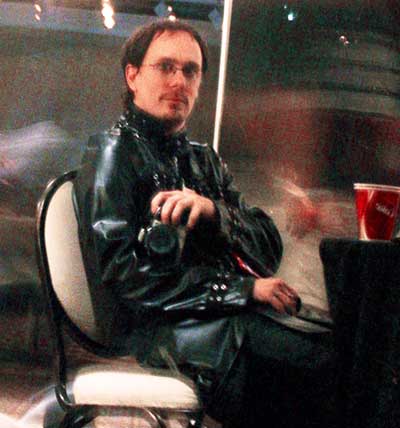
The second night of the con, I snapped a self-portrait reflected in the hotel window. Long exposure, no flash, and I really like the gritty, almost surreal way it turned out.

In unrelated matters: I now have a firm date for the move to Atlanta; I’ll be there a week from Wednesday. I had planned to go spend some time with smoocherie today, but I need to meet up with the principals of my client’s company (the one that’s hiring me), and they were supposed to meet with me here in Gainesville this afternoon and give me a check. They were delayed, and I likely won’t see them ’til tomorrow, so I didn’t get the chance to see smoocherie after all. Work is interfering with my romantic life, and that’s not okay with me!

Also, Shelly came home from seeing her other sweetie with a hickey on her neck, and that is absolutely delightful. There is very little in the world more totally hawt than when she comes home marked. 🙂

I am in love with a dragonslayer

Once upon a time, the planet was tyrannized by a giant dragon. The dragon stood taller than the largest cathedral, and it was covered with thick black scales. Its red eyes glowed with hate, and from its terrible jaws flowed an incessant stream of evil-smelling yellowish-green slime. It demanded from humankind a blood-curdling tribute: to satisfy its enormous appetite, ten thousand men and women had to be delivered every evening at the onset of dark to the foot of the mountain where the dragon-tyrant lived. Sometimes the dragon would devour these unfortunate souls upon arrival; sometimes again it would lock them up in the mountain where they would wither away for months or years before eventually being consumed.

The misery inflicted by the dragon-tyrant was incalculable. In addition to the ten thousand who were gruesomely slaughtered each day, there were the mothers, fathers, wives, husbands, children, and friends that were left behind to grieve the loss of their departed loved ones.

When I first met Shelly, we recognized each other immediately. There are many things the two of us share–not just common ideas about relationship, or shared values (though we do have those), but something else. We both share the experience of seeing the Void–the inescapable realization that we are, each of us, mortal, and the understanding of what it means that we are going to die.

If you have seen the Void, it never leaves you. Some people seek escape in religion, which offers the promise that once we’re past the grave, nothing can go wrong. Some people seek escape in raising a family, or in the notion of reincarnation. For some of us, though, all these things have a feel of intellectual dishonesty about them; in the end, the most parsimonious idea, and the one that is almost certainly true, is that there will be a time when we cease to be, and that ultimately, that is all there is. And that is not okay.

Some people tried to fight the dragon, but whether they were brave or foolish was difficult to say. Priests and magicians called down curses, to no avail. Warriors, armed with roaring courage and the best weapons the smiths could produce, attacked it, but were incinerated by its fire before coming close enough to strike. Chemists concocted toxic brews and tricked the dragon into swallowing them, but the only apparent effect was to further stimulate its appetite. The dragon’s claws, jaws, and fire were so effective, its scaly armor so impregnable, and its whole nature so robust, as to make it invincible to any human assault.

Seeing that defeating the tyrant was impossible, humans had no choice but to obey its commands and pay the grisly tribute. The fatalities selected were always elders. Although senior people were as vigorous and healthy as the young, and sometimes wiser, the thinking was that they had at least already enjoyed a few decades of life. The wealthy might gain a brief reprieve by bribing the press gangs that came to fetch them; but, by constitutional law, nobody, not even the king himself, could put off their turn indefinitely.

The relationship between Shelly and I has been at the same time both effortless and extraordinarily difficult. It’s been effortless because that shared recognition of one another makes understanding easy, and that understanding makes our shared experiences easy. It has been extraordinarily difficult because we connected at a time when our connection was not acceptable to many of the people around us, and we have had to forge the relationship we now share at great cost. In a number of important ways, neither of us is the person we were only a few years ago; indeed, neither of us would likely ever again begin a relationship so fraught with difficulty and pain.

For some people, though, recognition is worth almost any cost. For those of us who live outside the bell curve, the idea of meeting another human being who can really see us, and who can not only understand but cherish those things which make us unlike the people around us, is a thing precious beyond price.

For many centuries this desperate state of affairs continued. Nobody kept count any longer of the cumulative death toll, nor of the number of tears shed by the bereft. Expectations had gradually adjusted and the dragon-tyrant had become a fact of life. In view of the evident futility of resistance, attempts to kill the dragon had ceased. Instead, efforts now focused on placating it. While the dragon would occasionally raid the cities, it was found that the punctual delivery to the mountain of its quota of life reduced the frequency of these incursions.

Knowing that their turn to become dragon-fodder was always impending, people began having children earlier and more often. It was not uncommon for a girl to be pregnant by her sixteenth birthday. Couples often spawned a dozen children. The human population was thus kept from shrinking, and the dragon was kept from going hungry.

Humanity is a curious species. Every once in a while, somebody gets a good idea. Others copy the idea, adding to it their own improvements. Over time, many wondrous tools and systems are developed. Some of these devices – calculators, thermometers, microscopes, and the glass vials that the chemists use to boil and distil liquids – serve to make it easier to generate and try out new ideas, including ideas that expedite the process of idea-generation.

Thus the great wheel of invention, which had turned at an almost imperceptibly slow pace in the older ages, gradually began to accelerate.

Sages predicted that a day would come when technology would enable humans to fly and do many other astonishing things. One of the sages, who was held in high esteem by some of the other sages but whose eccentric manners had made him a social outcast and recluse, went so far as to predict that technology would eventually make it possible to build a contraption that could kill the dragon-tyrant.

The king’s scholars, however, dismissed these ideas. They said that humans were far too heavy to fly and in any case lacked feathers. And as for the impossible notion that the dragon-tyrant could be killed, history books recounted hundreds of attempts to do just that, not one of which had been successful. “We all know that this man had some irresponsible ideas,” a scholar of letters later wrote in his obituary of the reclusive sage who had by then been sent off to be devoured by the beast whose demise he had foretold, “but his writings were quite entertaining and perhaps we should be grateful to the dragon for making possible the interesting genre of dragon-bashing literature which reveals so much about the culture of angst!”

I have written many times in this journal about a philosophy called “transhumanism.” This philosophy, or if you prefer this way of viewing at the world, holds at its essential core the notion at each of us is made of the same stuff as everything else in the universe, and that that stuff is bound by the same physical laws. It also holds that as human beings become increasingly clever, our ability to make the matter and energy from which the universe is made jump through hoops at our command becomes increasingly precise. The development of written language took seventy thousand years from the dawn of mankind as a species; the harnessing of the atom required less than half that time from that point. The ability to create machines which could store and manipulate information needed about the same amount of time; the ability to carve those machines into patterns mere dozens of atoms thick onto objects scarcely visible to the eye required but sixty years after that.

I was introduced to transhumanism by datan0de, a person who has also seen the Void and in whom I also see that essential spark of recognition–fitting, I think, in an arch-nemesis. Through him as well I was introduced to Dr. Ralph Merkle, a pioneer in the field of biomedical nanotechnology, a science whose goal is nothing less than the ability to rebuild and repair living systems at the level of the molecule, doing for medicine what the development of solid-state logic and the integrated circuit have done for computers.

Meanwhile, the wheel of invention kept turning. Mere decades later, humans did fly and accomplished many other astonishing things.

A few iconoclastic dragonologists began arguing for a new attack on the dragon-tyrant. Killing the dragon would not be easy, they said, but if some material could be invented that was harder than the dragon’s armor, and if this material could be fashioned into some kind of projectile, then maybe the feat would be possible. At first, the iconoclasts’ ideas were rejected by their dragonologist peers on grounds that no known material was harder than dragon scales. But after working on the problem for many years, one of the iconoclasts succeeded in demonstrating that a dragon scale could be pierced by an object made of a certain composite material. Many dragonologists who had previously been skeptical now joined the iconoclasts. Engineers calculated that a huge projectile could be made of this material and launched with sufficient force to penetrate the dragon’s armor. However, the manufacture of the needed quantity of the composite material would be expensive.

The anti-dragonists met again to decide what was to be done. The debate was animated and continued long into the night. It was almost daybreak when they finally resolved to take the matter to the people. Over the following weeks, they traveled around the country, gave public lectures, and explained their proposal to anyone who would listen. At first, people were skeptical. They had been taught in school that the dragon-tyrant was invincible and that the sacrifices it demanded had to be accepted as a fact of life. Yet when they learnt about the new composite material and about the designs for the projectile, many became intrigued. In increasing numbers, citizens flocked to the anti-dragonist lectures. Activists started organizing public rallies in support of the proposal.

When the king read about these meetings in the newspaper, he summoned his advisors and asked them what they thought about it. They informed him about the petitions that had been sent but told him that the anti-dragonists were troublemakers whose teachings were causing public unrest. It was much better for the social order, they said, that the people accepted the inevitability of the dragon-tyrant tribute.

Shelly has a determinism in her which, once is awakened, is ferocious in its intensity. Meeting Dr. Merkle energized her in a way that I have never seen before. We spoke with him for less than an hour, and by the end of that time, the rest of the course of her life had been determined.

Within weeks of our return from Atlanta, where we’d been introduced and spoken to him, she was obtaining transcripts and applying for school. There were a couple of people who said her interest was fleeting, some people who said that pursuing a degree in biomedical nanotechnology was not an endeavor suited for her, even one person who believed that it was simply a ruse on her part to win my affections by assuming an interest in things that interested me. The thing that all these people had in common, I believe, was that they did not see Shelly, and because of that, they could not recognize that fire inside her. Those people around us who do see Shelly never doubted her for an instant.

The king, who was at the time enjoying great popularity for having vanquished the rattlesnake infestation, listened to his advisors’ arguments but worried that he might lose some of his popular support if was seen to ignore the anti-dragonist petition. He therefore decided to hold an open hearing. Leading dragonologists, ministers of the state, and interested members of the public were invited to attend.

The meeting took place on the darkest day of the year, just before the Christmas holidays, in the largest hall of the royal castle. The hall was packed to the last seat and people were crowding in the aisles. The mood was charged with an earnest intensity normally reserved for pivotal wartime sessions.

After the king had welcomed everyone, he gave the floor to the leading scientist behind the anti-dragonist proposal, a woman with a serious, almost stern expression on her face. She proceeded to explain in clear language how the proposed device would work and how the requisite amount of the composite material could be manufactured. Given the requested amount of funding, it should be possible to complete the work in fifteen to twenty years. With an even greater amount of funding, it might be possible to do it in as little as twelve years. However, there could be no absolute guarantee that it would work. The crowd followed her presentation intently.

Next to speak was the king’s chief advisor for morality, a man with a booming voice that easily filled the auditorium:

“Let us grant that this woman is correct about the science and that the project is technologically possible, although I don’t think that has actually been proven. Now she desires that we get rid of the dragon. Presumably, she thinks she’s got the right not to be chewed up by the dragon. How willful and presumptuous. The finitude of human life is a blessing for every individual, whether he knows it or not. Getting rid of the dragon, which might seem like such a convenient thing to do, would undermine our human dignity. The preoccupation with killing the dragon will deflect us from realizing more fully the aspirations to which our lives naturally point, from living well rather than merely staying alive. It is debasing, yes debasing, for a person to want to continue his or her mediocre life for as long as possible without worrying about some of the higher questions about what life is to be used for. But I tell you, the nature of the dragon is to eat humans, and our own species-specified nature is truly and nobly fulfilled only by getting eaten by it…”

The audience listened respectfully to this highly decorated speaker. The phrases were so eloquent that it was hard to resist the feeling that some deep thoughts must lurk behind them, although nobody could quite grasp what they were. Surely, words coming from such a distinguished appointee of the king must have profound substance.

The speaker next in line was a spiritual sage who was widely respected for his kindness and gentleness as well as for his devotion. As he strode to the podium, a small boy yelled out from the audience: “The dragon is bad!”

The boy’s parents turned bright red and began hushing and scolding the child. But the sage said, “Let the boy speak. He is probably wiser than an old fool like me.”

Throughout all of human history, we have seen that the sum total of human knowledge and ability increases exponentially. For the vast majority of our time on this planet, existence has been hard, ugly, brutal, and short. But we today live in a time unlike that of any of our ancestors, even a few generations ago. We take for granted things that would have been miracles only a century ago, let alone a thousand or ten thousand years ago. And looking ahead, we can see the sum total of our understanding increasing at a rate more rapid than many of the people alive even today can comprehend. We are at the most interesting point of the exponential curve–the part of the curve where it just begins to shoot skyward, and things become very interesting indeed.

The path Shelly has set herself upon is a very difficult and often lonely one; the first people to see a new possibility are rarely recognized or rewarded for it, and it is not until after the impossible has been done that the majority looks back and says “Oh, that was obvious.”

At first, the boy was too scared and confused to move. But when he saw the genuinely friendly smile on the sage’s face and the outreached hand, he obediently took it and followed the sage up to the podium. “Now, there’s a brave little man,” said the sage. “Are you afraid of the dragon?“

“I want my granny back,” said the boy.

“Did the dragon take your granny away?”

“Yes,” the boy said, tears welling up in his large frightened eyes. “Granny promised that she would teach me how to bake gingerbread cookies for Christmas. She said that we would make a little house out of gingerbread and little gingerbread men that would live in it. Then those people in white clothes came and took Granny away to the dragon… The dragon is bad and it eats people… I want my Granny back!”

There were several other speakers that evening, but the child’s simple testimony had punctured the rhetorical balloon that the king’s ministers had tried to inflate. The people were backing the anti-dragonists, and by the end of the evening even the king had come to recognize the reason and the humanity of their cause. In his closing statement, he simply said: “Let’s do it!”

As the news spread, celebrations erupted in the streets. Those who had been campaigning for the anti-dragonists toasted each other and drank to the future of humanity.

Thus started a great technological race against time. The concept of an anti-dragon projectile was simple, but to make it a reality required solutions to a thousand smaller technical problems, each of which required dozens of time-consuming steps and missteps. Test-missiles were fired but fell dead to the ground or flew off in the wrong direction. In one tragic accident, a wayward missile landed on a hospital and killed several hundred patients and staff. But there was now a real seriousness of purpose, and the tests continued even as the corpses were being dug out from the debris.

Despite almost unlimited funding and round-the-clock work by the technicians, the king’s deadline could not be met. The decade concluded and the dragon was still alive and well. But the effort was getting closer. A prototype missile had been successfully test fired. Production of the core, made of the expensive composite material, was on schedule for its completion to coincide with the finishing of the fully tested and debugged missile shell into which it was to be loaded. The launch date was set to the following year’s New Year’s Eve, exactly twelve years after the project’s official inauguration. The best-selling Christmas gift that year was a calendar that counted down the days to time zero, the proceeds going to the projectile project.

The fire inside Shelly is nothing less than the desire to defeat the Void, to strike back against the notion that old age and death are the inevitable heritage of mankind. She has set herself on a course toward a Ph.D. in a science so new that it does not even have a universally agreed-upon name yet. This will probably consume at least the next ten years of her life, and when she has that degree, she will likely have tens or hundreds of thousands of dollars of debt to go with it–and that degree is only the means to an end, not the end in itself. That degree represents only the tools to do the thing which she actually wants to do, which is pure research–in a field so few people believe in that she will probably earn about as much money as the person down the street whose job it is to ask you “do you want some fries with that?”

When she started school, one person predicted that she would quit within a year. not only has she not done so, she has not stopped even for summer break; she has not left school for more than two weeks since the first day she walked into a classroom. Shelly has declared war upon the Void; the stakes could not possibly be higher.

The cost has been high. She studies for sixty hours a week, not counting the time she is in class. I see her only a couple of hours out of the day. When we drive somewhere, she has a textbook in her lap. When we go out to eat, her organic chemistry text comes with us.

There is beauty in this; in chemistry and in biology, Shelly sees the Matrix–the underlying processes by which the universe itself works, the code that makes it all happen. Philosophers, poets, and sages have nothing on scientists when it comes to seeing the majesty and wonder of the physical world. It is a very hard road to take, though, and one few people understand or even see the value in.

The last day of the year was cold and overcast, but there was no wind, which meant good launch conditions. The sun was setting. Technicians were scuttling around making the final adjustments and giving everything one last check. The king and his closest advisors were observing from a platform close to the launch pad. Further away, behind a fence, large numbers of the public had assembled to witness the great event. A large clock was showing the countdown: fifty minutes to go.

An advisor tapped the king on the shoulder and drew his attention to the fence. There was some tumult. Somebody had apparently jumped the fence and was running towards the platform where the king sat. Security quickly caught up with him. He was handcuffed and taken away. The king turned his attention back to the launch pad, and to the mountain in the background. In front of it, he could see the dark slumped profile of the dragon. It was eating.

Some twenty minutes later, the king was surprised to see the handcuffed man reappearing a short distance from the platform. His nose was bleeding and he was accompanied by two security guards. The man appeared to be in frenzied state. When he spotted the king, he began shouting at the top of his lungs: “The last train! The last train! Stop the last train!”

“Who is this young man?” said the king. “His face seems familiar, but I cannot quite place him. What does he want? Let him come up.”

The young man was a junior clerk in the ministry of transportation, and the reason for his frenzy was that he had discovered that his father was on the last train to the mountain. The king had ordered the train traffic to continue, fearing that any disruption might cause the dragon to stir and leave the open field in front of the mountain where it now spent most of its time. The young man begged the king to issue a recall-order for the last train, which was due to arrive at the mountain terminal five minutes before time zero.

“I cannot do it,” said the king, “I cannot take the risk.”

“But the trains frequently run five minutes late. The dragon won’t notice! Please!”

The young man was kneeling before the king, imploring him to save his father’s life and the lives of the other thousand passengers onboard that last train.

The king looked down at the pleading, bloodied face of the young man. But he bit his lip, and shook his head. The young man continued to wail even as the guards carried him off the platform: “Please! Stop the last train! Please!”

The king stood silent and motionless, until, after while, the wailing suddenly ceased. The king looked up and glanced over at the countdown clock: five minutes remaining.

Four minutes. Three minutes. Two minutes.

The last technician left the launch pad.

30 seconds. 20 seconds. Ten, nine, eight…

As a ball of fire enveloped the launch pad and the missile shot out, the spectators instinctively rose to the tips of their toes, and all eyes fixated at the front end of the white flame from the rocket’s afterburners heading towards the distant mountain. The masses, the king, the low and the high, the young and the old, it was as if at this moment they shared a single awareness, a single conscious experience: that white flame, shooting into the dark, embodying the human spirit, its fear and its hope… striking at the heart of evil. The silhouette on the horizon tumbled, and fell. Thousand voices of pure joy rose from the assembled masses, joined seconds later by a deafening drawn-out thud from the collapsing monster as if the Earth itself was drawing a sigh of relief. After centuries of oppression, humanity at last was free from the cruel tyranny of the dragon.

The joy cry resolved into a jubilating chant: “Long live the king! Long live us all!” The king’s advisors, like everybody that night, were as happy as children; they embraced each other and congratulated the king: “We did it! We did it!”

But the king answered in a broken voice: “Yes, we did it, we killed the dragon today. But damn, why did we start so late? This could have been done five, maybe ten years ago! Millions of people wouldn’t have had to die.”

The king stepped off the platform and walked up to the young man in handcuffs, who was sitting on the ground. There he fell down on his knees. “Forgive me! Oh my God, please forgive me!”

The rain started falling, in large, heavy drops, turning the ground into mud, drenching the king’s purple robes, and dissolving the blood on the young man’s face. “I am so very sorry about your father,” said the king.

“It’s not your fault,” replied the young man. “Do you remember twelve years ago in the castle? That crying little boy who wanted you to bring back his grandmother – that was me. I didn’t realize then that you couldn’t possibly do what I asked for. Today I wanted you to save my father. Yet it was impossible to do that now, without jeopardizing the launch. But you have saved my life, and my mother and my sister. How can we ever thank you enough for that?”

“Listen to them,” said the king, gesturing towards the crowds. “They are cheering me for what happened tonight. But the hero is you. You cried out. You rallied us against evil.” The king signaled a guard to come and unlock the handcuffs. “Now, go to your mother and sister. You and your family shall always be welcome at the court, and anything you wish for – if it be within my power – shall be granted.”

Shelly has picked up the sword and the armor of the dragonslayer. There are no higher stakes. I do not believe she will put them down until the dragon has killed her or it is slain itself.

Today, she and I ordered a pair of rings. I will be leaving for Atlanta within weeks, and we wanted to exchange rings before I leave. She will remain here, in school, studying the ways of her enemy and the tools and weapons by which to defeat it. The rings are made of titanium (atomic number: 22; atomic mass: 47.867; melting point: 1,660 C; number of neutrons: 26; number of electrons and protons: 22) and are engraved on the inside. Mine says “No Fate But What We Make.” Hers simply says “Dragonslayer.”

The young man left, and the royal entourage, huddling in the downpour, accumulated around their monarch who was still kneeling in the mud. Amongst the fancy couture, which was being increasingly ruined by the rain, a bunch of powdered faces expressed a superposition of joy, relief, and discombobulation. So much had changed in the last hour: the right to an open future had been regained, a primordial fear had been abolished, and many a long-held assumption had been overturned. Unsure now about what was required of them in this unfamiliar situation, they stood there tentatively, as if probing whether the ground would still hold, exchanging glances, and waiting for some kind of indication.

Finally, the king rose, wiping his hands on the sides of his pants.

“Your majesty, what do we do now?” ventured the most senior courtier.

“My dear friends,” said the king, “we have come a long way… yet our journey has only just begun. Our species is young on this planet. Today we are like children again. The future lies open before us. We shall go into this future and try to do better than we have done in the past. We have time now – time to get things right, time to grow up, time to learn from our mistakes, time for the slow process of building a better world, and time to get settled in it. Tonight, let all the bells in the kingdom ring until midnight, in remembrance of our dead forbears, and then after midnight let us celebrate till the sun comes up. And in the coming days… I believe we have some reorganization to do!”

Shelly has picked up the sword and the armor of the dragonslayer. There are no higher stakes. I do not believe she will put them down until the dragon has killed her or it is slain itself.

If i were the dragon, I would be very, very worried.

The full text of the dragon fable, which is © Journal of Medical Ethics, 2005, Vol. 31, No. 5, pp 273-277, is available here.