Likely not safe for work, depending on how conservative your work environment is…enjoy! (Edit: Link is dead now.)
Cool Link o the Day… Urban Decay Body Painting
28

Likely not safe for work, depending on how conservative your work environment is…enjoy! (Edit: Link is dead now.)
What you are about to read is a true story. It is a tale of adventure, and courage, and horror, and as such it may not be appropriate for the sensitive. Adults should take young children by the hand, and make sure their arms and legs remain in the ride at all times. Brace yourself, for this tale contains scenes of such horror and woe as to make a grown man weep. You have been warned.
I live in a sleepy little suburb of Atlanta called Duluth. Folks hereabouts value peace and quiet, and not much happens here. Life is quiet, and horror rarely visits this place, save during Presidential elections. About the most exciting thing that happens ’round these parts is the occasional referendum against extending Atlanta’s mass transit system into Duluth…but more on that later.
I live in a small apartment in this sleepy little community, a domicile which is, alas, filled with the detritus of a life of adventure in far corners of the globe. Ancient relics of long-forgotten computers and other prized trophies of a misspent youth fill my living space to overflowing, and with Shelly’s recent move to Tallahassee, where she has precious little space for storing things, my apartment has filled even more.
A couple of weeks ago, Shelly came up to visit, and brought with her such artifacts and relics as I had been keeping in storage with her. Owing to the aforementioned cramped living space I have here, we had little choice save to begin storing some of these legendary artifacts on my balcony.
I have two cats, as regular readers of this journal will no doubt recall. Now my cats, in keeping with the nature of cats everywhere, love little more than to sit in the window and observe the various daily activities of Man and beast as they go by below. The cats particularly love to spend their leisure time in front of the sliding glass door to the balcony, and watch the squirrels leaping about in the skeletal husks of the undead zombie trees outside.
When I first moved to Duluth, the vista offered from the vantage of my balcony was lovely indeed, a stunning panorama of deep forest beyond the apartment complex. Lovely, but fraught with the hints of impending doom, for the trees were…wrong, somehow. The leaves, which should be bright green, were changing, becoming monstrous, turning to sickly hues of yellow and red; within weeks, they began falling from the trees, leaving only the dry bones of skeletal trees.
The denizens of Duluth took this strange and foreboding change in stride. This happens regularly, I was told, every year like clockwork; the trees seemed to the casual observer to be dead, but were actually in a state beyond death, sleeping like the Great Old Ones until the day the stars were right for their return to life. In the spring, they said, the trees would return to life, and roll away the stone to the salvation of us all, or stalk the countryside in search of human blood to feed their zombie reanimation, or some such thing, and that all of this was a part of God’s promise of renewal.
So we see how even the most horrific of things can in time become normal. Humans are a curiously adaptable species.
But I digress.
 As I was saying, Shelly’s arrival precipitated the need for storing many of my ancient and hoary treasures on the balcony. Shelly slid open the balcony doors, and a thunderbolt of realization struck our cats, particularly Snow Crash, the more flighty and impressionable of the two. “Holy Mother of God!” he said. “You mean there’s another room out there??! Why was I not informed of this??? I insist, mortal human, that you allow me out there at once!”
Or perhaps that is what he would have said, had he been gifted with the power of speech.
In any event, it should suffice to say, gentle reader, that the cats were fascinated by the discovery that this huge pane of glass was in fact a doorway to places unknown, and they immediately made the exploration of this strange portal the utmost priority.
This is the setting of my tale. The tale itself begins three nights ago, when I returned from a long day’s toil to my humble abode, cluttered as it was with the possessions of my lifetime, and took it upon myself to bring to the chaos some semblance of order. To this end, I began moving things from my living room to the balcony, where I could later properly catalogue them and decide upon their future disposition.
I slid open the door to the balcony, nimbly evaded the frantic attempts of the cats to dash through the opening during this narrow window of opportunity, and closed the door behind me scant millimeters from their pink wet noses.
In that moment, the horror began, though at this point I was as yet unaware of the trials that awaited me.
With my task on the balcony complete, I turned to open the door, and discovered to my surprise and dismay that it appeared to be stuck. “Oh, great,” I thought, “it’s being stubborn. I’ll have to wiggle it open.”
I tugged, pried, wiggled, and yes, gentle reader, even kicked the door, to no avail. A chill seeped into my bones, as I realized that I had closed the door with such vigor that the lock had latched itself, and I was now trapped on the balcony with no means of egress available save for a long plummet to what would most undoubtedly be a grisly demise at the feet of the unliving trees.
I did not yet panic, however. I have endured many trials and adventures at the hands of an uncaring fate, and I felt supreme in my ability to prevail over this misfortune. I renewed my attack on the balcony door with great vigor, pulling and prying and even jiggling it on its track in my efforts to open it.
All came to naught; the door stubbornly resisted me.
Nights in Atlanta are harsh and unforgiving. As time passed, the temperature plummeted into the high fifties. A howling gale, easily two or three miles per hour, began, and the icy wind brought the temperature into the mid fifties or worse. I had only a heavy winter jacket to protect me from the elements, and feared for my survival.
The sliding glass door taunted me, offering me a vision of safety and warmth denied me by only a single pane of glass. I renewed with even greater vigor my assault on the door. On the other side, the cats watched me, and I could almost hear their voices taunting me.
I have known many brave men–noble, strong men, to a one–who have confronted the unknowable mysteries of the Great Cthulhu and the other Old Ones, and one by one succumbed to madness, their corruptible human minds slowly eroded by the horrors they had witnessed and experienced until at last they were reduced to gibbering imbeciles, spending the last days of their lives imprisoned deep within asylums for the insane.
The wind grew stronger and, confronted with the horror of my own situation, I feared my own descent into madness had begun.
The mocking stares of the two cats pressed heavily upon me. I cast my mind about frantically, hoping to chance upon some idea that might free me from my lofty prison and return me to the safety and sanity of a normal life.
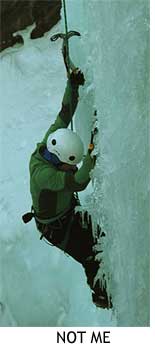 I know! A rope! Surely, if only I had a rope, I could climb down from this accursed balcony and be free! I thought.
With that vision to guide me, I began to search through the boxes and parcels stacked high in my prison. And to my great wonder, I found in a large and otherwise unremarkable box, a long coil of smooth white rope. Salvation!
With trembling hands, I made fast one end of the rope to the beam supporting the roof above me. I climbed over the rail of the balcony, and perched precariously on its edge, the free end of the rope in my hand. It was at this moment I realized the folly of my thoughts.
I do not know to this very day, gentle reader, what had possessed me to believe a rope could possibly save me. For you see, I am a pervert; I can use rope to tie people up in all manner of strange and wondrous ways before working my will upon them. I am not, however, Sir Edmund fucking Hillary, or James Bond, or any other person who might use a rope to climb down from a balcony.
I stood there for a time, balancing on the rail with a rope in my hand, and knew the unshakable truth: my position was not one whit improved.
 Even in the darkest night, there can sometimes shine a glimmer of light. Within the whirlwind of my despair, a tiny flicker of memory asserted itself: figment_j was due at my domicile that evening, as we had previously made a dinner engagement. I resolved to hunker down, sheltering myself as best I could from the fierceness of te elements, and wait it out, hoping that rescue would soon come.
And arrive it did, almost before I could even have dared hope, before I had surrendered any body parts to frostbite. Se stood below me, bathed in radiant light, and a plan began to form.
I resolved upon a course of action which, though fraught with peril, might ultimately lead me from my dreadful perch. As I explained my plan, her eyes widened in shock and fear, but she summoned reserves of courage from somewhere deep inside and agreed to my proposal. I would, i explained, toss my keys down to her, so that she might walk around to my front door, open it, and let me in.
Now came the most delicate moment. The plan rested on the most fragile hope. I withdrew my keys from where they lay in my pocket, and took a deep breath. The slightest of miscalculations, or a chance gust of wind at the wrong moment, and she might not catch the keys, leaving them to fall to the ground in the darkness. I steeled myself, sent a brief silent prayer of good fortune to whatever supernatural beings might be making their silent way overhead on any of the various mysterious errands that bring them on occasion from the nether realms, and released my keys, sending all my hopes and fears with them toward her waiting hands.
The plan succeeded! She caught the keys effortlessly. At last, I thought, I am free!
But it could not be so easy.
The horror of the night peeled back layer upon layer, like the skin of an onion–a horror onion, made of horror.
Duluth, Georgia, is not quite the quaint and charming place it might seem to the casual visitor. Beneath its bucolic charm lurks a deep, dark, sinister fear–a fear that pervades every corner of this village. Duluth is, in the words of a wise woman who has been my mentor and guide in this land, “scared white person central.” This deep, pervasive fear manifests itself in many subtle and mysterious ways.
Duluth is known, quaintly, for its referendums of which I made note earlier, in which her citizens seek to prevent Atlanta from extending mass transit here. A train, it is feared, might give undesirable elements easy access to Duluth, where they may violate her sanctity by breaking into people’s houses and stealing their flat-screen plasma televisions and other consumer goods, and perhaps even partaking of her women in lustful ways that makes one shudder to contemplate.
A tangible manifestation of this fear hangs on my door as a grim reminder of the dark and evil thoughts that poison this fair place–a second deadbolt lock, with no manner of operation from the outside. When i had come to my abode from my daily toil, I had, in an absent-minded moment, turned that deadbolt.
Perhaps I was touched even then by madness. Perhaps the mark tattooed on my back, a symbol of chaos that has been my protection as I have delved into mysteries man was never meant to know, had caught the notice of a passing sprite, who had seen a dim and shadowy vision of my future and elected to play a trick on me. Perhaps the imp that so plagued the mind of the great Edgar Allen Poe had possessed me in that instant. Whatever the cause, which I doubtless will never know, that fateful twist of my wrist had barred figment_j from entrance to my home, and condemned me to further time in my icy prison.
With hopes dashed, I turned once more to an inspection of the door itself. Doors of this variety, I was once told, can sometimes be removed from their tracks, allowing ingress. I searched once more through the collected items at my disposal, finally settling upon a large screwdriver and a hammer with which I hoped to be able to put to the proof this theory.
The door, like all things in this land, was shaped and twisted by the macabre fears of Duluth-s citizens; it had been designed to resist this manipulation. After much sweating and prying, and cursing in the Old Tongues the things which may if uttered casually invoke great Names from beyond knowledge to the calamity of all, I succeeded in prizing the bottom part of the door sufficiently to let my arm within. I basked briefly in the warmth and light of my home, but victory was not yet in my grasp; the latch of the door evaded my reach.
I called down to figment_j, explaining my need. Something, I said, with which to extend my grasp, and perhaps the nightmare would end! A branch or a stick, or perhaps a rod of metal, as long as…as long as… I held aloft a bicycle pump. About as long as this is. With such a tool, as long as this pump and about as rigid, I might…
Amid the swirling madness, dawn broke. Perhaps I could use the very bicycle pump I now held in my hand! I returned with spirit to the door that had so denied me, and thrust my arm through the gap I had made. One swing, another, a third, and…
Yes! I struck the latch squarely, and with a tumultuous noise, as of the very hosts of Hell breaking ground before the advances of the mighty armies of man, the door yielded and slid partway open.
Victory now assured, I bent my might against it, and within moments it stood open. Warmth and light streamed around me as my will prevailed; somewhere in unknowable spaces where the Great Old Ones sleep, Fate herself trembled.
Afterward, figment_j and I went to Ruby Tuesdays for dinner.
I have a great deal of work to do, and a crushing deadline that’s looking nigh-impossible. It’s very, very difficult to be properly motivated to get it all done when the company’s payroll account is completely empty.
Hence, I’m being Posty McPosterson today. LiveJournal: because it beats working…
I now have, courtesy of chaos5023, a titanium spork–arguably the coolest piece of cutlery ever created. With that, a steak knife, and about eighteen hundred nuclear bombs, I could rule the earth.
This morning, I received in my email a long essay, written (EDIT: or rather, quoted; this person has since said she isn’t the original author of the piece) by one of the founders of the New Age, Tantric-sex-loving “World Polyamory Association,” claiming that polyamory can save the world. The reasoning, if it can be described with that word, is very straightforward. The essay begins with
Polyamory – the answer to the hate of our world …
Polyamory is not about deception – devious behaviour, wantonness, lust, passion, licentious behaviour or wreckless [sic] abandon. It’s about the ability to see beyond the narrow forms of society’s restrictive norms – be able to reach out … touch, offer … share and grow.
Love is about being compassionate, giving, sharing … becoming whole – not destroying all that is about us … the negative, destructive … evil by-products of hate. Love is about connecting and forming that special bond with those whom we love. It is about reaching – attaining a higher plain in our evolutionary stage as homo sapiens.
When the world has lost all concept of humanism – waging wars – devastation & destruction… outright genocide – killing millions of innocent people (women and children) it no longer possesses any moral compass. We have been rendered to the lowest ebb of what civilization was ever meant to be.
It goes on from there, asserting that since polyamory is about love and that war and terror are about hate, the solution to war and terror is more love–ie, polyamory. Now, I happen to think this idea is bunk, for a number of reasons, but I didn’t come here to talk about polyamory at all. I came to talk about the nature of war, and the nature of hate.
It’s a mistake to believe that love is the opposite of hate. Human emotions aren’t so simple. Love and hate do not exist on opposite ends of the Great Continuum of Feeling, and increasing the number of people one loves does not necessarily move a person away from hate. In fact, it is quite possible, and indeed altogether common, for a person to love some people, and hate some other people, and adding names to the list of people in the “loved” category does not remove names from the list of people in the “hated” category. Only a shallow and tenuous grasp of human emotional behavior would suggest otherwise.
In fact, love can be the genesis of hate, and can sometimes even provide a fertile field in which hate can grow.
Consider, for example, the Palestinian refugee whose beloved family is killed by an Israeli bomb, or the mother of a child killed in the World Trade Center. The loss of a loved one usually results in a strong emotional response, and if a person feels that those he loves have been taken from him with malice, his love for those who were lost can fuel his hate for those he perceives as responsible for that loss. Combine loss with a feeling of powerlessness, hopelessness, or despair, and you can easily end up with a person who expresses his pain and hate by strapping dynamite to his body and blowing himself up in a roadside cafe.
It need not even take any act of malice for this to happen. Anyone who’s survived a divorce or the end of a romantic relationship is likely familiar with how easily and how completely love can transition into hate. The person who one once shared his life, his home, and his bed can become a threatening, spiteful monster in his eyes overnight; the loss of something valued leads to grief, anger is a normal and natural part of the grieving process, and anger is fertile ground indeed for hate.
This is not helped at all by the fact that we tend to look in the outside world for things which justify our emotional responses. Look for reasons to hate someone, and they become easy–trivial, even–to find. So much of the way we perceive other people is in interpretation. If we believe, rightly or wrongly, that someone means us ill, we interpret that person’s behavior very differently than we might if we perceive they love us; and that perception can make the love or the ill real.
There’s a monkeysphere issue at work here, too. At the end of the day, our monkeyspheres–the sum total of those people with whom we can form meaningful, intimate emotional connections–is finite. Not only is it finite, it’s pitifully small; perhaps a hundred and fifty people or so. Past that point, we start taking shortcuts–lumping people into groups, and considering them only in terms of the group to which we’ve assigned them.
There are people who say they love everyone, or they love the whole human race. Those people are full of shit, at least if you are talking about meaningful, intimate bonds of love rather than a vague, poorly-defined, general sense of generic goodwill toward all of mankind. The silliness in the idea that it’s possible to love everyone is exposed by a simple thought experiment: did you mourn the deaths of the hundreds of people killed in the Philippines last month like you would the loss of your lover, or your child? Would it even be possible to function if you did? If the lives and deaths of everyone in the world impacted you the way the lives and deaths of those most intimate to you did, would you be able to survive at all?
The monkeysphere sets an upper limit on those we can love, yet it the same does not apply to hate; love is a uniquely personal, uniquely intimate experience, but we as human beings seem capable of hating people as a class or a group. Witness only those who hate all blacks, or all Jews, or all Americans, or all Arabs, and the fanaticism and obsession with which that hatred burns. We can not seem to love in the same way; one can not feel a deeply personal love for all Muslims, but people can and do feel a deeply personal hatred for all Muslims, or members of any other group, and build the entire shape of their lives around that hate.
Is love the answer to war? Answering that question requires understanding why wars are fought, and that understanding sometimes runs counter to intuition.
Wars are sometimes fought for reasons at least partially rooted in emotion, it is true. It’s not terribly difficult to support the notion that the bitter conflicts in the Middle East are fueled at least as often by equally bitter personal hate as they are by more prosaic concerns, such as control of economic resources.
But it’s not always so straightforward.
Let’s take a look at a very simple question. You are the leader of one nation; I am the leader of another. Your army has four divisions of troops. My army has ten. Our troops are in all respects equally matched. Our nations are at war. When will our war end?
This is the basis of an article with a nonintuitive answer to the question. The most simple answer, of course, says that the war will end when our armies engage in battle, and my ten divisions destroy your four divisions. But is that actually the case?
A sociologist might say that the war will end before it even begins. Given that the outcome is certain, your best course of action is to surrender before a shot is fired; if we do go to war, you will lose your entire army, and you will lose the war.
But in the real world, the answer is neither of the above. The answer is that the war will end when one of us reaches a point past which we are unwilling to accept further loss. Even if my army dominates yours entirely, even if my soldiers kill 170 of your soldiers for every man I lose (as was the case with US and North Vietnamese armies in Viet Nam), if you are willing to sustain losses that are sufficiently greater than the losses I sustain, you will win and I will lose. War then becomes a question of information theory; we will know the victor when we know the point at which one of us is unwilling to sustain further losses.
So. Back to the question at hand. Why do we fight wars? We fight wars because you and I have different and mutually incompatible goals. How do we fight wars? We fight wars by inflicting pain on one another until one of us reaches the point at which we are no longer willing to tolerate any additional pain. This process may be hateful, but it need not be driven by hate; two competing armies do not necessarily hate one another, and nations that were once embraced in war, such as Japan and the United States, can upon the conclusion of that war be embraced as allies.
But the process of inflicting pain during the prosecution of that war can breed hate, and love is not the answer to that hate; indeed, love can be the progenitor of that hate. If in the process of inflicting pain upon your nation, I deprive your people of something that they love, I will breed in your people a hatred for me. This hatred can actually increase the amount of pain you are willing to withstand; if I deprive your people of that which they love, they no longer have anything left to lose, and a person with nothing to lose can withstand just about any pain. A person with nothing to lose can become a dangerous person indeed, as many governments throughout the world might be well-advised to remember.
A person capable of love is capable also of hate. A person who loses that which he loves can easily turn to hate, whether that loss comes through the irreconcilable differences that end a marriage or the acts of malice that begin a war. More love does not mean less hate, for love is fundamentally bounded and hate, sadly, seems not to be.
In the scheme of world events, polyamory is essentially irrelevant. It is a relationship model, nothing more. It does not breed love nor turn hate to love, and people who adopt this relationship model are as capable of malice and spite as those who adopt any other–witness the dot_poly_snark community. In fact, I submit that the belief that polyamorous people are somehow more enlightened, wiser, or more evolved than their poor plodding monogamous brethren is nothing more than narrow elitism, no different save in the details than the belief that whites are somehow better than blacks. Believing one’s self to belong to a class of people superior in any dimension to the rest of the people with whom we share this planet does not breed love, but it certainly can and does breed hate–a nice irony, if one believes the class of people to which he belongs is superior because it is more loving.
 |
 |
 |
 |
 |
 |
 |
 |
 |
 |
 |
 |
…now with 63% more blasphemy!
The true meaning of Christmas is often, I fear, overlooked in this day and age. This Christmas was a back-to-basics kind of holiday for me; in the spirit of remembering the meaning of Christmas, this year’s gifts to Shelly and I included a Baby Jesus Butt Plug, a Virgin Mary dildo, and a copy of Richard Dawkins’ The God Delusion. figment_j gave me the least blasphemous gift, a copy of Robert Heinlein’s Time Enough for Love, and even that has plenty in it to upset the fine upstanding God-fearin’ folk.
But, it did keep me thinking about Jesus for the holidays!
I could write a great deal more, about rum and eggnog and having a part of my intentional family over for several days, but I’m installing Ubuntu Linux on one of my computers and it’s calling for my attention, so perhaps later.
“Stupidly polygamy.”
I get a lot of spam. I mean a lot of spam. I know everyone gets a lot of spam, but I get a quantity of spam every day that’s just quite unreal.
About two-thirds of the spam I get is in Russian. Of the remaining spam, a good bit of it is in French, a lot of it is in Spanish, some of it is in German, some of it is in Chinese, a little bit is in Italian, a little bit is in Polish, every so often I get the odd occasional bit of spam in Hebrew (usually advertising a Web site I can’t make hide nor hair of but featuring expensive American electronics and watches with large bold prices and bulleted lists), and today I got my first spam in Arabic.
I was puzzling about that a while ago. Yesterday, I started working on a new page for my polyamory site, which lists all the mirrors of the page tat have been translated into other languages, and it clicked.
I did a Google search for my name in non-English languages, and found translations of my poly pages in Russian, French, Spanish, German, Italian, Polish, and Hebrew, each with an email link to my primary AOL address. This suggests that spammers are actually scraping email addresses from Web sites and taking note of the language tags in those Web sites, and selling the email addresses scraped from the non-English sites (probably at a premium) to people who spam in languages other than English.
Today’s Arabic spam puzzles me, though. I can’t find any mention of my name or email on any Arabic-language Web sites, at least not via Google.
So, as many of you may already know, today is Global Orgasm Day–a day in which we can all show our fundamental unity by getting off.
Now, don’t get me wrong here. I’m strongly in favor of orgasms. I mean really strongly in favor of orgasms. I like a good orgasm–or two, or three, or seventeen–as much as the next guy, and probably rather better than most. The idea of a “Global Orgasm Day” sounds great to me.
In fact, dare I even say it, I think that maybe a Global Orgasm Day shows a certain failure of imagination. I might humbly suggest a Global Orgasm Week, or–hell, let’s be wild!–even a Global Orgasm Month.
But the idea that there is some kind of “science” behind the Global Orgasm Day, and that this Global Orgasm Day can make the world a more peaceful place? C’mon.
I mean, here it is, right from the Web site:
The Global Consciousness Project (http://noosphere.princeton.edu), runs a network of Random Event Generators (REGs) around the world, which record changes in randomness during global events. The results show that human consciousness can be measured to have a global effect on matter and energy during widely-watched events such as 9/11 and the Indian Ocean tsunami. There have also been measurable results during mass meditations and prayers.
The Zero Point Field or Quantum Field surrounds and is part of everything in the universe. It can be affected by human consciousness, as can be seen when simple observation of a subatomic particle changes the particle’s state.
We hope that a huge influx of physical, mental and spiritual energy with conscious peaceful intent will not only show up on Princeton’s REGs, but will have profound positive effects that will change the violent state of the human world.
Seems to me someone’s been drinking too much Kool-Aid. I mean, seriously. This half-baked, lame-ass, uneducated, superstitious gobbledygook is what people these days call ‘science’? Jesus Hypothetical Christ on a three-legged camel! Someone’s started spouting quantum physics without actually, y’know, learning anything about quantum physics. If this is the sort of rubbish that the common man (or woman) on the street actually accepts as “science,” then I fear for the future of us all.
Look, orgasms are good. Orgasms are fun. I daresay orgasms can even change the world; if Bill Clinton woke up every Monday knowing he was going to get a blowjob from Monica the following Wednesday, seems to me he’d be less likely to put his finger on the button that blows us all to smithereens on Tuesday.
But, c’mon. There’s no need to wrap orgasms up in this ridiculous dressing of pseudoscientific babble and ridiculous nonsense in order to justify them. Orgasms don’t need validation. There doesn’t have to be this notion of “saving the world” to make an orgasm fun and healthy. Orgasms are fun! They are not quantum events that are going to unify to change the energy vibration of the global fucking energy field or some such bullshit; they’re just fun! Go out, get off, don’t wrap it all up in this pathetic junk-science rubbish!
Earlier this week, I challenged figment_j to a rematch after the beating she put on me in air hockey a few weeks back. She took me up on the challenge, and I sought to salvage the tattered remnants of my manhood after the air hockey pasting she’d delivered to me.
Se well and truly trounced me again, decisively crushing me four games to one, just as before. I am nearing the point where I may simply have to accede to her superior air hockey skills.
After she delivered the second thrashing, we wandered around the arcade looking at all the other various and sundry video games offered for our passing fancy, all of which were lame beyond human reckoning. One of the games, the objective of which I do not fully understand, appears to have two side-by-side animated people racing over a BMX/dirt-bike style track; the players control the on-screen characters by means of two large, heavy levers with rubber bumpers. Apparently, each player can slam his lever up against the other player’s lever and attempt to knock the other player’s character off the track, or something. Near as I can tell, the game is an excuse to pummel the other player.
Anyway, it has this warning sticker affixed to it, which I photographed with my cell phone:
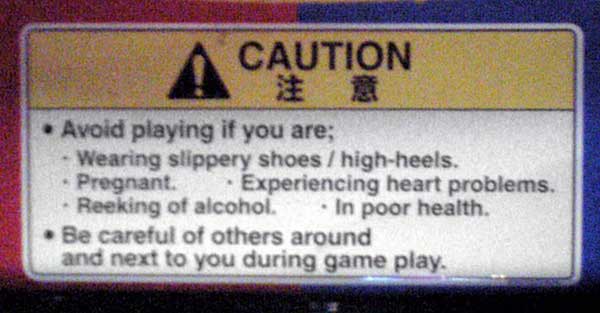
Yes, that’s right, boys and girls…don’t play this game if you are reeking of alcohol. You can play drunk, but for the love of God, eat a breath mint first!
I also think it’s interesting that it says “Caution” in both English and Japanese, but the rest of the label–presumably, the important bit–is only in English. (At least, I assume it says “Caution” in Japanese. It may actually say “Silly roundeye, we will kill you!”–I don’t know.)
…especially in modern-day America, currently in the grip of a wave of anti-intellectualism and a backlash against reason and logic that’s quite remarkable, and depressing, to behold:
I wish to propose for the reader’s favorable consideration a doctrine which may, I fear, appear wildly paradoxical and subversive. The doctrine in question is this: that it is undesirable to believe a proposition when there is no ground whatever for supposing it true. I must, of course, admit that if such an opinion became common it would completely transform our social life and our political system: since both are at present faultless, this must weigh against it.
— Bertrand Russell, On the Value of Skepticism, 1935.