Because sex is a lot like astrophysics…

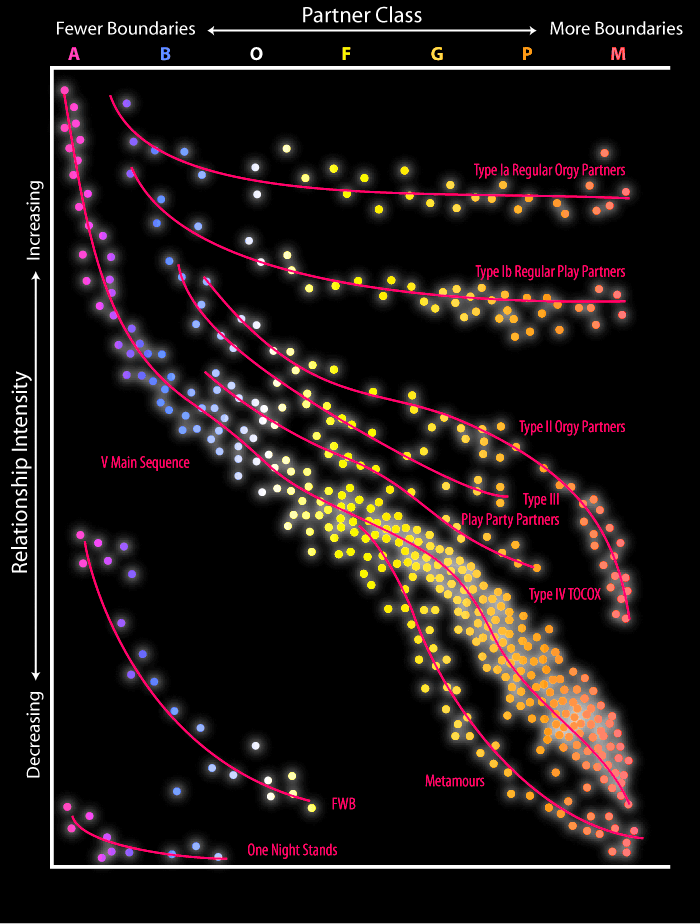
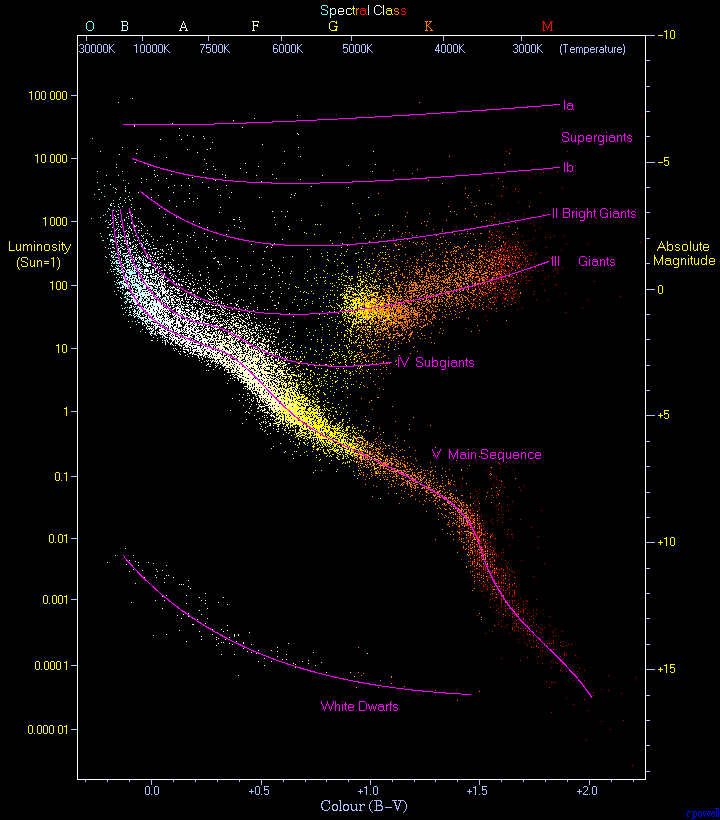
In the study of stellar evolution, there is this concept called the main sequence, a well-defined band that you see whenever you survey all the stars in the sky and plot their color on one axis and their brightness on the other. Not all stars fall into the main sequence, but the vast majority do; there’s even a lovely image of the graph here.

It seems the same is true of relationships. Stellar evolution and stellar nucleosynthesis map with remarkable fidelity onto relationships, I’ve observed, with a plot of “intensity of relationship” (as a function of emotional investment and expectation of continuity) vs. “sexual boundaries” showing patterns startlingly similar to the main sequence. At least to me.

So for example if you plot sexual boundaries horizontally and relationship intensity vertically, you might see something like this:

The sexual boundaries increase from left to right, with the classifications as:

A: Anything goes. Unbarriered, unprotected, full-on squishy fluid-bonded sex.
B: Barriers for anal and PIV sex
O: Unbarriered oral; no penetrative sex.
F: Fisting and/or fingering without barriers; barriers for anything else.
G: Gloves for fingering; no wet and squishy contact, even manual, without them.
P: Pants stay on; above-the-pants contact allows.
M: Makeout partners–no removing of clothing.

Now, not all the partners one can have fall in the main sequence. Along the top of the graph, we see partners distributed in Type Ia and Type Ib classifications: these are people you will schedule regular orgies with or a regular BDSM play relationship with, which may or may not involve sex (directly) but do involve a high level of emotional investment and commitment. Some of these folks might even be considered “family.”

If you’re part of the sex-positive community, you might go to orgies or play parties on a regular basis, and see the same folks over and over. These are folks you don’t necessarily have squishy sex with, but you might have some sort of irregular or semi-regular play/makeout relationship with. There’s not necessarily a high level of emotional investment, but you notice when you show up to a party and they aren’t there.

Type IV partners are most commonly found in poly relationships. These are the “Too Complicated To Explain” partners–they’re not necessarily partner partners, and they’re not necessarily part of the family, but they’re not not partners either…

A branch from the main sequence sometimes occurs for metamours, who a person might have some sort of sexual relationship with, but might not continue if that person’s partner breaks up with that person, but then again, sometimes these relationships do continue on their own, and…yeah, it’s complicated. Past a certain point, it’s not always clear from a single partner whether that person is main sequence or metamour.

A scattering of partners exist with a high level of sexual contact but a low level of relationship investment. These partners tend to scatter along the Friends with Benefits and One-Night Stand axes.

Why I Want to Live Forever

I’ve mentioned this before, but one of the things that baffles me the most when I say I want to live forever is the folks who say “Wouldn’t you get bored?”

The question totally boggles me. Bored? Who on earth has time to be bored? Life changes constantly. In the last two thousand years, we have gone from Bronze Age tribalism through the Iron Age, the rise and fall of the empire of Rome, feudalism, the Renaissance, the discovery of a new continent, industrialization, the rise of mass communication, to atomic power and the beginning of the exploration of the physical universe. In all of that, we have seen incredible changes in society, philosophy, science, art, engineering, customs, tradition, and knowledge. Who would say of a man born in the time of Jesus and still alive today, “But aren’t you bored?

The question to me seems to show a projection of the present onto the future–I almost wonder if the folks who ask aren’t envisioning people commuting to work, stopping for lunch at McDonald’s, listening to Rush Limbaugh on the radio, heading home through rush-hour traffic to watch reruns of “Friends” on TV in the year 6,000. I think that’s particularly strange given that, in the memory of people who are still alive today, the United States has moved from a largely agrarian nation to a post-industrial nation, pausing along the way to split the atom, tame Niagra Falls, and put men on the frikkin’ MOON.

No, I don’t think I’d be bored.

In fact, I’ve started to make a list of some of the things I would like to live long enough to see–things for which a single “ordinary” human lifespan is insufficient. The next thousand years offers exciting prospects for the human species unmatched in the last ten thousand, and I want to see what happens. For example:

What will happen when we discover evidence of life elsewhere in the universe? Given the incomprehensibly vast scope of the physical universe, it seems profoundly unlikely that we alone live here. If the emergence of life is so unlikely that it happens even once out of ten billion solar systems, that would mean it’s everywhere–the physical universe is just that big. If, as seems more likely, it develops and takes a foothold anywhere that it is not prevented from doing so by the laws of physics, then it’s probably ubiquitous. What does it look like? How does it work? What would it mean to us to learn that we’re not alone? What form would it take? Where will we find it? What implications will it have for philosophy, religion, morality, our conceptions of ourselves? What will we learn from it? Will the knowledge that it exists make us feel more connected or more disconnected from the universe and from each other? Will we see life as being more sacred or less sacred?

Will we succeed in moving beyond our own fragile home on earth? Where will we go? What will we learn? How far will it be possible for us to extend our reach? How will we change in the process? Will knowing that we have left the only home humanity has ever had for its entire existence change our conceptions of ourselves, and in what way? How will we adapt?

What does a post-scarcity society look like? From the stone knives used by our earliest hominid ancestors to the Large Hadron Collider, everything we have ever built has been built in the same way–by taking the materials we find and heating, cooling, chipping, hammering, carving, cutting, and pounding away at them until they’re shaped to do the task we want. This crude method of building things, which has been refined only in degree but not in kind since the days of flint knapping and bearskins, necessarily means resource scarcity, because it is limited both by the natural raw materials available and by the man-hours of labor needed to fashion the raw materials into finished things. But what happens when we gain the ability to put things together on a molecular level exactly as we want to? Oh, then everything changes. Then it becomes possible to make just about anything–food, Ferraris, fuel, iPods, spaceships–from dirt and sunlight. No more scarcity means no more resource competition, no more competition between the “haves” and the “have nots,” no more division of nations into “first world” and “third world.” What will that mean for human society? How will it change the way we interact with each other? Who will be the first to figure out molecular assembly, and how will that affect everyone else? Is it true, as some folks say, that wars are fought for resources first and ideology second, and if so, will a post-scarcity society really make war obsolete? Or will we simply shift from competing for material resources to competing for ideas?

What happens when we gain the ability to control ourselves on a molecular level? Biomedical nanotechnology is a hot field of research, barely out of the starting gate–the state of the art right now is roughly at the state of the computing art during the time of Charles Babbage. We know it is possible to build machines that can change and repair living organisms on a cellular or molecular level–we just don’t know how to get there yet. But what happens when we do? What does a human society look like when you take away the inevitability of deterioration, aging, enfeeblement, and death? And more than that–what does it mean to be able to make modifications to to ourselves on the level of our DNA? When you give people the ability to change in that way, will you see a society of nearly-identical supermodels, or a society of people with orange fur and tails? Will we begin to enforce common standards of physical appearance, or will we start changing ourselves in all sorts of novel and interesting ways? If people can change their physical sex at will, and be completely functional in whatever their chosen physical sex is, what will that mean for gender differences? How will that affect society, when some of our most basic assumptions about what being human means become obsolete?

What happens when we remove the biological limitations on our brains and bodies? Human brains and human bodies do not have infinite capacity. Our brains are limited, both in terms of raw processing power and in terms of the concepts we are easily able to imagine and comprehend. Are there things about the physical universe that we simply do not have the capacity to understand, in the same way that a dog does not have the capacity to understand calculus? Are we nearing the limits of what we are able to understand about the physical world around us? What will it mean if we can re-wire our brains to add capacity? What will it mean if we can change our bodies to give ourselves abilities we lack now–the ability to breathe underwater, say, or to adapt to hostile environments? How much of what we consider our “humanity” is a consequence of our limitations and of the environment we live in? If we begin to diverge from one another in these ways, will we lose our ability to relate to one another, or will this simply serve to underscore the ways in which we are all connected? What will we learn about ourselves? What will we learn about the world we live in?

What happens when we encounter the first non-human intelligence? There are many ways this might come about; it could be an AI, a non-human race, even an animal that’s been modified to have a higher level of cognitive capability. How will seeing an intelligence that isn’t ours affect us? What will we learn about ourselves? Will we discover new ways of comprehending the universe? Will we discover blindness in our own way of thinking, and if so, how will we be better for it?

What kind of macroengineering projects are we capable of? The largest-scale engineering we’ve ever done is really, when you get right down to it, not that far above Stonehenge. But what happens when we become capable of building on a global scale, or larger? The Space Elevator is a good beginner’s macroengineering project, but what comes next? Will we be able to terraform planets? Build ringworlds? What will those things look like? How can they be done? How will they extend our capabilities as human beings? How will transforming the physical universe transform us? Will we encounter anyone else who is already building on this scale? What will that mean for us?

Now, to be perfectly honest, even if these things were not on the horizon, even if things would always be as they are now, I would still want to live forever. There is hardly a day that goes by that I don’t encounter something that is so mind-blowingly beautiful that it makes me grateful to be alive; the world just as it exists in this instant in time is so filled with wonder and beauty that I could live for thousands of years and never grow tired of it. There is so much joy to be had, all around, that I can’t quite fathom living in anything other than a perpetual state of awe.

Aaaand continuing the theme of “long overdue updates”…

…two more updates to two of my long-neglected side projects.

First, I’ve updated and tweaked the software on HackerSluts, which is my server-side RSS aggregator for sex blogs. Or, at least, sex blogs I know about. It’s kind of my own combination of Feedburner and Technorati but for sex and kink.

I’ve also made some user interface changes over at Weekly Sex Tip, which is a site I update with a new sex tip once per week. Err, exactly as the name suggests. The tweaks to the skin now allow you to choose a category and browse sex tips only in that category.

Whew! I almost feel accomplished.

Well, I’ve finally got ’round to an old project…

…an update to the interactive version of the Map of Human Sexuality.

Finally solved the single biggest problem with it, which was that you could not correct a mistake while you were creating a map. With the new version, you can now remove a pin if you accidentally place one in the wrong page…a simple idea that took a lot of head-pounding and hair-tearing to implement.

Next on the List of Things To Do is to make a login system so you can go back and update/change your map later.

And in honor of the revamped map software, I’ve created a new personal map that reflects some of the new things I’ve tried since doing the original!


Find out where I’ve journeyed
on the Map of Human Sexuality!
Or get your own here!

Because not buying anything on Black Friday is SO last decade…

…I have decided to help fuel the orgy of capitalistic excess with some special offers of my own!

As a Twitter friend of mine put it (and who says Twitter is always insipid?), the biggest shopping day of the year is a good time to support artisans and small businessmen you like. So with that in mind, I’ve set up two special deals on my own Web site!

The first is the “Get One, Give One” deal on the poster version of the Map of Human Sexuality. Looking for a cool, fun gift for someone on your Christmas list of naughty people? Want something cool to hang on your wall that will get people talking? Running short on funs in the recession? The Get One, Give One deal is your answer! Buy a poster, get a second poster for half price and I’ll even ship it to a second address for free if you like!

The second is a Sexual Explorer’s Wilderness Survival Kit. Buy a copy of the Map of Human Sexuality and get ten dollars off the registration for Onyx, the Game of Sexual Exploration. Onyx helps you explore, and the Map lets you know where you’ve been! The only thing missing is a canteen. And a compass. And, y’know, one of those wilderness adventure knives with the little thing on the handle that you can unscrew and put matches in so they don’t get wet.

Sound interesting? Clicky the link to learn more!

Brilliance! Pure brilliance!

The thing about the Internet is that no matter how long you surf and how many sites you visit, there’s always something really awesome and cool that you just haven’t stumbled across yet.

There’s also a phenomenal amount of teh dumb, to be sure. In that way, the Internet is, as the saying goes, like a herd of performing elephants with diarrhea — massive, difficult to redirect, awe-inspiring, entertaining, and a source of mind-boggling amounts of excrement when you least expect it.

But still. There’s a lot of really cool stuff out there. Like PartiallyClips, a clip-art Webcomic that devoured my entire afternoon recently. I ended up reading every single one of them.

Some of my personal favorites:

A few more, with a special bonus comic for datan0de

File under “should be obvious”…

From an email I just made on a polyamory-related list:

I’ve found that a lot of my relationship fears vanish and my relationships become a lot stronger and more healthy when I start with certain assumptions: namely, that my partners want to be with me, that they see value in me, that when given the opportunity they will seek to make choices that honor our commitments and cherish the relationship we’re in, that they are honest and can be counted on to behave with integrity, and that when they say they love me, it’s because they do.

Often it seems to me that people base relationship rules on the assumption that their partners can not be trusted, that if given free action their partners will not choose to honor and nurture their relationships, and that their partners are harboring secret agendas involving dumping them when someone ‘better’ (whatever that means) comes along. I can’t quite fathom building a relationship on those assumptions, nor why someone would want to remain in a relationship where they were true.

Ahh, the mysteries of life.

Engrish Spam of the Week

From my email inbox this morning, a bit of spam directed at my Symtoys address from a sex toy manufacturer:

Dear Owners

We are the Leading manufacturers-cum-exporter of complete Adult Body Jewelry like Nipple Rings, Nipple Weight Stretchers, Cock Rings.

We TRIUNE SKINMOD SUPPLIES exporting this Adult Body Jewelry successfully throughout the world. Your good-self kindly requested to please visit our web-site indicate items of your choice enable us.

The company in question is in Pakistan…and no, it isn’t the same company that has offered to sell me sex toys from Pakistan in the past.

Quote of the Day: 1984

You were so busy worrying about 1984 you didn’t notice you were living Brave New World.

What Orwell feared were those who would ban books. What Huxley feared was that there would be no reason to ban a book, for there would be no one who wanted to read one. Orwell feared those who would deprive us of information. Huxley feared those who would give us so much that we would be reduced to passivity and egoism. Orwell feared that the truth would be concealed from us. Huxley feared the truth would be drowned in a sea of irrelevance. Orwell feared we would become a captive culture. Huxley feared we would become a trivial culture, preoccupied with some equivalent of the feelies, the orgy porgy, and the centrifugal bumblepuppy. As Huxley remarked in Brave New World Revisited, the civil libertarians and rationalists who are ever on the alert to oppose tyranny “failed to take into account man’s almost infinite appetite for distractions.”

In 1984, Orwell added, people are controlled by inflicting pain. In Brave New World, they are controlled by inflicting pleasure. In short, Orwell feared that what we fear will ruin us. Huxley feared that what we desire will ruin us.

–Neil Postman, Amusing Ourselves to Death

Though I must say it isn’t necessarily either/or. We have created a culture that has spawned both an unprecedented attack on civil liberties from on high, particularly under the last administration, along with a reactionary anti-intellectualism that openly scorns the quest for knowledge, giving us the worst of both.