What squirrels taught me about post-scarcity societies

If you know any transhumanists or other forward-looking folks, you’ve probably encountered the notion of a “post-scarcity society.”

I just got back from a two-month writing retreat in a cabin deep in the heart of rural Washington, many miles from civilization. The squirrels at the cabin are quite talented at stealing birdseed from the bird feeders around the cabin, and that taught me a lesson about transhumanism and post-scarcity society.

This might make me a bad transhumanist, but I think the hype about post-scarcity society is overblown, and i think the more Panglossian among the transhumanists have a poor handle on this whole matter of fundamental human nature.

I’ve written an essay about it over on Think Beyond Us, which includes a video of squirrel warfare. Here’s a teaser:

We’re moving toward the technology to do things in a completely different way: using tiny machines to build stuff from a molecular or atomic level. In the book Engines of Creation, K. Eric Drexler envisions a time when we will be able to fabricate almost anything we can imagine from simple raw materials and energy.

And on this foundation, futurists say, post-scarcity society will be built. If we can make anything from any raw materials cheaply or free, there is no longer a divide between rich and poor. Think Las Vegas where everyone is a millionaire whale. Want a car? A sofa? A cup of tea? Program assemblers with the characteristics of the thing you want, push a button, and presto! There it is.

In a society where everyone can have whatever stuff they want and nobody has to work, entertainment becomes very important indeed. And those who can provide it—those who can write, or sing, or perform—well, they control access to the only resource besides land that means anything.

So what, then, do we make of a society where the 1% are determined not in accordance with how many resources they control, but how creative they are? A Utopian might say that anyone can learn to be creative and entertaining; a look around the history of humanity suggests that isn’t true.

Those who own land today command one of the few resources that will matter tomorrow. Those who can entertain command the only thing that can buy that resource. And the rest of humanity? Suddenly, Utopia starts to look a whole lot less Utopian to them, and a whole lot more like the same old same old.

Check it out! You can read the whole thing here.

Two Chaosbunnies in the Desert: Bodie, part 2

Part 1 of this saga is here. Part 8 of this saga is here.
Part 2 of this saga is here. Part 9 of this saga is here.
Part 3 of this saga is here. Part 10 of this saga is here.
Part 4 of this saga is here. Part 11 of this saga is here.
Part 5 of this saga is here. Part 12 of this saga is here.
Part 6 of this saga is here. Part 13 of this saga is here.
Part 7 of this saga is here.

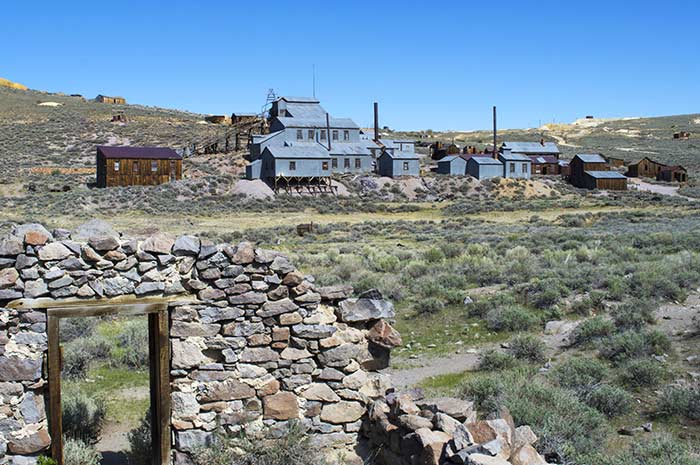
Bodie, California is a classic nineteenth-century California gold rush town. It’s high atop a mountain in the desert, and every part of the town exists for one purpose alone: to facilitate the extraction of gold from the surrounding hills.

The whole of the town exists to support the stamping mill, the large gray building about which everything else revolves. On our second day there, Bunny and I toured the stamping mill. This can be done only as part of a twice-daily guided tour group. The stamping mill, you see, represents the absolute apex of Victorian-era technology, and Victorian-era technology was not exactly built on a foundation of safety first. Even when it hadn’t been abandoned for nigh on a century.

This is a view of the mill from what’s left of the bank, which was, not coincidentally located right across the street.

In principle, a stamping mill is relatively straightforward. Ore goes in the top. It’s crushed into a fine powder—”about as fine as flour,” the tour guide said—by large mechanical hammers. Then, and this is where the famed Victorian indifference to human life really shines, the powder is sifted across a pool of mercury. The mercury reacts with gold to form a mercury-gold amalgam, which becomes a semi-solid mass that workers roll up into a ball and stick in a safe (I swear I am not making this up).

The rock doesn’t stick to the mercury and is discarded. The ball of hideously toxic mercury-gold amalgam is then, get this, placed in a furnace, where the mercury is boiled off, leaving molten gold behind. The molted gold is poured into bars, assayed, and then shipped off down the mountain.

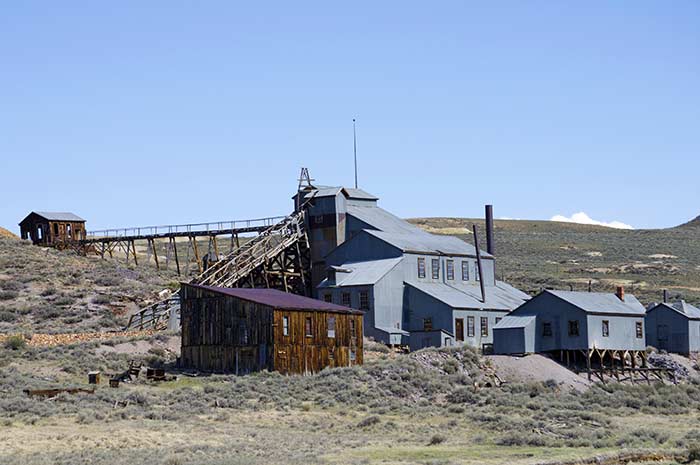
The whole fearsome, dangerous, mind-bogglingly toxic process begins with getting bits of gold ore into the top of the stamping mill, which is done via conveyor belts.

Rain or shine, summer or winter, the gold ore is hauled into the small brown wood building behind the mill, situated atop a hill because Bodie often saw 20 feet of snow in the winter and the mine operators were stubbornly unwilling to let a little thing like that stop the flow of money. The building in the foreground with the very narrow chimney is the furnace where the mercury was boiled off, and I can’t believe I’ve now typed that phrase twice.

The mercury. Was boiled off.

Jesus.

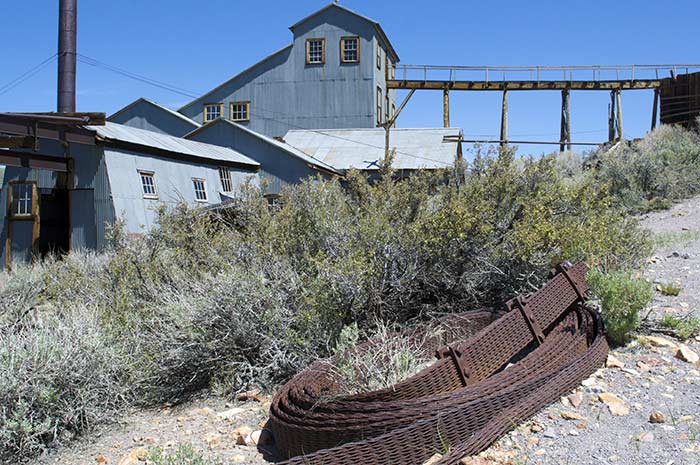
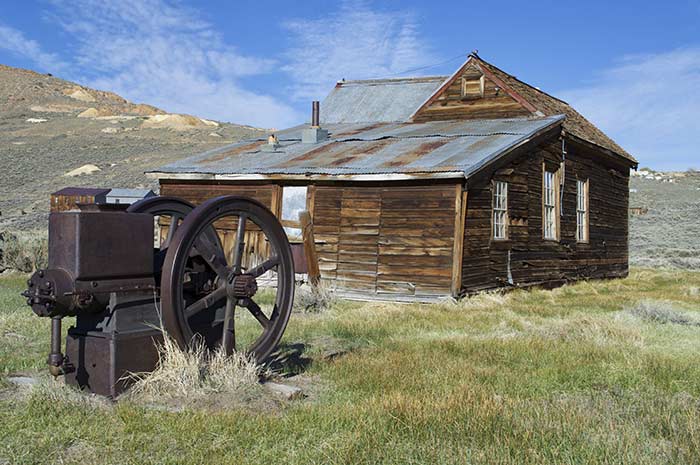
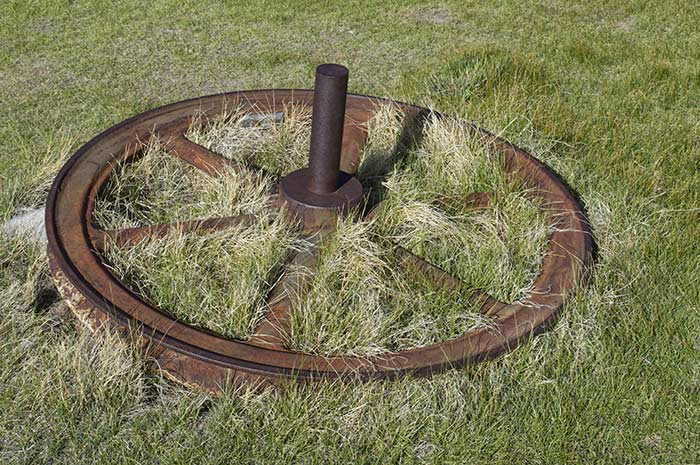
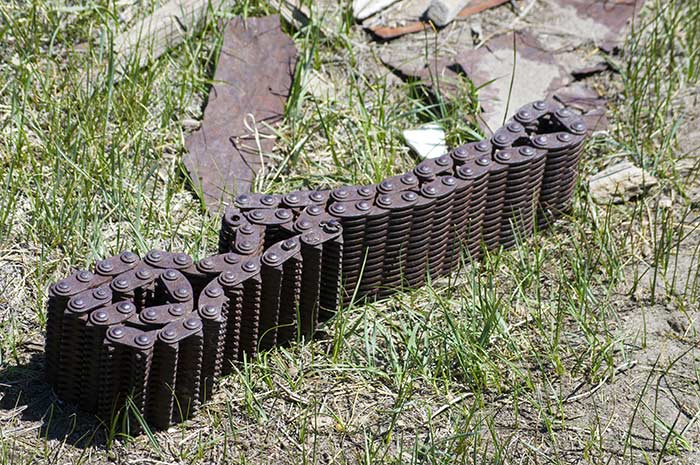
Bodie is about money. That’s it. From stem to stern, everything about the town was in service of making money. The Victorians, ever practical, used whatever new technologies would help with that endeavor, and cast off whatever bits of technology were no longer useful. Even now, the ground around the mill is littered with broken bits of machinery, like this cast-off drive belt made of woven iron.

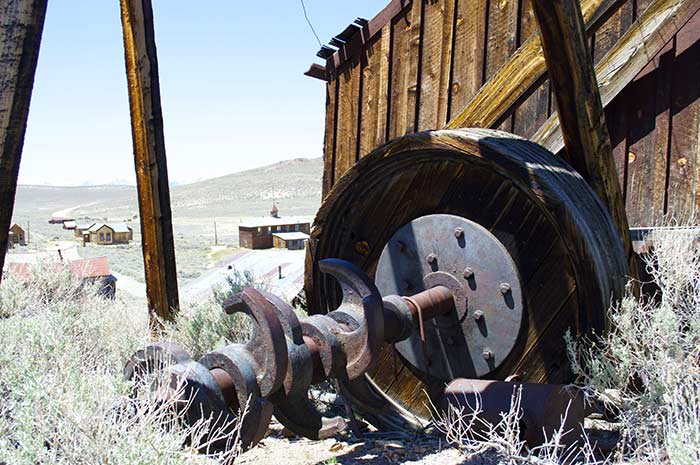
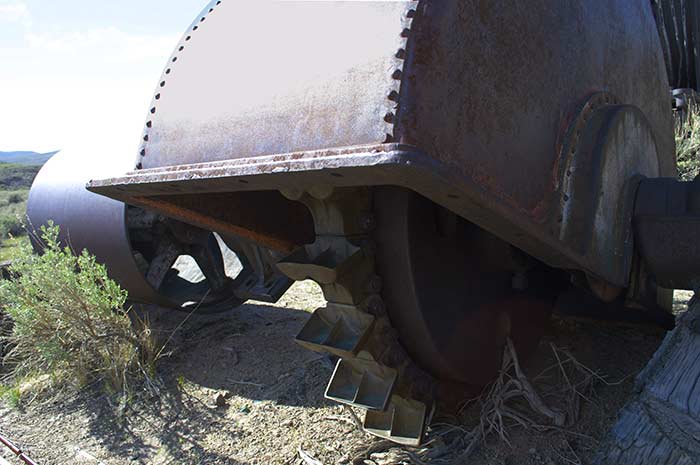
Or this enormous camshaft. His thing was mounted to an axle driven by an absolutely huge, room-sized steam engine or, later in Bodie’s history, an almost equally ginormous electric engine. The camshaft spun around and as it did, the cams lifted and then dropped hammers that crushed the rock. The hammers were more than a story long and weighed over a thousand pounds apiece. The din, according to the tour guide, could be heard halfway up the mountain. Workers wore cotton in their ears to keep from going deaf.

It didn’t work; deafness was a common problem among stamping mill operators. So were horrifying industrial accidents, mercury poisoning, and in at least one case, being sliced in half by a drive belt.

This being a Libertarian paradise, an injured, poisoned, or deafened worker was fired, given a couple of hours to pack, and kicked out of town.

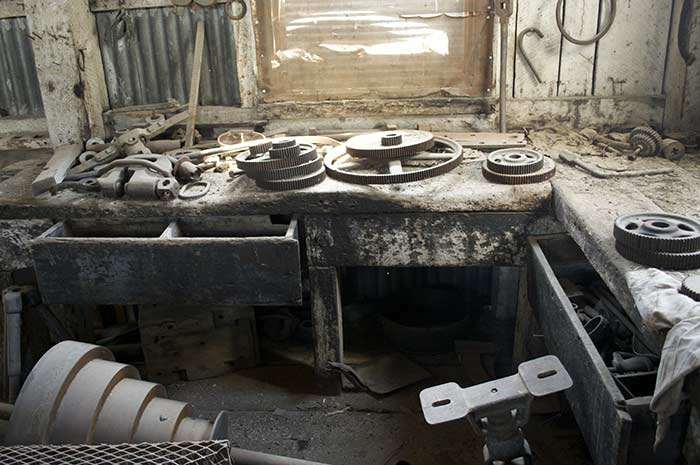
Our tour started with the machine room, which was, naturally, the second most important part of the stamping mill. The mill had a state-of-the-Victorian-art workshop, with lathes, presses, and other metalworking equipment able to repair or even fabricate almost any part the vast machine required.

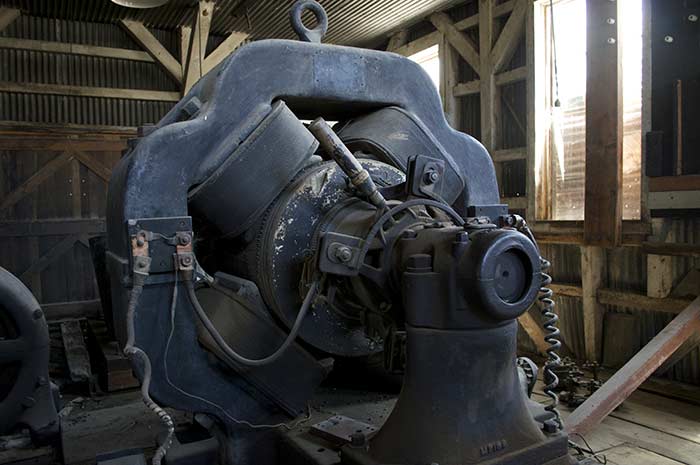
This is all that’s left of the huge electric motor that once ran the place. The Victorians were as pragmatic as they were reckless with the lives and safety of others. The mill had multiple stamps, each of which had multiple hammers. They reasoned that it was cheaper to build one enormous engine to power all that than to make numerous smaller engines to power each hammer individually. That presented a single point of failure, true, but as the saying goes, an airplane with three engines has three times as many engine problems as an airplane with only one.

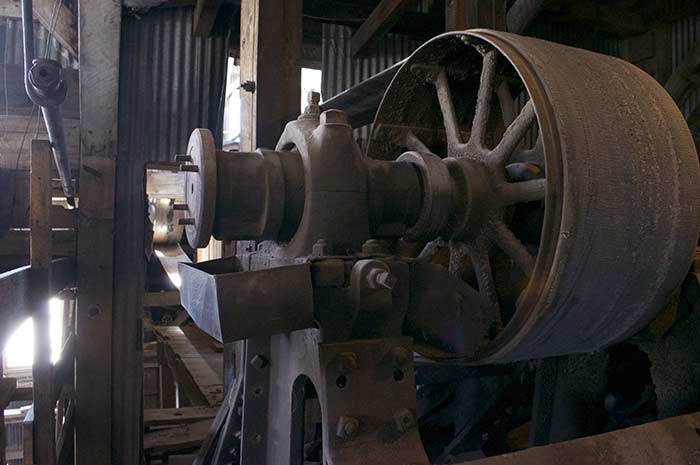
The engine turned this pulley, which fed power to the rest of the mill via the biggest belt you’ve ever seen. It was, according to our guide, this belt that once cut a luckless worker in half.

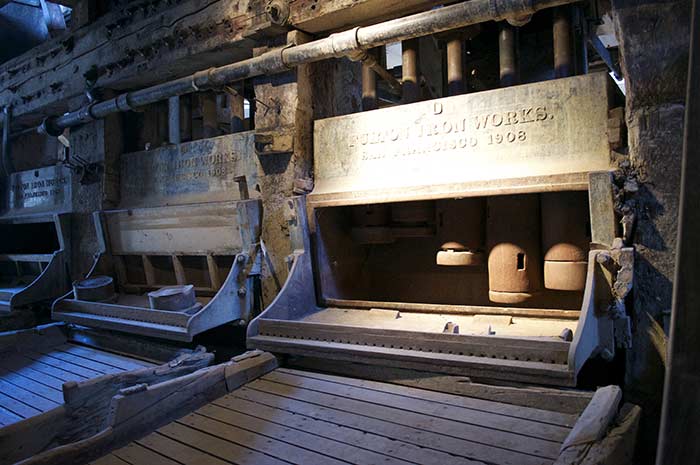
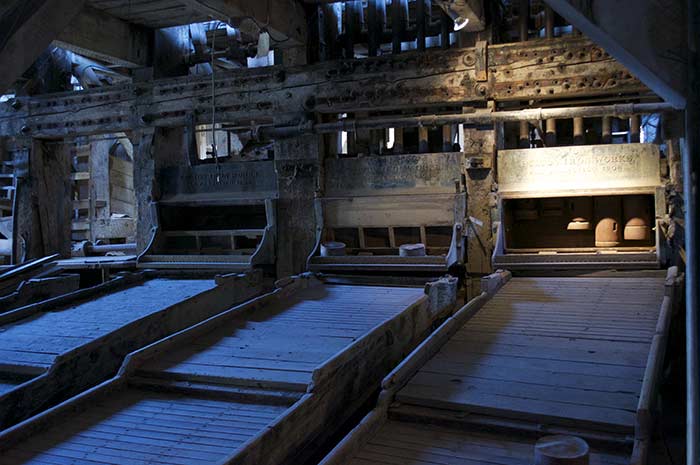
This is the business end, literally, of the stamping mill: the stamps themselves. Each hammer is a ten-foot-long iron rod with a hook on the top end and a several-hundred-pound iron weight at the bottom end. The camshaft spins, lifting and then dropping all the hammers, and crushing everything beneath them into very, very fine dust.

The dust then poured down the slide and onto the pools of mercury.

Across from the stamps is yet another workshop, this one equipped with large metal-turning lathes to manufacture oversized parts. I say that is if everything in this entire building wasn’t oversized. We make things smaller and smaller; the Victorians, on the other hand, were size queens. If a part didn’t weigh a ton and a half, it was firmly in the province of jewelers and watchmakers, not machinists. It’s a wonder they could make a pocket watch any smaller than a manhole cover.

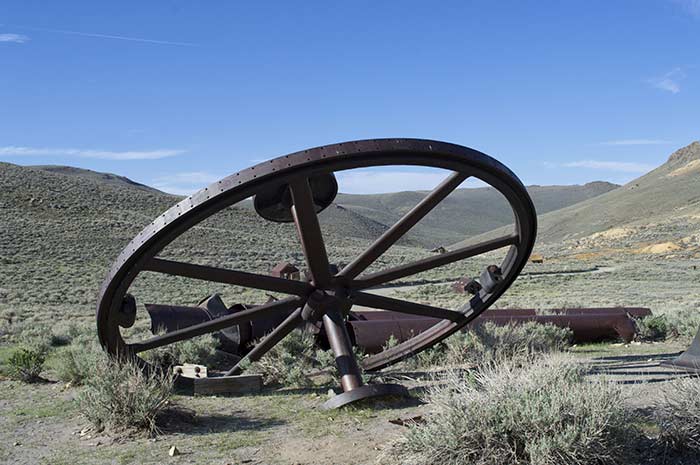
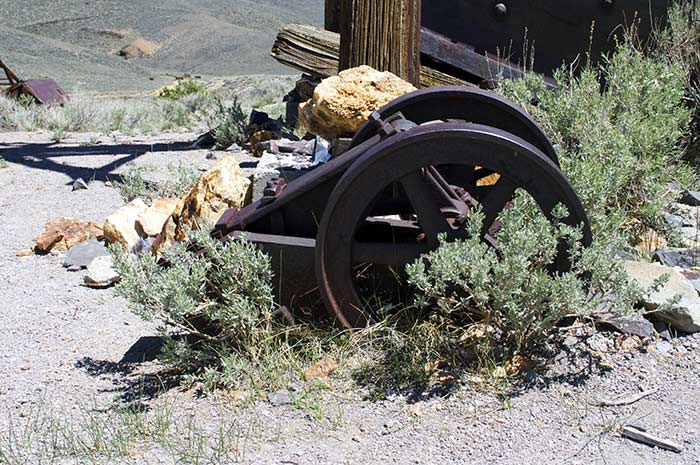
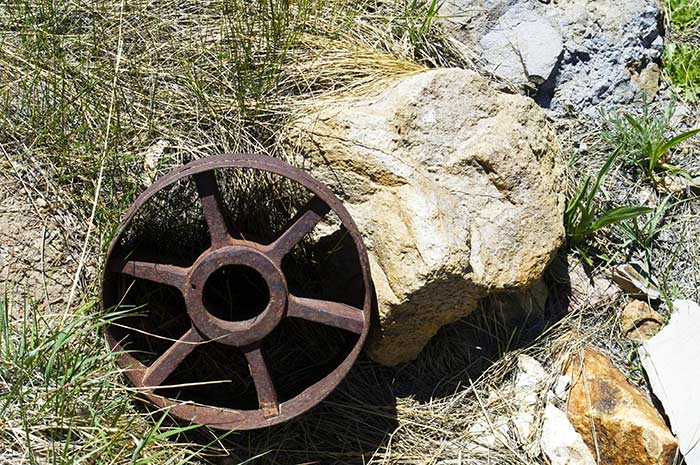
Once out of the mill, which even today probably violates a dozen EPA regulations on mercury exposure, we wandered around some more, looking at the old-school mining equipment scattered like weird metal vegetation.

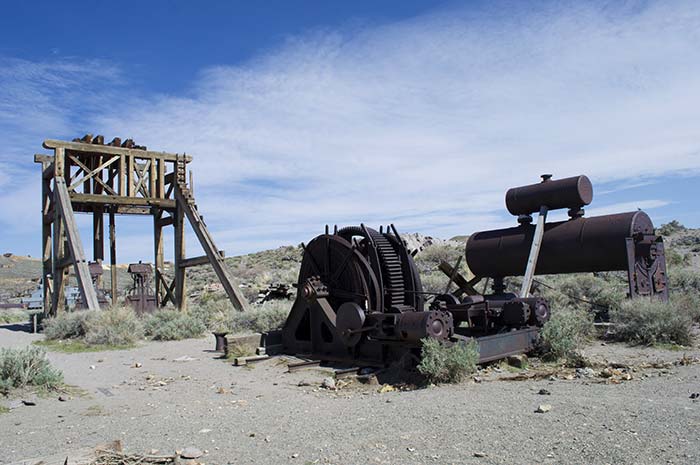
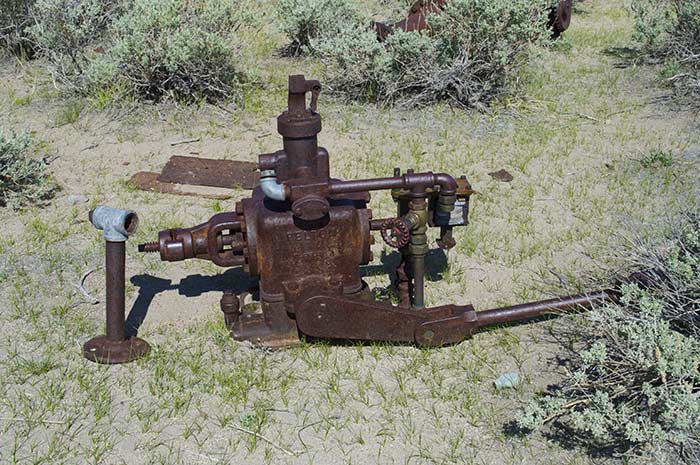
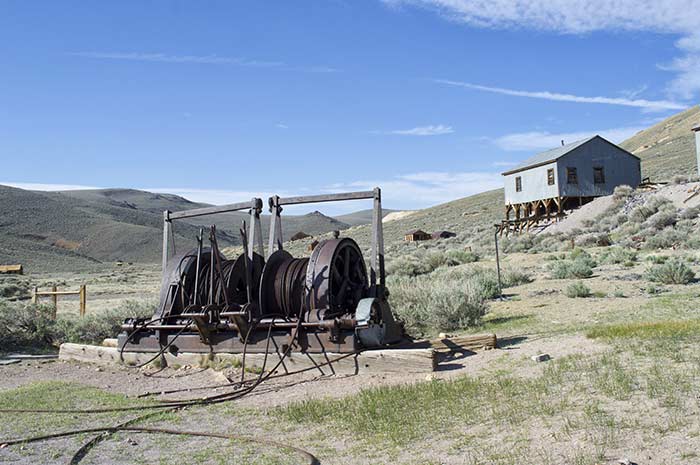
Like this steam-powered elevator that lowered miners into the deep shafts.

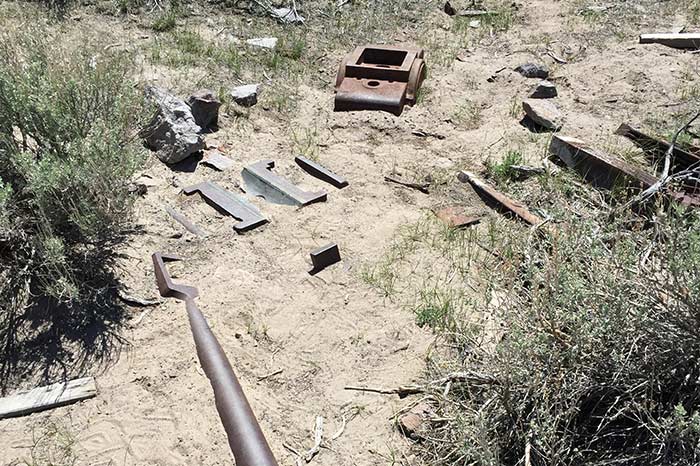
When I say the castoff bits of Victorian tech were everywhere, I mean everywhere. You can’t walk anywhere in Bodie without tripping over, stepping on, or stubbing your toe on it. The Victorians believed the only thing better than iron was more iron. Subtle they were not.

The rod in the foreground of that last photo is one of the tops of the giant hammers from the stamping mill. You can see the hook that engaged the cams in the camshaft that lifted and dropped them. If a particular hammer or stamp needed to be fixed, the worker would take a block of wood, reach in to where the camshaft ran through the top of the stamps, and jam the piece of wood in under the hook to hold that hammer up…because, naturally, they wouldn’t stop the mill just for a paltry thing like service.

Workers lost their fingers doing this. They were fired and given a couple hours to leave.

When we came back out, Bunny and I saw…a bunny. A real, honest-to-God Bodie bunny, right there watching us.

This was not the end of our adventures in Bodie, or in fact of our adventures period; I still haven’t got to the copulating dinosaurs yet. Stay tuned!

It’s the summer “Help Franklin Pay His Taxes” sale!

It’s that time of year again, when Franklin realizes that the tax bill is coming due and it’s going to be down to the wire about whether he can pay it.

But my distress is your gain. I’ve just created a new coupon code for registered versions of my sex game Onyx.

What is Onyx? Glad you asked!

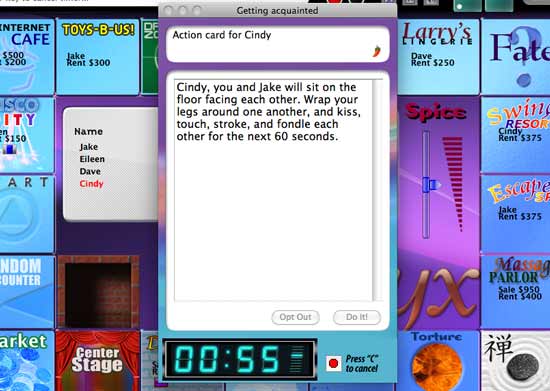
Onyx is a sex game for 2-6 players. Think Monopoly, with a sexy twist. If you land on a property owned by another player, you have a choice of paying rent or working off the debt. If you choose to work off the debt, Onyx looks at its vast database of sexy fun things to do to show your gratitude for being allowed to stay on the other player’s property.

You can download it free for Mac, Windows, and Linux. And if you want to register the game, use coupon code Summer16 to take $6.00 off the full version.

[ Download Onyx here! ]

Unwrapping a new project: an uncensored Amazon erotica search tool!

I am a self-published erotica writer. I write BDSM fiction, including the novel Nineteen Weeks, a story I’m very proud of.

A couple of years ago, I discovered that the number of books I was selling suddenly fell off a cliff. I did some research and found that the same thing was happening to a lot of erotica writers, especially self-published writers. Amazon’s Search function on their Web site was filtering out a lot of erotica, particularly erotica with themes of non-traditional relationships like BDSM.

However, I discovered something interesting a few months back: The Amazon search API, a set of programmer’s tools that allows Web programmers to search Amazon’s book titles, doesn’t filter search results. You can log on to Amazon and do a search for a particular book and see no results, but if you write a Web site that uses Amazon’s API and do a search, ta-da, there it is!

I’m sure you can see where this is going.

On and off for the past few months, I have been working on building a new Web site, called Red Lit Search. This site has a database of erotic books in Amazon’s catalog–so far only about eighteen hundred or so, but the list is growing–and also allows you to do uncensored searches of Amazon. My hope is to grow it into a portal for erotic books; if it succeeds, I plan to add new sections with things like articles, interviews with erotica writers, and all kinds of fun stuff like that.

So check it out! Spread the word! Kick the tires, test the software, and let me know what you think!

[ Visit Red Lit Search, the erotica search engine ]

Get it while it’s hot! Watch the magic happen before your very eyes!

A couple of months ago, I was in the car on my way back from having dinner with Eve, her husband, and her mum. Without warning, while I was sitting in the car, the first chapter of a fantasy novel detached itself from the firmament and fell into my head.

Think Terry Pratchett meets Hitchhiker’s Guide to the Galaxy, but set in a Victorian London that never happened (partly because Queen Victoria herself never happened).

When Eve went to bed, I stayed up writing it. I roped Eve into helping to develop the world it’s set in, only a little against her will, and it’s taking shape into something big and weird and fun.

As I write the first draft of each chapter, I’m putting them up on a sooper sekrit page that’s only available to people who back me on Patreon.

I’m putting the first chapter here on my blog to give you a taste of what to expect. If you want more, you will have to pledge at least $1 on Patreon, or possibly wait until the book gets published, assuming it gets published.


It was the rain that woke him. At least he hoped it was rain. In his experience, when you found yourself lying on the street with the feel of something wet falling on your face, you couldn’t always assume it was rain. There was a multiplicity of possibilities, nearly all of them far less pleasant than rain.

His head hurt. So did his shoulder, though not as much. And his back, that hurt too. The throbbing in his knee, he could probably ignore for now, though it might present a bit of a problem when it came time to stand. With a bit of luck, he wouldn’t need to run, though that, too, was something you couldn’t take for granted. Something in his pocket was poking most unpleasantly into his thigh, but he didn’t quite feel up to moving his leg just yet.

First things first. Where was he?

Reluctantly, and with great effort, he opened his eyes. Grey. Okay, that seemed right. Buildings towering above him, drab brick faces daubed with soot. Above them, a tangle of electrical wires, strung in hodgepodge fashion from building to building. Above that, zeppelins, a lot of them, floating in a flat gray sky. And rain, an endless drizzle of it. It pattered on the rough cobblestone around him, pooled in the cracks between the stones, formed larger rivulets that sought to find their way to the Thames, that enormous body of what was in theory water, or had once been water, or had water as one of the less odiferous components of it. Some of the tiny streams paused on their journey to join the sluggish mud-colored river of maybe-water just long enough to make him miserable. Cold wet fingers seeped into his cuffs, sent icy fingers of wet misery down along his back, and trickled from his collar to rejoin the rest of the water making its indirect way toward the lowest point of the city.

New Old London, then. The wires were a dead giveaway. That was mildly surprising. He was used to waking up across the river, in Old New London.

It hadn’t always been called New Old London. Once, it had simply been London. It sprawled out helter-skelter until it ran into the banks of the Thames, where it had paused its growth for a bit, building its strength until it had reached some critical mass and sprouted bridges across the river like brick and metal tendrils. Once those tendrils touched down on the opposite bank, the city resumed its growth with vigor.

For a while, the bit of London on the far side was called New London, which made the older bits Old London. Then, about the time the reigning monarch Her Most Excellent Majesty Queen Margaret the Merciful, granted that name in a fit of excessive artistic license, was graduating from wetting herself to standing upright, her father, the late Royal Majesty King John the Proud, had decided Old London was a bit fusty and by royal decree had ordered much of it razed and rebuilt.

A handful of people objected to his bold—some said “audacious”—approach to civil engineering, questioning both the cost and the small but nevertheless still important matter of what to do with all the people so displaced, but a handful of beheadings soon sorted that out. It turns out that a man can accomplish quite a lot when he commands both the nation’s treasury and the headsman’s axe.

So Old London became New Old London, which meant that New London, more or less by default, was now Old New London, and there you had it.

He moved his arm, the one pressed quite uncomfortably against the curbstone. His father had always said that any day you woke up looking down at the gutter instead of up at the gutter was a good day. This was not shaping up to be a good day.

His father. That’s right, he’d had one of those, once.

A clue, then. He probably wasn’t an orphan or a golem. Orphans didn’t have memories of their fathers, he didn’t think—or did they? Maybe he would ask the next one he caught trying to pick his pocket. And golems—well, everyone said golems didn’t have thoughts at all. They were frightfully expensive, and as beasts of burden only moderately effective, but they’d been all the rage since that doctor with the German name had started making them a couple of years back. All the trendiest aristocrats employed one or two for manual tasks like carrying heavy loads or in some of the messier parts of home security. He found them creepy, with their weird (and often mismatched) dead eyes and their occasional bursts of unprovoked violence.

I think, therefore, I am not a golem. That seemed a safe bet.

He still wasn’t quite sure who he was, or what he was doing beyond lying face-up in a gutter in New Old London, but he didn’t feel an undue sense of urgency about that. At the moment, he seemed not to be bleeding from anywhere, and nobody was chasing him, so might as well take advantage of this unexpected luxury. He could work out who he was at leisure.

He looked down the length of his body. Both legs seemed present and accounted for, and in more or less the correct shape. Nothing obviously broken…but what were those ridiculous things on his feet? The shoes were gaudy, made of a patchwork of different kinds of leather that was the latest style among the fashionistas, with bright red clasps and pointed metal tips. They were, he felt, certainly not the sorts of things he would wear under ordinary, or indeed even extraordinary, circumstances. They seemed quite impractical for either running or creeping, two things he had a vague sense that he probably did rather a lot of.

The thing in his pocket poked into him with greater urgency. Time to do something about that.

He closed his eyes, summoning his strength, then, with a titanic effort, rolled over onto his side. That should sort it out. He paused, breathing heavily from the exertion. This new position squashed his hand rather unfortunately beneath him, so it wouldn’t be long before he had to move again. Baby steps.

A loud clattering sound from down the alley. He blinked again. A huge machine stomped past him, all black iron and copper. Smoke poured from its chimney. A clanker. Two-legged, this one, vaguely human-shaped—a newer model, then. Its driver, high up in his cage, didn’t even spare him a glance. It continued down the alley, dragging a cart piled high with freshly-fired bricks.

Alley. Another clue.

New Old London was arranged in a grid, the late and much-lamented monarch being of a mind more than a little obsessed with perfect geometry. It was said he could not eat unless every table-setting was properly arrayed, all the plats precisely centered in front of each chair, the service perfectly parallel, the chairs exactly the same distance from their neighbors. There were rumors of an unfortunate noble who had moved his plate from its appointed place before His Royal Highness had been seated, and consequently lost his title, or perhaps his head.

New Old London was arranged in two grids, to be more precise. You would, if you were to look down on it from one of the many zeppelins crowding the leaden sky above, see an alternating pattern of streets and alleys. The streets were broad and level, with wide sidewalks fronting tidy storefronts well-lit by gas lamps or, in the more fashionable districts, electric arc-lamps. The alleys were narrower, and more pockmarked, without sidewalks or lighting. The rows of buildings faced the streets, with the alleys running behind them.

Street, alley, street, alley: two different grids, slightly offset from each other. The people who mattered—aristocrats, merchants, skilled tradesmen; people with money, all—used the streets. Those without money used the alleys. Two different classes of people flowing along two different grids, living in two different cities, in a manner of speaking. It all made sense to somebody. Somebody in the former class, most likely. It seemed that wherever you went, the rich were willing to travel extraordinary distances to look at poor people, but went to equally extravagant lengths to avoid looking at the poor people closer at hand.

He felt at home in alleys.

His hand throbbed. Time to do something about that, then. Summoning his strength, he rose to his knees, then, with another Herculean effort, to his feet.

This must be what the heroes of Greek stories felt like, after they’d just skinned a hydra or defeated a twelve-headed lion or whatever it was they did.

There was a tangle of black silk cloth and bamboo struts on the ground where he’d just been lying, looking wet and broken. Strange, that.

He leaned against a wooden refuse-dump, trying to catch his breath. Its side was caved in, its contents spilling across the ground near the black silk whatever-it-was. By some stroke of fortune, the refuse that spilled around him was mostly vegetative. There were far less savory refuse-dumps around the city, like those behind the laboratories of people engaged in the business of golem-making.

He looked up. The rain gutter that clung to the red tiled roof of the building next to him was broken, two ends sending forlorn little cascades of water down into the street. A wide swath of tikes had been smashed and scattered, forming a path that led from the broken gutter to a large circle of pulverized clay about three-quarters of the way up the roof.

Ah. So that explained the various aches and pains, then. From the looks of things, he’d hit the roof pretty hard, then skidded down and over the edge into the refuse-dump, taking a bit of the gutter with him, and from there, landed in the gutter.

At least it explained the “how,” if not the “why.”

No, he thought, it didn’t even explain the “how.” It seemed that he had fallen onto the roof, and from there into the gutter by way of a large pile of moldy produce, but where precisely had he fallen onto the roof from?

And more to the point, why was he wearing this ridiculous getup? A sodden black jacket with tails—tails, for the love of all that was holy!—clung limply to him. A couple of feet down the alley was what had once been a top-hat, and was still trying against all odds to be a top-hat. He had a vague sense that it belonged to him, though he did not know for the life of him why he would own such a thing. He was still a bit hazy on who he was, exactly, but he was quite certain he was not the sort of chap who habitually engaged in the wearing of top-hats.

Nor in the habit of falling from the sky into a refuse-dump, either, he had to admit to himself, so perhaps he shouldn’t be too hasty in the matter of the top-hat.

A party. He had been to a party. In a top-hat and the ridiculously impractical shoes he was wearing, shoes he was certain he would never wear absent compelling need of the most dire sort.

He frowned, adding up what he knew. A party, a top-hat, shoes, a long fall onto a roof, a sudden slide into a rubbish-bin, and the wreckage of some silk and bamboo contraption that he knew, with abrupt clarity, had once been a kite.

A zeppelin. The party had been on a zeppelin. And he had left the party with some alacrity. Planned, evidently, to do so. From the look of things, he’d made arrangements in advance to depart over the side of the airship, rather than waiting for it to land to make a more traditional exit.

Damn, he thought, it sure would be nice if he could remember who he was.

The pokey thing in his pocket intruded into his consciousness again. The pants he was wearing were just as ridiculous as the shoes. Like much of what the upper class wore, they had been designed to show off the fact that their owner had no need to do something as profane as work, and therefore need not carry around anything larger than a pocket watch. The pockets, therefore, were vestigial, barely more than slits with a small pouch sewn inside. Whatever it was in his pocket was much larger than the pocket was intended to accommodate.

And it had sharp edges, or so it seemed. He would, he supposed ruefully, probably have quite a large bruise to show for it.

He stuck a hand in his pocket and drew it out.

Memory poured into him like wine into a wineglass.

He, Thaddeus Mudstone Alexander Pinkerton, ne’er-do-well and ruffian of the most despicable sort, had just robbed, though only by the skin of his teeth and at, evidence suggested, great personal peril, Her Most Excellent Majesty Queen Margaret the Merciful.

He picked up the battered top-hat, set it atop his head at a rakish angle, and walked, or rather limped, down the alley, whistling.

Perhaps this would be a good day after all.

Kickin’ it Old-School: Wololo

I’ve rediscovered a love of the old real-time strategy game Age of Empires II, which might arguably be the apex of the Golden Age of RTS games.

Those of you who share my love will get this joke.

The Baloney Detection Kit: An update to the classic

In 1995, scientist and educator Carl Sagan published a book called The Demon-Haunted World: Science as a Candle in the Dark. I can not recommend this book highly enough. It is a manifesto of clear, rational thinking. If you’re at all interested in understanding the physical world or, more importantly, understanding how to understand the physical world, you really need to read this book.

Seriously. I mean you. Go get a copy.

One of the many brilliant things in The Demon-Haunted World is the Baloney Detection Kit. In a chapter titled The Fine Art of Baloney Detection, Sagan lays out an excellent set of rules for determining whether or not you’re being hoodwinked by pseudoscience–luncheon meat masquerading as knowledge.

I am not and never will be as brilliant as Carl Sagan. However, he lived in a time when pseudoscience, and specifically conspiracy theories about science, were not nearly as endemic in the public discourse as they are today.

So I would modestly like to propose an update to the Baloney Detection Kit.

Here’s the updated version:

  • Wherever possible there must be independent confirmation of the “facts.”
  • Encourage substantive debate on the evidence by knowledgeable proponents of all points of view.
  • In science there are no authorities; at most, there are experts.
  • Spin more than one hypothesis. If there’s something to be explained, think of all the different ways in which it could be explained.
  • Try not to get overly attached to a hypothesis just because it’s yours.
  • Quantify. If whatever it is you’re explaining has some numerical quantity attached to it, you’ll be much better able to discriminate among competing hypotheses.
  • If there’s a chain of argument, every link in the chain must work (including the premise).
  • When faced with two hypotheses that explain the data equally well, choose the simpler.
  • Extraordinary claims require extraordinary proof.
  • Do not continue to make arguments that have already been discredited.
  • Do not trust a hypothesis that relies on a conspiracy to conceal the truth.
  • Arguments that rely on anecdotal evidence or have not been subject to peer review are not reliable.
  • While scientific consensus is not always correct, a hypothesis that contradicts the general consensus should be treated skeptically.
  • Correlation does not imply causation.
  • Always ask whether the hypothesis can be, at least in principle, falsified.
Click on the image for a (much) embiggened version!

“I trust my girlfriend. I just don’t trust other guys.”

It’s a comment I see scattered far and wide across the Internetverse. In almost any conversation where some guy is complaining about his wife or girlfriend having male friends, inevitably someone else will ask, “don’t you trust her?” And inevitably, as sure as night follows day, he will say “Oh, I trust her, I just don’t trust other guys.”

Which, as near as I can tell, translates into English as “I don’t trust my girlfriend.” Because the only alternative reading I can see is far more horrifying.

First things first. Let’s call this what it is: an endorsement of the belief that what women want doesn’t matter.

“I trust my girlfriend.” I think my girlfriend wants to be faithful to me, wants to support me, wants to be with me. “I just don’t trust other guys.” Because at the end of the day, it doesn’t matter what she wants. She’s not a man. It only matters what those other guys want.

There are a couple of ways to read this, one of them pretty messed up, the other one even more so.

The first, messed-up reading: My girlfriend wants to be with me and be faithful to me, but other guys don’t want her to be. Other guys will trick, persuade, cajole, or convince her to cheat on me. You know, because they’re guys and she’s a woman. Women are weak of will, incapable of holding out when faced with a determined guy who wants to seduce her.

The second, even more messed-up reading: My girlfriend wants to be with me and be faithful to me, but other guys don’t want her to be. They’ll just rape her. Because, you know, they’re guys, and that’s what guys do.

Regardless of the reading, the conclusion remains the same: Ergo, the thing I must do is prevent my woman from hanging out with other guys. Charmers or rapists, it doesn’t make any difference if she wants to be faithful to me; they want her, so they’re going to fuck her.

And that’s a whole world of messed up right there, it is.

Disempowering and infantilizing on the one hand, or implicitly supportive of rape culture on the other—there’s no interpretation that makes this idea smell any less bad.

So, I would like to have a word with all you men out there who have ever used this reasoning, thought about using this reasoning, or nodded in sympathetic agreement when someone else has this reasoning. I will try to put this as delicately as possible:

Cut it out. It’s bullshit.

“I trust you, but…” is just a way of saying “I don’t trust you.”

Look, I get it. It’s scary to trust someone else. When you do, you’re putting your heart in their hands and giving them a chance to let it shatter on the floor. You’re hoping they won’t drop it, knowing it will hurt if they do. I totally understand how scary that is.

But you can’t have it both ways.

If you trust your partner not to betray you, you have to have confidence that she won’t even if she has the opportunity to. And if you try to control her to prevent her from having the opportunity to hurt you, you don’t trust her.

This is not about other guys or what they want. It’s about her.

If you don’t think she can say “no” to a silver-tongued bloke with a huge, massive, throbbing bank account, you don’t trust her. If you trust her, it doesn’t matter what other men’s intentions are.

And if you assume as a given that other men who take an interest in your girlfriend will ignore her ‘no’ and just rape her, there’s a bigger problem than her fidelity. Perhaps it’s time to stand up, you know? And I don’t mean stand up to control your girlfriend. I mean stand up against the notion that it is in any way, shape, or form acceptable to assume that other men will not listen to her ‘no’ and there’s anything normal about that…because there isn’t.

“I trust my girlfriend. I just don’t trust other guys.” Basically, you’re saying your girlfriend’s desires don’t matter.

Is that really what you believe?

My hunch is that it’s not. My hunch is what you’re really saying is you think your girlfriend will choose to cheat, but you don’t want to say it because you understand what it might mean. You don’t trust her, and a healthy relationship can’t function without trust.

If you trust her, it doesn’t matter what other guys want. If you don’t trust her, have the courage to own it. But listen, all you other men out there, enough with the “I trust her, I don’t trust other guys” already.

You aren’t fooling anyone.

An Amazon Product Advertising API SimpleStore PHP script that works!

I’ve been working on a project lately that I’m excited about, but not quiiiiite ready to talk about just yet.

Unfortunately, this project has involved working with the Amazon API. I say “unfortunately” because the Amazon API is truly the Mos Eisley of the computer world: you will never find a more wretched hive of bugs and poor documentation.

Nearly all of the sample code in the Amazon developer index dealing with the Product Advertising API does not work, and has not worked since 2009, when Amazon made a change requiring cryptographic signing of all API requests. I am a PHP programmer, and the PHP sample code for dealing with the API does not work and has not worked for a very long time.

For example, the sample SimpleStore PHP script called “Amazon Associates Web Service Simple Store in PHP” in their code library was written in 2006 (ten years ago!), broke in 2009, but is still on their developer site.

You can imagine how rage-inducing this is. In science, we are all standing on the shoulders of giants. In computer science, we are all standing on each other’s feet.

So I’ve spent the last few days eyebrow-deep in Amazon’s technical documentation, trying to make decade-old sample code work so that I could do something–anything–with the API.

I’ve finally made the SampleStore PHP script work with the modern Amazon API, and fixed some bugs and closed some security holes along the way. I’ve decided to make the fixed script freely available to anyone who wants it. I’ve commented it extensively in the code.

If you’re working with the Amazon API in PHP and you’re tearing your hair out because nothing works and there is no sample code to show how to build cryptographically signed API requests, fear not! This code works. The interface is simple and ugly, but the PHP will get you up and running.

Please feel free to use, remix, copy, redistribute, or do whatever else you want. I sincerely hope that this code will help someone somewhere not have to tear their hair out the way I did.

Update #7 on the sex toy you can feel

It’s been a busy month in smart sex-toy land.

We’ve just finished another round of testing of the third-stage prototype design, and ironed out some bugs that cropped up with the first incarnation of the current design. We’ve demonstrated conclusively that the idea works, and works well–even with the crude hardware we’re currently using, we’re able to trick the brain into internalizing the device into the wearer’s sense of self.

It was fascinating watching the most recent beta testers. We tested with two volunteers. With one of the volunteers, I was able to tell the exact moment her brain worked out the sensation and internalized the dildo. She was running her hand along the dildo, and she said “I don’t know, it feels weird and kind of uncomfortable, it just–” and then the switch flipped and she said “Oh!” and grinned.

Unfortunately, we’re running into limitations in how much further we can take the design by ourselves, given that I’m building each prototype by hand. Right now, each prototype is a hand-made one-off that takes hundreds of dollars and several days’ worth of work to put together. There’s a lot of hand soldering of some very tiny and somewhat fiddly components involved with every new prototype, which then ends up getting tossed at the end of each round of testing. The current design can’t be sterilized, so I have to build a new one each time we beta-test with a different person.

We’re learning quite a lot from each test. One thing we’ve found is there’s incredible variability between different people in internal anatomy and neurology. Some people are approximately evenly sensitive everywhere in the vaginal canal; some people are more sensitive in the lower portion of the vagina than the upper portion; some people are more sensitive on one side than the other. That means the final device will have to be tunable to each individual who wears it, with the wearer customizing the intensity of stimulation from each individual electrode. That adds a new level of complexity to the electronics, not to mention the user interface.

The current prototypes are built by modifying off-the-shelf dildos with sensors and electrodes. The prototypes use copper electrodes, which have a very short life expectancy; the final version may have to use gold for the electrodes. We’re still researching that.

We’re researching quite a lot, actually. Now that we know the concept is sound, we’re moving toward a more research-intensive phase of development. Questions we’re still addressing include things like what is the maximum sensory resolution inside the vagina, how does it vary in different areas of the vagina, how does it vary across different people, what is the safest electrode material that offers good durability while being body-safe, what’s the minimum number of sensors the dildo must have to create the sensation of being part of the body, what’s the maximum number of sensors and electrodes past which the wearer can’t distinguish different sensations any more, and what’s the best signal shape to stimulate the sensory nerves in the wearer without being painful or unpleasant. (The first versions of the prototypes used a very simple signal generator; the most recent version uses a programmable signal generator.)

The prototypes we’ve built so far have all had an insertable portion designed to be worn vaginally. We’ve had many people ask us about designs that don’t require insertion, or that work with an anal insertable portion. That’s also something we plan to experiment with; we want to find out whether stimulation of different parts of the body will achieve the same results. We plan to do some prototyping of designs that don’t require vaginal insertion soon.

That’s where you come in, O denizens of the Internet.

We are looking for people to partner with to help us do more sophisticated prototyping. Right now, we’re in desperate need of a company interested in partnering with us that has experience doing short-run custom silicone molding, preferably in or near Vancouver, BC. We are also looking for an electronics engineer who is sex-positive and interested in this project, especially one with experience in doing switching and amplitude modulation of analog RF signals.

If you know of anyone with those skills who would like to be involved in this project, please let me know, either here or by email at franklin (at) franklinveaux (dot) com.

Want to keep up with developments? Here’s a handy list of blog posts about it:
First post
Update 1
Update 2
Update 3
Update 4
Update 5
Update 6
Update 7