We’re now a month and a half into 2024. I’m sitting on my sofa absolutely miserable—cough, runny nose, fever, body aches, stuffy head, but two tests have insisted I don’t have COVID even though I feel rather like I have COVID.
Anyway, I’ve a ton of interesting projects in the air and a lot of really cool stuff happening this year.
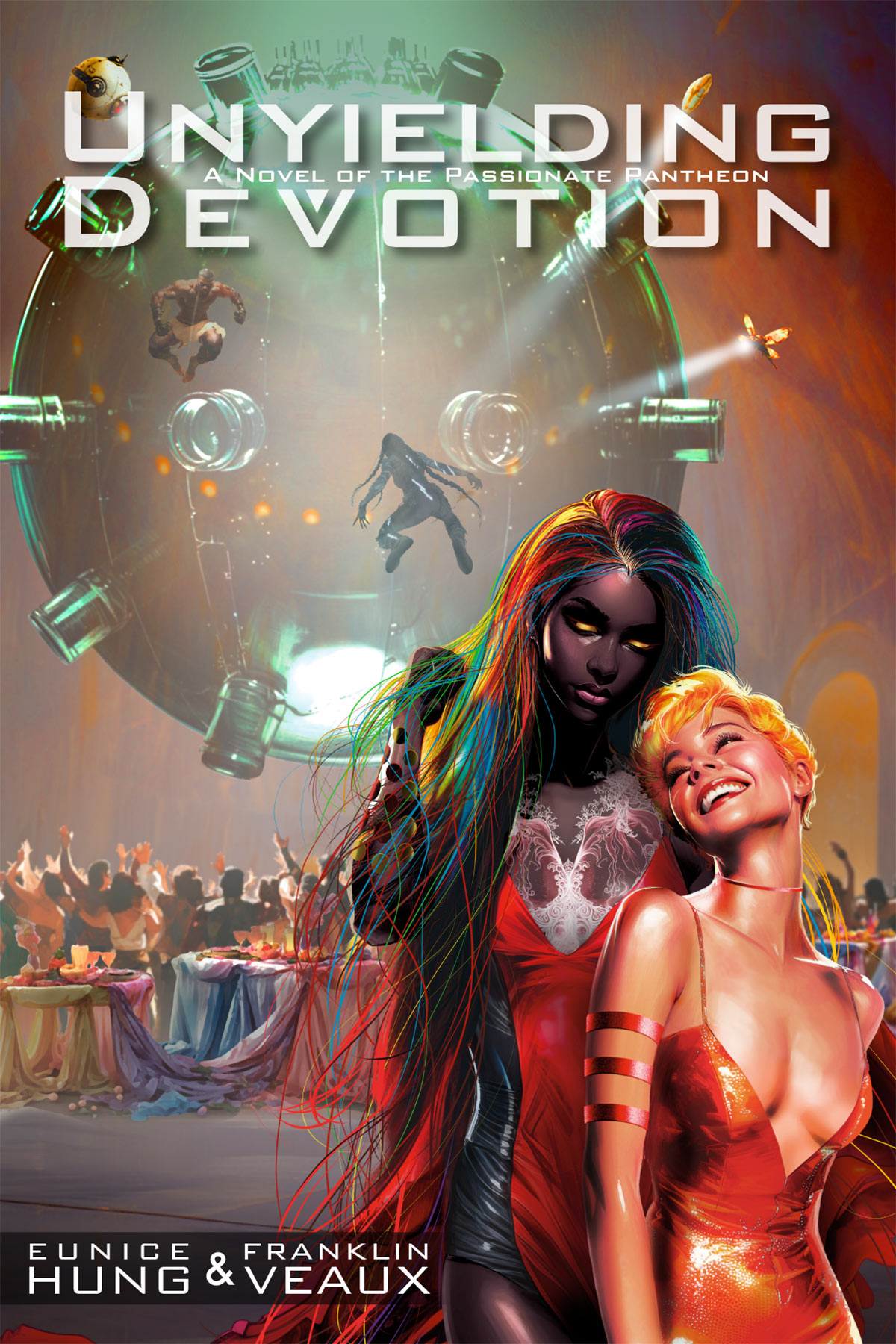
FiErst off, Eunice and I are just putting the finishing touches on Unyielding Devotion, the fourth Passionate Pantheon novel!
The Passionate Pantheon books are far-future, post-scarcity science fiction theocratic erotica, plus philosophy. We use a tick-tock cycle for these novels: odd-numbered books are upbeat Utopian stories, even-numbered books are dark erotic horror, our explorations of how post-scarcity societies can go wrong.
We were pleased to be fortunate enough to get well-known artist Matt Haley for the cover art for the fourth novel, which calls back to the Golden Age of sci-fi book cover design.
Eunice will be at WorldCon Glasgow on August 8-12 in Scotland with this and our other novels, so if you get a chance, be sure to say hi!
And speaking of covers: Black Iron. I’ve won back the rights to the book and the entire universe it’s set in, so I’m preparing to re-release a newly edited second edition of the novel, which will be available next month in paperback and eBook, significantly polished from the first edition and with a brand-new cover.
We also have another novel due out later this year, in a completely new and unrelated series. It’s a contemporary urban fantasy set in London in 2016. Here’s the basic gist:
Imagine Harry Potter meets The Matrix by way of Jason Bourne…with sex. When May, a London 20something infosec tech at a Shoreditch webhosting firm, escapes an abduction attempt, she finds herself in a centuries-long underground war between an ancient guild of spellcasting sex workers and a powerful society of Tory rage mages. Now she must learn the ways of magic if she is to survive this new reality.
Springfield bound! I have quite a number of books in the pipe this year, including a literary novel called Spin, currently about 80,000 words into what will likely be somewhere around 140,000.
It’s a post-Collapse magical realism novel set in the Dominionate, a theocracy that has taken over the midwestern United States thousands of years from now. My Talespinner and I have been working on this book for some time, and we’ve reached a point where the timing of events in the novel has become quite hairy and tricky to work out, so…we’re taking a journey, following the protagonist’s path through present-day Missouri, along the roads that will, thousand of years hence, still be in use in much the way ancient Roman roads are still used in Europe today.
I think it will be fun, taking some days to follow the path of our fictional character through the fictional Dominionate, on the run from the Church toward something she can’t even imagine. (We are hard on our protagonists in this novel.)
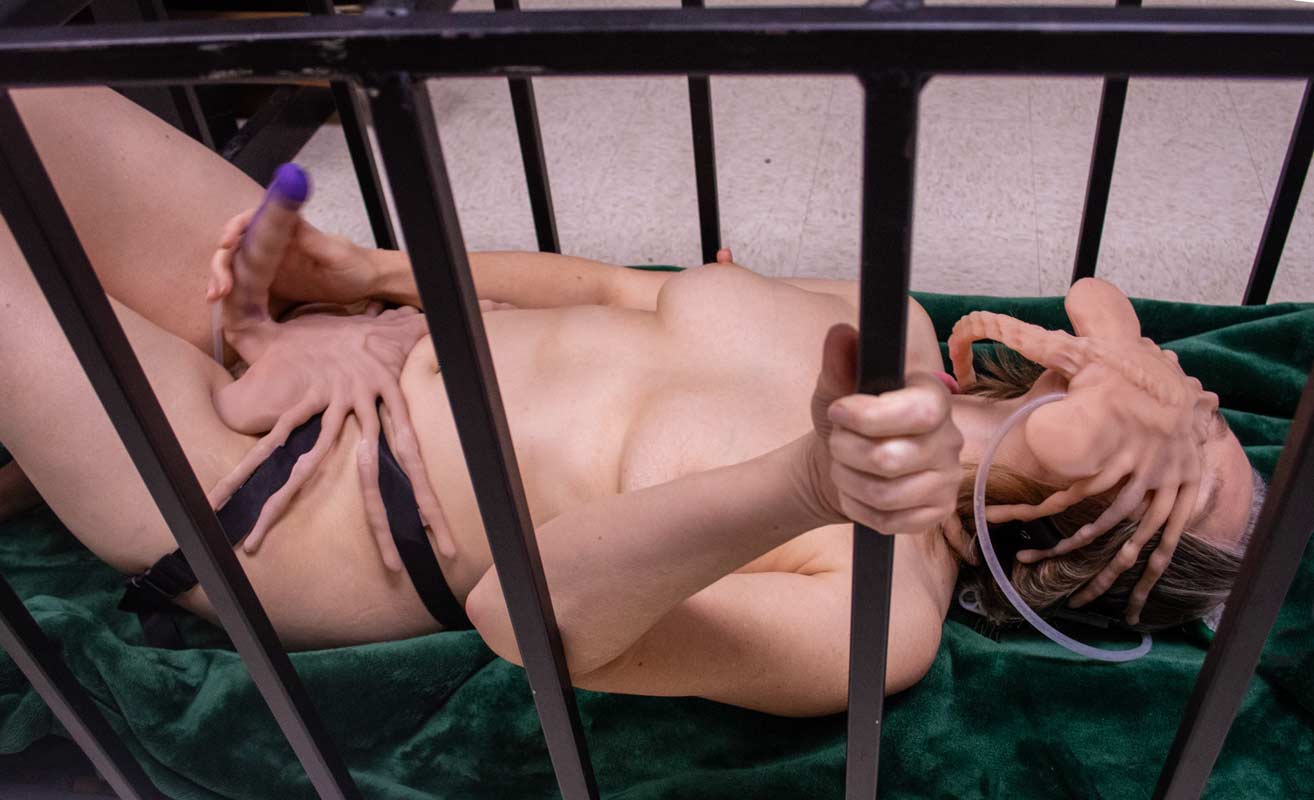
I should, with a bit of luck, have the Xenomorph Facehugger Gag v3.0 prototype done by the time I leave, so we can test it out (tests of the v2.0 prototype went swimmingly).
The third (and, with luck, final) variant should be lighter and more suited to…err, longer-term wear.
One of the things I generally try to do is leave the world in a slightly better state than I found it. Of course, I’m not always perfect at that, but on the whole I think it’s a good goal to shoot for.
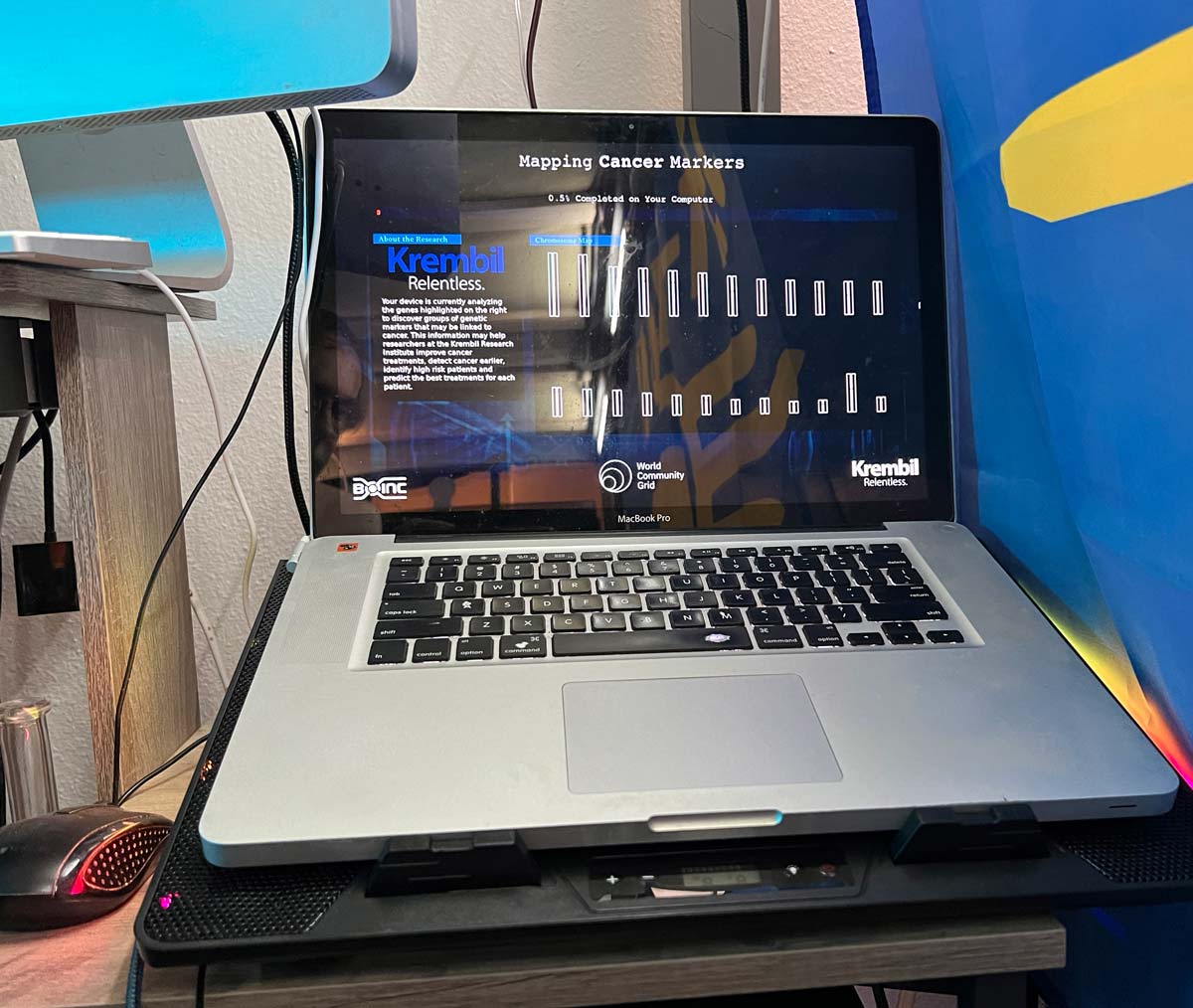
To that end, I recently started participating in BOINC again.
If you haven’t heard of it, BOINC is a system where nonprofit science research teams can solve computationally complex problems without having to build or buy time on horrifically expensive supercomputers, by using all the spare idle computation time of ordinary people who leave their computers on even when they aren’t using them. BOINC detects when your computer is idle, and donates CPU cycles to researchers, basically making your computer part of an enormous ad-hoc supercomputer. You can choose what research projects you want to participate in.
Back when I lived in Canada, I joined BOINC and allowed them to use my laptop to look for new treatments for diseases by studying protein folding.
I dropped out of BOINC when I came back to the US from Canada, but I’ve just re-joined again.
This is my old 2012 laptop, which now does nothing but BOINC. I’ve joined two research projects, Rosetta@Home (which does research on protein folding to look for new drugs and disease treatments) and World Community Grid (which looks for genetic markers for cancer and searches for cures for diseases that are too uncommon or appear in parts of the world too impoverished to be worthwhile for conventional for-profit pharmaceutical companies).
I have a computer that is essentially a backup Time Machine server and Web server, and I may run BOINC on that as well.
I would encourage anyone out there who wants to help solve real problems by donating idle computer time to join.
BOINC stops running whenever you use your computer, so it won’t slow you down, but it means your computer time isn’t being wasted whenever your computer is turned on but you aren’t sitting in front of it.
I am, as regular readers know, a big fan of various types of “consent play” in sex. A lot of people who hear “consent play” think “rape role-play” or “consensual non-consent” or “resistance play,” and don’t get me wrong, all of those things are fun, and a regular part of my sex life.
But what I really enjoy, the siren song that really calls to me, is a little different: it’s the consent play that comes from navigating that space where I give my lover consent to do something to me, then deliberately and intentionally remove my own ability to withdraw consent. Once the activity begins, I’m in it for the ride—there’s no taking it back.
Before we get going, let me say up front a lot of folks consider some of the play my lovers and I explore “edge play,” and there are a lot of people, including veteran BDSM enthusiasts, who flat-out won’t even consider some of the things I do. And that’s okay. I freely admit these tastes are unusual even in the kink scene, and with good reason. They require an iron-clad, unparalleled trust, a deep foundation in trusting both your partner to know and understand how far to take things and, just as importantly, trust in your own resilience in the event you have an unpleasant experience. (People talk quite a lot in the kink scene about the first kind of trust, but not so much about the second. I might write more about that in the future.)
And I get that high resiliency is a privilege. I also get that I haven’t grown up in an environment that tells me I’m supposed to have sex I don’t want, that I’m expected to have sex I don’t want, is a form of privilege, too. I’ve had sex I didn’t want to have, but always by my choice; it was never forced on me. So, yes, I completely understand the emotions I’m describing aren’t necessarily available to everyone.
That inability to withdraw consent, the knowledge that when I start, I’m saying ‘yes’ to my lover knowing that she’s going to do whatever it is and once it starts I will be unable to say no, is absolutely delicious to me.
What does that look like?
Image: https://unsplash.com/@klugzy
Part of it is somnophilia—the taste for sex with a sleeping partner. I don’t wake easily, so when I give a lover permission to use my body whilst I’m asleep, I do it knowing there’s a good chance that I won’t wake up quiiite enough to be able to communicate a ‘no’ even if I decide I object to what’s going on. That’s part of what makes it hot.
That inability to say ‘no,’ that idea that the yes, once I’ve uttered it, can’t be recalled, is intoxicating to me.
The Passionate Pantheon novels Eunice and I write, our far-future, post-scarcity philosophical erotica, explore this theme of consenting to things you can’t take back a lot—it’s a theme we keep returning to.
I wrote a scene into the fourth Passionate Pantheon novel Eunice and I co-authored, Unyielding Devotion (due out later this year), that plays on that idea:
“What’s happening?” Kaytin asked Chasoi, who stared at Lanissae and Royat with bright, hungry eyes.
“They’ll each take two Blessings,” Chasoi said. “The first one ensures their bodies will remain physically aroused no matter what happens to them. And the second, well, that’s the magic.”
“The magic? What does that mean?”
“One of them,” Jakalva said, “will become desperately horny beyond all reason. Are you familiar with the Blessing of Fire?”
“Yes,” Kaytin said.
“It’s like that, but more violent. It removes inhibition and obliterates self-control. The other does just the opposite, causing intense aversion, repulsion even, to the idea of sex. The cage makes sure neither of them can escape.”
“Oh.” Kaytin blinked. “So whoever gets the first vial will…”
“Yes. But that’s only half of it.”
“Half of it how?”
“That’s the beauty,” Chasoi breathed. “The moment either of them has an orgasm, they switch. Whoever was needy becomes averse. Whoever was averse becomes wild beyond control. They stay in the cage until they collapse from exhaustion.” Her eyes glittered.
This scene has been in heavy rotation in my internal fantasy library for years. If I were to live in the City, I might very well volunteer to be in the cage with Lanissae, at least once.
Why?
We included a scene that explains why I find it so attractive:
“Okay, let me try to explain,” Lanissae said. “It’s…” She paused, regarding Kaytin through hooded eyes. “I like…I like the tiny spaces. I like that little moment of clarity that happens when you switch, you see? There’s that one second when you know what’s going to happen. You see it in their eyes. You know that when that second is over, they will want you so badly that nothing you can do will stop them.” She shivered, eyes half-closed, and slipped one hand inside the plunging neckline of her shimmering, lacy dress. “Mmm. To be seen with such desire, to know that when the moment passes you will not want it and would do anything to make it stop, to know that it will happen anyway…there’s a delicious inevitability to it.” She cupped her breast. Her eyelids fluttered. “It’s such an exquisite surrender. You exist only to be ravished.” She exhaled in a soft moan. “You can’t get away. You lose yourself in how much you don’t want it, but it doesn’t matter. You stand on the brink and for one instant, you see it all so clearly, and you know what’s about to happen, and you also know that you chose to be here. You walked into the cage yourself, of your own free will…oh!” She leaned back on the couch and caressed her nipple beneath her thin dress.
Kaytin stared at her with desire and revulsion roiling within her. “And then,” Lanissae went on, “the violation is over, and the change happens, and you have that moment of clarity again. You feel the heat in your body. For that one delicious second, you know. When the heat reaches your head, the need will take you, and nothing in the world will matter except the person you are about to ravish. Everything stops. You balance on that edge. You recognize each other. You see the humanity there. In that instant, you share a connection that’s absolutely magical. For that one brief second, you see each other, really see each other—not as predator and prey, but as two people sharing an experience. You know that when the moment passes, you will not be able to stop yourself any more than you could stop what was coming when you were the object. You can feel your mind going…mmm.” She caressed her neck with her fingertips. “You embrace that moment of humanity, before it all slips away. It’s…uh! It’s so magnificent to stand on that cliff and feel yourself about to fall.” Lanissae arched languidly, running both hands down her arms. “When I’m in the cage, I live for those moments of connection between the moments of madness.”
I totally, 100% get that most people would take one look at that scenario and say “oh hell no.” And I get why, and that’s okay.
We don’t actually have the technology to do that, of course, but I’ve experimented with things that get as close to that feeling as I can.
For example, I learned when I burned my foot that cannabis edibles work really well for pain management on me—better, in fact, than the oxycodone the burn clinic prescribed.
I also learned that I get extremely suggestible when I’m high. and I’ve incorporated that in my sex life with some of my partners. I know that once I take that edible, my ability to withdraw consent will become impaired. That’s the point. That’s part of what makes it hot—that inevitability, that sense that once I’ve taken it, I will not be able to do anything about it. The drug takes about half an hour to start working, and that’s half an hour to really savor the knowledge that I have already passed a point of no return: that my ability to withdraw consent will soon fade and there’s nothing I can do to stop it.
In principle, yes, consent to sex exists only in the moment and cannot be withdrawn.
In practice, the idea I like to explore is, can I give consent that is irrevocable? Can I deliberately create a situation where once i have given my lover consent to do something to me, I have also given away my right (or my ability!) to change my mind?
Is it ethical to do this? I think it is. We do it all the time in areas that aren’t connected to sex. Contracts, for example, don’t usually have an “oops, I changed my mind” clause—once signed, that’s it, no taksies-backsies.
Can we do the same with sex?
I think the answer is yes. I also think that’s super-hot. Other people might not agree. The thing about autonomy, though, is that people who value consent and agency must also respect that I have the right to say “yes, you can do this to me, and I explicitly give you permission to continue doing it to me even if I change my mind.”
Is this everybody’s cup of tea? No.
Should it be permissible in the context of sexual ethics? I think the answer is yes. I do believe that basic autonomy, the notion of “my body, my rules,” extends to me choosing, if I want, to give someone else consent with the explicit understanding it can’t be revoked.
In fact, I’ll even go one step further. Ready?
What we find sexy often varies with our mood. If you’re reading this, you’ve probably already learned that there are things that sound sexy when you’re aroused, but as soon as you’re sexually spent, suddenly seem a whole lot less interesting.
I’ve had a lover where one of our dynamics is we would negotiate new things to try whilst in the middle of having sex, when we were both ramped up and horny…things I would give this sort of irrevocable consent to. Then she would get me off, or I’d get myself off, over and over again until I was completely d-o-n-e done and not interested in sex anymore…
…at which point, then she’d do the thing.
And that is quite a potent head trip, let me say.
Now: Do I believe that it’s ethical to do this? Yes. Do I believe it’s ethical to give irrevokable consent and then change your mental state, for example with drugs or change in mood or arousal? With fully informed consenting adults who understand exactly what they’re getting into, yes.
Do I believe it’s ethical to do this for an indeterminate amount of time, as in “now and forever you can do whatever you like to me even if I say no”? That’s…a different thing. I think healthy relationships are always voluntary, and you cannot reasonably make promises of access to you or your body that continue past a relationship’s end. Not gonna tell you you’re a bad person if that’s your jam, but I am aware of ways that could easily become problematic.
And yes, I can see where even limited irrevocable consent might become problematic. Like I said, edge play.
But here’s the thing:
Playing in this way is beautifully, powerfully, intoxicatingly intimate.
Image: https://unsplash.com/@klugzy
Intimacy is about letting someone in, about letting them touch you, about allowing access to your deepest and truest self.
Part of the bewitching beauty of irrevocable consent for me is, as the character Lanissae says in our book, the connection. I am granting someone access to me in a literal, visceral way, allowing them to touch me, and giving up my ability to throw them out, to shut the door.
It’s an exquisite kind of intimacy, an intimacy that says “here, in this space, with you, right now, I promise not to take this back.” It’s an embrace of intensely deep trust.
I’m about to say something a lot of my fellow liberals might find upsetting:
Some people who complain about “woke ideology” are actually kinda sorta right, though for entirely the wrong reasons.
Before you pick up the torches and pitchforks, hear me out.
No, the conservatives who whine and cry and have their little meltdowns about “woke Disney” for making movies with characters who aren’t straight white Christians are completely wrong, obviously. But some complaints about “woke,” while they’re farcical—even laughable—on their face, have, if you gig down deep enough, a teeny tiny kernel of truth, or at least truth-adjacent material, buried under the layers of racism and sexism and misogyny and homophobia and transphobia and white supremacy and all that other bullshit that spews from the lower orifice of the conservative snowflakes.
Liberals can get so attached to the underdog that we actually forget that even people who have been on the receiving end of systemic oppression are human, and like all humans, are capable of occasional shitty behavior.
Human beings are really bad at both. I mean really bad. Liberals like to go after conservatives for following the herd and doing as they’re told, yet liberals do the same thing—it simply expresses differently.
Conservatives who moan and cry about “woke ideology” are, often as not, just mouthing the words and feeling the emotions they’re instructed to by the people above them. Ask any of the conservatives what “woke” actually means and you’ll get crickets as an answer. They legit don’t know. They have no idea what “woke” means, any more than that know what “socialism” is. They’re simply told that the enemy tribe is bad because they’re woke, and they accept it because that’s what they do.
Ask a liberal what “woke” means, or ask a conservative attorney under oath what “woke” means, and you’ll get an answer like “aware of institutionalized, systemic injustice, and motivated by the need to address them.”
Which is true.
But…
The place we liberals go off the rails is that we are just as intellectually lazy as conservatives, it’s just that our laziness manifests differently.
Make no mistake about it, we liberals are every bit as intellectually lazy as we accuse conservatives of being. (Image: Wavebreaker Media.)
At the end of the day, it’s about cognitive effort. People don’t like cognitive effort. It’s work, just like physical effort. We look for labor-saving shortcuts whenever we can.
Conservatives tend toward vertical hierarchy. The labor-saving shortcut they use is submission to recognized authority. They think and believe what they’re told by the people they recognize as leaders to think and believe.
Liberals tend toward horizontal social structure. The labor-saving shortcuts we use are “oppressed people right and good, oppressors wrong and bad.” We think and believe whatever fits that narrative.
The key component of being “woke” is recognizing that yes, systemic, structural, institutional oppression exists. It’s sometimes overt, it’s more often subtle, but it’s there and it’s quite real. It’s hard for those of us who benefit from it to see, because it’s part of the environment we exist in; almost by definition, institutional systems of oppression are designed to be invisible to the privileged class. It takes active effort just to see them, at least when you’re the beneficiary.
When you do that, you start seeing the same patterns replay over and over and over again. And that makes you lazy.
It’s the same laziness, ironically, of the police officer who engages in racial profiling. You turn off your brain. You see patterns, you’re like “yeah, that fits,” you don’t dig any deeper. Gradually, the people you see as on the receiving end of systemic oppression become Always Right. The people you see who benefit from systemic oppression become Always Wrong. You stop seeing individuals and start seeing narratives.
Which is exactly the mindset that leads to those structures in the first place.
And I mean, I’ve done this. I’m not claiming any special insight or immunity here. Basically, when we hear a story, we do exactly what we accuse conservatives of doing:
We don’t fact-check
We engage in thought-terminating cliches
We lead with our feelings
We let narratives blind us to nuance and detail
Basically, we side with the perceived underdog, always and completely. We commit the gravest of sins that we critique in conservatives: we allow stereotypes and preconceptions to determine who’s the good guy and who’s the bad guy.
And yes, the critiques of ‘woke’ leveled by conservatives tend to be incoherent, a confused, unintelligible mishmash of name-calling and unintelligible “everything I don’t like is woke!”
This meme is legit how a lot of critiques of “woke” end up landing:
So we congratulate ourselves that that means our philosophy is unassailable by reasoned critique. Which is most definitely is not.
Thinking is difficult, therefore let the herd pronounce judgment! —Carl Jung, Civilization in Transition – Volume 10
Recently, a user on Quora asked a question about why people are so prone to judging others, even those they don’t know.
And the truth is, there isn’t one reason. There are lots of them, including Carl Jung’s…and one that I’ve been chewing on lately but I’ve never seen anyone talk about before.
This question has been on my mind quite a bit over the last five years. It’s weird, isn’t it? I mean, people will dogpile complete strangers, even when they know nothing about them except what other people say. And it happens fast. Like overnight.
When people outside your tribe do it, it’s called “cancel culture.” When people who are part of your tribe do it, they like to imagine that it’s “accountability,” though to whom and for what isn’t always perhaps quite as clear as the folks who call it that think it is.
That’s a big part of what it is—tribalism.
There’s also an element of virtue-signaling to it. Part of the way people police the border between in-group and out-group, Us and Them, is virtue signaling. Liberals accuse conservatives of virtue-signaling and conservatives accuse liberals of virtue-signaling, but in reality it’s a human trait, a way of loudly proclaiming that you’re part of the group, you beling, you’re one of the in-group, see? Look at how you champion the values of the group!
Groups, especially small subcultures, also turn viciously on their own for alleged or perceived wrongdoing because it’s a social safety valve. When you’re a member of an oppressed or persecuted minority, it’s normal to be angry, but you don’t dare express that anger against the larger, more powerful group that oppresses you, so instead you direct that anger inward, against your own, because it’s safer. That’s why small resistance groups tend to fragment, as was parodied so brilliantly in Life of Brian: because the only safe place to direct your rage is against your own community.
We’re the People’s Front of Judea, not the Judean People’s Front!
It’s kind of like an ablative heat shield that protects a spacecraft by burning up; each fragment that burns away carries heat with it, protecting the space capsule from that heat. By burning away its own members, turning on them with incredible viciousness, the community finds a way to dissipate its anger without calling down the wrath of the larger, more powerful group oppressing it.
And all those things are part of it. There’s no one reason people judge others.
But lately, as I’ve been trying to understand what motivates people to do this, I think there’s another reason that doesn’t get discussed, but that’s at least as important as tribalism and virtue-signaling and in-group/out-group gatekeeping and self-directed rage:
It’s fanfic.
It’s storytelling using real people as characters.
We are a storytelling species. We understand the world through narrative. You see this all the time in politics. Information by itself almost never changes attitudes, because we accept information that fits our narrative and reject information that doesn’t.
It’s always been that way. We always explain the world through stories. Religion is basically, at its core, made-up stories that explain the world, of course. Foundational myths are stories that tell people who they are and where they come from.
But it goes a lot deeper than that. If you say the words “abusive relationship,” the overwhelming majority of people will picture a heterosexual relationship in which a man abuses a woman, because that’s the prevailing narrative of what ‘abuse’ looks like. And so everything you’re told about a specific abusive relationship will tend to get filtered through that narrative.
Okay, so.
We understand the world through narrative in a metaphorical sense, but we also understand the world through narrative in a much more literal sense. People make up stories constantly and then fit other people into the roles in those stories, as if they were real-life characters.
See, here’s the thing: To the vast majority of the world’s eight billion people, you are not real. You’re a vague blur, a background character. An NPC. You don’t exist except perhaps as a set of impressions.
We are limited in the number of real connections we can form. This limit is called Dunbar’s number, and it’s generally assumed to be about 150 people or so—in other words, about the maximum size of a tribe of our hunter-gatherer ancestors. Those are the numbers of direct personal connections you can hold in your head—friends, enemies, family, everyone. Above that number, people blur and fade into the background. They become less real.
People who aren’t real, are easy fodder for simple morality stories. These stories are abstractions, we make up in order to understand the world we live in and to signal our moral values to others. There’s no room for nuance or complexity. We cast NPCs in the roles of hero or villain or victim or tyrant or whatever, because those people aren’t fully fleshed-out human beings, they’re characters. The stories we write are basically “reality fanfic.”
The thing that’s appealing about fanfic is you can do whatever you want with it.
Think about all the people who make Elon Musk out to be a cartoon hero or a mustache-twirling supervillain. The thing about the weird veneration of Elon Musk is that a lot of the things his legions of drooling fanbois say about him are kinda true. The thing about the weird demonization of Elon Musk is that a lot of what his many haters say about him is also kinda true.
But fanfic doesn’t leave a lot of room for complexity. Most people aren’t very good storytellers, so the stories they tell about the real-life NPCs around them aren’t very nuanced.
The Fall from Grace is arguably the human story, the narrative that is so deeply embedded it reaches all the way back to tales of Adam and Eve in the Garden of Eden. The story of Faust, the story of Anakin Skywalker…it’s no coincidence that real-world fanfic tends to echo these themes. We love demonizing people we used to hold up as heroes. We get off on it. Very little feels better than tearing down today the person we venerated yesterday.
And it makes us feel good about ourselves. When you write fanfic about real-life people. You can slot people into your narratives and then pat yourself on the back about how good you are, how much you care, how moral you are, because when you share those stories, you’re showing your tribe how much you value your tribe’s values. This real-life fanfic feeds into virtue signaling and tribalism and all those other things.
Plus thee’s an element of self-empowerment. We long for connection, especially to people we look up to. Part of tearing down the people we look up to is, I think an expression of that desire for connection.
When we judge people we don’t know, often we hope to make them do something. Go through some process, resign from some position…we want a response from them. This can be part of a redemption narrative, of course—the fallen hero who is redeemed by some act is also a narrative as old as time—but more directly, more immediately, we judge others when we want them to acknowledge us, to interact with us, to do as we say.
That’s incredibly empowering. It validates us. It tells us that we can have an effect on that remote, inaccessible person we don’t know, and of course we can have an effect on the world. We’re powerful. It validates our virtues and our values. It makes us feel strong.
All of this, every bit of it, is easier to do with people we don’t know than with people we do. When we actually know someone, we see the nuance, we’re confronted with complexity. But with someone we don’t know, someone who’s a vague abstract blur? It’s easier to ignore the humanity. It’s easier to make them a character in our fanfic of life. It’s easier to see them as an archetype, a cartoon.
Of course we judge people we don’t know! Judging people we don’t know validates us, signals our virtue, lets us scrawl our own design on reality. Who can resist that temptation?
[Edit 11-Jan-2023] I’ve received a reply from Fly.io; see end of this entry
Ah, a new year has come. Out with the old, in with the new…strategies for phish and malware sites, that is.
And what would phish and malware sites be without complicit webhosts and web service providers?
So today I’m going to dive into an enormous quantity of SMS text message spam I’ve been flooded with over the past couple of months, who’s behind it, and what it’s doing.
It started in mid-November of last ear (2023), with a text message saying “The USPS package arrived at the warehouse but could not be delivered” and a link to a site that was just a random collection of letters and numbers. No biggie, I get these all the time. Standard run of the mill phish attempt. If you visit the link, you’re taken to a site that looks like the Post Office, but it’s a fake, of course. They ask you to type a bunch of personal information, which the people responsible will use to steal your identity, get loans in oyur name, whatever.
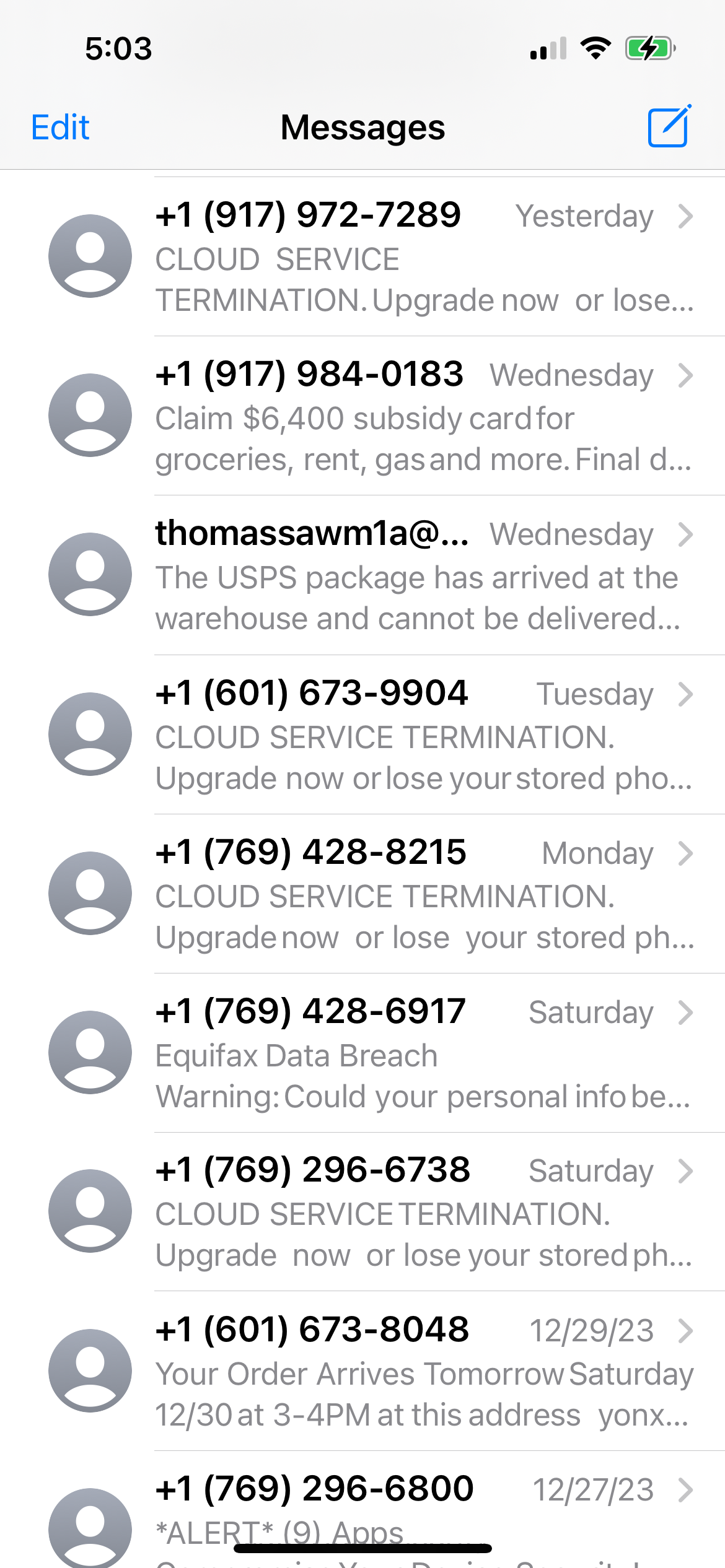
Then I got another. And another. And another. And another. And then dozens more, coming in one, two, three, four, sometimes five or more a day.
And they haven’t stopped.
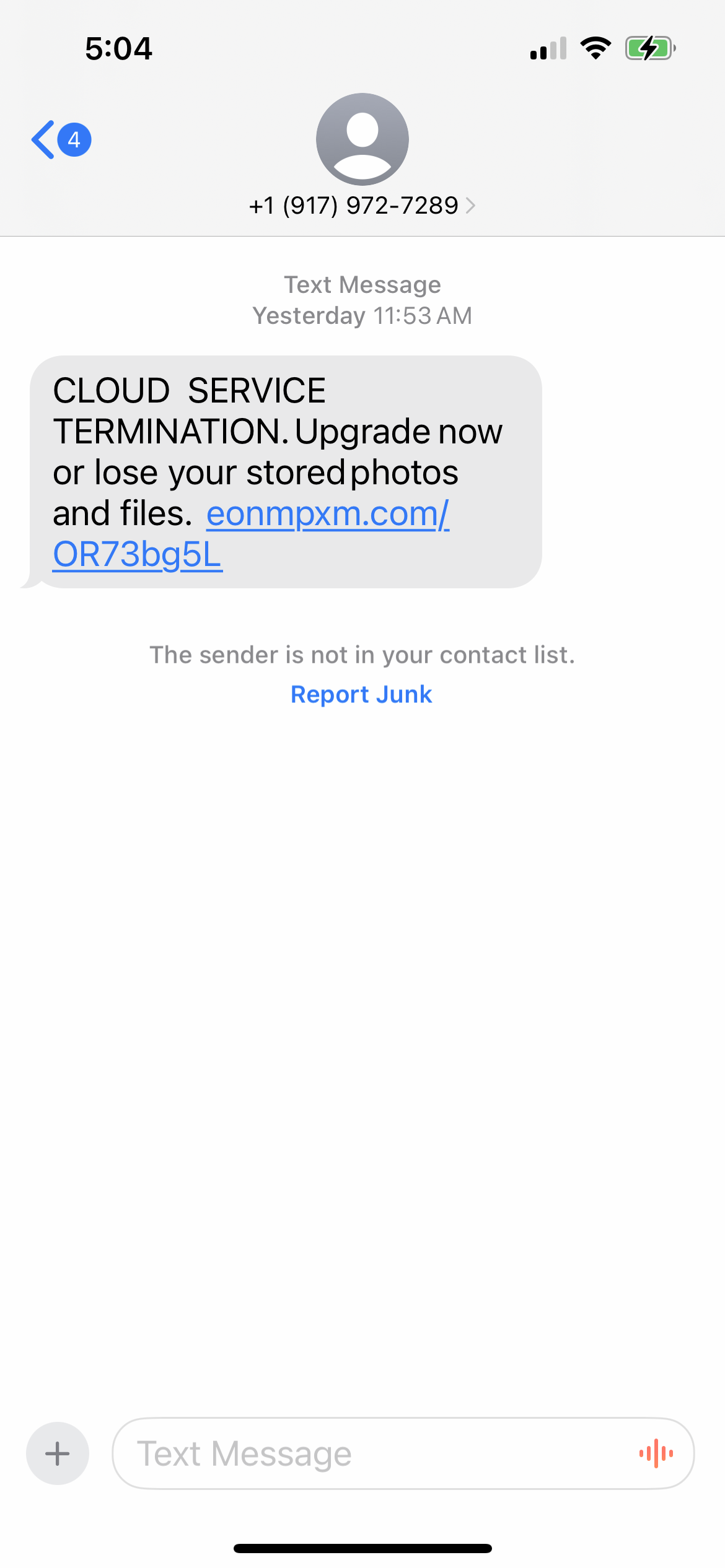
Text message after text message after text message. “You’ve been infected with viruses.” “Your cloud service has been terminated.” “We couldn’t deliver your package.”
All of them with URLs that looked like random strings of letters and numbers.
So my spidey sense was activated, and I looked up all those URLs.
Surprise, surprise, every single one is hosted on the same web service provider, an outfit called fly.io.
And there are a lot of them.
*** CAUTION *** CAUTION *** CAUTION *** THESE LINKS ARE LIVE AS OF THE TIME OF WRITING THIS. Many of these links will bring you to malware or phish sites. DO NOT visit these links if you don’t know what you’re doing.
I started collecting the URLs from the text messages:
http://eonmpxm.com/OR73bg5L FakeAV malware site
http://wkcetku.com/G1LO5X38 Fake “government subsidy” site
http://nztkspy.com/MK2RVeJg FakeAV malware site
http://lkxsxef.com/KJeQ09Vp FakeAV malware
http://klxnitq.com/oxp18G47 Equifax phish
http://epgguli.com/0M37VmkO McAfee phish
http://yonxutn.com/1MZbOrZv FedEx phish
http://zveeyou.com/7Xy1E8G8 FakeAV malware
http://mirumbf.com/KJeQ09Vp FakeAV malware
http://mirumbf.com/KJeQ09Vp FakeAV malware
http://qjkwmww.com/yng4eExR Fake USPS phish
http://wnddwet.com/KJe40qm5 FakeAV malware
http://pdxftwt.com/ER39R0rR XFinity phish
http://plefaas.com/rNzdEAEW FakeAV malware
http://oitbaon.com/A3B6vBOe FakeAV malware
http://napiyib.com/nQ0mJKoZ FakeAV malware
http://kozqtlp.com/vGeO0XmX Xfinity phish
http://ugokulc.com/KJM89Mem USPS phish
http://iqbyojt.com/KJeQ09Vp FakeAV malware
http://sobagiw.com/nQVA0bVp Xfinity phish
http://oosjrjt.com/GRG8ML9n FakeAV malware
http://xqzfnuh.com/ZjgL4GbE Xfinity phish
http://tecvxzo.com/5aannZO7 Google phish
I notified fly.io’s abuse team about the problem. And notified them. And notified them. And notified them. Each time, I received an identical reply, from a guy calling himself “Matt Braun,” saying only “I have let our customer know. Thanks!”
Matt Braun doesn’t appear to have grasped that their customer is the phisher. And lately, I haven’t even received these replies; they haven’t acknowledged recent abuse reports in days. Meanwhile (of course) all the links remain active because (of course)…their customer is the phisher.
Okay, so how does the scheme work?
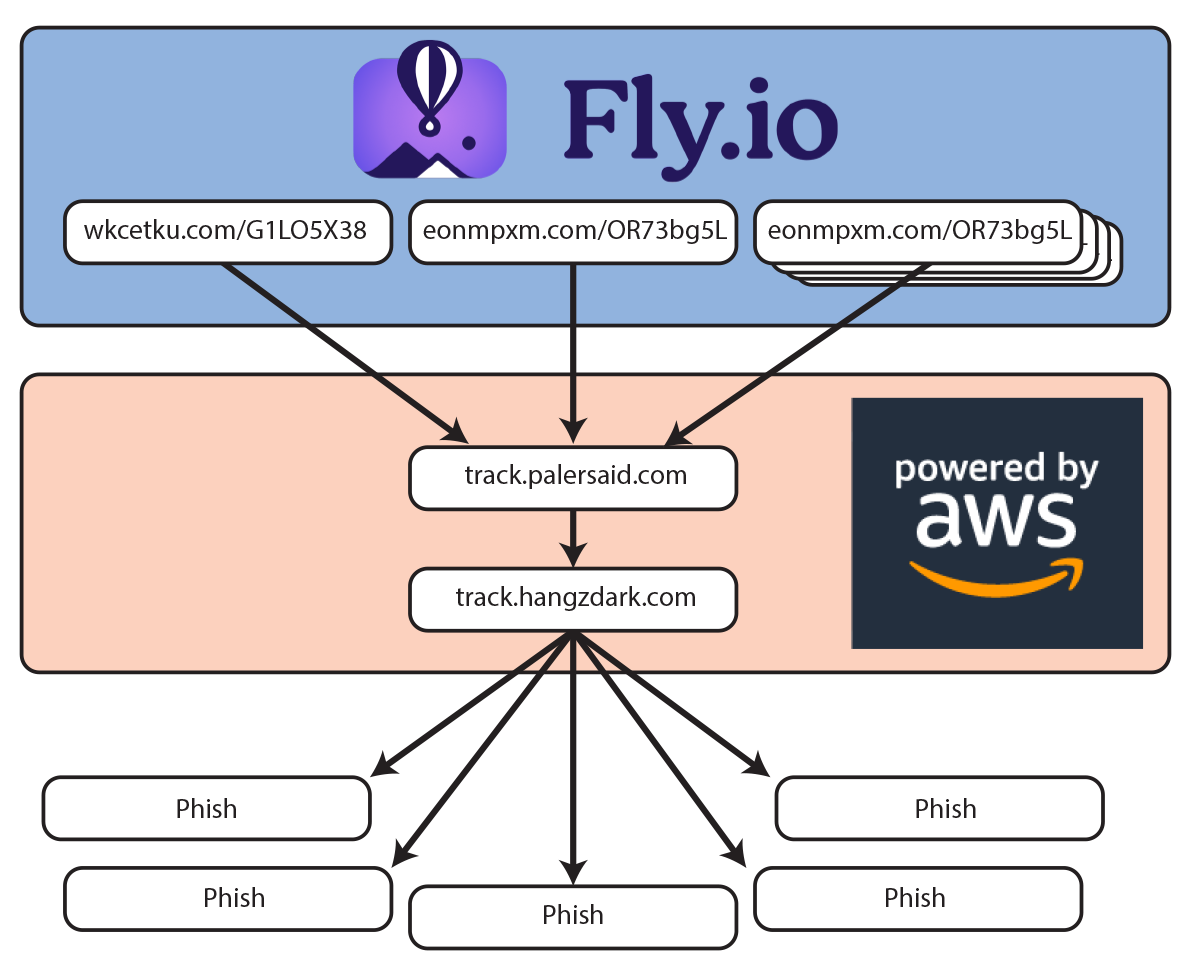
I’ve spent some time mapping out the network. The quick overview:
A text message is mass broadcast, advertising a URL on fly.io.
Marks who click on the link in the message are redirected to a site called “track.palersaid.com,” hosted on Amazon AWS. Track.palersaid.com looks at the incoming fly.io URL, the type of computer or smartphone you’re using, and probably other stuff, then sends you on to another site.
This site, track.hangzdark.com, is another tracking and redirection site also hosted on Amazon AWS.
From there, marks are redirected to the actual target site, which might be a fake FedEx page, a fake UPS page, a fake “virus scan” page, or more. There are a lot of these destinations: read.messagealert.com, kolakonages.com, aca.trustedplanfinder.com, and more. Some of these destination sites are, no surprise here, hosted on Namecheap, which is in my opinion one of the scuzziest of malware and spam sewer hosts.
If you get these text messages, do not follow the links. If you are also seeing these messages, please let me know in a comment! I would love to know how big this network is. Fly.io seems reluctant to shut down these phishers, which leads me to wonder if they aren’t making quite a bit of money from them.
[Edit 11-Jan-2023] I’ve received a reply from Fly.io’s Abuse team:
Thank you for your patience with us over the holiday, and some follow up details.
Usually, when we have reports of spammer or abuser on our platform, our internal systems have a host of signals that we can look to to verify the report and take the appropriate action. In the vast majority of cases the signals are clear and unequivocal. However, in this instance, the signals were entirely the opposite: all signs pointed to a seemingly-legitimate user.
Our systems are set up for “either you are a customer or you are not”, and banning a customer would mean immediate and irrevocable loss of that’s customers data. That’s is not a risk we take lightly so we were not going to flip the switch and risk blowing away someone’s information without a smoking gun. I expect you and I have both seen dozens of those posts on Hacker News or elsewhere where an innocent user writes “Company has deleted my entire account without warning and I’ve lost years of data”. We don’t want to do that to someone.
So where does that leave us? The apparent reason for the behavior/signal disconnect is that it was our customer’s customer doing the abuse. Our customer has committed to evicting their customer today which should put an end to the redirection through our systems (though, unfortunately, I don’t expect that’ll have any impact on the SMS spam). If it doesn’t resolve things, let us know. We’re back online after the holiday and more in a position to chase things things down.
Additionally, there were two other concerns we need to address internally: 1) We don’t have the ability to suspend users. This is something that I’m going to pursue as we need something more nuanced than our all-or-nothing approach so that we’re able to move on complaints sooner without risk of harming someone innocently caught in the middle of things. 2) We did not follow up with the customer as often as we should have after their initial acknowledgement of the problem and indication that they would address it. That’s a coordination process breakdown exacerbated by people taking time off during the holidays and not having the usual “obviously-abuse” signals. Additionally, we need to come up with an approach to our abuse ticketing system that allows for long-lived cases.
You can email me, personally, if you feel you aren’t getting attention on this (email redacted) and I’m sincerely sorry for the delay in letting you know where things stood or getting things sorted with the customer.
It seems Fly.io is one of the good guys.
The spam stopped for a few days, though it has resumed again. This time, the SMS spam domains are hosted on Alibaba rather than Fly.io.
The difficulty lies in the fact that I can tolerate only a narrow range of temperature. Anything above or below that range is pain.
I inherited this trait from my mom, along with her resistance to local anesthetics. It has a name, in fact: “congenital thermal allodynia.” It’s caused by a genetic anomaly of genes that direct production of a class of receptor protiens called “transient receptor proteins,” or TRPs, particularly receptor called TRPA1 (which activates in response to cold) and TRPV1 (which activates in response to heat).
TRPV1, the sensor that makes painfully hot things painfully hot
Simplified, handwaving over details, many TRPs respond to changes in temperature, allowing ions to flow through into the nerve cells the receptor proteins are attached to if temperature goes above or below a threshold. When these receptors are found on pain nerves, triggering them results in pain. The temperature-sensing receptors produced my body aren’t formed correctly, so the heat-sensitive receptors trigger at too low a temperature and the cold-sensitive receptors at too high a temperature; a shower that’s perfectly fine for someone else is painfully hot for me, and cold showers are unbearable agony.
That’s the background part I.
So.
Some time ago, I severely burned my foot by dropping a kettle of boiling water on it, which is how I discovered that boiling water burns are just about the only things that suck worse than kidney stones.
The hospital gave me a shot of morphine, which did nothing except make me throw up, and prescribed oxycodone, which also did nothing but make me throw up. Finally, in desperation, I tried cannabis edibles, which I found worked far better than opiates on pain—cannabis was the only thing that made followup viits to the burn clinic tolerable.
That’s the background part II.
Incidentally to this, I also learned that cannabis edibles quench the thermal allodynia. It was, I must say, quite an amazing thing to be able to take a nice warm shower and have it, astonishingly, be a pleasant experience.
For the first time, I really understood what people mean when they talk about enjoying a hot shower.
Fast forward a few years, and I discovered, also quite by accident, that cannabis edibles put me in my body. Normally, my experience of the world is that I live in a ball behind my eyes, connected to and driven around by a meat machine that I can feel, sure, but that isn’t really me. The first time I ever had the experience of completely inhabiting my body was after an experiment with psilocybin mushrooms some years back; and boy, lemme tell you, the experience that I, the me that I am, reached all the way to the floor was fascinating.
I learned earlier this year that small doses of cannabis edibles, about 1.25mg of THC and 1mg of CBD, will induce the same thing.
I also learned, entirely by accident, that a low-dose cannabis edible plus a Mike’s hard lemonade will put me entirely in my body but also make the experience extremely unpleasant.
That’s the background part III.
Now that you know the background, allow me to get to the point of this essay, in which your humble scribe and his Talespinner decide to do “Science!”, and instead accidentally do real, honest-to-god Science!
So first, the “Science!”
Those of you who’ve followed the adventures chronicled herein may be aware that for the last three years I’ve been hard at work on various xenonorph-themed sex toys, most notably the Xenomorph Hiphugger Strapon.
I made a xenomorph hiphugger for my Talespinner as well, and also I’ve been working on a xenomorph facehugger gag, which I brought with me to Springfield.
Two nights ago, my Talespinner and I attended a play party a a local dungeon, at which she played the role of a captive experimental subject caged and parasitized by xenomorphs.
A great time was had by all—you know it’s a party when the facehuggers come out—and so, the next day, we decided to bring out the facehuggers again.
Being that it was close to New Year’s Eve, we got a bottle of aggressively mediocre spiced rum, nowhere near as good as the rum we had in Barcelona, but adequate to the task of toasting the end of an objectively shite year.
And in the name of “Science!”, my Talespinner suggested we replicate my accidental findings with cannabis and alcohol, because, as all reasonable people know, replicability is the foundation of both “Sicence!” and Science!
And so it came to pass, Gentle Readers, that your humble scribe took a low-dose edible and a shot of mediocre rum, his Talespinner strapped a facehugger alien to her hips, and we were off to “Science!”
I won’t disturb you with the details of what happened next, as they would..err, disturb you. However, I will tell you that what we learned was the experience of being in my body was overall quite pleasant.
Until I crawled, exhausted and spent, beneath the blankets.
And the cold blankets were…I won’t say agonizing exactly, but certainly agonizing-adjacent.
Here is where we move from “Science!” to actual bona-fide Science!
It seems that alcohol doesn’t actually make my perception of fully inhabiting my body unpleasant. Rather, what one recreational chemical giveth, the other taketh away. Where cannabis removes the thermal allodynia, alcohol brings it back. And the combination of extreme—some might even say unreasonable—temperature sensitivity and being more consciously aware of my body than I otherwise am is an experienced not to be missed, unless you can miss it, in which case I suggest you do.
I spent some time this morning scratching my head about this, as I would not expect, at first consideration, alcohol to affect transient receptor proteins.
I finally dod a Google Scholar search while we were on our way to the store to purchase tools for minor alien penis surgery, when what to my wondering eyes should appear, but an NIH article directly on point about this:
And so it came to pass, Gentle Reader, that our attempts to get jiggy with alien hiphugger parasites and recreational intoxicants actually resulted in a finding supported by genuine empirical Science!, namely that cannabinoid molecules can suppress congenital thermal allodynia, a result reversible by concomitant administration of ethanol.
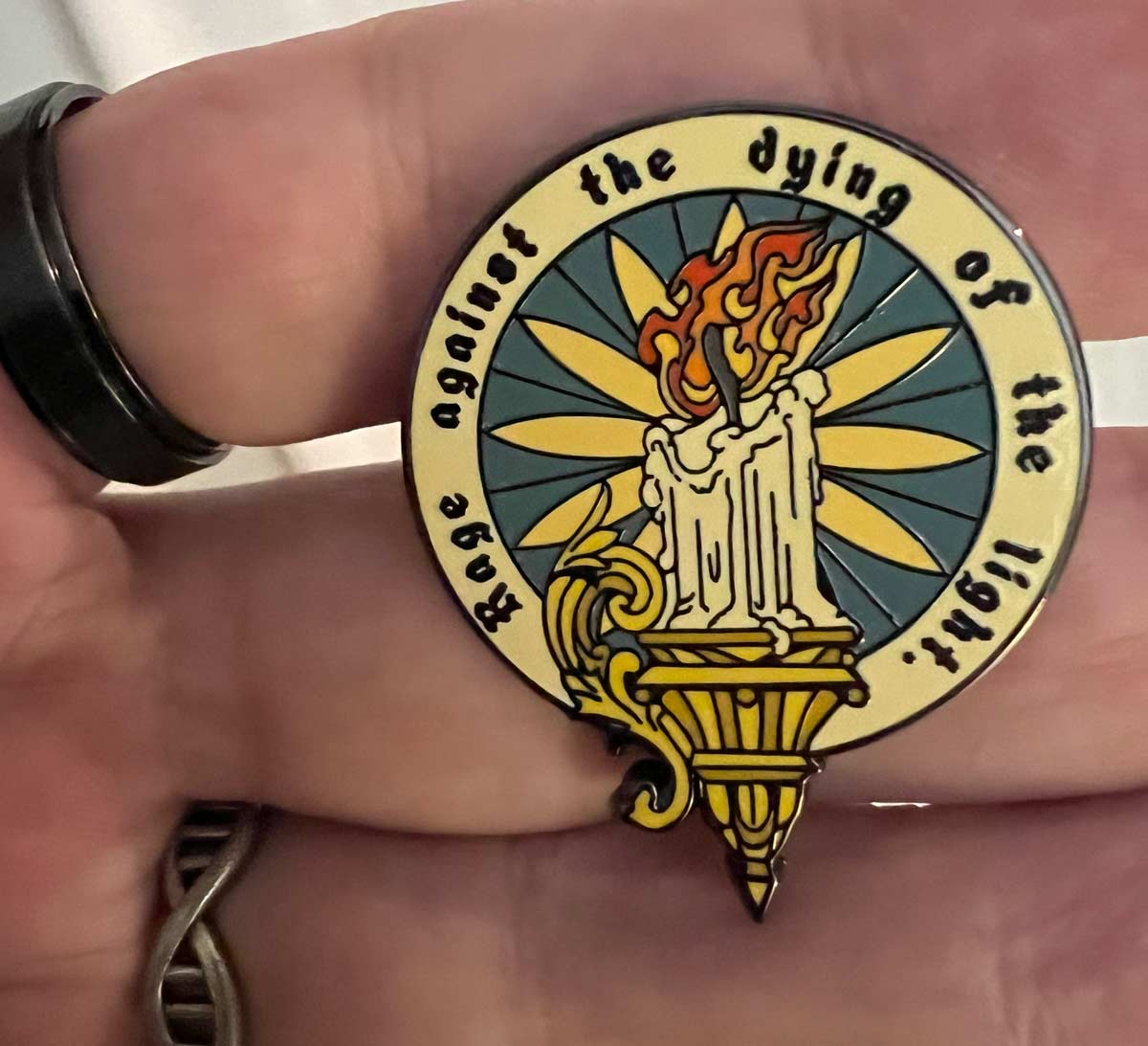
When I arrived in Florida a few weeks ago to help care for my mom, who was in the last stages of terminal cancer, Facebook showed me an ad for a pin. I ordered it on the spot. It arrived yesterday, on what would have been my mom’s birthday.
For anyone who doesn’t recognize it, it’s from a poem called Do not go gentle into that good night, by Dylan Thomas, whose first stanza reads:
Do not go gentle into that good night, Old age should burn and rave at close of day; Rage, rage against the dying of the light.
I’ve talked a lot about my mom’s wisdom. It was a quiet, understated thing; she had a knack for comprehending the world in ways subtle and deep. When I was growing up, she used to tell me, “information by itself almost never changes attitudes.” She understood that we are not rational creatures, we are rationalizing creatures, prone to making decisions for emotional or tribal reasons and then pressing our rational selves into service to justify our choices.
Other things she told me countless times:
“Education is not the solution if ignorance is not the problem.”
“We are predisposed to believe what we wish were true or what we’re afraid is true.”
“Never ask a question whose answer you don’t want to know.”
Even more than her sometimes pointed wisdom, though, I remember she was always, always there for me, without fail. If there was one thing I could count on absolutely, without question, as surely as the rising sun at the end of night, it was that she’d be there without fail. I never for even a millisecond, at any time in my life, doubted her love. Not once.
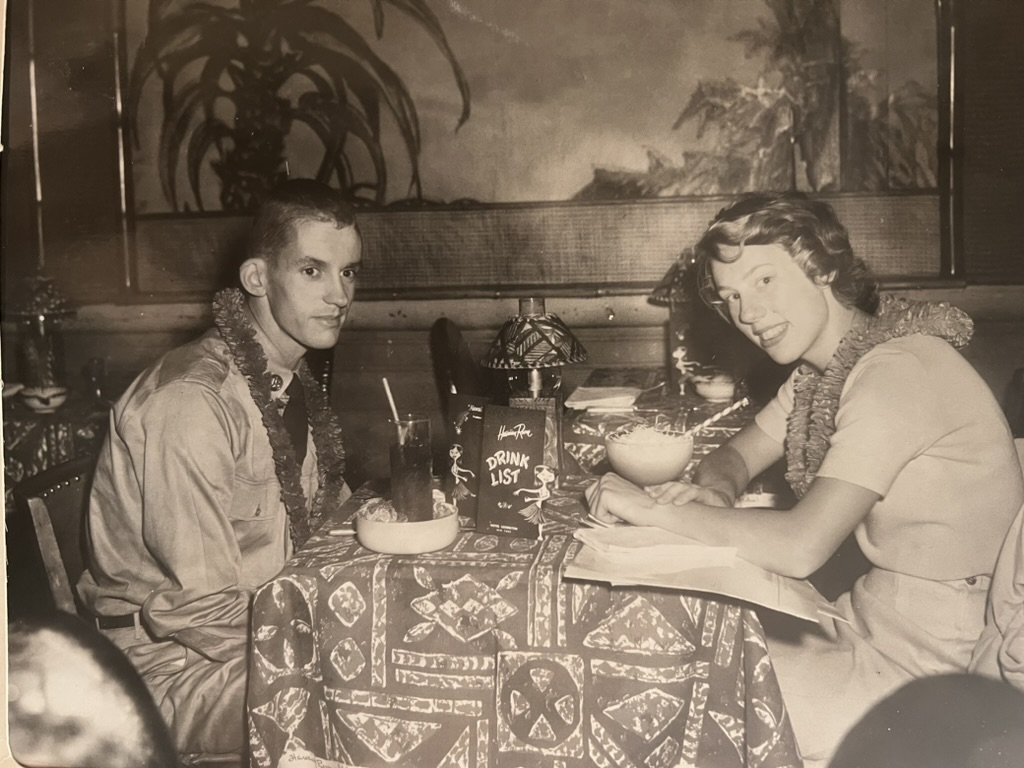
My mom and my dad on a date, six years before I was born.
I remember one night many years ago, when I was 18 or 19, driving to Ft. Lauderdale in my notoriously unreliable ’69 VW Beetle to visit friends. The car broke down at about 2AM four hours from home, so I called my mom from a pay phone. Without the slightest hesitation, without lectures or rancor, she got up, dragged her ass the four hours to come rescue me, then the next day took me to a repair shop for the part I needed to fix it and drove me right back down again.
She was always that way. That sort of cast-iron knowledge that someone always has your back is probably the single greatest gift you can ever give someone growing up.
My mom was diagnosed with cancer in November 2022, thirteen months almost to the day as I type this. She tolerated chemo poorly, though she was not one to go gentle into that good night, and stuck with it no matter how miserable it made her.
In the end, it wasn’t enough.
I came down to Florida a few weeks ago to help my dad care for her. At the end, she needed round-the-clock care, so my dad and I alternated in twelve-hour shifts.
In the tiny hours of the night last week, she started having difficulty breathing. I called 911. She’d been in and out of the hospital several times, so I didn’t know this would be the last time she’d ever be home.
The hospital confirmed the cancer had spread to her lungs and brain. A few days later, the doctors took her off life support.
She died at 9:36 in the morning on December 15, 2023, four days before her birthday. We (my dad, my sister, and I) were in the car on the way to the hospital to see her when she passed.
That night, when I called 911, I don’t think any of us knew it was the end. We knew the end was near, of course, but she’d had other crises, other storms she’d weathered.
I’ve been thinking about that a lot this week, as I go through a million little things I never imagined having to deal with—arranging for the home hospice care people to come and pick up the hospital bed, resetting her iCloud passwords, all the various ways we close the threads of a life. (The truck is titled in my mom’s name but my dad isn’t on the title, something my sister is dealing with.)
You never know.
Someday, there will be a last time you see the moon through the trees. Someday, there will be a last time you hug the people close to you. Someday, there will be a last time you hear a bird sing, a last time you have your favorite dessert, a last time you feel the sun on your face.
You might not know when that is. It might have already happened.
You are an anomaly. Yes, you. The odds of your existence are incomprehensibly small. You trace your lineage directly across the billions of years to a primitive, single-celled organism, and any tiny disruption of that slender thread would erase your existence. Had your parents gone to the movies that night, you would not be here.
You have these brief moments under the sun, and that is a gift beyond price—beyond imagining. Somehow, you beat odds so great your brain literally cannot comprehend them, and of the trillions of potential beings that might exist, here you are.
These few moments are all you will ever have. Cherish them, because there will be a last time for everything.
Right now, as I type this, I’m in Florida helping care for my mom. My dad and I have been doing 12-hour shifts with her, because she needs round-the-clock care. Between that and all the thousand things around the house that need tending to that my dad isn’t able to, I haven’t been sleeping much.
Last night at about 5am my mom started having trouble breathing, so I called 911. We just heard from the hospital 10 minutes ago. The cancer has spread to her lungs and brain. She really wanted to make it to her birthday in 6 days. The doctors don’t think she’ll make it.
So I’m not maybe the best person to talk about loving life right now.
And yet…
A few days ago, my wife and I spent a couple of hours at the Festival of Lights in Cape Coral. They had hot cocoa and a campfire with marshmallows.
When I stumbled out of bed this morning (well, technically this afternoon), the first thing that happened was my mom’s cat sat at my feet, meowed at me, and headbutted me to say hi.
Right at this very moment, I’m looking out the window onto my parents’ patio, where three squirrels are chasing each other across the screen roof, and it’s delightful.
I was born just barely early enough to see humanity walk on the moon—-some of my earliest childhood memories are sitting in front of a B&W TV watching the Apollo launches. Odds are good I will see humanity walk on Mars. Isn’t that amazing?
I am surrounded by love. I’m spending Christmas with my Talespinner. My life is filled with creativity and joy—I write books with some of my lovers, my wife and I created the Borg Queen xenomorph parasite cosplay from an idea she had three years ago, I’m teaching myself CNC machining and laser engraving.
I live in a time of unprecedented peace and prosperity in human history. We can fly through the air. Every day, we learn more about the universe.
This photo:
was taken by a probe that landed on a comet. We have the capacity to launch a probe that can travel for years and then arrive precisely on a small rock traveling at 84,000 miles per hour, which is about like a person in Boston shooting a rifle and hitting a golf ball in midair in Moscow. (Bizarre how many people think science is “just another belief system,” eh?)
And, I mean, I get it. The world isn’t all roses. Right now, far too many people in my country are too uneducated in history to recognize when they’re being lied to by yet another populist grifter selling them the same old tired lie that all their failures are the fault of somebody else.
We have a political party that takes gleeful, sadistic delight in mendacious cruelty, and a voting populace that sincerely believes it’s okay to vote for the Leopards Eating People’s Faces Party because surely the leopards won’t eat their faces—only the faces of the Mexicans and the gays and the trans people, right?
There is pettiness, and cruelty, and meanspiritedness. There are people who make voting choices because they want to hurt other Americans just to own the libs.
But viewed on a large enough scale, the moral arc of the universe bends toward justice. We may be in the “one step back” part of the “two steps forward, one step back” cycle, yet this too shall pass.
I keep, on my phone, a list of books I want to write. There’s something wrong with it; somehow, every time I finish a book, I discover the list has grown longer, not shorter. (Side note: You can tell someone’s an amateur whaen they say “I don’t want to show my book to an editor or publisher because I’m afraid someone will steal my idea.” Nah bruh, ideas are worthless, and we all have too many ideas of our own to be interested in yours. The bitter truth of writing is it’s almost impossible to get anyone interested in your book in the first place!)
One of the books on the to-be-written list is a nonfiction work titled A World of Sh*t: Normalizing bad design and lazy craftsmanship. Because man, there’s a ton of it out there.
The way I imagine the book’s title
As I sit here in my parents’ house in Florida, I find myself particularly annoyed by the bad, lazy, incompetent, “we didn’t think this through” design around me.
There’s a term that describes a lot of this crap: “psychic litter.” The expression was coined by David Joiner in the 1990s, to describe small acts of immorality that fall beneath the threshold of conscious awareness.
Take, for example, the Windows installer. It takes a while to install Windows, especially older versions. A lot of that time is spent building the Registry. The Windows installer designers could have pre-built a Registry in the installer itself, which would save almost half an hour on each install, but chose not to because it would mean taking an extra half an hour of their time to build the installer. So rather than spending the half an hour on their end, they chose to waste thousands of man-hours of other people’s time.
This kind of selfishness and lack of care is the essential beating heart of a lot of sh*t design.
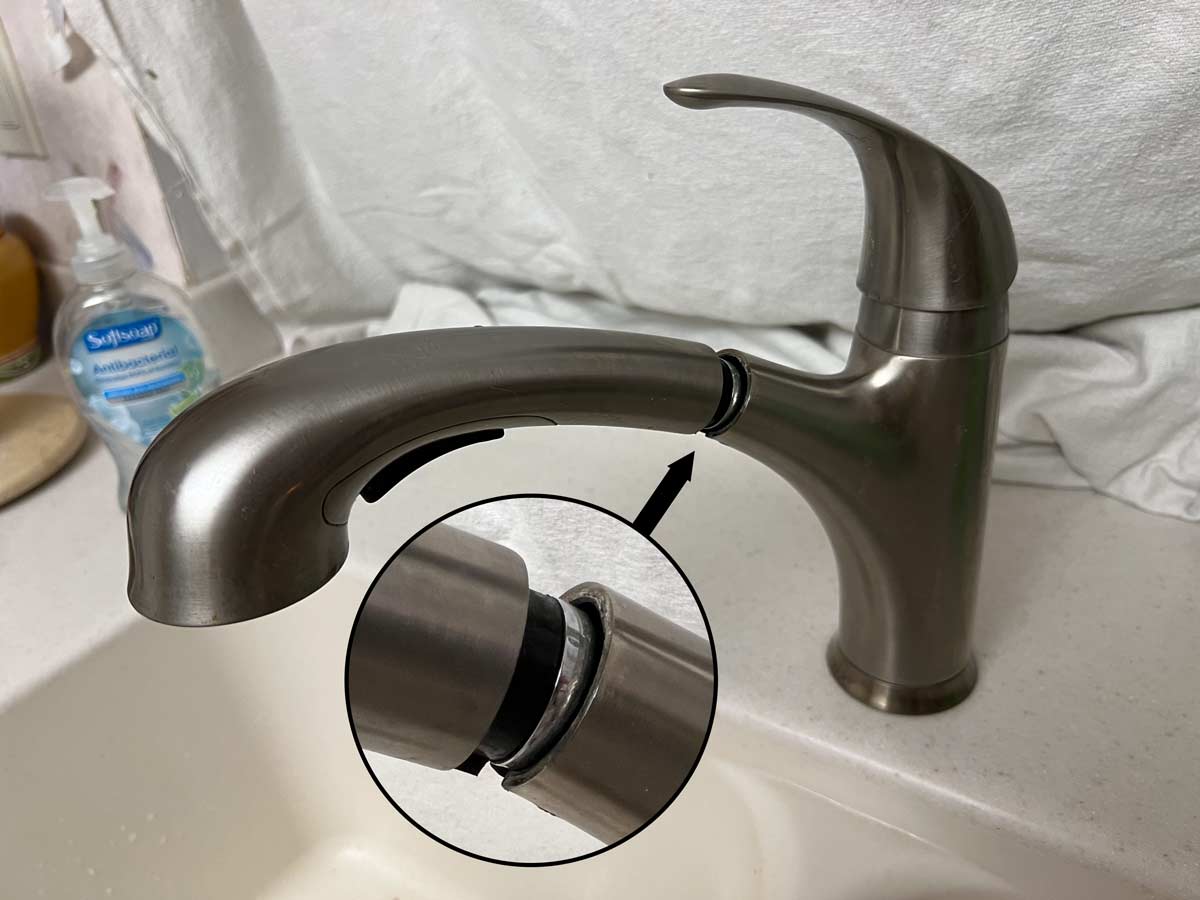
Take my parents’ kitchen faucet (please!).
It’s pretty. It’s sleek.
It doesn’t move.
You literally cannot rotate it between the two sinks, which is, you know, one of the most basic of all faucet functions. It doesn’t turn. At all. They have two sinks, but you can only use the faucet with one of them.
Worse, it’s also a sprayer; the entire faucet removes. Clever, except that it does not, and has never, docked correctly. It has a plastic ring on the faucet that fits a plastic sleeve on the base, but the ring is too large; it doesn’t fit. (I imagine the fact that it’s a sprayer is the reason it can’t rotate, and that would be absolutely perfect for a three-armed user.)
And then there’s this marvel of engineering:
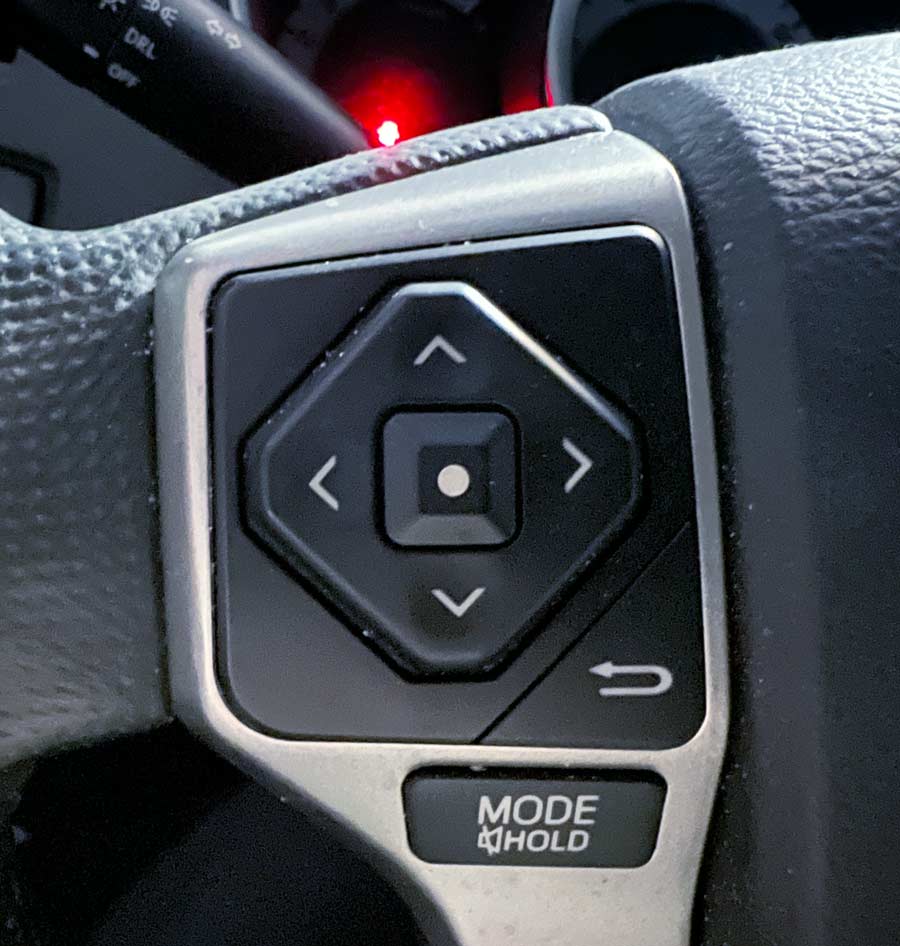
This is the steering-wheel-mounted remote for the car stereo in my parents’ truck, a Toyota Tacoma.
Steering-wheel-mounted remotes for a car stereo are a brilliant idea. And they’re really not that complex. They move the most often-used functions to a place where you need not look away from the road or take your hands off the steering wheel to use them.
This control has four primary buttons: left, right, up, down. Now, thinking about what it’s supposed to do (work a CD player/Bluetooth combo), you might reasonably expect that left and right go to previous and next track, and up and down raise and lower the volume.
And you’d be 100% wrong.
Left skips back 10 seconds in the current track. (Yes, seriously.) Right skips forward 10 seconds. Up goes to the next track, down goes to the previous track.
What about volume? How do you adjust the volume?
You don’t. There are no volume controls on the steering wheel. To change the volume, you have to take your hands off the steering wheel.
Yes, you read that right. They literally believed that forward 10 seconds/back 10 seconds was so important it should be on the steering wheel, but volume? Eh. Who uses the volume controls, anyway?
Every single digital music player I’ve ever used, from the Radio Shack Compact Disc Player CD-1000 my parents got in 1984 to my iPhone today, uses left and right arrows for previous and next tracks. But whatever Toyota intern who designed the car stereo controls, having apparently never used or indeed seen an entertainment sound system before, had his own ideas, and somehow, somehow it passed all the design review steps. Somehow, someone signed off on manufacture.
Skip ahead ten seconds yes, volume control no.
And here’s the thing:
The world we live in today, our world of marvels and miracles, is filled with examples like this.
It’s hard not to believe that the vast majority of industrial designers are anything but lazy and barely competent, unwilling or unable to put any effort into their job (and it certainly feels like they never use the things they design). From consumer electronics to furniture to software to clothing, we live in a universe of shit.
My jacket has a zipper edged by a hem that is exactly the right width to catch the slider as it moves. It is not possible to zip or unzil the jacket without the hem catching the slider at least three times.
Someone designed that. It went through several review steps before it was released to manufacture. And yet, neither the designer nor any of the peple resonsible for reviewing the design ever put the jacket on. (I’m serious when I say you cannot zip or unzip it without catching the slider. Even one test would’ve been enough.)
We live, we exist in a world of sh*t. We don’t pay attention to the way design impacts our lives, and as a result, trivial design failures—failures that can easily be corrected in minutes during the design stage—waste countless person-years of time. In some cases, like car stereos with cluttered or counterintuitive layouts, they kill people.
And we as a society are remarkably okay with that.
I’m not sure what changed, but in the last five years or so, I’ve found it increasingly difficult not to notice shitty design all around me. And once you’ve started to see it, it snowballs. You can’t un-see it.
I would like to live in a world where perhaps people cared about design more. But the problem seems to be getting worse, not better.