I’ve rediscovered a love of the old real-time strategy game Age of Empires II, which might arguably be the apex of the Golden Age of RTS games.
Those of you who share my love will get this joke.

I’ve rediscovered a love of the old real-time strategy game Age of Empires II, which might arguably be the apex of the Golden Age of RTS games.
Those of you who share my love will get this joke.

In 1995, scientist and educator Carl Sagan published a book called The Demon-Haunted World: Science as a Candle in the Dark. I can not recommend this book highly enough. It is a manifesto of clear, rational thinking. If you’re at all interested in understanding the physical world or, more importantly, understanding how to understand the physical world, you really need to read this book.
Seriously. I mean you. Go get a copy.
One of the many brilliant things in The Demon-Haunted World is the Baloney Detection Kit. In a chapter titled The Fine Art of Baloney Detection, Sagan lays out an excellent set of rules for determining whether or not you’re being hoodwinked by pseudoscience–luncheon meat masquerading as knowledge.
I am not and never will be as brilliant as Carl Sagan. However, he lived in a time when pseudoscience, and specifically conspiracy theories about science, were not nearly as endemic in the public discourse as they are today.
So I would modestly like to propose an update to the Baloney Detection Kit.
Here’s the updated version:
It’s a comment I see scattered far and wide across the Internetverse. In almost any conversation where some guy is complaining about his wife or girlfriend having male friends, inevitably someone else will ask, “don’t you trust her?” And inevitably, as sure as night follows day, he will say “Oh, I trust her, I just don’t trust other guys.”
Which, as near as I can tell, translates into English as “I don’t trust my girlfriend.” Because the only alternative reading I can see is far more horrifying.

First things first. Let’s call this what it is: an endorsement of the belief that what women want doesn’t matter.
“I trust my girlfriend.” I think my girlfriend wants to be faithful to me, wants to support me, wants to be with me. “I just don’t trust other guys.” Because at the end of the day, it doesn’t matter what she wants. She’s not a man. It only matters what those other guys want.
There are a couple of ways to read this, one of them pretty messed up, the other one even more so.
The first, messed-up reading: My girlfriend wants to be with me and be faithful to me, but other guys don’t want her to be. Other guys will trick, persuade, cajole, or convince her to cheat on me. You know, because they’re guys and she’s a woman. Women are weak of will, incapable of holding out when faced with a determined guy who wants to seduce her.
The second, even more messed-up reading: My girlfriend wants to be with me and be faithful to me, but other guys don’t want her to be. They’ll just rape her. Because, you know, they’re guys, and that’s what guys do.
Regardless of the reading, the conclusion remains the same: Ergo, the thing I must do is prevent my woman from hanging out with other guys. Charmers or rapists, it doesn’t make any difference if she wants to be faithful to me; they want her, so they’re going to fuck her.
And that’s a whole world of messed up right there, it is.
Disempowering and infantilizing on the one hand, or implicitly supportive of rape culture on the other—there’s no interpretation that makes this idea smell any less bad.
So, I would like to have a word with all you men out there who have ever used this reasoning, thought about using this reasoning, or nodded in sympathetic agreement when someone else has this reasoning. I will try to put this as delicately as possible:
Cut it out. It’s bullshit.
“I trust you, but…” is just a way of saying “I don’t trust you.”
Look, I get it. It’s scary to trust someone else. When you do, you’re putting your heart in their hands and giving them a chance to let it shatter on the floor. You’re hoping they won’t drop it, knowing it will hurt if they do. I totally understand how scary that is.
But you can’t have it both ways.
If you trust your partner not to betray you, you have to have confidence that she won’t even if she has the opportunity to. And if you try to control her to prevent her from having the opportunity to hurt you, you don’t trust her.
This is not about other guys or what they want. It’s about her.
If you don’t think she can say “no” to a silver-tongued bloke with a huge, massive, throbbing bank account, you don’t trust her. If you trust her, it doesn’t matter what other men’s intentions are.
And if you assume as a given that other men who take an interest in your girlfriend will ignore her ‘no’ and just rape her, there’s a bigger problem than her fidelity. Perhaps it’s time to stand up, you know? And I don’t mean stand up to control your girlfriend. I mean stand up against the notion that it is in any way, shape, or form acceptable to assume that other men will not listen to her ‘no’ and there’s anything normal about that…because there isn’t.
“I trust my girlfriend. I just don’t trust other guys.” Basically, you’re saying your girlfriend’s desires don’t matter.
Is that really what you believe?
My hunch is that it’s not. My hunch is what you’re really saying is you think your girlfriend will choose to cheat, but you don’t want to say it because you understand what it might mean. You don’t trust her, and a healthy relationship can’t function without trust.
If you trust her, it doesn’t matter what other guys want. If you don’t trust her, have the courage to own it. But listen, all you other men out there, enough with the “I trust her, I don’t trust other guys” already.
You aren’t fooling anyone.
I’ve been working on a project lately that I’m excited about, but not quiiiiite ready to talk about just yet.
Unfortunately, this project has involved working with the Amazon API. I say “unfortunately” because the Amazon API is truly the Mos Eisley of the computer world: you will never find a more wretched hive of bugs and poor documentation.
Nearly all of the sample code in the Amazon developer index dealing with the Product Advertising API does not work, and has not worked since 2009, when Amazon made a change requiring cryptographic signing of all API requests. I am a PHP programmer, and the PHP sample code for dealing with the API does not work and has not worked for a very long time.
For example, the sample SimpleStore PHP script called “Amazon Associates Web Service Simple Store in PHP” in their code library was written in 2006 (ten years ago!), broke in 2009, but is still on their developer site.
You can imagine how rage-inducing this is. In science, we are all standing on the shoulders of giants. In computer science, we are all standing on each other’s feet.
So I’ve spent the last few days eyebrow-deep in Amazon’s technical documentation, trying to make decade-old sample code work so that I could do something–anything–with the API.
I’ve finally made the SampleStore PHP script work with the modern Amazon API, and fixed some bugs and closed some security holes along the way. I’ve decided to make the fixed script freely available to anyone who wants it. I’ve commented it extensively in the code.
If you’re working with the Amazon API in PHP and you’re tearing your hair out because nothing works and there is no sample code to show how to build cryptographically signed API requests, fear not! This code works. The interface is simple and ugly, but the PHP will get you up and running.
Please feel free to use, remix, copy, redistribute, or do whatever else you want. I sincerely hope that this code will help someone somewhere not have to tear their hair out the way I did.
It’s been a busy month in smart sex-toy land.
We’ve just finished another round of testing of the third-stage prototype design, and ironed out some bugs that cropped up with the first incarnation of the current design. We’ve demonstrated conclusively that the idea works, and works well–even with the crude hardware we’re currently using, we’re able to trick the brain into internalizing the device into the wearer’s sense of self.
It was fascinating watching the most recent beta testers. We tested with two volunteers. With one of the volunteers, I was able to tell the exact moment her brain worked out the sensation and internalized the dildo. She was running her hand along the dildo, and she said “I don’t know, it feels weird and kind of uncomfortable, it just–” and then the switch flipped and she said “Oh!” and grinned.
Unfortunately, we’re running into limitations in how much further we can take the design by ourselves, given that I’m building each prototype by hand. Right now, each prototype is a hand-made one-off that takes hundreds of dollars and several days’ worth of work to put together. There’s a lot of hand soldering of some very tiny and somewhat fiddly components involved with every new prototype, which then ends up getting tossed at the end of each round of testing. The current design can’t be sterilized, so I have to build a new one each time we beta-test with a different person.
We’re learning quite a lot from each test. One thing we’ve found is there’s incredible variability between different people in internal anatomy and neurology. Some people are approximately evenly sensitive everywhere in the vaginal canal; some people are more sensitive in the lower portion of the vagina than the upper portion; some people are more sensitive on one side than the other. That means the final device will have to be tunable to each individual who wears it, with the wearer customizing the intensity of stimulation from each individual electrode. That adds a new level of complexity to the electronics, not to mention the user interface.
The current prototypes are built by modifying off-the-shelf dildos with sensors and electrodes. The prototypes use copper electrodes, which have a very short life expectancy; the final version may have to use gold for the electrodes. We’re still researching that.
We’re researching quite a lot, actually. Now that we know the concept is sound, we’re moving toward a more research-intensive phase of development. Questions we’re still addressing include things like what is the maximum sensory resolution inside the vagina, how does it vary in different areas of the vagina, how does it vary across different people, what is the safest electrode material that offers good durability while being body-safe, what’s the minimum number of sensors the dildo must have to create the sensation of being part of the body, what’s the maximum number of sensors and electrodes past which the wearer can’t distinguish different sensations any more, and what’s the best signal shape to stimulate the sensory nerves in the wearer without being painful or unpleasant. (The first versions of the prototypes used a very simple signal generator; the most recent version uses a programmable signal generator.)
The prototypes we’ve built so far have all had an insertable portion designed to be worn vaginally. We’ve had many people ask us about designs that don’t require insertion, or that work with an anal insertable portion. That’s also something we plan to experiment with; we want to find out whether stimulation of different parts of the body will achieve the same results. We plan to do some prototyping of designs that don’t require vaginal insertion soon.
That’s where you come in, O denizens of the Internet.
We are looking for people to partner with to help us do more sophisticated prototyping. Right now, we’re in desperate need of a company interested in partnering with us that has experience doing short-run custom silicone molding, preferably in or near Vancouver, BC. We are also looking for an electronics engineer who is sex-positive and interested in this project, especially one with experience in doing switching and amplitude modulation of analog RF signals.
If you know of anyone with those skills who would like to be involved in this project, please let me know, either here or by email at franklin (at) franklinveaux (dot) com.
Want to keep up with developments? Here’s a handy list of blog posts about it:
First post
Update 1
Update 2
Update 3
Update 4
Update 5
Update 6
Update 7
| Part 1 of this saga is here. | Part 7 of this saga is here. |
| Part 2 of this saga is here. | Part 8 of this saga is here. |
| Part 3 of this saga is here. | Part 9 of this saga is here. |
| Part 4 of this saga is here. | Part 10 of this saga is here. |
| Part 5 of this saga is here. | Part 11 of this saga is here. |
| Part 6 of this saga is here. | Part 12 of this saga is here. |
We are nearing the end of this tale, gentle readers, but what an end it is.
Bunny and I piled into the Adventure Van, headed to where we had heard of a large ghost town called Bodie, an 1800s gold-mining town in the rugged mountains of eastern California. Bodie was a–
“Hey, pull over!” Bunny said.
I pulled over near this apparently abandoned(?) building advertising bail bond services. Seemed legit.

We took some pictures, tromped about for a bit, then climbed into the Adventure Van once more, headed for Bodie. Bodie was a thriving gold mining town with more than ten thousand residents at its peak, located at more than eight thousand feet elevation in the Sierra Nevada mountains. It was a huge and fantastically profitable gold mining town, producing tens of millions of dollars (in 1850s dollars!) in gold. Miners were paid $4 a week for dangerous, heavy physical labor under grueling conditions; of that $4, $2.75 per week was deducted for room and board.
You get there by following a narrow dirt track up and up and up into the mountain. Bodie is well off the beaten path, in much the same way that a manned excursion to Mars is not a jaunt down to the local grocery store. Fortunately, it was not a terribly steep grade–stagecoaches loaded with gold had to be able to make the trip, after all–and the Adventure Van was up to the journey with a minimum of grumbling.
We drove for a couple of hours. “I hope this is worth it,” I said. Bunny said something noncommittal.
It was worth it.
When at long last you’ve traveled up to the summit of the Bodie Hills, the first thing you see from the road, aside from a “State Park” sign, is this.

This was the jackpot, the mother lode, the Platonic ideal of a Western ghost town. This, gentle readers, truly was the bee’s knees.
We parked–with, I must confess, some excitement–and left the comforting shelter of the Adventure Van into the dry, dusty heat of Bodie, California.
The moment you step out of the parking lot, thoughtfully provided for you by the California Department of Parks and Recreation, you walk up a slight rise and see…this.
This small picture can not do justice to how amazing this place is. Click on the picture to see a (much) bigger version.
Less than a quarter of the town remains; the rest burned to the ground quite some years ago. At its peak, the town had sixty-five saloons, numerous brothels, and several churches that one could go to for absolution of one’s sins, which were numerous indeed. Bodie was by all accounts a very violent place; common hobbies included murder and various lesser crimes. According to one of the tour guides we spoke to, it’s not uncommon for people who do heavy labor at high altitudes without proper acclimatization to suffer psychotic breaks.
Bodie had an extensive network of roads, all unpaved. Again, click on the picture to embiggen.
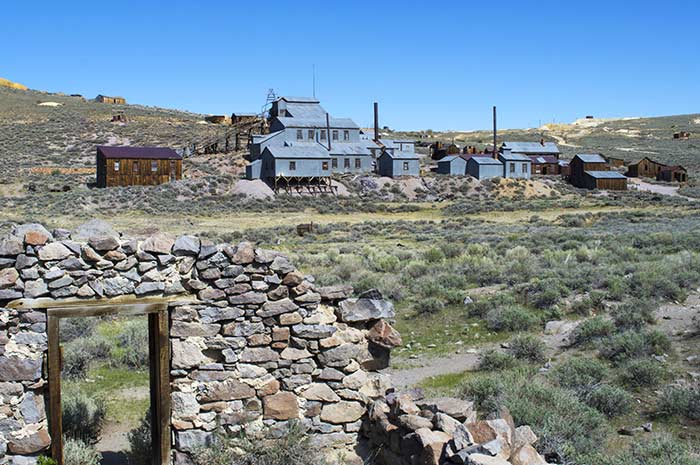
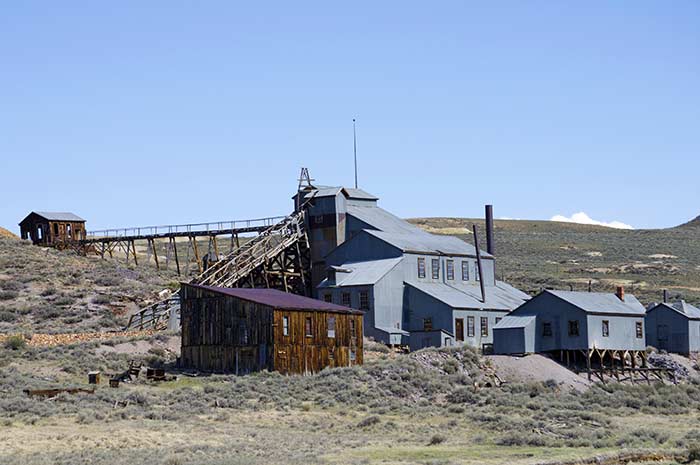
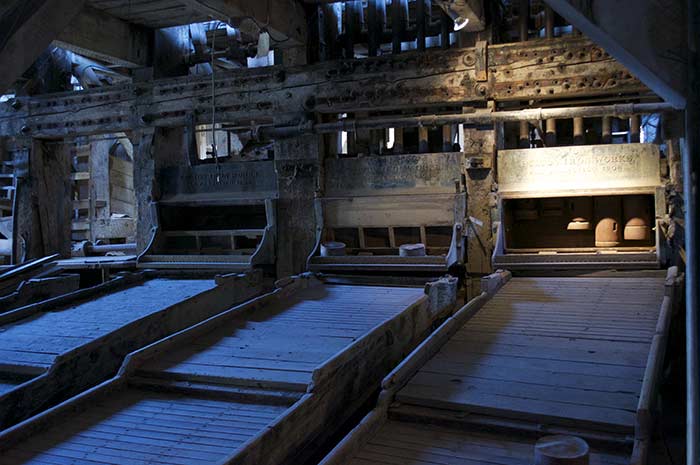
The large gray building on the left-hand side of the first picture is the stamping mill, the entire reason for Bodie’s existence. I plan to write an entire post about that stamping mill. Raw gold ore was carried to the stamping mill, where the rock was crushed to a powder as fine as flour, and gold was extracted from it by a process that was absolutely and completely bonkers and showed a careless–indeed reckless–disregard for the life, health, and safety of the people who worked there. More on that later.
Bunny and I eventually spent two days in Bodie, wandering around taking pictures–many hundreds and hundreds of pictures. I’ve condensed the trove down to about eighty or so, which will likely take several posts to work through. Apologies in advance for what I’m about to do to your bandwidth, O readers.
Life in Bodie was not particularly pleasant. The air at eight thousand feet is thin. During the summer, the temperature routinely exceeds a hundred degrees Fahrenheit; during the winter, twenty feet of snow is not uncommon. Everything from building supplies to construction equipment had to be carried up the mountain. There was one road that climbed into Bodie from the west, ran straight through town, and exited to the east. Naturally, as it was the only way into or out of Bodie, it was a toll road (buggies 25 cents; carriages 75 cents; discounts for firewood and mining gear).
The houses we saw tended to be quite small and simple, save for this one, a veritable mansion belonging to the overseer of the stamping mill. You can click this picture to embiggen it, too.
The tour guide didn’t say, but I suspect the stamping mill overseer made rather more than $4 a week.
This place was more typical of the houses in Bodie.

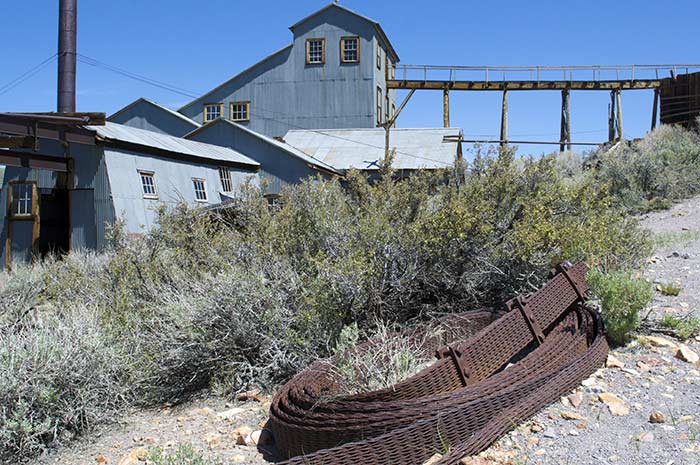
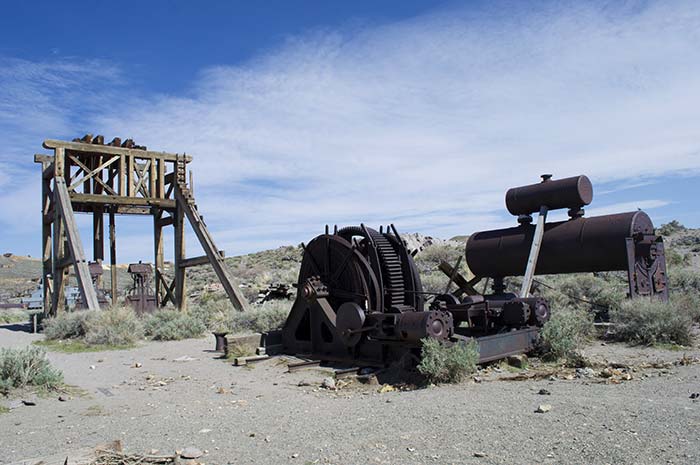
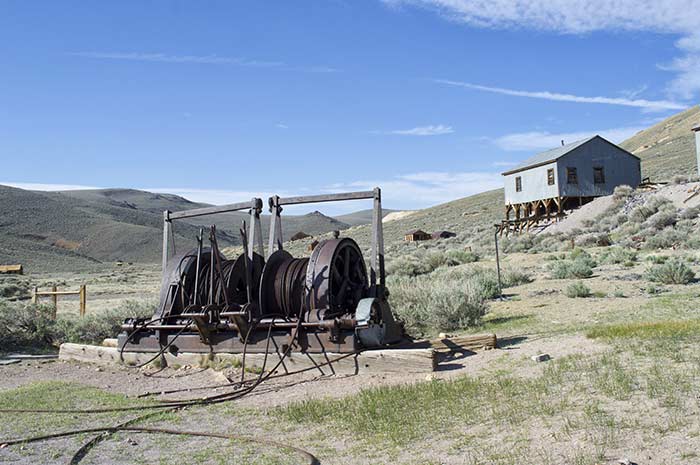
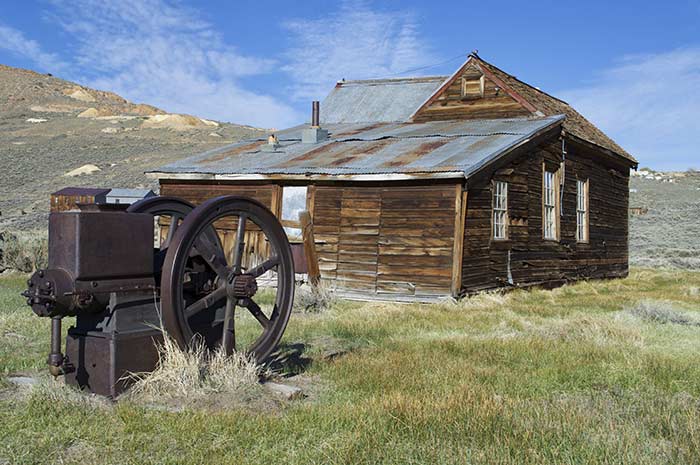
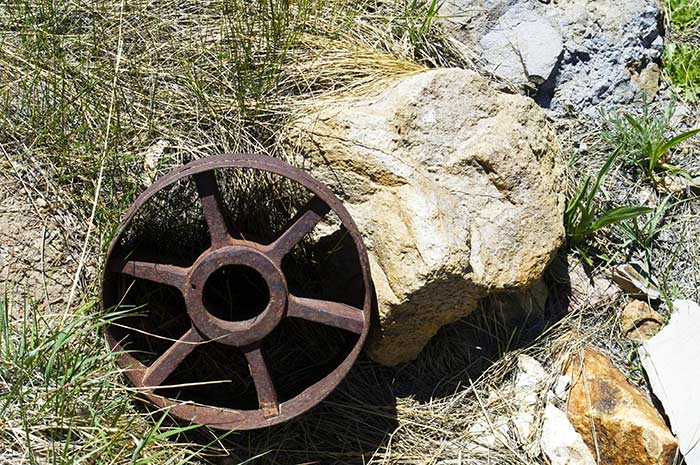
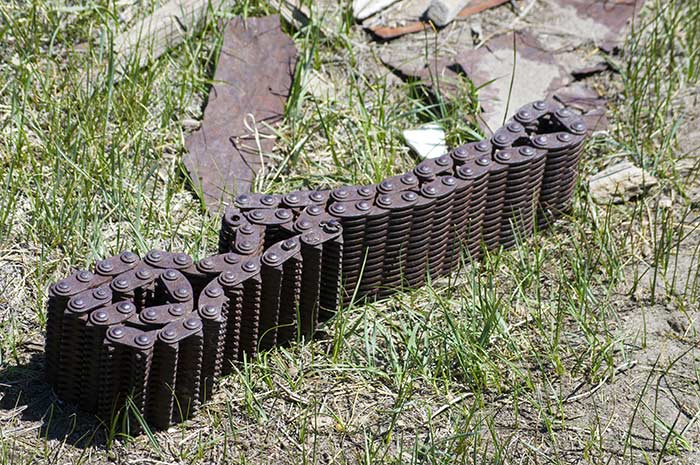
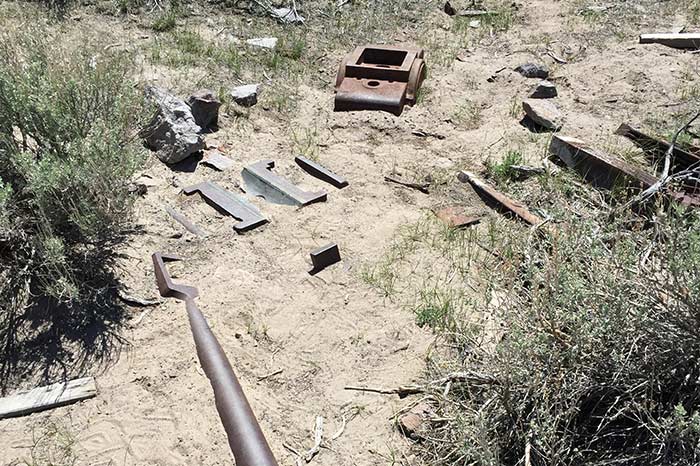
You’ll notice the remnants of derelict machinery in the foreground. Bodie is littered with abandoned equipment rusting quietly into the desert; it’s everywhere.

Even with all its violence and squalor, Bodie was the absolute pinnacle of Victorian technology. It was on the cutting edge of mining industry, and there was no new, experimental mining tech they would not use if it would increase the rate at which they could mine or process ore. The town of Bodie was a bit like the Silicon Valley of the 1800s–it was absolutely state of the art for new machinery and new techniques.
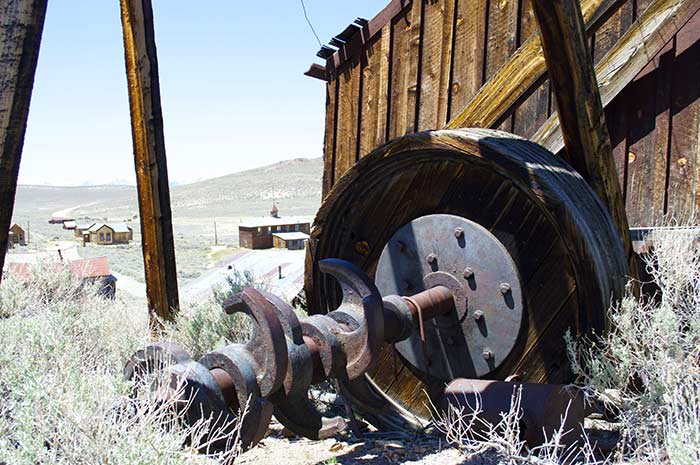
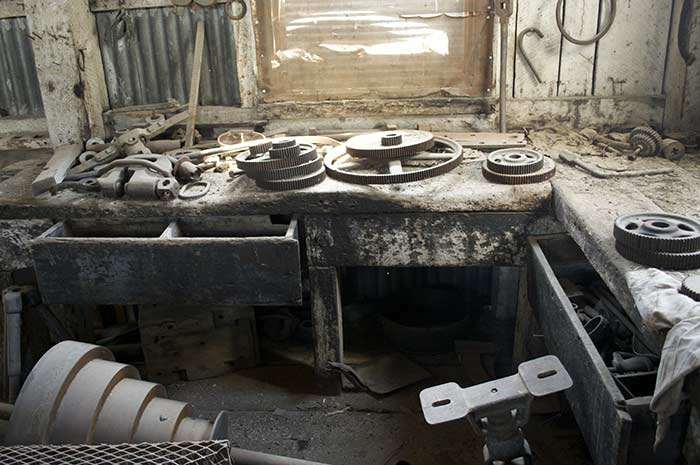
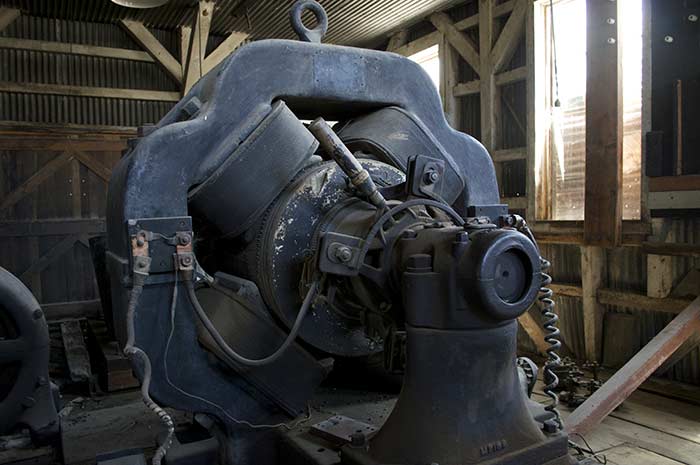
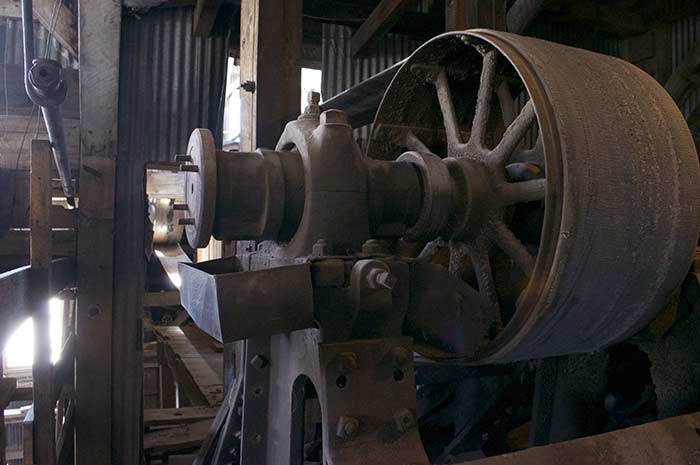
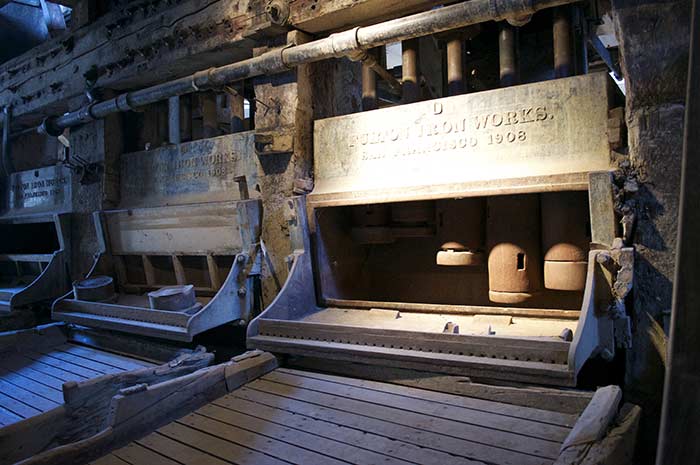
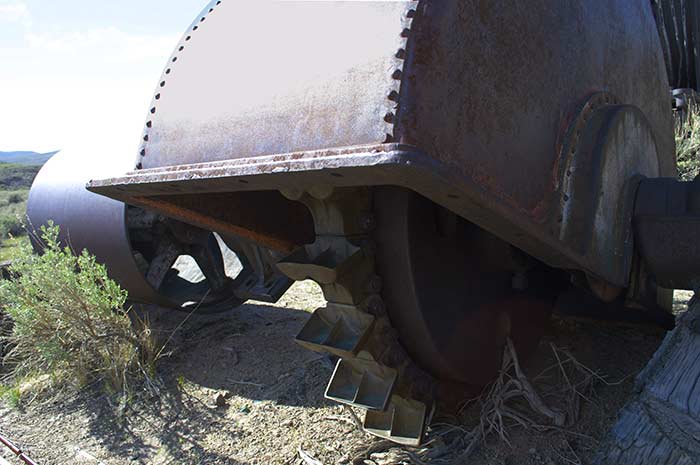
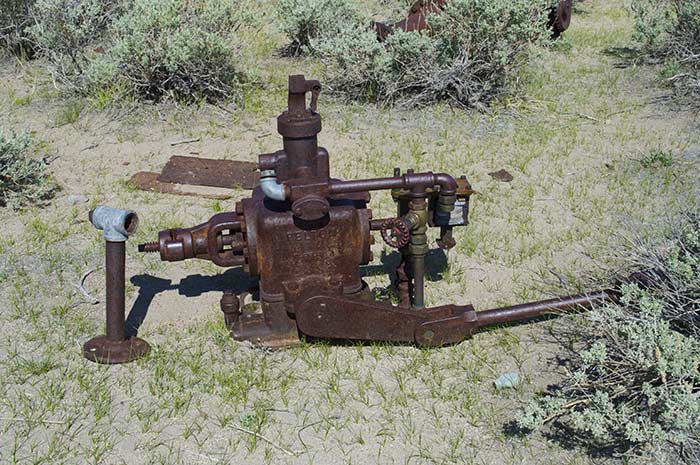
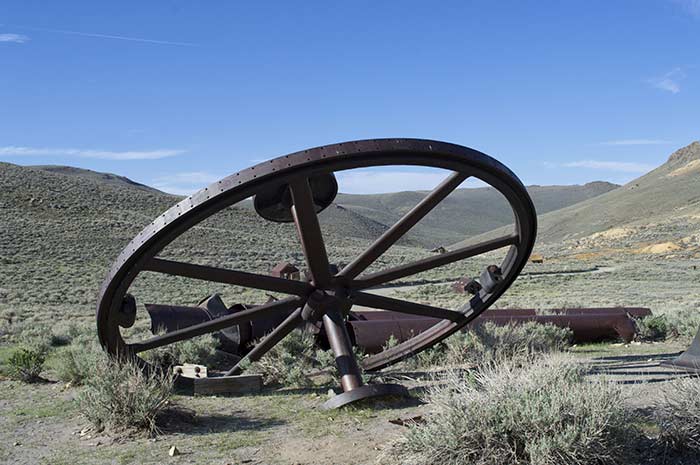
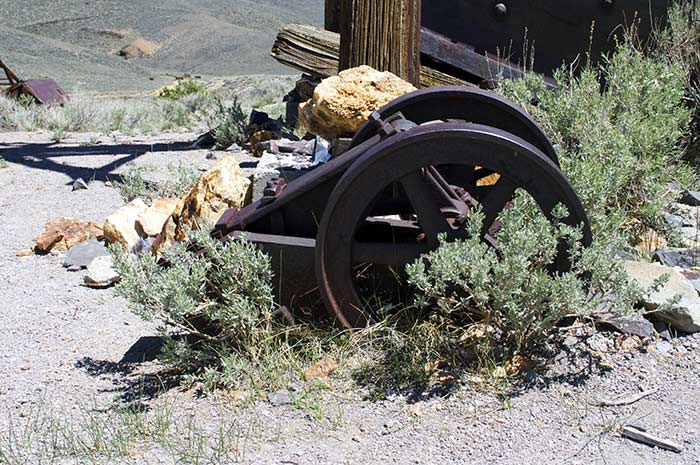
Bodie was abandoned rather abruptly when the mines stopped being profitable. All that tech was left where it was, because Bodie is so remote and inhospitable that it simply wasn’t worth carting it all back down the mountain again. So now it lies scattered everywhere, remnants of what was once innovative, up-to-the-minute industrial know-how.
In fact, I’ll probably dedicate an entire post just to various bits of cast-off technology we found littering the countryside.
At one time, Bodie sported several churches. Today, only the Methodist church still stands.


The writing on the archway in the back reads “Praise waiteth for thee O God in Zion.”
The buildings are in remarkably good shape because of the foresight of one person, James S. Cain, who, as people left, offered to buy their houses or shops for a dollar. Since they were leaving anyway, and there was little of value remaining, almost everyone agreed. He continued to work the mine, making far less money than it had produced at its peak but still enough for him to turn a modest profit. Later, he hired guards to protect the deserted town from looters and vandals.
In the early 1960s, what was left of Bodie became a protected state park.

Being a closely-packed, densely-populated town made entirely of wood in deep desert, Bodie had several fire stations, only one of which remains.

In the 1930s, after the town was all but completely deserted, a fire swept through it, destroying a significant percentage of the remaining buildings, including all of the brothels (of which there were once many) and all of what had once been Chinatown.
Only a few of the buildings along what used to be Main Street survive, including a tavern and a gym.

At its peak, Bodie had a significant enough population of children that it featured a large, two-story school. I’m not sure I would have tried to raise children here, but hey, that’s me.

This is what happens if you leave an 1850s-era globe in a window exposed to harsh ultraviolet light for over a century. I think this is amazing.

The sun really is brutal at 8,000 feet. Bunny and I both got sunburned right through our clothes–something that, I gather, is quite common at that altitude. Wish I’d have known about it before we were there!
The mill overseer’s digs, as I mentioned before, were quite luxurious.

“Luxury” is not the first word that springs to mind to describe most of the other housing, but the accommodations weren’t really that bad, considering. That is, if you can get past the harsh environment with its blistering heat and brutal cold, the violence, the long hours of backbreaking labor without insurance or OSHA regulation, and the lack of medical care or sanitation.

It’s hard to imagine what this place must’ve been like when it was home to tens of thousands of people, when we see only the few remnants that are left.


One of the nicest houses we found was located a good distance from the mill that was the hub of Bodie’s economic activity. It was huge, even larger than the mill overseer’s mansion, and crafted to a much higher standard. I’d love to know the story of whoever lived there.
Bodie had its own prison–necessary given the proximity to extremely valuable resources, the general criminal proclivities of many of its inhabitants, and the tendency of hard manual labor at high altitude to produce psychosis.

It also had a rather large cemetery, which included a special wing just for infants. Infant mortality in Bodie was frighteningly high, with cholera one of the leading causes of death.
The Victorians knew rather a lot about steam technology but rather less about medicine. All the buildings had outhouses; there was no sewer system. Outhouses were built near houses, and higher areas were more desirable for houses. Water came from wells, which were easier to dig in low areas. So a common pattern you see over and over throughout Bodie is outhouses located just up the hill from a well.

We arrived in Bodie late in the afternoon and soon had to make our exit. I asked one of the park rangers where the closest town was. She said we could go back out the way we came, which would take us to a town about an hour away, or we could continue through the town and go down the other side of the mountain to get to Aurora.
We opted for the latter. It turns out that either I radically misheard her, or she was playing a trick on us. Aurora, you see, is a ghost town in Nevada, even more inhospitable and inaccessible than Bodie.
We got to the base of the mountain and discovered we could go no further. The Adventure Van simply wasn’t up to what passed for a road. So we camped for the night at the base of the hill, near a sign that warned us not to travel any farther.

The next day, we drove back up the mountain to Bodie, which will be the subject of the next chapter.
Three days ago, I celebrated my fiftieth birthday.
Well, perhaps “celebrated” is too strong a statement. I was in the middle of an allergy attack that made me miserable, so I spent it faffing about on the computer rather than engaging in the kind of orgiastic bacchanal that one might expect from an Internet sex gargoyle.
In any event, in between faffings on the Internet, I spent some time musing about what an absolutely bizarre trip it’s been, and some time cleaning in my writer’s loft. These two things are related, as it turns out, because in the process of cleaning I came upon some old photographs.
I started the journey through life in New Jersey. Before I was a year old, I realized that living in New Jersey was a bit rubbish, so I moved to Idaho, taking my entire family with me. My parents drove a Volkswagen Bug, something which apparently left quite an impression. What can I say? I was struck by the elegant simplicity and robustness of the design.

We stayed in Idaho long enough for me to pick up a sister, then bounced around the Great Midwest for a while, where I picked up the hobby of model rocketry. There is, it seems only one battered and scuffed Polaroid photo exists from this particular time in my life–peculiar, when one considers that model rocketry was pretty much the greatest thing in my life for quite a long time.
And yes, that’s a plastic model of a Romulan bird of prey from the original Star Trek on my desk. Don’t judge me.

I had a computer back then as well, a Radio Shack TRS-80 Model 1 that was a Christmas gift from my aunt in 1977. That thing might have saved my sanity. I didn’t have any friends while I was growing up in Venango, Nebraska, but who needs friends when you have a computer and a bunch of rockets?
Radio Shack published the complete schematic of the TRS-80. Seriously, you could walk into the store and buy not only the schematics but also books on how to modify it, and a complete, commented disassembly of the ROM chips–something that is beyond unthinkable today.
I modified the computer extensively, spray-painted it black, and overclocked it. Stock, it had a 1.77MHz Z80 8-bit processor, which I modified to work at 2.44 MHz (which caused some software to break) or at approximately 4 MHz (which caused it to malfunction frequently and required that I set it in a tray full of plastic bags of ice). The yellow LED you see in this photo would come on when I ran it at 2.44 MHz, the red LED would come on at 4 MHz. My parents were often horrified to see it spread out all across my bed, which was the only work space I had.

I kept it until I was almost 40, purely from nostalgia.
In my memoir The Game Changer, I talk about taking two dates to my high school senior prom. This wasn’t because I was suave with the ladies; it was because one person asked me to the prom, I said yes, another person also asked me, I said yes again, and it didn’t even occur to me that this might be a problem.
Fortunately, they were both totally cool about the whole thing. I took them both to dinner before the prom, which raised a few eyebrows.
Only two photos from that prom exist that I’m aware of, and I found both of them. Yes, I’ve always been a weird-looking motherfucker.

Until recently, I have not been much into partner dancing, though I do love to dance. My high school senior prom might’ve been the last time I partner danced until I was in my 40s.
I had a storied checkered educational career. I went to school at Lehigh University, where I discovered, and feel in love with, a Digital Equipment Corporation DECsystem-20 mainframe. Ours was a forbidden love. There were certain…allegations from the faculty of less-than-completely-aboveboard activities involving that mainframe. “Computer hacking,” they said. Also, “your scholarship is revoked.” And “don’t come back.”
I bounced around for a bit, worked fast food for a while, then ended up going to school in Florida again. Sadly, that part of my life is poorly documented–if any photos exist from that period, I don’t have them.
I did find this photo of me, taken in April of 1991, the last year I was in college.

My early childhood experience with my parents’ Volkswagen led to a long-term love for the cars, of which I’ve owned two. The first car I ever owned was a 1969 Bug; my third car was a 71 Bug, which, like my computer, I modified extensively.
There’s a passage in The Game Changer in which I talk about how absolutely clueless I was about sex and relationships, and how I could not recognize even the most obvious attempts at flirting:
Worse, I was in that awkward stage of male development where I was so desperate to try to figure out how to get girls to pay attention to me that I completely missed it when girls paid attention to me. Prior to that afternoon at Jake’s place, Caitlin and I had spent quite a lot of time together. We were great friends. But when I look back with wiser eyes, I can see she was trying in a thousand ways to tell me she was open to more.
One particular evening, I drove her home from work in my beat-up Volkswagen Bug. We sat in the car in front of her house talking for a while. She complained there was something on the seat digging into her butt. She dug around for a bit and came up with a small machine screw—a leftover, no doubt, from the work I’d just done replacing the back fenders with the half-sized fenders popular among people who liked to take Volkswagens through deep mud. “Hey!” she said brightly, holding it up. “Wanna screw?”
The whoosh of her flirt passing over my head might have sucked all the air out of the car had the windows not been open. It was years before I realized she’d been flirting with me all along.
This is the car in which that happened.

From about 1978 or so on, I had been involved heavily in the computer BBS scene. A BBS was the forerunner of modern Web forums–a computer running special software connected to a phone line, which you could dial into and leave messages on (text only, generally) at agonizingly slow speeds. Most BBS systems could only accommodate one user at a time, so if you called while someone else was logged on, you’d get a busy signal. Popular systems were constantly busy, so you’d set your computer up to keep redialing, over and over, until it got through, then alert you when it made a connection.
I was on systems with names like CBBS-Chicago, Pirate-80, and Magnetic Fantasies. When I started school in Sarasota, I ended up with a roommate who was, like me, an enthusiastic TRS-80 hacker and BBS fan. He ran a BBS called The Wyvern’s Den. I thought “hey, I can do that!” and started a BBS of my own, called a/L/T/E/R r/E/A/L/I/T/Y.
I ran A/R for about six or seven years, on a TRS-80 Model 4 that had been heavily modified. The IBM PS/2 computer had just come out, and the PS/2 systems used 3.5″ floppy drives that had a design defect: they were prone for going out of alignment. IBM would replace them under warranty and then, rather than taking the five minutes to fix the floppy drives, would just throw them out. I went Dumpster diving behind an IBM repair shop one evening, came out with a big pile of 3.5″ floppy drives, cleaned them up, aligned them, and connected them to the TRS-80 by way of a custom hardware interface I designed and built. These became the storage for the A/R message boards. You can see two of them, sitting bare without cases, to the right of the computer in this photo. There’s a third one sitting on the shelf just behind the center of the computer, and a fourth one under the 5.25″ floppy in the foreground on the right.
TRS-80 floppy drive controllers were only supposed to be able to access four floppy drives, but it turned out to be possible to instruct the floppy controller to access two drives at the same time, so with a bit of software trickery and a 4-line-to-16-line demultiplexer chip, you could actually get them to talk to up to 16 drives at once.
There’s a wooden box just barely visible in the right-hand side of the picture. It held a power supply that powered all the floppy drives. I used to warn guests to the apartment, “don’t touch that, you’ll get electrocuted.”

I was a late bloomer sexually, but made up for it through the rest of my life. In the late 90s, I developed a prototype of an Internet-controlled sex toy. It rose up out of a toy I’d developed in the mid-90s that was designed to be plugged into a telephone line and controlled by the tones from a Touch-Tone phone. My former business partner and I tried to bring it to market, with less than stellar success.
We designed a plastic cabinet for it, which we made with a vacuum-forming rig we built. We had a run of circuit boards made, and I would sit for hours at the kitchen table with a soldering iron in my hand putting components on them. The company we’d hired to fab the circuit boards made a mistake in the fabrication, so each board required reworking as well.
We called the device “Symphony.” This is the very first one we ever sold. It’s supposed to have the name “Symphony” screen printed on the front; somehow, this one ended up without the screen printing.

And now, decades later, Im still exploring the intersection of sex and technology.
From high tech to low tech: in the early 2000s, I was invited to speak at Florida Poly Retreat. One of the classes I taught was in how to build a trebuchet, a Medieval siege engine. During the course of that workshop, we designed and built a working model trebuchet.

The T-shirt I’m wearing in this photo reads “Catapultam habeo. Nisi pecuniam omnem dabis, ad caput tuum saxum immane.”
Even after my divorce from my ex-wife Celeste, which story forms the backbone of The Game Changer, I kept this habit of extensively hacking any computer I own. (That continues to this day; I’m typing this on a MacBook Pro that has had its DVD drive removed and replaced with a second hard drive, and the first hard drive has been replaced with an SSD.)
My partner Amber and I moved into an apartment together after the divorce. The living room looked like this.

I kept the TRS-80s and an Apple Lisa, even though they’d largely been retired by this point. The black thing stuck to the ceiling is an Apple //c monitor, spray-painted black. It had a green screen monochrome display that accepted a composite video signal, so it was easy to pipe just about any video into it. Most of the time, Amber and I had it showing Bladerunner on a loop. When I played World of Warcraft, though, I would pipe that to it instead.

Amber and I ended up rescuing two cats during the time we lived together. One, a rather handsome tabby, had climbed a tree to the third story of the apartment building next to ours, jumped from an overhanging branch onto the roof, and then realized he couldn’t get back down. He cried piteously for days. We threw food up to him until we could figure out a way to rescue him. We named him Snow Crash.
The other adopted Amber when we were out walking in a large park late one night. We heard a cat meowing from under some bushes. When we turned around, a cat came catapulting out straight for Amber and jumped up into her arms. She refused to let go, holding on to Amber until we walked all the way back to the car, then insisting on accompanying us home. We named her Molly, for the character Molly Millions in Neuromancer.

So here I am, fifty years old, and what a peculiar thing it is to be a human being. Life is amazing.
When I was a child living in Venango, the bus that took me to school would drive past a church with a sign out front that had pithy sayings on it intended to inspire us to live better lives. One day, that sign said “Your life either sheds light or casts a shadow.” I knew, at eleven years old, there was something wrong with that, but I didn’t have the words to describe what. Now, almost forty years layer, I understand: it’s bullshit. We are all, every one of us, made of light and shadow, good and evil.
I have screwed things up and hurt people. I have been hurt. I have gotten things wrong, made mistakes, been careless with the hearts of others.
I have also experienced the most amazing love. I have known and been loved by people who are so remarkable, I consider myself privileged merely to have known them. I have learned things and gotten some things right.
We are all made of light and shadow. It is on all of us to treat each other with care. We’re all confused. Being human is fundamentally weird and more than a little scary. We’re all making this up as we go along, even those of us–especially those of us–who try to pretend we Have It All Figured Out.
I’ve spent thirteen and a half billion years, give or take, not existing, and fifty years existing. That’s enough of a sample size to tell me that existing is better. It’s harder, sure. We have to do stuff. We have to make choices. You don’t have to make choices when you don’t exist. Making choices means sometimes we make wrong choices, and making wrong choices means sometimes we hurt people. Hurting people sucks.
I carry a lot of regrets with me. There are many things I have done that I wish with all my heart I could undo–times when I have not been as careful as I should be, perhaps too preoccupied with my own fears to be properly gentle with other people. It’s a consequence of being plonked into existence without a user’s manual.
We all get banged up a bit on the journey through life. But despite that, I would not trade a goddamn minute of it for anything. I am flawed and I make mistakes. All the people I know are flawed and make mistakes. And yet, this brief moment we share in the sun is a gift of inestimable value. I am grateful for every moment of it, and I hope to be here in existence for much, much more.
Today is my birthday! Unfortunately, I’m spending it at home in front of my computer rather than out celebrating, because I’m in the middle of a very nasty allergy attack and I feel miserable.
However, I’d like someone to have a good time, and it might as well be you. So, in honor fo my birthday, I’ve created a coupon to let people download my BDSM novel Nineteen Weeks from Smashwords for a discount!
Nineteen Weeks is a story that takes the tropes of a conventional bodice-ripper romance and turns them all on their head. It follows Amy, a housewife to a successful lawyer, who discovers him cheating on her and decides to turn the tables by taking control of her husband…and his mistress. And it’s been getting a bunch of lovely five-star reviews on Amazon.
Anyway, for the next month, you can download it at a discount by using coupon code VE87E. Enjoy! And if you like it, please consider leaving a review on Goodreads or Amazon!
Whew! Lots of things going on in the world of high-tech sex.
I’ve been hard at work on the second-generation prototype of the sex toy you can feel. The first-generation prototype was intended as a proof of concept rather than a usable sex toy; the sensors I was using were large and bulky, and made the strapon impractical to have sex with.
The second-stage prototype features a new and more powerful wearable computer, a larger number of much smaller sensors (each about as thick as a sheet of paper), and a completely redesigned vaginal insert. The new prototype took a while to assemble–mad science is hard!
Today, we reached a milestone. For the first time, one person (we will call her “Experimental Volunteer A”) had sex with another person (who we will call “Experimental Volunteer B”) with the prototype. Aside from a few minor design glitches which will be solved with the third-generation prototype, the sex went smoothly and was a great success. Experimental Volunteer A was able to feel the dildo moving inside Experimental Volunteer B, and there was much screaming, giggling, and moaning. A great time was had by all involved.
One of the areas of focus for the near to mid term future will be doing some research on the neural density of the inside of the vagina. I haven’t been able to locate anything in the literature that talks about this. It’s going to be one of the design factors in how many neurostim electrodes the final device will have, as there’s little point in having a number of outputs that exceeds the wearer’s ability to differentiate between them. We may end up having to do some research to find this out.
We’ve also received word that the patent application is in the hands of the US Patent Office, so at this point we’re able to say “Patent Applied For.” Patent applied for! When the PTO publishes the application, we’ll be able to say Patent Pending.
I’ve already started to take the things I’ve learned from today’s experiment to make some design changes to the third-stage prototype.
Want to keep up with developments? Here’s a handy list of blog posts about it:
First post
Update 1
Update 2
Update 3
Update 4
Update 5
Update 6
I get, as readers of this blog will know, a lot of spam. I’ve been using the same email address for decades (my AOL address since 1992, my own domain address since 1996), so I’ve had plenty of time to get on a lot of spam lists.
Recently, I started to see a whole series of very similar spam messages, all variations on the same message (“Hot Lady Wants You to F*ck Her,” “Invited to H00kup”) and all advertising redirectors on hacked Web sites. I’ve received a ton of these spam messages–about 75 in the last three weeks alone, with more coming every day.

The spam messages all spamvertise malicious redirectors that are placed on hacked Web sites. The redirectors all go to a destination that says “This is NOT a dating site! WARNING! You will see nude photos. Please be discreet.”

There’s a lot of hacking activity going on. Every spam message points to a different hacked site, all of which redirect to a whole network of identical landing sites. This, then, is the work of an organized, deliberate hacker or (more likely) group of hackers, likely using automated tools to hack vulnerable Web sites and plant the malicious redirectors.
Curious, I decided to go down the rabbit hole, to see what I could find out. I started collecting the spam emails, tracking how often they came in, what URLs they spamvertised, and where those URLs redirected to.
I discovered an organized gang of hackers and fraudsters operating out of a series of companies organized in Cyprus, who had built a large network of hacked sites and were using the hacked sites to funnel traffic into a fake dating site that attempts to get rather a large amount of money from marks it cons into signing up.
I followed the link from one of the spam messages, a site called
*** WARNING *** WARNING *** WARNING ***
The URLs mentioned in this post are live as of the time of writing this. I recommend you do not visit them if you don’t know what you’re doing. The URLs are compromised sites or sites owned by people who compromise Web sites. They may attempt other malicious actions.
The site
Mitsis Building 1, Stasinou Avenue
Nicosia, Cyprus
I answered the questions and filled out a signup form on

The site at
Peiraios 30, 3016
Limassol, Cyprus
If you are foolish enough to agree to give them a credit card number, totally just for age verification (and recurring membership fees of $49.95 per month), your credit card is sent to a Web site called
From there, you’re taken to yet another site,

and ten seconds after that, I got a chat request, supposedly from a woman near me:

This is par for the course for Web sites that prey on lonely and desperate men. The employees of such sites keep stables of fake profiles, often hundreds of them, and message new users with the intent to entice them to pay for the service. I’ve known folks who’ve worked for such sites.
So, it’s an ordinary and common fraud, atypical only in that the people who own the fraudulent site are aggressive computer hackers who compromise large numbers of sites and ten send out barrages of spam containing links to redirectors on the hacked sites.
I took a look at the Web host responsible for

So what’s happened is a group of folks operating out of Cyprus are running aphony, and very expensive, dating Web site. They are aggressively hacking large numbers of other sites, which they use as a redirection network. They spam their redirection network to funnel people into the fake dating site. The ISP hosting the fake dating site has explicitly said it refuses to hear spam complaints regarding the fake dating site.
The overall system looks like this:

So this is a group of sleazy operators in the sleazy fake dating sphere, who have crossed over from sleazy to outright criminal activity in using hacking to compromise Web sites and enlist them as traffic redirectors.
People often ask me, “what’s the big deal if I don’t stay on top of security for my little WordPress site? There’s nothing on it. I only get three visitors a month, and one of them is my mom. Why would anyone want to hack me?”
The answer is “people don’t hack you to get whatever’s on your site. They hack you so they can use your site for their own purposes–placing illegal content on your site, hosting phish pages on your site, planting malware on your site, putting redirectors on your site which they can then use in spam campaigns. It’s not about you. Obscurity doesn’t matter.”
Secure your Web sites. If you have a presence on the Web, it’s on you to prevent operators like these from hijacking you.
I have reached out to Rackco to see if they’re willing to explain why they host this site and refuse to accept spam reports about it. I’ll update this blog post if I get a reply.