A lot of folks who follow this blog know that I’m a writer, activist, photographer, amateur infosec researcher, traveller, and general all-around geek, among other things.
But did you know I have a YouTube channel?
Yeah, surprised me, too. Apparently I have a YouTube channel now. I talk about all sorts of stuff what bugs me, like this one, where I muse that male influencers are grifters who deliberately give terrible advice:
I didn’t set out to have a YouTube channel, it just sorta happened. Anyway, if this kind of thing interests you, check it out!
A short while back, I wrote an answer on Quora, the Q&A site, about how to spot romance scammers, the sourge of the internet.
Briefly: Romance scammers are people, almost always men, from places like Nigeria, Ghana, the Philippines, and Myanmar, who use stolen photos to pretend to be hot women or handsome men in order to trick lonely people out of money. They strike up a conversation, pretend to “fall in love,” and then comes an endless series of asks for money: I need money to buy a plane ticket to come see you, darling. Oh no, I was in a car crash, I need money for hospital bills. I’m on an oil rig and I can’t access my bank account, I need money, I swear I’ll pay you back when my rotation ends. I need money for my sick kid. I need money for a new computer. Money money money.
It’s big business. These scammers work in HKs (Hustle Kingdoms), large organized crime gangs that specialize in extracting money from the gullible and the lonely. A single romance scammer typically has 50-60 “mugus” (a Nigerian slang term for “fools”) on the hook at any one time, and can make hundreds of thousands to millions of dollars a year.
In the past, these scammers targeted mainly women, pretending to be Army generals or oil rig workers or doctors working in distant war-torn countries. Today they pretend to be hot women, and target men, because, they say, men are easier to fool. They’re all over social media, using stolen photos of models and porn stars, talking about how much they hate being single, putting come-ons in their profiles.
So, here we go: a guide to spotting scammers. Most of the examples here are on Quora, but the same applies to other social media sites.
“Atrocity is recognized as such by victim and perpetrator alike, by all who learn about it at whatever remove. Atrocity has no excuses, no mitigating argument. Atrocity never balances or rectifies the past. Atrocity merely arms the future for more atrocity. It is self-perpetuating upon itself — a barbarous form of incest. Whoever commits atrocity also commits those future atrocities thus bred.”
The world is filled with people who want to be writers. The world is even more filled with people who don’t want to be writers but want to have written a book, which isn’t the same thing, though that’s a matter for another post.
The number of people who can get published is, as a fraction of the number of people who want to publish a book, quite small. In fact, you’re statistically more likely to win the lottery—yes, really—than you are to make a living at writing. It’s a bit like playing pro sports that way.
And as with playing pro sports, whenever you have a huge number of people who really really really want to do a thing and only a small number of people who can do the thing, that entire field soon attracts scammers that hover like a cloud of bloodsucking flies around anyone who even breathes the slightest hint of interest in the thing.
I have quite a number of books out (I’ll likely follow this up with a list of the books I have out now or soon coming out), which means that I am absolutely swamped with email come-ons and social media DM solicitations from people who would love to help take my money without giving me anything in return.
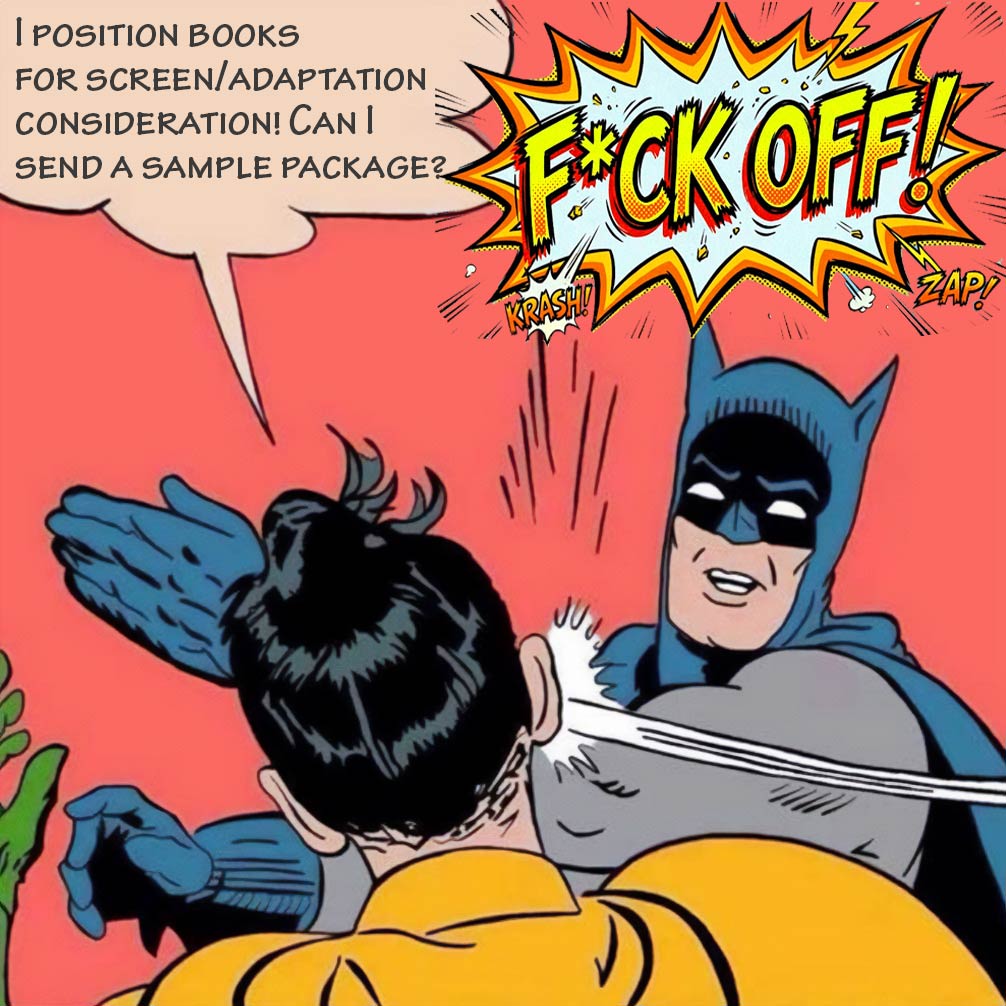
On an average day, I receive anywhere from three to ten or more spam emails from people claiming they can get me a film deal, or put me in front of their “book club,” or pitch my book to TV studios, or do a “publicity drive” for me, or make book trailers for me…all for pay, of course.
A lot of these emails are just straight-up fraud. Yesterday, I got an email claiming to be from a famous and well-known acquisitions editor for a major, highly-regarded publisher…but using a gmail address instead of that editor’s actual publisher address.
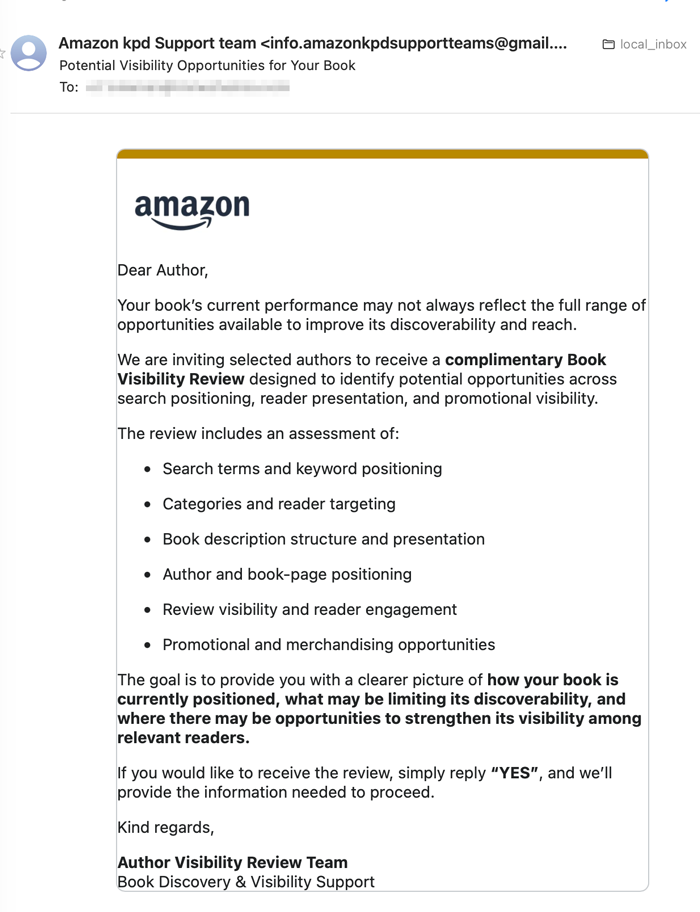
Today I got this gem, which uses the Amazon logo and implies through paltering that they’re affiliated with Amazon, which is, again, just a straight-up fraud.
So, if you’ve ever dreamed of being a writer, here’s a quick run-down of how to spot the obvious scams and frauds.
In real publishing, money flowsfromthe publishertothe author, never the other way. The “vanity press” is the oldest and most well-known scam in the publishing world.
Vanity presses pretend to be publishers, but they charge you, the author, to publish your book. The business model of real publishers is that money comes from book readers, flows to the publisher, and from there some of the money flows to the author. The business model of vanity presses is money flows from the author to the “publisher.” The “publisher” tyically has no distributor; they will tell you they can get you into bookstores (spoiler: they can’t), and at the end of the day they will not do anything to promote your book because they don’t care about book sales. That isn’t where the money comes from.
This same thing applies to “self-publishing services.” A lot of writers know about self-publishing on Amazon KDP and such, but don’t know how to do it. Enter the “self-publishing service,” which will, for fees ranging from thousands to tens of thousands of dollars, get your book on Amazon KDP…something that you could do yourself for free.
They typically will tell you they will handle things like book formatting and editing. They typically don’t, or if they do, they do it poorly.
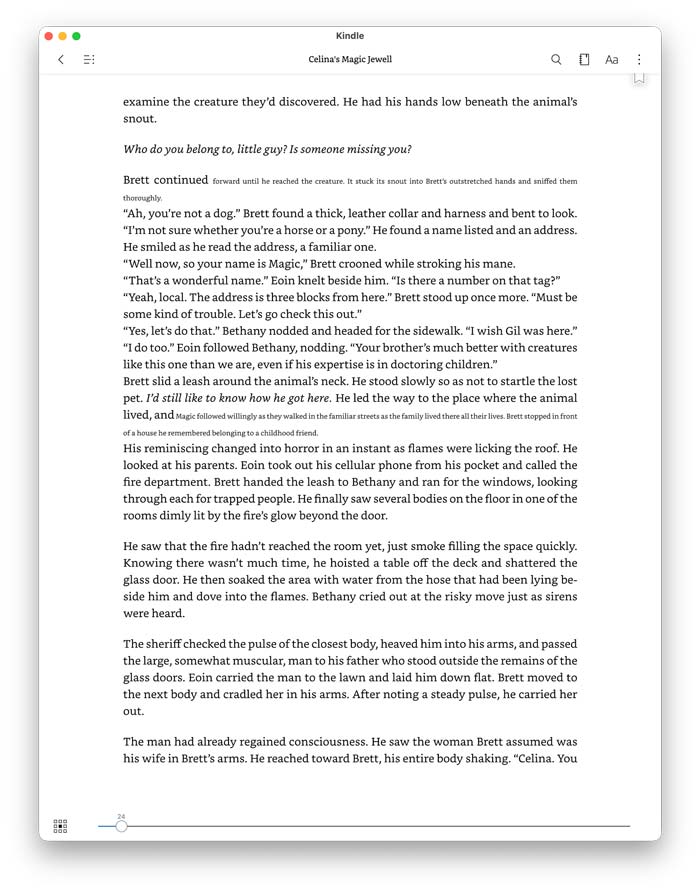
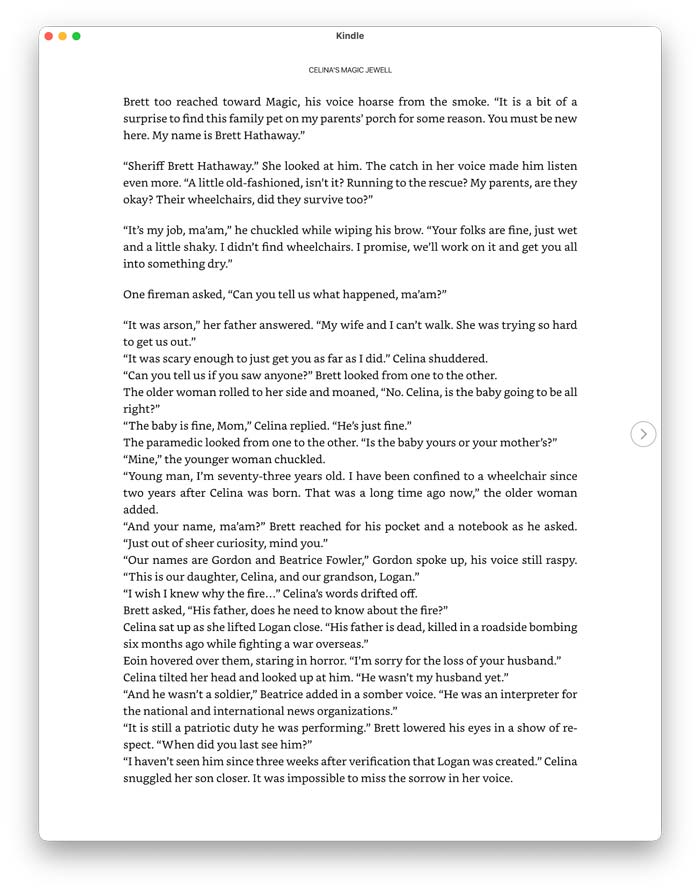
Case Study #1: “Luminous Library,” which bills itself as a service to help authors publish their masterpieces. They will, for a substantial fee, handle formatting and such, but…
Inconsistent fonts, inconsistent type sizes, no indenting, no standard formatting at all.
This extends to their own website; their home page contains multiple grammar and usage errors:
Many “self-publishing agencies” are like this: huge fees, minimal work that produces material unacceptable even by the modest standards of most self-published content.
Real publishers do not send unsolicited emails or requests. Real publishers receive tens of thousands of unsolicited manuscripts a year. Real agents can get hundreds of queries a day. They do not have time nor interest in sending would-be authors emails saying “hey, I want to represent you.” That doesn’t happen.
The new shiny in author scams is people who claim to be famous agents or editors, using the names and logos of famous literary agents and publishers to scam people.
Corollary #1: Agents and publishers use their official company email addresses, not free emails like Gmail.
Corollary #2: Agents never, ever, ever, ever, ever, ever, ever charge money up front to prospective clients, for “reading fees” or for any other reason.
The business model of a book agent is they make a percentage of the royalties on your book. That means they have an incentive to get you the best possible deal. Their money, like the publisher’s money, comes from sales of your book, not from you, the author. All “agents” who charge you up front are always scammers. No exceptions.
Emails offering to “put you in front of movie studios” are always, always a scam. Again, there are no exceptions.
Movie studios are only interested in IP that has already demonstrated a track record of successful sales. There are no people who accept money from you in order to pitch your book to studios. As with agents, the people who promote intellectual property to studios make their money on the back end, not from the owners of the IP.
Emails offering to do podcasts or “book club readings” for money are always, always a scam. These make up the vast bulk of the scam emails I get, outnumbering fake agents, fake publishers, and fake marketers combined by about 4 to 1.
Fake publishers were once the mainstay of the author scam machine, but the Internet and spam email have democratized the scam industry. Fake book clubs are the domain of the solo scammer, the scammer who doesn’t want to set up a legitimate-looking business. Anyone anywhere in the world can send out fake book club scam emails…and they do.
Many of these people impersonalte Lori Hettler, the founder of the Next Best Book Club. I get emails from various fake “Lori Hettler”s on a monthly basis, all of them using free email providers.
Unsolicited emails offering to do promotion, “book trailers,” Amazon “optimization,” and so forth are always scams. Yes, there are real book promotion companies. No, they don’t contact you out of the blue.
Now, there are legitimate companies who support authors with pay-for-play services like editing, book formatting, and so forth. There are even “hybrid publishers” where the author and the publisher split production costs, though in my experience most of these lean toward the scammy end of the spectrum.
The thing about all of these, though, is they don’t send unsolicited emails.
The scam emails have, when you’ve seen a few hundred of them, a certain cadence and tone: they flatter you, quote from your book’s blurb or Amazon listing to try to make it seem as though they’ve read your book (spoiler, they haven’t), and they tell you how wonderful you are and how many books you could be selling if only you’d use their services…because it totally isn’t your fault you’re not a bestseller, it’s always down to just not quite having what they offer.
Beware, beware anyone who reaches out to you unsolicited on social media or in email offering to turn your book into a sensation for a price.
Regular reminder: Whether you’re a beginning writer or a seasoned pro, whether you write niche nonfiction or mass-market fiction, never, ever sign a book publishing contract before you email
beware (at) sfwa (dot) org
This free service helps you avoid scammers and publishers with poor reputations listed on the Writers Beware list of predatory book publishers.
I’ve been spending some time lately thinking about what I’m calling “glass mountain theory.”
Most people like to think of themselves as honest. Most people don’t like to lie directly, even when they want you to believe something that isn’t true. So rather than out and out lie, many people will palter: that is, tell the literal technical truth, but do it in such a way as to manipulate and mislead.
Paltering is a specific form of manipulation involving lies of omission and misdirection while sticking only to the precise technical truth. What the palterer says is factually correct…from a certain point of view. It’s a common tool of manipulation.
There’s quite a body of research on this that shows people palter when they have two conflicting desires: they want to see themselves as good, trustworthy, and honest, and want to be able to tell themselves they aren’t liars; but at the same time, they want to create an impression or a belief that isn’t compatible with truth.
I did quite a lot of research about paltering and other forms of deception while I was working on the first draft of my new nonfiction book about social justice. I found a Harvard Business School article on paltering, which provided this example of paltering:
In one study, they asked participants to imagine this scenario: Over the last 10 years your sales have grown consistently, but next year you expect sales to be flat. If you are asked by your counterpart “How do you expect sales to be next year?” the response will be different depending on the type of deception: […]
If you mislead with paltering, you might say, “Well, as you know, over the last 10 years our sales have grown consistently.” This answer is technically true, but it doesn’t highlight your expectation that sales will be flat in the year ahead, and you are aware that it is likely to create the false impression by your counterpart that sales will grow.
There’s an interesting thing about this palter: it doesn’t actually answer the question. If the question is “how do you expect sales to go next year?”, then “our sales have increased over the last ten years” isn’t an answer to the question that was asked.
What is the glass mountain?
Imagine a mountain made completely of absolutely transparent glass: it’s invisible, but still solid.
You wouldn’t be able to see it directly, but you would still be able to see its shape, its contours, by the way the environment moves around it.
On a foggy day, you’d be able to see the mist rolling off its slopes. On snowy days, you’d see the snow accumulating in its crevices. You wouldn’t see the mountain, but you’d see the shape of the mountain by its absence, by the way things move around it.
I think that happens with paltering.
When you read examples of paltering (and while I was researching my book, I read a lot of examples), you start noticing something peculiar: palters form a linguistic glass mountain. They steer around questions. They fail to offer details. You see them by the way words move around the absence of the thing you aren’t supposed to notice.
Paltering manipulates by steering you away from the truth, by leading your eye away from the thing the palterer doesn’t want you to see. But like the glass mountain on a foggy day, you can, if you look, still see the shape of it, hidden in the negative space between words.
The problem is that sneaky little qualifier: if you look.
People largely hear what they want to hear. People are not rational animals, we are rationalizing animals. A person who wants to hear that the next few quarters will still show growth is unlikely to question the “over the last 10 years our sales have grown consistently” non-answer. It’s an answer-shaped space, a conversational void where an answer should be, that gives the person asking the question a reason to believe what she wants to believe, and that’s good enough. It’s a glass mountain.
I mean, we live in a world where people can create romance scam profiles using broken English and stolen photos of famous celebrities and still find marks. Motivated reasoning is a hell of a drug.
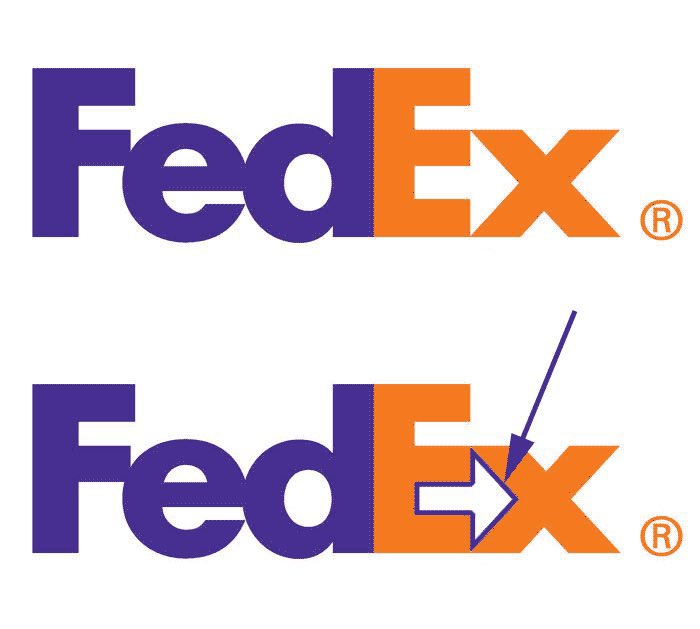
The thing is, though, the glass mountain is a bit like the arrow in the FedEx logo: once you’ve seen it, you can’t unsee it. (Yes, it’s an intentional part of the logo.)
Paltering as Collaboration: Scaling the Glass Mountain Together
Paltering is occasionally a collaboration between palterer and person being paltered, and when that happens, you can see the form and shape of the glass mountain not only in what the palterer doesn’t say, but when the person being paltered to doesn’t ask.
There is, for example, a phenomenon I only became aware of a few years ago, where someone in the public eye is accused of wrongdoing and then people that person has never had a romantic or sexual connection with at all begin describing themselves as that person’s “ex” and describe being abused or mistreated by that person.
This happens so often that therapists and psychologists are aware of it and have described the reasons it happens, which generally fall into one of four broad categories of reasons: delusional thinking (which is a whole area of psychologiy of its own; when it manifests as false stories of being involved with someone you were never involved with, it’s called “delusional erotomania”), control/manipulation, attention-seeking, and jealousy/revenge.
I watched in fascination a few years back when a TV actor was accused of abusing his partner, and then another woman came forward to report he’d abused her, too. This other woman was interviewed in New York magazine and The New York Post, both of which described her as an “ex-girlfriend” even though it later turned out they’d never even met.
The glass mountain became obvious in the questions the interviewers didn’t ask her, which showed up like the arrow in the FedEx logo: they didn’t ask how they’d met, or how long they’d been dating, or how their relationship unfolded—questions you’dnormally expect to hear from someone trying to uncover truth rather than sell an agenda.
Sometimes this is intentional, as a newspaper that wants to sell a sensational story, and sometimes it’s motivated reasoning, as someone who wants to believe the lie so doesn’t want to poke too closely at the story for fear of undoing the illusion.
Once you’ve learned to see the glass mountain in the spaces left unsaid by the palterer, you also start to see the dance, the collaboration between palterer and palteree, in the spaces left unasked by the palteree.