A short while back, I wrote an answer on Quora, the Q&A site, about how to spot romance scammers, the sourge of the internet.
Briefly: Romance scammers are people, almost always men, from places like Nigeria, Ghana, the Philippines, and Myanmar, who use stolen photos to pretend to be hot women or handsome men in order to trick lonely people out of money. They strike up a conversation, pretend to “fall in love,” and then comes an endless series of asks for money: I need money to buy a plane ticket to come see you, darling. Oh no, I was in a car crash, I need money for hospital bills. I’m on an oil rig and I can’t access my bank account, I need money, I swear I’ll pay you back when my rotation ends. I need money for my sick kid. I need money for a new computer. Money money money.
It’s big business. These scammers work in HKs (Hustle Kingdoms), large organized crime gangs that specialize in extracting money from the gullible and the lonely. A single romance scammer typically has 50-60 “mugus” (a Nigerian slang term for “fools”) on the hook at any one time, and can make hundreds of thousands to millions of dollars a year.
In the past, these scammers targeted mainly women, pretending to be Army generals or oil rig workers or doctors working in distant war-torn countries. Today they pretend to be hot women, and target men, because, they say, men are easier to fool. They’re all over social media, using stolen photos of models and porn stars, talking about how much they hate being single, putting come-ons in their profiles.
So, here we go: a guide to spotting scammers. Most of the examples here are on Quora, but the same applies to other social media sites.
The world is filled with people who want to be writers. The world is even more filled with people who don’t want to be writers but want to have written a book, which isn’t the same thing, though that’s a matter for another post.
The number of people who can get published is, as a fraction of the number of people who want to publish a book, quite small. In fact, you’re statistically more likely to win the lottery—yes, really—than you are to make a living at writing. It’s a bit like playing pro sports that way.
And as with playing pro sports, whenever you have a huge number of people who really really really want to do a thing and only a small number of people who can do the thing, that entire field soon attracts scammers that hover like a cloud of bloodsucking flies around anyone who even breathes the slightest hint of interest in the thing.
I have quite a number of books out (I’ll likely follow this up with a list of the books I have out now or soon coming out), which means that I am absolutely swamped with email come-ons and social media DM solicitations from people who would love to help take my money without giving me anything in return.
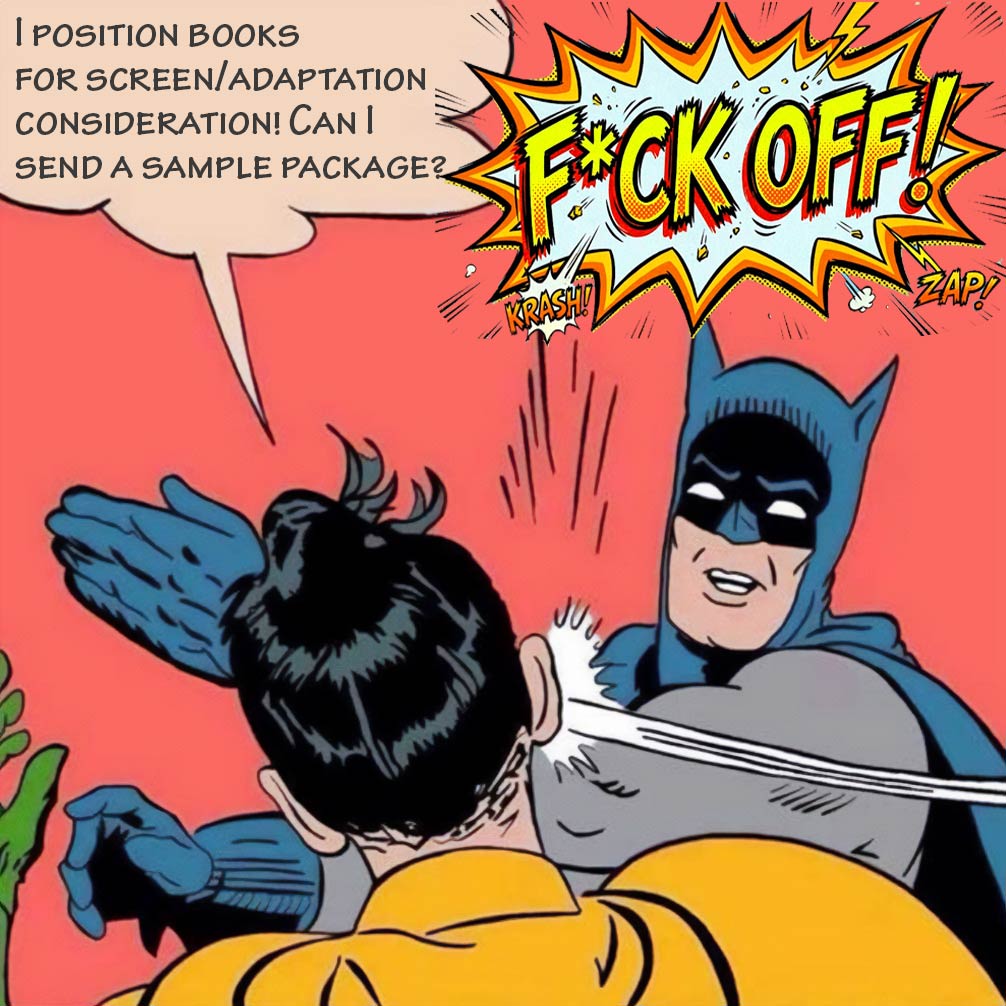
On an average day, I receive anywhere from three to ten or more spam emails from people claiming they can get me a film deal, or put me in front of their “book club,” or pitch my book to TV studios, or do a “publicity drive” for me, or make book trailers for me…all for pay, of course.
A lot of these emails are just straight-up fraud. Yesterday, I got an email claiming to be from a famous and well-known acquisitions editor for a major, highly-regarded publisher…but using a gmail address instead of that editor’s actual publisher address.
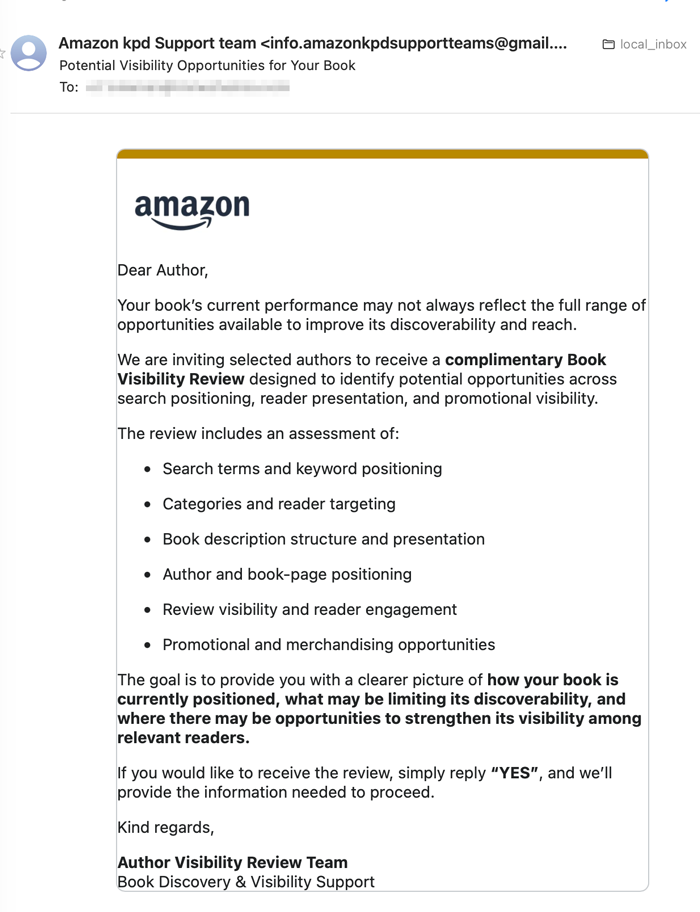
Today I got this gem, which uses the Amazon logo and implies through paltering that they’re affiliated with Amazon, which is, again, just a straight-up fraud.
So, if you’ve ever dreamed of being a writer, here’s a quick run-down of how to spot the obvious scams and frauds.
In real publishing, money flowsfromthe publishertothe author, never the other way. The “vanity press” is the oldest and most well-known scam in the publishing world.
Vanity presses pretend to be publishers, but they charge you, the author, to publish your book. The business model of real publishers is that money comes from book readers, flows to the publisher, and from there some of the money flows to the author. The business model of vanity presses is money flows from the author to the “publisher.” The “publisher” tyically has no distributor; they will tell you they can get you into bookstores (spoiler: they can’t), and at the end of the day they will not do anything to promote your book because they don’t care about book sales. That isn’t where the money comes from.
This same thing applies to “self-publishing services.” A lot of writers know about self-publishing on Amazon KDP and such, but don’t know how to do it. Enter the “self-publishing service,” which will, for fees ranging from thousands to tens of thousands of dollars, get your book on Amazon KDP…something that you could do yourself for free.
They typically will tell you they will handle things like book formatting and editing. They typically don’t, or if they do, they do it poorly.
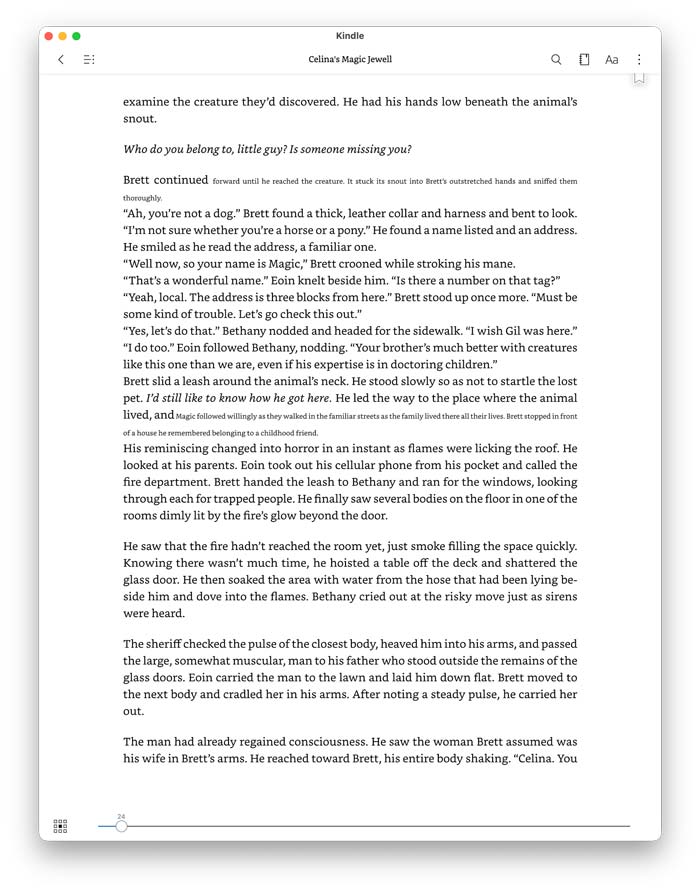
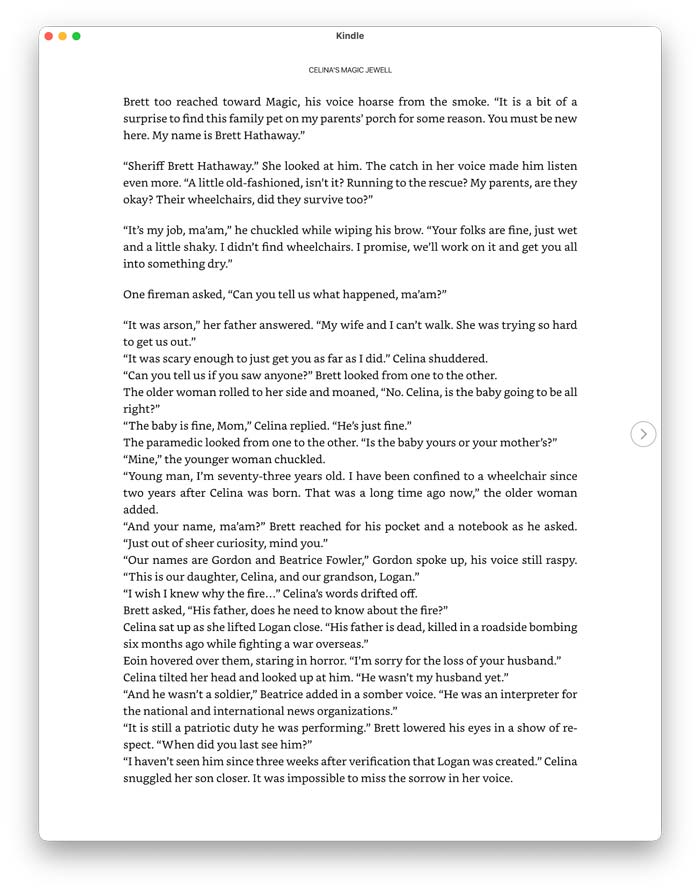
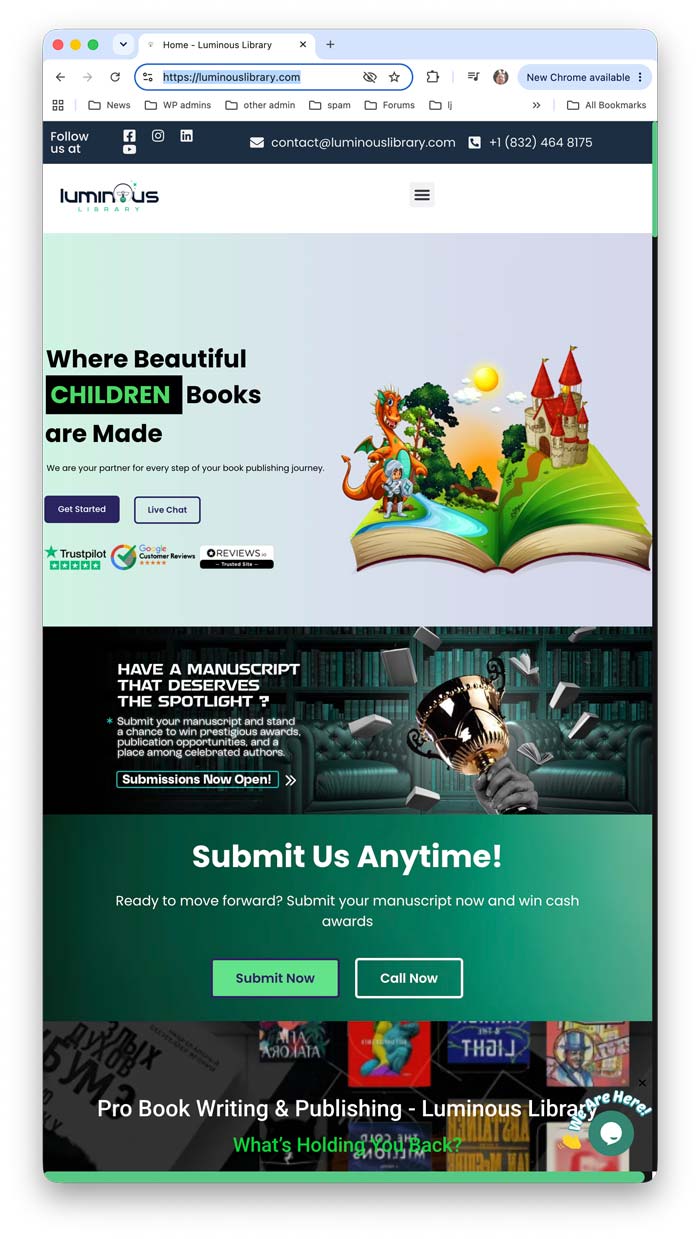
Case Study #1: “Luminous Library,” which bills itself as a service to help authors publish their masterpieces. They will, for a substantial fee, handle formatting and such, but…
Inconsistent fonts, inconsistent type sizes, no indenting, no standard formatting at all.
This extends to their own website; their home page contains multiple grammar and usage errors:
Many “self-publishing agencies” are like this: huge fees, minimal work that produces material unacceptable even by the modest standards of most self-published content.
Real publishers do not send unsolicited emails or requests. Real publishers receive tens of thousands of unsolicited manuscripts a year. Real agents can get hundreds of queries a day. They do not have time nor interest in sending would-be authors emails saying “hey, I want to represent you.” That doesn’t happen.
The new shiny in author scams is people who claim to be famous agents or editors, using the names and logos of famous literary agents and publishers to scam people.
Corollary #1: Agents and publishers use their official company email addresses, not free emails like Gmail.
Corollary #2: Agents never, ever, ever, ever, ever, ever, ever charge money up front to prospective clients, for “reading fees” or for any other reason.
The business model of a book agent is they make a percentage of the royalties on your book. That means they have an incentive to get you the best possible deal. Their money, like the publisher’s money, comes from sales of your book, not from you, the author. All “agents” who charge you up front are always scammers. No exceptions.
Emails offering to “put you in front of movie studios” are always, always a scam. Again, there are no exceptions.
Movie studios are only interested in IP that has already demonstrated a track record of successful sales. There are no people who accept money from you in order to pitch your book to studios. As with agents, the people who promote intellectual property to studios make their money on the back end, not from the owners of the IP.
Emails offering to do podcasts or “book club readings” for money are always, always a scam. These make up the vast bulk of the scam emails I get, outnumbering fake agents, fake publishers, and fake marketers combined by about 4 to 1.
Fake publishers were once the mainstay of the author scam machine, but the Internet and spam email have democratized the scam industry. Fake book clubs are the domain of the solo scammer, the scammer who doesn’t want to set up a legitimate-looking business. Anyone anywhere in the world can send out fake book club scam emails…and they do.
Many of these people impersonalte Lori Hettler, the founder of the Next Best Book Club. I get emails from various fake “Lori Hettler”s on a monthly basis, all of them using free email providers.
Unsolicited emails offering to do promotion, “book trailers,” Amazon “optimization,” and so forth are always scams. Yes, there are real book promotion companies. No, they don’t contact you out of the blue.
Now, there are legitimate companies who support authors with pay-for-play services like editing, book formatting, and so forth. There are even “hybrid publishers” where the author and the publisher split production costs, though in my experience most of these lean toward the scammy end of the spectrum.
The thing about all of these, though, is they don’t send unsolicited emails.
The scam emails have, when you’ve seen a few hundred of them, a certain cadence and tone: they flatter you, quote from your book’s blurb or Amazon listing to try to make it seem as though they’ve read your book (spoiler, they haven’t), and they tell you how wonderful you are and how many books you could be selling if only you’d use their services…because it totally isn’t your fault you’re not a bestseller, it’s always down to just not quite having what they offer.
Beware, beware anyone who reaches out to you unsolicited on social media or in email offering to turn your book into a sensation for a price.
Regular reminder: Whether you’re a beginning writer or a seasoned pro, whether you write niche nonfiction or mass-market fiction, never, ever sign a book publishing contract before you email
beware (at) sfwa (dot) org
This free service helps you avoid scammers and publishers with poor reputations listed on the Writers Beware list of predatory book publishers.
Okay, so, this is not going to be a rant about how terrible AI art is, or how LLMs have stolen all our creative output (though I’m still waiting for thousands of dollars from the Anthropic settlement, given how Anthropic bootlegged several of my books to feed the gaping maw of their LLMs).
No, I’m talking about another kind of AI enshittification: Price-grouging.
I just this moment filed a formal complaint with the California attorney general against a company called GoHardDrive. I am hopeful this becomes some kind of class-action thing. A similar case is currently grinding through the gears of justice against Samsung, for doing the same shitty thing.
So.
In August of 2024, I bought a hard drive from GoHardDrive. It came with a 2-year warranty. In May of 2026, it failed, under warranty. No problem, I thought, I’ll file a warranty claim and get it replaced.
I didn’t count on the AI boom.
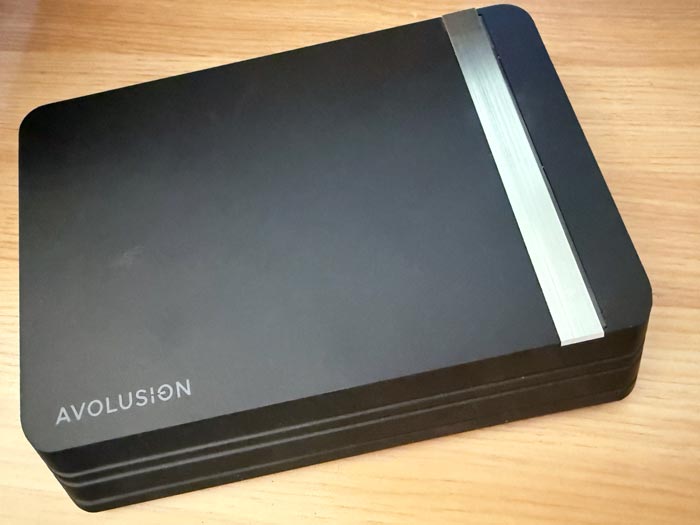
The hard drive in question
Thanks to the AI boom, computer RAM and hard drive prices have shot up, anywhere from triple to quintuple their old prices, as demand for memory and storage outstrips the world’s entire supply. People are signing purchase orders for entire manufacturing runs through 2032-2034.
That means what was once an $89 hard drive now sells for $299 (or more!). So by replacing my hard drive under warranty, GoHardDrive is losing the immense profit in selling it to an AI datacenter…and it’s not like they can just make more because the world’s manufacturing capacity is completely saturated. Hard drives are being sold at enormous markups that literally haven’t been manufactured yet.
Faced with that, hard drive companies (including big, well-known companies like Samsung) are now routinely refusing to honor their warranties. Why should they? Every warranty replacement is costing them an extra $200 in profit, and what are you gonna do? Refuse to buy a hard drive from them again? They’ve already sold every hard drive they will make from now to 2034, why on earth would they care?
This is a big, big problem. It’s a double whammy for anyone buying computers, hard drives, SSDs, or smartphones right now. Not only are you paying through the nose for your kit, but if it fails, what are you gonna do? If the vendor says “nah, bruh, I’m not gonna replace that,” now what? A warranty is only worthwhile if it’s honored.
In my case, what I did was file a formal complaint with the California Attorney General, since GoHardDrive is in California. The California government is taking a pretty dim view of AI profiteering right now, so I have some small measure of hope they’ll be invested in this.
If you’ve run into problems like this, I’d love to hear from you!
Every so often, I find myself involved in conversations about grammar online. Every time this happens, without fail, someone will trot out some variant of the old saw “grammar is elitist. Who cares if you have every apostrophe or period in the right place? As long as you can make your idea understood it’s fine.”
Inevitably it’s someone with terrible grammar who says this, of course, but no matter.
There are a bunch of standard responses to this argument, but they all miss an important point.
The standard responses are typically something along the lines of “using proper grammar helps make sure your idea is understood,” or “using proper grammar gives you credibility,” or “not using proper grammar makes you look like an uneducated hick, and why should anyone pay attention to an uneducated hick?” All of which are true, but all of which miss an important point, and play into the “grammar is elitist” narrative.
The mistake people make when they talk about the value of proper grammar is in focusing on the person doing the communicating, not the person receiving it.
The most compelling reason I know to learn and understand grammar isn’t about making yourself understood. The real value? Preventing you from being played for a fool.
I spend quite a bit of time tracking down scammers, spammers, malware writers, and other lowlife vermin on the Internet. The Internet started out as a hack on top of a kludge on top of some interesting ideas by brilliant but naïve people who wanted to make a better world but didn’t think about the way the tools they were building could be put to evil use, so it was built from the ground up with no mechanisms for authentication, identity verification, or security. Several fundamental decisions made very early on, when there were only about twenty sites on what would become “the internet” and everyone who had an email address knew everyone else who had an email address, would later make the Internet a haven for criminal activity. (In fact, I’m writing a nonfiction book that talks about this right now.)
The Internet is swarming with scammers and con artists. Many of them don’t speak English natively; in Nigeria, for example, Internet frauds are the nation’s #4 source of foreign income.
Knowledge of English grammar is one of the first, best defenses against being scammed and conned.
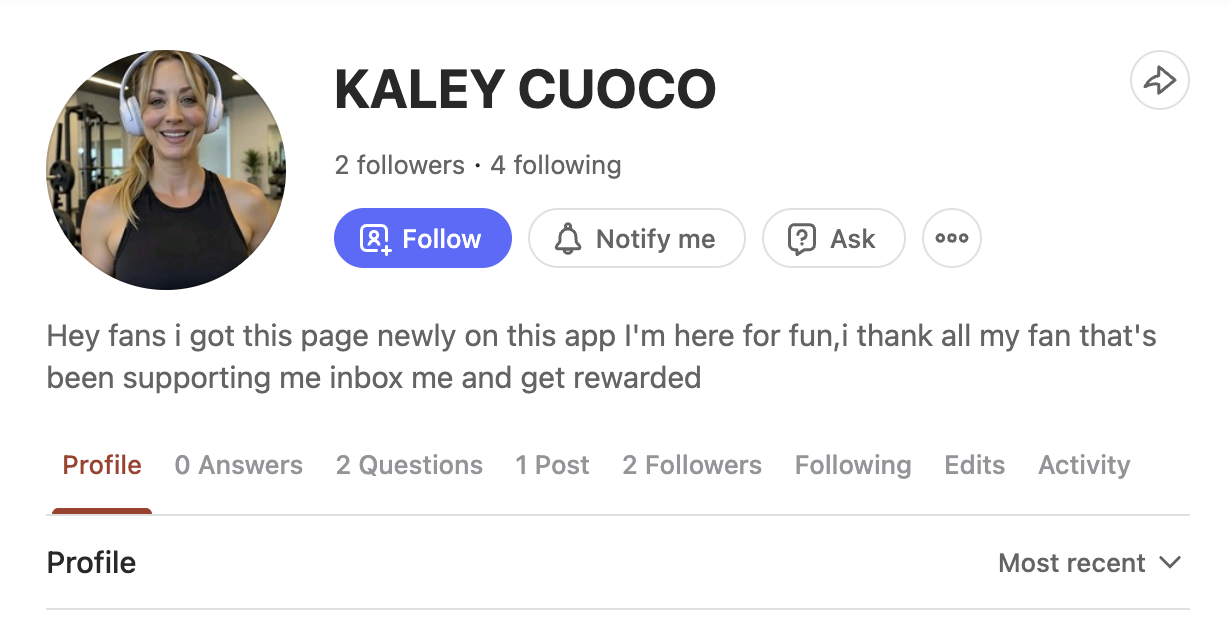
Consider this, a fake Quora profile made by a romance scammer likely somewhere in West Africa:
This is a bog-standard celebrity impersonation scam; needless to say, this account is not owned by TV actress Kaley Cuoco. The man (it’s almost certainly a man) who created this profile most likely speaks English as a second language. Certain tells (“I got this page newly”) point to a native speaker of a West African language.
There are quite a few of these “tells” that can suggest where a scammer is from.
Native speakers of Yoruba, one of the languages of Nigeria, struggle with English first-person pronouns, which work differently in Yoruba than they do in English. So they’ll say things like “am a single woman, am looking for a good man” instead of “I am a single woman, I am looking for a good man.”
Nigerian scammers often have difficulty with English conjugations of “to be,” and rather oddly, will frequently use the word “at” in place of “have.”
Overuse of the word “kindly” usually suggests a scammer in India, particularly when it’s used in the expression “kindly let’s,” as in “kindly let’s talk on Signal.” The phrase “do the needful,” which is strange to English ears, is unique to India. “Please quickly” is another phrase common among Indian scammers. Indian scammers also tend to add a -s to the end of words that are already uncountable plurals, like “stuff” becomes “stuffs” (for example, “I need to get some stuffs from the store”).
Russian scammers struggle with English indefinite articles and often leave them out of sentences completely.
“I need urgently” is a phrase that is common to scammers in Myanmar but almost never seen outside Myanmar. “Against” in place of “at,” as in “I am angry against you,” is also unique to Myanmar.
Standard received wisdom is that Internet scammers make deliberate grammar mistakes in order to target only the least educated, most dimwitted marks. That’s (sometimes) true of phishing emails, which try to trick a mark into visiting a fake website like a phony banking site or a phony PayPal site, but romance scammers and confidence scammers succeed best when they speak convincing English. The romance scammers who make these grammar mistakes do so unintentionally, and at HKs (Hustle Kingdoms, scam academies in West Africa where budding scammers pay to learn scam techniques and buy scam scripts), scammers can learn better English.
The point is, knowing “correct” grammar (I put “correct” in quotes because grammar is a consensus construct that changes all the time; properly understood, grammar is descriptive, not prescriptive) is not just about communicating your ideas clearly, though of course it does help with that. It is also a potent defense against being scammed, particularly by scammers who don’t speak your language natively.
Weird, incorrect, idiosyncratic grammar is often one of the best early warning signs that someone is attempting to scam, mislead, or trick you.
This goes beyond Internet scams, too. Most people, most of the time, prefer to be honest. Few people are comfortable with telling direct lies. However, people are quite comfortable paltering—that is, lying without telling a direct untruth, by carefully constructing what they say to be technically true but to lead you to a false impression. People palter because they can tell themselves “I’m still a good person, I didn’t lie, everything I said was factually true.”
There are a number of ways to detect paltering that are outside the scope of this essay (I talk about that in the nonfiction book I’m working on right now, too), but one of them is grammar that’s just a little bit off. A palterer will torture grammar and syntax to make what he says technically true, by the most rigid definitions of “true,” but also evasive or misleading.
This is particularly the case in direct questioning, where a palterer will offer answers that seem to answer the question, but if you stop to think about it, actually don’t. Palterers may omit important information, add extraneous information that doesn’t actually address the question, or use vague language to avoid some part of the question; in all these cases, strangely convoluted grammar and syntax can alert you to the palter.
To sum up: It’s not about what you say so much as about what you hear, what you as the person receiving the communication perceive. Knowledge of grammar makes you harder to con.