
I got called for jury duty a few months back, and ended up seated for voir dire for a case that quite frankly scared the shit out of me. I wasn’t selected, something I’m still not sure if I’m relieved or disappointed about, but man, there’s no way the prosecution would ever have allowed me within a thousand feet of that jury.
I have never served on a jury. I’ve been called many times, of course, but it’s always gone the same way. “Number 17, what do you do for a living?” “Well, I’m a computer programmer, and I also—” “Thank you, Number 17, you’re dismissed.” That’s happened in Florida, Georgia, and Oregon.
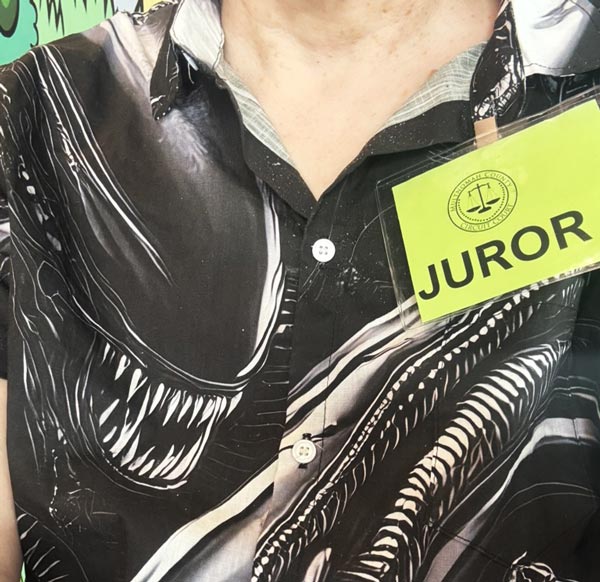
I didnd’t say that this time. I haven’t done development work in far too long. When I showed up, they gave us these fluorescent nametags to wear, because apparently at some point in the past a juror seated at a trial went to a restaurant for lunch, the prosecutors sat down nearby, and proceded to talk about the case unaware a juror sat next to them, and caused an expensive mistrial.
I knew something weird was up when they called us for voir dire. They’d been calling people out of the pool room all morning, but this time, they called twice as many potential jurors than normal, 48 of us. So many of us that we couldn’t all fit in the space reserved for potential jurors.
The prosecution talked to us for a while. “This is a rape case,” she said. “I’m going to ask you all a list of questions. You’re required to answer honestly. Has anyone here ever been physically abused by a romantic partner?”
I and a handful of other people raised our hands.
Then it got weird.
“Has anyone here ever heard the expression ‘junkies lie’?” she said. “Are you able to believe the testimony of a victim even if you’re aware the victim is addicted to drugs like heroin?”
“Do you believe that people suffering from mental illness are trustworthy? Would you be able to believe someone’s testimony even if you knew she had been diagnosed with borderline personality disorder?”
“Would you be able to believe the testimony of a victim even if you knew she had made false accusations in the past?”
Then it got really weird.
“Suppose a victim recanted her testimony and told you that she had not been assaulted. Would you be able to look at her original testimony with an open mind?”
“Would you automatically assume that the defendant were not guilty if the victim refused to testify against him during the trial?”
“If the victim testified for the defense to say that she didn’t think he should be convicted, would you still be able to convict?”
Then she dropped a doozy:
“Do you accept that in the court system in Oregon, the job of determining guilt or innocence is separate from the job of passing sentence? If you personally felt that a defendant was guilty, but you believed the defendant was facing a sentence you considered harsh or undeserved, would you still be able to return a verdict of ‘guilty,’ knowing that deciding on a sentence was the judge’s job, not yours?”
The defense attorney had a much shorter list of questions, but one of them really jumped out at me:
“Does anyone here believe that men can abuse women, but it is impossible for a woman to abuse a man?”
It took quite a long time for the two sides to choose twelve people for the jury. I was not, as you might imagine, one of them. I suspect saying “yes” to “have you been physically abused by a romantic partner” did me before the process even got started.
I have no idea how that case panned out or what happened to the defendant, but I have to say if I’d been on the jury, I’d’ve quite likely found it very hard to convict him, given only what I know from the prosecutor during voir dire.