Look at me, still talking when there’s Science to do!

In which Franklin chokes your friends list…scroll, my byatches! Scroll!

PART I: THE RANT

Every other year, the National Science Foundation does a survey of Americans’ understanding of basic principles of science and basic facts about the physical world. And every other year, the results are disappointing. In 2006, the last year of this exercise in the humiliation of the human species, we learned that about 70% of American adults do not understand what the scientific method is; 60% of American adults believe in psychics and ESP; half of Americans believe that antibiotics kill viruses; and nearly a quarter of all Americans(!) say that the sun moves around the earth, rather than the other way around.

It’s depressing, it is.

And the results from 2006 actually, if you can believe this, show some improvement over results from 2004 and 2002.

The numbers keep getting more miserable, too. A whopping 66% of American adults reject evolution, for example; more on that in a bit.

When these results are combined with other results from surveys on American ideas and beliefs, the gloom deepens. Various polls by CNN purport to show, among other things, that 80% of surveyed American adults believe the US government is hiding knowledge of space aliens, and 70% of American adults still believe that Saddam Hussein played a role in the attacks on the World Trade Center.


This level of anti-intellectualism in US society beggars belief. And it does a lot more than just make us look bad.

Some kooky, anti-intellectualist ideas, such as the notion that NASA faked the moon landings, are frustrating, but in the overall scheme of things not terribly important of and by themselves. Other ideas, such as the conspiracy theory that claims the government staged the World Trade Center attacks, reveal a deep-seated suspicion of government that’s so strong it overrides reason.

But some of these ideas are actively harmful. The ignorance of American adults about antibiotics and viruses means that many folks are inclined to take antibiotics when they can not do any good; overuse of antibiotics can lead to the development of antibiotic-resistant strains of bacteria which are a threat to the public health. Worse, the notion that vaccination is a “myth” used by evil scientists and doctors to “keep people sick” can cause people to refuse to vaccinate their kids, which leads to a susceptible population that offers childhood diseases a handy reservoir.

The “evil scientists” refrain is one that seems to be a common theme in the general voice of American anti-intellectualism. We’re not exactly sure what science is, but we’re sure that the people who do it are bad, motivated by dark, sinister goals of–I don’t know, keeping people sick or something. Whether it’s these anti-vaccination activists talking about the AMA or Greenpeace spouting uninformed bullshit about genetic engineering that they know isn’t true (says who? The founder of Greenpeace, no less), an active antipathy of science and scientists is the backdrop against which all of this anti-intellectualism is arrayed.

We even see this in American pop culture.

Video games like Half-Life and Resident Evil start with the same premise: a group of scientists, working together in a secret facility, brings about calamity and disaster; the solution to the problems they create is to go in and shoot stuff with a big gun.

Or a rocket launcher. Or a flamethrower. Or a railgun. Some of the things you use to shoot stuff with are pretty cool. But I digress.


PART II: The Problem

Americans are, by and large, woefully unequipped for rational, analytical thinking. The most basic tools of cognitive bullshit detection are simply not part of people’s toolkits; as a result, the most preposterous of ideas will sail through the minds of many folks unchecked, like a railgun through tissue paper.

Deepak Chopra, a minor star in the constellation of anti-intellectualism, once reacted to the idea that consciousness and personality are emergent phenomena from the physical processes of the brain by arguing that since brains are mostly made of water, saying that a brain is capable of consciousness without some outside spiritual force is like saying a bucket of water is capable of consciousness. This argument is, of course, utterly absurd; it’s a bit like saying since concrete is mostly sand, we can build skyscrapers out of sand. (The other stuff in there, and the physical structure, is important too, Deepak!) his argument was made only slightly more ridiculous when he then went on to say that yes, a bucket of water actually is conscious.

Water appears to be an obsession among certain parts of the New Age spiritualist crowd. One guy actually believes that water responds to human emotions and reads Japanese, and he’ll sell you a cure for cancer based on this “discovery.” If you have six hundred dollars in your wallet and a hole in your head, anyway.


I wish I was making this up, really I do. But, yes, there are folks who believe water has an emotional state. This idea came forth in the public consciousness through the movie What the Bleep Do We Know, a film that does for anti-intellectualism what Die Hard did for action-adventure flicks.

In this marvelous (for some value of “marvelous”) movie, we learn (among other things) that water “absorbs” human emotions. There’s this guy, you see, who turns out to be a friend of the producer, and he says that you can write emotionally-charged words on paper and wrap the paper around glasses of water, then you can freeze the water, you see, and the emotional “energy” will be absorbed by the water and change the crystals. Negative emotions, see, produce ‘ugly’ crystals; positive emotions produce ‘pretty’ crystals. This actually sounds plausible to enough folks that this guy sells a wide range of products, from books and CDs about emotional water to geometrically “clustered” water (at $35 a bottle) to gadgets that put your personal emotional energy into your food and water in order to make it better for you.

This shambling wreck of a movie communicates its message in an indirect way, by exploiting its audience’s fuzzy understanding of basic scientific processes and principles. It leads its viewers to factually incorrect conclusions by presenting factually accurate statements with careful framing intended to create inferences that aren’t true; for example, it talks about quantum mechanics and how the presence of an “observer” can influence a quantum state, then talks about the way our minds and emotional states can influence our immune system, and leads the reader to draw the conclusion that our minds can directly affect the physical world on a quantum level (which is not correct) without actually saying so directly.

To do this, it relies on ambiguities and fuzzy grasp of scientific terminology. Folks believe they know what the word “observer” means; when they hear it, they think of a person standing there looking at something. To a scientist, though, a person is not an observer; an observer is any particle which interacts with the observed system in a way that’s thermodynamically irreversible. The image that springs to mind when folks hear the word “observer” is wrong; the movie counts on this to lead the audience to a conclusion that is also wrong.

Profitable, though. The machines that program “emotional energy” into your water will set you back about $2500 US (plus tax and shipping).


One of the biggest problems facing anyone who cares about science and reason is the fact that folks sincerely believe they understand the concepts they’re grappling with, even when they do not. One thing I’ve seen is that everyone everywhere believes, truly believes, that he understands both quantum mechanics and evolutionary biology, while in reality, they don’t.

Nowhere is the gap between a person’s perceived understanding of a subject and the actual tenets of the subject as irritating as it is with evolution. I have met many people who passionately reject, even hate, the idea of evolution, but I have not yet met one who can explain what evolution is.
The list of misconceptions about evolutionary biology is endless. I could talk for days about the number of things folks think evolution says that it doesn’t, but then both you and I would be here for days, and I’m sure neither of us wants that. So in no particular order, some of my favorites:

– Evolution says there is no god. False; evolution says nothing abut god whatsoever, any more than astronmy, low-temperature physics, or agriculture say anything about god. Evolutionary biology (and geology and physics and astronomy and chemistry and astrophyscis and…) says that the world is more than six thousand years old, but it is silent on the subject of god.

– Evolution says that one species can change into another species, like a cow can change into a horse, but this has been proven false because there are no half-cow, half-horse creatures running around. Again, false; evolution says something completely different, which is that a a group of organisms that’s isolated and subject to adaptive pressure can and will change over time, to the point where it no longer belongs to the same species as the originals…but this process is extremely gradual, and does not at any time result in the birth of a creature halfway between one species and another. Eventually, given the right conditions, the right adaptive pressure, and the enough time, an initial population of cows might give rise to organisms that fill the same ecological niche that horses fill now, but a half-cow, half-horse will never exist.

-Evolution is about survival of the fittest; an organism that gets a mutation will spread it if the mutation helps it survive, and will not spread it if it doesn’t. Evolution relies on good mutations happening; the fact that there are bad mutations proves it doesn’t work. False; evolution is about the propagation of traits that allow the organism which holds them to reproduce. It doesn’t rely on mutation in the X-Men sense of the word; what it needs are a population whose members are different from one another, it needs for those variations to be inheritable, and it needs for those variations to determine, to some extent, reproductive success. That’s it.

If an organism has tentacles, and some have longer tentacles than others, and the ones with longer tentacles are more likely to reproduce, then over time the average tentacle length in the species will increase. It’s important to understand that a particular trait does not need to kill its inheritor to be selected against, and does not need to increase the odds of survival to be selected in favor of. It only needs to have an effect on reproduction. Even a tiny one. A trait that makes its possessors die younger but increases the odds that they will bear offspring by 0.001% will still be selected in favor of. Sometimes, the things that cause an organism to be more likely to reproduce don’t necessarily have anything to do with survival at all!

– For a structure to evolve, it must arise from simpler structures. If the eye evolved, it couldn’t evolve all at once. We should see creatures with half an eye. True; and we do. Very simple creatures like parasitic roundworms don’t have eyes; they have eyespots–simple clumps of cells slightly sensitive to light. That’s it. More advanced invertebrates have cup-shaped eyespots–a tiny improvement since they can get a general sense of the direction light is coming from, but still not an eye. Squid have round eyes lined with light-sensing cells, but they act like pinhole cameras–there is just a hole in front. No iris, no lens, no cornea, no eyelid. More complex fish have a lens but still lack a cornea or eyelid. Reptiles like snakes have an eye with a lens and cornea, but no lid–the eye is behind a special transparent scale. And so on.

– Science says we are more highly evolved than other organisms. False; evolution is not goal-directed, and every species, including ours, continues to be subject to adaptive pressure all the time. The virus that causes HIV, which evolves very quickly, could reasonably be said to be “more evolved” than we are!

– Evolution says all life is random, but if you mix chemicals at random, you don’t get life. False, and very annoying; it’s hard to understand where the notion of “evolution = random” even comes from, it’s so far off the mark. Evolution is about preserving structures and about natural selection, which is a most decidedly unrandom process. When you mix a bowl of chemicals, or parts of a watch, there is no mechanism that preserves increases in order; yet this is exactly what inheritance does.

– Science says that things go from an ordered state toward greater and greater states of disorder. Evolution violates thermodynamics. Which is what happens when folks take one thing they don’t understand, thermodynamics, and apply it to something else they don’t understand, biology. Entropy and disorder increase in a closed system, but this planet is not a closed system. If you add energy to a system from the outside, order in that system can go up. The earth has energy coming in from the outside…from the sun.

Ignorance about a topic leads to misunderstanding and misinformation about that topic. Sadly, though, it also leads to an inability to assess how much one knows about a topic, so those who most profoundly misunderstand something, like evolutionary biology or the Van Allen radiation belts (those bugaboos that the moon landing hoax nutters like to trot out as “proof” that visiting the moon is impossible), the less likely one is to know that they don’t understand it.

Which leads into…


PART III: WHAT TO DO ABOUT IT

“But I’ve done the research!” folks will wail, when one attempts to say that, no, vaccination isn’t a myth, or yes, the World Trade Center was brought down by commercial aircraft, or no, NASA didn’t fake the moon landings.

“I’ve done the research!” In fact, someone once told me this while trying to argue that vaccination is a hoax perpetrated by evil doctors. “I’ve done the research, and I know it’s true!”

This person does not know what the “immune system” is or how it works. She does not know the role that various parts of the immune system play in fighting disease. She does not know the difference between a virus and a bacteria, nor does she know the basic theory by which vaccines operate. So I think it’s reasonable to say that she has not, in any way, “done the research” to gain the cognitive tools necessary to evaluate claims about immunology.

This is something one sees often–people who, sincerely and without intentional deceit, believe they have “done the research” to support some proposition about which, even after the “research” has been done, they actually know absolutely nothing. The majority of folks–including, I bet, some people reading this right now–believe that looking for arguments which support one’s idea is “research.”


There’s a book I like to talk about. It’s called How We Know What Isn’t So: The Fallability of Reason in Everyday Life. It’s a very, very dry book; the author’s writing has the charm and wit of a robot wearing a pair of knit booties…but it’s an extraordinarily informative book. A chapter of the book is dedicated to the tendency of folks, when trying to support or refute an argument, to look only as far as the first idea that supports their position but no further. People believe this is “research”–you look for someone who says something that appears on the surface to support your position, then look no further than that.

I think this idea of “research” is one that our educational system does nothing to dispel. I’m sure most of you reading this have at one point or another been told to do a “research paper,” and most likely you were told that “research” means finding a list of folks who agree with your position, then citing those folks in the appropriate way. Guess what? That’s not research. When you do this, you will tend to look no deeper than the initial arguments that support your idea, and you certainly won’t investigate the validity of those arguments.


A wonderful example of this approach to “research” just recently popped up in a conversation I was involved in about the notion that pornography “causes” violence and rape. There are two factoids that the folks who see a casual relationship between porn and rape like to trot out, and you’ll see the littered all over anti-porn Web sites. Both factoids are statistical. The first is that Alaska has the highest per-capita rate of readership of men’s magazines in the nation, and also the highest per-capita incidence of violence, including rape, in the US. The second concerns Oklahoma City; in 1985, the city closed 150 porn shops and violent crime, including rape, decreased dramatically, while rising elsewhere in the state.

On the surface, these arguments might seem convincing. Deeper investigation, though, causes them to fall apart.

You see, Alaska has the highest per-capita readership of men’s magazines in the country. It also has the highest incidence of alcoholism, and the second highest rate of unemployment. Both alcoholism and unemployment are strongly and positively correlated with violence; higher incidence of both are tied to higher incidence of violent crime. When one controls for other factors such as unemployment and other statistical correlaries to violence, one actually finds a negative correlation between porn and violent crime; that is, higher rates of porn correlate, unintuitively, to lower rates of rape and violence.

The Oklahoma City claim is also flawed–or at least, incomplete. The two facts as stated are true: in 1985, Oklahoma City shut down their porn stores, and subsequently, incidence of violence and rape decreased. But further investigation reveals a lot was going on in Oklahoma City at the time: namely, in response to a homicide rate that was one of the worst in the nation, Oklahoma City introduced a number of sweeping anti-crime measures. They hired more police (itself statistically correlated to decrease in violent crime); started their first narcotic detection unit; and initiated a purge of corruption and fraud in the police departments. A reasonable person might conclude that these factors played a role in the subsequent reduction in crime.


There is a lesson here. Skepticism applies first and most importantly to arguments which support one’s ideas. The scientific method is fundamentally a technique of doubt; a scientist tries to disprove his idea, not prove it; the more it resists debunking, the more faith can be placed in it. Research does not consist of finding arguments in support of one’s idea. To “do the research,” look for facts that do not support your idea. Place value only in ideas which resist your most vigorous efforts to debunk them. If you believe that vaccination is a plot, and you read a book that says vaccination is a plot, you have not done the research.

This is a learned cognitive tool. That’s bad news and good news. It’s bad news because it does not come naturally; in fact, it’s precisely the opposite of what our instincts tell us to do. It’s good news because, really, it’s a simple tool; anyone can learn it. And that one tool opens the door to obtaining a whole new cognitive toolkit of bullshit detectors.

Maybe there’s hope for us after all.
Tech porn

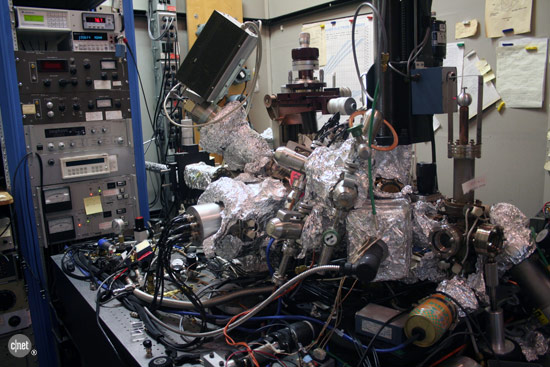
The world’s first scanning tunneling microscope, outfitted to do double duty as an atomic force microscope. This machine was invented at IBM Zurich in 1981; its creators won a Nobel Prize in 1986. And yes, it really is one of the coolest pieces of tech in the world.

See that orange round thing in the lower right hand corner? It’s an Arizona Iced Tea can. Some things in experimental physics never change. 😉

Origin of Species

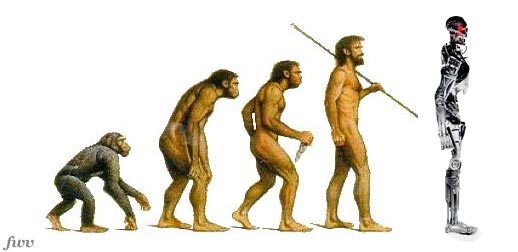
Evolution of the human species

I’ve been spending a great deal of time lately thinking about anti-intellectualism in all its various forms, after I read a conversation thread about evolution on a different forum in which one poster summed up the “arguments” (if they could be called that) in the creationist crowd by saying something along the lines of “Evolution is just another way that evil scientists try to rob humanity of its specialness.”

That’s a telling idea, and its something I’ve talked about before, but it’s been pressing in on my consciousness again these days. I don’t really have time to write another in-depth post at the moment, but it was fun putting this pic together. 🙂

Oh, for God’s sake…

…all the rhetoric about “revolution” and how he’s different from all the others, and Ron Paul is just another anti-intellectual, anti-science creationist nutjob. Are there any Republican politicians anywhere who aren’t ignoramuses?

Science will Fuck You Up

So I just finished writing a post about the Sandia Z-Machine over on the Stormy Weather blog. Why? Because it’s cool and it involves lots of electricity, which is sort of related to lightning, kinda, if you squint hard enough.


Clicky for a bigger version!

This is the sort of science that’ll ruin your day if you make any wrong moves around it.

Your daily dose of teh ky00t

This is Liam.

Liam is cursed with that same irresistible urge that gave us hairless naked apes the iPod, the steam engine, and nearly complete domination over all the earth: curiosity. If I place a box anywhere in my apartment, even if it’s simply a bottled water box that is set to go out with the trash, Liam will not rest until he has been over, under, around, and through it. He’s compelled, you see. He loves novelty, and he wants to know what it’s all about.

He’ll usually sleep in any box I put on or near the floor, at least for a few days. When it ceases to be novel and interesting, he grows tired of it and returns to sleeping at the foot of the bed with me. Like us naked apes, he’s curious and also fickle in his attentions.


Curiosity is a pretty sophisticated trait for an animal whose brain is smaller than my fist and not very wrinkly. In terms of raw processing power, a dozen Liams put together would compare pretty poorly to an IBM Blue Gene/L supercomputer, a much more computtionally powerful, yet singularly uncurious, piece of equipment.

Liam is actually pretty sophisticated in many of his behaviors. A couple weeks ago, he made a face at me.

It happened while I was eating frozen TV dinner apples. Microwave baked apples are tasty and delicious, and I make a point to eat them regularly. Five minutes in the microwave and you can have a small black plastic tray of bliss.

So there I was, sitting by my desk playing World of Warcraft and eating microwave baked apples, and Liam hopped up onto the desk and, brazen as you please, reached into my black plastic tray of bliss with his paw, hooked out a small piece of apple, brought it up to his nose, sniffed it suspiciously, licked it, and made a face at me. He shook the apple off his paw in disgust and wrinkled his nose at me.

Then he watched me eating the apples for several minutes, stole another bit of apple, sniffed at it even more suspiciously, and made another face at me.

There are many ways one might respond to this. One might say “Aww! How cute!” (And really, it was.) One might say “Hey! That’s my food! Don’t put your paw in that!” (And really, I did, though I knew even as I said it that it was pointless-an exercise more for my benefit than for the cats. We naked walking monkeys are kind of insecure in our position that way.) One might push the cat off the desk sternly. (And really, I didn’t have the heart to, because i dote on the cat so. A pushover, I am.)

Or, if one’s inclination runs that way, one might sit back and ponder the surprising degree of cognitive prowess the cat possesses.

I mean, seriously, think about it.

The cat recognized that I was eating something. We take that for granted, but there’s a lot of intellectual horsepower being brought to bear on a task of that sort. First, it means that he was able to map a projection of himself onto a projection on me well enough to be able to determine what kind of activity I was engaged in, and to recognize that it’s an activity he also engages in, despite great physical dissimilarities between us. That, at its foundation, means he was able to recognize the difference between himself and the rest of the world, and to recognize that some things in the world are more like him than other things in the world, to recognize those things when he sees them, and to recognize patterns of behavior common to he and I even as he recognized that I am distinct from him. Human babies take rather a long time to sort all this out.

Then, he was able to make an inference–namely, that what I was eating might be something e would like to eat as well. He made this inference in the absence of other cues, such as smell; he is, after all, a carnivore, and he is uninterested in a tray of baked apples just sitting by itself. (I know; I tried. What can I say? I was curious, too. He probably thinks they small like rotting plant matter.)

When he made this inference, he was able to formulate and then implement a plan of action, which shows at least a very limited ability to plan, even if only in a simple way.

When he obtained a piece of apple and decided it was just as revolting as it smells, he was then faced with a conundrum; this stuff was revolting, but clearly I was eating it (and with great gusto and no small amount of satisfaction, I might add). So he was willing to re-evaluate his original decision, and put it to the test again–something, the cynic in me begs to point out, that appears beyond the cognitive grasp of many people I know.


A couple of weeks ago, in a repeat of the I am not Sir Edmund fucking Hillary debacle that left me stranded on the balcony with a rope in my hand, Shelly went onto the porch to do some tidying up and the door locked behind her, trapping her until I came home for lunch.

Liam, in another example of cognitive dexterity (the only kind he has, I fear, as he is a stunningly clumsy cat), recognized that she was trapped, and became highly distressed and agitated. That shows empathy–the ability to map himself onto her and to respond as if he was the one in the distressing situation. He also knew that the door’s latch was to blame, and pawed and batted at it in a charming but unsuccessful bid to release her. Lack of opposing thumbs, and all that.


A Blue Gene/L system has, at very rough estimation, approximately the same processing power as a human brain. The Blue Gene/P supercomputer, currently in development, will well and truly trounce human beings in terms of processing ability. However, the architecture is very, very different. Modern computers are just really big, really complex Von Neumann machines, bound by the fact that the processing and memory are distinct entities which interact with one another in a series of discrete state changes.

A brain cell can roughly be mapped onto a transistor in the sense that it has only two discrete states, “firing” and “not firing,” but the architectural similarities pretty much end there.

Still, they are both finite state machines with memory, handwaving and nattering of Roger Penrose aside. And it is an axiom of state machines and formal language theory, which I will leave as an exercise to te reader to explore further, that any universal Turing machine, which is a finite state machine with memory, can, given sufficient memory, emulate any other universal Turing machine.

Which means that, given sufficient cleverness on our parts, it should be possible to take these wonderful brains of ours and emulate them in these crude computers of ours, without loss of fidelity.

Handwaving and nattering of Roger Penrose aside. (“Look! Consciousness is a quantum phenomenon! I don’t know anything about quantum physics, neurophysiology, consciousness, or cognitive science, but consciousness is a quantum phenomenon! I have no proof of this, so watch as I wave my hands!” But I digress.)

And, of course, when you emulate one kind of machine (yes, I said it, brains are machines, deal with it) on another kind of machine, if the host machine is sufficiently faster than the emulated machine, the emulation of the emulated machine is faster than the real thing.

Chew on that for a while.


I love Liam. He’s very sweet, and he is a constant little reminder in my life of figment_j. I continue to be impressed by the range of cognitive flexibility we take for granted, even in relatively unsophisticated animals, and I can hardly wait until we start building machines which can exhibit the same kind of cognitive skills.

We’re not there yet, but we will be soon. When IBM makes a supercomputer that has Liam’s level of cognitive prowess, the Singularity will well and truly be nigh.

DragonCon ’07

Science is teh AWESOME!

The Geek Group, an organization founded by physicsduck, brought a pair of singing Tesla coils to Dragon. Tesla coils are cool–they’re scary high-voltage devices that make noise and shoot lightning bolts. Singing Tesla coils, which shoot lightning bolts and make music, are even cooler.


Tesla coils buzz when they operate. Essentially, what you do is you inject a current into the primary winding, which is a loop of wire at the base of the tall, skinny coil. This indices a current in the secondary winding, which is the tall, skinny coil. The current travels up the coil ’til it hits the top, then travels back down again. You inject another current into the primary winding, and it creates another, stronger wave of induced current in the secondary winding, which travels up the coil and then back down again, when you hit it again, and each time it gets stronger until finally it becomes strong enough to shoot lightning bolts out the top. (That’s the Reader’s Digest condensed version for non-geeks, anyway).

I’m assuming that making them sing involves changing the frequency of the voltage supplied to the primary winding, so that they buzz at a different rate. If that’s true, it suggests that there’s a limit to the range of tones you can squeeze out of the coil, because every Tesla coil has an optimum frequency (determined by the size and construction of the coil) for the primary voltage. Deviate from that frequency and the coil operates less efficiently; stray too far from it, and the coil doesn’t work at all.

In any event, these things are cool as hell to watch. Even if there does need to be more VNV Nation on the playlist.

Some thoughts on evolution

No, this is not an Evolution Versus Creationism Death Match. Really, there’s only so many times one can watch Godzilla squash Bambi before it ceases to be amusing any more.

Rather, this is a post intended to clear up some popular misconceptions about how evolution works. I’ve been meaning to write it for a long time, and some comments made at a Dragon*Con panel reminded me that I still haven’t ranted about this in my journal. So, it’s high time to get my rant on!

There are two popular notions about evolutionary processes that I hear all the time, often from folks who ought to know better, and they tend to get under my skin. The first is that evolution is no longer operating on human beings; the second is that evolution is goal-directed, that it makes a species “better.” Ready? Here we go!

Evolution still operates on people, just as it always has

“Evolution is about survival of the fittest,” people say. “Today, thanks to the miracles of modern technology, people who would have died a hundred or a thousand or ten thousand years ago can be kept alive. They don’t die off, so their genes still spread. So that means we’ve stopped evolving.”

Fine, except that it’s wrong. Evolution isn’t about survival of the fittest. That wasn’t Charles Darwin’s phrase; it was coined by Herbert Spencer, and was included in On the Origin of Species only at the fifth reprint, as it had become popular by that time.

But evolution is not, and never has been, abut “survival of the fittest.” That’s an overly simplistic and inaccurate view of how evolutionary processes work. Evolution is about the propagation of those genes which most enable an organism to…propagate its genes. What’s good for the gene is often, but not necessarily, what’s good for the organism; a gene that shortened its host’s life by fifteen years but increased the probability that its host would reproduce by .01% would do quite well in the evolutionary game.

(As a segue, I’ve frequently heard an argument against transhumanism in general and life extension in particular that says “Mortality and a finite life expectancy must be good for us. If they were not good for us, then we would not have evolved to have a finite life span. So the fact that we have evolved in such a way means that there is some benefit to being mortal.” This argument does not hold water, because the bulk of our evolutionary heritage comes from a time when most members of the species would die through accident, disease, or predation far, far before they would die of old age. A gene that conferred immortality offers no reproductive benefit to a species whose members are killed by leopards, diseases, tumbles off a cliff, or each other before they’re thirty. Ergo, such a gene would not be selected in favor of. We have genes that confer mortality because there’s no advantage to genetic immortality.)

Evolution is not about survival of the fittest. It’s about the genes that spread. Evolution needs only three things to operate, namely:

1. A population whose individuals are different from one another;
2. A system whereby those differences are heritable; and
3. A system whereby those differences make a difference in how likely an individual is to reproduce.

That’s it. That’ all it needs. And yes, you have those things in humanity. We are not all the same; the differences between us can be transmitted to our children, and sometimes, those differences make a difference in how likely we are to have children, or how many children we have.

Contrary to the crude understanding of evolutionary processes so common in pop culture, it is not necessary for individuals who have a particular trait to die for that trait to be selected against. If a particular gene–a gene making its bearer more likely to have asthma, say–decreases the odds that a person will reproduce by 0.01%, that’s enough. If even one person out of ten thousand has one fewer child because of a particular gene, then evolution is still working.

Modern medicine keeps many people alive today who would die in a pre-industrial society. That does not mean that people with detrimental genes have exactly the same number of children at exactly the same rate as people without that gene. As long as a particular gene has any impact on the number of children its hosts have, however slight, evolution still works.

Evolution is not goal-directed

Evolution does not make a species “better” for any value of “better” that people often use. Evolution favors genes that make its hosts more likely to reproduce. That’s it. A gene that causes you to die of a horrifying, debilitating cancer after you hit menopause isn’t going to be selected against.

Furthermore, evolution is completely blind with regards to “better” and “worse” as human values. At the panel, one person used Down’s syndrome as an example of how evolution no longer applies to human beings. If people with Down’s, he reasoned, have children, then how can evolution make the human species better?

This question falls down on a number of levels, and shows a lack of understanding of what evolution is. Down’s syndrome is not generally heritable; it’s caused by a particular genetic malfunction that does not, usually, affect the gametes.

But leaving that aside for the moment, let’s assume that it is heritable. What does that mean? If people with Down’s syndrome had more children than people without it, then from an evolutionary perspective, Down’s syndrome would be “better.” From an evolutionary standpoint, there is one and only one definition of the word “better,” and that is “more likely to reproduce.”

I mean, if you think about it, I am a worst-case scenario. I have not had children at all, and I have even opted for voluntary sterilization, so I never will have any children. My particular collection of genes is a dead end. I am, evolutionarily speaking, the poorest possible outcome. From the perspective of the processes we’re talking about, a person who has Down’s syndrome and has children is better than I am.

It frustrates me that American culture is so divided and American politics is so wrapped up in the idea of evolution, yet very few people even understand what “evolution” is. They feel passionately about it, but they’re incapable of articulating the most basic principles of evolutionary biology.

Rant off.

Some thoughts on nanotech’s dark side

Iran is currently working on obtaining fissionable uranium which can be used for nuclear weapons. This is presenting something of a thorny issue for our current Simian-in-Chief, whose approval rating is dipping perilously close to single digits over his mismanagement of the botched and ultimately pointless war in Iraq. We currently lack the political capital and the military and financial resources to mount any kind of overt action in Iran, wishful thinking of the pro-war Far Right aside. None of this is news to anyone who’s not been living under a bridge for the past four years or so.

There’s some good news and some bad news in this situation, none of which has anything to do with American politics or the situation in Iraq. The good news is the part that says “Iran is currently working on obtaining fissionable uranium which can be used for nuclear weapons.” This is good news because, more than fifty years after Word War II, it still requires a major committed effort on the part of an entire nation to obtain fissionable uranium which can be used for nuclear weapons. The bad news is generic programmable nanotech assemblers. The good news is that these don’t exist yet. The bad news is that they will.


The process of enriching uranium is delicate, costly, complex, and fiddly. The Reader’s Digest Condensed Version is this: Uranium occurs in nature in two isotopes, U-235 and U-238. The difference is the number of neutrons in the atomic nucleus of the uranium atoms. U-238 has three more neutrons in the nucleus than U-235 does.

The vast majority of the uranium in nature is U-238. U-235 is quite scarce, making up just over one-half of one percent of the uranium you can dig up out of the ground. For various complicated reasons that have to do with Science and are beyond the scope of this post, U-238 doesn’t go boom. In order to be useful to people who want to make things go boom, uranium needs to be “enriched,” meaning that the percentage of U-235–the kind that does go boom–needs to be increased.

This process is really, really, really hard to do. Essentially, you take your uranium and combine it with fluorine to form a gas called uranium hexafluoride. You then put this gas into a special centrifuge and you spin it really, really fast for a really, really long time. A tiny percentage of the U-235, which is just oh such a little bit lighter (by the weight of three neutrons) than U-238, ends up at the top. Then you take some of the gas out of the bottom, where it’s more U-238, and put the remaining gas into a second centrifuge, which you spin really, really fast for a really, really long time. You keep doing this over and over and over again for months, and you’re left with a little bit of enriched uranium hexafluoride, which you take the fluorine atoms off of to end up with uranium.

The centrifuges are complicated and difficult to make, even if you’re an entire country. The process is so delicate that if one of your workers sneezes while it’s happening, the whole shebang gets all mixed up again and you have to start over. Even with billions of dollars on hand and the resources and will of an entire nation behind you, making nuclear bombs is tough to do.


There is this notion that once a nation acquires nuclear weapons and realizes how destructive these things are, that nation tends to become very, very reluctant to use them. In the history of the world, only two have been used in war. There are historians who will argue that the existence of nuclear weapons has likely averted a third world war; these weapons are so bad that nobody really wants to use them, so nations that have them tend to think twice about getting into shooting matches with other nations that have them.

Of course, this assumes people are reasonable. This is often, but not always, the case. Witness 1 for the prosecution: Kim Jong Il, the poster boy for “deranged psychopaths,” who just so happens to be the leader of North Korea, a nation which just so happens to have nukes.

I tend to think the notion that nuclear weapons have a calming effect on countries is a historical artifact, because they’re so hard to make that only highly industrialized, rationalist nations get them first. There is a correlation between countries with stable, rational governments,and countries which are wealthy and industrialized.

Don’t look at me like that. Compared to Kim Jong Il, Josef Stalin is a model of reason and rationality. And George W.’s administration didn’t invent the Bomb. Had all our nation’s leaders been like W, we would never have become a First World nation to begin with, and we may still not be a First World nation by the time he leaves office. Half a trillion dollars drained out of the nation’s economy to finance a war against a paltry and largely unmilitarized Third World country…but I digress.

The point is, making nuclear bombs is tough and expensive, even for entire nations. Your next door Al Qaeda cell isn’t going to get one any time soon, wishful thinking of the pro-war Far Right aside.

But hold on. Things are getting better.


Nanotechnology is a cutting-edge new technology that offers the promise of doing for manufacturing, medicine, and materials engineering what electronics did for computation. Right now, human technology is barbaric and primitive almost beyond reason. We like to think that we’re high-tech, but we’re not. The process by which we make things has hardly changed since flint knives and bearskins. We take a piece of something, we whack off all the bits that don’t look like what we want, until we get what we do want. Today the whacking is done by computer-controlled, automated CNC milling equipment instead of with a big rock, but essentially it’s the same. Our processes for making stuff are better, but our basic techniques have scarcely changed.

The Holy Grail of manufacturing nanotech is the universal programmable assembler, a hypothetical device that makes stuff the way the cells in your body made you–at an atomic scale, one molecule at a time. The theory is simple: you take a bunch of little programmable machines, each of which is the size of a couple dozen molecules or so, and you program them with what you want to make. Then you give them some carbon, iron, or whatever, and they make that thing for you from the ground up, one molecule at a time. It’s the ultimate dream manufacturing technique; if you can conceive it, you can make it. (Of course you don’t want to make stuff literally one molecule at a time; when I say a “bunch” of assemblers, I mean like “a few billion.”)

It’s less farfetched than it sounds. Read Engines of Creation. Go ahead; I’ll wait.

You back? Cool stuff, right? Radical longevity, effortless and cheap manufacturing that doesn’t pollute or deplete natural resources, personalized cancer cures that cost less than a low-end Dell desktop. The advent of nanotechnology will arguably change human civilization more than the advent of agriculture did.


If we live that long, that is. You see, nanotech offers the promise of building stuff on a molecular level. Nanotech assemblers manipulate matter on the level of individual molecules. Forget that complicated, tedious mucking about with expensive and finicky centrifuges and uranium hexafluoride; dissolve your uranium in hydrogen peroxide and sodium hydroxide, stir in some nano devices that sort out the U-235 bits from the U-238 bits, and wait. Enriching uranium is removed from the realm of entire nations and brought down to the level where anyone who’s having a bad hair day can do it.

If he can get the uranium to begin with, of course. It’s not like you can buy it at the corner grocery. But we’re a clever species; someone will figure out how to solve that problem. 🙂

Lots o’ linky goodness

Found all over the Intarweb and among various posts on my flist. I’ve had these browser windows open, in some cases, for weeks, and so I’m dumping them all here so as to make a record.

Political humor

Conan O’Brien Hates My Homeland. Funny, work-safe, sometimes painfully true.

Different Meanings of Country Flags. Work-safe, funny, and even more painfully true. Ouch!

Science, Tech, and Medicine

Mechanistic link between stress and the development of Alzheimer’s disease

The physiology and processes of aging

Masters student delivers thesis in her underwear–video game controllers you use by feeling up your partner

Keeping a backup copy of your immune system

Milky Way galaxy is eating a small neighborturns out our sun actually didn’t form in the Milky Way. It originally belonged to a small galaxy called the Sagittarius dwarf galaxy, which is being devoured by the Milky Way. New Agers are going crazy about what this means for the “energy field” of the planet. [Edit]: The claim that the sun originated in the galaxy being cannibalized by the Milky Way has been debunked.

And while we’re on the subject, here’s a video of a model of the collision between the Milky Way and the Andromeda galaxy, due to commence in a couple billion years. This collision is bad news.

Binary calculator made out of wood and marbles–eat your heart out, Alan Turing!

Miscellaneous

Disturbing Sex Toys–funny, possibly not work safe.

Joined at the Brainstem–really bad relationship advice.

The new fad among hyperconservative, literalist Christians: Christian spanking porn. Work-safe. Would Sir like some domestic abuse with his porn today?

A partial list of common English words invented by William Shakespeare

Mingle2Online Dating