From a spontaneous late-night drag-king photo shoot on the way back from watching Weird Science and going to Steak & Shake with some of the local Orlando poly peeps, yo.
More later, if you ask really nice.

From a spontaneous late-night drag-king photo shoot on the way back from watching Weird Science and going to Steak & Shake with some of the local Orlando poly peeps, yo.
More later, if you ask really nice.

On the way back from Frolicon, the three of us (joreth, emanix, and I) stopped in Cordele, Georgia, just outside Tifton ad home of the Titan-I missile I’ve stopped to admire before.
This time, the gate in the fence around it was open, ad I was able to get more up-close and…err, personal. I’ve never dry-humped a nuclear weapon before. I think I rather like it.


By 2145, symbols such as these were common in public areas, and were used to indicate restroom facilities for women and men, and recharging stations for androids. The origin of the universal symbol for ‘Android’ is shrouded in mystery.
![]()
emanix the Chaosbunny in the back; the pet lesbians and your humble scribe down in front. Bunny ears not optional.


Orgasm button pressed
877051,631426,273670,148368,337897,357081,156687,252130
1066507,153786,63145,57488,129078,50440,173709,109819
1585110,580090,160991,167229,157232,260284,79462,27377
147919,82705,11760,43571,55125,60752,33791,31729
146346,70311,5912,46054,53651,58255,33226,29107
246097,296325,162358,86699,203578,368388,273746,160780
788224,423060,299575,274288,351033,216863,198371,100922
296435,696530,190339,144327,378529,613425,149675,95380
801372,581291,271888,274933,386881,207813,135433,116997
300081,165239,23121,56824,42235,40362,31752,32249
1050677,198894,228346,179001,327919,288723,200497,73206
1902006,219078,213577,99485,107608,277309,249533,199702
522238,139126,277209,238029,720111,257846,287912,252290
659995,778016,146931,187483,229644,229198,114254,85620
Orgasm button released
Numbers are 32-bit representations sampled at 1-second intervals showing delta, theta, low alpha, high alpha, low beta, high beta, low gamma, and high gamma brainwave activity during an orgasm by joreth. i love science!
I just did my taxes yesterday, and was kind of horrified to learn that not only was I not getting a refund, I ended up owing the IRS quite a lot more than I thought.
So in the interests of helping to ease the bite for all my blog readers, I’ve decided to create my own tax relief program. From now until the end of May, you can take $6.00 off the price of a registered copy of my sex game Onyx. And if you scored a tax refund this year, well, this is a good time to give the gift of sex!
Use the coupon code omgtax2011 in the shopping cart when you check out to get your tax relief.
Sex for Science! Chapter 0
Sex for Science! Chapter 1
Sex for Science! Interlude
Sex for Science! Chapter 2
Sex for Science! Chapter 3
Sex for Science! Chapter 4
San Francisco has a store that bills itself as the largest independent pirate supply store in the city.
I don’t know if it is in fact the largest pirate supply store in San Francisco or not, but it is indeed a large pirate supply store. lapis_lazuli and her partner brought us there in part because I needed some pirate supplies, and in part because it’s a cool place to visit.
The store sells really cool hand-made cast-iron padlocks. My sweetie zaiah has a large cage which will be part of the dungeon furniture once the dungeon is finished, and every cage needs a hand-made cast-iron padlock, so the pirate supply store turned out to be just the right place to visit.
The very cute young cashier who sold me the padlock asked me if I already had a use in mind for it. I told her that I did, and that would have been the end of it, except that she kept on pressing. “What do you plan to use it for?” she asked.
“A cage.”
“Like a cage for a dog?”
“Not exactly, no.”
“What kind of cage?”
“A big cage.”
“What’s it for?”
“It’s part of the dungeon.”
“You have a dungeon?”
“We’re building one, yes.”
“What kind of a dungeon? Like for–”
At that point she turned a brilliant shade of red from the tips of her ears down to her toes and started saying “Oh my God” a lot. She also started stuttering quite a bit and generally looking flustered. Finally, after a lot of “um”s and “err”s and a bit of hand-flapping, she said something about it taking all kinds of people and turned away.
That was the second most fun thing that happened in the pirate supply store, for some value of “fun” that means “I don’t believe in protecting people from the results of their own questions.” The first most fun thing was when lapis_lazuli took me by the hand, looked me straight in the eye, and said “kiss me.”
Which I did. And then did again. She’s rather a nice kisser.
Smart, confident, direct women are sexy. Ahem.
The Porn ‘n’ Cupcakes, the tour of the submarine, and smooching lapis_lazuli in a pirate supply store all aren’t directly related to finding myself in a seedy motel room in Seattle with a bullet hole in the window and a door that looked as if it had been kicked down repeatedly, watching a tattooed grad student in striped socks having a huge screaming orgasm, but they’re indirectly related in the sense that I can perhaps be forgiven for having sex a little bit more on the brain than I usually do during the drive back to Portland, and to the idea that would inevitably bring us to that motel room in Seattle, to which I am by degrees coming.
In fact, the trip to MacWorld led to two different instances of watching a pierced, tattooed woman having a screaming orgasm. This story has several branches, which I’ll get to later.
At this point, the genesis of that idea that brought me to Seattle was less than twenty-four hours and a quick side jaunt through Shasta Caverns away. That side jaunt deserves a bit of talking about of its own.
Shasta Caverns is a cave system near Shasta Mountain, which has an interesting history. It was, apparently, discovered in 1878 by a Native American fishery worker who’d been out hunting and followed an animal through a small hole into what he believed would be a tiny niche in the mountainside.
Scott and I stopped at Shasta Caverns on the way back to Portland partly because our original plan, to head back along the coast and take pictures, was thwarted by reports of rain.
The cave system at Shasta Caverns is accessible only from the top of a mountain across Lake Shasta from the road. Entrance to the cave system involves taking a WWII-era landing boat across the lake, then taking a bus up a very steep, narrow, winding trail that’s so curvy in some places that the bus actually overhangs the edge of the road when it’s turning. The buses themselves were carried across the lake by that very same boat;, which was barely big enough to accommodate them; the guide said the landing ramp can’t be raised while a bus is on the boat, meaning that a ripple any bigger than a matchstick will swamp the boat while it’s transporting them.

The mountain itself looks like this from the edge of the lake.

I still have yet to get used to how folks just leave scenic natural wonder lying around all over the place here in the Pacific northwest.
The cave itself is small but quite spectacular. Unfortunately, a guided tour is the only way to go through it; visitors aren’t allowed to wander about on their own, the way they can at Carlsbad. Which is a damn shame, because I’d love to return here one day with a model and do some nude photography in this place.

Scott and I lagged behind the group as much as our patient and remarkably tolerant guide would permit, shooting long-exposure images from a pair of tripods. The cave system is small but spectacular, and features every type of rock formation that can exist in a limestone cavern.


After we left the cave system, through an exit five hundred feet or so above the entrance, we were confronted with this view:

At the very peak of the caverns is the remnants of this rusted ladder, which for nearly a century was the only way in or out of the cave system. The hole in the ceiling is the original entrance through which the cave’s discoverer made his discovery.

Detour complete, we hopped back into Scott’s car and headed north. That’s when it happened.
Scott has a habit of listening to books on tape via his iPhone whenever he travels–a habit which, by the way, I endorse.
On the trip down, he had introduced me to Wooster & Jeeves, which is pretty funny stuff. On the way back, he opted for something a bit different: Mind Wide Open: Your Brain and the Neuroscience of Everyday Life by Steven Johnson.
I’m not quite sure what made him choose that particular book. Maybe it was simply the next one in the queue. Maybe he’d decided that entertainment a bit more meaty than turn-of-the-centry tales about an incompetent buffoon and his hyperconfident butler might be suitable. Perhaps it was entirely random, and the hand of fate reached out to touch him. In any event, the moment he pressed “play,” the dice were cast, and the Seattle motel room became inevitable.
The book, you see, talks about a company called Neurosky.
Neurosky makes a single-chip EEG device that’s designed to be embedded in small electronic toys and gadgets. Neurosky got into business making neurofeedback devices–gadgets intended to train a person to control her own mental state by analyzing her brainwaves and then providing some sort of reward for reaching the goal state.

Their earliest gizmos were video game controllers, which would read the player’s brainwaves and let her control some part of the video game accordingly. They made a race car game, for instance, in which the harder the player concentrates, the faster the car goes.
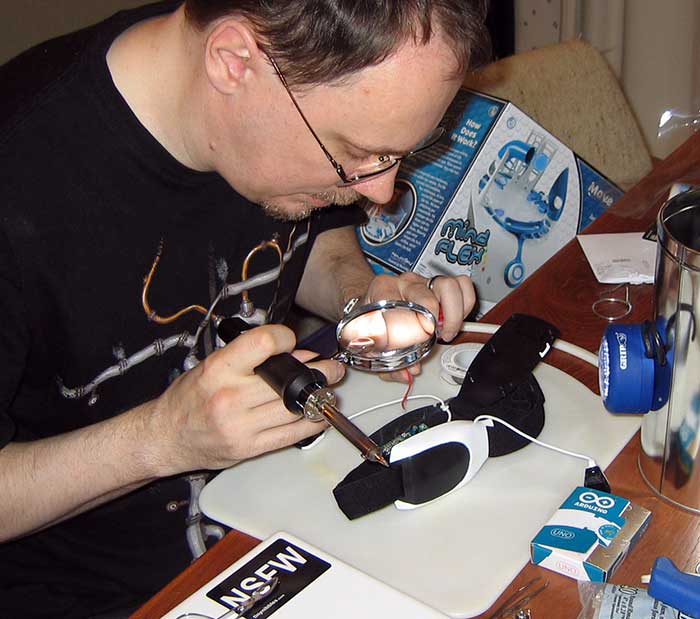
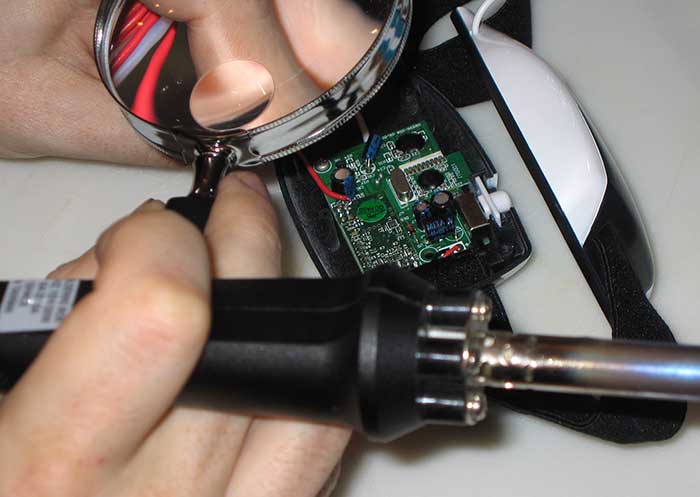
More recently, Neurosky has started making chips for other companies. One of their customers is Mattel, who makes a toy called the MindFlex, in which you move a ball around by concentrating on it. The game has a motor connected to the chip’s outputs, so that when you concentrate, a fan blows and levitates a ball in the air.
Pretty cool, I think, for the first five minutes, and then probably quite boring after that.
To me, though, in my already riled-up state (and to be fair, my baseline state is pretty riled up to begin with), the connection was obvious. Here is a brain-scanning device that could be used to activate a motor.. Think about that for a minute.
A brain-scanning device. That could activate a motor.
The idea hit like a lightning bolt. If a MindFlex could turn on a motor attached to a fan, surely it could turn on a motor attached to something else, too. Like, say, a vibrator.
It was Twitter that provided the last bit of the puzzle.
On the drive home, I tweeted, as I always do. “Is sexual arousal a discrete brain state?” I said. “Can you use neurofeedback to condition it?” All good questions, I thought. That’s the nice thing about neurofeedback; you can use it to train yourself to be able to go into a certain metal state, like meditation or concentration, at will.
So why not apply the same idea to sexual arousal? If an EEG could detect sexual arousal, ad run a vibrator whenever the wearer became aroused, could it become a neurofeedback training device to teach people to become aroused whenever they wanted? And more to the point, wouldn’t be fun?
There are a lot of folks who read my Twitter feed. One of those folks is partnered to a neurobiology grad student who was thinking along similar lines, although for entirely different reasons. Shortly thereafter, she got in touch with me.
Of course I’d like to collaborate on a project involving hooking people up to an EEG and getting them aroused to see what happens…I mean, really, does the question even need to be asked? It’s Science, right? Science is something I’m in favor of, after all.
So you see, the seedy motel room lurking in my future was all part of the great enterprise of Science, the noblest of all human endeavors.

On March 23 of this year, two notable things happened.
The first was that I celebrated the anniversary of my birth. My sweetie zaiah and I have been working very hard on the project to remodel our home into a dungeon to host play parties; to help celebrate the occasion of my birth, a lot of friends came over and did a bang-up awesome job of helping us paint the soon-to-be dungeon. It’s still not finished, but we made a lot of progress.
The second thing that happened is that Apple Computer, in apparent response to a petition by a GBLT group, pulled an app by a group called Exodus International from the App Store. And in all honesty, I’m a bit disappointed in the activists who demanded its withdrawal.
Exodus International, in case you have been fortunate enough to avoid these lunkheads so far, is a right-wing Christian organization founded on the premise that through prayer and “spiritual healing” (whatever that is), they can cure people of homosexuality and turn them into nice, normal, inoffensive heterosexuals.
Leaving aside for a moment that there are many people who can shag members of the same sex and then end up in heterosexual relationships–a better term for such folks than “ex-gay” might be “bisexual” or “pansexual,” if one wants to get all semantic about it–the notion that homosexuality is a condition or that it can (or should!) be “cured” is absurd on the face of it.
I don’t much cotton to Exodus International, nor for that matter to any other group that thinks there’s an invisible dude who lives up in the sky who has rules about who you’re supposed to shag or how to do it, and that they have the direct skinny on what those invisible dude’s rules are and how they should be implemented.
But here’s the thing. As odious, offensive, and just plain stupid as Exodus International (the “Exodus” is an exodus from gayhood–get it? Get it? Aren’t they just so clever?) might be–and believe me, if you look at these folks’ Web site, the stupid, it burns–I think the GBLT shot itself in the foot, and in the process showed that some of its members can match the Christian right intolerance for intolerance and deception for deception–by petitioning for its removal.
But first, before I go into why, let me explain something about how the app got approved in the first place. Some noisy but uninformed folks have spouted a lot of nonsense about how Bad And Wrong Apple was to have approved the app in the first place, pointing to how its “unoffensive” rating within Apple’s system showed that Apple is an anti-gay, right-wing establishment.
It’s rubbish. Apple’s second in command, Tim Cook, is arguably the most powerful gay man in all of Silicon Valley. Apple has a long history as a gay-friendly place to work. Apple’s App Store submissions are not, and have not for quite some time, screened by a human being; Apple uses a suite of automated tools to check that apps conform to Apple’s programming guidelines. The Exodus International app was not hand-built; it was built using a pre-existing application framework, one that is used for many other App Store apps. The framework draws its content from a Web site (in this case, the Exodus International Web site); its content was not populated until after the app was approved.
So, no, Apple does not habitually go around approving anti-gay apps. The notion that some person at Apple saw the app and said “Cool! An app by an anti-gay organization; well, let me just put this up on the App Store straightaway, then!” is simply factually wrong.
While we’re on the subject, let’s talk about what the app itself is not.
Shortly after the app came out, a GLBT group calling itself Truth Wins Out put up a petition on change.org calling on Apple to remove the app. The campaign that supported the petition described the app as containing information that was scientifically unsound and potentially dangerous about “reparative therapy,” the notion that homosexuality can be “cured,” and described the app as an “ex-gay app.”
To be sure, reparative therapy is dangerous and scientifically unsound. It’s about as scientifically valid as homeopathy or faith healing, and works about as well.
But that’s not really what the app was. The app was, essentially, a calendar of events and a bunch of Web links.

As such, the content of the app was quite a lot different from what it was claimed to be.
Now, this country has a long, storied tradition of dealing with upsetting, inflammatory, objectionable, or uncomfortable content by banning it. For a society of folks quick to shout “free speech!” whenever someone suggests we ought not say something we want to say, we’re just as quick to shout “ban it!” whenever someone else says something we think they ought not say. It’s a sort of national cognitive dissonance, a hypocrisy that’s woven into the American social fabric.
The gay community has been the target of that “ban it!” impulse for longer than this country was a country. It’s no accident that homosexuality has been described as “the love that dare not speak its name.” So it’s a bit disappointing to me to see the folks who’ve been harmed by the notion that certain ideas should not be discussed being so quick to turn that particular weapon back onto others.
And the fact is, by doing so they committed two wrongs. First, they used tactics that are disingenuous at best. Second, they played right into the hands of Exodus International, a group which the cynic in me suspects wanted to have their app banned.
When I first became aware of the Exodus app, I had read about it on Web sites run by pro-GLBT activists and bloggers. I came away with the notion that the app was a how-to guide for “curing” gays. It wasn’t until I started looking at screen shots and app descriptions–by the time I found out about it, the app had already been removed from the App Store–that I learned its content was considerably different from what I’d been lead to believe.
Whenever I hear someone misstate or overstate an argument against something, that leads me to the conclusion that the person who’s making the argument doesn’t really believe his case to be terribly persuasive. Exaggeration is the tool of first resort for someone who really, really, really doesn’t like something, but who doesn’t think that other folks will share his opinion if it’s stated factually.
And the fact that these arguments were picked up by so many folks suggests to me that a lot of bloggers fell into the same trap that the religious right often falls into–condemning something without actually seeing it. We (and by “we” I mean progressive bloggers, activists, and writers) tend to snigger and laugh at Christians who call for banning a book or a movie and then, when asked if they’ve actually seen it, say “No! Of course I haven’t!” as if their ignorance somehow enhances their moral superiority.
Yet this is precisely what a lot of folks who condemned the Exodus app did. I’d be willing to wager that less than one half of one percent of the folks who condemn it bothered to look at it, and barely more than that even bothered to look at screenshots of it.
That’s pretty dumb. Fact-checking is (or at least ought to be) a basic, basic part of informed activism of ANY sort.
On another forum I read, a lot of folks were hailing the removal of the app from the App Store as a triumph of Libertarianism. I found that notion pretty weird; Apple acts as an absolute regulator of the App Store, with the ability to enforce any rules it chooses about what may and may not be found there.
Now, I am not a Libertarian by any stretch of the imagination. But it seems to me that appealing to an absolute regulator to pass a rule banning a product that you don’t like, for the purpose of ensuring that the product is not available to anyone, is precisely the reverse of Libertarian belief. A more reasonable interpretation of Libertarianism, as I understand it, is that the market itself determines what has value; if folks don’t think the Exodus app has value, they don’t download it. If they do think it has value, they do download it. And in that way, individuals, rather than overarching regulatory authorities, make up their own minds about what has value and what doesn’t.
Which brings up a point that I think is absolutely vital in any pluralistic society: the solution to bad speech is more speech, not less speech.
The fact is, there are people who think that Exodus’ ideas have merit. And those folks don’t go away because the app does! The solution is not to try to control the dissemination of the ideas; that’s a fool’s quest. The solution to bad speech is more speech. Hatred and misinformation thrive in dark places.

I wish–I really, really wish–I had been aware of the Exodus app before pple pulled it down. Do you want to know what I would have done? I’ll tell you.
I would have made an app of my own. My app would have parodied and mocked the Exodus app. It would have lampooned the notions in it. It would have made fun of Exodus International–its ideas, its philosophy, even its lame-ass logo. And it would have provided links to better information about homosexuality.
And you know what I would have done then? I would have sold my app for 99 cents, and I would have donated the proceeds from each sale to a pro-GLBT charity.
If there is one thing that right-wing religious wingnuts can not abide, it’s mockery. Humor is a far more powerful weapon than the banhammer. And frankly, I think that providing funds–as in, actual, real money–to GLBT groups would do a lot more to protect at-risk people, particularly the most vulnerable people targeted by Exodus International–than just removing an app from the App Store would have.
It might’ve gotten more positive press, too.
As it stands now, the GLBT activists have scored a stunning own-goal by playing right into the hands of Exodus International. I really do believe that they expected their app to be banned; c’mon, Apple already has policies against this sort of thing, so it was really just a question of time.
But by creating the petition and making so much noise, the activists have turned themselves into an Exodus photo op. They have allowed Exodus to crank up the press release machinery saying “See? See? Look at these hypocritical gays! They accuse us of intolerance, and then they use distortion and misinformation to advance the Gay Agenda by silencing our voices!” (The fundraising appeal along those lines is already up and running on the Exodus Web site.) And, y’know, it’s kinda hard to argue the point.