Some thoughts on post-scarcity societies

One of my favorite writers at the moment is Iain M. Banks. Under that name, he writes science fiction set in a post-scarcity society called the Culture, where he deals with political intrigue and moral issues and technology and society on a scale that almost nobody else has ever tried. (In fact, his novel Use of Weapons is my all-time favorite book, and I’ve written about it at great length here.) Under the name Iain Banks, he writes grim and often depressing novels not related to science fiction, and wins lots of awards.

The Culture novels are interesting to me because they are imagination writ large. Conventional science fiction, whether it’s the cyberpunk dystopia of William Gibson or the bland, banal sterility of (God help us) Star Trek, imagines a world that’s quite recognizable to us….or at least to those of us who are white 20th-century Westerners. (It’s always bugged me that the alien races in Star Trek are not really very alien at all; they are more like conventional middle-class white Americans than even, say, Japanese society is, and way less alien than the Serra do Sol tribe of the Amazon basin.) They imagine a future that’s pretty much the same as the present, only more so; “Bones” McCoy, a physician, talks about how death at the ripe old age of 80 is part of Nature’s plan, as he rides around in a spaceship made by welding plates of steel together.


Image from Wikimedia Commons by Hill – Giuseppe Gerbino

In the Culture, by way of contrast, everything is made by atomic-level nanotech assembly processes. Macroengineering exists on a huge scale, so huge that the majority of the Culture’s citizens by far live on orbitals–artificially constructed habitats encircling a star. (One could live on a planet, of course, in much the way that a modern person could live in a cave if she wanted to; but why?) The largest spacecraft, General Systems Vehicles, have populations that range from the tens of millions ot six billion or more. Virtually limitless sources of energy (something I’m panning to blog about later) and virtually unlimited technical ability to make just about anything from raw atoms means that there is no such thing as scarcity; whatever any person needs, that person can have, immediately and for free. And the definition of “person” goes much further, too; whereas in the Star Trek universe, people are still struggling with the idea that a sentient android might be a person, in the Culture, personhood theory (something else about which I plan to write) is the bedrock upon which all other moral and ethical systems are built. Many of the Culture’s citizens are drones or Minds–non-biological computers, of a sort, that range from about as smart as a human to millions of times smarter. Calling them “computers” really is an injustice; it’s about on par with calling a modern supercomputer a string of counting beads. Spacecraft and orbitals are controlled by vast Minds far in advance of unaugmented human intellect.

I had a dream, a while ago, about the Enterprise from Star Trek encountering a General Systems Vehicle, and the hilarity that ensued when they spoke to each other: “Why, hello, Captain Kirk of the Enterprise! I am the GSV Total Internal Reflection of the Culture. You came here in that? How…remarkably courageous of you!”

And speaking of humans…

The biological people in the Culture are the products of advanced technology just as much as the Minds are. They have been altered in many ways; their immune systems are far more resilient, they have much greater conscious control over their bodies; they have almost unlimited life expectancies; they are almost entirely free of disease and aging. Against this backdrop, the stories of the Culture take place.

Banks has written a quick overview of the Culture, and its technological and moral roots, here. A lot of the Culture novels are, in a sense, morality plays; Banks uses the idea of a post-scarcity society to examine everything from bioethics to social structures to moral values.


In the Culture novel, much of the society is depicted as pretty Utopian. Why wouldn’t it be? There’s no scarcity, no starvation, no lack of resources or space. Because of that, there’s little need for conflict; there’s neither land nor resources to fight over. There’s very little need for struggle of any kind; anyone who wants nothing but idle luxury can have it.

For that reason, most of the Culture novels concern themselves with Contact, that part of the Culture which is involved with alien, non-Culture civilizations; and especially with Special Circumstances, that part of Contact whose dealings with other civilizations extends into the realm of covert manipulation, subterfuge, and dirty tricks.

Of which there are many, as the Culture isn’t the only technologically sophisticated player on the scene.

But I wonder…would a post-scarcity society necessarily be Utopian?

Banks makes a case, and I think a good one, for the notion that a society’s moral values depend to a great extent on its wealth and the difficulty, or lack thereof, of its existence. Certainly, there are parallels in human history. I have heard it argued, for example, that societies from harsh desert climates produce harsh moral codes, which is why we see commandments in Leviticus detailing at great length and with an almost maniacal glee who to stone, when to stone them, and where to splash their blood after you’ve stoned them. As societies become more civil more wealthy, as every day becomes less of a struggle to survive, those moral values soften. Today, even the most die-hard of evangelical “execute all the gays” Biblical literalist rarely speaks out in favor of stoning women who are not virgins on their wedding night, or executing people for picking up a bundle of sticks on the Sabbath, or dealing with the crime of rape by putting to death both the rapist and the victim.

I’ve even seen it argued that as civilizations become more prosperous, their moral values must become less harsh. In a small nomadic desert tribe, someone who isn’t a team player threatens the lives of the entire tribe. In a large, complex, pluralistic society, someone who is too xenophobic, too zealous in his desire to kill anyone not like himself, threatens the peace, prosperity, and economic competitiveness of the society. The United States might be something of an aberration in this regard, as we are both the wealthiest and also the most totalitarian of the Western countries, but in the overall scope of human history we’re still remarkably progressive. (We are becoming less so, turning more xenophobic and rabidly religious as our economic and military power wane; I’m not sure that the one is directly the cause of the other but those two things definitely seem to be related.)

In the Culture novels, Banks imagines this trend as a straight line going onward; as societies become post-scarcity, they tend to become tolerant, peaceful, and Utopian to an extreme that we would find almost incomprehensible, Special Circumstances aside. There are tiny microsocieties within the Culture that are harsh and murderously intolerant, such as the Eaters in the novel Consider Phlebas, but they are also not post-scarcity; the Eaters have created a tiny society in which they have very little and every day is a struggle for survival.


We don’t have any models of post-scarcity societies to look at, so it’s hard to do anything beyond conjecture. But we do have examples of societies that had little in the way of competition, that had rich resources and no aggressive neighbors to contend with, and had very high standards of living for the time in which they existed that included lots of leisure time and few immediate threats to their survival.

One such society might be the Aztec empire, which spread through the central parts of modern-day Mexico during the 14th century. The Aztecs were technologically sophisticated and built a sprawling empire based on a combination of trade, military might, and tribute.

Because they required conquered people to pay vast sums of tribute, the Aztecs themselves were wealthy and comfortable. Though they were not industrialized, they lacked for little. Even commoners had what was for the time a high standard of living.

And yet, they were about the furthest thing from Utopian it’s possible to imagine.

The religious traditions of the Aztecs were bloodthirsty in the extreme. So voracious was their appetite for human sacrifices that they would sometimes conquer neighbors just to capture a steady stream of sacrificial victims. Commoners could make money by selling their daughters for sacrifice. Aztec records document tens of thousands of sacrifices just for the dedication of a single temple.

So they wanted for little, had no external threats, had a safe and secure civilization with a stable, thriving economy…and they turned monstrous, with a contempt for human life and a complete disregard for human value that would have made Pol Pot blush. Clearly, complex, secure, stable societies don’t always move toward moral systems that value human life, tolerate diversity, and promote individual dignity and autonomy. In fact, the Aztecs, as they became stronger, more secure, and more stable, seemed to become more bloodthirsty, not less. So why is that? What does that say about hypothetical societies that really are post-scarcity?

One possibility is that where there is no conflict, people feel a need to create it. The Aztecs fought ritual wars, called “flower wars,” with some of their neighbors–wars not over resources or land, but whose purpose was to supply humans for sacrifice.

Now, flower wars might have had a prosaic function not directly connected with religious human sacrifice, of course. Many societies use warfare as a means of disposing of populations of surplus men, who can otherwise lead to social and political unrest. In a civilization that has virtually unlimited space, that’s not a problem; in societies which are geographically bounded, it is. (Even for modern, industrialized nations.)

Still, religion unquestionably played a part. The Aztecs were bloodthirsty at least to some degree because they practiced a bloodthirsty religion, and vice versa. This, I think, indicates that a society’s moral values don’t spring entirely from what is most conducive to that society’s survival. While the things that a society must do in order to survive, and the factors that are most valuable to a society’s functioning at whatever level it finds itself, will affect that society’s religious beliefs (and those beliefs will change to some extent as the needs of the society change), there would seem to be at least some corner of a society’s moral structures that are entirely irrational and completely divorced from what would best serve that society. The Aztecs may be an extreme example of this.

So what does that mean to a post-scarcity society?

It means that a post-scarcity society, even though it has no need of war or conflict, may still have both war and conflict, despite the fact that they serve no rational role. There is no guarantee that a post-scarcity society necessarily must be a rationalist society; while reaching the point of post scarcity does require rationality, at least in the scientific and technological arts, there’s not necessarily any compelling reason to assume that a society that has reached that point must stay rational.

And a post=scarcity society that enshrines irrational beliefs, and has contempt for the value of human life, would be a very scary thing indeed. Imagine a society of limitless wealth and technological prowess that has a morality based on a literalistic interpretation of Leviticus, for instance, in which women really are stoned to death if they aren’t virgins on their wedding night. There wouldn’t necessarily be any compelling reason for a post-scarcity society not to adopt such beliefs; after all, human beings are a renewable resource too, so it would cost the society little to treat its members with indifference.

As much as I love the Culture (and the idea of post-scarcity society in general), I don’t think it’s a given that they would be Utopian.

Perhaps as we continue to advance technologically, we will continue to domesticate ourselves, so that the idea of being pointlessly cruel and warlike would seem quite horrifying to our descendants who reach that point. But if I were asked to make a bet on it, I’m not entirely sure which way I’d bet.

Women’s rights and GLBT rights are human rights

Note: I’ve started posting most of my writings about sex, culture, and society over to the Promiscuity Keepers Web site. The most recent post is an essay about why I, as a cisgendered straight man, care about the political assault on women’s rights and GLBT rights. Here’s a teaser:

Before I get started, though, let me say this: I am a white, cisgendered heterosexual man. That puts me in a uniquely privileged position; since I will never be pregnant, the assault on women’s right to choose doesn’t affect me directly. Since I am straight, the assault on the rights of gays and lesbians doesn’t affect me directly. Since I am a man, I am almost never the target of slut-shaming. I am, in other words, not the target of the campaign against women and gays that’s playing out on the airwaves and in the ballot boxes all over the United States right now.

But in a way, that’s kind of the point, because even though I am not the target of the attacks on women and gays, they still very much affect me. The thing is, these are not assaults on women’s rights or gay and lesbian rights; they are assaults on human rights. I am not gay and I am not a woman, but I am a human being. It would be a mistake for me to think that these things don’t affect me directly.

Let’s look at contraception. The debate over whether or not women should have easy access to contraception has turned into one of the defining issues in the current political discussion. Last October, presidential candidate Rick Santorum said “One of the things I will talk about, that no president has talked about before, is I think the dangers of contraception in this country. Many of the Christian faith have said, well, that’s OK; contraception is OK. It’s not OK. It’s a license to do things in a sexual realm that is counter to how things are supposed to be.” …

Want to see more? Read the whole post here!

Noted without comment: Android phones and condoms

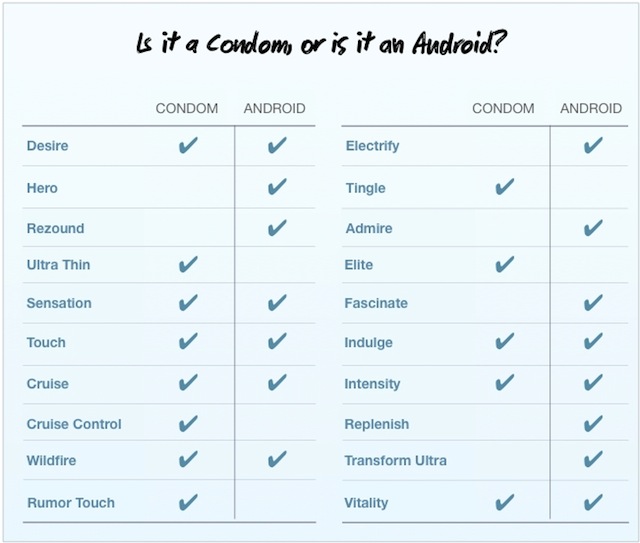
From Gawker comes this article confirming what I’ve long suspected: Android phones often share the same name as condoms.

Boston Chapter 11: When Hair Metal Attacks

I have, as the regular reader will no doubt have noticed, been remiss in relating the end of the tale about the adventures experienced on the road to Boston. The parts concerning giant prairie dogs, rooftop wonderlands, Guatemalans, and the fury of Nature have been related already, but a cavernous hole remains in my tale, that of our experiences once we arrived.

Fear not, gentle readers, that much-needed hole is about to be filled.

As I related before, we carefully timed our arrival in Boston to coincide with the wrath of Hurricane Irene, which had filled us with some not inconsiderable consternation yet which turned out, truth be told, to be something of a damp squib.

We spent the night–a night which, I might add with a not inconsiderable amount of frustration, we had originally intended to spend in Cincinnati in the care of the pet lesbians–watching reruns of the new Dr. Who on TV, while outside the walls Irene thundered her rage, by which I mean tossed around a few leaves and then slipped quietly away to go sulk somewhere else.

We did, as I mention before, brave the fury of the hurricane to find cheap Mexican food. Along the way, we passed this building, which is apparently for sale.

It’s an old Catholic church, on a large plot of land with an old school (complete with dormitories!) behind it. Apparently, the whole complex is long abandoned and up for sale. Oh, the thoughts that poured through my head, let me tell you…I thought, gentle readers, of secret lairs and poly communes and hacker spaces and, buried somewhere deep don inside, perhaps just a bit of doing something unspeakable on the altar, assuming it’s still there.

Ahem.

The next morning dawned bright and clear, and figmentj soon arrived to carry me off. I was soon able to meet her then-fiancee (and now husband–congratulations, sweetie!), and together they exposed me to downtown Boston, a weird record store, and, God help me, Bulbous Bouffant.

The latter actually came first, and it turned out to be rather a good thing. Had I not been exposed to the wonders of the Bulbous Bouffant, I might have departed that afternoon to wander Boston’s urban delights with my sanity wholly intact, and the consequences of that might have been…unfortunate. We ventured, you see, to a vintage record store.

Dear God, we ventured to a vintage record store.

I am a child of the 80s, by which I mean a teenager of the 80s, and so I’ve lived through what is arguably some of the worst pop music the 20th century ever produced. It didn’t seem all that bad, at the time; but I suppose it is always hindsight that reveals true horror. While we’re in the thick of it, our brains shut down, a protective measure gifted to us by millions of years of evolution and an ancestry made up of hunter-gatherers who were often so busy fighting of leopards with their bare hands that they couldn’t afford to spend the time to think “Holy shit I’m fighting off a motherfucking leopard with my motherfucking bare hands!” And so, during the 80s, it all seemed totally natural and normal that we would listen to music produced by emotionally volatile prima donnas with bleached hair teased to within an epsilon of reason and sanity on the illuminating topic of how bad they got it for teacher.

All this I knew, having, as I mentioned, lived through it, though that doesn’t mean I was quite prepared to come face to face with that unfortunate chapter of musical history, in the form of…

…Christian hair metal.

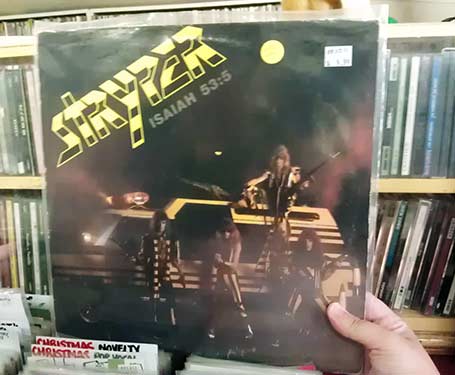
For those of you unfamiliar with the genre, which as near as I can tell both began and ended with Stryper, let me repeat that: Christian hair metal.

Christian hair metal is a microcosm of one of the most knotty and intractable problems of theology; namely, how can a divine being who is both good and just allow evil to exist? On the one hand, the fact that Christian hair metal ended with Stryper is evidence of God’s bountiful mercy toward His creation; but on the other, the fact that Christian hair metal began with Stryper is inherently at odds with the notion that there exists anything which is beneficent or just anywhere in all that which is or ever will be.

That wasn’t the real horror, though.

The real horror was lurking for us over the checkout counter.

Yeah, I got nothing.

The horror of my adolescence relived, we headed out to Boston Commons.

I have a soft spot in my heart for Boston Commons. I’ve been there a few times now, and one of the best memories I have of my sweetie Shelly involves the two of us watching the two happiest puppies in the world playing with each other on the grass on a beautiful spring day there, many years ago.

On this particular day, a bit more blustery and less sunny than that day, there were no surrealistically happy puppies rolling around with each other. There was, however, a man passing out flyers and railing against the perceived deficiencies of the public school system.

I spent most of my formative years in southwest Florida, where I received, it must be said, rather a good public-school education. Upon leaving that state, for reasons far too complicated to relate here but involving some of the more appalling shortcomings of the capitalistic system under which we live, I landed for a time in Georgia, where I spent a few years being knocked about by that very same capitalistic system. While I won’t bother to give you the details, I can offer this bit of hard-won wisdom: Should you ever be given the opportunity to become a minority partner in a desperately underfunded tech startup, run. Run your ass off. Don’t look back.

But I digress.

The upshot of all of this is that I am deeply inculturated with the ideas and values of the American South. So I can be forgiven, I hope, for assuming, when confronted with a man in a public park angrily carrying on about the shortcomings of the public educational system, if my first impulse was to assume that he wanted the subject of evolutionary biology struck from the curriculum, or wanted to bring back a mandatory hour of prayer to the classroom, or something else along those lines. It has generally been my experience, you see, that when someone complains about the quality of education in the twentieth century, it’s because he wants to bring it back to the eighteenth.

So it was with quite some surprise and pleasure that I listened to him for a bit, and read the pamphlets he was handing out, and I learned that he was arguing in favor of teaching critical reasoning and analytical thought in the public classroom, and proposed a course of study rich in mathematics, science, and logical reasoning.

One day, Boston, I will return to you. Even if only for a short time. Oh, yes, I will.

My tale is at this point nearly finished; there is little left to relate save for the bit about the elephants, which will have to wait until next time.

Love, love, love: where the Greeks went wrong

Everyone who’s ever had a liberal arts background, and most folks who’ve ever spoken to someone with a liberal arts background, and some folks who’ve never done either but who’ve talked about the philosophy of polyamory for any length of time, are probably aware that the Greeks, who loved creating classification systems for things almost as much as they loved war, developed a classification system for love.

In the Greek system, there are four distinct types of love. They believed in Agape, unconditional all-encompassing love like the love of the gods for humans (presumably just before the gods kill lots of people in an earthquake or a flood or something); Eros, or passionate love, usually (but not always) sexual; Philia, or friendship love, of the sort between comrades (and later used by psychologists for sexual kinks that most folks don’t have and usually that the psychologist in question doesn’t quite understand); and Storge, or familial love.

It occurred to me while I was preparing to shower this morning, as such things often do, that the Greeks missed a couple of types of love in their categorization.

Now, I am aware that the Greeks were legendary for their considerable talents in sorting and labeling things, an art they developed to such an advanced degree that their philosophers even devised classification systems for people (bronze, for slaves; silver, for tradesmen and politicians; and gold, for philosophers)…so it is with the greatest trepidation that your humble scribe dares to suggest that the Greek taxonomy of love might in the slightest way be lacking.

However, as much respect as I hold for their considerable skills at pigeonholing (and believe me, I hold it in exactly as much respect as it so richly deserves), I feel I must point out that their system is incomplete.

So I would like to propose two additional categories of love:

Orwellos, for compulsory love that is mandated by authority, such as the love of Big Brother, the love of Kim Jong Il, and the love of various hypothetical divine entities who love you in return but will cast you into a lake of fire if you fail to love them enough, or love them in the wrong way.

Stockholmia, or the love of one’s abuser, such as the love of Patty Hearst for the Symbionese Liberation Army and the love of Linux users for Linux.

There may yet be a seventh category of love, for love of people for political institutions which act against their interests, though it is not entirely clear to your humble scribe whether that’s an entirely separate category of love or simply a combination of the last two.

Edit: After further consideration and consultation with zaiah, I have come to the conclusion that the love of people for politicians and political parties who act against their interests is indeed its own unique form of love, rather than being a combination of Orwellos and Stockholmia.

I would therefore like to propose a seventh type of love. Following slutbamwalla‘s brilliant suggestion, may I propose:

Santoros, the love that people have for politicians or political organizations who appeal to their sense of identity while simultaneously acting against those people’s own interests.

Science: Not perfect, but just a bit better than most other systems

On another forum I read, someone made the claim that in science, politics and general human fallibility get in the way of learning the truth just as they do in all other areas of philosophical endeavor, and ended with “Science is little more or less immune to this effect.”

Which is, when it comes right down to it, totally wrong.

The entire point of using the scientific method as a means to understand the physical world is that science is, at least slightly, more immune than most other human endeavors. There are three reasons for science’s resilience when compared to other human institutions: skepticism, replicability, and peer review.

Skepticism means deliberately mistrusting your data, even if it says something you really really really really want it to say. Science works very hard to get rid of things like confirmation bias. It’s not always perfect, but at the end of the day it’s pretty damn good.

Replicability says that if something is true, it’s true for everyone, regardless of belief or political persuasion. If I measure the gravitational constant, and some guy in Iran measures the gravitational constant, if our measurements are correct they will be the same. No matter what philosophical, political, or religious differences we have.

Peer review means nothing is taken on faith. There are no holy fathers in science, no infallible popes. No matter how renown, popular, or revered a scientist is, if he’s wrong, he’s wrong. Einstein got some things wrong. So did Newton. Everyone’s work is checked. Nobody’s work is taken at face value. Everyone’s data is analyzed. Everyone’s results are scrutinized. From time to time, a scientist might try to bully his way into acceptance, sure; scientists are, after all, only human. But peer review has a way, eventually, of correcting their errors.

No human endeavor is perfect, but those built-in checks do mean that science tends to be self-correcting to a degree that most other human endeavors are not.

It is this fundamental attribute of the scientific method–its self-correcting process–that is the single most valuable thing about it. The scientific method does not guarantee happiness or justice or peace or validation. It does not guarantee that the results it offers will be what we expect them to be, or even that they will be comprehensible to us; the more we learn about the laws of nature on a very small and a very large scale, the stranger they seem to our intuition. It offers only one thing: the ability to model the physical world in a way that is consistent with observable reality.

But that one thing it does, it does very, very well indeed.

Up your bumper, Rush Limbaugh

Some time ago, before Rush Limbaugh and his buddies launched their all-out assault on women in their effort to give the Democratic party a landslide victory this November, I created a bumper sticker over at Cafepress: “I (heart) Sex and I Vote”.

I abandoned Cafepress years ago. However, this sentiment seems far more relevant and necessary today than it did back then, so I’ve set up the store again.

So, here it is again. If you’d like to show Rush’s fans how you feel about sex, click here!

I’ve also created icons suitable for LiveJournal, Twitter, and other blogs and forums from the same design, which you are free to download and use however you’d like:

100×100 pixels

80×80 pixels

Some Thoughts on Radical Honesty

A couple of weeks ago, before I travelled to the UK, I was home watching old episodes of the TV show Bones on Netflix. If you’ve never seen the show, it’s about a beautiful forensic anthropologist with an inability to relate to other people’s emotional state that’s as tenuous as a BitTorrenter’s understanding of intellectual property, a dashing FBI agent who has a startling lack of ability to think outside the box, and the wacky hijinks that ensue in the world of forensic science because each is too cowardly to admit that they fancy the other.

One particular episode I watched centered around a group dedicated to the idea of “radical honesty.” As might be expcted from a mainstream television show written for a mass audience by generally competent but not particulalry brilliant writers, the show’s main characters spent some time debating the merits of complete honesty in interpersonal relationships, and wacky hijinks ensued. In the end, cultural norms were validated, the easiest answer was reached, the bad guy was arrested, and everyone was happy.

Something left me flat about the episode, and after processing it for a while, I figured out what it was. Any discussion about radical honesty invariably ends up getting framed as a question about whether or not being honest all the time is good, and that is a terrible way to look at the question.


It has been my experience that people dedicated to the Radical Honesty™ movement tend to be, not to put too fine a point on it, rather horrible people. Now, I’m sure there are absolutely lovely, smart, compassionate folks who are part of the whole Radical Honesty thing…but I have yet to meet any.

The folks I have met to advocate Radical Honesty™ tend to fetishize blunt, unvarnished, raw communication, at the expense of compassion or of any sort of concern for the emotional response of the people to whom they are speaking. Like the main character in Bones, they tend to display a lack of empathy toward their fellow human beings that, from the outside, borders on active hostility.

And that’s unfortunate, because it means that conversations about Radical Honesty almost always end up being framed in terms of “Is honesty good, or do we need little white lies and other small deceptions in order to make civilization go?” The debate gets set in terms of honesty vs. dishonesty, and that’s a damn shame.

To me, it seems self-evidently obvious that honesty in one’s romantic affairs is not just the best policy, it’s the only policy that’s likely to lead to healthy, secure relationships. Debating the relative merits of honest relationships is, to me, as pointless as debating whether “round” is a good general shape for a wheel.

I advocate, absolutely and without reservation, for honesty in relationships. That would, at first blush, seem to put me square in the same camp as the Radical Honesty™ folks…and I still can’t abide them.

To understand why, one need only consider the question “Does my butt look big in this?”


It is a fact of the human condition, as sure and immutable as the fact that night follows day: Whenever anyone discusses the idea of honesty in a relationship, at some point the conversation will turn to “Does my butt look big in this?”
Those who advocate for dishonesty will say that the easy, comforting answer, the flattering lie, is best. The Radical Honesty™ crowd will say that telling the truth gives the other person the opportunity to learn the valuable life skill of Not Taking Things Personally…and besides, you’re not responsible for someone else’s emotional state anyway.

And they’re both wrong.

The question “Does my butt look big in this?” is almost never about the clothing in question or the butt in question. (I won’t say it’s never about that; the speaker might be getting ready for a job interview or a date or something, and looking for advice on the most flattering outfit to wear. But that’s very situational.) Instead, the question is almost always about something else–a passive way to fish for compliments or validation, an expression of body-image insecurity, something like that.

The white lie–“Yes, dear, your butt looks magnificent!” if it doesn’t–does little to address the real issue. And the person asking the question is unlikely to believe the answer, anyway.

But the Radical Honesty™ answer is no better; in fact, it’s worse. “Your butt looks big no matter what you wear” also does nothing to address the real issue, but on top of that it’s pointlessly, needlessly cruel.

It is possible to be honest without being cruel. That’s the part the advocates of Radical Honesty™ rarely get right. “I like your butt better in the polka-dotted skirt” might be an honest answer. “I love you dearly; there’s no reason to worry about your butt, because that’s nothing to do with the reasons I love you” is another.

Honesty without compassion is rubbish. The question should not be framed as “Which is better, honesty or dishonesty?” but rather “How can we strive for absolute honesty in a framework of respect, compassion, kindness, and sincerity?” All too often, when the question is framed as Radical Honesty™ vs. The Little White Lie, the only compassionate answer is The Little White Lie, because the philosophy of Radical Honesty™–at least as I’ve seen it practiced–treats compassion with disdain, or even contempt.


Honesty is the best policy. Being honest is an absolute prerequisite for healthy relationships. But honesty does not excuse indifference to the feelings of others. Poor behavior is poor behavior even when it’s wrapped in the cloak of honesty.

The same is true, I think, of many different ideas about relationships.

There are a number of relationship philosophies that I think are absolutely essential to healthy positive romantic relationships. Other than honesty, they include the notion of accepting responsibility for one’s emotional state, being willing to accept and work through issues such as personal insecurity, and being willing to accept responsibility for wrongdoing without externalizing blame, among others.

Essential to all of these, though, is compassion and respect for the particular feelings and experiences of other people.

Unfortunately, I have seen examples of situations where people use every one of these principles as a blunt instrument against others. Any one of these can be subject to the Radical Honesty™ Effect–enshrinement of the principle above the basic rules of decency, to the point where adhering to the principle becomes validation enough that compassion can be discarded.

I’ve seen the idea that we are all responsible for our own emotional state become distorted by the Radical Honesty™ Effect in some parts of the poly community, where it seems to be taken as a code phrase for “I can do whatever I want to you, and no matter how it makes you feel, that’s your shit to deal with, not mine.”

With personal responsibility, as with honesty, there are compassionate ways to interact with others, and there are ways that suck. The notion that we are all ultimately responsible for our emotional states does not, in point of fact, justify one in being an arsehole, any more than honesty does.

Radical Honesty™ can become an excuse to say whatever’s on your mind without regard to the effect your words will have. The idea that we are all responsible for our own emotions can, if not watchdogged, become an excuse to behave however you like without regard for the way it affects other people. Unfortunately, what that means is that debate about either of these things tends to get framed in some unfortunate ways–honesty vs. dishonesty, personal responsibility vs. projecting responsibility for the way you feel onto others–that miss the real heart of the matter.


The heart of the matter, as far as I am concerned, is “What can I do to make my relationships stronger, built on a foundation of integrity and trust, and to help the people around me feel supported, cherished, and loved?” I don’t feel that dishonesty, whether in the form of “little while lies” or otherwise, does that; but I also don’t think that saying “Man, that dress makes your butt look like two enraged hippopotamuses dueling with light sabers under a circus tent!” does that, either. I don’t think that enabling insecurity by accepting responsibility for the emotional experiences of my partner does that; but I also don’t think that saying “Tough shit, that’s your issue, you deal with it” does that, either.

It is possible to be compassionate without sacrificing any of these ideals, which is something I rarely seen talked about in any conversations about them. In the case of a person struggling with some kind of negative emotional response, it can be as simple as “I see that this is something you are having difficulty with. I want to help support you and give you safety while you come to terms with it. Let me know how I can make you feel cherished and loved. If you need more of my time and attention while you deal with this, I am here for you.”

The key here is that any philosophy, even if it is true, does not excuse one for being a douche. This probably should be self-evident, but apparently it isn’t.

Another day, another massive Dreamhost hack attack

A few months back, I wrote about a WordPress attack that affected a friend of mine. The hack was aimed at WordPress installs, and planted very subtle modifications to core WordPress files that redirected users to spam pharmacy sites.

At first, I thought the attack was aimed at unpatched WordPress sites, though my friend’s site was fully patched and updated. As I pursued the patch, I started noticing that a highly disproportionate number of the hacked sites were hosted on the same Web hosting provider my friend’s site lived on: namely, Dreamhost.

Dreamhost, as I observed later, seemed to be hosting quite a number of these hacked sites. And more worrying, the sites were generally fully patched, suggesting somesort of zero-day exploit against Dreamhost’s Web hosting servers.

I made note of it, fired off some emails to Dreamhost’s abuse team, and forgot about it.

Fast forward to today.

Today, I received a number of spam emails that used redirectors planted on hacked sites to redirect to a spam pharmacy page selling fake Viagra. More concerning, the site appeared to be attempting an exploit to download malware. It’s an exploit I’ve seen before, often used to distribute the W32/ZeuS banking Trojan.

In the spam messages I received, the redirect file had the same name: “jbggle.html”, So, curious, I did a Google search for sites with this filename in the URL and discovered quite a large number of hacked sites that redirect to the same spam pharmacy page:

http://cottinghamhuntingclub.com/images/fbfiles/avatars/gallery/jbggle.html
http://www.hesslerdesign.com/clients/alkarsteel.com/images/navigation/jbggle.html
http://theaquilareport.com/images/fbfiles/avatars/gallery/jbggle.html
http://view.ghava.org/cache/Inspiration/Moving_imagery/Stop_frame_animation/Kristofer_Strom/jbggle.html
http://ketchup-mustard.com/sketchbooks/jbggle.html
http://irenderer.com/photo/data/seasonal/1171063984/jbggle.html
http://hisdoulos.com/media/wpmu/uploads/blogs.dir/3/files/jbggle.html
http://bahiarestaurant.net/administrator/components/jbggle.html
http://www.mcc-studio.org/components/com_flexicontent/librairies/phpthumb/cache/source/jbggle.html

*** WARNING *** WARNING *** WARNING ***

All these URLs are live as of the time of this writing. All of them will redirect you to a spam pharmacy Web site which may also attempt to download malware on your server.

And interestingly, ALL of these Web sites is hosted by Dreamhost. Every. Single. One.

I strongly recommend that people steer well clear of Dreamhost. I have not seen this level of compromised Web sites on a single server since the zero-day exploit against iPower Web several years ago.

Dreamhost’s security team seems unwilling or unable to deal with this problem, which is quite disappointing for a large, mainstream Web hosting company.

Edited to add: Within minutes of this blog post going live, I received an email from Dreamhost’s security team that they had started examining the sites on their servers to remove these redirectors. It is not clear from the email whether or not they have identified the exploit being used to plant them, or indeed intend to do so.

So what IS wrong with rules, anyway?

I’m currently in the small coastal town of Brighton in the UK, a couple hours from London, staying with friends of emanix‘s. I’ve been severly jetlagged since I arrived in the UK; as near as I can tell, my internal clock, not sure whether to remain on Portland time or change to London time, has compromised by splitting the difference, and I am now on what would be a reasonable schedule if I lived in an empty spot of the Atlantic Ocean about 600 miles off the coast of New York.

As a result, I awoke at about 6 AM local time (or 10 PM Portland time) and couldn’t get back to sleep, so I turned to Twitter for solace.

One of the first tweets I saw asked a question about polyamorous relationships: If the people involved in the relationship are happy, what’s wrong with having a rules-based relationship?

Now, anyone who’s read anything I’ve ever written about relationships at all knows that I’m not a fan of relationship rules. To get a sense of why that is, one need only read here or here or..well, almost anything else I’ve ever written about polyamory.

But I still think it’s a fair question. As long as the people involved in the relationship are happy, what’s wrong with having a rules-based relationship? Is there really anything so bad about the idea of rules?

I thought about it for a bit, while struggling unsuccessfully to get back to sleep. And I think the answer is that yes, there is a fundamental flaw in the notion of rules-based relationships.

But before I get started on that, some background.


There are folks in the world who simply don’t like rules, and reflexively reject any form of rule as an unwarranted imposition on their freedom.

I am not one of those people.

My objection to rules in poly relationships does not come from an inherent dislike of rules in general. Far from it; when I first started this whole business of relationships, about twenty-six years ago, rules seemed like a natural and comfortable fit, a simple and obvious way to keep the relationships I was in stable and to keep the wheels from flying off unexpectedly.

And in fact there are quite a lot of rules in many parts of my life. I like games that have lots of rules. My relationship with zaiah is a strange switchy quasi-D/s thing that is evolving rather a complicated set of rules, which we have taken to writing down in a special book. So I’m not simply opposed to rules per se.

Also, I’m not much in to the notion of dictating to others how to live their lives, though I speak with certainty and as a result folks often believe I’m being prescriptive in the things I say. My ideas about polyamory tend to be predicated on what I have observed working and what I have observed not working; I’m enough of a pragmatist that what succeeds and what fails is much more interesting to me than what’s “right” and what’s “wrong” when it comes to relationships. (The definitions of “success” and “failure” are, of course, subject to interpretation, and that’s something I’ll touch on in a minute.)

All of my relationships have always been polyamorous. I have never once in my entire life had a monogamous relationship. Still, I did grow up in a culture where monogamy is the norm, and it seemed quite natural to me that such an unconventional relationship style must have some sort of system of rules in place in order for everyone to feel safe.

For many, many years, my “primary” partner (and yes, I did have a hierarchal primary partner) and I had a complex set of rules about who, when, where, why, and under what circumstances each of us could have another partner.

And it worked just fine for us, so there’s nothing wrong with that, right?

Except that, looking back, no, it really didn’t. And that brings me to reason #1 why I’m deeply suspicious of rules-based relationships:

#1. “It works for everybody” rarely, if ever, means it works for everybody.

It has been my experience that people who talk about agreements and rules which work for them usually–indeed, almost always–use a definition of “for them” that includes only “for the original people (often the original couple) in the relationship.” The impact of those rules on anyone who might come into the relationship later is seldom if ever considered. A person who enters the relationship is fenced in with a ring of rules, to contain and minimize the perceived threat that person represents; and if that person should find the rules unacceptable, or run afoul of the rules and then be ejected from the relationship, this isn’t seen as a failure of the rules. It’s seen as a failure of the person. “He isn’t REALLY poly.” “She was too threatening.” “He didn’t respect me.” Almost invariably, fault for the failure of the relationship is shifted onto that third person…but as long as the original couple remains together, the rules are working, right? And if the rules are working, what’s the problem, right?

Now, if I were to go back in time about ten or fifteen years and ask my earlier self “Are your rules working for everyone involved?” there is no doubt that that younger self would answer “yes” without the slightest hesitation.

At the time when i first started with rules, I believed they were necessary because, somewhere deep down inside, I believed that without them my relationship could not survive. Without rules, what would keep my partner with me? Without rules, how could I be sure my needs would get met? Without rules, how could I hope to hold on to what I had?

And I would have said that they worked for everyone, including my other non-primary partners, not out of malice but out of sincere belief, because…

…and this is a lesson it took me a very long time to learn…

…it is almost impossible to be compassionate, generous, or empathic when you are filled with a fear of loss. So certain was I that the rules were necessary in order to protect myself from losing what I had, so afraid was I that without them I would lose everything, that not only did I not see the way those rules fenced in and hurt my other partners, I could not see it. It was as invisible to me as the concept of “wet” is to a fish.

Relationship rules and fear of loss often seem to go hand in hand in poly relationships. People who make rules don’t do it at random; they do it because, as was the case with me, it feels necessary.

We live, after all, in a society that holds very tightly to the notion of “the one” and “true love” and teaches us, from the moment we draw our first breath to the moment we take our last, that anything which interferes with the idea of couplehood represents a grave threat. Without sexual fidelity, there can be no commitment. Without commitment, there can be no safety, no security, no expectation of continuity.

Polyamory throws all that into question, yet we are still products of the ideas with which we’re raised; even someone who truly believes in loving more than one can fall prey to the idea that inviting someone else in is a threatening thing to do, fraught with peril.

Which brings me to reason #2:

#2. A rule can not, and never will be able to, fix insecurity.

Insecurity sucks. Believe me, I know. It’s one of the worst feelings in the world. When your partner does something that triggers a feeling of insecurity, the only thing you want to do is make that feeling go away.

It is natural, easy, and obvious to think that if your partner does something that brings on these awful feelings, if you pass a rule forbidding your partner from doing that thing, you need not worry about that feeling ever again.

So naturally, the rules that I had with my former primary partner largely revolved around things which triggered insecurities. Anything that felt like it threatened or diminished feelings of specialness, anything that seemed to take away from the things we most valued in each other, anything that got too close to home, anything that seemed to distract us from focusing on one another…all these things became fair game for rules-making.

These rules, of curse, were almost always applied to other partners rather than being made with other partners. We were the architects; other people were the subjects of the rules. Even when we negotiated them in the presence of “secondary” partners, it was very clear that they existed to protect us from them, not them from us. No matter how the negotiations were done, the power flowed in one direction only; they “worked for” a secondary partner in the sense that such a person could accept it or leave, no more. In that sense, they existed–deliberately, by design, though I would not have put it this way back then–to work against other people.

The idea that a system of rules can protect against insecurity, as seductive as it is, is ultimately bankrupt. The thing about insecurity is that it creates its own world. When you feel afraid of loss, or feel that your partner doesn’t value you, or feel that you’re not good enough, confirmation bias works its evil magic and you find evidence to support that belief everywhere.

Seen though the peculiar lens of expectation, everything becomes proof of your deepest fears. And no matter how many rules you pass, that never, ever goes away. The little fears whisper in your brain, all the time, like Gríma Wormtongue in The Lord of the Rings, planting its poisonous seeds in your brain. No matter how quickly you make rules to stamp out its triggers, the insecurity remains.

It is possible to overcome insecurity. I don’t think anyone ever really starts out secure and well-centered; it takes deliberate effort. I was not able to do it myself until the day come when I was able to take a leap of faith, cast aside the rules, and blindly trust that my partners loved me and cherished me and wanted to be with me despite all the fears that screamed in my face.

It took a tremendous amount of courage to do that. Which leads into the third reason I am skeptical of rules:

#3. Rules often inhibit growth.

There was a time in my life when I was dreadfully, powerfully insecure. I was never quite 100% sure why a partner would be with me, nor that if a partner were with someone else what she’d need me for.

Today, those feelings seem alien to me, like something that happened to some other person whose memories I have inherited but can’t quite connect with. Today, I build relationships that are powerfully secure, and I trust implicitly in my ability to construct a stable foundation of safety and security. More than that, though, I am secure inside myself. I am confident in my value, but also confident in my ability to grow and to be happy even if one (or more) of my relationships should happen to fail.

And indeed, that’s the only kind of security that is, or ever can be, real. No matter what promises I extract or what rules I make, there is nothing that can guarantee my lover won’t be struck by a bus, or develop a terminal disease, or even simply decide she’s had enough and leave. Nothing can ever keep me safe from loss; any such safety can only be an illusion. But I don’t need it; I know that should I feel loss, I may hurt, but I will survive, and ultimately I will be happy.

Many years ago, I had a friend who had an enormous pet iguana. Whenever she reached into its cage, it would lash at her with its tail. She would jump, then reach in again, and it would docilely allow her to pick it up.

On one occasion, after this ritual had played out, she said to me “I wish it would hit me, just once, so I would know what it felt like and I wouldn’t have to be afraid of it any more.” The older I get, the wiser that idea becomes.

There is a powerful lesson here. Just as you can never be compassionate when you’re filled with fear of loss, you can never be secure if you believe that you absolutely can not survive without your partner.

And you can never know that, or know that your partner truly cherishes you and wants to be with you, until you can gather the courage to face the fear of loss head-on, directly, no matter how much it scares you.

Until the day came that I was able to say “This scares the crap out of me, but I want to see if my insecurities are true, I want to see if what they’re warning me of will really happen,” there wasn’t anything I could hope to do to stop myself from being insecure.

And now that I have done that–now that I have slipped off the leash of rules and said to the people I love “Here are the ways you can cherish me; you are free to do whatever you want, to make whatever choices you think are necessary, and I will trust that you will make choices that show you cherish me”–I do not think I will ever feel insecure again.

It takes, unquestionably, a great deal of courage to step away from the safety and comfort of rules. However, once that is done, the fourth problem with rules-based relationships becomes obvious:

#4. The safety that is offered by a framework of rules is an illusion.

When I was in a hierarchal, primary/secondary relationship, the rules that my primary partner and I used to fence in secondary partners felt, to those people, like gigantic walls of stone and razor wire.

For the people upon whom such rules are enacted, that is quite common, I suspect. Such people rarely have a voice in those rules, and yet often end up hanging their entire relationship on the wording and interpretation of the rules, always knowing that a misstep or a changing condition can be the end of the relationship. Many folks who claim primacy in a primary/secondary relationship often say they need rules because otherwise they don’t feel “respected” by secondary partners, yet it’s difficult to be respectful when one feels hemmed in, encircled by walls, and knowing that one’s relationship is always under review.

But from the position of the primary partner in a hierarchical, rules-based relationship, I always knew that to me, they were nothing but tissue paper. The rules which were so immutable to a secondary partner applied to me only for so long as I chose to allow them to apply to me.

And when the day came, as it finally did, that I looked past my own screaming insecurities and my own well of fears for long enough to see–really see–what this structure of relationships was doing to my secondary partners, how it was constantly placing them in a minefield where what seemed to them like even a trivial miscalculation could bring down the wrath of the furies upon them, I decided that I could no longer in good conscience bear to subject people to this sort of environment, and I ended my primary relationship.

Just like that.

All the rules, all the covenants, all the agreements, all those things were no more effective at keeping me in the relationship, in the end, than a rice-paper wall is effective at stopping a charging bull.

Rules can not make someone stay. Once the decision is made to go, no rule will prevent it. That fortress that seems so impregnable, that seems able to give safety and security in a frightening world, is made of mud and straw.

Now, for folks who believe in rules-based relationships: Maybe your experiences are different from mine. Maybe you have rules that are considerate, compassionate, equitable, and kind. But are you sure?

If you were to talk to that version of me fifteen or twenty years ago, and ask him how he felt, he would absolutely tell you that all his rules were both necessary and fair. It’s a near-universal truth of the human condition that when you’re mired in your own emotional responses, it’s damn near impossible to see someone else’s. Even when partners told me that they felt unsure of their place in my life, or that the structures of my primary relationship put them in a tenuous position, it was easy for me to believe that the fault must lie with them and not with me…if I was even able to hear that much at all. It is very, very hard to understand your own strength when you feels weak, and to understand how you hold all the cards in an established relationship when you feel threatened by the newcomer.

The question “What’s wrong with having a rules-based relationship?” is absolutely a legitimate question to ask.

I’d like to flip it on its head and approach it from the other direction, though. Why have a rules-based relationship? What is the purpose of structuring relationships around rules? How, for those of you who feel the need for rules, would you complete the sentence “I have rules to structure my relationships because without those rules, the bad thing that would happen is ____?” What is it about rules that feels necessary, and how exactly do they serve to fill the function they are intended to fill?