When big tech gets careless: Google Forms spam

So lately, I’ve seen a thing in my inbox. Well, I mean, I see a lot of things in my inbox, but this is an annoying thing: 419 scams inside Google Forms invites.

I’m getting a ton of these:

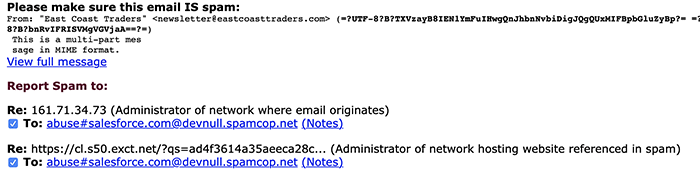
Google forms spam

In spam fighting communities, these are called “419 scams,” from Section 419 of the Nigerian criminal code. Most of them originate from Nigeria, and they’re a form of scam called “advance fee fraud,” where the scammer promises to give you a lot of money if you just pay these fees (bank certification fees, wire transfer fees, blah blah blah whatever) in advance. You pay all the fees and then you get…nothing. That’s it. That’s the whole scam.

I’ve noticed an absolutely enormous uptick in 419 scam emails using Google Forms as well. In fact, I’ve spent the past few weeks collecting examples and figuring out what’s happening, and I think I have a handle on what’s going on.

419 scams are a large, bulk-market business. Maybe 1 person in 10,000 is dumb enough to fall for these scams. (Fun fact, the scammers use the slang term “maga” to refer to the dupes fooled by these scams; in a pidgin of English and Yorùbá often used by these scammers in Nigeria, “maga” means “fool.”) That means a 419 scammer has to send a lot of emails to succeed.

But spam filters, especially Bayesian filters, have become really, really good at detecting 419 scams. In fact, many spam filters actually have “probably 419” as one of their identifiers for spam email.

Enter Google.

Google lets people send emails for free using Gmail. However, Gmail mail gets passed through normal spam filters, which flags the bulk of 419 scams.

However, Google has a service where you can create a Google Form and then invite people to visit your Google Form. And for some reason I don’t understand, outgoing invitations from Google servers for a Google Form don’t pass through Google’s spam filters—don’t ask me why.

Furthermore, the Google Form header or HTML wrapper or something seems to prevent client-side or email-host-side spam filters from identifying the emails as 419 scams, too. Why? ¯_ಠ

For whatever reason, 419 scams that appear within the body of a Google Form invitation fly right past spam filters. As soon as the 419 scammers discovered this, they were all over it like flies on cowshit. At the moment, I’m receiving several of these emails an hour.

It started a few weeks ago and shows no sign of letting up. I’ve emailed Google’s abuse team multiple times about it but so far no reply.

Check out my new book!

2020 has been a bit shit, no question about it. However, it’s also been the most creative year of my entire life, in no small measure because I’ve been spending all my time at home away from people.

I’m pleased to announce that one of the many projects I’ve been working on, a new novel with the delightful Eunice Hung, is now coming to fruition.

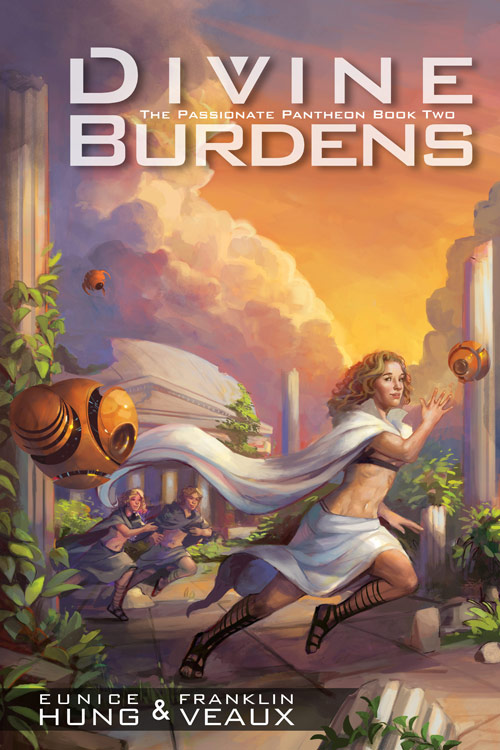
We have written the first in a series of far-future, post-scarcity erotic science fiction theocracy novels called The Passionate Pantheon. May I present: The Brazen Altar.

The book doesn’t publish until May 1, 2021, but you can get a copy before then and also help show there’s a market for smart, literate erotica with nuanced characters and rich worldbuilding! The book is live now on Indiegogo, and you can get it early for less than cover price!

The followup novel, Divine Burdens, publishes Fall 2021. Want to find out more about the world of The Passionate Pantheon? The Web site for the series is live! I guarantee you’ve never seen erotica anything like this before.

Apple Silicon and losing our legacy

[Edit] This post sparked a conversation on Ycombinator!

I am concerned about Apple’s move to its own home-grown processors.

It’s not because I’m worried about the new silicon, or Apple’s ability to make high-performance CPUs, or even because I am worried about changing architectures. I survived the move from Motorola 68K processors to PowerPC, and PowerPC to Intel.

I’m still using High Sierra on my 2016 MacBook Pro. I still have legacy 32-bit software I use professionally, and I also boot this computer into Windows with Boot Camp to play games like Fallout 4 and Witcher 3 that won’t run in Parallels.

I am concerned about the switch to Apple Silicon because I’m worried about what it means to archivists and historians.

I understand why Apple is doing it. I get it, I do. But I’m really worried about what it means to the legacy of the late 20th century.

Desktop publishing revolutionized human communication. It’s hard to overstate what a Big Deal desktop publishing was. It arguably democratized communication more than any other invention since the printing press. It fueled an explosion of creativity and led to a boom in the underground ‘zine scene.

PageMaker, the first DTP software, revolutionized entire industries…plural. Overnight the entire publishing community moved to it.

And, of course, mergers and acquisitions happened as the disruption shook itself out. Aldus, the startup that created PageMaker, got swallowed by Adobe. Quark arose to compete, and a lot of the industry jumped ship, since QuarkXPress was objectively better. Then Adobe created a new program, InDesign, which was objectively better than QuarkXPress, and the industry moved on. That’s how capitalism is supposed to work, right?

But here’s the thing:

A vast chunk of the history of desktop publishing, including countless underground ’zines of significant cultural and historical value, are still tied up in old files. Old files that can still be accessed, albeit with difficulty.

InDesign CS6 can open PageMaker and QuarkXPress documents. Later versions dropped the ability to open PageMaker files.

Old Mac emulators like SheepShaver can open even older files, by running ancient PowerPC apps directly. I recently rescued a bunch of old ‘zines I published in the early 90s this way.

But a window is closing.

It’s starting to close even without the move to Apple Silicon. When I set up a SheepShaver PowerPC Mac emulator to install the software to rescue these files, one of the pieces of software tried to contact activation servers that went offline in 1999. I had to do a bit of hacking to get the software to install.

I opened PageMaker 4 files in PageMaker 6, opened the PageMaker 6 files in InDesign CS6, and opened the InDesign CS6 files in InDesign 2020.

I opened Macromedia Freehand files in Freehand, saved them as EPS, opened the EPS files in Illustrator 6, saved them, and opened them in Illustrator 2020.

Now here it gets tricky.

InDesign CS6, the last modern app that can read a PageMaker file, won’t run on new versions of macOS because it’s 32-bit only.

It won’t run in emulators like SheepShaver because it’s OS X only.

SheepShaver and InDesign CS6 both won’t run on Apple Silicon.

We are on the cusp of losing the ability to open PageMaker files completely.

In a perfect world, someone would write a Mac emulator that lets you emulate a High Sierra Mac on Apple Silicon hardware, just like SheepShaver lets you emulate a PowerPC Mac on Intel hardware. If you can bring old software and old emulators with you, those people—historians, digital archivists, and the like—can, with enough faffing, still recover the rich legacy of information from the early days of desktop publishing.

But for various arcane technical reasons, writing an emulator for x86–64 on ARM is a huge undertaking, something beyond what an open source project is likely to do. I honestly don’t see the open source community writing a Mac emulator that will run High Sierra on Apple Silicon. Emulating x86 on ARM is an enormous project, one that requires a well-resources company to do.

A company like…Apple.

It turns out Apple has done this. It’s called Rosetta 2 and it’s built into Big Sur.

What I’d like to see is Apple donate code to emulate an Intel processor on ARM to the open source community, so they can build an emulator for Intel Macs. This would permit access to ancient files and legacy software—albeit with rather a lot of faffing—and permit access to apps and files all the way back to the PowerPC (and 68K, since the PowerPC system 9 has a 68K emulator). This would, I feel, show corporate responsibility on Apple’s part, without really costing them anything. The Intel emulation is already done.

But without that? I really do feel we as a society are, in the relentless march of late-stage capitalism, destroying part of our own history simply because there’s no profit in keeping it.

And that worries me.

Fragments of SquiggleCon: Two mottes one bailey

If you’ve read my blog for any length of time, or for that matter been on the Internet for any length of time, you’ve probably encountered the phrase “motte and bailey argument” or “motte and bailey doctrine” before.

A motte and bailey argument is an argument in which you believe something, but you don’t really have a good justification for it. So when you’re attacked, you retreat into a different, much more specific belief, for which you do have a good argument. When the attack is over, you come back out to your original, more general belief, the one that’s harder to justify.

An example of a motte and bailey argument I hear in polyamory circles all the damn time is this one:

“You need to have a veto in your relationship if you want your primary relationships to stay healthy.”

“Veto doesn’t necessarily keep relationships healthy. In fact, using a veto on someone your partner loves can break your partner’s heart, and if you break your partner’s hert then you are going to damage your relationship.”

“But a veto just means you can discuss your concerns with your partner! It means you can talk about problems you see in their other relationships! You favor open communication in your relationships, right?”

“Yes.”

“So you agree, all poly relationships need veto.”

In this argument, the bailey is a need for veto, usualy understood to mean the unilateral and unquestioned ability to end a lover’s other relationship. This is a difficult position to defend, so when called, a person may retreat into the motte (“When I say ‘veto,’ I’m only talking about open communication!”), then, when the argument is over, go back to advocating for unilateral and unquestioned ability to end a lover’s other relationship.

The Motte and Bailey argument comes from a style of fortification called a “motte and bailey,” which is a place where an area of land that’s difficult to defend (the bailey) is overlooked by an easily defensible structure (the motte). If raiders or an enemy army or whatever show up, you evacuate the bailey, bringing all the people into the motte. The he motte can be defended from attack. When the attached tack is over, everyone goes back out into the bailey.

Okay, so now that you’re up to speed…

The town of Lincoln in northern Britain is home to a motte and bailey castle, called, appropriately enough, Lincoln Castle. Naturally, I had to visit.


Lincoln Castle was built somewhere around 1068 or so, and has been in use continuously ever since. It’s an unusual motte and bailey structure in that it actually has two baileys. The motte is a smooth, round valley between two hills. Naturally, since if one is good, two must be better, William the Conquerer built two baileys, one on each hill, and there you have it.

Originally, the motte was completely enclosed by a wood fence, and both baileys were built of wood. It was replaced over the years centuries with beefier fortifications of stone. Today, nothing remains of the original wood structures.

Lincoln Castle is still in use today–the castle is now the courthouse and, from what I gather, capitol building for Lincoln. The rest is an open-air museum. We had a blast running around the place.

Here’s a view from one of the two mottes, looking down into the bailey. The round structure on the left is the fortified gate through the outer wall. The red brick structure to the right is an old Victorian-era prison. The round tower in the background is the second motte, because you know what they say about mottes: you can never stop at just one.

Here’s what’s left of the second motte, seen from the middle of the bailey.

As soon as I found out that Lincoln Castle has two mottes, I immediately, on that very spot, registered the domain name twomottesonebailey.com — though I have absolutely no idea what I will use it for. Suggestions?

The second motte, which is in much better shape than the first. The tower still exists, though most of the rest of it is now a broken, hollowed-out shell in which it would be tremendous fun to film a cheesy low-budget movie.

See what I mean? This place is just screaming for orcs or spectral knights or some sort of special effect where mist flows through the windows before congealing into an undead sorceror or something.

The fortification has two gates, one on each side. Breaking in through one of these gates would be a nontrivial undertaking for sure. In the background, between the two trees, is a place where the wall widens into a large round structure that contains cells where prisoners due to be executed were chained up prior to being hanged–more on that in a minute.

Here’s the actual “castle” bit of Lincoln castle. It has been the administrative center and courthouse for Lincoln for…oh, for longer than the country I live in has been a country, honestly. It’s still used today, which is why I have no photos of the inside. Tourists aren’t allowed in, being that it’s a functional courthouse and all.

The Victorian prison. Touring this was interesting. Whenever I see something like this, I always wonder how many innocent people were sentenced here, and how many people ended up here for political rather than criminal justice reasons.

The inside had rather more windows than I expected, though I suppose in an age without electric lights, that makes sense.

Prisoners were kept in cells lining both sides of the stacked corridors. The building is divided into two halves, one for male and one for female prisoners. More on that in a minute, too.

Some of the cells were used by the prisoners to do tasks like washing laundry, making bedrolls, or stamping license plates.

This left fewer cells for actual housing of prisoners, so they were stacked in like cordwood.

Though to be fair, I have stayed in a hostel whose accommodations were roughly similar.

This being Victorian times, God was kind of a big deal (those Victorians were quite the bunch of God-botherers, even as they did the most ungodly of things), so of course the prison had a chapel, and of course, attendance was mandatory.

Each pew was a separate room, divided from its neighbors by a little door, presumably to make it more difficult for the prisoners to shank each other during services, that being considered rather uncouth and all. The prisoners could not see each other, but the person delivering the sermon could see all the prisoners, cleverly combining the functions of a chapel and a panopticon into one (a Chapelopticon? Panchapelcon? I don’t know). Thus do we see religion reflected in architecture. God sees you, so stop doing that thing you do with your private parts ands that feather duster, you pervert.

I was, while we toured the prison, engaging in cybersex with a lovely woman who lives in Waterloo, Ontario, which was a bit freaky. I have now imprinted on Victorian prisons as arousal triggers. There’s no way that can go wrong.

So yeah, executions. The Victorians were big on ’em. They’d kill you just as soon as look at you. Steal something? Say something bad about the king? Poke a badger with a spoon? You’re a dead man walking.

Or women. They were remarkably egalitarian in the judicial application of death.

They had special cells in that bulge in the wall I mentioned earlier. They look like this:

Each one had a steel ring set in the wall, to which they would literally chain the condemned.

On the appointed day, after the crowds had gathered, they’d unchain the people, lead them out into the bailey, and kill them for the entertainment of the guests justice and peace of the land.

And yes, there were crowds. Big ones. People who lived in houses near the walls would rent out second-story rooms with a view at exorbitant rates to folks who wanted a good view. Apparently, there was a full-on riot on execution day when the star of the show had ruined everyone’s entertainment by committing suicide earlier on–the people demanded to see someone be killed, but the prison didn’t have anyone else to kill that day, and it was all a hell of a mess.

I guess that’s what happens before the age of Marvel superhero movies.

So anyway, one of the Victorian prison wardens was a man of Science, who installed a telescope in one of the mottes so he could look at the stars. Err, yeah, that’s right, the stars. To look at. In the sky. Stars.

Remember how I said the prison was divided into a male and a female wing? Female prisoners were kept in the back, and allowed into an outdoor courtyard behind the motte.

Here’s a view from the observatory the warden built for his telescope.

…yeah. Apparently, from what our tour guide said, he had sevral illegitimate children with several different female prisoners.

Those whacky Victorians, amirite?


There is one other bit I don’t have photos of, because photos aren’t allowed in the super special room where it’s kept: the Magna Carta.

Yes, the Magna Carta, one of the original handwritten copies. It’s here, in a climate controlled room with the text of the thing up on the wall.

And there, right at eye level smack dab in the middle of this enormous wall of text, is Clause 54:

No one shall be arrested or imprisoned on the appeal of a woman for the death of any person except her husband.

Even back then, women’s voices were never taken seriously.

Fragments of SquiggleCon: Writing Erotica

The various evil things spearheaded by my crush notwithstanding, being able to spend time with her in Europe was fantastic fun.

For the past several months, we’ve been talking about collaborating on a writing project. She has built a fascinating world—a quasi-steampunk, high-tech, post-scarcity society with advanced biomedical technology ruled over by more or less benevolent AIs, worshipped as gods, who are fascinated by human sexuality, and so have bent the entire society toward the intersection of sex and religion.

It’s a fun (and hot!) place to visit. We want to create a book of erotic short stories set in that world.

While we were all in Europe, she and I officially started that project…using her body as a canvas. She brought a collection of fountain pens with her. I spent a couple of hours in the orgy room, beginning the writing of the book..on her back.

This his is, I think, probably the most unusual way I have ever started writing a book.

I have no idea when it will be finished; there are a number of writing projects ahead of it, and I’m still shopping for a publisher. (I am considering pitching it to Cleis and Circlet.) Still, I’m really excited about this book!

As a side note, writing on human skin with a fountain pen is remarkably difficult. Also, remarkably fun.

Fragments of SquiggleCon: Sex and Probability

A short while ago, someone on Quora asked the question, What is the kinkiest sex toy you have ever used? It’s a tricky question, but not for the reasons you might think. And I’m afraid the answer involves math.

And prime numbers. Hang on, I’ll get to that.

I own three violet wands. I sometimes use one of them with a body contract probe while I hold a giant Medieval battle axe. Touching someone with the axe causes all these lovely blue sparks to jump from the axe to the person I’m touching. There are folks who think that’s kinky, and folks who are like “Violet wand? Ho hum.”

I have a set of poi-handled floggers. I can spin them the same way I spin fire, flogging the holy hell out of a partner while looking stylish doing it. I recently did so to my wife in front of a small audience. But at the end of the day, no matter how flashy your technique, floggers are still floggers—they’re pretty much entry-level kink toys.

I have a straitjacket I’m quite fond of. I’ve been placed in that straitjacket by my partner Zaiah while she pegs me with a custom-modified strapon.

I have a sound. I got it on my wedding trip; it was used on me by my wife and my girlfriend at one of the wedding orgies. Actually, I now have two sounds, one of which I got recently in Boston—that will be the subject of a future episode of this series. (It involves churches and my crush. It’s a good story.)

The sound almost got me in trouble, in fact. I was flying back from the wedding when the TSA agent ran my carry-on bag through the security X-ray multiple times, then finally tore it apart and found the sound, which was tucked (naturally) in my toiletries kit.

“What’s this?” he asked. “Is this a weapon?”

“No, it’s a sex toy,” I said, and explained how it was used. He tucked it hurriedly back in my bag and waved me on my way.

But I digress.

Even a lot of hardcore kinksters wince and cover their nethers at the notion of sounding, but that doesn’t necessarily make a sound a kinky toy; the first time Maxine ever sounded me, she used a smooth aluminum chopstick. Are chopsticks kinky?

That’s the problem with asking “what’s the kinkiest sex toy you’ve ever used?” Kink is in the person using it, not in the thing itself.


So let’s talk kink. And math. And probability. And prime numbers.

Right now, the kinkiest thing in my repertoire is probably this:

It’s a six-sided die, unremarkable except that it’s made of aluminum rather than plastic, because metal dice are cool.

Before I headed out to Europe for SquiggleCon, my wife, my partners, and my crush started a private Facebook group to discuss what to do with me. Or, more accurately, to me.

It was generally agreed that if I was to be in Europe at an extended orgiastic gathering in rural England, I should be in the proper…err, frame of mind for the event.

So the women in my life schemed and plotted, and hatched a Plan.

For the six weeks prior to flying to Europe, I would, each day, roll one six sided die. The day’s roll would be multiplied by the previous day’s roll, producing a number between one and thirty-six. That number would be the number of times I would edge myself that day.

Orgasm, however, was strictly forbidden.

For six weeks.

This had, as you might well imagine, Gentle Reader, the effect of focusing my mind to a laser-like sharpness, oh yes it did. You don’t know what “horny” is until you’ve spent six weeks in mandatory compulsory edging without gratification.

The idea was to do far more than keep me horny, though of course having one be horny at an orgy has benefits self-evident to the most casual of observers.

No, they wanted me horny and malleable. It was hoped that the lengthy period of frustration might put me in a psychological state where I was more suggestible and more given over to doing whatever I was told.

When I was lying in bed one night after a particularly long session of self-non-gratification, my mind went, as it often does, to mathematics. I tried to figure out what the probability distribution for multiplied dice rolls was.

This is not easy to figure out.

If you add dice rolls, you get a perfect Gaussian distribution, as any player of pen and paper role-playing games well knows. The distribution of two six-sided dice added together looks just like you’d expect it to.

Look at that symmetry! Look at that perfectly even distribution! You know what you’re getting, when you roll 2d6.

But what happens if you multiply the numbers instead of adding them?

Well, then the situation goes all cattywumpus. There is no beautiful symmetry, no lovely, lovely Gaussian distribution. The probability graph is disconnected and helter-skelter.

One thing you might immediately recognize is that when you multiply the results of two six-sided dice together, you can never get a result that’s a prime number greater than 5.

What’s less intuitively obvious, until you think about it just a bit more, is you can also never get a number that has a prime factor greater than 5. 14, for example, is right out.

The probability graph looks like this:

Just…just look at that abomination!The most probable numbers are 6 and 12, with about an 11% chance of either. There’s a great void between 25 and 30, and another between 30 and 36. You can get a 1….and it’s exactly as probable as getting a 9.

It’s very untidy.

It’s a bit more useful to look at the probabilities as a matrix rather than a graph. When you do, you see that this matrix has interesting properties along every row, column, and diagonal.

This mathematical construct shaped my experience every day for more than six weeks. This seething, chaotic mess had me a seething, chaotic mess by the time I arrived in Europe. With the poi-handled floggers and the sound and the other kinky toys I own (lesson learned, by the way: put your sounds in checked luggage!).

Kink is always in the people. Using dice to change someone’s psychological state so as to make them more obedient and open to suggestion? I’d say that’s…relatively kinky.

The sound did end up getting used (several times, once while I was wearing the straitjacket), but is that the kinkiest toy I’ve used?

For right now, I’m going to go with no, the kinkiest toy I’ve used is…the humble six-sided die.

Fragments of Squigglecon: Lincoln Cathedral

In my last blog post, I mentioned that Lincoln Cathedral has become my favorite of all the various houses of worship I’ve visited.

Of course, this honor is conditional; I have not yet seen the Sagrada Familia in Barcelona–a place that’s been on my bucket list for decades–so there’s no telling how long Lincoln Cathedral will retain its heavyweight title.

It may be a tough challenge, though. Lincoln Cathedral is gorgeous. I spent a day there prior to the Black Iron photo shoot, taking (literally) hundreds of photos. During the shoot, we went up on the roof, which let us see some parts of the cathedral not normally visible to guests, and man, there’s not a nook or cranny that is not magnificent.

Which is remarkable, considering how many nooks and crannies there are. You could say the whole place is made of nooks and crannies.

So without further ado, check it!

Yes, I am an atheist. I still love cuurches and cathedrals. They are among the finest examples of awesome architecture, and I use the word “awesome” in its original, literal meaning–architecture intended to inspire awe.

If you were a peasant living in a tiny thatched-roof shack with a dirt floor, this place must seem almost incomprehensibly grand to you. How else but through the grace of a supernatural entity could such a thing ever come to exist?

Someone needs to write a book about the use of architecture to evoke emotional response. I would read the hell out of that book.

Fragments of SquiggleCon: Black Iron in Lincoln Cathedral

I’m now back in the US after spending a week in Europe with the extended poly network, in which we rented a manor in the English countryside for debauchery and mayhem (an event we called “SquiggleCon 2”), followed by a week in Boston with my crush, who is now my “um, something something relationship,” as we’re calling it.

Now, a week in the rural English countryside with more than a dozen sex-positive, kinky people might seem invitation to nonstop orgiastic bliss, and you wouldn’t necessarily be wrong to think so.

But having reached A Certain Age, namely, that age where orgies and similar sexual shenanigans are not exactly a rare event, but being in the English countryside is, Joreth and I took a couple of days off to explore the nearby towns.


As regular readers may already know, my first professionally published novel, Black Iron, comes out this October. It’s a Discworld-style romp through an alternate 19th-century England, one where Queen Victoria doesn’t exist, the Protestant Reformation never happened, the Colonies are still Colonies, and the British don’t drink tea. It features a princess and a ruffian and an overworked police constable and undead things made of other things.

Inspired by one of the scenes in the book, in which the Lady Alÿs, the aforementioned princess, is attending a formal dance aboard Queen Margaret’s airship when she witnesses a strange little man Peter Pan over the edge in the wake of an Unfortunate Discovery, Joreth decided to make a dress modeled after the one the character wore to the dance. And since there’s no cosplay like cosplay in an 800-year-old Gothic cathedral built atop a 1,000-year-old Norman church, we packed up, headed into Lincoln, and did an all-day photo shoot in a magnificent cathedral.

Lincoln Cathedral is magnificent indeed. I’ve been to some amazing houses of worship—I’ve seen Mass at St. Peter’s in Rome and at Notre Dame; I’ve visited the Church of the Savior on Spilled Blood (Церковь Спаса на Крови) in St. Petersburg, Russia; I’ve looked out over Reykjavík from atop the peak of Hallgrímskirkja in Iceland; and I’ve climbed the 409 steps to the top of St. Mary’s Church in Gdańsk, Poland—but Lincoln Cathedral may be my favorite. It’s immense and beautiful and grand and awe-inspiring, and I spent two days of my seven days in England there.


Joreth and I literally spent a solid day running about Lincoln Cathedral, camera in hand, and I think some of the images we got are quite grand. Take a look!

Sex toy review: Lovense Hush

I met her at a castle in France. Twenty-two people or so all came together to celebrate the birthday of my partner Maxine in the best way kinky poly people know how: by spending a week having kinky group sex in a castle.

I found myself with a bit of a crush on her almost immediately. We had a lovely time snogging.

I talked about that crush in an answer on Quora, in fact.

Fast forward about eight years. I invited her to my wedding. We’re all sitting there at dinner: me, my wife-to-be, Maxine (who graciously agreed to be the best man at the wedding), my other partners, the bridal party, mutual friends, when Maxine says “Hey Eunice, did you know Franklin has a crush on you? Check out what he wrote about you on Quora!”

Because that’s just the kind of troublemaker Maxine is.


Maxine, me, Eunice, arranged in order of height but not in order of evil

Now, Eunice lives in London, and I do not. She also doesn’t do long-distance relationships. So we’re in a…well, let’s just call our situation a “situationship” and leave it at that.

A long-distance situationship requires a fair bit of creativity, to overcome the logistical incompatibility inherent of being a very small creature living on a very large world.

Fortunately, we live in an era of technology. And the last half-decade has seen a renaissance in high-tech sex toys.

Ladies and gentlemen, I present the culmination of thousands of years of relentless technological progress, stretching in an unbroken line from the first stone tools to the Information Age: the Lovense Hush.


So much better than flint knapping!

When you buy a sex toy that comes with a 40-page instruction booklet, you know you’re in for a treat. (Granted part of the reason it’s that long is it’s written in several languages, but still.)

Remote-controlled sex toys are the greatest gift to long-distance relationships since the invention of writing.

They’re not everything, of course. Part of the creativity we’ve had to exercise as part of this situationship has involved installing new server infrastructure in the house and brushing up on open-source streaming video server software. I now have a streaming camera in the bedroom that any of my partners can log in to so as to make sure I’m properly behaving myself, which, given the sorts of folks I like to date, generally means behaving very improperly indeed.

It was nice to find a turnkey gadget that allowed her to reach out and touch me without the need for fussing with Darwin Streaming Server or dynamic DNS configuration. The current state of the art in open source software is why we can’t have nice things…but I digress.

This is a lovely device. It’s absolutely fantastic fun. The smartphone software is easy to use, though you need to register an account with Lovense to make use of it…such is the nature of our modern, interconnected world. (And, as we recently discovered, it won’t work long distance if the vendor’s authentication servers are down. This, too, is the nature of our modern, interconnected world.)

While the Amazon description doesn’t mention this, the control app included an alarm clock function.

Let me say that again to let the magnificence sink in: The app includes an alarm clock function! I anticipate that making waking up in the morning a whole lot more interesting.

The plug itself is quite well-designed and definitely stays put even when you’re out and about. It’s not silent, but it’s a lot quieter than many other wearable toys I’ve used. In a normal environment like a restaurant, the sound it makes is not likely to be noticeable.

It offers powerful vibrations, of a deep, raspy sort. I quite prefer this to the high buzzing of some other vibrating toys.

From an engineering perspective, it’s covered in silicone, but it is not solid silicone all the way through; the electronic gubbins are inside a hard plastic shell beneath the silicone. For that reason, it’s a lot harder than pure silicone plugs. I was debating whether to get the small or large size. I’m glad I went with the small. (If you’re contemplating getting one of these but on the fence as to size, I’d recommend going with the smaller size, simply because if you’re accustomed to other toys the hardness of this one makes it feel a bit bigger than it is.)

The description advertises 1.5 to 2 hours of use. We get 2 or more, but that might be because my crush is a tease and likes to run it at low levels just to frustrate me. If it’s not running at all, expect about a full day of standby power on one battery charge, which means if you’re in, say, hypothetically speaking, just as a random example, the Pacific time zone, and your significant other is in London, and you wear it to bed, you might expect to be jolted out of your sleep at 4AM when your London partner is waking up for the morning. Just, you know, hypothetically speaking.

All in all, this thing is quite lovely. Definitely worth the price. We’ve talked about getting one for her.

My new book!

I was out on the porch enjoying the lovely Portland weather this morning when the postman came by with the advance review copies of my new novel, Black Iron,, straight from the publisher.

No, it’s not about polyamory. Not at all.

So what’s it about? Well, that’s kinda hard to say. It’s a bit steampunk, if you interpret “steampunk” very loosely. It’s about a heist, kind of. Well, it’s really a murder mystery, sort of. No, wait, that’s not quite it. It’s a story of political intrigue, in a manner of speaking.

Think Terry Pratchett’s Discworld books or Douglas Adams’ The Hitchhiker’s Guide to the Galaxy, only set in an alternate 19th-century London where there’s no British empire and the British don’t drink tea. (Joreth read the first draft and described it this way: “Imagine if Terry Pratchett and Neil Gaiman had a love child who grew up on a steady diet of George RR Martin.”)

It’s the same kind of loopy, over-the-top humor that you see in books like Night Watch or Hitchhiker’s Guide, the sort of absurdist comedy that’s really social commentary.

There’s a petty thief and a princess, of course, because if you have a 19th-century heist political intrigue steampunk murder mystery, you have to have a petty thief and a princess—it’s required by law. There are undead things, after a fashion. There’s a cameo by Doctor Frankenstein; in this world, his experiments worked, but not quiiiiiiiite the way he expected them to.

There are airships. The New World colonies are still colonies. Oh, and people die, because we now live in a world where Game of Thrones is a thing, so gone are the assumptions that sympathetic characters are immune to being killed.

It’s also available for preorder on Amazon (pub date is October 1).

Oh, and if you know anyone who would like an advance review copy, let me know!