Eunice and I will be in Washington, DC on Wednesday, July 27, and we’re flying back out again Wednesday, August 3. If you’re in the DC area and want to meet up, we’d love to get together! Saturday, July 30th is the most likely date, but we’re flexible.
We’re staying fairly close to the Capitol, so we’re open to suggestions about where and when in that area. (Sadly, the Smithsonian Air & Space Museum is closed until the end of the year, which suuuuuucks. It’s part of the reason we chose DC.)
But if you’d like to meet up, drop a comment! (We’re both vaxxed and boosted.)
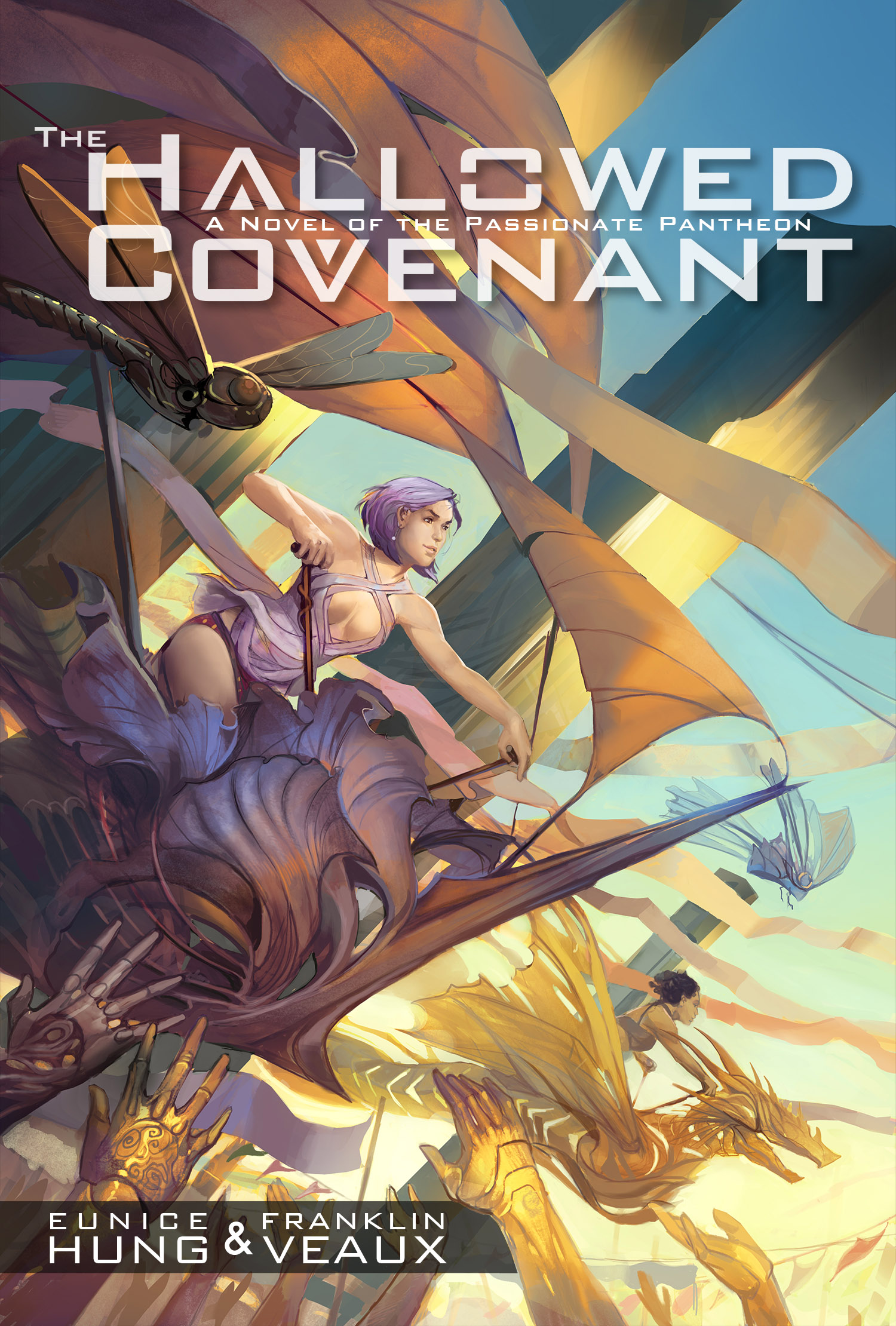
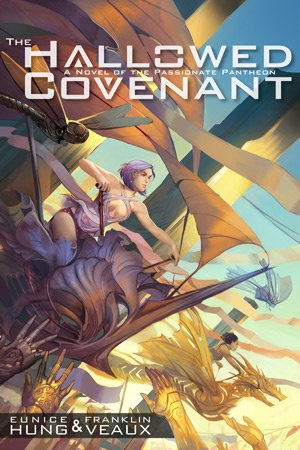
Preorders for The Hallowed Covenant, my new post-scarcity science fiction erotic novel with Eunice Hung, just went up today! And man, I am really, really excited about this book.
This is probably my favorite book I’ve ever coauthored. We take a deep dive into what it’s like to live in the City, along the way touching on themes like:
• How do you have a system of justice in a post-scarcity society with no police or codified laws?
• What are the AIs the people in this society worship as gods? What are they like?
• What do transgression and atonement look like when there’s no such thing as law?
And of course there’s lots of sex, much of it involving kinks so exotic they don’t even have names.
The novel follows seven friends as they wrestle with changes in their lives, set against the backdrop of the Festival of the Lady (the AI god of art and creativity)—think Burning Man in a society with a tech level that makes Star Trek look late Bronze Age, but more hedonistic.
The first two novels in the Passionate Pantheon universe have done so well people started asking us for audiobook versions, and guess what? We delivered! The Hallowed Covenant has an audiobook, narrated by the amazing (and incredibly sexy) Francesca Peregrine.
Just finished recording the final chapter of #TheHallowedCovenant by @franklinveaux and @Eunice_Serina. I am BEREFT. It’s been the most incredible sexy intense trippy magical erotic ride, and I can’t wait to find my way back to The City.
— Francesca Peregrine (@readtomefrankie) June 20, 2022
I am just incredibly, incredibly proud of this book. Like, I am absolutely giddy that it’s almost out. If you like science fiction and you like sex, I suspect you’ll probably like it too.
Check it out here! If you back the crowdfunding, you can score a copy before pub date for less than you’ll find it anywhere else. (And stay tuned for new perks coming soon!)
(Note: This blog post started as an answer I wrote on Quora.)
As I’ve grown more experienced and looked out over the world, I’ve noticed that self-identified liberals and self-identified conservatives love to attack each other for “virtue signaling,” even though it’s far from unique to one side of the political spectrum. They often end up talking past each other, though, because they do it in different ways, against different targets.
One key difference between the left and the right is often the way they feel about hierarchy. Political conservatives tend (with some exceptions, of course) to lean toward vertical hierarchies; political liberals, toward flat egalitarian social structures.
This isn’t just an American thing. Peer-reviewed, published studies have observed this difference across different societies.[1] [2] [3] There appears to be a structural, neurological basis for this division.[4] [5]
So how does this play out in virtue signaling?
The simple answer is: While both liberals and conservatives frequently virtue-signal by denouncing external threats or perceived threats—members of the out-group—liberals are far more likely to turn on their own, virtue-signaling by attacking members of the in-group seen as violating the norms and standards of the in-group.
That might seem contradictory at first. If conservatives value hierarchy, and with it conformity, doesn’t that mean conservatives would be likely to turn on people perceived to be insufficiently adhering to the group’s thinking?
And the answer is no.
When you are part of a hierarchy and have strongly hierarchical views, it seems like a natural consequence of that hierarchical thinking is a set of double standards for those at the bottom of the hierarchy vs those at the top. This is how conservatives can claim to support “family values” while worshipping—sometimes literally—a twice-divorced serial adulterer who’s had five children from three different women.
Adherence to the hierarchy itself is what’s important. The people at the top aren’t subject to the rules.
Liberals don’t accept this. Liberals are biased toward egalitarianism; the same rules apply to everybody.
On the one hand, that makes liberals far less likely to overlook transgressions on the part of those at the top. Al Franken was urged to resign when a photo showing him pretending to grope a woman (without touching her) started circulating; on the other side, Matt Gaetz is the subject of a criminal investigation for statutory rape, pandering of a minor, sex trafficking of minors, and obstruction of justice—an investigation that has already resulted in the criminal conviction of a co-conspirator—and conservatives are like “eh, whatever.”
This difference in reaction comes directly from differences in attitude toward hierarchy and egalitarianism.
What this means is that liberals and conservatives both virtue signal, and in many of the same ways, but when they, for example, crank up the Twitter rage machine, conservatives are more likely to target members of out-groups, whereas liberals are much more likely than conservatives to eat their own.
Which is not to say that conservatives never target their own or liberals never target the out-group, of course. One of the biggest modern examples in American history of cancel culture was the conservative rage at the Dixie Chicks, which resulted in employees of radio stations that played their music being stalked and receiving death threats, and venues that hosted Dixie Chicks concerts getting bomb threats.
But the Dixie Chicks committed a crime against hierarchy; they questioned George W. Bush’s rationale for war in Iraq.
This is a big part of the disconnect between liberals and conservatives about cancel culture and free speech. Conservatives will cry about “Liberal cancel culture! Liberals don’t care about free speech!” But when liberals are like “wait, isn’t that what you did with the Dixie Chicks?” conservatives will say “no,” leaving liberals thinking “what a lying pack of hypocrites.” But from the conservative perspective, they aren’t lying and aren’t hypocrites. The Dixie Chicks were attacked for undermining the hierarchy, not for speech. The fact that speech was the tool they used to undermine the hierarchy is an irrelevant detail.
Liberals, on the other hand, turn their virtue-signaling on their own, often for “offenses” that seem inexplicably petty and stupid to conservatives.
This happens to an extraordinary degree in small liberal subcommunities—often, the smaller the subcommunity, the more vicious the virtue-signalling and infighting. I’m reminded of the Henry Kissenger quote, “The reason that university politics is so vicious is because stakes are so small.”
A real-life example:
Some years ago, a woman complained on Tumblr that she didn’t like polyamorous people because polyamorous people would talk about being “poly” on Tumblr posts, and it made it harder for her to search Tumblr with “poly” to find Polynesian Tumblr users.
Now, this was one person on one social media platform, not Polynesian people in general.
But the polyamory scene, or parts of it, started to turn—sometimes with incredible viciousness—on polyamorous people who used the word “poly,” demanding that they use “polya” or “polyam” instead.
To polyamorous people, those who use the term “poly” committed a crime against the marginalized.
This, too, is a big part of the disconnect between liberals and conservatives about cancel culture and free speech. Liberals will cry about “Conservative cancel culture! Conservatives don’t care about free speech!” But when conservatives are like “wait, isn’t that what you do when you police language around minority groups?” liberals will say “no,” leaving conservatives thinking “what a lying pack of hypocrites.” But from the liberal perspective, they aren’t lying and aren’t hypocrites. The people using the word “poly” were attacked for undermining a historically disenfranchised group, not for speech. The fact that speech was the tool they used to undermine this group is an irrelevant detail.
This kind of policing of the “insufficiently woke” is far more common in liberal than conservative scenes, and it turns easily into virtue signaling when people uninvolved with the original whatever-it-was start to pile on because piling on is an easy, no-cost way to be seen on the side of the righteous. (There’s another pile-on starting up these days about people who use “consensual non-monogamy” vs “ethical non-monogamy” to describe polyamory; the idea is that consent isn’t necessarily ethical, so the people who use “consensual non-monogamy” clearly don’t really care about ethics.)
The pile-on is kind of the definer of virtue signaling. Once it becomes socially acceptable within a certain group to attack a certain person or subset of people, those without any dog in the fight will pile on merely for the admiration of their peers.
Well, also to congratulate themselves for being moralistic too, I suppose, but I gotta say, when you express your virtues only when it’s safe and easy to do so, costs you nothing, and there’s no risk…are they really virtues?
Left and right virtue signaling is generally quite similar:
It involves attacks on perceived threats to the orthodoxy. In conservative circles, the orthodoxy is likely to be the current hierarchy, or dominant religious or social tradition. In liberal circles, the orthodoxy is likely to focus on perceptions of egalitarianism and power imbalances: men always have more power than women (hence “believe all women”), and so forth.
It is an easy tool of bullies to use to exert authority and control. Bullies skilled in whipping up outrage can direct that outrage against targets of their choosing by manipulating the values of their social group.
It is safe, risk-free, and no-cost for those who jump in. Hopping on a bandwagen is pretty much the safest thing you can possibly do; in fact, the person who stands up against bandwagoning is the one who risks more. (Ask anyone who refused to name “Communists” during the McCarthy witch hunts!) The real determinator of your virtue is not what you do when proclaiming your virtue costs you nothing, but what you do when holding to your ideals costs you something.
Where they differ is in the common targets, and of course in the rhetoric used to justify the virtue signaling.
“The street finds its own uses for things.” —William Gibson, Burning Chrome
Last year, my wife, my co-author, and I launched a new podcast, The Skeptical Pervert. We talk about sex…and more specifically, we talk about sex through a lens of empiricism and rationality.
The Skeptical Pervert’s website runs WordPress. Now, I’ve been around the block a few times when it comes to web security, and I know WordPress tends to be a rather appetizing target for miscreants, so I run hardened WordPress installs, with security plugins, firewalls that are trained on common WordPress attack vectors, and other mitigations I don’t talk about openly.
I automatically log hack attacks, including failed login attempts, known WordPress exploits, and malicious scans. I run software that emails me daily and weekly statistics on attacks against all the WordPress sites I own or host. I also subscribe to WordPress-specific infosec mailing lists, so I am aware of the general threat background.
Because WordPress is such a common target—it’s the Microsoft Windows of the self-hosted blog world, with everything that implies—any WordPress site will get a certain low level of constant probes and hack attempts. It’s just part of the background noise of the Internet. (If you run WordPress and you’re not religiously on top of security updates, by the way, you’ve already been pwn3d. I can pretty much guarantee it.)
The fact that I host WordPress sites not connected with me to the outside world gives me a good general baseline reading of this background noise, that I can use to compare to hack attacks against sites that are publicly connected with me.
And the results…well.
In all the years I’ve been on the Web—and I started running my own Web sites in the mid-1990s—I have never seen anything even remotely close to the constant, nonstop barrage of attacks against the Skeptical Pervert site. Joreth and Eunice are probably quite sick of my frequent updates: “Well, the firewall shows over a thousand brute-force hack attempts against the Skeptical Pervert site so far today and it isn’t even noon yet” (seriously, that’s a thing that happened recently).
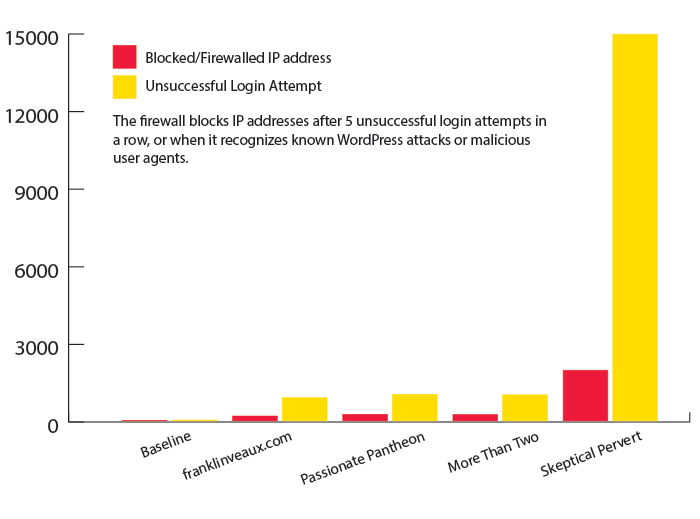
Here’s a graph showing what I mean. This graph covers one week, from June 13, 2022 to June 20, 2022. The “baseline” in the graph is an average of several WordPress sites I host that aren’t in any way connected to me in the eyes of the Internet at large—I don’t run them, I don’t put content on them, my name isn’t on them, I merely host them.
Note that the attacks don’t scale with traffic; the More Than Two blog has the most traffic, followed by franklinveaux.com, then the Passionate Pantheon blog, then the Skeptical Pervert.
So what to make of this?
Part of it is likely the long-running social media campaign my ex has been running. Attacks on franklinveaux.com and morethantwo.com increased in the wake of her social media posts.
But that doesn’t explain what’s happening with the Skeptical Pervert, which has turned out to be targeted to an extraordinary degree.
Now, I don’t know who’s attacking the site, or why, so this is speculation. It’s hard to escape the idea, though, that when a site and podcast explicitly about sex, co-hosted by two women of color, talking about non-traditional sexual relationships is targeted, at least part of the answer might simply be the same old, same old tired sex-negative misogyny and racism we see…well, everywhere, pretty much. The fact that my ex doesn’t like me (and will say or do anything to get other people not to like me) doesn’t explain what’s happening here.
It’s easy to blame conservative traditionalists, but Eunice reminded me there’s another factor at work as well. The Skeptical Pervert approaches sexuality from a rational, evidence-based, skeptical lens. In the United States, there’s a stubborn streak of misogyny amongst the dudebros of the skeptics community. A podcast with two women that looks at sex from a highly female-focused, feminist point of view taking on the mantle of skepticism? It’s possible there are dudebros who will perceive that as an encroachment into their space.
In short, I don’t think this is about me. I think this is about women talking openly about real-world non-traditional sex, and getting the same pushback that women always get when they dare to do that.
If the podcast were just me, or me with obviously male co-hosts, I don’t think the level of Web attacks would be anywhere near the same.
The street finds its own uses for things. In the hands of people threatened by or frightened of non-traditional voices, the Internet has become a safe, anonymous tool of harassment.
This has been an incredibly productive year. Well, years, actually. The last three years have been the most creative, most productive time in my life. And I’m pleased to share some of that creativity with you!
First up, a new novel, The Hallowed Covenant! This is the third book I’ve co-authored with the marvelous Eunice Hung. It’s also the third book in the Passionate Pantheon series of far-future, post-scarcity science fiction theocratic pornography.
Yes, we invented a genre.
Anyway, I’m incredibly proud of this novel. We explore (I think) some really interesting ideas about autonomy, responsibility, atonement, and forgiveness, amidst all the really hot super-kinky sex.
This is also the first Passionate Pantheon novel that will have an audiobook version, narrated by the amazing Francesca Peregrine. She had some lovely things to say:
Favourite chapter so far: a description of a festival that basically sounds like Sexy Sci-fi Burning Man. I want to…go there? Like….now? Immediately, please. Give me chaotic, beautiful art blended seamlessly with hot people Doing It. @franklinveaux and @Eunice_Serina
— Francesca Peregrine (@readtomefrankie) June 16, 2022
Just finished recording the final chapter of #TheHallowedCovenant by @franklinveaux and @Eunice_Serina. I am BEREFT. It’s been the most incredible sexy intense trippy magical erotic ride, and I can’t wait to find my way back to The City.
— Francesca Peregrine (@readtomefrankie) June 20, 2022
The book publishes this October. Preorders are up on Barnes & Noble and Amazon, but watch this space! You’ll be able to get a copy before pub date at a special price (and an early peek at the audiobook and the fourth novel in the series, Unyielding Devotion) if you back our crowdfunding next month!
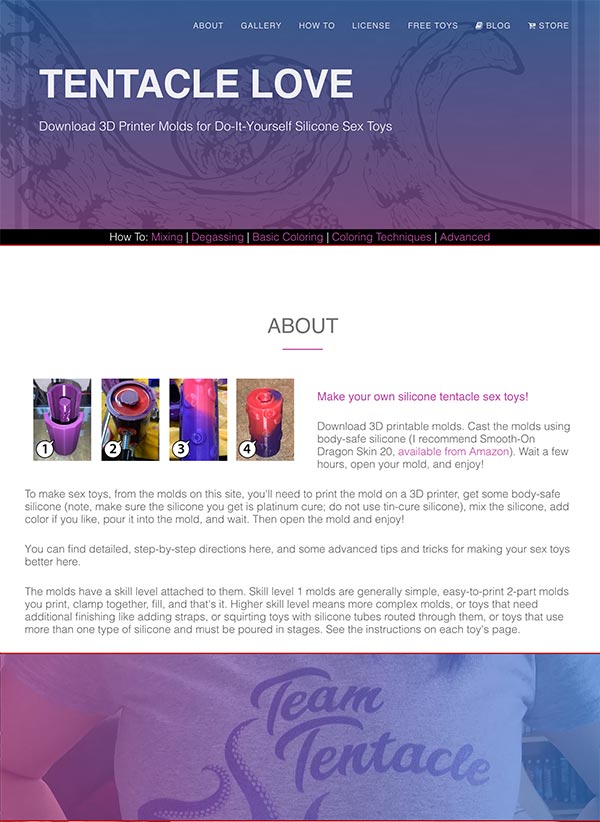
I’ve also just launched a new website for makers who like sex: Tentacle Love. This is a DIY site full of tutorials and tips for making your own silicone sex toys, and includes downloadable 3D printable molds for you to cast sex toys yourself.
I’ve been making silicone sex toys for a while, so from time to time I also plan to put one-offs on the site for sale. These aren’t your typical sex toys, oh no—my tastes being what they are, I’ve made everything from kazoo ball gags (yes, seriously) to double-sided tentacle gags to…well, stranger things.
I’ve been thinking about the Capitol riots lately. I don’t mean “how could this happen?” (anyone who’s read even a little bit of history already knows the answer) or “what role did the former President play? (that answer is self-evident, and getting more so every day).
No, that’s tedious, dreary, and altogether too predictable. What I’ve been thinking about is the fascinating narratives that have sprung up around the failed coup, how contradictory they are, and how those contradictions don’t seem to matter.
I’ve come to an unexpected conclusion: The fact that the narratives are inherently self-contradictory is part of what makes them compelling. The mutual impossibilities in the narrative threads are precisely why they work.
Okay, so hear me out.
In the aftermath of the January coup attempt, a bunch of different, competing stories started to coalesce on the political right about what happened. There were no riots; the Capitol attackers were just tourists. It wasn’t insurrection; it was completely peaceful. The attack wasn’t peaceful, but it also wasn’t Trump supporters, it was Antifa. Or no, not Antifa; it was an FBI false-flag operation. But the rioters were martyrs. If Trump is re-elected, he will give them all pardons.
Clearly these can’t all be true. The attack was orchestrated by peaceful tourists who were really FBI Antifa in disguise, yet they’re all martyrs who deserve pardons? Nobody can believe all of this.
And that’s exactly the point.
I’ve started calling this strange, scattershot approach to propaganda the “MSTF technique:” Make Something That Fits.
Propaganda 101
When I was growing up, my mother always used to say, “information by itself almost never changes attitudes.”
Wow. A few weeks back, I asked for help to save my website More Than Two. I’m now over three-quarters of the way to the crowdfunding goal for my legal expenses to help save the site. Once again, thank you all so much. I am incredibly grateful for your generosity.
I would like to share a little bit more about what’s happening. First, a little bit of context. (Don’t worry, I’ll be brief.)
The Backstory
I started writing about polyamory on the web in 1997, when my first writings about non-monogamy went online on xeromag.com. These pages quickly became by far the most popular part of xeromag.com. Before long, they were the most popular polyamory content on the internet in terms of monthly visitors.
In 2006, I registered the domain morethantwo.com. At first, this URL simply displayed the poly content hosted on xeromag.com.
I also started talking about writing a book called More Than Two in 2006. A poly activist who was heavily involved in the early poly community offered to underwrite the costs of writing the book. By late 2006 I’d written sample chapters and a content outline and started shopping the idea of the book around to publishers. Throughout 2007 and 2008, with the continued financial support of my patron, I refined the content outline and sample chapters of More Than Two, and kept looking for a publisher who might be interested. (I eventually accumulated about fifty rejection slips, many of which said some variation on “we don’t think a how-to book on polyamory will sell, but if you ever write a memoir we’d be interested.”)
In 2011, I spun off the polyamory content from Xeromag as its own site. I separated the poly content on xeromag onto morethantwo.com, and also published the outline of the book More Than Two on this domain name.
In 2012, I met my former partner. In 2013, she brought up my book project and suggested a collaboration. We co-founded a publishing company called Thorntree Press (we chose that name because we had our first date on Hawthorne Street in Portland), and in 2014, we published More Than Two.
In 2018, I left Vancouver and that relationship. We began trying to disentangle our financial affairs, since we still jointly owned Thorntree Press. My former partner wanted me to give her my shares of the company. I declined. This led to a long legal dispute which is still ongoing.
What’s happening now?
Three things, one of which is common knowledge and two of which aren’t.
In November 2021, we had a mediation in front of Judge Karsten Rasmussen. The details of that mediation are covered by a confidentiality agreement, but at the end of it, the judge, my attorney, and her attorney at the time believed we had arrived at a meeting of the minds.
Following the mediation, her attorney attempted to add a new term to the settlement which would have me turn over possession of the domain morethantwo.com to her.
Since then, she has replaced her attorney. She does not consider the mediation to have been binding.
In January of 2022, my former partner filed for a registered trademark on the phrase “More Than Two.” My lawyer, who specializes in intellectual property, informs me that if she establishes ownership of this trademark, she may be able to seize the domain name morethantwo.com under WIPO action.
My lawyer is confident that we can oppose her claim to the trademark, since I can show use of it going back to 2006, but also warns me that opposing a trademark is a very expensive and time-consuming undertaking. I have already paid him the initial sum of money to oppose the trademark filing, and provided him with the materials necessary to draft an opposition filing.
On March 17, 2022, she filed a lawsuit in Multnomah County Court to petition that the courts declare the November settlement void.
These three things together threaten the continued existence of the More Than Two site. She has already indicated she wishes to have the domain turned over to her, and she is attempting to claim a trademark that would give her the benefit of sixteen years of work I’ve done.
Thanks to your generosity, I have been able to provide my lawyer with the litigation retainer he needs to oppose her trademark application and to represent me in court.
However, this is not the end of the road! I expect this matter to continue to be expensive. I have already taken on considerable debt in this matter.
Over the last sixteen years, I’ve poured my heart and soul into this site. I could simply turn it over to her and allow her to take the trademark, but I think it’s wrong to surrender all my hard work for someone else to take advantage of.
Again, thank you all for your incredible support. I can’t tell you how much it means to me.
For those of you who wish to follow what’s going on, I have created a timeline here, which I will keep updating as the legal situation unfolds.
Okay, so we live in a time when the word ‘Orwellian’ is used rather a lot, often by people who clearly haven’t read any Orwell. (“The liberals don’t want to shop at Hobby Lobby! That’s so Orwellian!” “That dude got fired for going to a Nazi rally That’s so Orwellian!” No. No, it isn’t.)
But I’m going to offer a hot take, which is that Nineteen Eighty-Four hasn’t aged particularly well. I’ll even go further: the ideas in it don’t map well onto modern society, current political events notwithstanding.
Yes, yes, I know, it’s a literary classic. Yes, yes, I know, lots of people say it’s more relevant today than ever.
I disagree—not because I think everything now is all sunshine and roses, but because Orwell wrote from a specific place and time, with a particular set of assumptions, and as a result the dystopia he imagined isn’t the dystopia we got.
Orwell envisioned a future of old-school authoritarian totalitarianism, very much rooted in Post-WWII geopolitics, where totalitarians looked like Joseph Stalin and government enforcement looked like the East German Stasi.
Who would’ve guessed the real Big Brother would be a weedy computer nerd with poor social skills in a cheap T-shirt?
He projected his ideas about authoritarianism onto the technology of the day, imagining TV sets broadcasting State propaganda, and cameras in every room sending images back to the State apparatus.
He never imagined a pervasive Panopticon might just as easily be turned against the State. In an age where we all carry cameras with us everywhere we go, corruption and police brutality can be recorded and exposed.
He also could not imagine a society where common communications media were anything other than top-down—he was still trapped in a broadcast-television mindset, where content creation was centralized and transmitted out to the population.
We live in a much more decentralized world, a world where citizens are empowered in ways that Orwell couldn’t (and didn’t) imagine. Because of that, his vision feels very old-school, very Grandpa’s Dictatorship.
Who would’ve guessed the real Big Brother would be a weedy computer nerd with poor social skills in a cheap T-shirt?
It turns out—surprise!—that everyone in the 40s and 50s was 100% wrong about how societies work.The free and vigorous exchange of ideas doesn’t mean that good ideas rise to the top. Giving everyone instantaneous access to the world’s sum total of facts and knowledge doesn’t lead to a more enlightened society. Instant, unfettered worldwide communication doesn’t break down barriers, erode prejudice, promote egalitarianism, or increase understanding.
It took a long time for me to wrap my head around this. I was one of those naive optimists, back in the era before a pervasive Internet. Turns out that shit doesn’t happen. All the optimistic forward thinkers from the 1940s through the 1990s were utterly, 100% wrong.
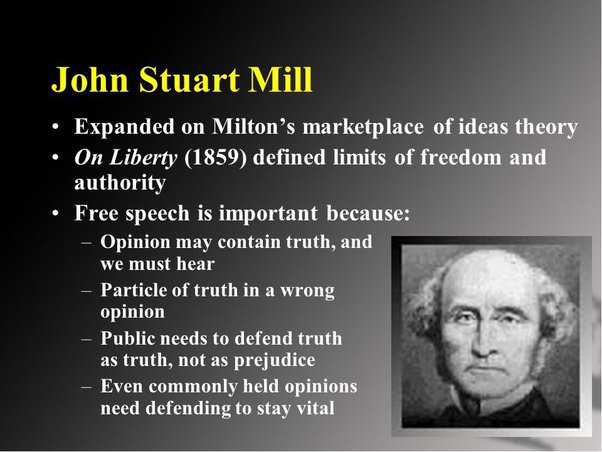
Ah HA ha ha ha ha! Good one! Now pull my other leg, Mr. Mill!
Dystopia is here, but it isn’t Grandpa’s “boot stamping on a human face forever.” That’s so last-century.Today’s authoritarianism is agile, data-driven, shaped by analytics and A/B testing, tested with focus groups, refined with demographic polling, all of it carefully tailored for different market segments.
Todays doublethink and thoughtcrime aren’t engineered by the Ministry of Truth and pushed out by the police apparatus. They’re crowdsourced, enshrined in tribal identity politics, and enforced by the Twitter rage generator and the 4chan hate machine. Offenders aren’t whisked away for extraordinary rendition; instead, the rage of the internet is summoned upon perceived offenders, anyone who appears to support perceived offenders, anyone standing too close to perceived offenders.
In this dystopia, narratives matter more than facts, secret courts are replaced by the court of public opinion, and we don’t need the Stasi to enforce this because we enforce it on ourselves.
George Orwell was right that the impulse toward authoritarianism is written deep in the social DNA of Western societies, he was just wrong that authoritarianism is always top-down. Turns out, paradoxically, it’s often bottom-up.He thought government would need to control our speech and our thought to control us.
Nope.
Give us unfettered communication and unlimited access to knowledge and we’ll do it ourselves.
In this post-fact dystopia, the government doesn’t create our reality, we choose the reality that best appeals to our biases and prejudices. Knowledge? That’s, like, just another opinion, man!
Join me and my co-author Eunice Hung Saturday, April 23, 2022 at 11:00 AM Pacific time/7:00 PM London time for a live-stream event! We talk about the book publishing process, how to co-author together, and how to start your own novel…plus you’ll be able to watch us begin work on a brand-new book!
DETAILS
Image by pascal stöckmann. There’s something unsettling about a camera pointed square at you, isn’t there?
It’s almost here! Where did the time go?Join Eunice and I for a live-streaming event on April 23, where we will answer questions about writing a novel, co-authorship, publishing, details about the world of the Passionate Pantheon, the trials and tribulations of working entirely remotely, and whatever other general random tangents that our brains drag us to (based on past experience)!All this, plus you get to watch the very start of the writing process for the fifth novel in the Passionate Pantheon series!
When: Saturday, April 23, 2022, from 11 AM Pacific/2 PM Eastern/7 PM London time, for at least two hours (but knowing us, probably a lot longer, because we don’t know when to stop).
What: You know that saying, “Everyone has a novel somewhere inside”? One of the most common questions we hear is “I’ve always wanted to write a novel, but how do you get started?” Another is, “I’ve always wanted to write with someone else, but how do you write together?”
Why: You can get your answers questioned…wait a minute, strike that, reverse it. (Although we’re always happy to have our answers questioned, if there’s folks with more expert knowledge in the livestream!) Plus people who attend will get a secret perk when the crowdfunder for the third novel, The Hallowed Covenant, goes live!
We’ll address both of those questions (though protip, you probably won’t start your novel(s) in quite the same way we started ours!), and talk publishing, writing, and the creative process. We co-author in quite an unusual way, so if the way we work sounds appealing, let us tell you all the mistakes we made so you don’t have to!
You’ll also be able to watch us begin a brand spanking new novel together! (Caveat: spanking not included.)
We plan to create a new, blank Google Docs file and start the fifth Passionate Pantheon novel right in front of you. It won’t just be us telling you how to start a novel; you’ll be able to see it happen!
The process itself—the conversations we have, the mechanics of how we write, the world-building, all of it will be on display for the whole world to see, warts and all. (Gulp!) You’ll see the dead ends, the changes, the moments when the plot or characterisation clicks—all the things you’ll probably experience during writing yourself, played out live in front of your eyes.
Wow. I am…I’m speechless. Only a few days into my GoFundMe, you have donated more than five thousand dollars.
Thank you all so very much.
When I started out this week, I felt pretty hopeless. My former partner had filed a lawsuit, and filed to obtain the trademark for “More Than Two,” and after years of legal disputes I had no more resources to continue. I hate asking for help, but the website was not something I could bear to lose, so I finally reached out for help. I am awed and humbled by your response. Thank you. I can’t express what your support means to me.
You all have been amazing. When I first started writing about polyamory way back in 1997, I wasn’t writing for an audience. I was writing for the earlier me, the person trying to figure all this out without the benefit of a community.
When I started writing online, I wanted to talk about the things we learned (and the things we got wrong), so that other people like me didn’t feel quite as lost and alone as I did. I never expected these experiences to resonate with so many people.
I registered the domain More Than Two in 2006, when I began talking about putting my experiences into a book to be called More Than Two. For a long time, this domain redirected to the polyamory writings I hosted at Xeromag, then in 2011 I made More Than Two into a full-fledged Web site of its own and moved my writings over here.
This site touched so many lives that in December of 2018, the Library of Congress selected the More than Two website for archiving as a “historic collection of Internet materials.” The Library of Congress archivist told me, “We consider your website to be an important part of this collection and the historical record.”
To have another person try to take possession of my trademark and domain name, after so many years of work, is one of the most crushing, disheartening things I’ve ever experienced.
Writing about my experiences helped me to find a community of like-minded people, first online and later in person. Now that community has been there for me once again.
I don’t know what the future holds. My lawyer tells me he is optimistic we may likely prevail, both in the lawsuit and in the trademark dispute. But litigation is costly no matter who wins, and always a bit of a roll of the dice. I’ve been forced to borrow money—a lot of it—just to pay my legal fees (and rent!) up to this point, so your support means more to me than you will ever know. I couldn’t do this without you.
Many people have messaged and emailed to ask me if they can donate privately through PayPal rather than GoFundMe. The answer is yes; my PayPal address is franklin (at) franklinveaux (dot) com. I am setting up a separate bank account to track the GoFundMe and PayPal contributions, and my legal expenses. As this unfolds I plan to post regular updates about what’s happening and where the money goes.