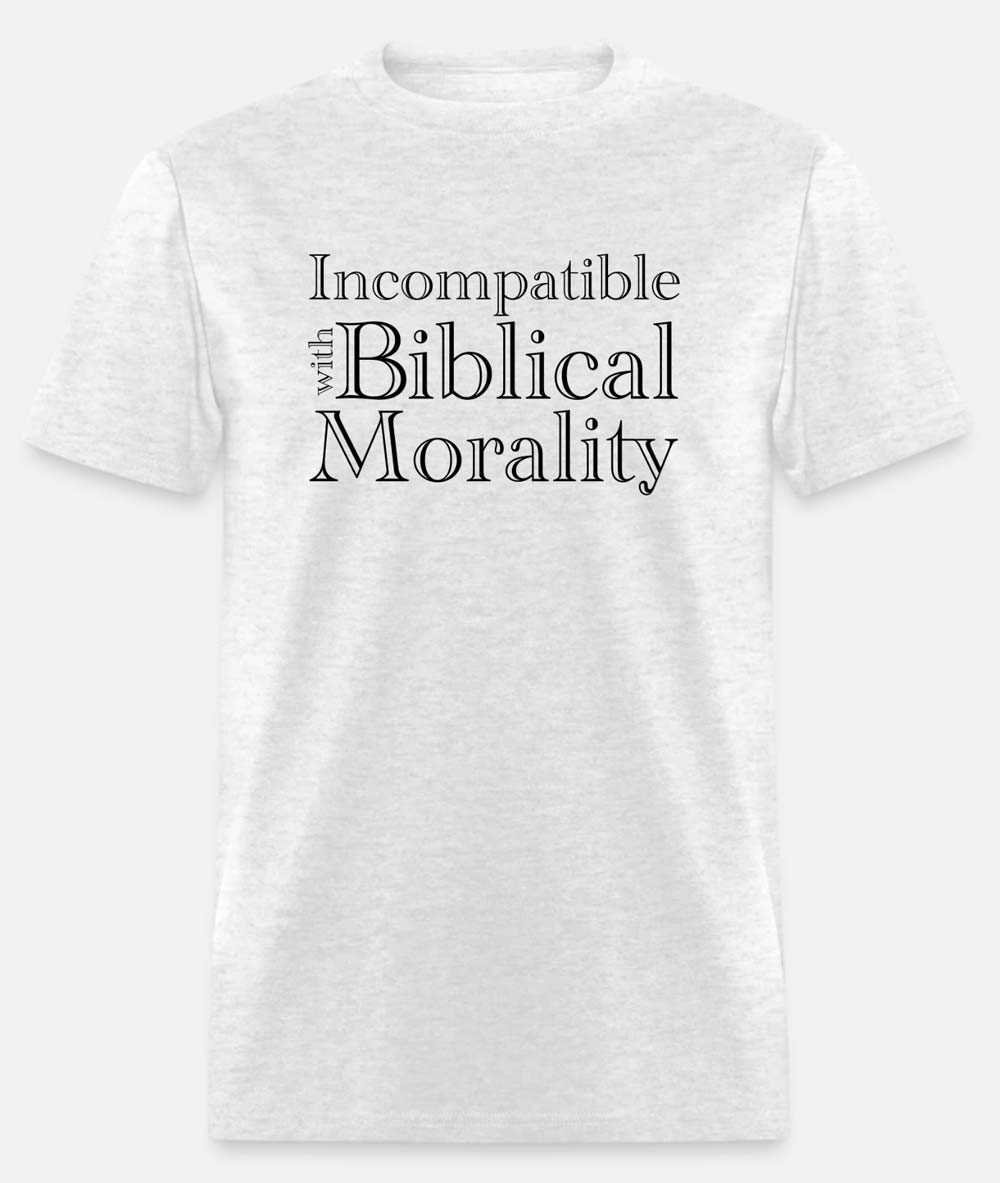
A while back, some wag left a comment on one of my Quora answers stating that I am, quote, “incompatible with Biblical morality.”
Which is a fair cop and no mistake. I mean, he thought he was being insulting, but there it is: I am indeed incompatible with Biblical morality.
So I made a T-shirt.
I put this on my social media, and right away people started messaging me to say they wanted one. Which isn’t what I expected—it’s a rather odd thing to say, which is part of why I made it a shirt—but hey, apparently there are a lot of us.
So I’ve made it available at Villaintees.com, for those of you who, like me, are incompatible with Biblical morality and proud of it. You can even get a sticker and a coffee mug!
So a couple weeks back, I ended up hospitalized for three days after seven hours of sex.
Not because of the sex, mind, though that would make for a much more interesting story. After we finished, I started feeling what I thought was indigestion, and…
Hang on, wait, lemme back up. I was in Missouri, because…
No, wait, not back far enough.
I started out in Florida. My mom was diagnosed with cancer last November, so I’ve been spending a fair bit of time shuttling back and forth between Portland and Florida, as I help my dad care for her.
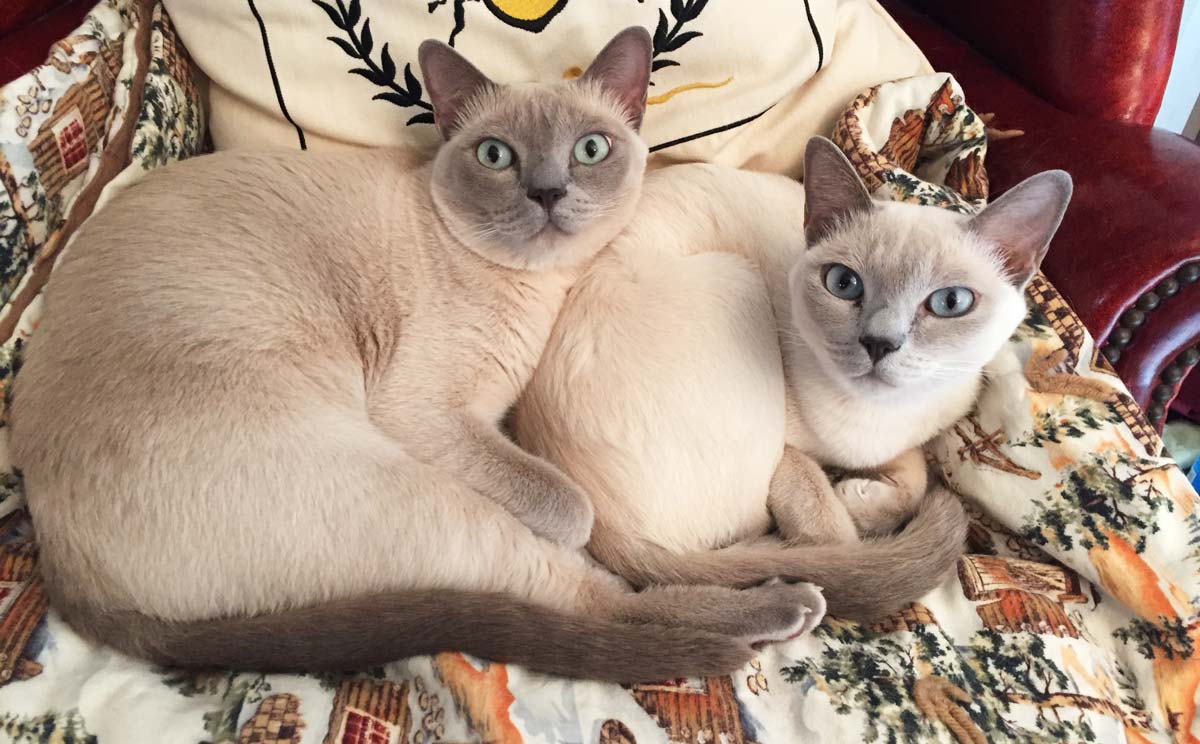
And not incidentally take tons of photos of her cats, which, and I say this purely objectively, are two of the most gorgeous felines ever to grace humanity with their presence. I mean, look at these two!
That’s Thelma (right) and Louise (left), and those names should give you a hint as to their attitudes and general disposition.
Anyway, I went to Florida in September, and from there flew to Springfield, MO to see my Talespinner and attend a sci-fi con with her. One of the cool things about being a writer, I can work from anywhere I have an Internet connection.
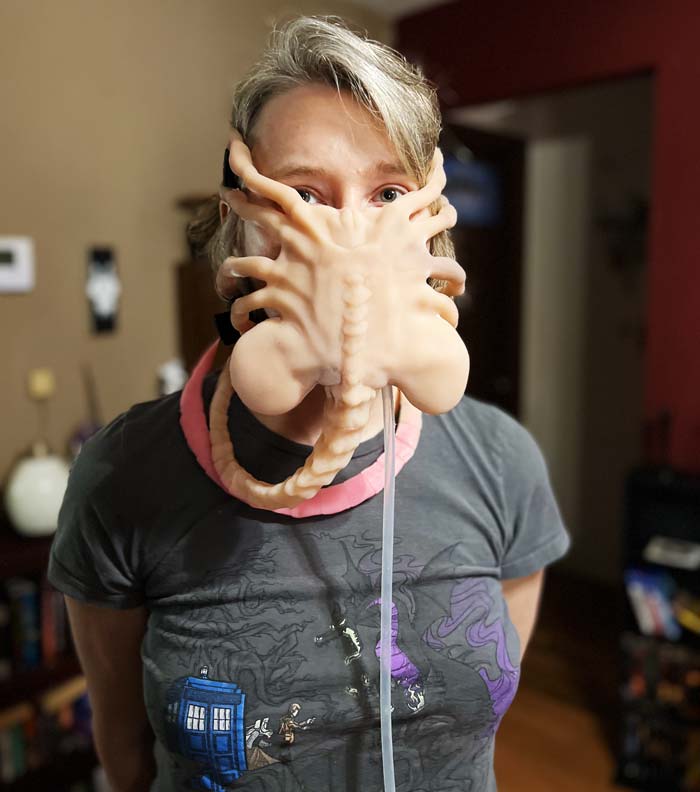
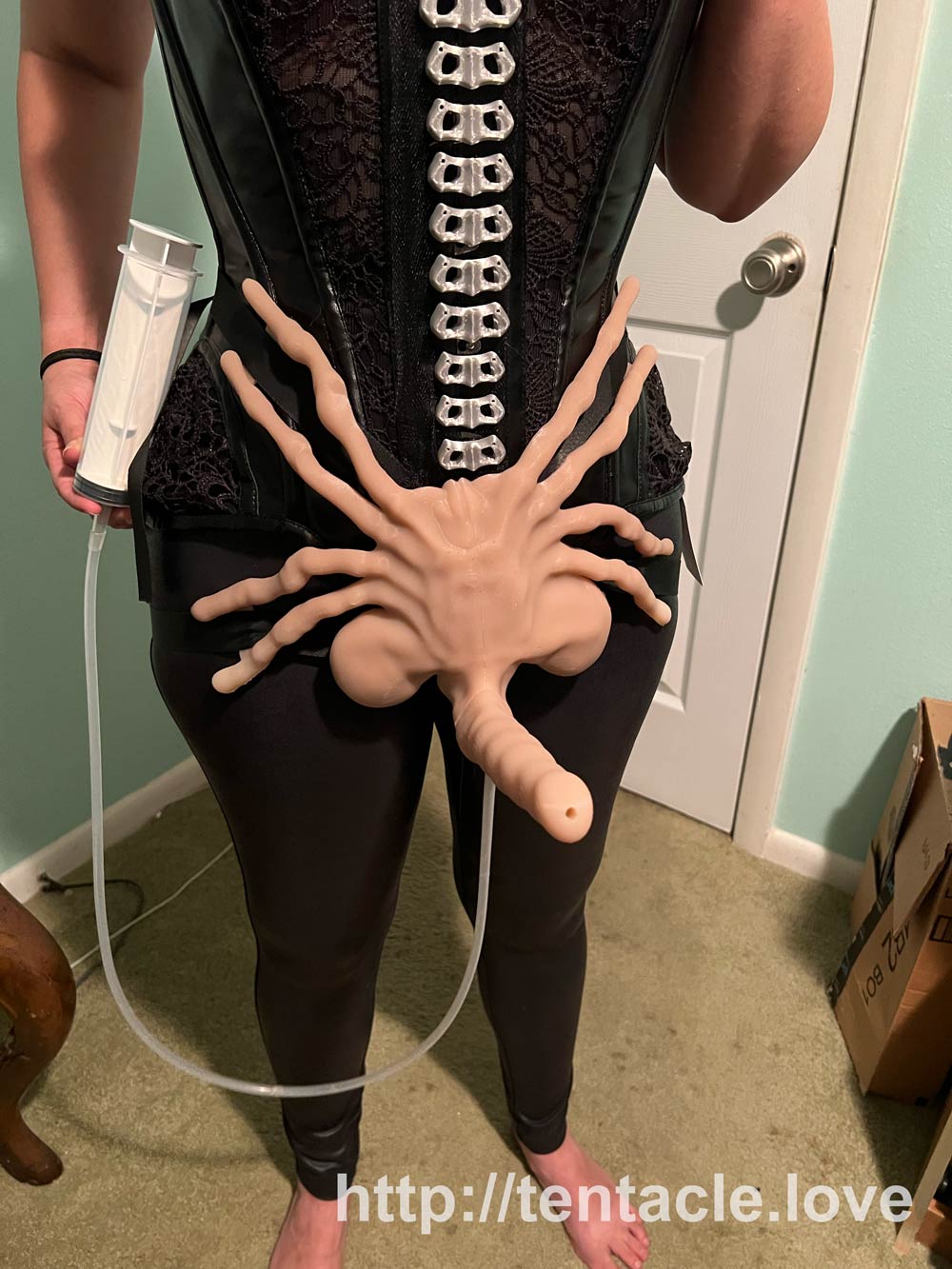
At first, all was good. No, scratch that, all was lovely. We had a wonderful time, that included a seven-hour marathon sex session during which we gave the xenomorph facehugger gag a thorough shake-down test cruise (verdict: it works splendidly but still needs a few design tweaks).
After that and some Chinese takeout, I started feeling a bit yucky. Yucky enough that we set out at 2AM for some Rolaids at the local Kum & Go, which, hand to God, is actually what they call convenience stores in Missourt.
The Rolaids didn’t work. In fact, in the span of about three hours I went from “I think I have indigestion” to spewing blood from both ends, quite literally. It was…distressingly disgusting.
So, long story short, I ended up in the hospital. For three days. While they put an endoscope down my throat and discovered a tear in my esophagus and a hole in the lining of my stomach. Both of which they fixed, but yeah, that was even more unpleasant than you probably think.
Side note: they shot me full of Dilaudid, which is injectable hydromorphone, think heroin but less kind and fuzzy. That honestly sucked almost as bad as the spewing-blood part. I will never understand why people use opioids recreationally. Dear God.
Anyway, I got to ride in an ambulance! Not as much fun as TV makes it seem. The guy riding in the back with me spent most of his time on his phone.
The doctors aren’t entirely sure what caused the malfunction, though the leading hypothesis is a bad reaction to a drug my Portland doctor put me on to control nightmares from complex PTSD. So, y’know, that’s a thing.
Still, a successful trip both to Florida and to Missouri, hospital stay notwithstanding. Apparently I have a $17,000 hospital bill heading my way, because I live in a savage country with a healthcare system optimized for profit, and there’s some question about whether or not my insurance will cover it, so that’s also a thing.
Had a blast at the sci-fi con. Think I’ll probably attend rather a lot of cons in 2024.
[Note: This entry originally started out as an answer on Quora. If you want to keep up with my writings, I’m most active over there these days.]
Most people want to think of themselves as basically “good people.” Many people want to appear to be good people, particularly to their friends and social group. The cynic in me believes that few people are all that concerned with being good people, because being a good person is hard work, requiring careful analysis of complex, nuanced situations, dealing with ambiguity, and occasionally being forced to confront uncomfortable facts.
Enter Virtue Signaling, a way to express to your tribe that you uphold the tribal values without, you know, doing that hard, uncomfortable work! Gain all the advantages of conforming to the norms of your social group without any of that messy ethical stuff!
In the US, the political right loves to accuse the political left of virtue signaling, but this is something that knows no political divide. The rural conservative who throws away his Bud Lite because Budweiser gave beer to a transgender activist, or smashes his Dixie Chicks CD, is engaging in virtue signaling just as much as the liberal who posts “boycott Avatar 2!” on his Twitter feed without ever intending to watch the movie in the first place.
Emory & Henry College defines virtue signaling this way:
The action or practice of publicly expressing opinions or sentiments to demonstrate one’s good character or moral correctness of one’s position on a particular issue. Modern examples of Virtue Signaling are posting opinions that you do not share on social media in order to gain popularity and reputation.
And, in the spirit of complete honesty, I admit I’ve done this. I’ve offered opinions on people and situations about which I was uninformed, because I wanted to be the good guy but didn’t want to take the time to better inform myself. (In fact, the times I’ve done this, I would’ve strenuously denied that was what I was doing, because of course I knew what I was talking about, even though I didn’t know the situation or talk to the people involved…I let my own narratives about How The World Works fill in the blanks for me. We human beings understand the world through stories; the narratives we accept, often without realizing it, inform the way we perceive the world.)
So, with that in mind, what separates genuine virtue from virtue signaling? How can you tell?
I would like to propose a set of guidelines that, I believe, makes separating the two rather easy:
Virtue signaling is cheap and costs nothing. You’re literally sending signals to improve your standing with your in-group; it will not cost you socially with your in-group by definition. It always goes with your in-group, never against it.
Virtue may cost you something—socially, politically, or financially. It sometimes may not match the expectations of the people around you. Holding to virtue might occasionally put you at odds with your in-group.
Virtue signaling has no nuance, no shades of gray. It boils everything down to bumper stickers: Jesus Is Lord. Make America Great Again. Eat The Rich. Kindness Is Everything. Because its purpose is to communicate that you belong with your in-group, it’s made up of simple slogans that champion the in-group’s values in simple, easy-to-understand ways.
Virtue allows for nuance. Virtue requires looking at complex situations and making informed choices, rather than relying on bumper-sticker deepitudes. Virtue isn’t about clearly-defined good guys and bad guys; it requires constant engagement.
Virtue signaling is about the person doing it. It’s a way to say “Look at me! Look at me! I share your values! Look at me!” It centers the person engaging in it: “everyone, see what a good person I am because I support the values of my in-group.”
Virtue is about the thing. It doesn’t grab the spotlight or seek attention. While a virtue signaler is on YouTube talking about how great they are for shining a light on the fact that homelessness is bad (don’t forget to click Subscribe! And sign up for my Patreon!), virtue is out there with a hammer building houses for Habitat for Humanity.
There’s actually a Bible passage about this: “And when you pray, do not be like the hypocrites, for they love to pray standing in the synagogues and on the street corners to be seen by others.” Virtue signaling is out there praying loudly in the middle of the street; virtue takes place off stage, with sleeves rolled up, doing the work to find the facts and minimize harm in a world where there’s not always a lot of adulation in it and sometimes things aren’t as simple as they seem.
Virtue signaling is about identifying who’s one of Us and who’s one of Them. We are good, noble, just, patriotic. They are evil, corrupt, traitorous dogs.
Virtue is about living, inasmuch as is possible, a life of kindness and compassion, rooted in truth, empathy, and generosity.
Virtue signaling is about keeping safe by rigidly enforcing and policing the boundaries between Us and Them through purity and moral conformity. It turns on itself. It eats its own. It seeks out those on our side who are insufficiently pure, insufficiently dedicated to our ideals. It frequently spends as much time savaging those on Our side as attacking those on Their side.
Virtue is about living in an imperfect world where people are not always 100% pure 100% of the time. It’s about genuine harm reduction, not moral purity. Harm reduction is, as my crush and co-author Eunice once said, “ethics trying to live in the real world.” Where virtue signaling is proving one’s moral purity in a vicious game of Last Man Standing, virtue is about making the world just a little bit kinder, a little bit better, not just for those who pass the moral purity litmus test, but for everyone.
Virtue signaling tells you who the good guys and the bad guys are.
Virtue is understanding that nobody is purely one thing or the other, so the best approach is to treat others the way you would have them treat you—ir, if you’re genuinely virtuous, to do unto others 20% better than they do unto you, to correct for subjective error.
In other words, the key takeaway I’d like to propose is this:
Virtue signaling is about bettering your own station by persuading the people in your social group of your moral purity. Virtue is about bettering the world for everyone.
[Note: This entry is based on two of my answers on Quora. If you want to keep up with my writing, that’s the best place to do it these days.]
So I’ve been spending some time lately thinking about the psychology of bullying, and why bullies seem unhappy when you live a good life once you’ve escaped their reach.
And I think I’m at least a bit closer to understanding.
Bullying, like many other forms of abuse, is ultimately about power and control. People who feel out of control in their lives—perhaps due to problems in their family of origin, perhaps because they don’t have a strongly developed sense of boundaries or sense of self, whatever—often see controlling other people as the only way to feel safe or to reclaim a personal sense of power.
I mean, this isn’t like, an incisive and cunning insight or anything. We’ve known this since the dawn of time. Abuse is about power and control—that’s pretty much both axiomatic and definitional whenever you talk about abuse. Basically any book on abuse or bullying will tell you that.
Hurt people hurt people.
Again, not an incisive and cunning insight. Eunice and I found this graffiti whilst doing some urban spelunking in a ruined mansion when we were in New Orleans together:
Do hurt people hurt people? Is that why bullies bully?
Yes, as far as it goes. That is, do I believe “hurt people hurt people” is true? Yes. Do I believe it’s the whole truth? No, I don’t.
On a surface level, yes, it’s obviously true. You see it often when people break up—they’ll lash out at each other. Anger is part of grief, and anger frequently causes people to do hurtful things.
But I also think the real harm is more often done not by people who are hurt, but by people who are scared.
All the books on abuse and bullying, all the research, all the anecdotes, point in the same direction: the core of abuse is power. Whenever you see two people pointing fingers at each other and calling each other abusers, look to the arrow of control. One of them will be exerting, or attempting to exert, power and control over the other. That’s the abuser, always.
But people who exert power over others, in intimate partner relationships, rarely do so because they wake up and say “Hey, you know what? I enjoy being bossy. I think I’ll control my partner today!” (I mean yes, that can happen, but it’s not the norm.)
Most people driven to control in intimate relationships do so, I believe, because they’re acting out of fear. The control is a means to an end, not the end itself. They’re afraid of losing the relationship, or of being abandoned, or whatever, and exerting control becomes a bulwark against the fear, the only way they feel safe. “If I control who my partner socializes with, I can make sure nobody steals my partner.” “If I control where my partner goes, I can calm my fear that my partner is sneaking around behind my back.” Whatever.
The thing about fear is it drives us to extremes,. Often, like insecurity, it drives us to do the exact things that will cause what we fear to come true.
Control is rooted in fear, and a controlling person often lashes out if their fear comes true. Anyone who’s ever worked with intimate partner abuse will tell you the single most dangerous moment for an abuse victim is when they leave the abuser. A person who has lost control of their partner is extremely dangerous, and will often say or do anything to try to re-assert that control.
Fearful people are often people who were hurt in the past, especially as children. Control becomes a dysfunctional, maladaptive way to try to prevent being hurt or abandoned again.
So yes, hurt people hurt people on a surface level—anger is part of grief, and angry people lash out. But the real harm is most often done not out of hurt, but out of fear, and specifically out of fear that becomes need to control.
So. If abuse is about power and control, and abusers often exert power and control out of fear, why then do bullies hate that you live your best life later on?
Because it shows that you have escaped control. You are thriving, your life is wonderful, you are surrounded by joy and love…
…without them.
They have failed to alter the trajectory of your life. They have failed to trap you in the muck with them. You’re accomplishing things, without them. You’re building joy, without them. They can no longer reach you. You are a living testament to their lack of control.
Abuse is about power and control. Your escape from the bully’s control is a personal affront that highlights whatever damage drives the bully to bully in the first place. It affirms the bully’s fear: I have been abaondoned. I am not loved. That’s intolerable.
A lot of my liberal friends seem baffled by the fact that 45’s supporters seem…remarkably unfazed by the fact that Trump keeps announcing he’ll do things he never gets round to doing. Like, for example, when he said he’d post overwhelming evidence of his innocence and a vast conspiracy at a press conference…then when the day of the conference came and went, he’d present it in court at his trial. As with the tax returns he promised to release after e was elected that somehow he failed to release, this seems a pattern.
“Don’t his supporters notice?” my liberal friends say. “Doesn’t that bother them? When will he show us this evidence, anyway?”
That actually isn’t the right question.
It isn’t the right question because the answer is obvious. There is no evidence. There was no evidence. There never will be any evidence. He’s had plenty of chances to offer evidence and he hasn’t.
And, of course, we now know that he didn’t present any evidence at a news conference—he canceled the conference before it started, and now he’s claiming he will present this “evidence” at trial.
It is embarrassingly, painfully obvious that he doesn’t have anything.
So that’s not the right question, given that the answer is so obvious.
What is the right question?
The right question is “since it’s plain as the nose on your face Trump has no evidence that the election was in any way stolen, and since he keeps saying over and over that he does but every single time he says he’s going to show us this evidence he doesn’t, why do people still believe him?”
And the answer to that question says something fascinating about human beings.
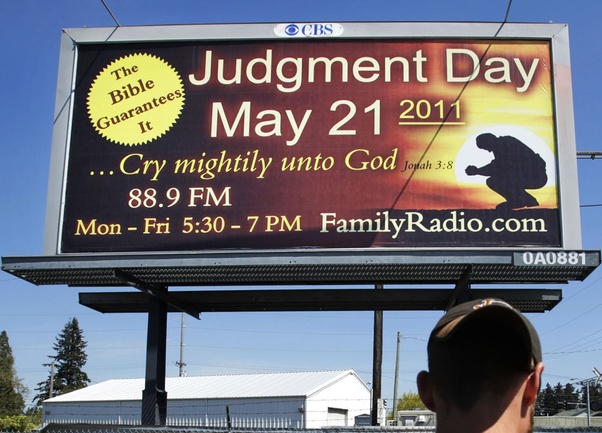
Back in 2011, a Christian radio preacher named Harold Camping predicted the end of the world. He encouraged his followers to give up all their earthly possessions, sell their houses, and use the money to buy billboards warning that the end of the world was coming.
Of course, May 21, 2011 came and went and the world kept on turning.
You’d think this would have caused his followers to abandon him. It did not.
This actually wasn’t Camping’s first rodeo. He’d predicted the end of the world before, on May 21, 1988.
And then again on September 6, 1994.
When May 21 came and went, ol’ Harold, not one to give up in the face of, you know, reality, predicted that the world would definitely definitely end, for realsies, on October 16, 2011.
So far, so boring. People’ve been predicting the end of the world for as long as there have been people in the world. That’s not the interesting part.
Here’s the interesting part:
When each day came and went, the faithful didn’t lose faith, they became more faithful. They became more convinced.
In 1956, a psychologist named Leon Festinger wrote a book called When Prophecy Fails: A Social and Psychological Study of a Modern Group That Predicted the Destruction of the World. In that book, he made up a term for people who struggle to reconcile a sincere, passionate, earnest belief that doesn’t align with reality. He named this psychological phenomenon he was studying “cognitive dissonance.”
His hypothesis: When you believe something that turns out not to be true, such as when you believe a preacher who tells you the world is going to end on a certain date and then nothing happens, it takes work to get your head around the fact that it didn’t happen. It takes effort. It takes labor.
You have to unpack your belief. You have to look at yourself. Why didn’t it happen? Why did I believe it was going to happen? How can I explain to myself that I accepted a belief that wasn’t true? Does this mean other beliefs I have also aren’t true? How can I tell? How can I be sure? Does this mean I have poor judgment in the people I choose to believe in? Is it possible that those people in a different tribe, the ones who kept telling me that my belief was wrong, could be right? Am I part of the wrong tribe? What else have I been wrong about?
All this is deeply difficult and deeply unsettling.
You would think that a religion that preaches the end of days to its followers would lose all its followers when the days don’t end. That doesn’t happen; in fact, its followers become more fanatic and more faithful and more likely to believe their preacher, because (and this is the bit that blows my mind) it’s actually easier—it’s less work, it’s less effort, it’s less painful—to reject reality than to reject a belief you’re emotionally invested in, reject a tribe you consider yourself part of, or reject an authority figure you believe.
One of the most potent tools for rejecting reality is what Festinger called selective exposure.
Selective exposure means you only talk to people in your tribe—your fellow believers—and refuse to listen to anyone else. You only watch media that reinforces your belief, and go out of your way to avoid media that doesn’t. You read, watch, and listen to only the things that reinforce your belief, and the stronger the cognitive dissonance, the more you isolate yourself in a bubble that rejects reality and confirms what you already believe.
So when Donald Trump says he is going to prove that the election was stolen, then he doesn’t, that creates cognitive dissonance, just like when a preacher says the world is going to end on May 21 and then it doesn’t.
And, of course, some people will wake up when the proof never materializes or the world doesn’t end and say “okay, fine, he was lying.”
But a lot of people won’t. They’ll accept any excuse: Oh, I miscalculated the date from the Biblical signs, it’s really October 16. Oh, my lawyer told me not to show you the proof, I’ll how it to you at my trial.
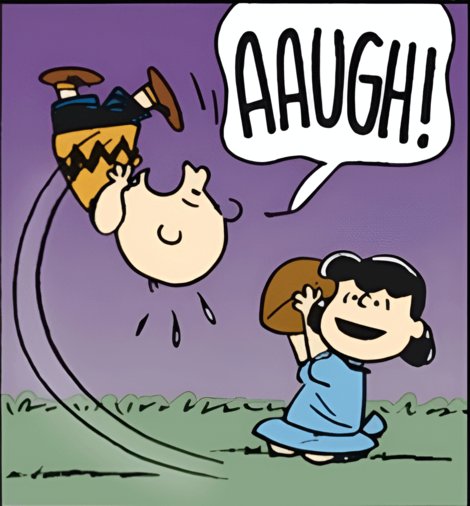
Paradoxically, the more dates come and go, the more the faithful cling to the belief that next time it’s definitely gonna happen. Just like Charlie Brown thinks next time, Lucy will definitely let him kick the football.
At this point, Donald Trump’s remaining followers are acting and behaving pretty much exactly like members of a cult. They sincerely believe that next time, he will show them proof that the election was stolen, and when he doesn’t, they’ll believe whatever excuse he gives them, and believe that the time after that, he will definitely show them proof that the election was stolen.
You cannot argue them out of it. You cannot point out that it hasn’t happened yet and it’s never going to happen. No combination of words, no evidence, no proof exists that can change their minds, because changing their minds is simply too painful. It would force them to confront that they have spent all this time, all this effort, all this money following the wrong man.
You have to recall that the people who still follow Trump have probably given up a lot. They’ve given him their money, yes, but they’ve also lost friends, lost family, endured being ridiculed and called stupid…and so they’ve turned inward, they’ve made a new tribe with new beliefs.
And now, at this point, to admit they were wrong? That means they lost their money for nothing. That means they gave up their friends and family for nothing. That means all those jeers were true. And, more than that, they would have to give up the new tribe they’ve created and the new friends they’ve made.
You really think there’s a combination of words you can say that would make them do that? No way.
In which our hero has alien sex toys scanned for bombs, and urethral sounds confiscated…
Okay, so. I travel a bit, sometimes internationally, and so it was I found myself jetting off to Barcelona for a vacation with the extended polyamorous family a few months back.
I have, as those who follow this blog know, been working for several years on a Xenomorph Hiphugger Strapon, inspired by (a) my lifelong fear of the alien from Alien (a movie my parents took me to when I was, like, 11 or 12 or something, thinking it was like a new Star Wars…no exaggeration, I had nightmares aout that alien for more than 30 years after), and (b) a suggestion by my wife that I should make a sex toy inspired by the alien, because she loves to push my buttons.
In fact, a photo of one of the early prototypes ended up going mad viral on the Internet, and I’m told has even been uploaded to the official Sigorney Weaver fan page, which means Ms. Weaver has likely seen it. 0.o
Anyway.
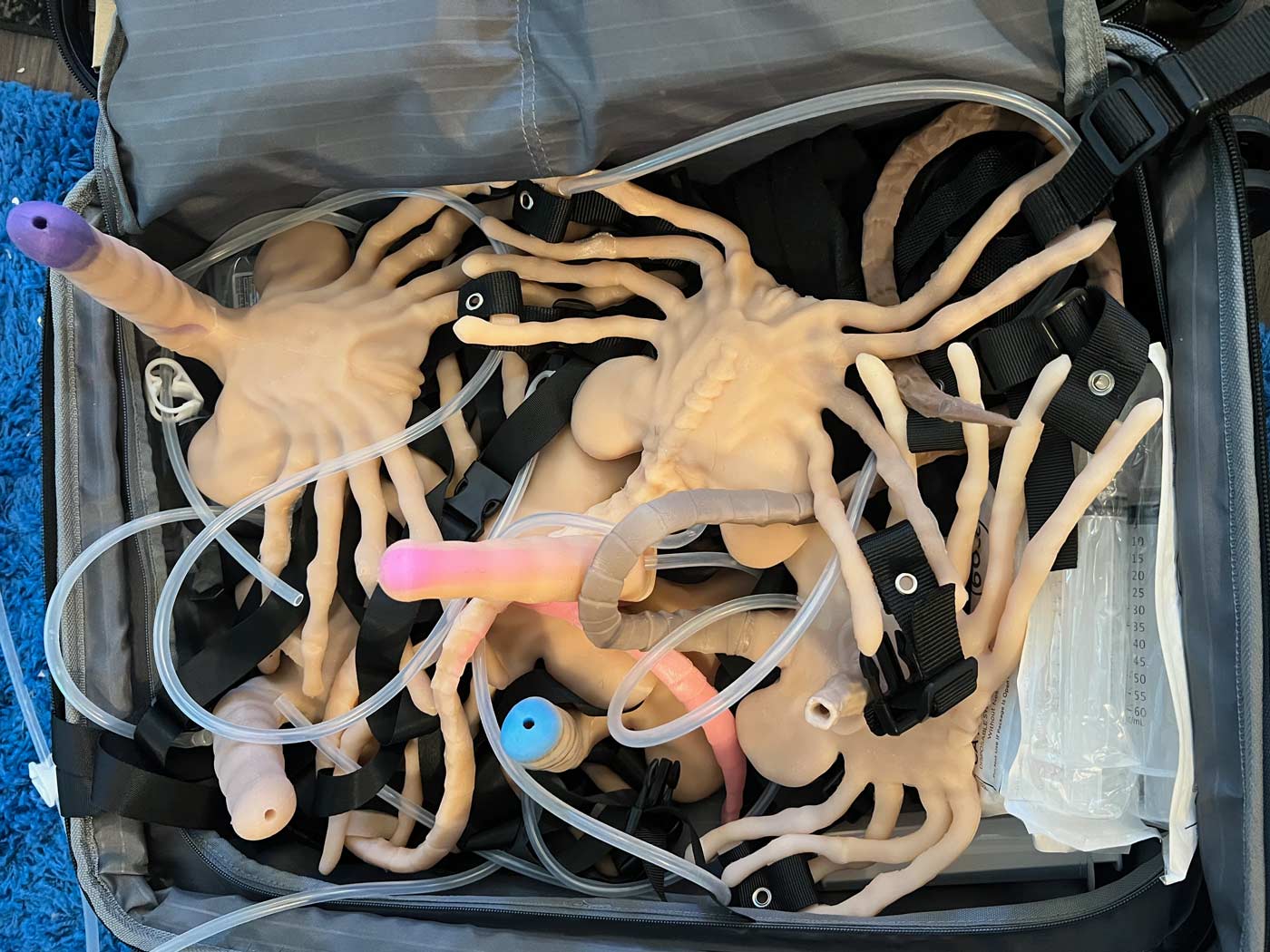
I cast four prototype xenomorph hiphugger strapons and one xenomorph facehugger gag in the runup to Barcelona, with the idea that having multiple lovers in the same space would be a fine opportunity for a xenomorph gangbang, truly a test of the design.
So it was I packed all these xenomorph hiphuggers in my luggage and jetted off to Springfield, MO, to meet my Talespinner, who would be accompanying me to Spain.
You would not believe what this looked like on the X-ray. Sadly, they refused to allow me to take a pic.
The problem started quite early. Whilst carrying my luggage aboard the plane, the X-ray showed a suitcase absolutely packed with aggressive alien endoparasites, which, as you might imagine, elicited some…excitement at screening. (I didn’t put them in my checked bag because it was mainly filled with photographic gear and clothes.)
The bag got bounced, the TSA checker opened the lid, and gentle reader, if I could have photographed his expression and shown it to you, you would know that it is possible for surprise to take on human form.
Within minutes, there was a crowd around the table: the TSA inspector, the woman running the X-ray, and two other people, all of them staring in slack-jawed astonishment. The TSA checker called for his superior, who was like “What the…?” One of the other TSA screeners said “Holy shit, that looks like the alien from the Alien movies!”
TSA screener: “Should I—”
Supervisor: “Yes.”
And then they, hand to God, scanned the hiphuggers for explosives.
Eventually convinced the hiphuggers weren’t actually bombs, they allowed me to board, where I sat in a chair that through the miracle of Science flew through the air.
But that’s not the end of the story, oh my no.
When the time came for us to head from Springfield to Barcelona, I re-packed everything, in no small part because of the way TSA freaked out about the xenomorphs, but also prompted by the need to rearrange in order to fit two rather large studio lights for the xenomorph photo shoot we had planned. (That was an adventure in itself; the tripods for the studio lights were an inch and a half too long to fit the suitcase, but fifteen minutes with a hacksaw soon fixed that.)
We set off for the airport, confident that this TSA experience would be far smoother. Alas, it was not to be.
During the rearranging, I’d put the more conventional sex toy kit in my carryon whilst the hiphuggers ent in checked baggage with the studio lights, UV-reactive body paints, UV blacklight, and other miscellaneous orgy supplies.
I did not know, Gentle Reader, I did not suspect, that I had planted the seeds of my own undoing.
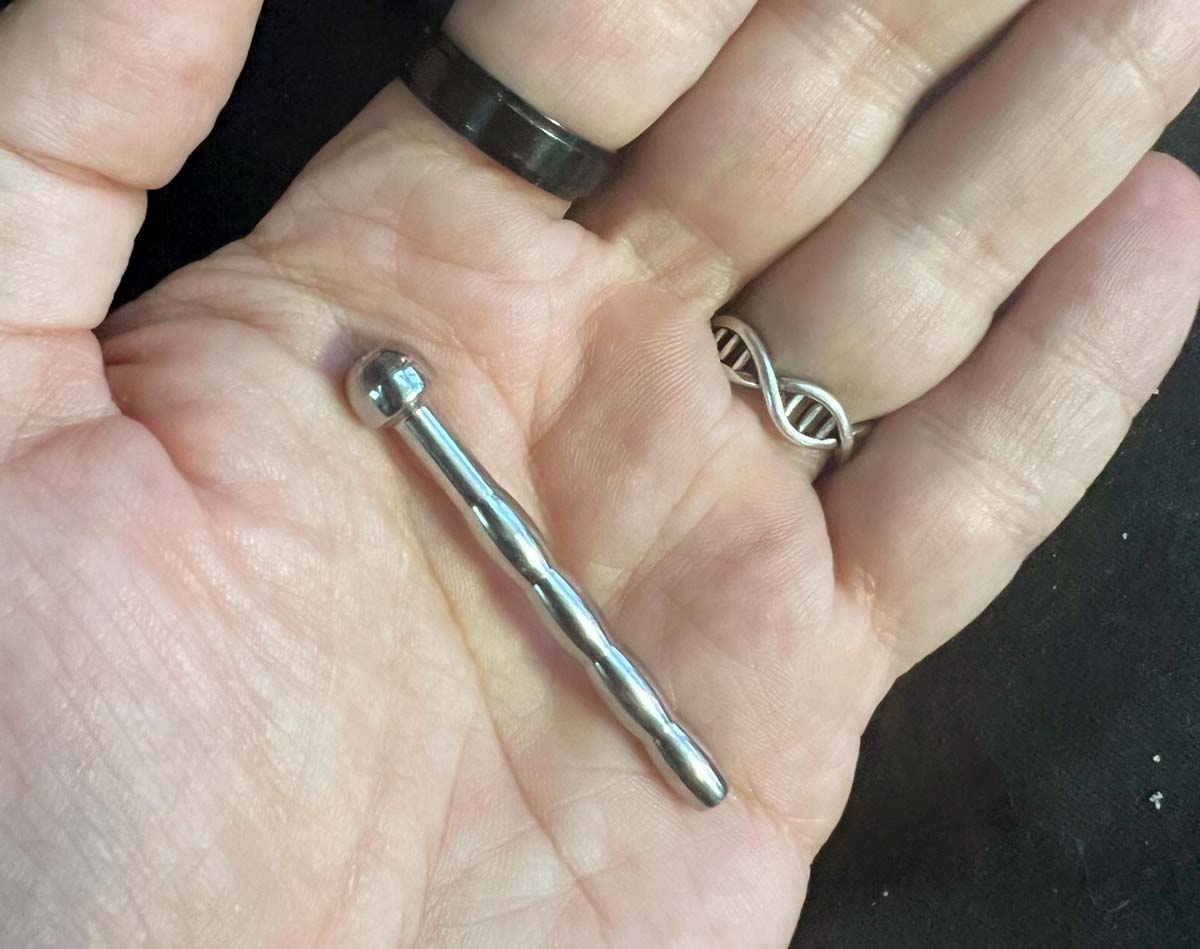
For you see, in my conventional sex toy kit I’d placed my collection of sounds. If oyu don’t know what those are, I won’t disturb you with the details, except to say that I had about ten or fifteen and they looked like this:
The TSA guy…
…confiscated and threw away the sounds.
When I asked him why, he looked me straight in the eye and told me, you could stab someone with them.”
You. Could. Stab. Someone. With. Them.
Words…words fail. Whatever danger these may pose as a weapon, Gentle Reader, let me assure you that the 100% sustainably made, biodegradable wood cutlery they gave us aboard the plane would be a far better stabby weapon in every single axis.At this point, it’s hard to escape the perhaps paranoid conclusion that my name exists on some TSA list somewhere. I had a slab of Barcelonan chocolate in my computer bag on the way home and it got scanned for explosives every single time I went through security.
Does silence mean consent? Sexually? No. Clearly not.
If you’re talking about Thomas More’s philosophy of qui tacet consentire videtur (he who is silent seems to consent), it’s…complicated.
I’ve been thinking about this quite a lot lately, and even had a long discussion about it with my co-author Eunice a few weeks back. We fall on opposite sides of the issue, or perhaps on subtly different sides of one aspect of the issue.
Buckle up, bruh, this might get long.
When people say “silence equals consent,” they’re uuuuusually not talking about sex. When More said “qui tacet consentire videtur,” he was responding to a legal question about why he didn’t recognize the king’s dominion over the Church. His answer basically meant “I didn’t object to it, therefore I recognize it.”
In law and international relations, qui tacet consentire videtur means something more like “silence means assent.” That is, if you don’t object to a statement or decision or policy or treaty or something, that is functionally the same as if you had voted “yes” to it.
Okay. So. Here’s the thing:
The same idea often seems to apply in social settings, especially in subcommunities. You’ll see this play out when, for example, people say “if you’re conservative but you don’t speak out against the fascists in your party, you’re basically saying you’re one of them.” Or “if you’re Muslim but don’t speak out against the violent extremists among you, you’re basically saying you agree with them.” (Whichever way you personally may fall on the political spectrum, dear reader, it always feels less comfortable when it’s turned around, doesn’t it?)
Now, I’ve seen this happen in a subcommunity that I used to belong to. I get how it works.
The thing Eunice points out, and I agree with, is qui tacet consentire videtur only applies if it’s safe to speak dissent. If you risk being beheaded for publicly saying that the king does not rightfully have dominion over the church, then keeping your mouth shut is not automatically assent.
The place we differ is whether or not remaining silent in the face of immorality is a morally defensible act.
Now I get it, I really do. If you live under the Taliban’s rule and you’re Muslim, you maybe might want to think twice about raising your voice in objection to extremism, or you and your family are at very real risk.
Where I think things get muddier is when you’re not at risk of having your head separated from your shoulders, but rather you don’t speak your dissent because you’re worried it will cost you social standing. Or friends. Or your position in your community. You know, something that’s not your life or your freedom.
Where Eunice and I differ is she’s way more patient than I am with people who don’t speak out about things they sincerely believe are wrong when doing so may cost something.
She believes, if I may take the liberty of stating her position as I understand it, that we all have the right to set for ourselves our own personal level of acceptable risk, and what we are willing to put on the line for our values. It is not necessarily wrong to decide the consequences for speaking dissent are more than we are willing to pay.
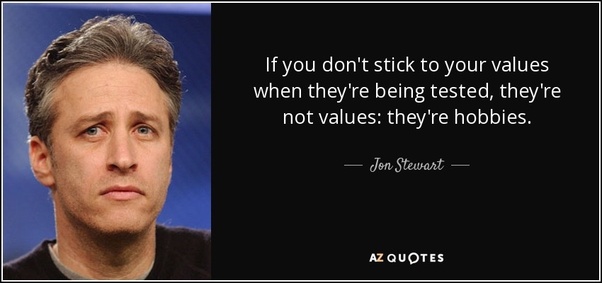
I’m a lot more hardline about it. I believe that, to quote Jon Stewart:
If you don’t stick to your values when they’re being tested, they’re not values, they’re hobbies.
If you make your values a part of your identity, but fail to express them whenever they might cost you something, then yes, your silence, functionally, does mean assent.
The only thing necessary for the triumph of evil is for good men to do nothing. The problem is, evil can make it expensive enough that nobody wants to be the first one to do something.
It’s like a criminal holding 30 hostages with a six-shot revolver. If everyone stood up, they’d win. But the first one to stand up is getting shot, so nobody wants to be the first one to stand up, so everyone meekly complies with the criminal and allows him to tie them up, so now he can kill all 30 at his leisure.
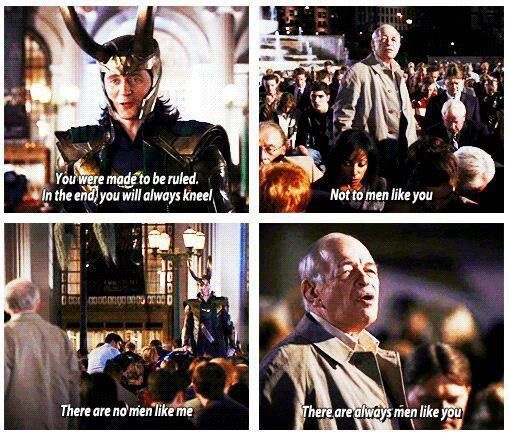
There’s actually a scene in a Marvel movie, of all things, that nicely illustrates the dilemma of qui tacet consentire videtur:
At what cost our dissent? Most of us would like to look in the mirror and tell ourselves we are like this man. Almost nobody actually is. I’ll bet folding money that most people will keep silent in the face of things they are think are wrong even if the cost of speaking up is quite small.
—–
When I posted this on Quora, a friend remarked that in his opinion, Eunice’s position shows greater empathy than mine; that is, Eunice is less hard-line than I am because she’s more sensitive to the plight of the person placed in the position of not being able to speak up without facing the community’s retaliation.
I chewed on that idea for weeks. I had a sense that there was something missing from that idea, but it took me a while to put my finger on what it was.
In situations where, for example, someone is in the closet as a member of some sexual or ethnic morality for fear of the community’s reaction if he comes out, I agree. That’s absolutely a reasonable choice, and deserves respect and compassion. In fact, I’ve chosen to live openly, as I’ve said in my memoir and also at events back as far as the 90s, in part because I can. I’ve never had a job that would be at risk because someone finds out I’m polyamorous, or family that would disown me.
In that sense, I’m privileged, and I know it, and it’s because I’m privileged I want to do whatever I can to make it easier for the next person to be open.
What I’m talking about here is slightly different from being in the closet, though. This answer is more about being silent in the face of things you know to be wrong—not silence in the sense of “I am silent about my own sexual orientation because I am worried people will harm me,” but in the sense of “I see people like me harming those who come out of the closet, and I’m silent about that because I don’t want those people to attack me too.” I do think those are two different situations, and in the latter, being silent to the bigotry of others does serve as assent to their bigotry.
If I as a straight person don’t stand up to homophobia, am I complicit in it? If I as a man don’t stand up to misogyny, am I complicit in it? I personally think the answer is yes.
The part about empathy is what triggered that realization, because it’s precisely empathy that makes me draw that bright line. I think that it’s easy to have empathy for the straight person who doesn’t stand up to the homophobe, because most of us identify with that person and it’s easiest to have empathy for those who are like us.
But the person who most needs empathy isn’t the straight person too scared to speak up, but the gay person being targeted in the first place.
Yes, it’s important to have empathy for the straight person who’s worried about being targeted by the bigots, because yes, bigots can and do come after those on the “side” of the disfavored group—look at, for example, American white nationalists who target Black people but also target “race traitors” they perceive as siding with Black people against their own race.
But in that particular case, who do we empathize with more? Who drives our compassion: the white person who is afraid of being branded a “race traitor” and harassed by the white nationalists, or the Black person at the receiving end of their hate?
I see that bright line not because I don’t empathize with the white guy who doesn’t want to draw attention to himself from the bigot, but because I do empathize with the person who has to live with that bigotry when nobody is willing to speak up.
Earlier this year, I received a significant sum of money in a settlement for a lawsuit. This settlement was enough to pay my lawyer, with a bit left over, which I had earmarked for a car since I’ve been sans vehicle after the unfortunate death of the Adventure Van (which needed new parts that are no longer manufactured).
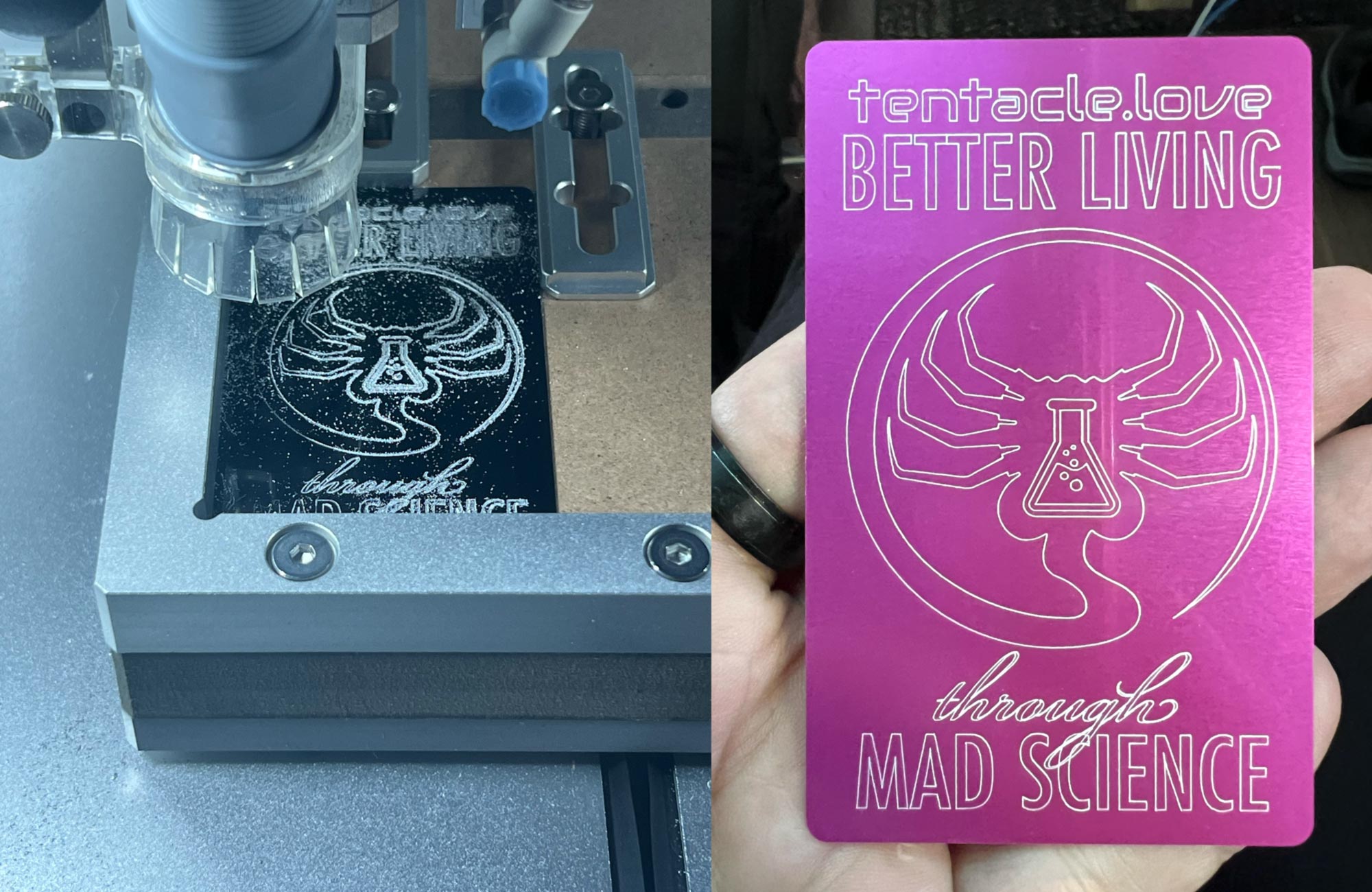
I had earmarked some of the settlement for a cheap used car, when I was captured by Facebook. I spotted an ad for a desktop CNC metal-milling machine for almost exactly the amount I’d set aside for the car, and I thought, if I can machine aluminum, I can make molds for sex toys without having to 3D print them any more! The molds would be higher quality, last longer, and produce better toys!
So of course I ordered the CNC machine instead of the car, and arrived home from Barcelona to an enormous shipping crate…
They call it a “desktop CNC machine,” but I don’t own a desk large enough or sturdy enough to hold it—the thing weighs in at almost 120 pounds(!). So it sits on my bedroom floor, still in the bottom of the shipping crate.
And My God, what an adventure.
I didn’t fully realize what I was signing up for. Carving 3D models out of metal is nothing like printing 3D models on a 3D printer. You don’t give it the model and say “here,carve this.” You have to specify the tool to use, the speed, and (this is the difficult part) the exact path the tool will take, over and over and over again, to carve the shape out of metal.
As one wag on Quora put it, “Dude, what you’re trying to cut requires graduating from trade school plus four years of apprenticeship.” (Whoevel writes an AI-driven expert system to automate some or all this process will become ridiculously wealthy, just sayin’.)
Anyway, I’ve been teaching myself CNC milling, and the learning curve is a cliff. This is quite possibly the most challenging thing I’ve ever attempted in my life.
I’ve worked out basic engraving…
…and I’m teaching myself Fusion 360 and Lightburn (it has a built-in laser engraver too). My wife has come up with some very cool projects to help teach myself, like tentacle fans with metal blades, which I’ll probably start selling once I’ve worked out how to make them.
But at the rate I’m going, I’m still quite a distance off from carving metal sex toy molds.
I’ve been talking a bit about my Talespinner lately, so inevitably, as night follows day, that’s prompted people to ask ask, “Your Talespinner? What’s that?” (Like, seriously, I’ve had dozens of folks on Quora, several emails and PMs, and one Facebook Chat question about this.)
If you’ve been reading my content for any length of time, you know I’m not monogamous. I have multiple partners, as do all of my partners. And naturally, because people aren’t fungible, all my partners are different.
Now, when I refer to my wife, people know what I mean. “Wife” is an ordinary sort of title. We all have a context for a wife. It’s not a terribly difficult concept, and as concepts go it has deep roots, dating back to the Agrarian Revolution or somewhere thereabouts. Point is, when I say “my wife,” most folks have a vague approximation of an understanding about what that means, even if some of the assumptions pre-packaged with “wife” aren’t necessarily true (we never pledged to forsake all others, for example, sometimes leading to raised eyebrows when I talk about my wife and my girlfriend and her boyfriend and I going on vacation together).
“Girlfriend.” That’s another easy one. When I say “my girlfriend,” most folks probably have some idea of what that means. And as when I say “my wife,” that mental model is not too badly wrong, though there are a few corners where expectation may not entirely line up with reality, as when I talk about my girlfriend sounding me while my wife holds me down and my crush takes video.
Ah, “my crush.” That’s where things start getting a bit tricksy. Most folks are at least passingly familiar with the idea of a crush, even if they tend to assume crushes are (a) short-lived and (b) unrequited. I met my crush at an orgy in a castle in France, a statement that never stops being weird however many times I type it, but it remained unrequited for nearly a decade until my wedding dinner, when my girlfriend said “hey Eunice, did you know Franklin has a crush on you?” (I still call her “my crush” because “my friend, co-author, and occasional lover with whom I share a vaguely defined relationship” is a bit of a mouthful.)
And that brings me to…
…my Talespinner.
So what TF is a Talespinner?
Well, as it says on the tin, a Talespinner is a spinner of tales. A weaver of dreams. A storyteller. A person who spins narratives and fables of fantasy from the cloth of imagination and language. A creator of mythology. A chronicler of the unreal.
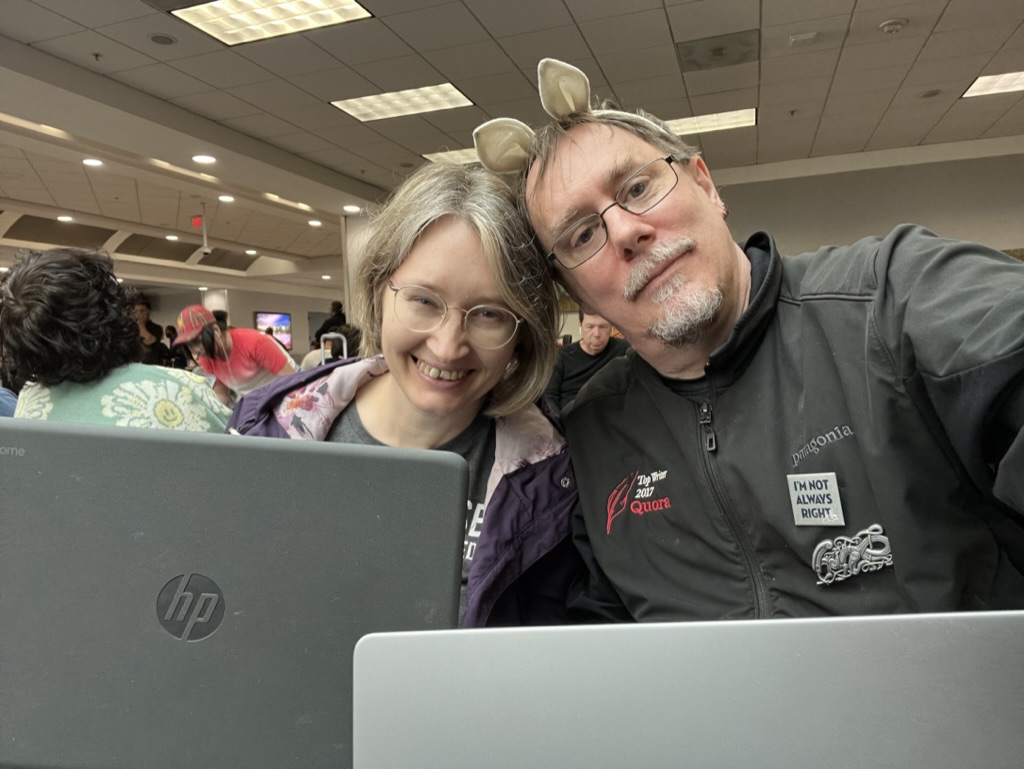
My Talespinner and I, working on our novel together in Hartsfield-Jackson International Airport on our way to Barcelona. The thing about being a writer? You write EVERYWHERE!
We met on Quora. Okay, not met, but “met”…
Lemme start over.
We “met” on Quora. We interacted with each other’s answers. At some point, I don’t really remember why or when, she said something about sex toys and I said hey, would you be interested in beta-testing some new designs? She said yes, I sent her tentacles and I think a kazoo ball gag, and so, when we were looking for titles, I became her Toymaker.
We looked for a title for her. I won’t disturb you with the details because they would…err, disturb you, but I was struck by her fertile imagination and her creativity, her ability to weave sexy stories from the most modest of threads. (In fact, we accidentally created a shared-world anthology of sexual stories with a robust and complex society, because apparently that’s the kind of nerds we are). So she is…my Talespinner.
We’re writing a book together.
No wait, scratch that, it’s not quite correct. We’re writing two books together, a rather heavy and quite dark literary novel that’s not about sex, and an anthology of erotic shorts that is.
The literary novel started because her girlfriend said “the Toymaker and the Talespinner? That should be a YA novel!” We started in that direction, got a bit more than a quarter of the way done with it, realized at about 28,000 words that it really wasn’t a YA novel but rather something much darker and more complex, tore up that novel, and started over from scratch.
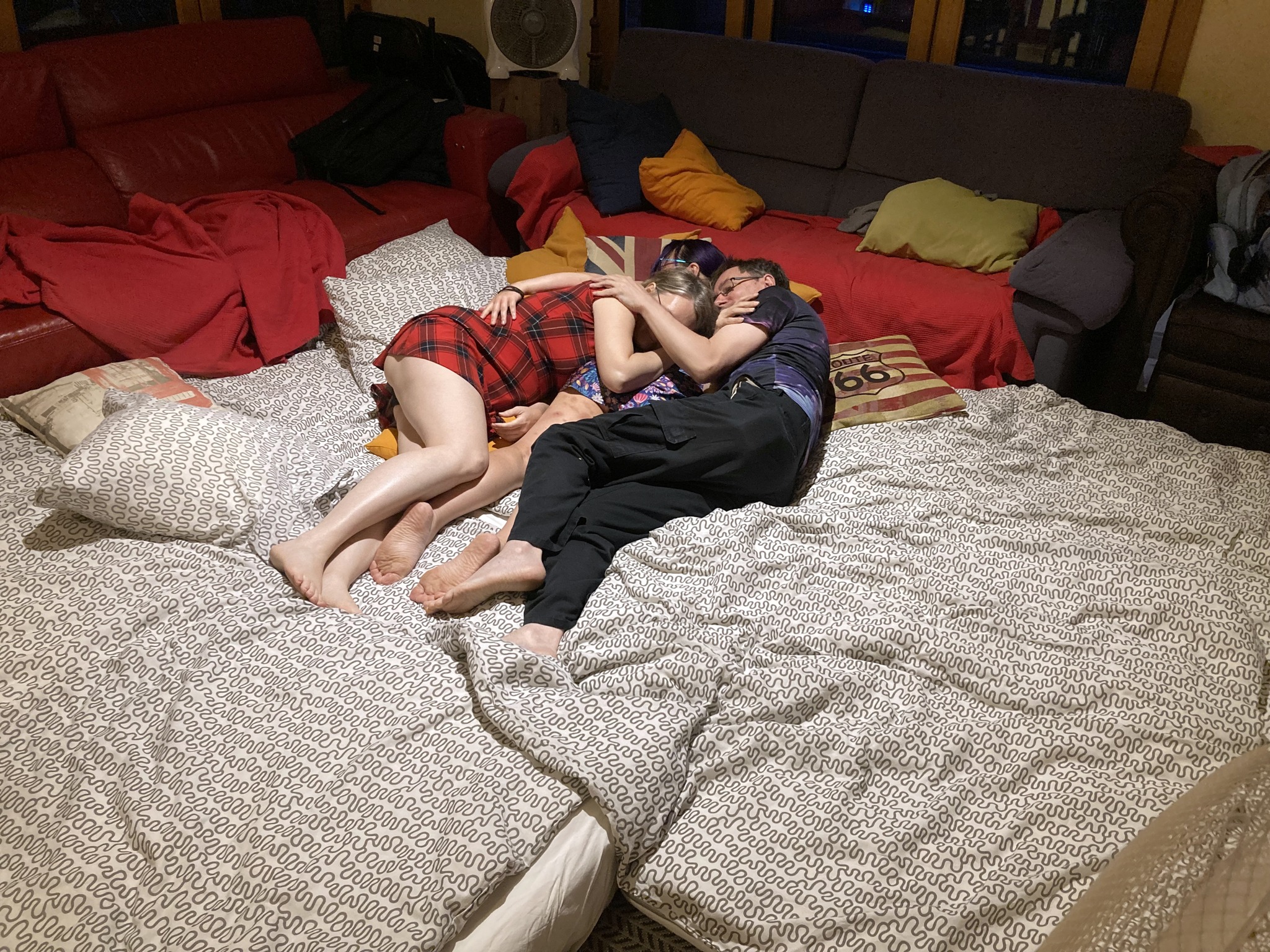
She accompanied me on the extended polyfamily’s vacation to Barcelona, which was fantastic fun; in fact, my wife took a lovely photo of me snuggling my crush and my Talespinner in the orgy pit.
I love my polycule! My Talespinner told me it’s one of the warmest, most welcoming poly networks she’s seen.
Well, to start with, nobody in the world actually wants social justice.
There. I said it.
Okay, lots of people sincerely believe they want social justice; the people who say they want it aren’t lying, exactly. It’s way more complicated than that, and a lot happens between “I’d like to live in a just world” and “I am going to work to make a just world happen.”
Buckle up, this answer is gonna get loooooong.
Let’s start here: The real world is complicated. Really, really complicated. You might think getting your scanner/printer to work with Windows is complicated, but that’s peanuts compared to socioeconomic and geopolitical reality.
And people, even smart people, handle complexity poorly.
Topical case in point: What’s happening in Israel and Gaza right now.
If you want to understand what’s happening, you need to know quite a lot of history from the 1940s on. There’s a lot of “there” there: the Israeli offer, turned down by the Arabic population; the reasons Egypt and Jordan closed their borders to the Palestinians; the history of Hamas, which is both a terrorist organization and also a government (and before that, the Muslim Brotherhood); the way Egypt has deliberately played the Gaza refugees as political pawns…it’s complicated and ugly and no side has totally clean hands, but even understanding where the balance lies requires a pretty thorough history lesson…
…and oh God that’s, like, sooooooo complicated, whyyyyyyy can’t someone just tell me who the good guys are and who the bad guys are?
That’s the thing: a lot of people want to treat actual, real-world political situations like football matches or WWF wrestling, with a clearly defined good guy and a clearly defined bad guy, so they know who they’re supposed to root for.
Even people who start out genuinely, sincerely interested in social justice can easily get bogged down.
That’s the heartbreaking thing about, you know, empathy and compassion. When you sincerely want to leave the world in better shape than you found it, you soon find yourself fighting an uphill battle. Injustice doesn’t exist because someone woke up one day and said “Hey! You know what? I think I’ll be a dick to other people today!”
Injustice exists because entrenched economic, social, and political systems with roots thousands of years deep have entrenched ways of doing things because the people atop those systems benefit from doing things that way.
Fighting against that is hard. It grinds you down. However energetic and idealistic you were when you started, it pulverizes you.
Nobody has infinite time. Nobody has infinite energy.
Which is fine, except that most people want to believe themselves to be one of the good guys, on the side of Truth and Righteousness and Justice, even when we don’t want to—or can’t!—do the work of getting there. It’s not enough to say “You know what? I’m not informed enough about this to have a reasonable opinion.” Oh, no, no, we want to take sides but we don’t want to invest the time or labor in making sure we pick the right side.
We just want to know who to blame.
Knowing who the bad guy is helps define us as the good guy. If we’re against the bad guy, that makes us good, right? Right?
So what do we do?
We develop heuristics. Cognitive shortcuts. Quick and dirty rules of thumb to simplify complex situations and help guide us toward the ‘right’ team to root for. These fast and easy heuristics, at least in theory, cut through all the tedious drek of having to learn all that history and become informed of the goals and grievances of all the players and untangle a knotty and nuanced tangle that’s been all balled up for decades.
But here’s the thing:
Heuristics are not subtle. They’re fast intuitive guidelines that substitute for actual understanding. They feel right, but that doesn’t mean they are right.
Those heuristics—“believe women,” “always side with the most historically oppressed,” whatever they are—gradually become rules, then social tribal markers, then symbols of moral purity. Heuristics become adopted by tribes as ways to tell the in-group from the out-group. If you see a hashtag like #believewomen, you can probably make a pretty good guess about the politics of the person who subscribes to it.
Before long, it actually becomes morally wrong not to obey the heuristics.
Enforcing moral purity becomes a way to feel powerful, to feel like you’re accomplishing something, in the face of the overwhelming hopelessness and despair that comes from fighting an entrenched system day after day and ending each day with nothing to show for it.
What it feels like to care about justice
Say your crusade is animal welfare, for example. You’ve fought for years and what do you have to show for it? There are even more factory farms now than when you started. Consumption of animals is up, not down.
But then let’s say Bob, your staunch and stalwart ally, your comrade in arms, reveals that he’s not a vegan…he thinks it’s okay to eat fish. And…and…and eggs. And he wears leather belts.
You can’t end factory farming, you can’t stop the senseless slaughter of animals…but hey, you can rally the troops against Bob, because he betrayed the cause! You can destroyed his reputation and cast him out! Look! Look! You accomplished something!
This is inevitably what happens in social justice circles. We end up here because:
People want a morality simple enough to fit in a hashtag; and
Any morality simple enough to fit in a hashtag cannot capture reality, and therefore is rather limited as a tool to change reality.
People tend to think of “social justice” as a left thing, but this process knows no political bounds. Those on the right do it just as often—they simply don’t call it “social justice.”
But the same things still apply: they have a way they want the world to be; changing the world requires tremendous amounts of effort and work; people don’t have limitless resources; they fall back on simple rules to tell them who the good guys and bad guys are; those simple rules become tribal markers; before long, it becomes morally unacceptable even to question those simple rules.
We see the world not at it is but as we are. We invent narratives to describe the world, and to tell us who the good guys are, and who we should be in order to think of ourselves as good. Anyone who can co-opt those narratives can control the lines between Us and Them, the boundaries that define our tribes.
So here we are. We’re terrible at nuance, we don’t have tome to get informed, so we let the hashtag mentality do the work for us.