Key West Part III: Urban Decay

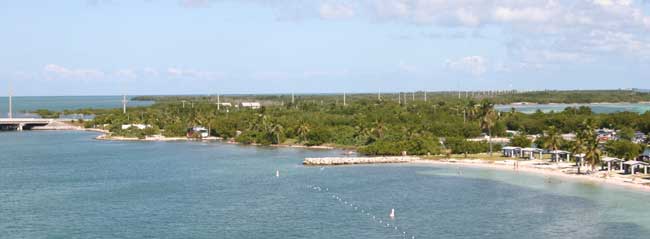
One of the most enjoyable parts of the trip to Key West for me was on Sunday, when Shelly, smoocherie, and I spent some time exploring the ruins of an old, wrecked bridge. The bridge was built in 1912 as a railroad passage, then later did double-duty as an automotive bridge before a new bridge was constructed parallel to it. The old bridge was left standing, as it would have been too expensive to demolish, but was broken at each end; the remaining structure is kind of slowly rotting away.

There’s urban decay visible everywhere in Key West, but as with everything else, they don’t do it quite the same way that any other town does. In most towns, the rot starts in industrial areas, and spreads outward as people flee the inner cities for the sterility and monotony of the suburbs, but Key West has no industrial areas and no suburbs, so things just kind of fall apart randomly.

So, without further ado… On to the pics!

Living in interesting times

I am still planning a long series of Key West posts, with pics. This still isn’t that post.

Rather, this is yet another “it seems the universe wants us to leave Tampa” post.

I don’t want to leave Tampa, really I don’t. But it’s looking more and more like it’s going to happen, and soon. I still have one client that’d like to hire me and ship me up to Atlanta, and now a second client–one I am a minority shareholder in–wants me to move up to the Atlanta region as well.

It’s kind of a complicated situation, but: when I first started my own business, one of my clients, an ad agency, provided me with rent-free office space in exchange for a discounted rate on prepress and other technical services. That client has a partnership with another company, which makes consumer electronics. The electronics firm is a small startup that’s been struggling for a number of years; they make a very popular device, and have patents on the basic technology behind many other devices that could be worth literally hundreds of millions of dollars, but they’ve lacked the capital to develop and market the products. They’ve actually paid me in stock for various services I’ve done for them, as they have virtually no cash.

Well, the electronics company has finally found venture capital backing. Lots and lots of it. Millions of dollars. Enough to start doing serious development on the new products they’ve prototyped. They’ve decided to lease an industrial park in Georgia, near Atlanta, and…they want me to move up there with them.

Simultaneously, the ad agency has decided to shut its doors. The people who own it are also the principal owners of the consumer electronics firm, and since the latter is getting venture capital and the former is losing clients, they’re closing the doors.

What that means to me: I’m losing my rent-free office. I’m losing my largest client. However, I have the potential to make a lot of money, and by “a lot” I mean “well over six figures,” by staying with the electronics company. So, it shakes down something like this:

If I stay in Tampa:

– I lose my office, and my accounting serivces (currently being provided for free by the ad agency). This means I restructure my business so that clients never come to me, or I spend the money it takes to get another office.
– I still do work for the electronics firm, via telecommuting. They’re willing to do this, but I’m skeptical about it. It’s rather cumbersome, and I think that in the end, what may happen is they’ll look for someone to do the day-to-day work locally, and I’ll gradually end up being phased out.
– I don’ have to spend the money to move. Moving will be a nontrivial expense.
– I keep my existing clients…but I’d better come up with some new ones to replace the advertising agency pronto.
– Shelly keeps going to school.
– We are in a place that’s much more socially supportive than Georgia.

If I move to Georgia:

– I have the potential of earning a six-figure salary, and possibly becoming a millionaire on the basis of my percentage of the company…if things go well for this company, if the venture capital works out, if the company succeeds. A startup company is always a gamble.
– I have the backup plan–my client that already wants me to move to Atlanta would be deliriously happy to have me, though it would mean giving up being self-employed.
– It’ll be expensive. Moving is not cheap, and we’re already out a lot of money because of the Boston thing.
– We break the lease here. Also not cheap.
– Shelly has to change schools, meaning she has to pay out-of-state tuition for a year.
– We have to leave all our friends in Florida. That sucks hefty moose willie.
– I will have to start from scratch if I plan to develop my own client base as well as working for the electronics company.
– I will have to leave my existing client base.

This is the third time this year that something has happened which has caused us to consider leaving, or caused us to leave (however briefly), Tampa. This is getting ridiculous. Losing my office space, and my largest client, is a big deal; packing up and moving to Georgia, and betting on a startup, is also a big deal.

The ad agency is shutting its doors in sixty days, which at least gives us some time to figure out what move to make, but in any event it looks like going out to San Francisco for MacWorld this January is a non-starter. Unless a miracle occurs, it ain’t gonna happen. In a way, I kind of feel like I’m in a chess game, and these next few moves will either win or lose the game. Where’s a future prediction device when I need one?

Some thoughts on the political process

I have a lot of things to post about our recent trip to Key West, and (as usual) lots of bandwidth-devouring, not-safe-for-work photos to go with. This isn’t that post, however.

On the way to Key West, i saw a truck with a patriotic bumper sticker–the one that has a picture of the American flag and the slogan “These Colors Don’t Run.” The sticker was printed with cheap inks, which had faded almost to nonexistance inthe sun–the red stripes on the flag were sunbleached to pale yellow, the slogan was barely readable. How appropriate, I thought.

Right now, America is the world’s sole superpower. Right now, we can do pretty much as we please on the world stage; right now, there is nobody who can out-muscle us. problem is, right now we’re facing an adversary who isn’t competing with us on our own territory. The Cold War, that bitter war of attrition with the Soviet Union, was largely about who could out-muscle the other, an arm wrestling match fought with nuclear weapons and with conventional weapons in thousands of indirect ways all over the globe. The Taliban in Afghanistan was an American creation; we found, trained, armed, paid, and equipped the most virulent, anti-Western, reactionary, xenophobic bunch of fanatic whackos we could find and set them loose against the Russians, hoping to bog the old USSR down in an unwinnable quagmire in Afghanistan. Fate, it seems, is not without a sense of irony.

So the Soviet Union is no more, and we’re the supreme military power in the world. These colors don’t run; that’s not what happens to solitary superpowers. These colors, instead, gradually fade away.

Being a solitary superpower is not a sustainable proposition. Ask the Persians, or the Romans, or the British. Indeed, we find throughout history that Afghanistan and Iraq are the places where world superpowers go to die.

During the fading days of the British empire, the British found themselves up to their hips in the quagmire of Afghanistan, spending what was left of its resources in a feeble and ultimately fruitless effort to bring order to that part of the world. Meanwhile, across the ocean, America was quietly and steadily building its own political, economic, technical, and military might. By the time the British realized what was happening, they’d been consumed in Afghanistan just as the Soviets would later be, and in Iraq, and they looked around and realized that the world had passed them by…the British Empire had faded, quite without anyone realizing it, and the nation that was once the reigning superpower was suddenly an also-ran.

So. Fast forward to today, and we have…a world superpower slowly being consumed in Afghanistan and Iraq, while across the ocean, another country, this time China, is quietly and steadily building its own political, economic, technical, and military might. The Chinese economy, which depends far less on the rest of the world than ours, is slowly becoming a mammoth juggernaut; the Chinese now publish more research papers every year than we Americans do; the Chinese are developing their own ambitious manned space program; the Chinese government is investing heavily in manufacturing, R&D, and technical firms abroad… Haven’t we seen this script before?

Afghanistan and Iraq is where world superpowers go to die. You’d think someone would have noticed by now.


I voted today. I doubt anybody will be surprised at the way I voted. Had a dead mackerel been running against Bush, I would’ve voted for the fish. “Vote smelly fish for a stronger America!” “The fish–it can’t do a worse job, right?” I did, however, jump outside the Democrat/Libertarian paradigm in my local elections, where I actually feel those votes might be of some use.


On a completely unrelated subject, I got my Alcor paperwork yesterday. Once I have it filled out and notarized, I’m in. I have to find some witnesses who’ll sign it as well; coordinating the witnesses and the notary, and a bit of luck, is all that stands between me and having a life that’s long enough to have some prayer of seeing a time, far far in the future, when human beings the world over will actually learn something from history. But then, I’m an optimist. I know that because OK Cupid says so.

Busy weekend, fun times…

Okay, just in case anyone missed it, the lunar eclipse last night was very, very cool. We were over at Game Night, and were able to watch it with a large group of friends… tampagypsy and company, the Smoosh, and even papertygre, who put in an unexpected appearance.

It was a delight to meet papertygre in person. From the conversations we’ve had in her journal, I expected her to be smart and interesting, but in reality she’s devastatingly intelligent and downright fascinating. All things considered, it’s probably a good thing Shelly and I had to leave early; had I spent any more time talking to her, I probably would’ve ended up with a full-blown crush on her.

This afternoon, we’re heading out of town–driving over to smoocherie‘s place. Tomorrow, we’re all heading down to Fantasy Fest in Key West, where we’ll be hooking up with our former roommate Eric and his girlfriend Sofia. This will, I think, be a whole lot of fun.

And anyone who ever gets the opportunity to play the game Ninja Burger should seize it!

Some thoughts on self-knowledge and happiness

This comment actually comes from a conversation I’m involved in in a UseNet newsgroup elsewhere. It’s part of a conversation thread regarding the skills and values that are positive or necessary in a polyamorous relationship. Another person in the conversation posted the usual list you’ll see in any poly discussion anywhere–you know, honesty, communication, that sort of thing. I added one more thing to the list; “Know thyself.”

One could reasonably say that this idea has not been well-received.

My commentary:

There is a difference, I believe, between a person who can’t answer general questions about himself because he feels that it doesn’t offer enough insight into what’s being asked or because he feels he has no place to start, and a person who can’t answer a general question (or a specific question, or for that matter just about any question about himself whatsoever) because he *does not know.*

Now, I’m about to make a series of statements which, if my experience holds up, will probably upset, threaten, or anger approximately 50% of the people who read them. Nevertheless, I will stand by all of them, because I believe they’re true. 🙂 Ready? Here we go!

1. Self-knowledge is an important and valuable tool; all other things being equal, a person who seeks to know and understand himself, a person who develops not only the skills but the *habit* of introspection, will probably be better off in many ways than a similar person who does not.

2. Self-knowledge is a process, not a state of being. It requires constant work, constant self-examination, and a genuine desire and commitment to understanding what makes one tick. Because it’s work, and furthermore because it’s work that never ends, there are many people who hate, despise, fear, feel threatened by, or otherwise respond strongly against the notion that self-knowledge has value. in fact, with some people, the statement “Self-knowledge is a valuable thing to have” will get much the same response as “Sex with dead animals is a good thing to have.”

3. Self-knowledge is valuable to relationships–not just polyamorous relationships, but relationships of any sort. Like communication, self-knowledge is both a tool and an approach; it benefits a relationship because a person who has a reasonably good grasp on who he is, how he reacts, and what makes him happy has a clearer idea of his wants, needs, boundaries, and so on than a person who does not, and therefore can more easily explain those to his partner. It is possible to have a good relationship with poor self-knowledge, just as it is possible to have a good relationship with poor communication skills, but having good self-knowledge, like having good communication skills, makes things a whole lot easier.

And just in case there’s anyone who’s not pissed off yet, this one should really do it:

4. Self-knowledge makes happiness easier to achieve.

Now, no reasonable person is static; I may know things about myself today that turn out not to be true tomorrow. This is why it’s a process, and this is why it requires work…and this, I believe, is why so many people hate it so much. Nevertheless, i submit that if you do not know what you want, you can not reasonably expect to have what you want, except by accident.

One of my favorite quotes comes from Francis Bacon, who wrote “Your true self can be known only by systematic experimentation, and controlled only by being known.” I also happen to agree with one of the things Socrates said: “The unexamined life is not worth living.”

Judging by the popularity of TV reality shows, I would suspect that many peope probably disagree with me, and would be more likely to believe that the untelevised life is not worth living. That’s fine with me.

More geeky goodness…

This one’s for nihilus:

Running MacOS X on a 25 MHz Centris

The machine is running Linux with PearPC installed on a 25 MHz 68040, with a minimal Panther install over PearPC. It takes–are you ready for this?–seven days to boot.

Man, I bet this guy gets ALL the chicks!

I was actually considering installing PearPC on my 800MHz Pentium III system, just to see how painfully slow it’d be, but geez, after this, there’s really no point, is there? Unless i want to install it on my 2MHz TRS-80 or something…

It just keeps getting better every single time i see it…

“Why, Mr. Anderson? Why? Why do you do it? Why? Why get up? Why keep fighting? Do you believe you’re fighting for something? Something more than your survival? Can you tell me what it is? Do you even know? Is it freedom or truth? Perhaps peace? Could it be for love? Illusions, Mr. Anderson! Temporary constructs of a feeble human intellect trying desperately to justify an existence without meaning or purpose. And all as artificial as the Matrix itself, although only a human mind could invent something as insipid as love. You must be able to see it, Mr. Anderson. You must know it by now. You can’t win. There’s no point in fighting. Why, Mr. Anderson? Why? Why do you persist?”

Watched The Matrix Revolutions again last night. That entire series is pure brilliance, beginning to end.

The “Hellraiser” computer room

So, some people in another forum have asked me to post pics of my computer room, which has an…unconventional design scheme (with kudos to zensidhe for the original idea).

If you don’t have any interest in seing it, move along; otherwise, just…
click me!

On hope, death, and life

This weekend, Shelly and I both got some new tattoos. We both got the same tattoo, but not for the reasons you might think.

The tattoo itself is the Kanji for “Hope,” and looks something like this:

We each got the characters on the inside of our right wrists. And no, it has nothig to do with the fact that we’re dating, and everything to do with a set of shared values about the future.

Every day since I was very young, every single day without fail for my entire adult life and most of my childhood, I have been aware of the fact that someday, I’m going to die. This has been a universal constant of the human condition since we first began using language and making tools. There’s no getting around it; the unescapable, inexorable reality of death has fueled the fabrication of entire complex paradigms and mythologies, all designed to reassure their believers that once you get past the grave, if you but only follow some arbitrary and manufactured set of rules, nothing can go wrong.

This has been the reality of the human experience for all of human history…until now. Now, for the first time ever, we can see a mechanism by which aging and death can be circumvented. We aren’t there yet, but we know it is possible. On the horizon, we can see a reality in which old age is no longer a part of the normal human reality, and death is not inevitable. We can see the mechanisms responsible for these things. We can see that these mechanisms can be manipulated. We know that altering these mechanisms does not violate any fundamental law of physics. At this point, it’s simply a question of figuring out how to do it.

Two years before the Wright Brothers flew, Lord Kelvin, the famos physicist who lent his name to the Kelvin scale of temperature and whose work was instrumental in understanding the nature of heat and energy, the man who helped contribute to our basic knowledge of thermodynamics, stated flatly and absolutely, “Heavier than air flight is impossible.” When it was pointed out to him that birds are heavier than air and birds fly, he answered to the effect of “That’s different–birds are alive.”

In fact, he was wrong for one simple and obvious reason: The fact that birds can fly demonstrates clearly and beyond refute that heavier-than-air flight violates no fundamental law of physics. History shows us that that which does not violate the fundamental laws of physics can, eventually, be done; it’s simply a matter of having the will and the time to figure out how to do it.

Nanotechnology promises something no other branch of human exploration has yet promised: the ability to, on an atomic scale, order molecular systems in any way we wish that is not prohibited by the laws of physics. Human beings are molecular systems; the laws by which cellular biology work are becoming very well understood, and when reduced to its simplest components, any biological system is simply a complex system of self-replicating biological machinery, operating in accordance with physical laws to construct large-scale macroscopic systems from small-scale molecular assemblers. Molecular assembly, like heavier than air flight, does not violate the laws of physics; we know this because we see large-scale systems built by molecular assemblers every day. Biological systems which do not age and die do not violate the laws of physics; we know this because we have examples of such systems, in trees that live for four thousand years and microbes that can survive for twenty-five thousand years or longer. Changing the operation of biological systems in arbitrary ways can be done without violating the laws of physics; we’ve known this since the advent of the first drugs, and advances in gene therapy have demonstrated that almost any result we want in almost any biological system is at least theoretically possible.

So, back to the tattoo. I am living in one of the first generations in all of human history where we can honestly say we are beginning to understand the physical mechanisms of aging and death, and we can see ways those mechanisms may be altered. Will it happen soon enough to save me? It’s a long shot. But make no mistake about it: we are fast approaching the first generation of human beings who will be born into a world where old age and death are not inevitable. There is hope–not only for me as an individual, but for us as a species. Erasing old age and the inevitability of enfeeblement and death will transform the human condition in ways that we can not hope to predict, and are at least as profound and as deep as the development of language.

I will do everything in my power to be there to watch it happen.

There’s a good chance, of course, that the technology will not develop before I die. In that eventuality, there’s a backup plan: Alcor. It too is a long shot, but now that I have a better understanding of what they hope to accomplish, and the mechanism by which they hope to accomplish it, it’s not as much of a long shot as it seems.

So. Now I have hope, and hope is a powerful thing.