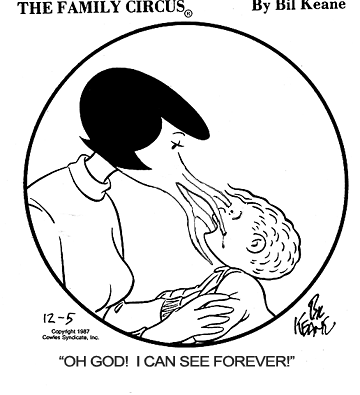

Some thoughts on specialness…

…taken from a reply in a thread in polyamory, borrowing in turn from a similar conversation thread on a mailing list I read.

Many, many people feel special in a relationship because of the things their partners do. For example, some people feel special by exclusivity–“I am special because he does not love anyone else,” “I am special because he only does thus-and-such with me.”

The danger in doing this is that if you’re not careful, sometimes what happens is you end up placing your sense of worth, your sense of value, and your sense of “specialness” on things outside of yourself.

If you need certain exclusive things in order to feel secure with your lover and in order to feel unique and special and valued, then you will never really be secure and you will never really feel unique and special and
valued–because you will always know that these things can be taken away from you.

I feel secure in my relationships because I know, deep down in my heart, that nobody else is like me and nobody can ever take my place. If my partner Shelly does everything with her other boyfriend that she does with me–if she goes to the same restaurants, watches the same movies, has sex in the same positions–it does not bother me and does not make me feel jealous or insecure, because I know that the things that make me special and irreplaceable are inside myself, not outside.

My specialness does not come from the exclusive things we do. My specialness comes from *who I am.* Knowing that makes me secure, and it also means I don’t need tokens of my specialness, like exclusive things from my partners; my specialness is assured, is concrete, and can never be taken away.

It’s been my observation that the more you place your sense of value and worth on things outside yourself–the more you need, and rely on, tokens of exclusivity in order to feel special–the more you will struggle with jealousy and insecurity. Real security, in the end, can come only from within.

I think that many problems people have with their partners’ behavior, especially in polyamorous relationships (but sometimes in monogamous relationships as well), come from the need to have their partner make them feel special. If you are in fact special to your partner, then there should be no need to set boundaries or controls on your partner’s behavior in order to feel it; it will shine through in everything your partner does, all the time. If, on the other hand, you are not special to your partner, then controlling your partner’s behavior isn’t going to make you special.

Credulity, autism, and vaccination information…oh, and space aliens, too.

So lately, I’ve noticed a trend.

More and more often, on various unrelated forums I read, it seems that anti-vaccination activism is becoming the trendy topic du jour. Decrying vaccinations as “dangerous” and “unproven” is hot these days; and worse yet, people are now advocating not immunizing children.

I keep seeing the same claims posted again and again on all these different forums…sometimes, word-for-word the same, which suggests that people are copying the information from one place and pasting it into another, without actually doing any research to verify the authenticity of this information.

This points, I think, to the same kind of credulity that lets people believe in the Loch Ness monster and the notion that human beings were created by space aliens from the tenth planet who used us as slaves to mine gold, but at the same time not believe that the world is round. Credulity pisses me off, as long-term readers of this journal will no doubt have noticed.

So I did some legwork. I visited a bunch of anti-vaccination Web sites, and made a list of the claims I’ve seen posted on many of these sites, and then tracked down the truth. I’ve invested, at this point, about seven or eight hours into looking up each of these claims, reading very dry articles, doing Google searches, looking at links, and compiling an assessment of whether the claims are true or false.

As it turns out, not all the claims are false. Some of them are true, though often not true in the way the activists campaigning against vaccination might think. And I found some surprises, too.

Into the abyss…

Warning! Caution! Danger! MAJOR geek posting about computer viruses!

Computer viruses. If you’re running a Windows computer, the odds are slightly more than 9 in 10 that your machine, right now, is infected with at least one virus. If you’re not behind a firewall and you’re on broadband, odds are good that when you leave your computer at night, spammers take control of your computer and use it to send spam, and Russian mafia roots around in it at will.

Microsoft would have us believe that there is nothing wrong with Windows, that there are many Windows viruses and zero Mac viruses because more people use Windows than Macs and virus writers go for the most popular platform, and that there are just as many known Mac security flaws as Windows security flaws.

This argument breaks down for a number of reasons. it’s commercially useful to Microsoft, of course; if people actually knew how badly and terminally insecure Windows really is, fewer people would use it, so it is very important to Microsoft’s bottom line that people accept the standard “nothing wrong here, it’s just because Windows is so popular” myth.

For starters, the number of “Windows computers” targeted by a particular virus is not necessarily higher than the number of Macs. People make the mistake of thinking all “Windows computers” are all running the same operating system–an operating system called Microsoft Windows.

Problem is, there is not an operating system called Microsoft Windows.

For those on my F’list who like Firefly and Battlestar: Galactica…

…from a link ganked from alem‘s journal…

Seems the same effects company did the effects for both shows, and slipped Serenity into a scene from Battlestar: Galactica. Apparently, there’s an episode where a character is in a room overlooking a spaceport, and through the window you can see Serenity lifting off:

Freaky, freaky, freaky stuff

Beneath the cut is an image created as part of a French AIDS awareness poster series, which has been making the rounds of the Internet lately. It’s work-safe, at least in the sense that there’s nothing particularly indecent about it (it was designed for public display, after all), but…

May be triggering, especially if you have a spider phobia. You’ve been warned.

chemistry geekiness and shower curtains

So Shelly bought a shower curtain with the Periodic Table of Elements on it, which is the second-coolest1 thing she’s got in the last two months.

And I was looking at it the other day, while sitting on the pot meditation, and noticed something about it that kind of bugged me.

So i went online and looked at other periodic tables as well. They all have the same error, and it drives me crazy.

Folks, hydrogen is a metal!!!

Look where it is. Same column as lithium, sodium, potassium, and other reactive light metals. In fact, the only periodic table that gets it right is the one at the Los Alamos National Laboratories Web site.

Hydrogen is a metal. I think we get all confused about hydrogen because we are accustomed to thinking of metals in a certain way; metal is what your car is made out of, and what your canned food comes in, and hydrogen is normally a gas, so it’s not a metal, right? (We don’t seem to have this issue with mercury, a metal that’s liquid at room temperature, but for some reason the idea of a metal that’s a gas at room temperature seems to make us think, well, that’s not a metal, it’s a gas!)

In its solid form, hydrogen is a metal. The core of Jupiter is an enormous ball of metallic hydrogen.

Which means that hydrogen on Shelly’s shower curtain should be teal, not red. Dammit.

Edit: Forgot the footnote!
1 The coolest thing? Shelly’s mom sent her Christmas lights with a BDSM theme. Each light is a round white ball, and the balls all have collars or harnesses or straps around them. 🙂

Goddamn Network Solutions anyway

So for the past week, many people (but not everyone) have been unable to surf to my business Web site, obsidianfields.com. This means, among other things, that images posted in my LiveJournal are not appearing for everyone.

The site’s DNS records are correct, but for some reason, about a week ago Network Solutions’ WHOIS data started showing the wrong IP address for the site. I have no idea how or why; the name server information is right, but the IP address isn’t.

Network Solutions insists that there’s no problem on their end; there’s no way their database can be wrong; the problem must exist with the Web host, GoDaddy. Yet I can log on to the GoDaddy control panel, and GoDaddy’s name servers are showing the correct information. In fact, I can surf to the web site through a proxy server such as MegaProxy, and DNSStuff shows the correct information. It’s only Network Solutions that’s showing it wrong.

So if you guys can do me a great big favor, I’d really appreciate it. Go to

http://www.obsidianfields.com

and tell me what you see. If you can tell me who your ISP is, that’d really be helpful, too.

For all you geeks on my f’list, if the domain won’t come up for you, I’d appreciate if you can do a whois and tell me what’s showing as the site’s IP address and what name servers are listed as well.

Being a Secure Person: Practicing the Piano for Love and Profit

Note: This message started out as a reply to a post in a completely different, non-LJ-related forum, about how to deal with fear and insecurity in a polyamorous relationship. It’s been reworked a bit from there.

I’m not terribly spiritual. (Yes, it’s true!) I don’t see polyamory as a “spiritual path,” I’m not prone to believing in “sacred sexuality” as a way to explore my connection with the Universal Cosmic Divine, and my own approach to polyamory (and to life in general) is very practical and hands-on. This is why I do not believe, for example, that love is infinite…but that’s a topic for another time.

There is a saying: “There is no fear in love, but perfect love casteth out fear.” I don’t believe a word of it. Often, the way it works in practice is quite the opposite. You get rid of fear, and the love follows more easily. The “getting rid of fear” part is the bitch…but it can be done.

And getting rid of fear and insecurity makes life better. Ultimately, dealing with fears and insecurities is something that must be done; a person can deal with them by hiding from them, deal with them by rearranging his life around them, or deal with them by destroying them completely, but not dealing with them generally isn’t an option. And frankly, with the amount of time and effort people invest in hiding from their fears or building their lives around their fears, just eradicating them to begin with is actually less effort in the long run.

So. Practical, ordinary dealings with fear:

Fear is deceptive. Fear will attempt to justify itself. Often, you can think of your fears as though they were living creatures of their own; they will fight to protect and defend themselves, just like any other living thing.

Fear is tricky because it can color and distort the way you see the world. You will often see (or, sometimes, fabricate) things which support your fear, while totally missing things which contradict your fear. On top of that, when you are afraid, you tend to project that feeling into the past, remembering most strongly those things which confirm your fear; and into the future, and believe, if only subconsciously, that this is the only way you will ever respond to this kind of situation, and no other response is possible.

Fear tends to wither and die if you drag it out into the light, though. I’m personally a big fan of marching into the closet, grabbing the biggest and ugliest monster in there by the tail, and then dragging it out and going toe-to-toe with it. Fears gain strength when you let them hide in the shadows, and lose strength when you examine them and confront them head-on.

So. I’m going to start with a hypothetical situation, and lay out a plan for conquering a fear, step by step. Different fears express themselves differently, and fears and insecurities can manifest in many ways, but the same tools can be used for dealing with them all. For the sake of example, I’ll start with a fairly common response I’ve seen in poly relationships many times: you have a partner, your partner has another partner, and you feel insecure or jealous when you see them together in a romantic context, like when you see them kiss.

Ready? Here we go.

Look beneath the surface

Figure out what lies at root of the response. This is the first and most critical of all tools for dealing with fear or insecurity. Insecurities, jealousies, and fears are often composite emotions–emotions made of other emotions. You can’t confront the fear until you understand what lies beneath it.

Say, for example, you see your sweetie kissing someone else, and that brings up a negative emotional response–jealousy, fear, whatever. Look at that fear! (Yes, I know this is difficult; when you’re in the grip of a negative emotion, all you want to do is make it stop, right now, by any means necessary.) Examine what it’s telling you. Why do you have that response? Is it because you believe that you can’t compete with the other person? Is it because you’re afraid your lover may find you wanting? Is it because you’re afraid your lover will leave you, or want you less, or prefer someone else’s company? Try filling in the blanks: “If my lover kisses another person in front of me, then the bad thing that will happen is ______.” “If this keeps happening, then it means ________.” “If my lover really loves this other person, then ______.”

Further Down the Rabbit Hole

Once you have an idea of what it is that underlies the fear, keep following it down the rabbit hole. For example, let’s say that you have a negative emotional response when you see your partner kiss someone else, and you figure out “I am afraid that that other person might kiss better than me, and my partner might want that other person more than me.” Well, now figure out what’s underlying *that* fear. Is it rooted in fear of abandonment? Low self-esteem? Fear of competition? Fear of loss? What is it you’re afraid that means? Why do you believe that the other person might kiss better than you–and more to the point, why do you think that’s even relevant?

Disassemble! Disassemble!

When you’ve done that, you’ve made a lot of progress. For example, let’s say you have a negative emotional response when you see your partner kiss someone else, you’ve figured out that the response is caused because you fear that if your partner’s other partner kisses better than you you will lose something, and you’ve figured out that this is rooted in the idea that if your partner’s other partner is more pleasing to him, your partner will want to be with that other person and not with you.

Okay, now we’re getting somewhere! The root of the response is fear of abandonment. Now you need to take that fear apart. This is what I mean when I say “drag the fear out of the closet and go toe-to-toe with it.” You need to disassemble the response, and figure out whether or not it’s valid.

One way to do this is to examine the assumptions about your relationship that your fear reveals. Do you believe that your partner is with you because of the way you please him in bed? Do you believe that if your partner finds another person more sexy or more pleasing, you may lose some or all of your relationship? Are those beliefs founded? Is it possible that your partner is with you for reasons besides those? What might those reasons be? What value do you add to your partner’s life? Does your partner value you for the way you please him, or for who you are? Is it even meaningful to say that one person can replace another?

Now, the danger in doing this is that sometimes, you may find your fear really is justified. Not all fears are irrational. There are people in the world who are only with someone for a lay, and will move on as soon as they find a better fuck. It could very well be that in this hypothetical situation, this is the case. If so, so be it. The best way to keep from being disillusioned is not to have any illusions in the first place; if your partner is only with you for a lay, then this is the kind of thing you should know.

But more likely, you will find that when you do this, your fears fall apart. When you examine your relationship with your partner, you will likely find that, no, you add value to your partner’s life in a myriad of ways, large and small, and that even if your top-level fears are realized and your partner finds someone better in bed than you (or whatever), it does not mean you will lose your partner.

How do you get to Carnegie Hall?

At this point, I’m going to digress a bit and talk about what it means to be a “fearful person” or an “insecure person” or a “jealous person.”

I’ve talked to a lot of people who say things like “Oh, i could never be polyamorous; I’m just a jealous person”–as if being a jealous person were some matter of genetics, something over which we all have no control, like being born with blond hair or…well, no, people actually think they have more control over their hair color than over their own conceptions about themselves, which is interesting.

Let’s say you went to a piano concert. Would you say that the pianist up on the stage was “just a good pianist,” as if that’s all there was to it? Hell, no–and if you did, she’d likely punch you. You get to be a good pianist by long, hard practice. A good pianist is made, not born.

The same is true of being a secure person–or an insecure person. People are accomplished at being insecure because they practice being insecure. They practice diligently, every day, for years; it’s no wonder they’re good at it.

You practice being insecure every time you let yourself think “Oh, I’m not good enough for that” or “Oh, my partner doesn’t really want to be with me” or “Oh, I don’t deserve that” or whatever.

After a time, this way of thinking becomes natural and effortless. A pianist who has practiced enough does not consciously have to move each finger to the proper key; after a while, they find the keys by themselves, without conscious effort. A person who practices being afraid or insecure soon becomes very natural at it; you find the things to support your fear, you learn the tools to reinforce your fear, without consciously thinking about it.

The same is true of self-confidence and security. These are things you practice; practice them enough, and they become totally natural, a part of who you are.

So back to dealing with fear. Once you’ve deconstructed your fear, discovered what it’s rooted in and taken those roots apart, once you’ve found a list of things which discredit your fear, it’s simply a matter of reaching for those things that your partner values in you and that you add to your partner’s life whenever the fear raises its head. The thing about fear and jealousy and insecurity is that these things are in some ways like playing a piano; they represent ways of looking at the world which improve with practice. Just as practice can make a person into a highly accomplished pianist, so does practice turn someone into a highly fearful or highly jealous person. And contrawise, practicing discrediting your fear, developing the mental habit of staring down your fears and insecurities and saying “No, you’re wrong, and here’s why” whenever they stir, will make you accomplished at feeling self-confident and secure.

Once you understand why your fear is flawed, you simply have to train yourself to stop reinforcing it, and to reinforce the feelings of value and security instead. This will feel awkward and unnatural at first, just as learning to play the piano feels awkward and unnatural at first. But you become good at what you practice. If you practice being afraid, you get good at it; if you practice being courageous and fearless, you get good at that.

Now, me, when I feel something that makes me feel insecure or fearful, I tend to want to push on that thing–a habit I picked up from Shelly, who is a master of it. So to take my hypothetical example, if I were to feel an unexpected negative reaction at seeing a partner kiss someone else, rather than try to hide from it or to tell my partner not to do it, I would instead tell her “I feel this way when I see this, so when you do this when I’m around, I may want to talk to you about those feelings later.” I certainly would not expect her not to do it in front of me; I believe that approach is the way away from courage, and would simply make the fear stronger.

When you push on the things that make you afraid–when you deliberately expose yourself to those things–you rob them of their power. On the other hand, when you give in to those fears, or (worse yet) when you pass relationship rules designed to hide the things you’re afraid of–“No kissing when I am around!”–you reinforce those fears, and you allow them to control your life. Building your life around your fears is not an effective strategy for leading a happy life; and manuvering your partner’s behavior around your fears is not a good strategy for building a happy relationship.

Link o’ the Day: WoW and Porn!

Courtesy of khepra: an amusing music video about the Internet, with WoW characters.

Sound, work-safe, funny.