There and Around and Back Again

I am not, it must be said, the sort of person who gets to the airport early.

I am the sort of person who rolls up to the gate just as they start boarding, then says “hmm, I’m in Boarding Group 8, that means I have time to dash down the hallway to grab a bite to eat.” (I’m serious. I’ve done this. My wife hates it.)

And so it came to pass that I woke on the morning of my recent trip to Springfield, started packing, and then saw a message from the airline: they’d canceled my flight and put me on another, scheduled to depart an hour and a half earlier.

Folks, if you ever see the distant gray not-a-moon shape of the Death Star in a clear blue sky over your home town, panic will not do to you what it did to me when I saw that text.

I grabbed whatever was close to hand and shoved it frantically into the suitcase: a couple pairs of pants, some shirts, maybe some socks I think? (I’d already packed the important stuff, the sex toy prototypes, the night before; I’m not a complete barbarian.)

I will spare you the harrowing and wildly improbable roller-coaster tale of what happened next—arriving just in time to discover that flight had also been canceled, flying standby on yet another—and skip ahead to the part where I arrive, exhausted but grateful, a couple hours earlier than I would have had things gone to plan. Suffice to say I eventually arrived in Springfield, through the magic of flight turned into something tawdry and uncomfortable.

I flew Airbus, so the flight was uneventful—nothing fell off, split open, or went “Sproing!”

My Talespinner and another of her lovers I hadn’t met yet greeted me at the airport. He turned out to be a lovely chap, and we immediately got on like two people who have a lover in common and are both dedicated to making her life as fun and interesting as possible. We got back to her place, yadda yadda yadda, a few days later we were off to the future city of Kanzit to do some sanity checking for a novel.

We are, you see, my Talespinner and I, spinning a tale. It’s a far-future, post-Collapse, magical realism novel about a young spinner named Aiyah and a brilliant but eccentric master tinker named Lazlo who specializes in making windup toys, who live not far apart from each other in the future Dominionate, a neo-Calvinist theocratic empire erected upon a horrifying slave society that has built their entire social foundation atop a legal and moral edifice of systemic subjugation of women.

In the novel, Aiyah takes a journey from her small snug cottage in the tiny village Half-Circle Cothold to the big, bustling city of Kanzit, the capital of the Dominionate. Along the way, she has many adventures, she meets all kinds of people, she makes new friends, she flees cross-country from the Inquisition without food or supplies, and she is forced to confront some uncomfortable moral truths about the horror that sits at the base of her society. Whee!

There’s a particular part of her flight that has some complicated timing and a lot of moving pieces, and even with Google Maps we weren’t certain about how the timing would work, so when my Talespinner was just like “fukkit, I’m gonna trace Aiyah’s path and see” I was like “you son of a bitch, I’m in” and that, rather than kinky group sex, was actually the purpose of the trip.

We rose and bundled into the car, my Talespinner, her lover, and I, to follow a path that does not yet exist through towns that aren’t there in the path of a woman who isn’t real, fleeing from an inquisitor who is both a proxy for the society we’re holding up as a mirror to our own and also far more complex than he lets on at first, to the complaints of her cats, who seemed to know something was up.

I’d say we traveled over hill and through vale, but that would be a lie. Much of that part of Missouri is as flat as workers’ real earnings since Ronald Reagan and as interesting as soggy gerbil bedding, so I will jump ahead once more to our arrival in Half-Circle Cothold, from which our protagonist set forth.

It’s not much now, but in two thousand years, it will still be…not much.

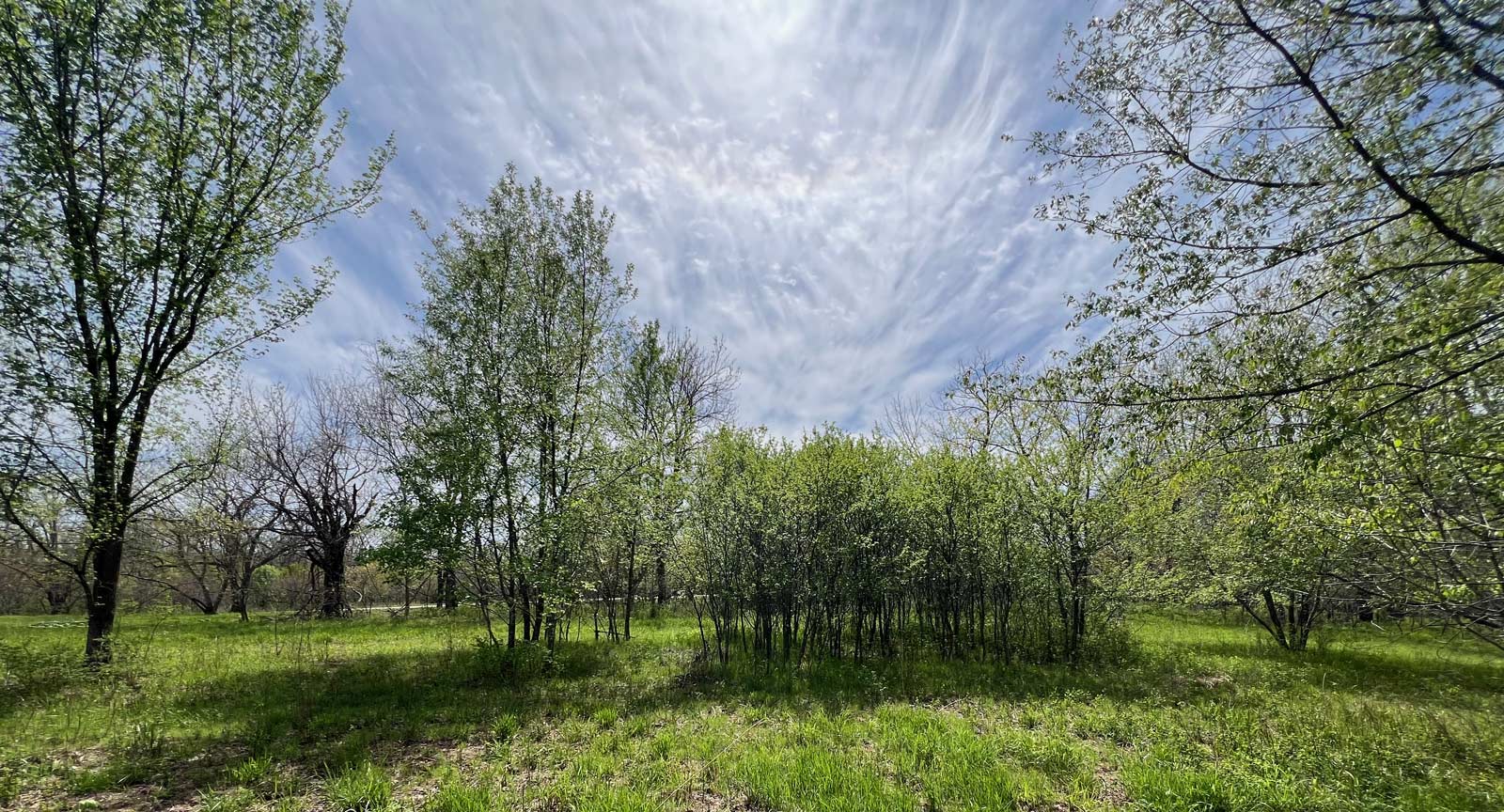
Fortified by convenience-store pizza and candy bars after a drive that would’ve been rather boring if not for the conversation and the company, we set out on foot across what will, in two thousand years and the deaths of billions of people, become a sleepy village on the water’s edge. (Neither geologic upheaval nor global change in temperature are likely to erase the spot; it’s safe against even six meters of sea level rise, which is beyond the most pessimistic projections.)

Onward we went, traveling not through the realm of the real but the realm of what Terry Pratchett calls ‘L-space,’ that place where untold stories await the person who will write them, discussing as we did everything from glassblowing to the economics of guild systems, observing how even today towns in rural America tend to be spaced about the distance a person on horseback can ride in a day.

Accommodations that night were to be in an America’s Best [sic] Value Inn. That failed to work out as planned, because it seems that while America’s Best [sic] Value Inns are fairly solid on the concept of taking a reservation, they are a bit less clear on what it means to keep a reservation.

Considerably frustrated with no room at the end, we at last located another hotel thirty minutes away, which turned out to be, Gentle Reader, the third worst hotel I’ve ever stayed in, and given that rodents and bullet holes figure prominently in the story of the first and second, believe me when I say that’s saying something.

After dinner, we settled in for more kinky group sex. Yadda yadda yadda, the next day found us at the seat of the Dominionate, or what will be in thousands of years. Right now, it’s home to a genuine Caravaggio, which truly was extraordinary, though I didn’t realize St. John the Baptist was quite so…buff.

All good things must end, and so we tore ourselves from the contemplative glower of Buff John the Baptist to follow the path of a different character, our villain rather than our protagonist, back to Springfield.

More group sex, followed by testing of xenomorph facehugger sex toys…

…somewhat interrupted by certain cats who insisted on photobombing the shenanigans…

…and yadda yadda, yadda, the next thing you know, we’re at a FedEx Office printing out pics from the trip for our very first Murder Wall™. (At least my very first Murder Wall™, I don’t actually know that my Talespinner has never made one).

I thought there would be more cackling involved in making a Murder Wall. I didn’t realize it’s so…prosaic. Hollywood never shows the obsessive conspiracy nutter dropping pins, or cutting the yarn too short.

Eventually, as time must do, the moment to leave came. It came inconveniently, at 3:30AM, since this entire adventure had been predicated on the cheapest airline tickets possible and that meant flying out at 5AM, but we do what we must because we can.

When my Talespinner’s cat figured out I was leaving, he became inconsolable in that way kittens who have taken a shine to you sometimes do.

So I hardened my heart, said my goodbyes, and disappeared into the night, leaving, or so I am told, rather a lot of my clothes scattered about her bedroom, because who can really pack at that hour of the morning?

Now, days later, we are still girding our loins for The Rewritening.
A Trip to the Dominionate

I’m typing this in Springfield, Missouri, where I’ve just returned from visiting several places that do not yet exist, and won’t exist for nearly two thousand years.

Lemme back up a bit.

My Talespinner and I are writing a novel. Specifically, we’re writing a rather chonky (~160,000 word) far-future, post-Collapse magical realism literary novel called Spin, set in the Dominionate, a sort of quasi-Catholic/Calvinist theocracy that extends through much of the center of what is now the United States.

We are, as I write this, about 90,000 words in, and we were having difficulty nailing down a crucial bit of timing, when our protagonist is forced by an encounter with the Inquisition to head off-road through what is now rural Missouri, trying to reach the city of Kanzit, the capital of the Dominionate and home to a character she hopes can save her.

We’ve looked at maps and Google Earth, measured distances, made calculations, and finally my Talespinner was like “You know what? Fuggit. Ima follow her path and see how long it would take.”

About this time, I received a letter from Oregon Revenue, informing me I’d made an error in my 2022 state income tax (cue heart attack)…and that I’d overpaid by $208 (whew!). So I found a plane ticket for $206, and said “You know what, Ima go with you.”

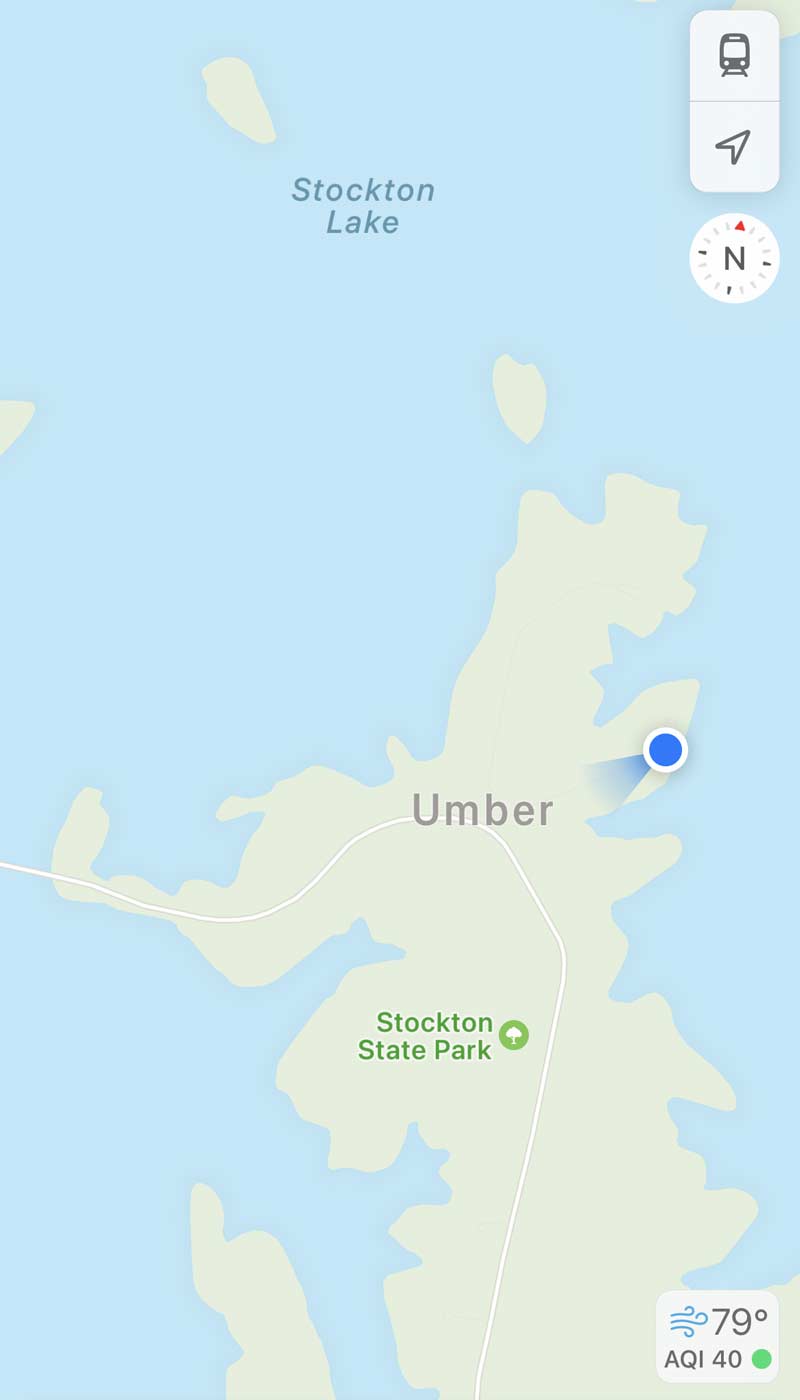
We started following the footsteps of our protagonist from modern-day Stockton State Park, a park on a small peninsula jutting into Stockton Lake.

In two thousand years, after the Great Collapse, sea level rise, and two smaller collapses, this will become the small village of Half-Circle Cothold, where our protagonist Aiyah Spinner was born and raised.

On this spot, right here, will be a church and Mother’s Cloister two millennia from now. From this very spot, Aiyah will begin her journey toward Kanzit, built on what was once Kansas City, a journey that will absolutely not go as she expects.

From here, her plan will be to cross the bridge into Bridgegate, heading toward Brightchurch and from there, Kanzit itself, following the ancient roads still maintained and used after all these years.

Ah, Brightchurch.

If Kanzit is the head of the Dominionate, Brightchurch is its heart, a walled city that hosts Brightchurch Cathedral, the Temple of a Thousand Lights, one of the wonders of the future world, destination of an endless river of pilgrims. Brightchurch Cathedral, its windows shining like God’s grace itself every moment of every day and night, thanks to thousands of oil lamps fed from a cunning engineering marvel that distributes oil through a vast system of tubes and pipes, driven by pumps powered by human and animal muscle, tended by an army of novices, awe-inspiring beyond imagination. (The idea for Brightchurch Cathedral came from a pen and paper role-playing game I ran for a time a few years back, expanded and incorporated into the world of the Dominionate.)

Brightchurch Cathedral will one day stand on this spot, right here, in present-day Nevada, Missouri.

(Honestly, I would never for a moment want to live in the Dominionate, but I nevertheless wish I could see Brightchurch Cathedral. It’s truly a magnificent, incomprehensibly beautiful place.)

Aiyah, for various reasons, never reaches Brightchurch, but instead is forced to flee overland, through what is now farmland but will be, in the age of the Dominionate, forest. We followed her path, and I’m so glad we did, because we found all kinds of treasures along the way.

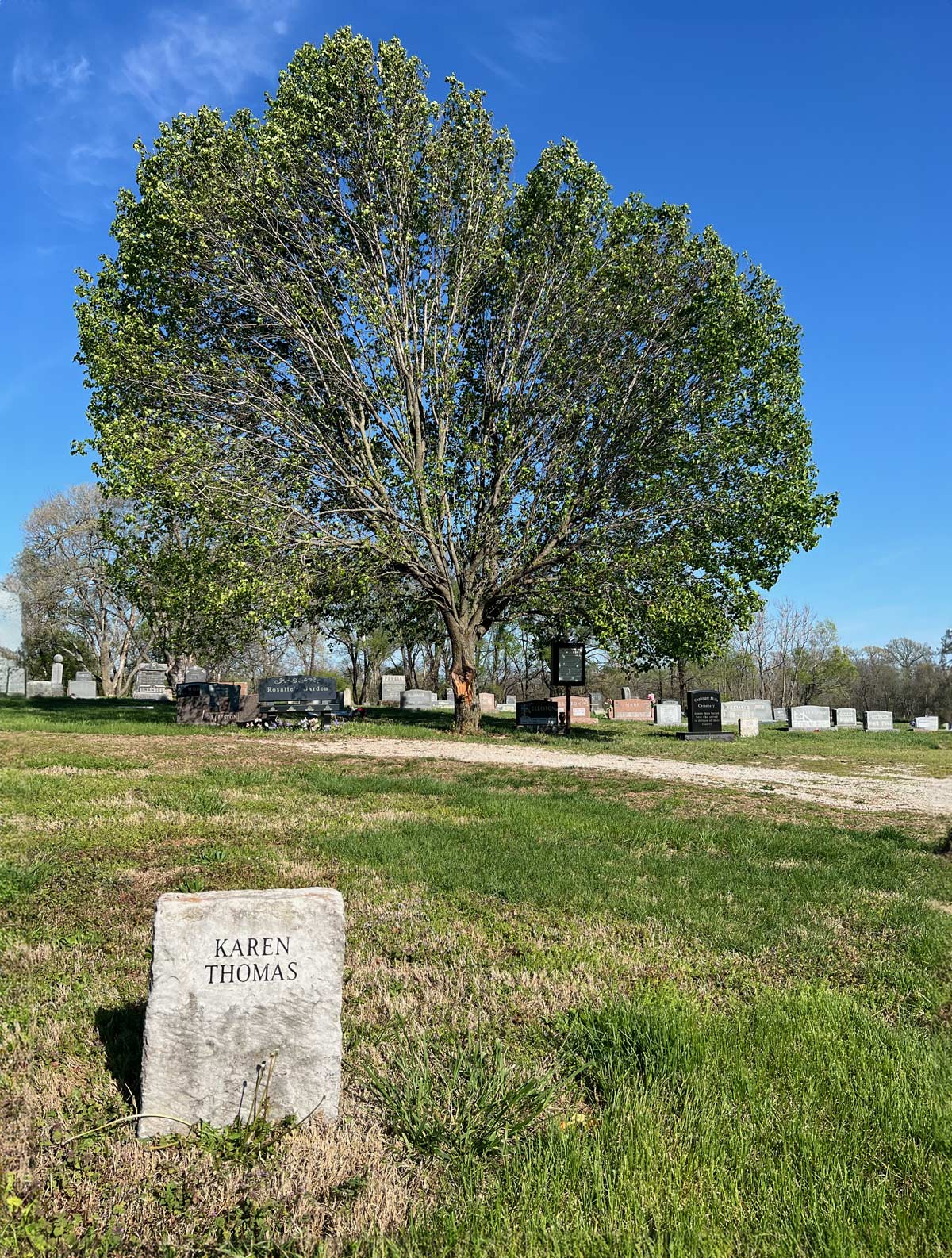
Like this tiny graveyard, which isn’t on any map or on Google Maps, but lies directly in her path and some remnant of which may still exist in the time the novel is set.

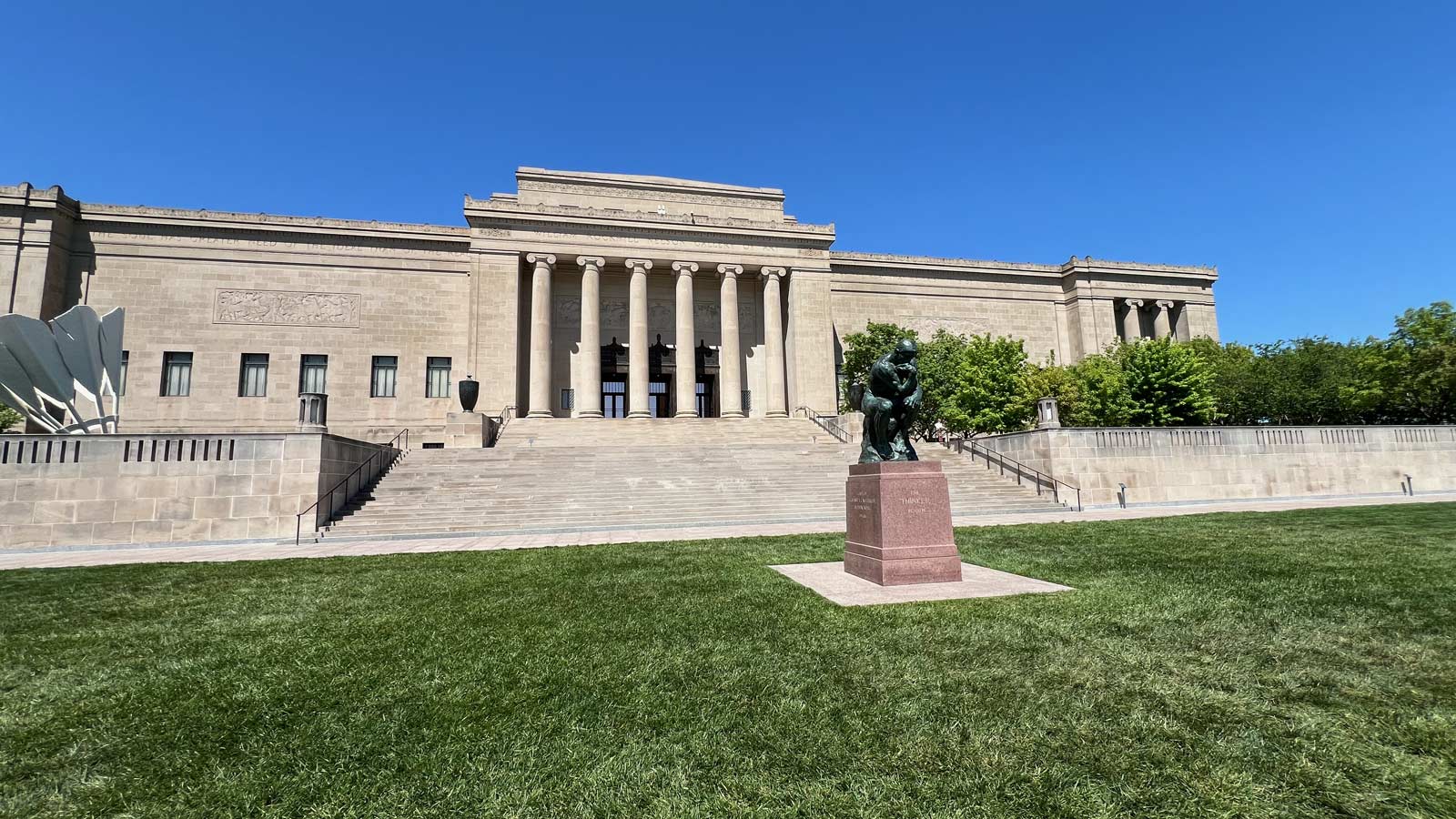
As for Kanzit, while it’s much reduced and sees countless changes, some of its buildings still exist, lovingly maintained over countless years.

The administrative center of the Church and, by extension of all the Dominionate lives in what is now the William Rockhill Nelson Gallery of Art, suited by both design and location to be repurposed to the head of the theocratic government. All the various aspects of the Church except the Inquisition are administered from here.

So let’s talk about the Dominionate.

When this novel publishes, I think people will compare it to The Handmaid’s Tale. The two stories have some superficial resemblances: social collapse, a theocracy carved out of what was once the United States, falling fertility that leads to sexual subjugation of women.

But that’s where the similarities end.

Margaret Atwood has said she explicitly modeled the government and culture of Gilead on the Islamic Revolution, a cautionary tale about what might happen in a society where reactionary religious zealotry comes to power.

But when I read The Handmaid’s Tale, I came away from the story with a sense that Gilead is fundamentally unstable. On a very deep level, the society doesn’t really work for anyone. Everyone is miserable—even the people on the top of the hierarchy. Offred, certainly, and all the other Handmaids…but even the Commander comes across as fundamentally unhappy. You really can’t point to anyone in Atwood’s story and say “yeah, those folks have a pretty good life, they seem happy and self-actualized.”

Which is, I think, part of the point she’s making.

The thing that makes Spin so horrifying, so deeply disturbing, is that the Dominionate works. The society of the Dominionate has long-term stability, peace, and prosperity. Many people—most people, really—are happy. Or if not happy, at least content. There’s little violence or crime. That sets Spin in sharp contrast to The Handmaid’s Tale (well, that and the fact Spin incorporates elements of magic, and a vastly different story).

Technology in the Dominionate is limited—the thing about the modern world is that we’ve largely stripped the earth of natural resources available to anyone without a post-industrial level of technology (there are no more surface deposits of iron, copper, tin, or coal, no oil available without modern drilling techniques, and without vast and available fuel, you might be able to “mine” landfills or junkyards for metals but you will have a very difficult time indeed smelting modern steels into things you can use)—but our knowledge remains. Even without modern levels of technology, most people still have a reasonably high standard of living.

But all of it—their standard of living, their society, their peace and prosperity—rests on a foundation of subjugation of (some) women. There’s no escaping it. They hide it away, in Mother’s Cloisters administered by the Church, and it’s been normalized for so long that everyone, even the people most oppressed, accept it as natural and necessary.

That is, I believe, way more horrifying than the society of Gilead, a society that does not have peace and prosperity, a society that seems unlikely to endure for two hundred years, or honestly even for twenty.

And more horrifying still, you can make a strong argument that the oppression and subjugation of the Dominionate is necessary. Without it, humanity will likely cease to be. Squaring that circle—trying to reconcile the idea that humanity has value with the horrific bedrock strata of sexual slavery on which not just this particular society but humanity’s future rests—is the core of the novel.

Spin is by far the most challenging, most ambitious writing project I’ve ever been part of. My Talespinner and I didn’t set out to write it this way. We’d originally imagined an 80,000-word young adult novel, something far more lighthearted. About 25,000 words in, we realized that story didn’t actually worked, tore it up, sat down, re-thought the story we wanted to tell, and came up with a detailed 27-page outline for something much, much different…and much, much darker.

I am absolutely thrilled my Talespinner and I took the opportunity to make this trip, following a character’s journey two thousand years from now. Everything we saw along the way will inform the novel. We have quite a lot of rewriting to do, particularly in the first third of the book, which will be far richer and more vibrant because we did this crazy thing.

I’m also profoundly grateful that one of my Talespinner’s other lovers was able to accompany us. His presence made the trip better, but even more, as we took copious notes—I still haven’t transcribed them into the outline yet—he offered ideas and suggestions that will make the novel so much better.

On Being a Writer in the Age of AI

AI generated image of an author sitting in front of a computer writing. Can you count the flaws in this image? And who the hell puts a glass of what I assume is whiskey behind the monitor?

People—by which I mean, the great teeming mass of human beings who make their livings by any means other than writing—are deeply weird about writers.

I make my living as a novelist. It’s not a particularly good living—I make less than an average fast-food worker in Oregon—but it’s a living. Like everyone who makes a living crafting words of whimsey, I have, on more than a few occasions, encountered folks with Great Ideas.

These encounters follow a predictable path, like water flowing down a riverbed. “Oh, you’re a writer?” says the person who’s just discovered that I’m a writer. “I have a great idea for a story! Why don’t you write it for me, and we’ll split the profits?”

There’s a strange, topsy-turvy logic in this proposal, a weird notion of how writing works that’s a bit like one of those maddening M. C. Escher paintings where the more you examine it, the less sense it makes.

On the one hand, the people with the Great Ideas seem to understand they lack the ability to turn the idea into a book, else they wouldn’t be making this (in their estimation, rather generous) offer. On the other, they trivialize the act of writing; it’s the idea that’s hard, see. The writing of it is a mere formality.

Inevitably, attempts to explain that ideas are really rather common and ordinary, and the difficulty lies in the turning of an idea into a book, fall on deaf ears. I have about half a dozen ideas for novels a day, no exaggeration. Ideas are everywhere. You can’t walk down the street without encountering ideas.

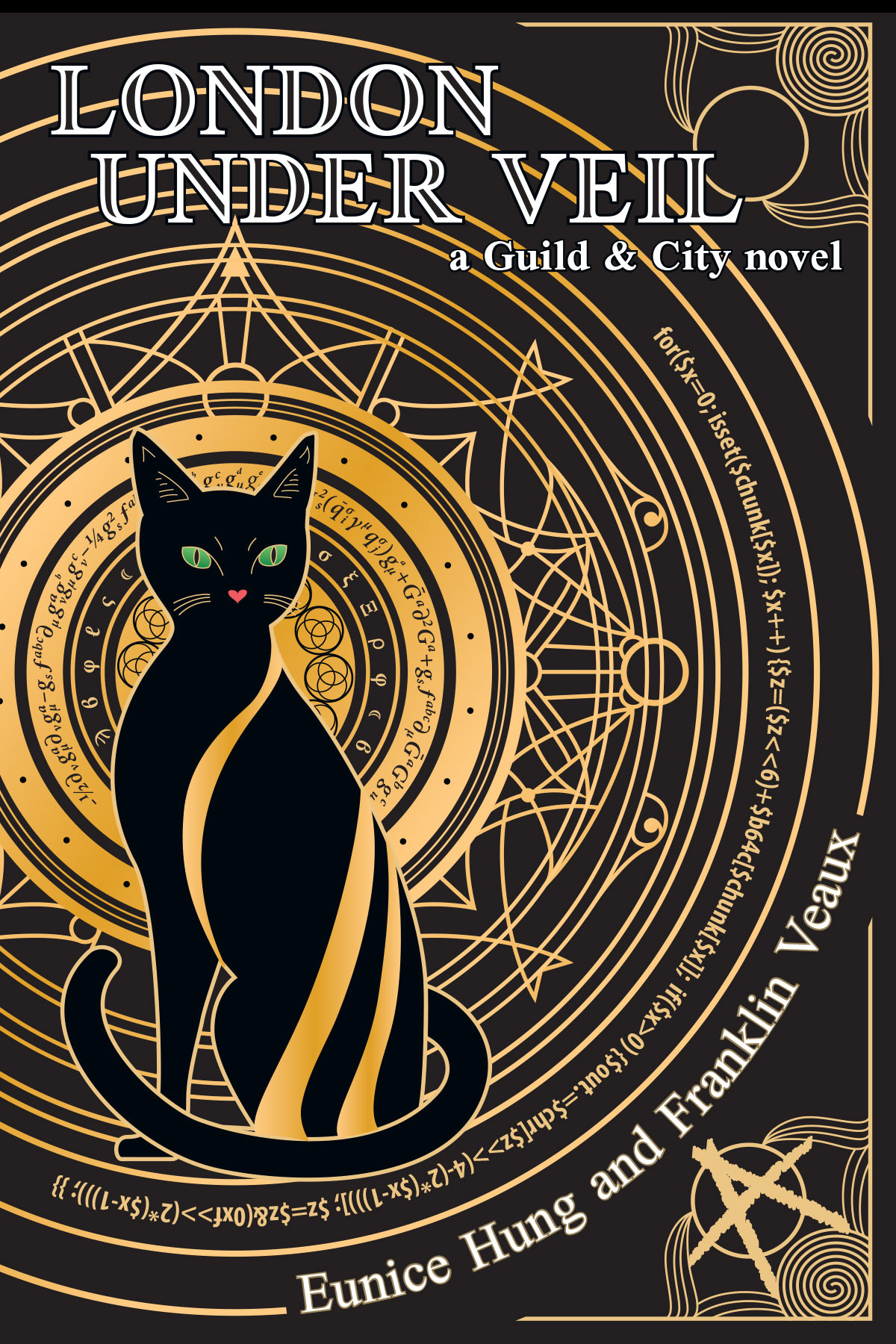
And I really mean it when I say ideas are everywhere. Eunice and I are just putting the finishing touches on a novel called London Under Veil, a contemporary urban fantasy that’s sort of Harry Potter meets The Matrix by way of Tom Clancy, but with sex.

That PHP is taken from a live, in-the-wild bit of WordPress malware.

Where did we get the idea to write a novel about a young British-born-Chinese infosec worker at a London webhosting company who gets sucked into a centuries-long underground war between a group of spellcasting sex workers and a society of rage mages that has infiltrated and captured the Tories?

From a social media question.

That. That sparked a conversation betwixt Eunice and me that led to a book.

Ideas are everywhere.

The folks with the Grand Ideas generally seem to believe that 75% of a book is coming up with the idea, and 25% is the writing (or, if they’re especially generous, that the idea is 50% and the writing is 50%). In reality, it’s more like the idea is 0.25%, and the writing is 99.75%, though if you’ve never written a book that might not seem credible.

I’ve talked before about the process of writing a book, and man, there’s nothing like the Writer’s Roller Coaster…largely because if there were, it would contravene the Geneva Convention.

So let’s talk about AI.

The advent of ChatGPT has led to a ton of folks who think that since the idea is the hardest part of writing a novel, and the writing is the trivial bit—a mere incidental—that in a world of ChatGPT, anyone can publish a novel. It’s so easy! Type your idea into ChatGPT and Bob’s your uncle! Fame and riches await!

Of course, it doesn’t work like that.

There’s a peculiar thing that happens with human beings where, when you lack the ability to do something, you also lack the ability to evaluate whether or not someone else who does that thing is good at the task. People who aren’t writers may sincerely be unable to tell that ChatGPT output is bland, dreary, inconsistent garbage—not really information so much as an information-shaped space, a suggestion of what information might vaguely look like.

I’ve been asked if I’m afraid ChatGPT will make me obsolete.

No. The answer is no.

Folks who think that ChatGPT can turn their amazing idea into a best-selling book…well, let’s just say I see disappointment in their future.

Will AI get better? Sure. Will AI ever replace technical writers? Mmmmmaybe, though I think it’s more likely it will enhance technical writers by creating a tool in their toolkit for certain formulaic parts of technical writing. A good technical writer needs to be able to imagine herself in the position of someone unskilled in the art being guided through an unfamiliar task, and I don’t see AI doing that untill it actually becomes, well, real artificial intelligence, which ChatGPT and its like most definitely are not.

Will AI replace creative fiction writers? I think that’s an AI-Complete problem—a problem unlikely to be solved until we have true self-aware general AI, at which point AI people are people, and like human people, may r may not be good at writing.

But I digress.

The point I’m making here is the fascination with ChatGPT producing a novel comes, I think, from a profound ignorance of how common ideas are and how difficult it is to turn an idea into something someone else wants to read.

I’m writing this from the home of one of my co-authors in Springfield. Tomorrow, we are driving out to rural Missouri to trace the path of the protagonist in our upcoming far-future, post-Collapse literary novel, Spin, because we need to get a sense of what it’s like to make that journey…and that’s exactly the sort of thing ChatGPT cannot bring to the table.

Some Thoughts on Bad Sex

Last weekend, while I was working with Joreth and Eunice on an upcoming episode of the Skeptical Pervert podcast, the conversation veered off in a direction I’ve been chewing on ever since: male expectations around sex.

Image: charlesdeluvio

Men and women have, by and large, grossly unequal experiences of sex: socially (men who have lots of lovers are “studs,” women with many lovers are “sluts”), physically (women bear a disproportionate amount of physical risk from sex: pregnancy, sexual violence, and so on), and even in their expectation of outcome (men are more likely to report a random encounter as physically satisfying, and often have an easier time reaching orgasm).

A lot of this imbalance is rooted in sexism, and we often talk about how sexism disproportionately harms women, but I think sexist ideas about getting it on hurt men, too. One of the ways that can happen is social pressure around sex: men are supposed to want it, supposed to take advantage of any opportunities to have it, and, I think, supposed to enjoy it even if it’s bad sex. Men are supposed to be opportunistic about sex.

In fact, I’ve often heard men say “there’s no such thing as bad sex.” I have literally never heard a single woman say this, but men? Oh yeah. All the damn time.

There is bad sex. Even for men. (As an old friend of mine was fond of saying, “if you think there’s no such thing as bad sex, you probably are bad sex.”)

The thing that got me to thinking along these lines was an event that happened in my sex life many years ago, back when I still lived in Florida, and had only recently started dating my ex-wife.

I came home from work one night to find all the lights low. Curious, I wandered into the bedroom, to find her in bed in a negligee, snuggled in with a female friend of hers. I was barely through the door before my wife dragged me down into the bed and started pulling off my clothes. Yadda yadda yadda, we had an unexpected threesome, me, my wife, and her friend.

Sounds like a Penthouse Letters, right? (Is Penthouse Letters even still a thing? I legit have no idea.)

But here’s the thing:

Her friend wasn’t someone I would have chosen as a lover. I tend, by and large, to decline offers of casual sex because casual sex doesn’t really work for me. And it was quite clear from the beginning that’s all this was: casual sex, no kissing, nothing beyond the grunt-n-thrust of two more or less emotionally uninvolved bodies.

It wasn’t good sex. I mean, yeah, I had an orgasm, she had an orgasm…but the thing that’s lingered, the overall psychic impression it left in me, was that it just…wasn’t fun.

I didn’t feel, back then, like I had any call to say no. And it wasn’t just because this woman I was dating had clearly gone through a lot of effort to set this up. No, it was more than that:

What kind of man turns down sex with a willing partner? What kind of man says no to a threesome?

Answer: Me, now. I’m way more likely to say no than I was when I was 22, and way more likely to decide that sex with someone I don’t feel connected to just isn’t worth it. But back then? It happened fast, I was in for the ride the instant I walked through the door, nobody at any point asked me if I was on board with this or not, and I genuinely didn’t feel I should—or could—say no.

And here’s another thing:

When I tell this story to other men, invariably, in-fucking-variably, the response I get is “What do you mean it wasn’t good sex? Are you mental? Your girlfriend arranged for you to have a threesome with another woman and you’re complaining about it? What’s wrong with you??!” (That is, when they don’t simply accuse me of making it up out of whole cloth—I get that a lot too, even about things I consider fairly mundane.)

Which leads me to think that for a lot of men, “good sex” is somehow…I don’t know if “performative” is the right word exactly, but good sex is in the context, not in how enjoyable it was or how you felt about it after.

Was she hot? Then it was good sex. Was it kinky? Then it was good sex. Did you get off? Then it was good sex. A threesome? Dude, that’s the brass ring, the sine qua non of awesome sex. You had a threesome with your girlfriend and another woman, arranged by her? You can’t get any better sex than that!

Whether it was satisfying, whether it met the needs of the people involved, whether it gave you what you want…irrelevant. Your girlfriend set you up with another woman! How jaded do you have to be not to think that’s good sex? Do you know how many men would kill for that experience?

The social construction of male sex is that men want sex, men should be grateful to have sex, and certain forms of sex—including the Holy Grail, sex with two women at once—is the pinnacle of the male sexual expression. The experience of that sex isn’t particularly important, or indeed even particularly relevant.

And I think that’s unfortunate. It means there are likely a lot of men out there having sex that…really isn’t that great, but that they’ve been told to believe is great, because what makes sex great is the display, the spectacle of it, not the experience of it.

But I rarely hear people talk about that, and that’s a damn shame.

I’m way more selective about sex now, and decline opportunities more often than I accept them (something else that often causes people to roll their eyes and say “yeah, sure, whatever, you’re clearly lying,” or in the case of one bloke I encountered on Quora who declared with absolute conviction, “no man anywhere would ever turn down sex”).

I wonder, sometimes, what the world might look like if we lived in a society that recognized men aren’t all cast from the same mold, and encouraged everyone to learn what works for them, and then have, you know, that kind of sex.