Namecheap: Why I’m moving away from them

I have a rather extensive collection of Web sites, where I write about everything from photography to transhumanism to sex. As a result, I have rather a lot of domain names, which until recently I’ve registered with Namecheap, as they have in the past been cheap and reasonably reliable.

However, I have begun the painful and expensive process of moving off Namecheap, and I recommend others do the same. There are two interrelated reasons for this, the first having to do with poor support and training (Namecheap employees don’t appear to know the differnce between a domain and a subdomain, which is rather a serious problem when you’re in the business of domains) and the second having to do with support for spam and malware (largely on account of the first).

The story is long and complicated, but it begins many months ago with a spam email advertising life insurance, which was plugging a domain hosted on Namecheap Hosting.

Namecheap, in addition to being a domain registrar (well, technically a reseller for a registrar called Enom), is also a Web hosting company. If you’re a Web hosting company, sooner or later a spammer will host a Web site with you. How you react when you receive abuse reports will determine how popular you are with spammers. If you react quickly, spammers will avoid you. If you allow the site to remain up, spammers will talk, and soon other spammers will flock to you. If you continue to leave spam domains up, pretty soon spammers will start choking out your other customers.

Anyway, it happens. A spammer found Namecheap Hosting. I hadn’t seen much spam on Namecheap before, so I fired off an abuse report and that was the end of it.

Or so I thought. But then things took a turn for the strange.

A couple of days later, I received an email from Namecheap abuse saying “we aren’t hosting this domain, go complain to someone else.” Now, that happens from time to time as well; spammers will sometimes hop from one host to the next, so by the time a host receives a complaint, the spammer’s Web site has been moved and they’re not hosting it any more.

I looked at the domain. Still hosted on Namecheap. I wrote back saying “no, it’s definitely hosted by you guys; here’s the IP address, 162.255.119.254. That address is in your space.”

And got back a second email: “We’re not hosting this site.”

“Huh,” I thought, “that’s strange. Maybe the site is hosted on many IP addresses?” That’s another spam tactic, putting a Web site on a bunch of hosts and then changing the IP address constantly. But no, the site had only ever been hosted by Namecheap.

I replied and said “no, here’s the DNS entry, ere’s the history for the site, you’re definitely hosting it.” And got back yet another reply: “no we’re not.”

And then something even weirder happened.

I started getting tons of spam advertising domains pointing to Namecheap’s IP address space. Tons. Spam advertising life insurance, promoting Bitcoin schemes, advertising phony “cures” for diabetes. Spam pitching window replacement services, Amazon gift cards, Russian dating sites, and home refinancing.

And I’d seen this spam before. It was word-for-word and image-for-image identical to spam from well-known, infamous spam purveyors that had always, until now, advertised sites hosted in Russia, Columbia, and the Ukraine–places that tend to permit spam hosting.

I started getting multiple pieces of this spam a day. Then dozens. All of it advertising domains on Namecheap IP addresses.

  
Left: Old spam advertising a site hosted in Eastern Europe. Right: Recent spam advertising a site on Namecheap.

I sent spam reports to Namecheap…and Namecheap’s abuse team kept sending responses saying “we aren’t hosting these sites.”
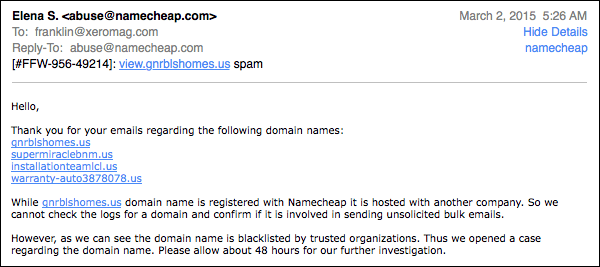

This is the point where I learned that Namecheap, a company that sells domain names, does not understand how a domain name works.

A typical domain name has three (or more) parts. The parts are separated by periods. Let’s look at an example:

www.morethantwo.com

Going from right to left: The last part is called a “top level domain,” or “TLD”. It’s things like “.com” or “.net” or a country-specific code like “.ca” (for Canadian sites). The UK uses “.co.uk” for various historical reasons.

The part before the TLD, in this case morethantwo, is the domain name.

The part at the very beginning, in this case www, is a subdomain. The subdomain “www” stands for “World Wide Web” and it’s the most common subdomain by far. But you can make a subdomain be anything you want. You could set up your Web site at “polyamory.morethantwo.com” or “groupsexisawesome.morethantwo.com” or anything else you like.

And here’s the important part:

You can put a subdomain on a completely different server, hosted by a completely different Web host.

For example, morethantwo.com is hosted by Incubus Web hosting. But if I wanted to, I could put “polyamory.morethantwo.com” on Dreamhost and “groupsexisawesome.morethantwo.com” on Softlayer–each subdomain can get its own IP address and its own Web server, if you want.

Now you might not know that, and you can be excused for not knowing that. It’s not necessary to understand how the Internet works in order to use it.

But Namecheap should know that. They sell domain names. This is what they do.

It’s okay if a person who owns a car doesn’t know that a car’s engine has more than one spark plug in it, but no professional mechanic should ever be ignorant of that simple fact. It’s okay if a person who uses the Web, or even a person who owns a Web site, doesn’t know that subdomains can be hosted on one IP address. It’s unforgivable that a domain registrar doesn’t know that.

In this case, the spammer is using domain names that look like

view1.gnrlbshomes.us

“view1” is a subdomain, hosted by Namecheap. The main domain,gnrlbshomes.us, is hosted elsewhere. Namecheap’s abuse team doesn’t know how that works. When they received the spam complaint, they didn’t look at view1.gnrlbshomes.us, they only looked at gnrlbshomes.us.

When I figured out what was happening, a light dawned. I fired off a reply explaining that view1.gnrlbshomes.us and gnrlbshomes.us were hosted at differnt IP addresses, and they were hosting the actual spamvertised URL, view1.gnrlbshomes.us.

Problem solved, right? They simply missed the subdomain, right? Wrong.
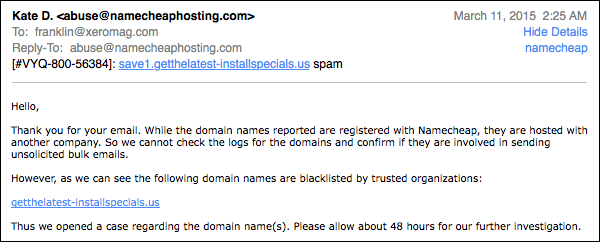
Elena, it seems, didn’t talk to Kate. Namecheap has a systemic problem. This isn’t someone not noticing the subdomain, this is someone not knowing how domains work.

And I got a lot of these emails, from all different people: “The domain ‘blah blah blah’ isn’t hosted by Namecheap.”
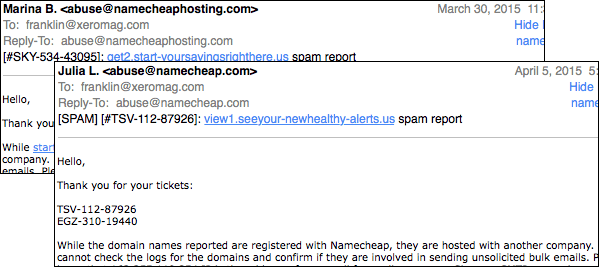
At this point, I was convinced the problem was incompetence…and a bizarre incompetence, an incompetence on the level of a professional auto mechanic not understanding that an engine has more than one spark plug.

But then, things took a turn for the even weirder.

I patiently replied to each of the emails, showing the IP address of the main domain and the subdomain, and that the subdomain was in fact on Namecheap IP space.

And then I started getting replies like this:
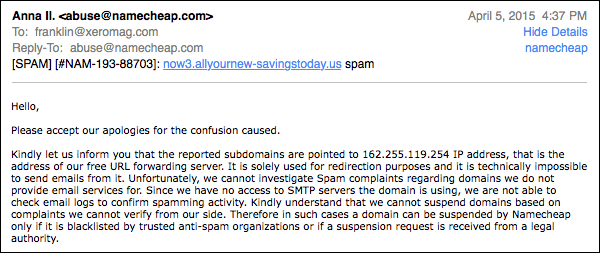
Essentially, what this says is “if you don’t actually send email from a Namecheap server, you’re welcome to spam a domain that lives in Namecheap space and we’re A-OK with that.”

Now, spammers almost never send emails from the same servers their Web sites live on. Usually, spammers send emails from home computers that are infected with viruses without their owner’s consent (a lot of computer viruses are written for profit; the virus authors infect computers with software that allows them to remotely control the computers, then sell lists of infected computers to spammers, who use the infected computers to send spam email.) Sometimes, the spam emails are sent from “bulletproof” spam mail servers in places like the Ukraine. But they almost never come from the same computer that’s hosting a site.

So Web hosting companies want to see a spam with full headers when you report spam, so they can verify that, yep, this is a spam email, and shut down the Web site that’s being spamvertised.

But not Namecheap. Namecheap will knowingly and willingly allow you to spam domains on their servers, provided the spam email doesn’t actually come from the same server.

I asked if their policy was to permit spam that doesn’t originate from the same server as the Web site, I received this reply:
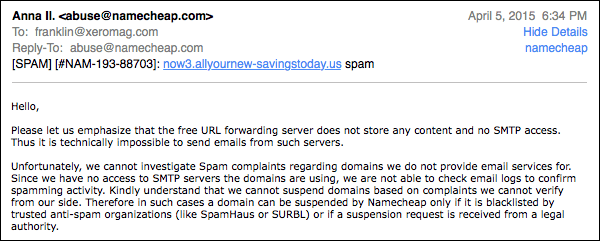
Which to me looks like a “yes.”

At the moment, I am currently receiving 11 spam emails a day advertising domains that resolve to Namecheap IP addresses. There are about half a dozen products being spamvertized; each day’s crop of spam messages are word for word and image for image identical to the previous day’s, but the domains are different. Clearly, the spammers feel they’ve found a good home in Namecheap.

So I took a look at that IP address, 162.255.119.254. It’s quite a mess.

Domains on 162.255.119.254 are all forwarded; that is, 162.255.119.254 is a pass-along to other IP addresses. If you want to put up a Web site and you don’t want anyone to know who’s really hosting it, you can put it there, and visitors will be invisibly passed along to its real home.

Now, can you guess what sort of thing that’s useful for?

If you said “spam and malware!” you’re absolutely right. A Virustotal analysis of 162.255.119.254 shows that it’s being used to spread a lot of bad stuff:
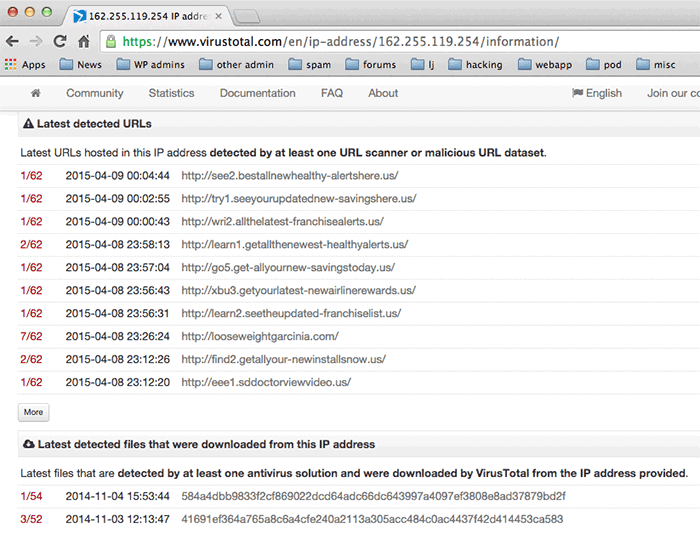
And it’s not just Virustotal. A Google search for 162.255.119.254 shows that it has a reputation as a bad neighborhood in a lot of places. It’s listed as a bad actor in the Cyberwarzone list:
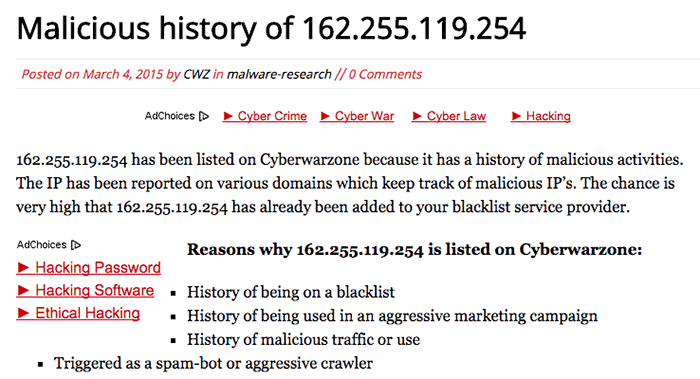
and as a virus distributor in the Herdprotect list:
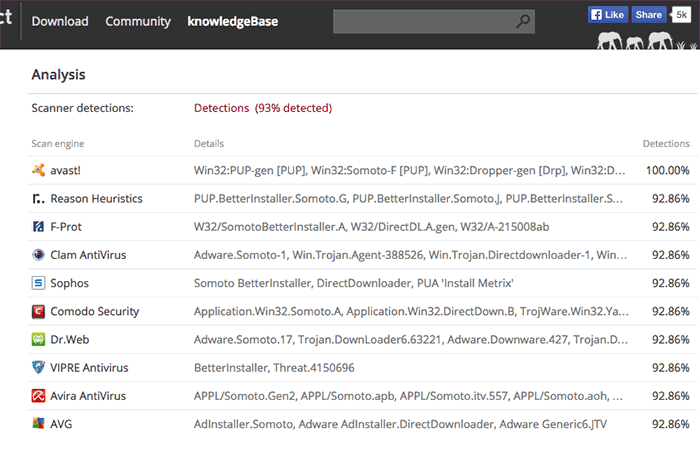
At this point, I got tired of making screenshots, but basically this Namecheap server has a bad reputation everywhere.

So whether through gross incompetence or active malice, Namecheap is running a server that’s a haven for spammers and malware distribution.

Which is why I’ve begun pulling my domain name registrations from them. I can not in good conscience spend money to support a company that’s such a menace to the Internet, and I spend about $500 a year in registrations.

Now, interestingly, I’m averaging about 11 spam emails a day advertising domains on Namecheap’s IP space, but I’m averaging 20 spam emails a day that are word for word identical to these but aren’t advertising a domain on Namecheap.

The ones that are advertising domains not on Namecheap are advertising domains hosted by a company called Rightside.co, a Web host I’m not familiar with.

As I mentioned before. Namecheap is a reseller for a registrar called Enom. And Rightside.co, well…
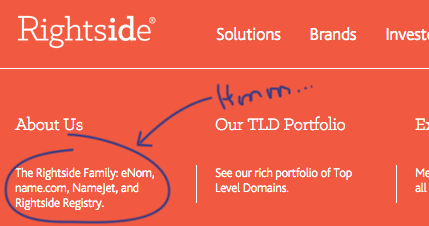
The fact that the same spammer is using Namecheap and Rightside, and they’re both front-ends for Enom, is interesting. Stay tuned!


Cloudflare: The New Face of Bulletproof Spam Hosting

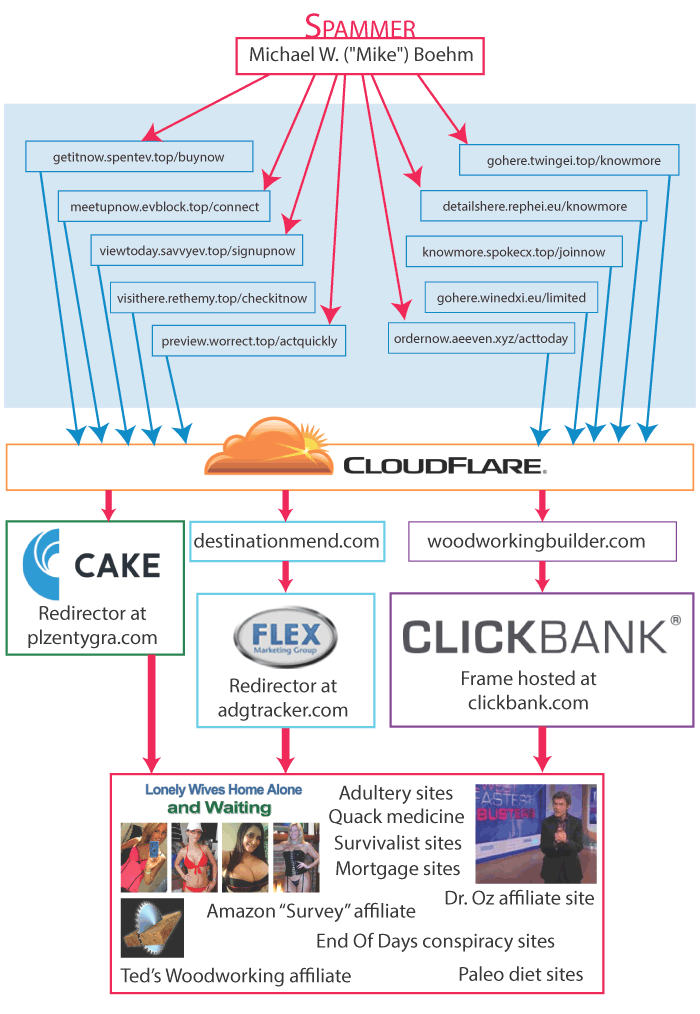
…or, why do I get all this spam, and who’s serving it?

Spammers have long had to face a problem. Legitimate Web hosting companies don’t host spam sites. Almost all Web hosts have policies against spam, so spammers have to figure out how to get their sites hosted. After all, if you can’t go to the spammer’s website to buy something, the spammer can’t make money, right?

In the past, spammers have used overseas Web hosting companies, in countries like China or Romania, that are willing to turn a blind eye to spam in exchange for money. A lot of spammers still do this, but it’s becoming less common, as even these countries have become increasingly reluctant to host spam sites.

For a while, many spammers were turning to hacked websites. Someone would set up a WordPress blog or a Joomla site but wouldn’t keep on top of security patches. The spammers would use automated tools capable of scanning hundreds of thousands of sites looking for vulnerabilities and hacking them automatically, then they’d place the spam pages on the hacked site. And a lot of spammers still do this.

But increasingly, spammers are turning to the new big thing in bulletproof spam serving: content delivery networks like Cloudflare.


What is a content delivery network?

Basically, a content delivery network is a bunch of servers that sit between a traditional Web server and you, the Web user.

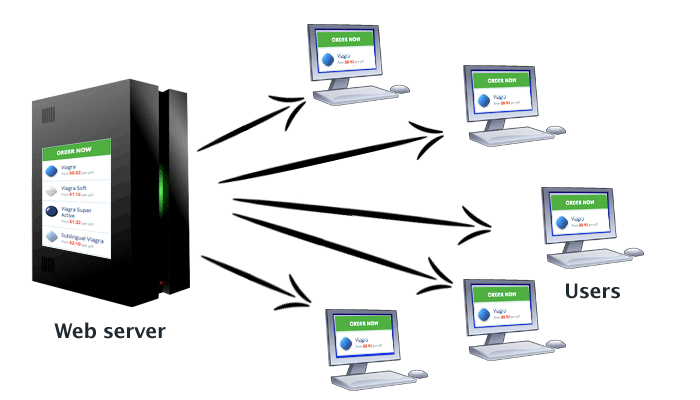
A ‘normal’ Web server arrangement looks something like this:

When you browse the Web, you connect directly to a Web server over the Internet. The Web server takes the information stored on it and sends it to your computer.

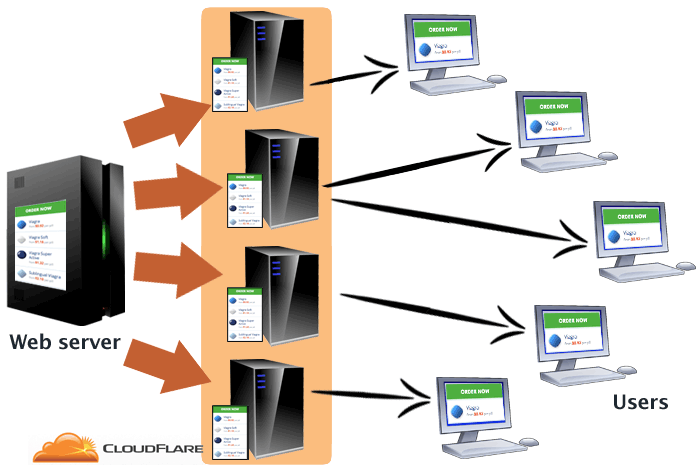
With a content delivery network, it looks more like this:

The CDN, like Cloudflare, has a large number of servers, often spread all over the country (or the globe). These servers make a copy of the information on the Web server. When you visit a website served by a CDN, you do not connect to the Web server. You connect to one of the content delivery network servers, which sends you the copy of the information it made from the Web server.

There are several advantages to doing this:

1. The Web server can handle more traffic. With a conventional Web server, if too many people visit the Web site at the same time, the Web server can’t handle the traffic, and it goes down.

2. The site is protected from hacking and denial-of-service attacks. If someone tries to hack the site or knock it offline, at most they can affect one of the CDN servers. The others keep going.

3. It’s faster. If you are in Los Angeles and the Web server is in New York, the information has to travel many “hops” through the Internet to reach you. If you’re in Los Angeles and the content delivery network has a server in Los Angeles, you’ll connect to it. There are fewer hops for the information to pass through, so it’s delivered more quickly.


Cloudflare and spam

Spammers love Cloudflare for two reasons. First, when a Web server is behind Cloudflare’s network, it is in many ways hidden from view. You can’t tell who’s hosting it just by looking at its IP address, the way you can with a conventional Web server, because the IP address you see is for Cloudflare, not the host.

Second, Cloudflare is fine with spam. They’re happy to provide content delivery services for spam, malware, “phish” sites like phony bank or PayPal sites–basically, whatever you want.

Cloudflare’s Web page says, a little defensively, “CloudFlare is a pass-through network provider that automatically caches content for a limited period in order to improve network performance. CloudFlare is not a hosting provider and does not provide hosting services for any website. We do not have the capability to remove content from the web.” And, technically speaking, that’s true.

Cloudflare doesn’t own the Web server. They don’t control what’s on it and they can’t take it offline. So, from a literal, technical perspective, they’re right when they say they can’t remove content from the web.

They can, however, refuse to provide services for spammers. They can do that, but they don’t.


History

CloudFlare was founded by Matthew Prince, Lee Holloway, and Michelle Zatlyn, three people who had previously worked on Project Honey Pot, which was–ironically–an anti-spam, anti-malware project.

Project Honey Pot allows website owners to track spam and hack attacks against their websites and block malicious traffic. In an interview with Forbes magazine, Michelle Zatlyn said:

“I didn’t know a lot about website security, but Matthew told me about Project Honey Pot and said that 80,000 websites had signed up around the world. And I thought ‘That’s a lot of people.’ They had no budget. You sign up and you get nothing. You just track the bad guys. You don’t get protection from them. And I just didn’t understand why so many people had signed up.”

It was then that Prince suggested creating a service to protect websites and stop spammers. “That’s something I could be proud of,’” Zatlyn says. “And so that’s how it started.”

So Cloudflare, which was founded with the goal of stopping spammers by three anti-spam activists, is now a one-stop, bulletproof supplier for spam and malware services.


The problem

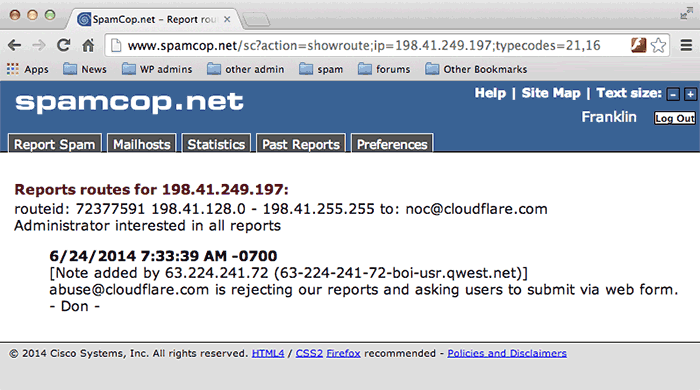
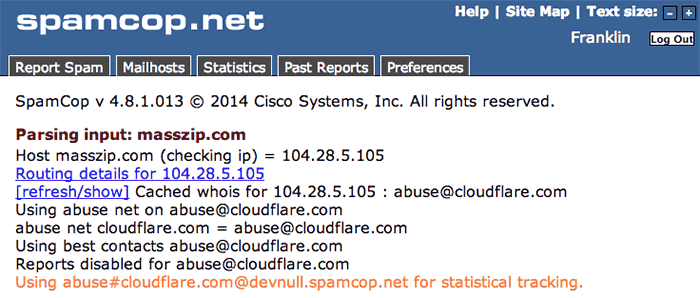
Cloudflare, either intentionally or deliberately, has a broken internal process for dealing with spam and abuse complaints. Spamcop–a large anti-spam website that processes spam emails, tracks the responsible mail and Web hosts and notifies them of the spam–will no longer communicate with Cloudflare, because Cloudflare does not pay attention to email reports of abuse even though it has a dedicated abuse email address (that’s often unworkakble, as Cloudflare has in the past enabled spam filtering on that address, meaning spam complaints get deleted as spam).

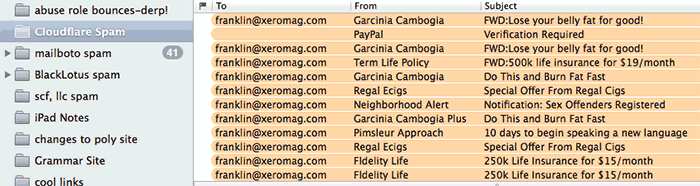
Large numbers of organized spam gangs sign up for Cloudflare services. I track all the spam that comes into my mailbox, and I see so much spam that’s served by Cloudflare I keep a special mailbox for it.

Right now, about 15% of all the spam I receive is protected by Cloudflare. Repeated complaints to their abuse team, either to their abuse email addres or on their abuse Web form, generally have no effect. As I’ve documented here, Cloudflare will continue to provide services for spam, malware, and phish sites even long after the Web host that’s responsible for them has taken them down; they kept providing services for the malware domain rolledwil.biz, being used as part of a large-scale malware attack against Android devices, for months after being notified.

One of the spam emails in my Cloudflare inbox dates back to November of 2013. The Spamvertised domain, is.ss47.shsend.com, is still active, nearly a year after Cloudflare was notified of the spam. A PayPal phish I reported to CloudFlare in March of 2014 was finally removed from their content delivery network three months later…after some snarky Twitter messages from Cloudflare’s security team.

(They never did put up the interstitial warning, and continued to serve the PayPal phish page for another month or more.)

Cloudflare also continues to provide services for sites like masszip.com, the Web site that advertises pirated eBooks but actually serves up malware.

In fact, I’ve been corresponding with a US copyright attorney about the masszip.com piracy, and he tells me that Cloudflare claims immunity from US copyright law. They claim that people using the Cloudflare CDN aren’t really their concern; they’re not hosting the illegal content, they’re just making a copy of it and then distributing it, you see. Or, err, something.

I am not sure what happened within Cloudflare to make them so reluctant to terminate their users even in cases of egregious abuse, such as penis-pill spam, piracy, and malware distribution. From everything I can find, it was started by people genuinely dedicated to protecting the Internet from spam and malware, but somehow, somewhere along the way, they dropped the ball.

I wonder if Michelle Zatlyn is still proud.

Spam network: Hold on to your networks!

I get, as most folks do, a lot of spam in my inbox. A lot of spam.

And, as most folks who follow my blog know, I dedicate some time to tracking down that spam, especially when it involves hacked Web sites.

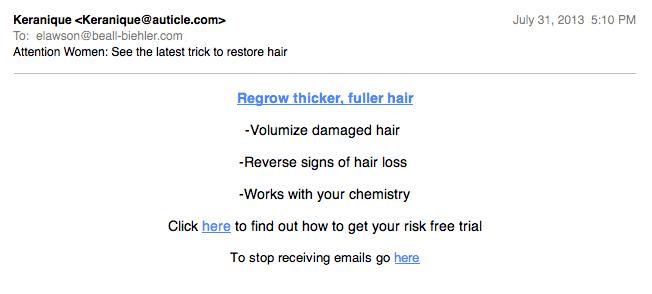
Lately, I’ve been getting a tremendous amount of spam that all looks pretty similar. It usually offers phony lose-weight-quick products, miracle hair regrowers, and other health and beauty scams, and the emails all tend to look pretty much the same. Here’s an example:

Pretty bog-standard stuff.

These emails invariably contain URLs that are either hacked sites or sites that have no content at all on the home page. The hacked sites are straightforward; the spammers hack the site, put in a new subdirectory, and put an index file that redirects to another site. The sites that have no content on their top level are a puzzler; it’s not clear if the spammers are setting up these sites themselves, using fake or stolen credit card information, or are hacking into sites that have been reserved and configured for hosting but have never had any content placed in them.

Where it gets interesting is in what happens after that.

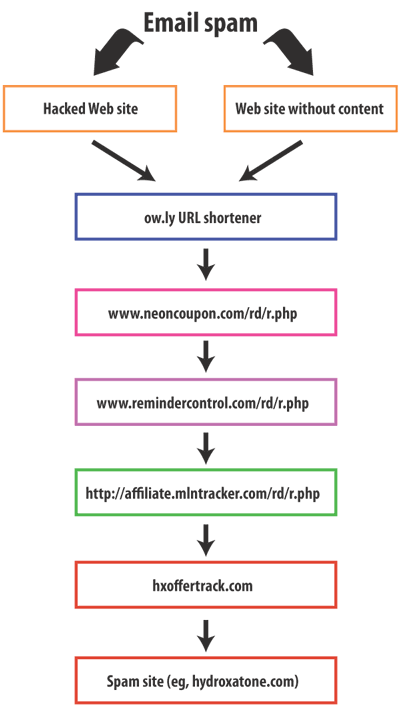
Clicking on the URL in a spam email takes you to the hacked or blank site, and leads to a redirector. The redirector leads to another, and another, and another, and another, until you finally end up at the spam site. The chain of events looks like this:

The first stop on the chain is ow.ly, a URL shortener used by Hootsuite, the social media company that lets you manage multiple Twitter, LinkedIn, Facebook, and other social media accounts.

Hootsuite is a large, rapidly-growing company that is filled with bright, ambitious programmers who appear to know very little about security and nothing at all about abuse prevention. I wrote a blog post a while ago with a flowchart of Web 2.0 startups; Hootsuite appears to be somewhere in the early stages of the Loss of Innocence part of the chart, having not yet keyed into the fact that their URL shortener is becoming popular with malware droppers and spammers. (The poor naive dears are still so innocent, they have no mechanism at all for reporting ow.ly spam! I predict that’s going to bite them in the ass in an ugly way, soon.)

After that, things get more interesting.

click here for technical stuff!

Spam of the day: With heat showers!

Most of the spam I get these days is in Spanish. Sometimes, it’s in English. Occasionally, it’s in Russian. Very occasionally, it’s in Arabic. And every so often, it looks like it’s in Russian that was translated into English via Google Translate.

Take, for example, this spam, which I reproduce below for your viewing pleasure unedited save for the reply email:

Subject: You I really liked

Hello Solitary heart!!!

I am a girl with beautiful name Julia, me 27 years. Dream to find the person for serious and long relations! I have interested your profile, since I seem that you search for such relations! Now I shall tell little about itself. I very cheerful and communicative, attractive girl. My growing forms 170 cm, my weight forms 57 kilograms. Much love to read the books, listen the classical music, walk on autumn wood and communicate with interesting people. If I have interested you, that anxiously waits your letter and photographies on my e-mail : m———c@yandex.ru With heat showers! Julia.

Best wishes,
Juliya

I am grateful for Juliya’s concern for the well-being of my romantic life, since truly do I search for such relations, it must be said.

I’m not quite sure, though, what “with heat showers” means. Google Translate renders this back into Russian as “С тепло души,” though of course I haven’t the foggiest notion what that might mean either.

I imagine it to be part of a lengthy blessing of travel in ancient Russian folklore, a ritual to prepare the hero for a journey of particularly perilous peril: “With this ox blood and this stone ax I bless thee, my son. Now go, and bring honor upon our clan, with heat showers.”

reCAPTCHA is Toast

Over the past six weeks or so, one o my email accounts has been flooded with spam advertising phony Internet “pharmacy” sites and penis pill sites.

It still blows my mind to this very day that people actually give money to these folks and actually believe they are getting real drugs, rather than corn starch and food coloring, in return, but that’s a whole separate issue.

The spam I have been getting differs from the ordinary, garden-variety junk “pharmacy” spam I get in that all of it advertises URLs belonging to social networking sites. Each URL is a phony profile of a bogus user, whose user information is nothing but a redirector to a spam site.

I’ve seen this happen before. Usually, it happens when some naive person decides to set up a niche social networking site of some sort, like a social networking site for professional engineers who work in Third World countries or a site for some obscure band or something, but doesn’t know anything about security.

The Russians love people like that. Nearly all Internet pharmacy sites, even (especially) the ones that claim to be Canadian, are run by Russian organized crime. The various crime gangs use bots–computer programs that automatically scan through hundreds of thousands of Web sites per day, searching for small social networking sites. When they find one, they attempt to create phony users. If they succeed, the bot software will start setting up thousands, or even tens of thousands, of bogus users, all automatically, and stuff those bogus user profiles full of ads for the phony pharmacy sites.

So you’ll end up with some Web site that’s dedicated to fans of some Brazilian soccer team or something, and it will have 27,498 users with names like “BuyCheapTramadolHere.” Whenever you visit the user profile page for the site, you get redirected to the fake pharmacy. The spammers then advertise the URL of the Brazilian soccer team site in their spam emails.

This is why it is absolutely essential that anyone who sets up a Web site that allows users to sign up and create profiles must, absolutely must, use some kind of system to prevent bot software from creating phony profiles.


Enter the CAPTCHA–those weird squiggly lines of text that you have to type in in order to fill out many Web forms. The idea behind a CAPTCHA is that a computer program can’t read the words, so computer programs can’t be used to fill out the form.

Organized crime has spent a huge amount of money and time in trying to figure out ways to break CAPTCHAs. Some of the most cutting-edge work in computer optical character recognition is coming from Eastern European organized crime. (Some Web services, such as Gmail, are worth so much to organized crime–mail sent from a Google mail server is almost never blocked by spam filtering software–that organized crime gangs have been known to pay unemployed Third Worlders a penny or so apiece to sit in front of a computer typing in CAPTCHA codes all day.) Another strategy that criminals have used to defeat high-value CAPTCHAs is to do things like set up phony Web sites offering free porn to people if they type in CAPTCHA codes first.

In the past, whenever I have received spam advertising a URL or a redirector hosted on a social networking site, the social networking site isn’t using a CAPTCHA. That makes it trivial for the spammers to create phony accounts to act as redirectors to their spam sites.

CAPTCHAs are such a mandatory part of good Web practice that there are businesses whose sole business is providing CAPTCHA generation software or services to Web owners. One such business is a company called reCAPTCHA, which provides free CAPTCHAs for Web site owners. Hundreds of thousands of Web sites, including many high-profile sites like Craigslist, use CAPTCHAs generated by reCAPTCHA.

And that’s where things get interesting.


Back to my inbox.

Like I said, it’s been flooded lately. I’ve seen literally thousands of bits of spam all advertising bogus profiles on various social networking sites.

Unsurprisingly, many of them are hosted by Ning, the failed and woefully insecure social networking platform cofounded by ex-Netscape cofounder Marc Andreessen, and which today seems to serve primarily as a platform for spammers (as I’ve detailed here). The URLs in the spam look like this:

http://scaryguy.ning.com/profiles/blogs/detrol-detrol-la-homeopathic
http://myjumpspace.ning.com/forum/topics/zocor-zocor-similar-products
http://igotittoo.ning.com/profiles/blogs/cialis-professional-cheapest
http://morecoffee.ning.com/forum/topics/acai-fit-com-now-foods-acai
http://onelion.ning.com/forum/topics/desyrel-buy-cheap-desyrel
http://tvsbrasil.ning.com/profiles/blogs/namenda-tapering-namenda-buy
http://cincinnatiown.com/profiles/blogs/omeprazole-marijuana-and

So in other words, about par for the course for Ning; it’s a sewer of spam, and since it recently fired most of its staff, it’s unlikely ever to improve.

But a lot of the other URLs I’ve been seeing aren’t hosted on Ning:

http://celexa108s.mysoulspot.com/
http://www.design21sdn.com/people/52077
http://community.sgdotnet.org/forums/t/28066.aspx

Those three sites (mysoulspot.com, design21sdn.com, and sgdotnet.org) have been hit particularly hard which each of them currently hosting literally thousands or even tens of thousands of spam profiles.

I visited these and other social networking sites that kept popping up in my spam, expecting to see that they were not using CAPTCHAs to protect themselves from bot software signups.

But that isn’t what I found at all. Instead, what I discovered is that every one of the sites I’m seeing that’s being attacked, including the Ning sites and the social networking sites not related to Ning, are using reCAPTCHA as their CAPTCH provider.

All of them.

Which suggests very strongly to me that reCAPTCHA has been busted. Organized crime has written, I suspect, software that is effective enough at breaking reCAPTCHA protection that it is effectively useless.

Engrish Spam of the Week

From my email inbox this morning, a bit of spam directed at my Symtoys address from a sex toy manufacturer:

Dear Owners

We are the Leading manufacturers-cum-exporter of complete Adult Body Jewelry like Nipple Rings, Nipple Weight Stretchers, Cock Rings.

We TRIUNE SKINMOD SUPPLIES exporting this Adult Body Jewelry successfully throughout the world. Your good-self kindly requested to please visit our web-site indicate items of your choice enable us.

The company in question is in Pakistan…and no, it isn’t the same company that has offered to sell me sex toys from Pakistan in the past.

Engrish: It’s what’s for breakfast

Over the past year or so, a goodly amount of the avalanche of spam that ends up in my inbox every day has been from companies in China that sell cheap, knock-off sex toys at wholesale prices.

Not too hard to figure out why. I’d be willing to bet that anyone who owns a Web site that talks about sex toys, or sells sex toys, gets ’em. They’re invariably from companies in China that want to sell me ripoffs of the Jack Rabbit vibrator and stuff like that, in bulk, at pennies on the dollar for the real thing. Their Web sites typically stay up for a few months and then disappear. (Got one of these spam emails in my mailbox today for a company whose Web site really inspires confidence: they have a hit counter on the front page, and as of right now the hit counter is at 4.)

That’s not the funny part, though.

The funny part is the Web sites themselves. They’re invariably written in Engrish, the particular variety of badly-translated English common amongst Far Eastern businesses who want to save money by not hiring professional translators.

The question I have, though, is does this approach work? How safe am I supposed to feel placing a $3,000 order for sex toys, when their Web site says things like “We are a professional and experience manufacture of condom products, lingerie, and sex toys for male uses and the female use. We have certificate for the condom. We have established the friendly relation with customers in USA. If you are interested in it, please don’t issue to contact us.”

How to Tell We’re In a Recession

All the old cockroaches are crawling out of the woodwork to feed.

Incredibly, unbelievably, I’m actually starting to see spam from two of the Web’s former most notorious spammers, streamate.com and webpower.com again. Old-school spam fighters will doubtless recognize these names–porn sites notorious for their spamvertising back in the day, who’ve kept a (relatively) low profile for years. I can remember being flooded under an avalanche of spam from these guys like five or six years ago.

Well, they’re back. Just a trickle now–an email advertising live sexy Webcams here, a set of cloaked redirectors that hop from server to server to server before ending up on Webpower there–and it makes me wonder if times are getting tough in the porn spam business. Maybe there’s some belt-tightening happening, folks aren’t buying as many subscriptions to pay-for-play Webcam sites these days, the owners of the sites are wondering how they’re going to make the payments on their Ferraris…who knows.

Webpower is a particularly interesting case, in that kind of yucky “I study cockroaches for a living because I’m fascinated by insects that eat their own young” kind of way. They started out making a gadget to allow remote control of sex toys over the Internet–a program you’d run and a little box you’d plug your vibrator into. The box had a suction cup that would attach to your computer monitor, and the program would flash a colored square on the monitor to send commands to the vibrator.

They got out of that business pretty quick–I don’t think anyone’s really made a profit on Internet controlled sex toys yet–and started doing porn Webcams instead. Their Web front page doesn’t suggest anything about them–just says “WebPower is an internet services and infrastructure company with offices located on both the West Coast (San Francisco bay area) and East Coast (South Florida)” with links to a “web services division” and a “web conferencing division”–but their bread and butter is live cam sex, and they’ve been in the spam business for almost as long as spam has been around.

It’s amazing to see this particular blast from the past. I haven’t been spammed by these guys since about the time I started dating Shelly.

Anyone familiar with an outfit called Suavemente?

So lately, my inbox has been flooded with an unusually large amount of spam This spam is advertising Web sites with URLs such as klhrvbhqw dot com, hyaiocgsk dot com, dcghffxba dot com, and ipwbquigi dot com — you know, nonsensical domains made up of random letters, usually a sure bet that it’s a throwaway spam domain the spammer plans to use once for a single spam run and discard.

All of these domains are hosted at the same ISP, an outfit I’ve never heard of before called Suavemente.

Now, two things about Suavemente scream “bulletproof spam host” to me. The first is they didn’t bother to register the .com; their only URL is suavemente.net. The second is that they’re headquartered in the US, but their front page proudly screams High-speed offshore. In the world of ISPs, “offshore” normally means “we allow our users to violate American law, safe in the knowledge that their servers can not be subpoenaed or subject to American jurisdiction.”

So at first blush, Suavemente stinks of “owned by spammers, run by spammers for spammers.” However, I can’t find them on the usual compilations of known rogue ISPs; they are listed in the ISP hall of shame, but that’s about it.

And they respond to abuse complaints. They don’t respond by shutting down their spammers, but they do respond nonetheless. Text and headers of an email I just received from Suavemente’s abuse department

Spam poetry

“Harry potter loves hottie lover, who loves mighty shocker poker.”

Spam for yet another penis pill site (are there really people in the world who honestly believe that taking a pill can make one’s penis bigger? For real?), but the poetry is quite nice.

Come, let me introduce you to my mighty shocker poker!