
A Taxonomy of Crackpot Ideas

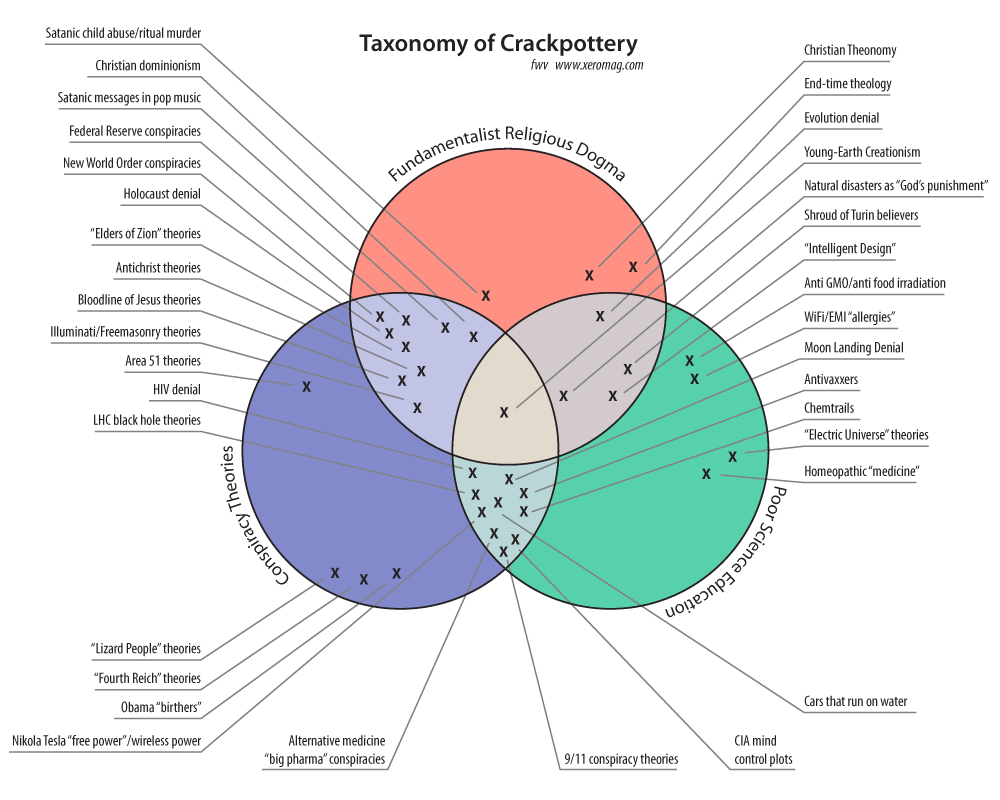
Some time ago, when the anti-science, anti-evolution, religious literalist movie “Expelled” was making the rounds, it occurred to me that a strict 6-day, young-earth creationist idea of the world requires a particular confluence of perceptual filters in order to exist. There has to be an unquestioned acceptance of literalist religious dogma, a profound ignorance of some of the basic tenets of science, and a willingness to believe in a vast, orchestrated conspiracy on the part of all the world’s geologists, biologists, archaeologists, geneticists, and anthropologists in order for this notion to seem reasonable.

I’ve been chewing on that thought for a while, and looking at the perceptive filters that have to be in place to accept any number of implausible ideas, from moon hoaxers to lizard people conspiracy theories to anti-vaccinationism.

And, since making charts is something I do, I plotted some of these ideas in a Venn diagram that shows an overlapping set of prerequisites for a number of different flavors of nuttiness.

As usual, you can click on the image for an embiggened version.
How to Tell when Something Isn’t Science

The process of science–the systematic, evidence-based, rigorous, controlled exploration of the processes of the natural world–has produced an explosion of knowledge and understanding. Since the Italian Renaissance and the Abbasid period in the Persian empire, both of which saw enormous gains in scientific thinking and with them huge leaps in technology and understanding, science has been the beacon of light shining in the darkness of superstition and ignorance.

So it’s probably not too surprising that many folks who seek to embrace all sorts of non-scientific ideas try to claim that their ideas are science. Calling these ideas “science” gives them a stamp of validation. If an idea is scientific, that means it has greater legitimacy in many people’s minds.

And the world needs to cut that shit out. Not all ideas are science, yet everything from phrenology to metaphysics to “crystal energy” tries to clamber onto the scientific bandwagon.

Most recently, the cry of the pseudoscientist has become “Quantum mechanics says!” Folks who can’t actually define what quantum mechanics is are nevertheless eager to fill New Age bookstores with books that claim to “prove” that quantum mechanics validates their ideas.

So here’s a handy-dandy, more-than-pocket-sized guide that will help you tell what science actually is and is not. Ready? Here we go!

RULE 1: If it doesn’t make a precisely defined, testable, falsifiable claim, it is not science.

This is the first and most basic premise of this whole “science” business. If someone claims “Science shows us that” or “Quantum mechanics proves that” and the next thing out of their mouth isn’t a testable, falsifiable claim, then what they’re saying is probably bollocks.

Continue reading
