“I don’t care about your stock portfolio:” A peek inside MAGA

Last night, whilst casually doomscrolling Elon Musk’s weird hatesite Twitter (if he can deadname his daughter, I’ll deadname his propaganda engine), I randomly came across a long screed from a MAGA True Believer that I screencapped, because it offers such an interesting insight into the alternate reality of MAGA.

Here it is for the benefit of screen readers:

No one in my family who voted for Trump owns any stocks

For all the rich Democrats panicking today- you now know how it must have felt

When Jimmy Carter destroyed 400,000 trucking jobs

When Bill Clinton signed NAFTA, shipping jobs to Mexico and Canada, causing industry to board up in the middle of the country, left to rot

When he deregulated the finance industry and lead us to the 2008 housing crisis

And When Obama told us: “sorry, some jobs just aren’t coming back”

If you see this post, I hope you look in the mirror at some point today and recognize the destruction your own party has played in the lives of working class Americans

This is what liberation day is all about

No one is going to weep for your stock portfolio

Where were you when we lost our American dream?

If this isn’t the perfect example of self-sabotaging, “hurt myself to own the libs” alternate history narcissism, I don’t know what is. It’s absolutely fascinating.

And the thing is, it’s not completely bonkers. It starts with a kernel of truth. Yes, the American dream did bypass a lot of people, especially poor, uneducated workers who were told that factory job would always be there for them after they dropped out of high school, and for generations it was…until it wasn’t any more.

They woke up one day to a bleak landscape of poverty, unemployment, drugs, and complete irrelevance. They have few prospects and no path forward.

They’re angry, reasonably. They’re suffering. They feel neglected and passed over because they are neglected and passed over. They’re unable to put food on the table, they’re spiraling into drug addiction, and whenever they try to say anything about it, they’re treated as the butt of standup comedy jokes, if anyone pays any attention to them at all.

And in their rage, they’re shooting themselves in the gut with a shotgun in the hopes that some of the splash will make life worse for the liberals they blame for all their woes.

So, let’s talk about this post.

This is too long to fit in a Tweet, thanks to the Bullshit Asymmetry Principle: it always takes more work to counter bullshit than it takes to vomit it up in the first place.

So from the top:

Yes, she’s correct that her MAGA family doesn’t own stock. It’s quite likely her MAGA family can’t really explain what the stock market even is or how it works. When you live in, say, rural Kentucky, Wall Street seems like it’s on another planet, utterly unconnected with you or your life. It goes up, it goes down, who cares? Doesn’t affect you. If some rich people (not sure why they say rich Democrats, the people who make money in the stock market tend to be Republicans) lose money, what of it? Doesn’t affect them!

They actually believe this, because they don’t understand how the stock market works, so they see no connection between the price of stocks on Wall Street and the construction of a new factory in Louisville.

But more than that, they are hurt and angry, and their pain and rage has been manipulated to point at the wrong target. (This is easy to do; angry people are always vulnerable to manipulation.)

I’m going to go from the bottom up, because the first bit, the one about Jimmy Carter “destroying trucking jobs,” is especially delicious and ironic, cutting right to the heart of the intellectual dysfunction of MAGA.

So:

When Obama told us: “sorry, some jobs just aren’t coming back”

…he was right.

One of the fundamental conceits of the MAGA movement, which is first and foremost a populist movement of low-information voters, is that the President is somewhere between a king and a dictator, with a bunch of buttons on his desk that control everything from the price of eggs to the number of jobs at the local Piggly Wiggly.

To them when Obama said “those jobs aren’t coming back,” he wasn’t stating something that was already true, he was making it so. He decided those jobs wouldn’t come back, and then did…whatever it is they imagine that presidents do to make it happen.

They genuinely don’t get that their jobs disappeared because their boss outsourced to China, not because Obama made them go away. They genuinely don’t get that this is fundamental to how capitalism works. They genuinely don’t get that coal mining is done by machines today, not by dudes in overalls carving coal from dark tunnels. They genuinely don’t get that fewer people want to buy coal now.

It’s easier to blame the brown person than to learn basic economics. They genuinely don’t get that the president doesn’t decide how many people the mines hire.

Given a choice between the person who said “your coal mining jobs will never come back, but I will pay you to learn something else!” and the person who said “durr, I love coal, durr,” they chose the latter.

And guess what?

The jobs didn’t come back. Obviously.

When he deregulated the finance industry and lead us to the 2008 housing crisis

This is a common narrative on the Right. “Bill Clinton signed a law that stopped banks from redlining Black people to keep them from buying houses. A bunch of Black people with no money bought houses they couldn’t afford and boom.” Simple, easy to grasp, easy to understand if you don’t have an education.

Problem is, that’s not what happened. For one thing, if it was all Bill Clinton’s doing then why did the housing crisis happen everywhere in the world, not just in the United States? (Easy answer: MAGAs tend not to know or care what happens in the world, the USA is the only thing they know about.)

For another, if it was all about those dumbass poors buying houses they couldn’t afford, how come it overwhelmingly affected lenders who weren’t covered by Bill Clinton’s law? And how come the overwhelming majority of foreclosures happened in suburbs, not inner cities?

There’s a whole dive into this here, but the tl;dr is: It wasn’t Clinton. The truth is complicated; “Clinton did it” fits on a bumper sticker. If you’re poorly educated, bumper sticker logic wins every time.

When Bill Clinton signed NAFTA, shipping jobs to Mexico and Canada, causing industry to board up in the middle of the country, left to rot

Classic MAGA, right here.

The idea of a free trade agreement between the US, Mexico, and Canada started in 1984 with Ronald Reagan. In 1988, Reagan signed the Canada-US Free Trade Agreement.

But what about NAFTA?

One of the things we see among MAGA over and over is this idea that the president who signs a bill is the president who made it. They don’t understand how laws or agreements work; they don’t know how long it takes to egotiate complex treaties.

Bill Clinton signed NAFTA. He did not negotiate it. NAFTA was negotiated by…

…wait for it…

…wait for it…

…George H.W. Bush.

Ah HA ha ha ha ha ha ha ha ha ha ha ha ha.

After the signing of the Canada–United States Free Trade Agreement in 1988, the administrations of U.S. president George H. W. Bush, Mexican president Carlos Salinas de Gortari, and Canadian prime minister Brian Mulroney agreed to negotiate what became NAFTA.

Mexican President Carlos Salinas (L), President George H.W. Bush (center), Canadian Prime Minister Brian Mulroney (R), October 7, 1992, negotiating NAFTA: The photo MAGA doesn’t want you to see

Typical MAGA, blaming Democrats for what Republicans do, and too incurious, too fundamentally uninterested in understanding the world we live in, to do even the tiniest bit of research. A Google search turns this up in ten seconds, which is nine seconds longer than MAGAs typically want to invest in their knowledge of politics.

And finally, the pièce de résistance:

When Jimmy Carter destroyed 400,000 trucking jobs

One of the articles of faith amongst the right, one of the pillars of the right-wing ideology, is “government bad, m’kay?” As the holy Prophet and Saint Ronald Reagan, peace be unto him, said, “government is not the solution to our problem; government is the problem.”

So in light of that, let’s talk about “Jimmy Carter destroying 400,000 trucking jobs,” because oh, man, this is delicious. MAGA doesn’t know what it wants.

Let’s talk about shipping before 1980. Specifically, let’s talk about how the government regulated shipping:

  • Trucking companies could only use routes approved by the Interstate Commerce Commission, the government agency overseeing trucking
  • Truckers could only apply for new routes if they could demonstrate that nobody served those routes, and the ICC approved
  • Truckers could not add new stops to existing routes without ICC approval
  • Trucking companies could not take over another company’s route without ICC approval
  • Sales of one route to another company demanded astronomical prices
  • Truckers could only charge rates approved by the ICC; requests for rate changes had to be submitted to the government for approval at least 30 days in advance
  • New trucking companies could not start shipping without government approval; you could not start a shipping business unless the government allowed it
  • Shippers in an area could object to new companies trying to get started in that area, and could object to new routes being added in their area—which they often did

In other words, trucking was pretty much the exact opposite of what conservatives wanted: No competition, no free enterprise, nobody allowed to start a business without government permission, government approval required for any changes, government setting the price.

The thing about MAGA is it wants what it wants until it wants something else.

There’s too much government regulation in oil drilling! We need to cut the red tape! Drill baby drill!

There’s too much regulation in home mortgages! We need to end government meddling in free markets! Redline, baby, redline!

There’s not enough government regulation in trucking! We need to bring back those old regulations! Protect our truckers’ jobs!

MAGA trying to decide if government regulation is good or bad today

Wait until next Tuesday and they’ll want something else. The only thing all their conflicting, contradictory desires have in common is it’s all the liberals’ fault.

No, that’s not fair. That’s not the only thing these conflicting desires have in common. The other thing they have in common is you have to be utterly ignorant of the basics of how the world works to believe any of this garbage. My God.

This is the fundamental contradiction of populism: populists don’t know what they want, but they sure are passionate about having it.

So there you have it. Insight into the MAGA mind, from a MAGA. Rage, fear, spite, all wrapped up with a neat bow of fundamental ignorance and incuriosity, weaponized against targets they truly do not understand.

Where were we when you lost your American dream?

We were telling you that your anti-intellectualism, your hatred of education, would destroy you in an advanced, technological society.

We were warning you that the world was changing and anyone who didn’t change with it would perish.

We were offering you free education and free training to make your lives and the lives of your children better.

That’s where we were.

The people who destroyed your dream are the ones telling you to blame the libs.

Some thoughts on propaganda

We are living through historic times right now, and I mean that in the worst possible way. We’re witnessing, in real time, a slow-motion coup against the United States government, one that may already have reached a point of no return.

We’re also seeing unparalleled propaganda, Soviet-state-level propaganda, become woven into the social discourse, which is terrifying but also fascinating to watch.

Some of the propaganda has historical parallels. Ssome of it does not. Unfortunately, those of us who care about the preservation of the Union tend to play into the propaganda. We reinforce it without intending to, without even knowing that’s what we’re doing.

O Canada

Image: edb3_16

The current Administration makes no secret of the fact it wants to annex Canada. The idea seems laughable on its face, but nearly every war, every act of atrocity in human history, starts with an idea that’s laughable on its face.

This is what propaganda is for: making the absurd seem inevitable.

It starts, of course, with demonizing the Other. That’s how atrocity works. You never go from zero to this:

Image: mikdam

without first passing through this:

Right here, right now, we get to see the start of the process.

Of course, I’m not comparing Trump’s rhetoric about Canada to anti-Jewish agitprop in WWII, but I am saying that the ideas, the fundamental process of propagandizing a society, are the same.

In both cases, the target is made out to be an enemy, inflicting ruin on the peaceful citizens of this great nation, without cause or pity—ruin that demands retaliatory action (in the name of self-defense, of course), ruin that constitutes a national emergency…and with it, emergency power.

The current Administration is in the process of declaring a national emergency against Canada on multiple fronts: there’s an emergency because Canada didn’t like Trump’s tariffs, there’s an emergency because fentanyl something something, there’s an emergency because Canada isn’t keen on selling electricity to the US after the Administration talked about conquering Canada to make it a state. I wish I could say this was all a South Park parody, but it’s not.

It’s fascinating, in a morbid kind of way, to watch this unfolding before our eyes, rather than reading about it in a history class.

Let’s talk about just one part of it: “We need to protect ourselves against Canada because they’re sending fentanyl into the US.”

This ticks all the ticky-boxes for effective propaganda:

✅ We have to protect our children from the evil scourge!

✅ They’re poisoning our people!

✅ The enemy is at the gates! They’re right at our border!

✅ We need to secure our border from the invasion!

The problem, of course, is the fact that less than 1% of the fentanyl coming into the US flows across the Canadian border; we send far more fentanyl to Canada than they send to us (though of course that doesn’t make us the bad guys; we’re the USA, everyone knows the USA is never the bad guys).

Liberals play into this propaganda

I’ve seen a lot of liberals try to push back against this narrative with information about fentanyl smuggling into the US, like the fact that almost all of the fentanyl coming into the US originates in China, or that the fentanyl that doesn’t originate from China tends to come in from Mexico and Central and South America. “Only 1% of the fentanyl that comes into the US crosses the border from Canada!” they say. “Canada is barely a rounding error on DEA statistics!”

Please stop doing that. It doesn’t work. It only reinforces the propaganda.

How?

When you say “Only 1% of the fentanyl that comes into the US crosses the border from Canada,” what you think you’re saying is “stop demonizing Canada. They aren’t the problem.”

That isn’t what die-hard MAGA hears.

What die-hard MAGA hears is something more like this:

See? Trump is right! Canada is the problem! Even the liberals agree! Oh, sure, the liberals want to argue about this percentage or that percentage or blah blah blah percentage, but they don’t deny Canada is sending us fentanyl that’s killing American children. They quibble over numbers, but they still admit he’s right. Fentanyl is coming from Canada. We have to defend ourselves from the Canadians poisoning our children.

And boom! By pointing out facts that you think prove Trump wrong, you have reinforced the propaganda.

This is about feelings, not fact. Feelings don’t care about your facts.

In fact, countering false narratives with facts is likely to make the false belief stronger, thanks to a psychological phenomenon called “entrenchment” or “the backfire effect.”

Put simply: When a person encounters a fact that contradicts a belief, that person is likely to rehearse—that is, to replay in his mind, over and over, all the reasons he believed that thing in the first place. Reinforcement strengthens the synaptic connections in the brain that correspond to that belief; it literally, not figuratively, reinforces the false belief.

The stronger the contradictory evidence, the more the person rehearses, and the stronger the false belief becomes.

What’s the answer, then?

Stop quibbling over facts and statistics. Facts and statistics don’t matter. Too many people don’t make decisions based on empirical reality.

The University of Pennsylvania has an excellent article on countering propaganda and entrenched narratives: bypass, don’t refute.

Instead of contradicting the false narrative with statistics that directly refute the false belief, find other avenues, other paths to the truth.

If people hold the false belief that GM food causes allergies—a common bit of misinformation among anti-GM circles—don’t talk about allergies. Find other ways to highlight the advantages of GM food.

If people hold the false belief that we need to retaliate against Canada for poisoning our children with fentanyl, don’t attack the idea that fentanyl is coming from Canada. Talk about the other sources of the drug problem. Talk about the reasons Canada, our largest trade partner, is vital to the US economy. Talk about the people who will suffer if Canadian trade breaks down.

Bypass the issue of “Canadian fentanyl.” The people who believe the narrative about “Canadian fentanyl” will only entrench in their false belief if you try to approach it head-on.

Don’t reinforce the propaganda you’re fighting against.

Today in American Anti-Intellectualism

Almost exactly two years ago, when I was in Florida helping care for my mom who had terminal cancer, I tweeted a photo of myself wearing a Stand Up for Science T-shirt. Cape Coral, Florida is antivax central, ground zero of the know-nothing Ron Desantist anti-intellectual craze, so I made a point of wearing that shirt around town.

Three days ago, that two-year-old tweet went viral, which was weird. Retweeted and commented on all over the place. So, curious, I took a look, and apparently it got picked up by the antivax/moon landing deniar/flat earth crowd. Here’s but one of the threads of retweets and comments, posted by a person who’s a moon landing denier, antivaxxer, and Reptilian conspiracy nutter:

The US has a long history of weird anti-intellectualism, going all the way back to the vicious streak of religious Puritanism that runs through American society. We’re so used to it we don’t even see it, but my European friends who visit are always a little shocked by how deep know-nothing, Fundamentalist Protestantism runs in US culture.

Evangelical religion is inherently incompatible with science. A lot, a lot of Americans truly, sincerely believe that the world is 6,000 years old, all the animals were made exactly as they are now, and people and dinosaurs once lived side by side. This is not in the least bit unusual in US society.

This has led to an ongoing, generations-long war against science education in the United States. The Scopes monkey trials are just the tip of the iceberg.

In the last 40 years, that war on education has been joined by American populist political conservatives, who see value in an uneducated population. It used to be that American conservatives, all the way up through Ronald Reagan, were 100% behind cold-eyed, factual science education; this fit with their idea that the US should lead the world in science and technology, because you can’t do that without an educated population.

It took a liberal in the form of JFK to promise to get us to the moon, but the engineers and rocket scientists who made it happen were overwhelmingly conservatives. Not in the current “populist know-nothing party” sense of conservatives, but old-school, pre-Reagan conservatives.

Nowadays, what passes for a “conservative party” in the US is isolationist populists. They want to withdraw from the world stage, so American technical and scientific leadership doesn’t matter to them. They openly embrace the most extreme Evangelical Christians, the Prosperity Gospel, Christian Dominionist movement that seeks to create a theocracy to replace the US government. Their goals are aligned: Education has got to go.

That’s created a huge backlash against science education. Educated people are “elitist.” Universities are “liberal indoctrination centers.”

This isn’t new, of course. What’s new is the alliance between political conservatives and the Evangelical right on opposition to science and knowledge, an unholy union where each of the two sides sincerely believes it is using the other for opportunistic gain.

It exists at least in part because we live in a time of prosperity and unprecedented safety. Very few people alive today remember a time when children weren’t expected to live to be adults, even though that was a frighteningly short time ago.

One of the people in my polycule, who wishes to remain nameless, rather brilliantly calls conspiracy thinking “idiot mantras for dopamine mining” and puts it like this:

It’s literally: Step 1: Confusion about actual science Step 2: read/hear confident idiot talk about how everyone is wrong except you, because you are listening to him so you must be smart Step 3: think “I don’t want to believe I’m stupid so I’ll believe stupid things to feel smart” Step 4: I are smart! I’ll just repeat the same things over and over like some sort of argument cheat code, and anyone who disagrees must be stupid, so I will ignore them”

This enshrinement of the idiocracy, this reflexive anti-intellectualism that has its roots deep in the fertile soil of the American ideals of exceptionalism and Rugged Individualism™, is fundamentally at odds with a post-industrial society in an interconnected economy.

As we turn away from learning and knowledge, craving the certainty of the Age of Superstition, we cede our role in the world. But not to worry, someone else will take over. I’m guessing China.

2024: The Year of Infinite Infosec Fail

First up in today’s game of “who fed it and who ate it:” Artificial Intelligence.

AI is everywhere. AI chatbots! AI image generators! And now, AI code assistants, that help developers write computer programs!

Only here’s the thing: AI doesn’t know anything. A lot of folks think these AI systems are, like, some sort of huge database of facts or something. They aren’t. They’re closer to supercharged versions of the autocomplete on your phone.

Which means if you ask an AI chatbot or code generator a question, it does the same thing autocomplete does: fills in syntactically correct words that are likely to come after the words you typed. There is no intelligence. There is no storehouse of facts it looks up.

That’s why AI is prone to “hallucinations”—completely imaginary false statements that the AI systems invent because the words it uses are somehow associated with the words you typed.

AI Fembot says: The Golden Gate Bridge was transported for the second time across Egypt in October of 2016. (Image: Xu Haiwei)

So, code generation.

AI code generation is uniformly terrible. If you’re asking for anything more than a simple shell script, what you get likely won’t even compile. But oh, it gets worse. So, so much worse.

AI code generators do not understand code. They merely produce output that resembles the text they were trained on. And sometimes, they hallucinate entire libraries or software packages that do not exist.

Which is perfectly understandable once you get how AI LLMs work.

What’s particularly interesting, though, is that malware writers can write malware, give it the same name as the packages AI code generators make up out of thin air, and devs will download and install them just because an AI chatbot told them to.

Bet you didn’t have that on your “Reasons 2024 Will Suck” bingo card.

And speaking of things that suck:

I woke this morning to a message from Eunice that a popular, trusted developer had inserted malicious code in an obscure Linux library he maintains, code that would allow him to log in and access any Linux system that his library is installed on.

In February, then again in March, the developer released updates to a library called “XZ Utils.” The update contained weird, obfuscated code—instructions that were deliberately written in a manner to conceal what they did—but because he was a trusted dev, people were just like 🤷‍♂️. “We don’t know what this code he added does, but he seems an okay guy. Let’s roll this into Linux.”

He seems a decent fellow. We don’t know what this code does, but what’s the harm? (Image: Zanyar Ibrahim)

Fortunately it was spotted quickly, befure it ended up widely used, so only a handful of bleeding-edge Linux distros were affected, but still:

What the actual, literal fuck, people??!

“This library contains obfuscated code whose purpose has been deliberately concealed. What’s the worst that can happen?”

Jesus. And it’s only March.

Developers should never be allowed near anything important ever.

The Lads from Cyprus: Now on Quora!

Back in March 2016, eight years and one day ago, I published an analysis of a spam ring advertising phony pay-for-play scam “dating sites.” This particular group was responsible for about 90% of the “Hot Lady Wants to F*ck You” spam in circulation. The spam contained links to hacked sites that the spammers placed malicious redirectors on, that would redirect to other sites that redirected to other sites that redirected to a site that would promise sex and ask you a bunch of questions about what you were looking for, then take you to the actual scam site.

I called these guys “the Lads from Cyprus” because invariably the scam dating sites were registered to a shell company organized in Cyprus.

Times have changed, and the Lads from Cyprus have changed with them. While they still do send spam emails, I rarely see them any more—perhaps six or eight times a year, where I used to see them multiple times per day.

Instead, they’ve moved on…to Quora.

The Quora Connection

I spend most of my time on Quora these days. A few years back, I started noticing a certain type of profile: large number of profiles with consistent behavior: a profile pic of a hot woman in a kind of blandly generic Instagram pose, answering questions at an enormous rate (sometimes once a minute or more), with the answers all being a sentence or so that might or might not be related to the question, but that always included a photo of a scantily-dressed woman.

The profiles look like this:

The links (“Latest Nude Videos and Pics,” “Hookup [sic] with me now”) all lead to domains that are registered on Namesilo, usually with ultra-cheap TLDs like “.life,” that—rather amazingly—are still using the exact same templates I saw in 2016.

Go with what works, eh?

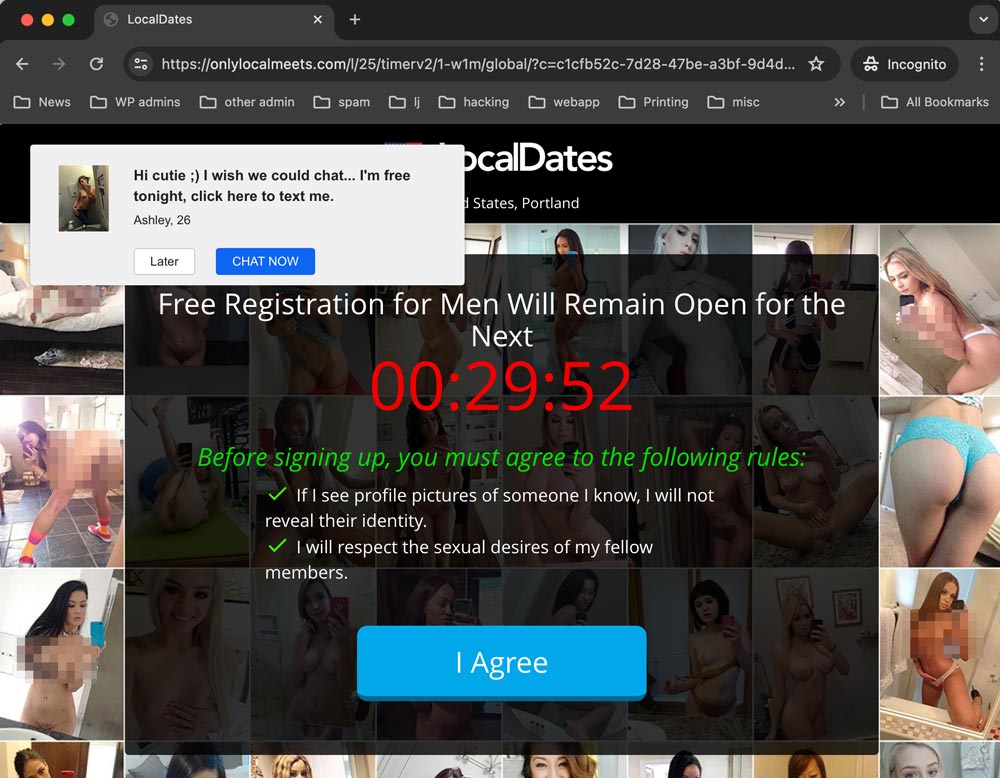
Anyway, these sites ask you a bunch of questions, tell you you’re about to see nude photos, then redirect you to a scam dating site—in this case, one called onlylocalmeets.com”—where you will immediately see a direct message request the moment you connect, though of course you’ll need to pay if you want to receive it.

It’s actually kind of amazing to me that they’re still running the same scams essentially unchanged, using the same templates they used eight years ago. They’ve clearly got this down to an art—the redirection sites even do some spiffy geolocation and collect as much information from your browser fingerprint as they can before sending oyu off to the scam site.

There are at least hundreds, possibly thousands, of these fake profiles on Quora, all of which use stolen photos of Instagram models, and all of which link back, through various intermediaries, to the same scam dating site.

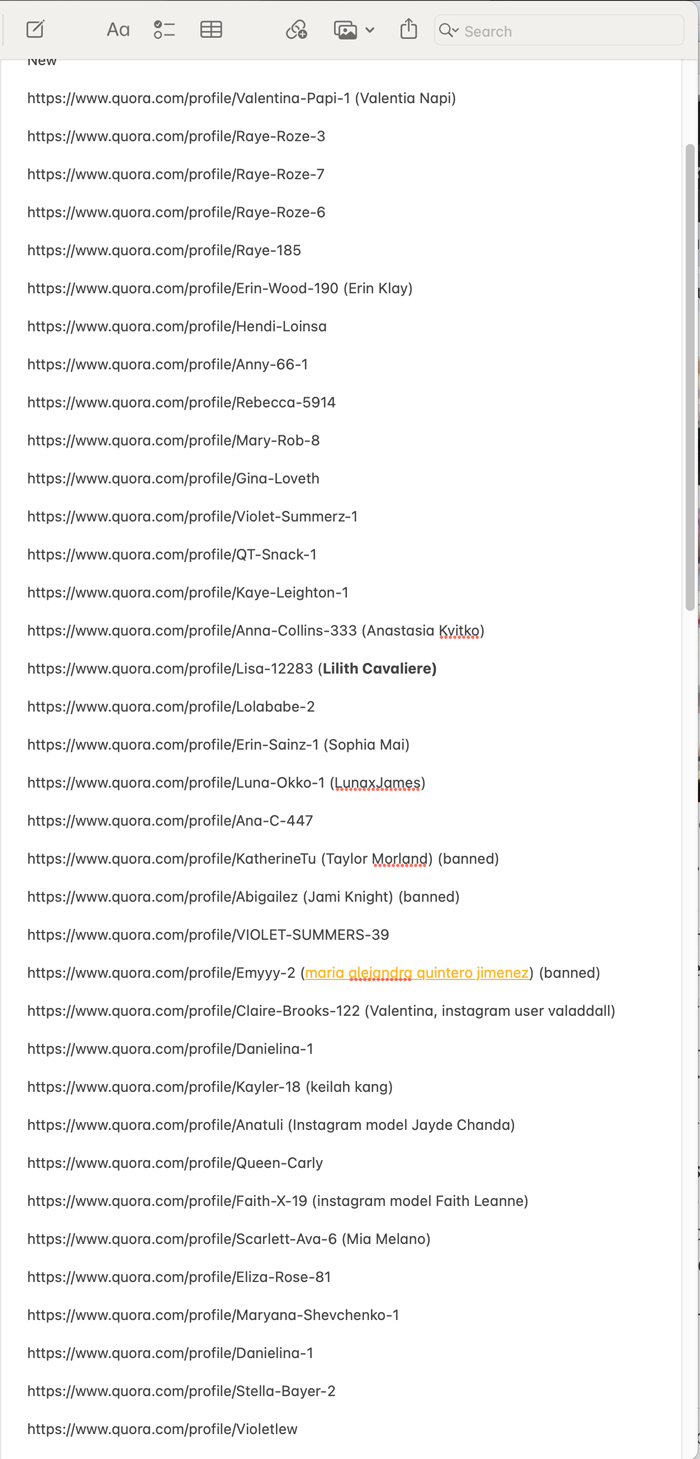
I started recording the scam profiles in a Notes file. I deliberately didn’t go out searching for them; instead, I just browsed Quora as I normally do, and made a note whenever I encountered one of these scam profiles (and if I was in the mood, did a reverse image search to see whose photos were stolen for that profile).

There are…a lot of them.

Based on what I’ve seen, I’d say probably 800 on the low end and 1,500 on the high end.

One of them even used stolen Instagram photos of pro golfer and model Paige Spiranac. When I reverse image searched the photos, I looked up the email address of her agent (who was easy to find) and sent an email saying “hey, just so you know, your client’s photos are being used in a catfishing scam, here’s the link.” The profile was banned a few days later, so maybe she or her agent filed a DMCA takedown request.

I find it interesting that this organized spam gang is still at it, still running the same scam they’ve been running for at least ten years, but always looking for new ways to find fresh crops of victims.

I also find it interesting that it works. These scam profiles quickly end up with thousands, sometimes tens of thousands, of followers.

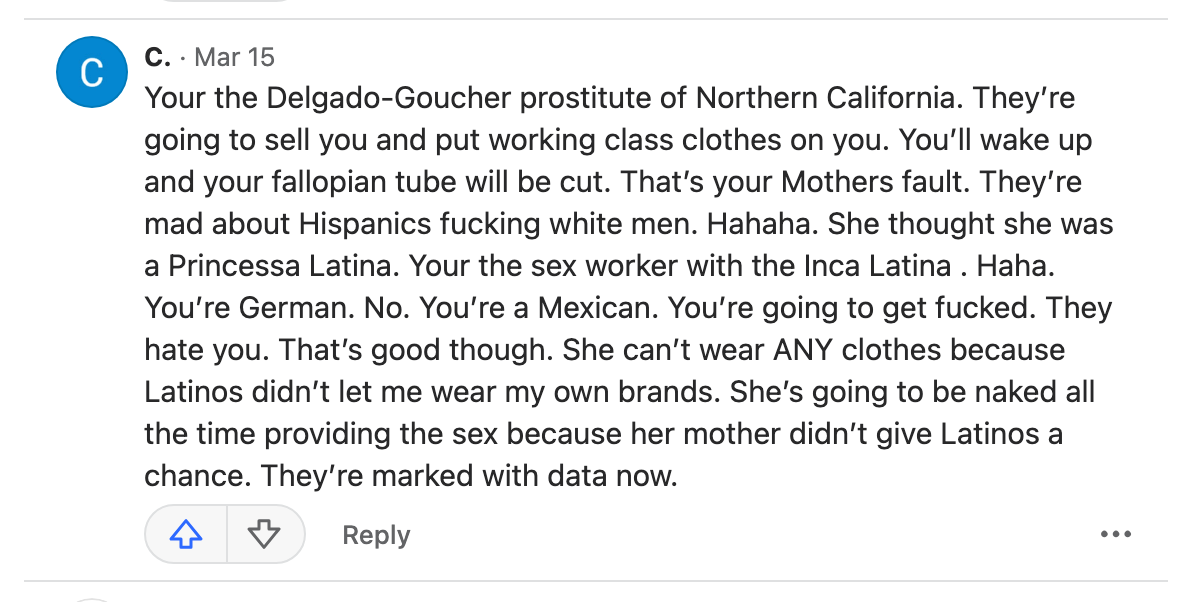
And finally, if you’ve ever wondered what it’s like to be a woman online, just look at the comments to the spam posts, which range from the drearily predictable:

To the completely unhinged:

(And what is it with these people not knowing the difference between “your” and “you’re”? You can be a completely deranged psycho who abuses women online or you can spell, but not, it seems, both.)

To the…well, I don’t know what the fuck this is. I’ve deliberately cropped off this fellow’s username.

Jesus, I do not understand why any woman would ever voluntarily go online.

On the one hand, it’s kinda hard to feel sorry for some of these blokes, who will no doubt be fleeced of all their money. That particular combination of toxic entitlement toward access to women’s bodies and aggressive stupidity makes it really hard to sympathize with the folks being ripped off here.

On the other, any scam is wrong, regardless of the victims it targets.

Hot take: When “woke” really is harmful

[Note: this essay started out as an answer on Quora.]

I’m about to say something a lot of my fellow liberals might find upsetting:

Some people who complain about “woke ideology” are actually kinda sorta right, though for entirely the wrong reasons.

Before you pick up the torches and pitchforks, hear me out.

No, the conservatives who whine and cry and have their little meltdowns about “woke Disney” for making movies with characters who aren’t straight white Christians are completely wrong, obviously. But some complaints about “woke,” while they’re farcical—even laughable—on their face, have, if you gig down deep enough, a teeny tiny kernel of truth, or at least truth-adjacent material, buried under the layers of racism and sexism and misogyny and homophobia and transphobia and white supremacy and all that other bullshit that spews from the lower orifice of the conservative snowflakes.

Liberals can get so attached to the underdog that we actually forget that even people who have been on the receiving end of systemic oppression are human, and like all humans, are capable of occasional shitty behavior.

Image: Marco Bianchetti

The problem is one of nuance.

Well, okay, cognitive effort and nuance, really.

Human beings are really bad at both. I mean really bad. Liberals like to go after conservatives for following the herd and doing as they’re told, yet liberals do the same thing—it simply expresses differently.

Conservatives who moan and cry about “woke ideology” are, often as not, just mouthing the words and feeling the emotions they’re instructed to by the people above them. Ask any of the conservatives what “woke” actually means and you’ll get crickets as an answer. They legit don’t know. They have no idea what “woke” means, any more than that know what “socialism” is. They’re simply told that the enemy tribe is bad because they’re woke, and they accept it because that’s what they do.

Ask a liberal what “woke” means, or ask a conservative attorney under oath what “woke” means, and you’ll get an answer like “aware of institutionalized, systemic injustice, and motivated by the need to address them.”

Which is true.

But…

The place we liberals go off the rails is that we are just as intellectually lazy as conservatives, it’s just that our laziness manifests differently.

Make no mistake about it, we liberals are every bit as intellectually lazy as we accuse conservatives of being. (Image: Wavebreaker Media.)

At the end of the day, it’s about cognitive effort. People don’t like cognitive effort. It’s work, just like physical effort. We look for labor-saving shortcuts whenever we can.

Conservatives tend toward vertical hierarchy. The labor-saving shortcut they use is submission to recognized authority. They think and believe what they’re told by the people they recognize as leaders to think and believe.

Liberals tend toward horizontal social structure. The labor-saving shortcuts we use are “oppressed people right and good, oppressors wrong and bad.” We think and believe whatever fits that narrative.

The key component of being “woke” is recognizing that yes, systemic, structural, institutional oppression exists. It’s sometimes overt, it’s more often subtle, but it’s there and it’s quite real. It’s hard for those of us who benefit from it to see, because it’s part of the environment we exist in; almost by definition, institutional systems of oppression are designed to be invisible to the privileged class. It takes active effort just to see them, at least when you’re the beneficiary.

When you do that, you start seeing the same patterns replay over and over and over again. And that makes you lazy.

It’s the same laziness, ironically, of the police officer who engages in racial profiling. You turn off your brain. You see patterns, you’re like “yeah, that fits,” you don’t dig any deeper. Gradually, the people you see as on the receiving end of systemic oppression become Always Right. The people you see who benefit from systemic oppression become Always Wrong. You stop seeing individuals and start seeing narratives.

Which is exactly the mindset that leads to those structures in the first place.

And I mean, I’ve done this. I’m not claiming any special insight or immunity here. Basically, when we hear a story, we do exactly what we accuse conservatives of doing:

  • We don’t fact-check
  • We engage in thought-terminating cliches
  • We lead with our feelings
  • We let narratives blind us to nuance and detail

Basically, we side with the perceived underdog, always and completely. We commit the gravest of sins that we critique in conservatives: we allow stereotypes and preconceptions to determine who’s the good guy and who’s the bad guy.

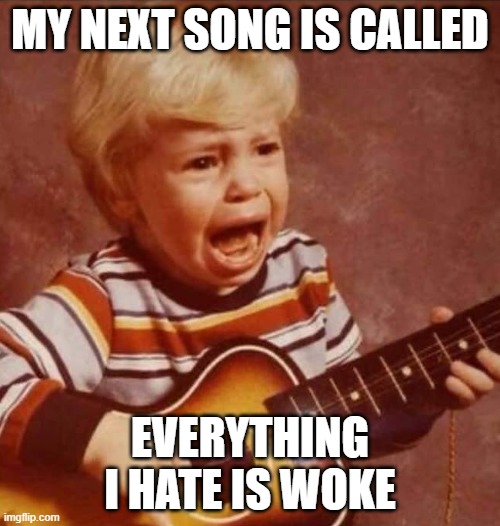
And yes, the critiques of ‘woke’ leveled by conservatives tend to be incoherent, a confused, unintelligible mishmash of name-calling and unintelligible “everything I don’t like is woke!”

This meme is legit how a lot of critiques of “woke” end up landing:

So we congratulate ourselves that that means our philosophy is unassailable by reasoned critique. Which is most definitely is not.

Why We Judge: Laziness, Tribalism, and…fanfic?

Thinking is difficult, therefore let the herd pronounce judgment!
—Carl Jung, Civilization in Transition – Volume 10

Recently, a user on Quora asked a question about why people are so prone to judging others, even those they don’t know.

And the truth is, there isn’t one reason. There are lots of them, including Carl Jung’s…and one that I’ve been chewing on lately but I’ve never seen anyone talk about before.

This question has been on my mind quite a bit over the last five years. It’s weird, isn’t it? I mean, people will dogpile complete strangers, even when they know nothing about them except what other people say. And it happens fast. Like overnight.

Image by Andrii Yalanskyi

When people outside your tribe do it, it’s called “cancel culture.” When people who are part of your tribe do it, they like to imagine that it’s “accountability,” though to whom and for what isn’t always perhaps quite as clear as the folks who call it that think it is.

That’s a big part of what it is—tribalism.

There’s also an element of virtue-signaling to it. Part of the way people police the border between in-group and out-group, Us and Them, is virtue signaling. Liberals accuse conservatives of virtue-signaling and conservatives accuse liberals of virtue-signaling, but in reality it’s a human trait, a way of loudly proclaiming that you’re part of the group, you beling, you’re one of the in-group, see? Look at how you champion the values of the group!

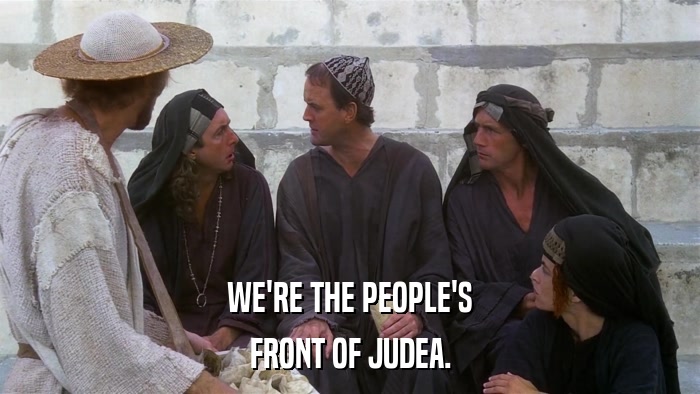
Groups, especially small subcultures, also turn viciously on their own for alleged or perceived wrongdoing because it’s a social safety valve. When you’re a member of an oppressed or persecuted minority, it’s normal to be angry, but you don’t dare express that anger against the larger, more powerful group that oppresses you, so instead you direct that anger inward, against your own, because it’s safer. That’s why small resistance groups tend to fragment, as was parodied so brilliantly in Life of Brian: because the only safe place to direct your rage is against your own community.

We’re the People’s Front of Judea, not the Judean People’s Front!

It’s kind of like an ablative heat shield that protects a spacecraft by burning up; each fragment that burns away carries heat with it, protecting the space capsule from that heat. By burning away its own members, turning on them with incredible viciousness, the community finds a way to dissipate its anger without calling down the wrath of the larger, more powerful group oppressing it.

And all those things are part of it. There’s no one reason people judge others.

But lately, as I’ve been trying to understand what motivates people to do this, I think there’s another reason that doesn’t get discussed, but that’s at least as important as tribalism and virtue-signaling and in-group/out-group gatekeeping and self-directed rage:

It’s fanfic.

It’s storytelling using real people as characters.

We are a storytelling species. We understand the world through narrative. You see this all the time in politics. Information by itself almost never changes attitudes, because we accept information that fits our narrative and reject information that doesn’t.

It’s always been that way. We always explain the world through stories. Religion is basically, at its core, made-up stories that explain the world, of course. Foundational myths are stories that tell people who they are and where they come from.

Image: Market Photo Design

But it goes a lot deeper than that. If you say the words “abusive relationship,” the overwhelming majority of people will picture a heterosexual relationship in which a man abuses a woman, because that’s the prevailing narrative of what ‘abuse’ looks like. And so everything you’re told about a specific abusive relationship will tend to get filtered through that narrative.

Okay, so.

We understand the world through narrative in a metaphorical sense, but we also understand the world through narrative in a much more literal sense. People make up stories constantly and then fit other people into the roles in those stories, as if they were real-life characters.

See, here’s the thing: To the vast majority of the world’s eight billion people, you are not real. You’re a vague blur, a background character. An NPC. You don’t exist except perhaps as a set of impressions.

We are limited in the number of real connections we can form. This limit is called Dunbar’s number, and it’s generally assumed to be about 150 people or so—in other words, about the maximum size of a tribe of our hunter-gatherer ancestors. Those are the numbers of direct personal connections you can hold in your head—friends, enemies, family, everyone. Above that number, people blur and fade into the background. They become less real.

People who aren’t real, are easy fodder for simple morality stories. These stories are abstractions, we make up in order to understand the world we live in and to signal our moral values to others. There’s no room for nuance or complexity. We cast NPCs in the roles of hero or villain or victim or tyrant or whatever, because those people aren’t fully fleshed-out human beings, they’re characters. The stories we write are basically “reality fanfic.”

The thing that’s appealing about fanfic is you can do whatever you want with it.

Image: Maria Menshikova

Think about all the people who make Elon Musk out to be a cartoon hero or a mustache-twirling supervillain. The thing about the weird veneration of Elon Musk is that a lot of the things his legions of drooling fanbois say about him are kinda true. The thing about the weird demonization of Elon Musk is that a lot of what his many haters say about him is also kinda true.

But fanfic doesn’t leave a lot of room for complexity. Most people aren’t very good storytellers, so the stories they tell about the real-life NPCs around them aren’t very nuanced.

The Fall from Grace is arguably the human story, the narrative that is so deeply embedded it reaches all the way back to tales of Adam and Eve in the Garden of Eden. The story of Faust, the story of Anakin Skywalker…it’s no coincidence that real-world fanfic tends to echo these themes. We love demonizing people we used to hold up as heroes. We get off on it. Very little feels better than tearing down today the person we venerated yesterday.

Image: Osman Goni

And it makes us feel good about ourselves. When you write fanfic about real-life people. You can slot people into your narratives and then pat yourself on the back about how good you are, how much you care, how moral you are, because when you share those stories, you’re showing your tribe how much you value your tribe’s values. This real-life fanfic feeds into virtue signaling and tribalism and all those other things.

Plus thee’s an element of self-empowerment. We long for connection, especially to people we look up to. Part of tearing down the people we look up to is, I think an expression of that desire for connection.

When we judge people we don’t know, often we hope to make them do something. Go through some process, resign from some position…we want a response from them. This can be part of a redemption narrative, of course—the fallen hero who is redeemed by some act is also a narrative as old as time—but more directly, more immediately, we judge others when we want them to acknowledge us, to interact with us, to do as we say.

That’s incredibly empowering. It validates us. It tells us that we can have an effect on that remote, inaccessible person we don’t know, and of course we can have an effect on the world. We’re powerful. It validates our virtues and our values. It makes us feel strong.

All of this, every bit of it, is easier to do with people we don’t know than with people we do. When we actually know someone, we see the nuance, we’re confronted with complexity. But with someone we don’t know, someone who’s a vague abstract blur? It’s easier to ignore the humanity. It’s easier to make them a character in our fanfic of life. It’s easier to see them as an archetype, a cartoon.

Of course we judge people we don’t know! Judging people we don’t know validates us, signals our virtue, lets us scrawl our own design on reality. Who can resist that temptation?

Some Thoughts on Donald Trump’s Appeal

[Note: This entry started out as an answer on Quora]

A lot of my liberal friends seem baffled by the fact that 45’s supporters seem…remarkably unfazed by the fact that Trump keeps announcing he’ll do things he never gets round to doing. Like, for example, when he said he’d post overwhelming evidence of his innocence and a vast conspiracy at a press conference…then when the day of the conference came and went, he’d present it in court at his trial. As with the tax returns he promised to release after e was elected that somehow he failed to release, this seems a pattern.

“Don’t his supporters notice?” my liberal friends say. “Doesn’t that bother them? When will he show us this evidence, anyway?”

That actually isn’t the right question.

It isn’t the right question because the answer is obvious. There is no evidence. There was no evidence. There never will be any evidence. He’s had plenty of chances to offer evidence and he hasn’t.

And, of course, we now know that he didn’t present any evidence at a news conference—he canceled the conference before it started, and now he’s claiming he will present this “evidence” at trial.

It is embarrassingly, painfully obvious that he doesn’t have anything.

So that’s not the right question, given that the answer is so obvious.

What is the right question?

The right question is “since it’s plain as the nose on your face Trump has no evidence that the election was in any way stolen, and since he keeps saying over and over that he does but every single time he says he’s going to show us this evidence he doesn’t, why do people still believe him?”

And the answer to that question says something fascinating about human beings.

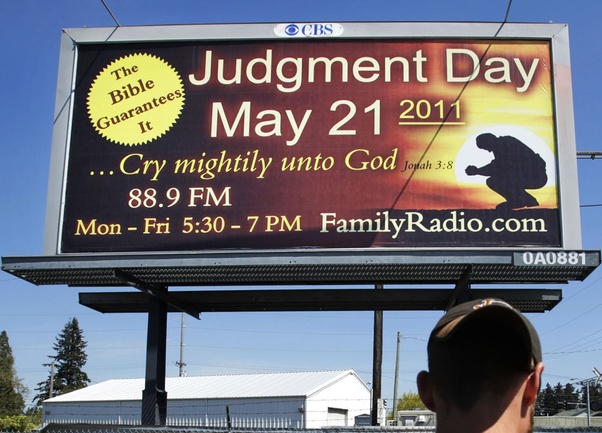
Back in 2011, a Christian radio preacher named Harold Camping predicted the end of the world. He encouraged his followers to give up all their earthly possessions, sell their houses, and use the money to buy billboards warning that the end of the world was coming.

Of course, May 21, 2011 came and went and the world kept on turning.

You’d think this would have caused his followers to abandon him. It did not.

This actually wasn’t Camping’s first rodeo. He’d predicted the end of the world before, on May 21, 1988.

And then again on September 6, 1994.

When May 21 came and went, ol’ Harold, not one to give up in the face of, you know, reality, predicted that the world would definitely definitely end, for realsies, on October 16, 2011.

So far, so boring. People’ve been predicting the end of the world for as long as there have been people in the world. That’s not the interesting part.

Here’s the interesting part:

When each day came and went, the faithful didn’t lose faith, they became more faithful. They became more convinced.

In 1956, a psychologist named Leon Festinger wrote a book called When Prophecy Fails: A Social and Psychological Study of a Modern Group That Predicted the Destruction of the World. In that book, he made up a term for people who struggle to reconcile a sincere, passionate, earnest belief that doesn’t align with reality. He named this psychological phenomenon he was studying “cognitive dissonance.”

His hypothesis: When you believe something that turns out not to be true, such as when you believe a preacher who tells you the world is going to end on a certain date and then nothing happens, it takes work to get your head around the fact that it didn’t happen. It takes effort. It takes labor.

You have to unpack your belief. You have to look at yourself. Why didn’t it happen? Why did I believe it was going to happen? How can I explain to myself that I accepted a belief that wasn’t true? Does this mean other beliefs I have also aren’t true? How can I tell? How can I be sure? Does this mean I have poor judgment in the people I choose to believe in? Is it possible that those people in a different tribe, the ones who kept telling me that my belief was wrong, could be right? Am I part of the wrong tribe? What else have I been wrong about?

All this is deeply difficult and deeply unsettling.

You would think that a religion that preaches the end of days to its followers would lose all its followers when the days don’t end. That doesn’t happen; in fact, its followers become more fanatic and more faithful and more likely to believe their preacher, because (and this is the bit that blows my mind) it’s actually easier—it’s less work, it’s less effort, it’s less painful—to reject reality than to reject a belief you’re emotionally invested in, reject a tribe you consider yourself part of, or reject an authority figure you believe.

One of the most potent tools for rejecting reality is what Festinger called selective exposure.

Selective exposure means you only talk to people in your tribe—your fellow believers—and refuse to listen to anyone else. You only watch media that reinforces your belief, and go out of your way to avoid media that doesn’t. You read, watch, and listen to only the things that reinforce your belief, and the stronger the cognitive dissonance, the more you isolate yourself in a bubble that rejects reality and confirms what you already believe.

So when Donald Trump says he is going to prove that the election was stolen, then he doesn’t, that creates cognitive dissonance, just like when a preacher says the world is going to end on May 21 and then it doesn’t.

And, of course, some people will wake up when the proof never materializes or the world doesn’t end and say “okay, fine, he was lying.”

But a lot of people won’t. They’ll accept any excuse: Oh, I miscalculated the date from the Biblical signs, it’s really October 16. Oh, my lawyer told me not to show you the proof, I’ll how it to you at my trial.

Paradoxically, the more dates come and go, the more the faithful cling to the belief that next time it’s definitely gonna happen. Just like Charlie Brown thinks next time, Lucy will definitely let him kick the football.

At this point, Donald Trump’s remaining followers are acting and behaving pretty much exactly like members of a cult. They sincerely believe that next time, he will show them proof that the election was stolen, and when he doesn’t, they’ll believe whatever excuse he gives them, and believe that the time after that, he will definitely show them proof that the election was stolen.

You cannot argue them out of it. You cannot point out that it hasn’t happened yet and it’s never going to happen. No combination of words, no evidence, no proof exists that can change their minds, because changing their minds is simply too painful. It would force them to confront that they have spent all this time, all this effort, all this money following the wrong man.

You have to recall that the people who still follow Trump have probably given up a lot. They’ve given him their money, yes, but they’ve also lost friends, lost family, endured being ridiculed and called stupid…and so they’ve turned inward, they’ve made a new tribe with new beliefs.

And now, at this point, to admit they were wrong? That means they lost their money for nothing. That means they gave up their friends and family for nothing. That means all those jeers were true. And, more than that, they would have to give up the new tribe they’ve created and the new friends they’ve made.

You really think there’s a combination of words you can say that would make them do that? No way.

So what’s wrong with social justice, anyway?

Well, to start with, nobody in the world actually wants social justice.

There. I said it.

Okay, lots of people sincerely believe they want social justice; the people who say they want it aren’t lying, exactly. It’s way more complicated than that, and a lot happens between “I’d like to live in a just world” and “I am going to work to make a just world happen.”

Buckle up, this answer is gonna get loooooong.


Let’s start here: The real world is complicated. Really, really complicated. You might think getting your scanner/printer to work with Windows is complicated, but that’s peanuts compared to socioeconomic and geopolitical reality.

And people, even smart people, handle complexity poorly.

Topical case in point: What’s happening in Israel and Gaza right now.

Image: Mohammed Ibrahim

If you want to understand what’s happening, you need to know quite a lot of history from the 1940s on. There’s a lot of “there” there: the Israeli offer, turned down by the Arabic population; the reasons Egypt and Jordan closed their borders to the Palestinians; the history of Hamas, which is both a terrorist organization and also a government (and before that, the Muslim Brotherhood); the way Egypt has deliberately played the Gaza refugees as political pawns…it’s complicated and ugly and no side has totally clean hands, but even understanding where the balance lies requires a pretty thorough history lesson…

…and oh God that’s, like, sooooooo complicated, whyyyyyyy can’t someone just tell me who the good guys are and who the bad guys are?

That’s the thing: a lot of people want to treat actual, real-world political situations like football matches or WWF wrestling, with a clearly defined good guy and a clearly defined bad guy, so they know who they’re supposed to root for.

Even people who start out genuinely, sincerely interested in social justice can easily get bogged down.

That’s the heartbreaking thing about, you know, empathy and compassion. When you sincerely want to leave the world in better shape than you found it, you soon find yourself fighting an uphill battle. Injustice doesn’t exist because someone woke up one day and said “Hey! You know what? I think I’ll be a dick to other people today!”

Injustice exists because entrenched economic, social, and political systems with roots thousands of years deep have entrenched ways of doing things because the people atop those systems benefit from doing things that way.

Fighting against that is hard. It grinds you down. However energetic and idealistic you were when you started, it pulverizes you.

Nobody has infinite time. Nobody has infinite energy.

Which is fine, except that most people want to believe themselves to be one of the good guys, on the side of Truth and Righteousness and Justice, even when we don’t want to—or can’t!—do the work of getting there. It’s not enough to say “You know what? I’m not informed enough about this to have a reasonable opinion.” Oh, no, no, we want to take sides but we don’t want to invest the time or labor in making sure we pick the right side.

We just want to know who to blame.

Knowing who the bad guy is helps define us as the good guy. If we’re against the bad guy, that makes us good, right? Right?

So what do we do?

We develop heuristics. Cognitive shortcuts. Quick and dirty rules of thumb to simplify complex situations and help guide us toward the ‘right’ team to root for. These fast and easy heuristics, at least in theory, cut through all the tedious drek of having to learn all that history and become informed of the goals and grievances of all the players and untangle a knotty and nuanced tangle that’s been all balled up for decades.

But here’s the thing:

Heuristics are not subtle. They’re fast intuitive guidelines that substitute for actual understanding. They feel right, but that doesn’t mean they are right.

Those heuristics—“believe women,” “always side with the most historically oppressed,” whatever they are—gradually become rules, then social tribal markers, then symbols of moral purity. Heuristics become adopted by tribes as ways to tell the in-group from the out-group. If you see a hashtag like #believewomen, you can probably make a pretty good guess about the politics of the person who subscribes to it.

Before long, it actually becomes morally wrong not to obey the heuristics.

Enforcing moral purity becomes a way to feel powerful, to feel like you’re accomplishing something, in the face of the overwhelming hopelessness and despair that comes from fighting an entrenched system day after day and ending each day with nothing to show for it.

What it feels like to care about justice

Say your crusade is animal welfare, for example. You’ve fought for years and what do you have to show for it? There are even more factory farms now than when you started. Consumption of animals is up, not down.

But then let’s say Bob, your staunch and stalwart ally, your comrade in arms, reveals that he’s not a vegan…he thinks it’s okay to eat fish. And…and…and eggs. And he wears leather belts.

You can’t end factory farming, you can’t stop the senseless slaughter of animals…but hey, you can rally the troops against Bob, because he betrayed the cause! You can destroyed his reputation and cast him out! Look! Look! You accomplished something!

This is inevitably what happens in social justice circles. We end up here because:

  1. People want a morality simple enough to fit in a hashtag; and
  2. Any morality simple enough to fit in a hashtag cannot capture reality, and therefore is rather limited as a tool to change reality.

People tend to think of “social justice” as a left thing, but this process knows no political bounds. Those on the right do it just as often—they simply don’t call it “social justice.”

But the same things still apply: they have a way they want the world to be; changing the world requires tremendous amounts of effort and work; people don’t have limitless resources; they fall back on simple rules to tell them who the good guys and bad guys are; those simple rules become tribal markers; before long, it becomes morally unacceptable even to question those simple rules.

We see the world not at it is but as we are. We invent narratives to describe the world, and to tell us who the good guys are, and who we should be in order to think of ourselves as good. Anyone who can co-opt those narratives can control the lines between Us and Them, the boundaries that define our tribes.

So here we are. We’re terrible at nuance, we don’t have tome to get informed, so we let the hashtag mentality do the work for us.

Some thoughts on truth

Image by Fotogoestober on Adobe Stock

Inspired by a question on Quora, I’ve been thinking about the idea of truth, and more specifically, the way societies seem to have an eccentric orbit around the truth—sometimes closer in, sometimes further away.

The United States, at the moment, is definitely at an apogee in its extremely elliptical orbit around the truth. At the moment, large parts of the American population, raised in a society that has attacked and undermined public education and critical thinking for decades, is of the opinion that truth is merely another opinion, and facts are whatever you want them to be. Don’t like the facts as they are? Come on down to Post Truth Incorporated, where we have 100% organic free-range no-cage alternative facts to suit every budget, agenda, and political ideology!

The pendulum doesn’t swing back and forth

A lot of folks think of society as a pendulum, swinging back and forth between two poles. This cyclic model of society suggests that countries or cultures swing back and forth between two poles, often liberalism and conservatism, but the overall tendency as time goes on is generally ‘forward,’ whatever ‘forward’ means.

I would like to propose that this is codswallop.

It’s overly simplistic. Societies don’t swing back and forth, and the poles are never fixed.

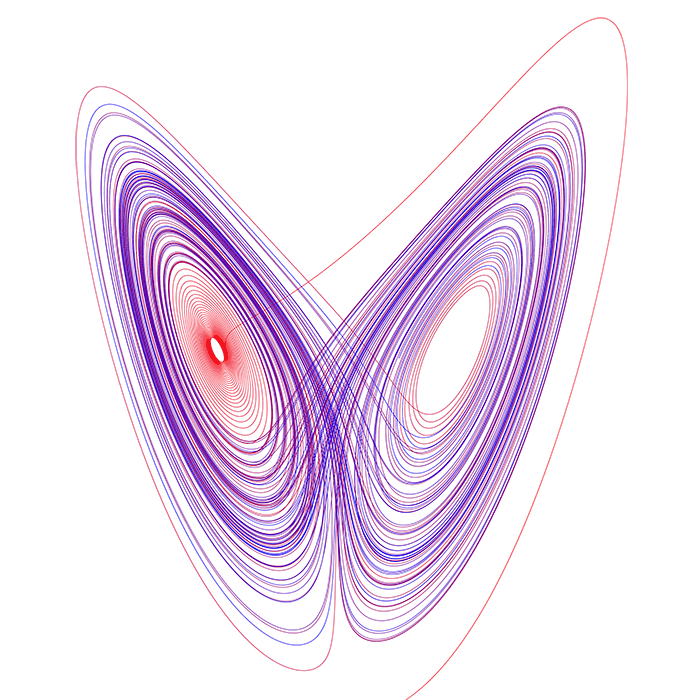
Instead, I think the truth is a strange attractor around which the trajectory of a society warps and bends, sometimes near, sometimes far, always in motion. The exact path the society takes is highly sensitive to that society’s origin myth, and varies with everything from current local politics to natural disasters to pop music trends.

Pretty much exactly like this:

Lorenz attractor (image: CC-BY https://commons.wikimedia.org/wiki/User:Dschwen

This means you could take snapshots of a society’s history, like paragraphs out of the society’s history books, and treat the pile of snapshots like a Poincaré map of that society’s eccentric orbit around the truth.

Mythologies are necessary for social identity, every culture will have one, and subtle variations in a society’s founding myth can have huge effects on its path around the attractor of truth. A society that, for example, idolizes the myth of the Rugged Individualist may at some point along its trajectory bend in the direction of the notion that truth is a matter of personal opinion, not empirical fact. A society that enshrines the value that belief in God is vital to being a good citizen might find itself pulled toward the attractor of authoritarian religion as it flows along its course.

But these attractions are never as simple as a pendulum swing. Too many variables, too many competing ideas go into a society’s culture. Just as you can never set foot in the same river twice, for when you return both you and the river will have changed, a society cannot revisit the same moment twice, however much its members may long for the nostalgic past.

Dr. Martin Luther King, Jr. famously said “The arc of the moral universe is long, but it bends toward justice.” That’s probably true over great stretches of time, years to centuries to millennia, but the loops and bends away from that direction happen all the time, drawn by the irresistible tropism toward Rugged Individualism, Somebody Else’s Problem, xenophobia, profiteering, fear, and the urge toward authoritarianism that seems baked into us as a species.

Right now, we’re on one of those crazy slingshots away from truth, in an era where American Republican operatives sneeringly refer to the opposition as the “reality-based contingent” and offer “alternative facts.”

For those of us trapped on this arc, it’s small comfort that given another 40, 50 years, the moral arc of the universe may once again bend back toward justice. So…let’s be kind out there.