Why we believe what we believe, and why that makes us gullible

Just how deep do you believe?
Will you bite the hand that feeds?
Will you chew until it bleeds?
Can you get up off your knees?
Are you brave enough to see?
Do you want to change it?

What is the purpose of the human brain? What function does it serve? Be careful; this is a trick question!

If you say “The brain is an organ of thought” or “The brain is an instrument of knowledge” or “The brain is the way we understand the world,” that’s the wrong answer. The correct answer is that the brain is an organ of survival. We have these big brains because they enabled our ancestors to survive; in that sense, they are no different from claws or fur or fangs.

And like all organs of survival, the brain was shaped by natural selection, sculpted by evolutionary pressures that favored the traits that helped our ancestors survive. The big brains we have now were molded and shaped to one purpose: to help small bands of hunter-gatherers survive.


Back in the day, when we rarely lived longer than 20 or 25 years and starvation battled with predation by other large carnivores for the number one spot in “things that killed human beings,” our brains gave us a competitive advantage. They did this in part by acting as engines of belief, allowing us to form models of the world and create beliefs about the world that gave us an advantage.

For example, an early human who observed that if he was upwind of his prey, the prey got away, but if he was downwind of his prey, he could more easily kill it formed a belief: “Staying downwind from the prey makes it more likely that the prey will not escape.”

Of course, other animals know these things instinctively. But the advantage of our big monkey brains is that we do not have to rely on instinct; we can form beliefs on the fly, as we go along, which means we can function in environments our instincts are not prepared to deal with. The brain as an organ of survival allows us to make observations and draw beliefs from these observations, and these beliefs give us a competitive advantage.


These beliefs can be immediate and concrete, such as “If I stick my hand in the fire, it will hurt.” They can make predictions about the future, such as “The sun will rise tomorrow” or “If the days grow longer and the weather grows colder, then winter is coming, and food is about to become less plentiful.” A belief can be negative, such as “If I leap from the top of this tree, I will not be able to fly.”

Having a brain optimized for forming beliefs is important if forming beliefs your survival schtick. If you think of the brain as a belief engine, which can either believe something or disbelieve it, and if you think of a particular belief as being true or false, it is easy to construct a game theory matrix describing all the possibilities, with two success modes and two failure modes:
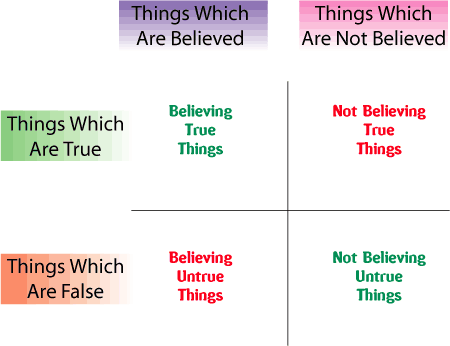
Ideally, our brains lead us to believe things that are true, such as “A large leopard is a dangerous adversary,” and to disbelieve things that are not true, such as “I can eat rocks.” But there are two failure conditions as well: rejecting beliefs that are true, and accepting beliefs that are not.


The failure conditions have survival implications. Believing untrue things and not believing true things can both lead to disaster.

Of the two, though, believing untrue things will, in a small group of hunter-gatherers, usually cause fewer problems than not believing true things. Believing that dancing in circles three times and carrying a magic stone around with you will increase the chances of a successful hunt doesn’t really hurt anything; not believing that staying downwind from your prey is important has a significant survival penalty attached to it.

There’s a strong survival imperative, in other words, to prefer failure by believing something untrue over failure by not believing something that is true. Believing is less expensive than not believing. If a primitive hunter-gatherer eats an unfamiliar food, then becomes sick, it might not be the food that caused him to get sick–but if he believes the food makes him sick, and he’s wrong, the consequences are not too great, whereas if he does not believe the food made him sick,a nd he’s wrong, the consequences can be deadly. The guy who ate some food, got sick, and believed the food made him sick is the guy who survived; today, his descendants give their kids a measles vaccination, and when coincidentally their kids are diagnosed with autism, believe that the measles vaccination caused the autism.

From a survival standpoint, the consequences of not believing something true are worse than the consequences of believing something that is not true. Natural selection, therefore, tends to select in favor of people whose default state is to believe something rather than in favor of people whose default state is to disbelieve something.

And to confound matters further, humans are social animals. In our earliest days, when our social groups tended to number fifty or a hundred people and leopards were a serious and ongoing threat, to live alone was a death sentence. We depended on the support of others to survive.

But that support had a price. Groups, like individuals, form beliefs. To reject the beliefs of your group was to risk ostracism and death. People who questioned and challenged the beliefs of their tribe often did not survive to pass on their genes to future generations; the ones that were most likely to pass along their genes were the ones who learned to believe what the group believed, even if it was contradicted by clear and available evidence.

And those who were adept at manipulating the belief engines of others–shamans, tribal rulers who convinced others of their divine right to rule–tended to be disproportionately successful at mating and tended to control a disproportionate amount of resources, meaning they tended to pass on their genes most successfully.


The greatest invention of the human mind is not fire, or agriculture, or iron, or the steam engine, or even the splitting of the atom. From the perspective of understanding the physical world, the greatest invention of the human mind is the scientific method–the systematic, skeptical approach to claims about the way the world works.

When a scientist has an idea, he does not believe it, and he does not seek to prove it. Instead, he approaches it skeptically, and he seeks to disprove it. The more the idea resists increasingly sophisticated and vigorous attempts to disprove it, the more faith he begins to put in it. This is why any idea that is not falsifiable is not science.

A correlary of this idea is the notion that physical reality behaves the same way everywhere, for everyone. If a brick falls when it is dropped in Kansas, it also falls when it is dropped in Salt Lake City–and, importantly, it falls no matter who drops it, whether the person who drops it believes that it will fall or not. The physical world does not change itself to conform to human wishes and expectations. A claim that is made about some process that must be believed in order to be seen, such as ESP, is not science.


But skepticism is not innate. It is learned. The human brain has been shaped by natural selection not to be skeptical. It has been shaped by evolutionary pressure into a belief engine that believes things more easily than it disbelieves things. For our ancestors, the penalty for skepticism was very high; those early hominids for whom skepticism came naturally did not live long enough to pass on their genes to us. Our brains evolved to be gullible, not skeptical.


Today, we live in a cognitive and physical environment very different from that of our ancestors. But the machinery of natural selection is slow.

In the modern world, the same four states of our belief engines still apply. We are still predisposed to believe things rather than disbelieve them; and we can still believe things that are true, disbelieve things that are true, believe things that aren’t true, or disbelieve things that aren’t true:

Believing things that are true
  • Eating uncooked pork can make you sick
  • If you do not feed your pet dog, your dog will become unhappy, and eventually will die
  • Provoking a large predator may have serious consequences
  • Falling from a great height may have serious consequences
  • A speeding car can not stop instantly
Believing things that are not true
  • A pill can make your penis grow bigger
  • There is a sea monster living in a small landlocked lake in Scotland
  • Atlantis was a lost continent possessed of fabulous technology
  • Space aliens abduct people and perform experiments on them
  • Republicans favor small government; Democrats favor big government
  • There is an invisible man living in the sky who will spank you if you have sex in the wrong position
Not believing things that are true
  • The Holocaust never happened
  • Vaccination does not protect from disease
  • NASA never went to the moon
  • Evolutionary processes did not created the variety of life we can observe on this planet
  • Viruses and bacteria do not cause disease
  • The world is not more than six thousand years old
  • Americans are not obligated to pay income tax
Not believing things that are untrue
  • The world is not flat
  • You can not fly no matter how fast you flap your arms
  • There is no jolly fat man at the North Pole who hands out gifts
  • Money does not grow on trees
  • Forwarding an email to all your friends will not get Bill Gates to give you money
  • Solar eclipses are not caused by gigantic maurading dragons swallowing the sun

What does this mean in practical terms? Simple. It means that your brain has been hard-wired over hundreds of thousands of years of natural selection to make you credulous. Look at the brain as an instrument of survival, look at natural selection creating pressures to prefer the failure mode of believing that which isn’t true over the failure mode of not believing that which is true, and you end up with people hard-wired from the ground up to be gullible.

Your brain is a tool of survival that works by acting as an engine for creating beliefs. When you form a belief, you get a little squirt of pleasure that lights up the reward circuit of your brain. You’re emotionally rewarded every time you believe something.

At the same time, skepticism, and rational, analytical thought, do not come naturally. They’re not what your brain was optimized for; because of that, they are skills which must be learned, and are not innate. In fact, they feel unnatural and uncomfortable to you. Your brain gives you a reward for accepting beliefs, not for challenging them.


There is good news, however. When you introduce sapience into the mix, things change. Biology is not destiny. Your brain is optimized to make you gullible, but you do not need to be. You can train yourself to recognize that little squirt of pleasure you get when you believe something for what it is–a biological holdover from a time when adopting beliefs quickly and without skepticism had survival advantage. You can train yourself to be skeptical, even though it’s not natural for you.

And the rewards for doing so are great. In a modern world, where people want you to believe that they will transfer THE SUM OF $25,000,000 (TWO HUNDRED FIFTY MILLION US$) into your bank account from Nigeria if you give them your bank account information, where emails tell you that you need to update your credit card information or PayPal will shut you down, where people tell you that viruses and bacteria don’t cause disease and if you just order magic “balancing powder” ($360 for a 6-month supply) from their Web site you’ll never get sick, credulity is a survival disadvantage, and skepticism an advantage.

But it doesn’t come naturally. You have to work at it.
Okay, TIRED poly math geeks gone wild

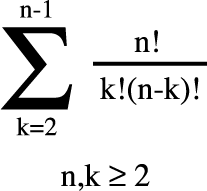
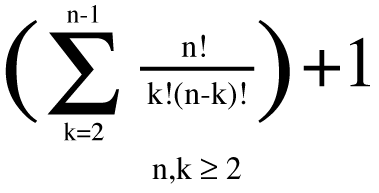
So, in this entry about finding the formula to determine the total number of possible relationship configurations for any group of n people, blaisepascal observed that the sum we came up with did not consider the case where everyone is involved with everyone else, which is something we had intended to include. The previous equation, therefore, has an off-by-one error. The correct form is:

This is, as many people have observed, essentially the standard “pick r of n permutations” equation, which (had we been thinking along those lines) we likely should’ve recognized from the start. And, to be fair, one of the more math-geeky among us said something like that early on, but it took much scribbling on many sheets of paper to prove it.

Experiments in asymmetry at 2:30 AM

One of the many people at smoocherie‘s party, james_the_evil1 brought rope. This should come as a surprise to nobody, really. S volunteered to be tied up, so I tried an experiment with incorporating her hair into the tie.

This is a two-layer harness, which looks deceptively simple from the front:

From the back, it’s a bit more complicated, though. I think it worked well; I like the asymmetry. Continue reading

Poly Geeks Gone Wild

So, what happens when you get a bunch of polyamorous geeks together at a party? Someone starts charting relationship configurations, and someone else starts wondering how many possible relationship configurations there are in a particular group, and someone else gets out a calculator and a sheet of paper, and…

As it turns out, the equation that will tell you for any size group of people n how many possible relationship configurations (couples, triads, and so on) are possible within that group is pretty complicated. It took a lot of work and many sheets of paper, and the considerable brainpower of a couple people with degrees in mathematics, but the equation is:

This will tell you for any group of people n how many possible relationship configurations exist in that group.

And the number goes up fast. Scary fast. For n=9, there are 502 possible relationship configurations in that group. The number of people in the Squiggle I belong to is 15; I haven’t calculated the number of possible relationship configurations exist in such a group.

I think I’m going to make this formula into a T-shirt.

Oh, for the love of God…

News item of the day: Woman blames security flaw in Mozilla web browser for destroying her relationship.

From the article:

“This privacy flaw has caused my fiancé and I to break-up after having dated for five years… Firefox should be respecting every single area of privacy per user on one system. It’s not doing that,” the woman writes.

Now this here, folks, is an outstanding example of how people absolutely hate to take responsibility for their own feelings, responses, and emotional reactions.

The bug in Mozilla did not cause the breakup. Insecurity caused the breakup, together with poor communication skills on the parts of both people involved.

The woman says she and her ex were together for five years. Well, if they were dating for five years, what in the name of all that is holy were they talking about–the weather? Whose turn it was to wash the car? Clearly, neither of them was talking about the parameters and assumptions of their relationship, else she would have known that he was visiting online dating sites, and he would have known that she was not OK with that.

She learned something she did not know, because they were not talking. What she learned triggered insecurity on her part, which she did not deal with gracefully because she does not take responsibility for her own emotional responses. She did not talk about her feelings and the fact that his behavior violated her boundaries and expectations, because they both lacked decent communication skills. And somehow, all of this is…

…Mozilla’s fault?

Amazing.

Whew! Back from FPR…

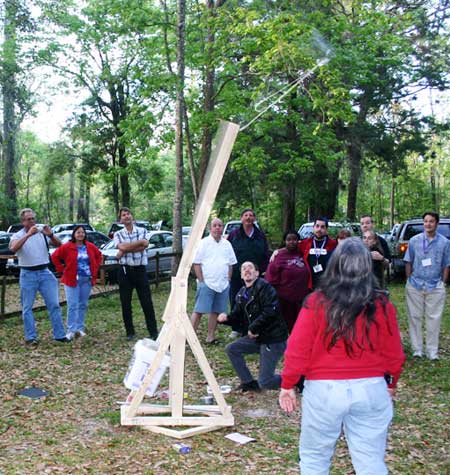
Much to post about, but most of it will have to wait. In the interim, however, I will tease you with this picture of the trebuchet I designed for the communication and conflict management workshop:

There is also a movie of the trebuchet firing here (3.5 MB direct download).

Whee!

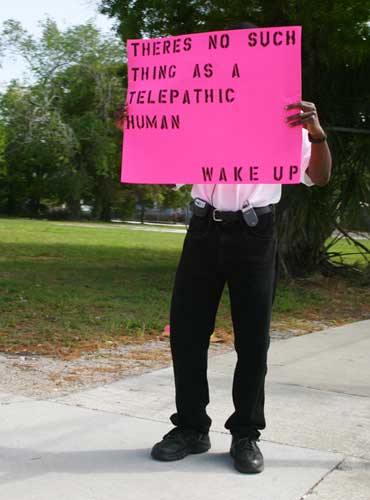
I’ve had days when I feel like this.

This guy was standing near where Shelly goes to school this afternoon. She called and told me about it, and then we drove down to try to get a pic. He was still there, and I got a great photo of him:

I can empathize with him, really. The world is filled with gullible suckers.

Trebuchet habeo.

Nisi pecuniam omnem mihi dabis, ad caput tuum saxum immane mittam.


Next weekend is the Florida Poly Retreat. I am signed up to do two workshops: one on jealousy management, and one on the design and construction of a trebuchet, a type of Medieval seige engine capable of throwing 300-pound boulders through a castle wall.

Trebuchets are cool.

This weekend, I’ll be designing and constructing hte trebuchet that’ll be used in the workshop. Originally, I had planned to build a six-foot trebuchet with an eight-foot throwing arm, capable of hurling a projectile the size and weight of a bowling ball about fifty yards or so. Shelly and smoocherie both, sadly, nixed that idea–Shelly because she was horrified at the safety implications of such a device, and smoocherie because the facility evidently doesn’t have enough space to be chucking bowling balls around.

So, alas, I’ve had to scale back a bit. I’m designing a trebuchet about three feet high, designed to toss golf balls or tennis balls around. Which is very sad, because tossing a golf ball is so much less fun than tossing a bowling ball. I think it would be fun to use an old-fashioned steel lawn dart as the projectile, but I don’t think you can buy those any more. (I certainly haven’t seen them in years…which, now that I think about it, is probably a good idea. Who the hell thought that throwing five-pound, sharp steel darts high in the air was a fun family game? No way THAT could go wrong…bit I digress.)

There’s actually a bit of accidental history behind this particular workshop. During the first Florida Poly Retreat in 2003, Shelly and I and some various other people found a pile of scrap wood at the facility, and I decided to use that and duct tape to make a quick, improvised trebuchet.

Well, actually, that’s not quite true. The device we ended up making was technically a mangonel–it was powered by a combination of a small counterweight and human muscle, a design first pioneered by the Mongols, who used caputured enemies as slaves to operate their mangonels, and built versions that could be disassembled quickly and carried on horseback which they used as antipersonnel devices rather than as seige engines…but again, I digress.

Anyway, the FPR in 2003 was arguably the first nationwide polyamory meeting to arm itself. We test-fired the mangonel by using it to fire the flashlights that were giveaways at the retreat, that projectile being necessitated because (a) it had a lanyard designed to be worn around the neck, removing the need for a firing sling on the weapon, and (b) it was dark by the time we were finished, so we needed a projectile that could be seen at night.

The finished engine worked far better than I had anticipated; by the time we got the firing mechanism worked out, it was hurling the flashlights about three times farther than I’d estimated. Which was great fun, as you can probably imagine.

Anyway, it’s been something of a standing joke since then–Florida Poly Retreat, the only polyamorous gathering to have seige equipment! So when smoocherie approached me with the idea of doing a formal workshop this time around, hey, who was I to say no?

The trebuchet workshop is being billed as a workshop on communication. Legendary cynic Ambrose Bierce described war as “untying with the teeth a political knot that would not yield to the tongue,” after all.

I plan to do a packet for the workshop that contains the plans, plus a writeup on the physics, theory of operation, and history of the trebuchet. For anyone who cares, this will be a HCW (hinged counterweight) design with a fixed throwing arm, and I’ll probably put it on wheels. If there is enough interest, I’ll probably make the packet available as a PDF from my Web site.

And now, off to Home Depot, the “Toys R Us” of the mad scientist and pervert communities.

Dreams and Weekend Stuff

So. Ove the weekend I had a dream–one involving zensidhe, datan0de, femetal, fatesgirl, and zombies. Any of you who know one or all of those people will probably know that adding zombies to the mix really isn’t that much of a stretch.

Anyway, in this dream, the six of us–the Smoosh, Shelly, and I–were all living in a big rambling country house together, a couple miles from town. During the dream, there was an enormous storm over the town, with weird glowing clouds and lightning and tornados and all kinds of chaos, and datan0de and I were standing outside the house watching the storm. A huge cone of light blasted out of the weird glowing clouds and hit right in the center of town, and somehow (through that weird dream logic that lets you know this sort of thing) we knew that it had turned all the dogs in town into zombies, and that soon the dogs would be biting people and turning them into zombies too.

So. datan0de and I were talking about this, in a casual offhand way–“Should be at least a Class 2 zombie outbreak in just a few minutes.” “Yep, seems about right. We probably have a couple hours before zombies are swarming all over the house.” “Yeah, I’d say that’s probably true. Hey, we should get the camera and take some pictures of the storm. Check out all the lightning!”

We were all relaxed and casual about the whole thing, because zensidhe was there, and if anyone knows how to handle a zombie outbreak, it’s him. So all of us were greeting the prospect of being overrun with a swarm of hungry zombies with about as much panic as you might expect from a weather report of a chance of scattered afternoon showers–“Yep, maybe we should take the lawn furniture inside and load the shotguns.”

Shelly feels that this dream is an expression of a great deal of confidence on my part in zensidhe‘s abilities. I think it’s just a subconscious desire to live with femetal and fatesgirl because they’re cute and all.


Sunday, Shelly and S‘s other boyfriend S and I drove up to Gainesville to meet indywind and her partner. I have no idea of her partner is on LJ or not.

We lounged in a park–or rather, I lounged in a park while indywind and her partner taught Shelly and S various Renaissance-era dances that are appropriate for poly folk. I have a new respect for how bawdy the Renaissance-era peasants were, but that’s a whole ‘nother post altogether.

The value of shame in protecting a healthy society…

…or, “strangeness in Franklin’s email yesterday.”

So. My Web site generates rather a lot of email, some of which tells me I’m going to hell, some of which is incoherent and relentlessy bizarre, but most of which is quite positive.

And then there’s this one, that just arrived:

Came across your website (http://www.xeromag.com/fvpoly.html), and had a strong reaction. I hope you might be interested. This is not your ordinary “you will burn in hell” flame mail.

You have revealed a great deal of yourself online–far more than any properly modest person would do (but you do not regard modesty as a virtue)–and my reaction to that is to analyze and critique what you have revealed. I’m embarrassed, even mortified for you. If ever you actually find a little more wisdom, I think you will look back at your online missives with utter horror for the rest of your life. But of course, stubborn fools die all the time.

The fact that you do not understand how mortifying it is to have so much of yourself, and of your friends, on display is very indicative to me. Once upon a time was nearly as self-revealing as you are, and so I’m motivated to offer you some unsolicited advice.

Your openness about yourself shows more clearly than anything else could that you believe that you are morally “in the clear.” That there’s nothing wrong with you or the way you live. For someone as arrogant as you are, I know that moralizing will not impress or help you in the slightest. The only thing that has a chance of helping you, actually, is a combination of intelligent criticism and real, liberal education (not just reading a lot of books).

You’re perfectly aware of your self-confidence. Among your other writings is a revealing section called “Three easy steps to self-confidence.” Self-confidence is in general, of course, a very good thing. But it seems you have confused positive self-confidence with the capacity to turn off your natural feelings of conscience, i.e., the ability to quell healthy and natural self-doubt. In this way, sociopaths are made, cults are born, and civilizations are ruined.

Every page on your webpage also conveys the message that you think you have it all figured out: you’ve thought it all through, and this is how it’s done. Your Polyamory FAQ is a perfect example. You’ve got it all covered. If you answer all the critical questions cleverly, that shows that polyamory as you approach it is morally OK. The trouble, of course, is that your FAQ proves no such thing. Your FAQ is absolutely full of elementary errors of reasoning and fundamental assumptions, which any sufficiently well-educated person could spot instantly. It is a statement of your personal dogma. The only thing it really proves is to me is that you are, underneath the facade you put on for yourself and others, a very confused person.

That’s why I recommend very strongly that you take some time out and get a real liberal education (from other, sane people–at a university) and learn the habit and virtue of self-examination. It’s quite evident both that you really have not learned that habit and that you think you have learned it. You are evidently reflective, and you pride yourself inordinately on that reflective habit. But you must not confuse a habit for reflection and introspection (i.e., self-indulgent navel-gazing, which any teenage girl can do) with a habit for well-informed, critical self-examination. The latter requires wisdom and critical thinking, which requires liberal education. A little bit of knowledge is a dangerous thing, and you’re an excellent example of why this is so.

Feel free to share this mail with your friends; amuse yourselves with it.”

Now, this is a very interesting piece of email, for a number of reasons. It’s not completely incoherent, but at the same time, I’m having a very difficult time understanding what this guy is saying, aside from the fact that he doesn’t much cotton to folks like me.

He seems to be saying, if I’m reading him correctly, that a deep and abiding sense of personal shame is the only thing that keeps society healthy, and that this deep sense of shame is the result of a proper education. I get the sense that for him, education, privacy, shame, and morality are all connected, and that for him, anyone who is not private both lacks shame and is “confused.”

I also get the sense that there’s a subtext here which suggests that this sense of shame is the only thing which prevents people from behaving unethically. He seems to feel that it’s lack of shame which characterizes a sociopath. (Most psychologists would say that a sociopath is characterized by a lack of empathy and emotional connection with other human beings; I wonder if this person feels that shame and empathy are the same thing, or that one can not connect with others emotionally if one is not shameful.)

An irony here is that he seems to feel a “liberal education” would fix my problems. This is ironic in no small part because I have sex [EDIT: Six! Six years’ worth! Aargh!] years’ worth of college education behind me, much of it a liberal arts education. It’s also ironic because, generally speaking, there is often an inverse correlation between degree of schooling and tendency to adopt socially and religiously conservative views; those who have a liberal education are, statistically speaking, more likely to talk about, and live, in unconventional ways.

Y’know, sometimes I just don’t get the way people think.